Contested dominance modifies the
anovulatory consequences of social
subordination in female marmosets
1Secretaria Municipal de Saúde, Natal, RN, Brasil
2Departamento de Fisiologia, Universidade Federal do Rio Grande do Norte,
Natal, RN, Brasil
3Department of Ob/Gyn and National Primate Research Center,
University of Wisconsin, Madison, WI, USA A.I. Alencar1,
M.B.C. Sousa2,
D.H. Abbott3
and M.E. Yamamoto2
Abstract
Dominance status among female marmosets is reflected in agonistic behavior and ovarian function. Socially dominant females receive submissive behavior from subordinates, while exhibiting normal ovu-latory function. Subordinate females, however, receive agonistic be-havior from dominants, while exhibiting reduced or absent ovulatory function. Such disparity in female fertility is not absolute, and groups with two breeding females have been described. The data reported here were obtained from 8 female-female pairs of captive female marmosets, each housed with a single unrelated male. Pairs were classified into two groups: “uncontested” dominance (UD) and “con-tested” dominance (CD), with 4 pairs each. Dominant females in UD pairs showed significantly higher frequencies (4.1) of agonism (pilo-erection, attack and chasing) than their subordinates (0.36), and agonistic behaviors were overall more frequently displayed by CD than by UD pairs. Subordinates in CD pairs exhibited more agonistic behavior (2.9) than subordinates in UD pairs (0.36), which displayed significantly more submissive (6.97) behaviors than their dominants (0.35). The data suggest that there is more than one kind of dominance relationship between female common marmosets. Assessment of progesterone levels showed that while subordinates in UD pairs appeared to be anovulatory, the degree of ovulatory disruption in subordinates of CD pairs was more varied and less complete. We suggest that such variation in female-female social dominance rela-tionships and the associated variation in the degree and reliability of fertility suppression may explain variations of the reproductive condi-tion of free-living groups of common marmosets.
Correspondence
M.E. Yamamoto
Departamento de Fisiologia, UFRN Caixa Postal 1511
59072-970 Natal, RN Brasil
Fax: +55-84-211-9206
E-mail: [email protected]
A.I. Alencar, M.B.C. Sousa and M.E. Yamamoto were supported by CNPq (Nos. 521186-97, 470601/ 2003-5, and 524409/96, respectively), and D.H. Abbott was supported by NIH (Nos. RR000167 and MH60728), and NSF (No. IBN-9604321).
Received March 22, 2005 Accepted December 6, 2005
Key words •Callitrichids
•Dominance
•Progesterone levels
•Agonistic behavior
•Marmosets
Introduction
Dominance and subordination reflect a relationship between two animals compet-ing for food, mates, territories, or other re-sources. Dominance is normally associated
with factors such as age, weight, size, and fighting skills, with dominant individuals often being larger, more aggressive and the winners of most disputes (1).
may remain stable for long periods of time and through all kinds of competition, as observed in Cercopithecus aethiops (2), or may be unpredictable as in Papio anubis, because one animal may be dominant in some aspects but not in others (3). It has been suggested (4) that there may be differ-ent kinds of dominance - clear or uncon-tested dominance (UD) in which one indi-vidual is always dominant in relation to an-other, or contested dominance (CD) in which subordinate individuals submit, but disputes occasionally occur.
In callitrichids, females that receive sub-missive behavior from other females are considered to be dominant (Callithrix jacchus
(5); Saguinus oedipus (6)). These dominant females are usually the only females in their social groups to exhibit circulating or ex-creted hormonal levels indicative of ovula-tory ovarian cycles (S. fuscicollis (7), S. oedipus (6,8) and C. jacchus (5,9)). These findings have suggested a close relationship between female dominance status and fertil-ity in these non-human primates.
In most callitrichid groups, only one of the females produces offspring, but in cap-tive family groups of C. jacchus, daughters of the reproductive female may cycle (5,10) provided that they are not subordinate to their mothers (11). Although ovulatory, these latter females do not usually become preg-nant and do not deliver term infants. The situation is somewhat analogous in captive groups of unrelated females, in which ovula-tory cyclicity can be exhibited by the highest ranking subordinate (rank #2) female while it is usually completely inhibited in lower ranking (ranks #3 and #4) subordinates (12). Nevertheless, polygyny has been reported for the genus Callithrix. Daughters of domi-nant C. jacchus females living in captive families were able to conceive and give birth in their intact family groups (13), provided that the daughters were given access to an unrelated male for fertile copulations away from the family cage. There have been
fur-ther reports of polygyny in captive (14) and wild-C. jacchus groups (15-17). In all re-ports of two-breeding female groups, close kin relations between the two reproductive females were known or at least suspected.
Which are the factors that allow suppres-sion of fertility in subordinate females in some groups and favor polygyny in other groups of the same species? Some research-ers (18,19) suggest that polygyny could be tolerated by dominant females when domi-nant and subordinate females give birth far apart, avoiding competition for food and for caregivers. It has been suggested (20) that polygyny in Leontopithecus rosalia groups may increase the dominant female’s inclu-sive fitness, especially when mother and daughter are the primary and secondary re-productive females in the same group. Could there be different kinds of dominance rela-tionships between callitrichid females that have different consequences for subordinate female fertility?
agonistic behavior would be lower than in female pairs of CD.
Material and Methods
Animals and experimental procedure
The 16 adult female and 8 adult male common marmosets used in this study were housed at the Núcleo de Primatologia, Uni-versidade Federal do Rio Grande do Norte (UFRN), in the Northeastern region of Bra-zil. Females were housed in 8 pairs in out-door individual cages measuring 2 x 2 x 1 m under natural conditions of light, tempera-ture and humidity. Animal management and nutrition were similar to those described elsewhere (21). All observation cages were equipped with one-way mirrors.
Each female-female pair was followed for 15 consecutive weeks in three weekly 30-min sessions, for a total observation of 22.5 h per pair. The 15-week period was not completed for pair #7 due to a fight that necessitated separating the females perma-nently. Pairs #1, 3, 5, and 7 were twin sibs, pairs #2 and 6 were mother and daughter and pairs #4 and 8 were donated to our colony by IBAMA (Brazilian Forestry Department). They arrived as female-female pairs but there was no information on their relatedness. Eight males from our colony, unrelated and un-known to the females, were introduced to the pairs of females from the 6th week of the experiment, as described below. Since closely related female common marmosets (N = 6 in this study, UD pairs #1, 2, 3, and CD pairs #5, 6, and 7) can contend for dominance and can exhibit dominant-subordinate relation-ships in both wild- (22) and captive (23,24) social groups, there were no expectations that pairs of closely related females would fail to exhibit qualitatively different domi-nant-subordinate relationships compared to pairs of unrelated females (N = 2 in this study, UD pair #4 and CD pair #8).
During the first 5-week observation
pe-riod, the pairs of females were observed without the male. During the second 5-week period, one male (always the same for each pair) was introduced into each pair’s cage during the observation period and was then removed. During the last 5-week period, the males were housed permanently in each of the female pairs’ cages. The three succes-sive 5-week observation periods were re-garded as successive escalations in female-female sexual competition.
Behavioral sampling
We recorded all occurrences of three ag-gressive behaviors that we described as in-dicative of dominance: piloerection, attack and chasing. These behaviors are usually considered to be indicators of dominance. We also recorded all occurrences of behav-iors indicative of subordination in 4 of the 8 pairs (pairs #3, 4, 7, and 8) for each 5-week period: facial submission, leg stand and con-tinuous submission. All recorded behaviors are described in Table 1. We used continu-ous focal sampling in all observations, using both females as the focal animals for each of two observers. The observers, with a mini-mum 85% coefficient of reliability, recorded behavioral frequencies on a check-sheet that were later transferred to computer files.
Blood and feces sampling
period of 10 min and frozen at -20ºC until they were assayed by enzyme immunoassay (EIA) for progesterone (26). In the remain-ing four pairs, we collected feces twice a week from undisturbed females in their cages between 12:00 and 15:00 h. During fecal sampling, we stayed close to a female’s cage until she defecated. We then entered and collected the feces. Fecal samples were stored in small plastic tubes labeled with the iden-tity of the animal, date and time of collection and frozen at -20ºC. Before running the EIA for progesterone, steroid hormones were extracted from the fecal material by hy-drolysis and solvolysis, as described previ-ously (27). The methodological difference in progesterone measurement (blood and feces) between pairs of females derives from the validation of a new method (27) at the time of the complementary data collection, compatible with blood assays, which was less invasive and less stressful for the animals.
Hormone assays
Blood samples from two pairs (#1 and
#2) were analyzed in the Assay Services Laboratories of the National Primate Re-search Center at the University of Wissin, Madison, WI, USA (WPRC). The con-centrations of plasma progesterone were de-termined using an EIA (28). The monoclon-al antibody (R4866) was obtained from Coralie Munro (University of California, Davies, CA, USA) and the sensitivity was 0.01 ng/mL. The standards were prepared using progesterone (99%, Sigma). Cross-reactivity for 20ß-hydroxyprogesterone was 2.5 and 7.0 for pregnanediol, whereas for 17α-hydroxyprogesterone, 11α
-hydroxypro-gesterone, pregnenolone, androstenedione, 17ß-estradiol, cortisol and testosterone was <0.1. Intra-assay coefficients of variation (CV) for low- and high-concentration plasma pools were 15.7 and 11.5% (N = 10), respec-tively. The other blood samples were as-sayed in the laboratory of hormonal assays of Universidade Federal do Rio Grande do Norte (UFRN). Inter- and intra-assay CV were 18.0 and 10.0% (N = 10) respectively. There were no differences (P > 0.05) be-tween follicular or luteal phase progesterone
Table 1. Definitions of the behavioral patterns used in this study.
Behavioral patterns Definition
Dominance
Piloerection Body pelage is fully erected accompanied by a conical erection of tail pelage. We recorded one occurrence each time one female erected and flattened the pelage, regardless of duration. Piloerection was recorded only when observed out of the context of attack and chasing.
Attack Focal animal grapples aggressively with the partner. This behavior involves biting, clawing and wrestling (31). We recorded one occurrence each time two females presented any of the behaviors above, until physical contact was broken for at least 10 s.
Chasing Focal animal follows and chases away another one in the cage. The chasing animal may present piloerection. We recorded one occurrence for each bout until chasing was discontinued.
Subordination
Facial submission Tufts flattened (lower ear tufts against the side of the head) and/or facial grimace (mouth partially open, exposing the teeth).
Leg stand The animal stands on its hind legs and stares in a fixed direction for a few seconds.
values determined at either WPRC or UFRN. Fecal samples were also analyzed as de-scribed previously (27,29) at UFRN and inter- and intra-assay CV were 19.6 (N = 10) and 4.4% (N = 10), respectively.
An index of ovulatory function for each female provided the basis for calculating a ratio for ovulatory function for each domi-nant and subordinate pair. This index was based on the profile of progesterone concen-trations in plasma or feces during the three experimental periods for each female. The index was determined as: 1) complete ab-sence of progesterone elevations; 2) irregu-lar increases in progesterone concentrations, plasma values >10 ng/mL or fecal values higher than three times the baseline values during the follicular phase or 100 ng/g, and 3) regular ovulatory cycles with luteal phase length typical of normal cycles for common marmosets. Females were considered to have ovulated on the day prior to a sustained (consecutive blood samples) increase in plasma progesterone levels above 10 ng/mL (30) or 2 to 4 days prior to a sustained increase in fecal progesterone of at least 1.5 times the mean of the preceding baseline values of the follicular phase (30). Follow-ing ovulation, they were considered to be in the luteal phase of an ovulatory cycle, or pregnant, until plasma progesterone fell to the levels recorded before ovulation, charac-terizing a following follicular phase which lasted until progesterone concentrations rose again (30). Thus, we operationally defined the irregular cycles as exhibiting more than 13 days between ovulatory cycles (10,31) during which plasma progesterone levels remained low between two successive luteal phases.
Statistical analysis
Repeated measures MANOVA followed by the post hoc Tukey test was used to analyze the differences between groups and between dominant and subordinate females.
The factors tested were rank (dominant or subordinate), group (UD and CD) and pe-riod (male absent, male present and male resident). Correlations between behavioral and hormonal data were calculated using the Pearson moment-product test.
Results
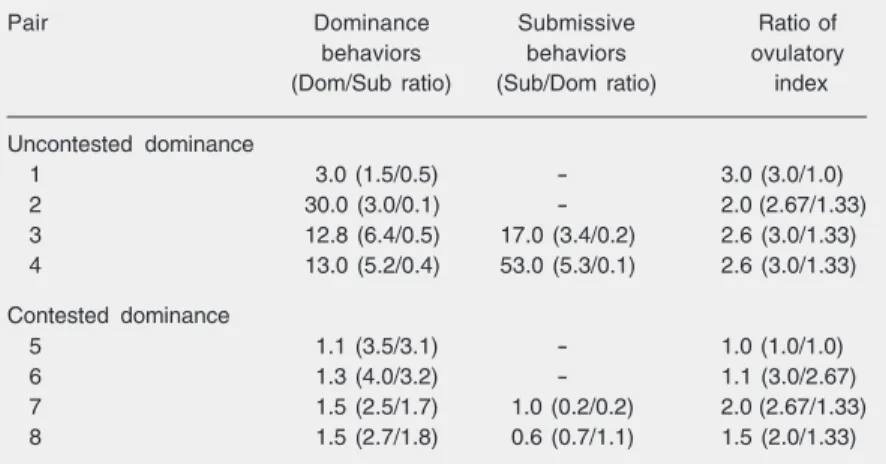
In all cases, dominant females were con-sidered to be the females exhibiting higher frequencies of dominant behaviors (Table 2). In each pair, during each 5-week period, dominant females were identified from their higher frequency of dominant behaviors (Table 2). There were, however, differences in the extent to which dominant females exceeded subordinates in the display of domi-nant behaviors. To qualify the associated characteristics of such differences, we clas-sified the pairs into two groups: UD (pairs 1-4) in which one female (the dominant fe-male) exhibited dominant behaviors at least at three times the frequency of the other (the subordinate), and CD (pairs 5-8) in which one female (the nominal dominant female) displayed dominant behaviors at only 1.1-1.5 times the rate displayed by the other female (the nominal subordinate; Table 2).
Table 2. Dominance ranking based on behavioral and hormonal measures.
Pair Dominance Submissive Ratio of
behaviors behaviors ovulatory (Dom/Sub ratio) (Sub/Dom ratio) index
Uncontested dominance
1 3.0 (1.5/0.5) - 3.0 (3.0/1.0)
2 30.0 (3.0/0.1) - 2.0 (2.67/1.33)
3 12.8 (6.4/0.5) 17.0 (3.4/0.2) 2.6 (3.0/1.33) 4 13.0 (5.2/0.4) 53.0 (5.3/0.1) 2.6 (3.0/1.33)
Contested dominance
5 1.1 (3.5/3.1) - 1.0 (1.0/1.0)
6 1.3 (4.0/3.2) - 1.1 (3.0/2.67)
7 1.5 (2.5/1.7) 1.0 (0.2/0.2) 2.0 (2.67/1.33) 8 1.5 (2.7/1.8) 0.6 (0.7/1.1) 1.5 (2.0/1.33)
These grouping differences were maintained during all three 5-week periods (MANOVA, F(1,44) = 5.343, P = 0.026). There were,
nev-ertheless, no significant differences between the frequencies of given dominant behaviors displayed by dominant females between CD and UD groups (Tukey, P = 0.945). In con-trast, the frequencies of dominant behaviors displayed by subordinate females in UD were significantly lower than those displayed by subordinates in CD (Tukey, P = 0.007) and by dominants in UD (Tukey, P = 0.047) (Figure 1A). Submissive behaviors were fre-quently displayed by subordinate females
from UD only. These frequencies were sig-nificantly different from those of all other females (MANOVA F(1,20) = 4.408,P = 0.049;
Tukey: UD dominant, P = 0.022; CD domi-nant, P = 0.0278; CD subordinate, P = 0.044 (Figure 1B).
An analysis of dominant and submissive behaviors during each of the three 5-week periods shows that the presence of an unre-lated male, even temporary, had an influ-ence on the females. In CD, dominance be-haviors were similar for both females during the three periods but in UD the dominant females displayed dominant behaviors more frequently than the subordinate females in the absence (period 1), in the presence (pe-riod 2) and during residence (pe(pe-riod 3) of a male (Figure 2A). These differences were not statistically significant possibly due to the low sample size (statistics in Table 3, lines 1-4), but they showed consistent trends for dominant and subordinate females in each group. Submissive behaviors were not displayed in the absence of the male in either group. During period 3, when the male was living with the pair, UD subordinates dis-played submissive behaviors significantly more than their dominant counterparts, and than dominant and subordinate females from CD pairs (Table 3, lines 5-8). CD dominant and subordinate females displayed submis-sive behaviors rarely and at similar frequen-cies during all 5-week periods (Table 3, lines 9-12) (Figure 2B). Males, on the other hand, did not treat dominant and subordinate fe-males very differently. They directed the same amounts of afilliative (Table 3, lines 13-15) and sexual behavior to both females during periods 2 and 3 (Table 3, lines 16-18).
The dominance behavior ratios of UD female pairs show that dominant females displayed up to 30 times, and at least 3 times, more agonistic behaviors than their subordi-nate partners and, in the two pairs for which we recorded submissive behaviors, subordi-nate females displayed 53 and 17 times more Figure 1. Frequency of behaviors indicative of dominance given (A, N = 8) and
subordina-tion given (B, N = 4) in Callithrix jacchus female pairs in the uncontested dominance (UD) and contested dominance (CD) groups. Data are reported as means ± SEM and the means were calculated using the data of the whole duration of the experiment (15 weeks). Open columns indicate dominant females and filled columns subordinate females. Different letters above the columns represent statistically significant differences (P < 0.05, Tukey test).
submissive behaviors than dominant females. In CD, in contrast, dominant and subordi-nate females displayed very similar rates of dominant and submissive behaviors, with all ratios close to 1 (dominance behavior ratios varying from 1.1 to 1.5 and submissive behav-ior ratios varying from 0.6 and 1.0; Table 2).
Female pairs from UD and CD also dif-fered in their hormonal profiles. In UD, only the dominant females displayed progeste-rone levels indicative of ovulatory cycles during the three 5-week periods, while sub-ordinate females showed varying levels of inhibition of ovulatory cycles. All UD domi-nant females became pregdomi-nant eventually. Dominant females of pairs 1 and 2 became pregnant during the experiment (see sus-tained levels of progesterone during male residence, period 3). The other two UD domi-nant females became pregdomi-nant and gave birth after the end of the experiment. In CD, both dominant and subordinate females showed similar progesterone levels during at least one of the three 5-week periods (Figure 3). In pair 5, both females were inhibited; in pair 6, both females ovulated simultaneously twice, and then the subordinate became in-hibited; in pair 7, both females ovulated, and in pair 8, both showed one ovulation cycle and subsequently both failed to ovulate. Accordingly, ovarian functioning ratios be-tween dominant and subordinate females varied from 1.0 to 2.0 in CD and from 2.0 to 3.0 in UD (Table 2). All CD dominant fe-males also got pregnant, all of them after the end of the observations. Two females (pairs 5 and 6) gave birth only after the removal of the subordinate females.
Correlations between dominance and sub-missive behaviors and progesterone levels yielded no significant results regarding domi-nant or subordinate females in either group (Pearson, dominants UD, r2 = 0.1286, P =
0.173; dominants CD, r2 = -0.1282, P =
0.172; subordinates UD, r2 = -0.0152, P =
0.872; subordinates CD, r2 = -0.0354 P =
0.707).
By the end of the observation period, and sometimes after that, we had to remove sub-ordinate females from the pairs (two CD pairs, 6 and 8), because of an escalation of aggression from the dominant female. In these two cases this was accompanied by changes in progesterone levels indicative of anovulation in one of the females of the pair, suggesting that the dominance relation had changed.
In one of the pairs (pair 7) there was a probable infanticide, as the first set of twins of the dominant female was found dead with clear signs of injuries caused by conspecif-ics, although we were not able to ascertain who the aggressors were.
Table 3. Statistical analysis of dominant and submissive behaviors between females and affiliative and sexual behaviors from males to females.
Line UD CD
Nos. (Dom vs Sub females) (Dom vs Sub females)
1 Dominance behaviors MANOVA, F(1,44) = 0.172, P = 0.843
2 Male absent P = 0.998 P = 1.000
3 Tukey Male present P = 0.411 P = 0.983
4 Male resident P = 0.175 P = 0.999
5 Submissive behaviors MANOVA, F(1,20) = 2.443, P = 0.129
6 Male absent P = 1.000 P = 1.000
7 Tukey Male present P = 0.228 P = 1.000
8 Male resident P = 0.039* P = 1.000
UD Sub females vs UD Sub females CD Sub females vs CD Dom females
9 Submissive behaviors MANOVA, F(1,20) = 2.443, P = 0.129
10 Male absent P = 1.000 P = 1.000
11 Tukey Male present P = 0.568 P = 0.296
12 Male resident P = 0.038* P = 0.047*
Male to UD females Male to CD females (Dom vs Sub) (Dom vs Sub)
13 Affiliative behaviors MANOVA, F(1,22) = 0.006, P = 0.938
14 Tukey Male present P = 0.980 P = 1.000
15 Male resident P = 0.936 P = 1.000
Male to UD females Male to CD females (Dom vs Sub) (Dom vs Sub)
16 Sexual behavior MANOVA, F(1,22) = 0.354, P = 0.568
17 Tukey Male present P = 0.863 P = 0.914
18 Male resident P = 0.882 P = 1.000
UD = uncontested dominance; CD = contested dominance; Dom = dominant behavior; Sub = submissive behavior.
Figure 3. Progesterone levels in 8 Callithrix jacchus female pairs during the three 5-week study periods. The hormone was measured in plasma (ng/mL) for pairs 1, 2, 5, and 6 or in feces (ng/g) in pairs 3, 4, 7, and 8, collected twice a week. Squares indicate dominant females and circles subordinate females. Straight lines indicate the end of a 5-week period and the beginning of the next. UD = uncontested dominance; CD = contested dominance.
Pair 1
UD CD
Pair 5
Pair 2 Pair 6
Pair 3 Pair 7
Pair 4 Pair 8
1200
1000
800
600
400
200
0
Progesterone (ng/g)
120
100
80
60
40
20
0
Progesterone (ng/mL)
120
100
80
60
40
20
0
Progesterone (ng/mL)
120
100
80
60
40
20
0
Progesterone (ng/mL)
120
100
80
60 40
20
0
Progesterone (ng/mL)
1200
1000
800
600
400
200
0
Progesterone (ng/g)
1200
1000
800
600
400
200
0
Progesterone (ng/g)
1200
1000
800
600
400
200
0
Progesterone (ng/g)
Discussion
We report, for the first time, the concept of CD and UD in female-female pairs of marmosets. Dominance relationships be-tween females are not always uniform in common marmosets, especially in the pres-ence of an unrelated male, as reported in other studies with captive (11) and wild animals (17). The relationships were more complex when there was continuing compe-tition among females. It has been reported (5) that in non-kin captive groups compris-ing multiple males and females, in which at least one anovulatory subordinate female was identified, a single dominant female emerged after 2 to 3 days of co-habitation, but that does not appear to be always the case when females are related, as demon-strated in the present study. Competition for dominance may last 10 weeks or more, and subordination may not readily be accepted by about 50% of females under these cir-cumstances.
Such long-term competition for domi-nance may provide an explanation for re-ports regarding wild-C. jacchus groups that describe either two ovulating (32,33) or two breeding females (15-17,20). Contesting dominance may provide an alternative strat-egy for otherwise anovulatory subordinate females that remain in their native groups. Under such circumstances, to reproduce as a secondary female may be more advantageous than waiting for a dominant female vacancy in a neighboring group or opting to emigrate away from a familiar forest area (17).
Why should there be competition in some of the groups and not in others? One possible explanation is the existence of kin relations between the females. It is well known that in this species around half of the daughters ovulate when housed together with their mothers (5,10). In the presence of an unre-lated male, those that ovulate are not subor-dinate to their mothers, whereas those daugh-ters that do not ovulate are subordinate to
their mothers (10,11). Of course, kinship cannot be treated apart from familiarity, and in that case, it would include the two pairs whose kin relations we do not know (34). Differing degrees of kinship, however, can-not explain the differences between the pairs of females in this study, since pairs with exactly the same kind of relatedness were classified as either UD or CD (2 pairs of twins, 1 mother and daughter pair, and 1 pair of females of unknown kinship in each group-ing).
Ovulating daughters show higher levels of aggression towards their mothers only in the presence of a new, non-related male (10), suggesting that this is a critical factor for the occurrence of polygyny. But again, this factor alone cannot explain the differ-ence observed here between UD and CD because an unrelated male was present in all pairs. Likewise, both polygyny and mo-nogamy have been reported in wild-L. rosalia
The suspected infanticide observed in one of our CD pairs (pair 7) might indicate a similar strategy employed by dominant females liv-ing in captive groups.
Some of the wild-subordinate females that bred with outside males in our field site (17) became, eventually, the only breeding female in another neighboring group. It was suggested that, as proposed before (36), the availability of breeding positions is unpre-dictable, and subordinate females should be ready to occupy them when they occur.
Previous reports (16,17,19), together with the data obtained in the present study, sug-gest that the occurrence of two breeding females in a C. jacchus group possibly re-quires predictable prerequisites: relatedness between females, and the reproductive and/ or behavioral stimulation of subordinate fe-males by an unrelated male. In wild groups, that stimulation could easily arise from males in neighboring groups, since extra-group copulations involving non-breeding females have been reported for C. jacchus (17,22,33). However, while all free-living female mar-mosets are exposed to such stimulation, not all free-living C. jacchus groups contain two breeding females (17).
It has been suggested that the occurrence of breeding by subordinates may arise from increased tolerance from dominants that al-low limited breeding as a strategy to retain subordinates in their groups (37). A critique of this model suggests that subordinates breed simply because dominants are unable to pre-vent it (38). This seems to be the case in C. jacchus, as dominant females do not make an effort to retain adult daughters in their group, and also, in some instances, direct agonistic behavior to subordinate females that attempt to breed (31).
The present study does not provide any indication as to why some females may be more responsive to unrelated male stimula-tion than others. Our data regarding the be-havior of males suggest that they do not
discriminate between dominant and subor-dinate females from either group as the tar-gets of affiliate and sexual behavior. Most probably, the differential response of subor-dinate females to the presence of a male results in some subordinate females being less willing to reliably submit to another female without contest. Despite the small sample size (N = 4), the evidence of this study reinforces the flexibility of the neuro-endocrine functioning of the hypothalamic-pituitary-ovarian axis in common marmoset females. As pointed out in the literature (39), the mechanism underlying the inhibition in-volves the lack of sensitivity of the pituitary to gonadotropin-releasing hormone in sub-ordinate females, mediated by behavioral and/or pheromonal cues. However, the in-trinsic mechanisms of inhibition and that of the rapid return to ovarian cyclicity in subor-dinate females remain to be demonstrated (40).
Acknowledgments
The authors wish to thank Guenther Scheffler, National Primate Research Cen-ter of the University of Wisconsin-Madison (WPRC), for kindly permitting the analysis of blood samples in the Assay Services
Labo-ratories, Antônio B. da Silva and Edinólia Câmara for assisting with the care of the animals, Fívia A. Lopes, Marcelina S. Oli-veira and Geylson O. França for helping with data collection, and Maja F.B. Veloso and Michelle S. Cunha for the assessment of fecal samples.
References
1. Liska J (1990). Dominance-seeking strategies in primates: an evolu-tionary perspective. Journal of Human Evolution, 5: 75-90. 2. Cheney DL & Seyfarth RM (1987). How Monkeys See the World.
Chicago University Press, Chicago, IL, USA.
3. Harding RSO (1980). Agonism, ranking and social behavior of adult male baboons. American Journal of Physical Anthropology, 55: 203-216.
4. Clarke MR, Kaplan JR, Bumsted PT et al. (1986). Social dominance and serum testosterone concentration in dyads of male Macaca fascicularis. Journal ofMedical Primatology, 15: 419-432. 5. Abbott DH & Hearn JP (1978). Physical, hormonal and behavioral
aspects of sexual development in marmoset monkey, Callithrix jacchus. Journal of Reproduction and Fertility, 53: 155-166. 6. Heistermann M, Kleis E, Prove E et al. (1989). Fertility status,
dominance, and scent marking behavior of family-housed female cotton-top tamarins (Saguinus oedipus) in absence of their mothers.
American Journal of Primatology,18: 177-189.
7. Epple G & Katz Y (1984). Social influences on estrogen excretion and ovarian cyclicity in saddle-back tamarins (Saguinus fuscicollis).
American Journal of Primatology,6: 215-228.
8. Ziegler TE, Savage A, Scheffler G et al. (1987). The endocrinology of puberty and reproductive functioning in female cotton-top tama-rins (Saguinus oedipus) under varying social conditions. Biology of Reproduction,37: 618-627.
9. Abbott DH, McNeilly AS, Lunn SF et al. (1981). Inhibition of ovarian function in subordinate female marmoset monkeys (Callithrix jacchus jacchus). Journal of Reproduction and Fertility,63: 335-345. 10. Saltzman W, Severin JM, Schultz-Darken NJ et al. (1997).
Behav-ioral and social correlates of escape from suppression of ovulation in female common marmosets housed with the natal family. Ameri-can Journal of Primatology,41: 1-21.
11. Saltzman W, Schultz-Darken NJ & Abbott DH (1997). Familial influ-ences on ovulatory function in common marmoset (Callithrix jacchus). American Journal of Primatology, 41: 159-177.
12. Abbott DH (1993). Social conflict and reproductive suppression in marmoset and tamarin monkeys. In: Mason WA & Mendoza SP (Editors), Primate Social Conflict. SUNY Press, Albany, NY, USA. 13. Hubrecht RC (1989). The fertility of daughters in common marmoset
(Callithrix jacchusjacchus) family groups. Primates,30: 423-432. 14. Rothe H & Koenig A (1991). Variability of social organization in
captive common marmosets (Callithrix jacchus). Folia Primatologica, 57: 28-33.
15. Scanlon CE, Chalmers NR & Monteiro da Cruz MAO (1988). Changes in the size, composition and reproduction conditions of wild marmoset groups (Callithrix jacchusjacchus) in northeast Bra-zil. Primates,29: 295-305.
16. Digby LJ & Ferrari SF (1994). Multiple breeding in free-ranging
groups of Callithrix jacchus. International Journal of Primatology,3: 389-397.
17. Arruda MF, Araújo A, Sousa MBC et al. (2005). Two-breeding fe-males within free-living groups may not always indicate polygyny: Alternative subordinate female strategies in common marmosets (Callithrix jacchus). Folia Primatologica,76: 10-20.
18. Goldizen AW, Mandelson J, van Vlaadingen M et al. (1996). Saddle-back tamarins (Saguinus fuscicolis) reproductive strategies: Evi-dence from a thirteen-year study of a marked population. American Journal of Primatology,38: 57-83.
19. Digby LJ (1995). Infant care, infanticide, and female reproductive strategies in polygynous groups of common marmosets (Callithrix jacchus). Behavioral Ecology and Sociobiology,37: 51-61. 20. Dietz JM & Baker AJ (1993). Polygyny and female reproductive
success in golden lion tamarins, Leontopithecus rosalia. Animal Behavior, 46: 1067-1078.
21. Arruda MF, Yamamoto ME & Bueno OFA (1986). Interactions be-tween parents and infants and infants/father separation in the com-mon marmoset (Callithrix jacchus). Primates,27: 215-228. 22. Lazaro-Perea C, Castro CSS, Harrison R et al. (2000). Behavioral
and demographic changes following the loss of the breeding female in cooperatively breeding marmosets. Behavioral Ecology and So-ciobiology, 48: 137-146.
23. Rothe H (1975). Some aspects of sexuality and reproduction in groups of captive marmosets (Callithrix jacchus). Zeitschrift für Tierpsychologie, 37: 255-273.
24. Saltzman W, Pick RR, Salper OJ et al. (2004). Onset of plural cooperative breeding in common marmoset families following re-placement of the breeding male. AnimalBehavior, 68: 59-73. 25. Harlow CRS, Hodges JK & Hearn JP (1983). The relationship
be-tween plasma progesterone and timing of ovulation and early em-bryonic development in marmoset monkey (Callithrix jacchus). Jour-nal of Zoology,201: 273-282.
26. Munro C & Stabenfeldt G (1984). Development of microtitre plate enzyme immunoassay for the determination of progesterone. Jour-nal of Endocrinology,101: 41-40.
27. Ziegler TE, Scheffler G, Wittwer DJ et al. (1996). Metabolism of reproductive steroids during the ovarian cycle in two species of callithrichids, Saguinus oedipus and Callithrix jacchus, and estima-tion of ovulatory period from fecal steroids. Biology of Reproduction, 54: 91-99.
28. Saltzman W, Schultz-Darken NJ, Sheffler G et al. (1994). Social and reproductive influences on plasma cortisol in female marmoset mon-keys. Physiology and Behavior, 56: 801-810.
30. Ziegler TE & Sousa MBC (2002). Parent-daughter relationships and social controls on fertility in female common marmosets, Callithrix jacchus. Hormones and Behavior,42: 356-367.
31. Saltzman W, Schultz-Darken NJ, Wegner FH et al. (1998). Suppres-sion of cortisol levels in subordinate female marmosets: reproduc-tive and social contributions. Hormones and Behavior,33: 58-74. 32. Albuquerque ACSR (2003). Estratégias reprodutivas de fêmeas de
Callithrix jacchus em grupos poligínicos e monogâmicos no ambiente natural. Doctoral thesis, Departamento de Fisiologia, Uni-versidade Federal do Rio Grande do Norte, Natal, RN, Brazil. 33. Albuquerque ACSR, Sousa MBC, Santos HM et al. (2001).
Behav-ioral and hormonal analysis of social relationship between oldest females in wild monogamous groups of common marmoset, Calli-thrix jacchus. International Journal of Primatology,22: 631-645. 34. Porter RH (1990). Littermate influences on behavioral and
physi-ological development in spiny mice. In: Dewsbury DA (Editor), Con-temporary Issues in Comparative Psychology. Sinauer Press, Sun-derland, MA, USA.
35. Arruda MF, Albuquerque FS & Miranda RQ (1994). Registro de
infanticídio em um grupo poligínico de Callithrix jacchus no ambiente natural. XII Encontro Anual de Etologia 1994,Cananéia, SP, Brazil, October 6-8, 157-158.
36. Emlen ST (1991). Evolution of cooperative breeding in birds and mammals. In: Krebs JR & Davies NB (Editors), Behavioral Ecology.
Blackwell, Oxford, UK.
37. Emlen ST, Reeve HK & Keller L (1998). Reproductive skew: disen-tangling concessions from control. Trends in Ecology and Evolution, 13: 458-459.
38. Clutton-Brock TH (1998). Reproductive skew, concessions and lim-ited control. Trends in Ecology and Evolution,13: 288-292. 39. Abbott DH, George LM, Barret J et al. (1990). Social control of
ovulation in marmoset monkeys: A neuroendocrine basis for the study of fertility. In: Ziegler TE & Bercovitch FB (Editors), Socioen-docrinology of Primate Reproduction. Wiley-Liss, New York. 40. Abbott DH, Saltzman W, Schultz-Darken NJ et al. (1998).