Ensaios Econômicos
Escola de
Pós-Graduação
em Economia
da Fundação
Getulio Vargas
N◦ 764 ISSN 0104-8910
Optimal Two-Sided Tests for Instrumental
Variables Regression with Heteroskedastic
and Autocorrelated Errors
Humberto Moreira, Marcelo J. Moreira
Os artigos publicados são de inteira responsabilidade de seus autores. As
opiniões neles emitidas não exprimem, necessariamente, o ponto de vista da
Fundação Getulio Vargas.
ESCOLA DE PÓS-GRADUAÇÃO EM ECONOMIA Diretor Geral: Rubens Penha Cysne
Vice-Diretor: Aloisio Araujo
Diretor de Ensino: Carlos Eugênio da Costa Diretor de Pesquisa: Humberto Moreira
Vice-Diretores de Graduação: André Arruda Villela & Luis Henrique Bertolino Braido
Moreira, Humberto
Optimal Two-Sided Tests for Instrumental Variables Regression with Heteroskedastic and Autocorrelated Errors/ Humberto Moreira, Marcelo J. Moreira – Rio de Janeiro : FGV,EPGE, 2015
36p. - (Ensaios Econômicos; 764)
Inclui bibliografia.
Optimal Two-Sided Tests for Instrumental
Variables Regression with Heteroskedastic
and Autocorrelated Errors
Humberto Moreira and Marcelo J. Moreira
1FGV/EPGE
This version: May 21, 2015
1This paper expands upon and supersedes the corresponding sections of our working
Abstract
This paper considers two-sided tests for the parameter of an endogenous variable in an instrumental variable (IV) model with heteroskedastic and autocorrelated er-rors. We develop the finite-sample theory of weighted-average power (WAP) tests with normal errors and a known long-run variance. We introduce two weights which are invariant to orthogonal transformations of the instruments; e.g., changing the order in which the instruments appear. While tests using the MM1 weight can be severely biased, optimal tests based on the MM2 weight are naturally two-sided when errors are homoskedastic.
We propose two boundary conditions that yield two-sided tests whether errors are homoskedastic or not. The locally unbiased (LU) condition is related to the power around the null hypothesis and is a weaker requirement than unbiasedness. The strongly unbiased (SU) condition is more restrictive than LU, but the associated WAP tests are easier to implement. Several tests are SU in finite samples or asymptotically, including tests robust to weak IV (such as the Anderson-Rubin, score, conditional quasi-likelihood ratio, and I. Andrews’ (2015) PI-CLC tests) and two-sided tests which are optimal when the sample size is large and instruments are strong.
1
Introduction
In an instrumental variable (IV) model, researchers often rely on asymptotic ap-proximations when making inference on the structural coefficients. These approx-imations, however, can be poor when instruments are weakly correlated with the endogenous regressors as explained by Nelson and Startz (1990), Bound, Jaeger, and Baker (1995), Dufour (1997), and Staiger and Stock (1997). The goal is to find reliable econometric methods regardless of how strong the instruments are.
There has been some progress in the IV model with one endogenous variable and
k instruments when errors are homoskedastic. Anderson and Rubin (1949) propose a
test statistic which has an asymptotic chi-square-kdistribution regardless of how weak
the instruments are. Moreira (2001, 2009) shows that the Anderson-Rubin statistic is optimal in the just-identified model, but points out potential power gains when there exists more than one instrument. Kleibergen (2002) and Moreira (2002) show that a score (LM) test statistic has a standard chi-square-one distribution whether the instruments are weak or not. Moreira (2003) proposes to replace the critical value number by conditional quantiles of test statistics. These conditional tests are similar by construction, hence have correct size. He applies the conditional method to the likelihood ratio (LR) statistic and the two-sided Wald statistic. Andrews, Moreira, and Stock (2006a) (hereinafter, AMS06) show that the conditional likelihood ratio (CLR) test satisfies natural orthogonal invariance conditions and is nearly optimal. Andrews, Moreira, and Stock (2007) find that conditional Wald (CW) tests, however, have poor behavior and object to their use in empirical work. Mills, Moreira, and Vilela (2014a) show that the bad performance of CW tests is due to the asymmetric distribution of one-sided Wald statistics when instruments are weak. By extending Moreira’s (2003) conditional approach, they find approximately unbiased Wald tests whose power is comparable to the CLR test.
While use of the IV model with homoskedastic errors was important to advance the literature on weak identification, the IV model with heteroskedastic and autocor-related (HAC) errors is considerably more relevant for applied researchers. Some of the theoretical findings for homoskedastic errors are easily extended for more com-plicated stochastic processes, whereas others are not. Important work by Stock and Wright (2000), Guggenberger and Smith (2005), Kleibergen (2006), Otsu (2006), and Andrews and Mikusheva (2015), among others, extends the tests conceived for the simple homoskedastic IV model to the generalized method of moments (GMM) and generalized empirical likelihood (GEL) frameworks. Their tests are of course applica-ble to the HAC-IV model, but it is unknown whether these adaptations are optimal. The purpose of this paper is exactly this: to develop a theory of optimal two-sided tests for the HAC-IV model.
appli-cable if a (long-run) variance has a Kronecker product structure. This limitation has profound consequences for the behavior of weighted-average power (WAP) tests. We choose two priors for the structural parameter and the instruments’ coefficients and denote the associated test statistics MM1 and MM2. The priors are chosen to illus-trate the effect of a poor weight choice on the power of WAP tests. Although priors vanish asymptotically as in the Bernstein-von Mises theorem, the associated tests can behave quite differently in finite samples (or under the weak-instrument asymptotics). When a variance matrix has a Kronecker product structure, both test statistics are
orthogonally invariant, but only MM2 satisfies an additionalsign invariance argument
that preserves the two-sided hypothesis testing problem. As a consequence, a WAP similar test based on the MM1 statistic can behave as a one-sided test and have poor power even with homoskedastic errors (this problem is analogous to the conditional Wald tests documented by Andrews, Moreira, and Stock (2007)) while the WAP sim-ilar test using the MM2 statistic has overall good power with a Kronecker-product variance matrix. Other weight choices face the same difficulties as the MM1 statistic for the HAC-IV model, including the recently proposed WAP similar test by Olea (2015), denoted ECS (HAC-IV).
When the (long-run) variance matrix does not have a Kronecker product represen-tation and the model is identified, the Anderson-Rubin test (among other equivalent tests) is the uniformly most powerful unbiased test. In the over-identified model, we show theoretically that it is possible to find a weight so that the test is approximately unbiased and admissible. The lack of invariance, however, makes it harder to con-struct such weights. In practice, we endogeneize this search by imposing in the WAP maximization problem a boundary condition based on the local power around the null hypothesis. This locally unbiased (LU) condition is a weaker requirement than unbiasedness, so it does not rule out admissibility. The WAP-LU tests are found with non-linear algorithms, which makes it difficult to implement them. We then propose a stronger requirement than LU, denoted the strongly unbiased (SU) condition. The resulting class of tests includes several two-sided tests robust to weak IV, including the Anderson-Rubin, score, (pseudo) likelihood ratio tests by Kleibergen (2006) and Andrews and Guggenberger (2014b), and I. Andrews’ (2015) PI-CLC tests. Two-sided optimal tests also satisfy the SU condition asymptotically when the sample size is large and instruments are strong. The WAP-SU tests have power close to the WAP-LU tests based on the MM1 and MM2 weights, with the advantage being that the WAP-SU tests are easy to implement with a standard linear programming software package. We refer to the WAP-SU tests based on our weights as MM1-SU and MM2-SU tests.
as one-sided tests and have power near zero. We do not recommend the MM1 and MM2 similar tests for empirical researchers. The MM2-SU test, however, outperforms other tests (including the MM1-SU test) and when it occasionally has less power than competing tests, the power loss is small. We recommend the use of the MM2-SU test in empirical work. Our asymptotic analysis is quite general and encompasses all WAP similar and WAP-SU tests whose weight does not depend strongly on the sample size. The remainder of this paper is organized as follows. Section 2 introduces the HAC-IV model and presents the test statistics, including the MM1 and MM2 statistics. Sections 3 and 4 discuss the power maximization problem and the WAP-LU and WAP-SU tests. Section 5 presents power curves and the role of LU and SU conditions in obtaining WAP tests with overall good power. Section 6 develops an asymptotic framework that encompasses the weak IV and strong IV asymptotics. Section 7 revisits the work of I. Andrews (2015) and Yogo (2004) on testing the intertemporal rate of substitution, with one important modification. Section 8 contains concluding remarks. All proofs are given in the appendices.
2
The IV Model and Statistics
Consider the instrumental variable model
y1 = y2β+u
y2 = Zπ+v2,
where y1 and y2 are n × 1 vectors of observations on two endogenous variables, Z
is an n×k matrix of nonrandom exogenous variables having full column rank, and
u and v2 are n × 1 unobserved disturbance vectors having mean zero. The goal
here is to test the null hypothesis H0 : β = β0 against the alternative hypothesis
H1 :β 6=β0, treatingπ as a nuisance parameter. We do not not include covariates in
this model, but we note that can be easily handled by the usual projection arguments; see AMS06.
We look at the reduced-form model for Y = [y1, y2]:
Y =Zπa′+V, (2.1)
where a = (β,1)′ and V = [v1, v2] = [u+v2β, v2] is the n ×2 matrix of
reduced-form errors. We allow the errors to be heteroskedastic and autocorrelated. Let
P1 =Z(Z′Z)−1/2 and let [P1, P2]∈ On, the group of n×n orthogonal matrices.
Pre-multiplying the reduced-form model (2.1) by [P1, P2]′, we obtain the pair of statistics
P′
1Y and P2′Y. In this section, we assume that (Z′Z)
−1/2
Z′V is normally distributed
with known variance matrix Σ (this assumption will be relaxed later at the cost
of asymptotic approximations). The statistic P′
2Y is ancillary and we do not have
tests based onR =P′
1Y:
R=µa′+ (Z′Z)−1/2
Z′V,
where µ= (Z′Z)1/2π.
It is convenient to find the one-to-one transformation of R given by the pair
S = [(b′
0⊗Ik) Σ (b0⊗Ik)]
−1/2
(b′
0⊗Ik)R and (2.2)
T = (a′
0⊗Ik) Σ−1(a0⊗Ik) −1/2
(a′
0⊗Ik) Σ−1R,
where R = vech(Z′Z)−1/2
Z′Yi, a
0 = (β0,1)
′
and b0 = (1,−β0)
′
. The pair S and T
have three important properties: (i) they are independent; (ii) S is pivotal; and(iii)
T is complete and sufficient for µ under the null. More specifically, the statistics S
and T have distribution
S ∼ N (β−β0)Cβ0µ, Ik
and T ∼N(Dβµ, Ik) , where (2.3)
Cβ0 = [(b
′
0⊗Ik) Σ (b0⊗Ik)]−1/2 and
Dβ =
(a′
0⊗Ik) Σ−1(a0⊗Ik) −1/2
(a′
0⊗Ik) Σ−1(a⊗Ik).
The joint density fβ,µ(s, t) is given by
fβ,µ(s, t) = (2pi)−k/2exp −
s−(β−β0)Cβ0µ 2 2
!
×(2pi)−k/2exp −kt−Dβµk
2
2
!
= fS
β,µ(s)×fβ,µT (t),
where pi= 3.1415...and fS
β,µ(s) and fβ,µT (t) are the marginal densities for S and T.
Examples of test statistics based on S and T are the Anderson-Rubin (AR), the
score or Lagrange multiplier (LM), and the quasi likelihood ratio (LR) statistics. Anderson and Rubin (1949) propose to use a pivotal statistic. In our model the Anderson-Rubin statistic is given by
AR=S′S. (2.4)
In Appendix A, we derive the LM and LR statistics under that the assumption the
errors are normal. For any full column rank matrix X, let NX =X(X′X)−1X′ and
MX =I−NX. Then the LM statistic simplifies to
LM =S′N
Cβ0D− 1
β0TS. (2.5)
The likelihood ratio statistic is given by
LR= max
a R
′
Σ−1/2N
The LR statistic is apparently not a simple function of S and T (which makes it difficult to implement the test coupled with conditional critical values). Kleibergen (2006) instead adapts the formula for the likelihood ratio statistic derived by Moreira (2003) in the homoskedastic IV model to the GMM framework. For the HAC-IV model, this quasi likelihood ratio statistic becomes
QLR = AR−r(T) +
q
(AR−r(T))2+ 4LM ·r(T)
2 , (2.7)
where AR and LM are defined in (2.4) and (2.5), and r(T) = T′T. Andrews and
Guggenberger (2014b) use a Kronecker product Ω⊗Φ (where Ω and Φ are
positive-definite matrices respectively with dimensions 2×2 and k×k) approximation to the
variance Σ; see Van Loan and Ptsianis (1993) for more details on Kronecker product approximations.
We now present two novel WAP statistics based on the weighted-average density
hΛ(s, t) =
Z
fβ,µ(s, t) dΛ (β, µ). (2.8)
These weight functions use the Kronecker product Ω⊗Φ approximation to Σ with
the Frobenius norm (i.e., the norm of a matrix X is given by kXk = ptr(X′X)).
For the MM1 statistic h1(s, t), we choose Λ (β, µ) to be N(β0,1)×N(0, σ2Φ). For
the MM2 statistich2(s, t), we first define the identity tan (θ)≡dβ(θ)/cβ(θ), where
cβ = (β−β0)·(b′0Ωb0)−1/2 and dβ =a′Ω−1a0·(a0′Ω−1a0)−1/2. (2.9)
We choose Λ (β, µ) so that the prior forθandµareUnif[−pi, pi]×N0,lβ(θ)
−2
ζ·Φ,
where lβ = (cβ, dβ)′.
In Appendix A, we show that the MM1 and MM2 statistics are
h1(s, t) = (2pi)−k−1/2
Z
|Ψβ,σ2|−1/2exp −
(s′, t′) Ψ−1
β,σ2(s′, t′)
′
+ (β−β0)2
2
!
dβ (2.10)
h2(s, t) = (2pi)−(k+1)
Z pi
−pi
Ψβ(θ),klβ(θ)k −2
ζ
−1/2 exp
−
(s′, t′) Ψ−1
β(θ),klβ(θ)k −2
ζ(s
′, t′)′
2
dθ,
where the matrix Ψβ,σ2 is given by
Ψβ,σ2 =I2⊗Ik+σ2
(β−β0)2Cβ0ΦCβ0 (β−β0)Cβ0ΦD
′
β
(β−β0)DβΦCβ0 DβΦD
′
β
2.1
Kronecker Variance Matrix
We consider here the special case where Σ = Ω ⊗Φ exactly. This framework is
particularly interesting for two reasons. First, it encompasses the homoskedastic case
by taking Φ to be the identity matrix. We will show that the S and T statistics for
general error structure simplify to the original statistics of Moreira (2001, 2009) for the homoskedastic model. Second, the model where Σ has a Kronecker product structure enjoys natural invariance properties. Some statistics are invariant but others are not. This has profound consequences for testing procedures based on these statistics. Indeed, typical tests based on noninvariant statistics (such as those using a constant or Moreira’s (2003) conditional critical value function) behave as one-sided tests for parts of the parameter space. We will illustrate this problem numerically in Section 5.
When Σ = Ω⊗Φ, the statistics S and T defined in (2.2) simplify to
S = Φ−1/2(Z′Z)−1/2Z′Y b
0·(b′0Ωb0)−1/2 and (2.12)
T = Φ−1/2(Z′Z)−1/2Z′YΩ−1a
0·(a′0Ω−1a0)−1/2. Their distribution is given by
S ∼N cβΦ−1/2µ, Ik
and T ∼N dβΦ−1/2µ, Ik
. (2.13)
AMS06 use invariance arguments for the special case Φ =Ik. However, the parameter
µΦ = Φ−1/2µis unknown becauseµis unknown. Hence, AMS06’s invariance argument
applies to the new parameter µΦ = Φ−1/2µ. Specifically, let g ∈ O
n and consider the
transformation in the sample space
g◦(S, T) = (gS, gT).
The induced transformation in the parameter space is
g◦(β, µΦ) = (β, gµΦ).
Invariant tests depend on the data only through
Q=
QS QST
QST QT
=
S′S S′T
S′T T′T
. (2.14)
The density of Q at q for the parameters β and λ = π′(Z′Z)1/2Φ−1(Z′Z)1/2π is
given by
fβ,λ(qS, qST, qT) =K0exp(−λ(c2β+d2β)/2)|q|
(k−3)/2
×exp(−(qS+qT)/2)(λξβ(q))−(k−2)/4I(k−2)/2( q
where K−1
0 = 2(k+2)/2pi1/2Γ(k−1)/2, Γ(·) is the gamma function, I(k−2)/2(·) denotes the
modified Bessel function of the first kind, and
ξβ(q) =c2βqS+ 2cβdβqST +d2βqT. (2.15)
The following proposition shows that the WAP densities h1(s, t) andh2(s, t) are
invariant when the covariance matrix is a Kronecker product. Indeed, the Kronecker
product approximation Ω⊗Φ to Σ in the definition of the weights was chosen exactly
to guarantee the test statistics are orthogonal invariant.
AMS06 show there also exists a sign transformation that preserves the two-sided
hypothesis testing problem. Consider the groupO1, which contains only two elements:
g ∈ {−1,1}. The group transformation in the sample is
g◦(QS, QST, QT) = (QS, g·QST, QT),
whose maximal invariant is QS, |QST|, and QT. This group yields a transformation
in the parameter space. For g =−1, AMS06 show that this transformation is
g◦(β, λ) = β0− dβ0(β−β0)
dβ0 + 2jβ0(β−β0)
, λ(dβ0 + 2jβ0(β−β0)) 2
d2
β0
!
, where
jβ0 =
e′
1Ω−1a0
(a′
0Ω−1a0)−1/2
and e1 = (1,0)′, (2.16)
for β 6=βAR defined as
βAR =
ω11−ω12β0
ω12−ω22β0
(2.17)
(by the definition of a group, the parameter remains unaltered at g = 1). The
transformation in (2.16) flips the sign ofβ−β0. So the sign transformation preserves
the two-sided hypothesis testing problem H0 : β = β0 against H1 : β 6=β0, but not
the one-sided, e.g., testing H0 :β ≤β0 against H1 :β > β0.
Proposition 1. The following holds when Σ = Ω⊗Φ:
(i) The weighted-average densities h1(s, t) and h2(s, t) are invariant to orthogonal
transformations. That is, they depend on the data only through Q; and
(ii) The weighted-average density h2(s, t) is invariant to sign transformations. It
de-pends on the data only through QS, |QST|, and QT.
The MM1 statistic is notsign invariant. We can create a weighted-average statistic
that is sign invariant by replacing the weight in h1 =
R
fβ0,λ(qS, qST, qT) dΛ1(β, λ) by
Λ (β, λ) = Λ1(β, λ) + Λ1(g◦(β, λ))
for g =−1. We note that
Z
fβ,λ(qS, qST, qT) dΛ (β, λ) = Z Z
fβ,λ(qS, qST, qT) dΛ1(g◦(β, λ)) ν(dg),
whereν is the Haar probability measure on the groupO1: ν({1}) =ν({−1}) = 1/2.
Because
Z
fβ,λ(qS,−qST, qT) dΛ (β, λ) = Z
f(−1)◦(β,λ)(qS, qST, qT) dΛ (β, λ)
=
Z
fβ,λ(qS, qST, qT)dΛ (β, λ),
the weighted-average statistic based on (2.18) only depends on qS,|qST|, qT. But the
MM2 statistic is already sign invariant for having chosen a clever prior for β and µ.
In fact, the MM2 prior was chosen so that the final statistic is sign invariant. Tests
based on h2(s, t) are naturally two-sided tests for the null H0 : β = β0 against the
alternative H1 : β 6= β0 when Σ = Ω⊗Φ. This important property does not hold
for standard tests based onh1(s, t). The WAP test (denoted ECS-HACIV) proposed
recently by Olea (2015) is notsigninvariant either. Sections 5 and 7 present numerical
simulations showing that all these WAP similar tests can behave like one-sided tests for some parameter values. In the next section, we will discuss ways to circumvent this problem whether Σ has a Kronecker product structure or not.
3
Weighted-Average Power Tests
So far, we have only described test statistics. Coupled with critical values, we obtain the test procedures commonly used in the literature. The Anderson-Rubin test rejects
the null whenAR > c(k), wherec(d) is the 1−αquantile of a chi-square distribution
with d degrees of freedom. The LM test rejects the null when LM > c(1). The
conditional tests reject the null when each test statistic ψ(S, T) > κ(T). Each
critical value function κ(T) is the null conditional quantile of ψ given T = t; see
Moreira (2003) for details (we omit the dependence of the critical value function on
the statisticψ when there is no ambiguity). For example, the CQLR test rejects the
null when the QLR statistic defined in (2.7) is larger than the conditional critical value.
Our goal in this section is to find optimal tests. Specifically, a test is defined to
be a measurable function φ(s, t) that is bounded by 0 and 1. For a given outcome,
the test rejects the null with probabilityφ(s, t) and accepts the null with probability
1−φ(s, t), e.g., the Anderson-Rubin test is simplyI(AR > c(k)) where I(·) is the
indicator function. The test is said to be nonrandomized ifφ only takes values 0 and
1; otherwise, it is called a randomized test. We note that
Eβ,µφ(S, T)≡ Z
is the probability of rejecting the null when the parameters are β and µ. The object
Eβ,µφ(S, T) taken as a function of β and µ gives the power curve for the test φ. In
particular,Eβ0,µφ(S, T) gives the null rejection probability. By Tonelli’s theorem, we
can write
EΛφ(S, T) =
Z
Eβ,µφ(s, t)dΛ (β, µ) = Z
φ(s, t)hΛ(s, t) d(s, t), (3.19)
where hΛ(s, t) is defined in (2.8). Hence, EΛφ(S, T) is the weighted-average power
for the measure Λ (β, µ).
A natural first step is to find tests that maximize WAP and have size no larger
than α. That is,
max
0≤φ≤1EΛφ(S, T) , where Eβ0,µφ(S, T)≤α,∀µ. (3.20)
Since the parameterµis unknown, finding a WAP test with correct size is nontrivial.
The task entails finding a least favorable distribution Λ0 to construct the WAP test
as described in Section 3.8 of Lehmann and Romano (2005). This test rejects the null when the likelihood ratio is large:
hΛ(s, t)
R
fT
β0,µ(t) dΛ (µ)
> κ, (3.21)
whereκ·Λ is really a Lagrange multiplier in an infinite-dimensional space; see Lemma
3 of Moreira and Moreira (2010) for details1. For a parameter µ of small dimension,
we can apply numerical algorithms to approximate the WAP test (such as the one by Elliott, Mueller, and Watson (2015) or the linear programming algorithm of Moreira and Moreira (2013)).
The task of finding tests with correct size is simplified if we can find optimal similar tests:
max
0≤φ≤1EΛφ(S, T) , where Eβ0,µφ(S, T) = α,∀µ. (3.22)
Because the statistic T is sufficient and complete under the null, any similar test is
conditionally similar (for almost all levels T =t). Hence, we can solve
max
0≤φ≤1EΛφ(S, t) , where Eβ0φ(S, t) =α.
The WAP similar test rejects the null when
hΛ(s, t)
fS
β0(s)·hTΛ(t)
> κ(t), (3.23)
1
where κ(t) is a conditional critical value function and hT
Λ(t) =
R
hΛ(s, t) ds. By Tonelli’s theorem,
hTΛ(t) =
Z Z
fβ,µ(s, t) dΛ (β, µ) ds
=
Z Z
fβ,µ(s, t)ds dΛ (β, µ)
=
Z
fβ,µT (t) dΛ (β, µ).
For arbitrary weights Λ, neither the WAP test with correct size nor the WAP
similar test is guaranteed to have overall good power in finite samples2. Take for a
moment the case where Σ = Ω⊗Φ. The WAP tests based onh1(s, t) can have very
low power for some parameter values. Because both WAP tests based on the MM1 weight are not sign invariant, they can actually behave like one-sided tests for parts of the parameter space.
This issue is analogous to the problem with conditional Wald tests found by Andrews, Moreira, and Stock (2007) which leads them to give a very specific
rec-ommendation: “The evident conclusion for applied work is that researchers choosing
among these tests (including conditional Wald) should use the CLR test. The strong asymptotic bias and often low power of the conditional Wald tests indicate that they can yield misleading inferences and are not useful, even as robustness checks.” For
our purposes we can of course circumvent this problem by replacing h1(s, t) by a
sign invariant weight given by (2.18) or by the density h2(s, t). However, this
solu-tion relies on model symmetries (i.e., sign invariance) and only works for Kronecker covariance matrices.
On the other hand, Mills, Moreira, and Vilela (2014a) find approximately unbiased Wald tests which have overall good power. Their procedure only works for the model with homoskedastic errors, but it does hint that imposing additional constraints can actually help to obtain optimal tests with overall good power for general Σ.
4
Two-Sided Boundary Conditions
The WAP similar test based onh2(s, t) is a two-sided test in the homoskedastic case
precisely because the sign-group of transformations preserves the two-sided testing
problem when Σ = Ω ⊗Φ. More specifically, because this test depends only on
QS, |QST|, and QT it is locally unbiased; see Corollary 1 of Andrews, Moreira, and
Stock (2006b). When errors are autocorrelated and heteroskedastic, however, the
2
covariance Σ typically does not have a Kronecker product structure. In this case, the
WAP similar test (or a WAP test with correct size) based on h2(s, t) may not have
good power for parts of the parameter space. Worse yet, when the covariance matrix lacks Kronecker product structure, there is actually no sign invariance argument to accommodate two-sided testing.
Proposition 2. Assume that we cannot write Σ as Ω⊗Φ for a 2×2 matrix Ω and
a k ×k matrix Φ, both symmetric and positive definite. Then for the data group of transformations [S, T]→ [±S, T], there exists no group of transformations in the parameter space which preserves the testing problem.
Proposition 2 asserts that we cannot simplify the two-sided hypothesis testing problem using sign invariance arguments. It is then much more difficult to find a weight so that the test is, loosely speaking, two-sided. An unbiasedness condition instead adjusts the weights automatically (whether Σ has a Kronecker product or not). Hence, we can seek approximately optimal unbiased tests.
An important property of WAP tests is admissibility. Theorem 1 below shows that the WAP unbiased tests are admissible. The proof follows exactly the same steps as the proof for admissibility of WAP similar tests of Moreira and Moreira (2013) (see
Comment 1 after their Theorem 4)3. For completeness, we provide a proof in the
appendix for the following theorem.
Theorem 1. Let (β, µ) ∈ B×P, both sets compact, and β0 be a cumulative point
B. Assume that the weight Λ appearing in (2.8) has full support on B×P. Then there exists a sequence of Bayes’ tests φm(s, t) which weakly converges (in the weak* topology to the L∞(R2k) space) to the WAP unbiased test. In particular, the WAP unbiased test is admissible.
Comments: 1. The weak convergence guarantees, for example, that the limiting
power function of φm(s, t) is the power function of the WAP unbiased test. See
Moreira and Moreira (2013) for details on weak convergence of tests.
2. The theorem assumes the parameter space is compact. It may be possible
to drop this assumption with some additional technical conditions; see Lehmann (1952). The compactness assumption, however, may not be overly restrictive in practice. First, one could argue that we can pin down a region large enough in which the parameter lies. Second, the usual mathematical and statistical software packages have limited numerical accuracy, so for all practical purposes the weight Λ in the
average densityhΛ(s, t) has support in a compact set.
Proposition 2 shows that there is no sign group structure which preserves the null
and alternative. This makes the task of finding a weight functionhΛ(s, t) which yields
3
a WAP unbiased test difficult with HAC errors. Instead of seeking a weight function Λ so that the WAP test is approximately unbiased, we can select an arbitrary weight and find the optimal test among unbiased tests; see Moreira and Moreira (2013). In practice, it would be computationally intensive to handle so many constraints of
the form Eβ,µφ(S, T) ≥ Eβ0,µ0φ(S, T) for any scalar β and k-dimensional vectors
µ and µ0, especially when k is large. Instead we choose two different restrictions.
The first condition is based on the local power around the null hypothesis. It is a weaker condition than unbiasedness, so it does not rule out admissibility. The second condition is a stronger requirement but is easier to implement. Better yet, numerical simulations will show it yields little power reduction compared to the first condition. Both conditions and their associated WAP tests are presented next.
4.1
Locally Unbiased (LU) Condition
If the test is unbiased, the derivative of the power function must be equal to zero
under the null. The next proposition uses this fact and completeness ofT to provide
a necessary condition for a test to be unbiased. This locally unbiased (LU) condition states that the test must be similar and uncorrelated with linear combinations (which
depend on the instruments’ coefficient µ) of the pivotal statistic S.
Proposition 3. A test is said to be locally unbiased (LU) if
Eβ0,µφ(S, T) =α and Eβ0,µφ(S, T)S′Cβ0µ= 0, ∀µ. (LU)
If a test is unbiased, then it is LU.
In the case k = 1 where the model is exactly identified, we have an optimality
result for any choice of Λ. The Anderson-Rubin test is the uniformly most power-ful unbiased (UMPU) test and has power function depending on the noncentrality
parameter (β−β0)2Cβ20µ
2. We can prove this result directly from Theorem 2-(a) of
Moreira (2001, 2009) for homoskedastic errors (with the scalarµand matrix Ω being
replaced by µΦ and Σ). As this setup resembles the just-identified model with
ho-moskedastic errors, optimality of the Anderson-Rubin test for HAC errors and k = 1
follows straightforwardly.
Proposition 4. If k = 1, the Anderson-Rubin test is the uniformly most powerful
unbiased test and has a power function given by
Pβ,µ(AR > c(1)) = 1−G c(1) ;
(β−β0)2µ2
b′
0Σb0
!
,
whereG ·;δ2is the noncentralχ2(1) distribution function with noncentrality
Following Proposition 3, the WAP-LU test solves
max
0≤φ≤1EΛφ(S, T) , where Eβ0,µφ(S, T) = α and Eβ0,µφ(S, T)S
′C
β0µ= 0,∀µ. (4.24)
The optimal tests based on h1(s, t) and h2(s, t) are denoted respectively MM1-LU
and MM2-LU tests. In the just-identified model, the MM1-LU test is shown to be the uniformly most powerful unbiased test. The MM2-LU test is equivalent to the MM2 similar test and is also optimal.
Proposition 5. The following hold when k = 1:
(a) The MM2-LU and MM2 similar tests are equivalent and uniformly most powerful unbiased tests.
(b) Both MM1-LU and MM2-LU tests are uniformly most powerful unbiased tests.
Comments: 1. The MM2 similar test automatically satisfies the LU condition
when k = 1. Hence, the MM2-LU and MM2 similar tests are equivalent when the
model is exactly identified.
2. The MM1 similar test is not locally unbiased even whenk = 1. Close inspection
of the weighted density h1(s, t) shows that dβ/cβ is the relative contribution of the
one-sidedS·T statistic to theAR=S2 statistic. If Σ is close to being singular (that
is, |Σ| is near zero), the ratio dβ/cβ can diverge to infinity. The MM1 test can then
behave as a one-sided test. We will illustrate this problem numerically in Section 5.
In the casek >1 where the model is overidentified, we no longer have a uniformly
most powerful unbiased test. However, we can still find WAP tests which are locally unbiased. Relaxing both constraints in (4.24) assures us the existence of Lagrange multipliers; see Moreira and Moreira (2013). Therefore, we solve the approximated maximization problem:
max
0≤φ≤1EΛφ(S, T) , where α−ǫ ≤ Eβ0,µφ(S, T)≤α+ǫ,∀µ (4.25)
and Eβ0,µlφ(S, T)S
′C
β0µl = 0, for l= 1, ..., m,
whenǫis small and the number of discretizations mis large. The optimal test rejects
the null hypothesis when
hΛ(s, t)−s′Cβ0
m X
l=1
cǫlµlfβ0,µl(s, t)>
Z
fβ0,µ(s, t) dΛǫ(µ), (4.26)
where the measure Λǫ and the scalars cǫl, l = 1, ..., m, are multipliers associated to
boundary constraints in the maximization problem (4.25).
We can use fβ0,µ(s, t) = fβS0(s)×fβT0,µ(t) to write (4.26) as
hΛ(s, t)
fS β0(s)
−s′C
β0
m X
l=1
cǫlµlfβT
0,µl(t)>
Z
fβT
Letting ǫ↓0, the optimal test rejects the null hypothesis when
hΛ(s, t)
fS β0(s)
−s′C
β0 m X
l=1
clµlfβT0,µl(t)> κ(t), (4.28)
where κ(t) is the conditional 1−α quantile of
hΛ(S, t)
fS
β0(S) −
S′Cβ0
m X
l=1
clµlfβT0,µl(t). (4.29)
This representation is very convenient as we can find
κ(t) = lim
ǫ↓0
Z
fβT0,µ(t) dΛǫ(µ) (4.30)
by numerical approximations of the conditional distribution instead of searching for
an infinite-dimensional multiplier Λǫ. We then search for the values cl so that
Eβ0,µlφ(S, T)S
′C
β0µl =
Z
φ(s, t)s′C
β0µlf
S
β0(s)fβT0,µl(t) = 0, (4.31)
by taking into consideration that κ(t) depends on cl, l = 1, ..., m. We can find cl,
l = 1, ..., mwith a nonlinear numerical algorithm4.
As an alternative procedure, we consider a condition stronger than the LU condi-tion which is simpler to implement numerically. This strategy turns out to be useful because it provides a simple way to implement tests with overall good power. We explain this alternate condition next.
4.2
Strongly Unbiased (SU) Condition
The LU condition asserts that the test φ is uncorrelated with a linear combination
indexed by the instruments’ coefficients µ and the pivotal statistic S. We note that
the LU condition trivially holds if
Eβ0,µφ(S, T) =α and Eβ0,µφ(S, T)S = 0,∀µ. (SU)
That is, the testφ is uncorrelated with the k-dimensional statistic S itself under the
null. This strongly unbiased (SU) condition states that the test φ(S, T) is
uncor-related with S for all instruments’ coefficients µ. The WAP-SU test based on the
weight Λ solves
max
0≤φ≤1EΛφ(S, T) , where Eβ0,µφ(S, T) = α and Eβ0,µφ(S, T)S = 0,∀µ. (4.32)
4
The two-step procedure just described is the usualsubstitution methodfor a system of equations,
The optimal tests based on h1(s, t) and h2(s, t) are denoted respectively MM1-SU and MM2-SU tests.
When k = 1, the LU and SU conditions are equivalent (hence, the MM1-SU and
MM2-SU tests are uniformly most powerful unbiased). When k > 1, the following
lemma proves the LU condition is strictly weaker than the SU condition. Hence, finding WAP similar tests that satisfy the SU instead of the LU condition in theory may entail unnecessary power losses. In practice, numerical simulations in Section 5 indicate that there is little power gain –if any– by using the LU instead of the SU condition (with the MM1-SU and MM2-SU tests having the advantage of being easier to implement).
Lemma 1. Define the integral
Fφ(µ1, µ2) =Eβ0,D−β01µ2φ(s, t)s
′C
β0µ1 =
Z
φ(s, t)s′C
β0µ1·fβS0(s)f
T β0,D−1
β0µ2(t) d(s, t).
For k >1, there exists a test function φ: [S, T]→[0,1] such that Fφ(µ1, µ1) = 0 for
all µ1, and Fφ(µ1, µ2)6= 0, for some µ1 and µ2.
Because the statisticT is complete, we can carry on power maximization in (4.32)
for each level of T =t:
max
0≤φ≤1EΛφ(S, t) , where Eβ0φ(S, t) =α and Eβ0φ(S, t)S = 0, (4.33)
where the expectation is taken with respect to S only. The WAP-SU test rejects the
null when
hΛ(s, t)
fS
β0(s)·h
T
Λ(t)
> κ(s, t),
where the functionκ(s, t) = κ0(t) +s′κ1(t) is such that the optimal test satisfies the
SU condition. The term hT
Λ(t) can be absorbed in the critical value function. For
numerical stability, however, we recommend keeping it so that the numerator and denominator are of the same order of magnitude.
In practice, we can find κ0(t) and κ1(t) using linear programming based on
sim-ulations for the statistic S. Consider the approximated problem
max
0≤x(j)≤1 J
−1
J X
j=1
x(j)hΛ s
(j), t
hT
Λ(t)
exp s(j)′s(j)/2(2pi)k/2
s.t. J−1
J X
j=1
x(j)=α and
J−1
J X
j=1
x(j)s(j)
Each j-th draw of S is iid standard-normal:
S(j) =
S1(j)
...
Sk(j)
∼N(0, Ik).
We note that for the linear programming, the only term which depends on T = t
is hΛ s(j), t
/hT
Λ(t). The multipliers for this linear programming problem are the
critical value functions κ0(t) and κ1(t). To speed up the numerical algorithm, we
can use the same sampleS(j),j = 1, ..., J,for every level T =t.
Finally, we use the WAP test found in (4.33) to find a useful two-sided power
envelope. The next proposition finds the optimal test for any given alternative which satisfies the SU condition.
Proposition 6. The optimal SU test for a point alternative (β, µ) rejects the null
hypothesis when
s′C
β0µ
2
µC2
β0µ
> c(1). (4.34)
This test is denoted the Point Optimal Strongly Unbiased (POSU) test and has power given by
Pβ,µ
s′C
β0µ 2
µC2
β0µ
> c(1)
!
= 1−Gc(1) ; (β−β0)
2
µ′Cβ20µ
,
where G ·;δ2 is the noncentral χ2(1) distribution function with noncentrality
pa-rameter δ2.
Comments: 1. The POSU test does not depend on β but does depend on the
direction of the vector Cβ0µ.
2. When k = 1, the Anderson-Rubin and POSU tests are the same.
The power plot of 1−Gc(1) ; (β−β0)2µ′C2
β0µ
as β and µ change yields the
two-sided power envelope. This power envelope is the two-sided analogue of the one-sided power envelope among similar tests. This power upper bound, based on the
Point Optimal Similar (POS) test for the alternative (β, µ), is given by the plot of
1−Φpc(1)− |β−β0|qµC2
β0µ
, where Φ (·) is the standard normal distribution.
5
Numerical Evaluation of WAP Tests
In this section, we provide numerical simulations for WAP tests based on the MM
MM-LU and MM-SU tests also satisfy respectively the locally unbiased and strongly unbiased conditions. The goal in this section is to numerically illustrate the impor-tance of using two-sided conditions to obtain tests with overall good power.
We can write
Ω =
"
ω111/2 0
0 ω122/2
#
PΩ
1 +ρ 0
0 1−ρ
P′
Ω
"
ω111/2 0
0 ω122/2
#
,
where PΩ is an orthogonal matrix and ρ =ω12/ω111/2ω
1/2
22 . For the numerical
simula-tions, we specify ω11 =ω22= 1.
We use the decomposition of Ω to perform numerical simulations for a class of covariance matrices:
Σ =PΩ
1 +ρ 0
0 0
P′
Ω⊗diag(ς1) +PΩ
0 0
0 1−ρ
P′
Ω⊗diag(ς2),
where ς1 and ς2 are k-dimensional vectors.
We consider two possible choices for ς1 and ς2. For the first design, we set ς1 =
ς2 = (1/ε−1,1, ...,1)′. The covariance matrix then simplifies to a Kronecker product:
Σ = Ω⊗diag(ς1). For the non-Kronecker design, we set ς1 = (1/ε−1,1, ...,1)′
and ς2 = (1, ...,1,1/ε−1)′. This setup captures the data asymmetry in extracting
information about the parameter β from each instrument. For small ε, the angle
between ς1 and ς2 is nearly 90◦. We report numerical simulations for ε= (k+ 1)−1.
As k increases, the vector ς1 becomes orthogonal to ς2 in the non-Kronecker design.
We set the parameterµ=λ1/2/√k1kfork= 2,5,10,20 andρ=−0.5,0.2,0.5,0.9.
We choose λ/k = 0.5,1,2,4,8,16, which span the range from weak to strong
instru-ments. We focus on tests with significance level 5% for testing β0 = 0. To conserve
space, we report here only power plots for k = 5, ρ = 0.9, and λ/k = 2,8. The full
set of simulations is available on Marcelo Moreira’s website.
We present plots for the power envelope and power functions against various
alter-native values ofβandλ. All results reported here are based on 1,000 Monte Carlo
sim-ulations. We plot power as a function of the rescaled alternative (β−β0)λ1/2, which
reflects the difficulty in making inference onβ for different instruments’ strength.
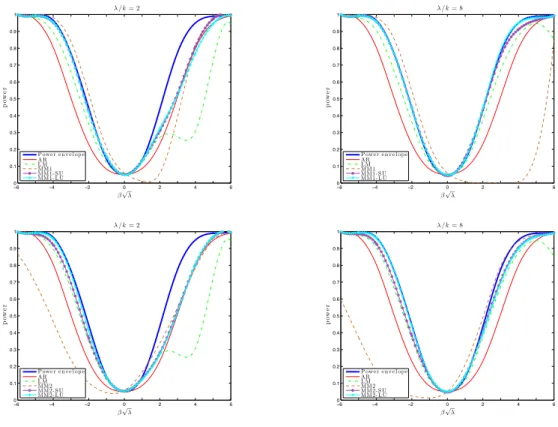
Figure 1 reports numerical results for the Kronecker product design. All four pictures present the power envelope and power curves for two existing tests, the
Anderson-Rubin (AR) and score (LM) tests.
The first two graphs plot the power curves for the three WAP tests based on the
MM1 statistic withσ2 = 10. All three tests reject the null when the h
1(s, t) statistic
is larger than an adjusted critical value function. In practice, we approximate these critical value functions with 10,000 replications. The MM1 test sets the critical value
function to be the 95% empirical quantile of h1(S, t). The MM1-SU test uses a
Figure 1: Power Comparison (Kronecker Variance)
−6 −4 −2 0 2 4 6
0 0.1 0.2 0.3 0.4 0.5 0.6 0.7 0.8 0.9 1 β√ λ po w e r
λ/k= 2
P owe r e nv e l op e AR L M MM1 MM1-S U MM1-L U
−6 −4 −2 0 2 4 6
0 0.1 0.2 0.3 0.4 0.5 0.6 0.7 0.8 0.9 1 β√ λ po w e r
λ/k= 8
P owe r e nv e l op e AR L M MM1 MM1-S U MM1-L U
−6 −4 −2 0 2 4 6
0 0.1 0.2 0.3 0.4 0.5 0.6 0.7 0.8 0.9 1 β√ λ po w e r
λ/k= 2
P owe r e nv e l op e AR L M MM2 MM2-S U MM2-L U
−6 −4 −2 0 2 4 6
0 0.1 0.2 0.3 0.4 0.5 0.6 0.7 0.8 0.9 1 β√ λ po w e r
λ/k= 8
P owe r e nv e l op e AR L M MM2 MM2-S U MM2-L U
The AR test has power considerably lower than the power envelope when
instru-ments are both weak (λ/k= 2) and strong (λ/k = 8). The LM test does not perform
well when instruments are weak, and its power function is not monotonic even when instruments are strong. These two facts about the AR and LM tests are well doc-umented in the literature; see Moreira (2003) and AMS06. The figure also reveals some salient findings for the tests based on the MM1 statistic. First, all MM1-based tests have correct size. Second, the MM1 similar test can have large bias to the point that it has zero power for parts of the parameter space. Hence, a naive choice for the density can yield a WAP test which can have overall poor power. We can elimi-nate this problem by imposing an unbiased condition when selecting an optimal test. The MM1-SU test is easy to implement and has power closer to the power upper bound. When instruments are weak, its power lies moderately below the reported
power envelope. This is expected as the number of parameters is too large5. When
instruments are strong, its power is virtually the same as the power envelope.
To support the use of the MM1-SU test we also consider the MM1-LU test, which imposes a weaker unbiased condition. Close inspection of the graphs show that the
derivative of the power function of the MM1 test is different from zero atβ =β0. This
5
observation suggests that the power curve of the WAP test would change considerably
if we were to force the power derivative to be zero at β =β0. Indeed, we implement
the MM1-LU test where the locally unbiased condition is true at only one point, the
true parameter µ. This parameter is of course unknown to the researcher and this
test is not feasible. However, by considering the locally unbiased condition for other values of the instruments’ coefficients, the WAP test would be smaller —not larger. The power curves of MM1-LU and MM1-SU tests are very close, which shows that there is not much to be gained by relaxing the strongly unbiased condition.
The last two graphs plot the power curves for the three WAP tests based on the
MM2 statistic with ζ = 10. By using the density h2(s, t), we avoid the pitfalls for
the MM1 test. Recall that h2(s, t) is invariant to those data transformations which
preserve the two-sided hypothesis testing problem. Hence, the MM2 similar test is unbiased and has overall good power without imposing any additional unbiased conditions. The graphs illustrate this theoretical finding, as the MM2, MM2-SU, and MM2-LU tests have numerically the same power curves. This conclusion changes dramatically when the covariance matrix is no longer a Kronecker product.
Figure 2: Power Comparison (Non-Kronecker Variance)
−6 −4 −2 0 2 4 6
0 0.1 0.2 0.3 0.4 0.5 0.6 0.7 0.8 0.9 1 β√ λ po w e r
λ/k= 2
P owe r e nv e l op e AR L M MM1 MM1-S U MM1-L U
−6 −4 −2 0 2 4 6
0 0.1 0.2 0.3 0.4 0.5 0.6 0.7 0.8 0.9 1 β√ λ po w e r
λ/k= 8
P owe r e nv e l op e AR L M MM1 MM1-S U MM1-L U
−6 −4 −2 0 2 4 6
0 0.1 0.2 0.3 0.4 0.5 0.6 0.7 0.8 0.9 1 β√ λ po w e r
λ/k= 2
P owe r e nv e l op e AR L M MM2 MM2-S U MM2-L U
−6 −4 −2 0 2 4 6
0 0.1 0.2 0.3 0.4 0.5 0.6 0.7 0.8 0.9 1 β√ λ po w e r
λ/k= 8
P owe r e nv e l op e AR L M MM2 MM2-S U MM2-L U
Figure 2 presents the power curves for all reported tests for the non-Kronecker design. Both MM1 and MM2 tests are severely biased and have overall bad power.
andζparameters large enough. However, this unbiasedness control is pointwise in the parameter space. We can always find a design such that each test behaves as a one-sided test and has very low power in parts of the parameter space. Hence, the strong asymptotic bias and often-low power of the conditional Wald tests found by Andrews, Moreira, and Stock (2007) also hold for the MM1 (even for the homoskedastic IV model) and MM2 similar tests (only for the HAC-IV model). These WAP similar tests are highly biased with power equal to zero in some parts of the parameter space. Therefore, just as Andrews, Moreira, and Stock (2007) object to the use of conditional Wald tests, we do not recommend the MM1 and MM2 similar tests for empirical researchers.
Proposition 2 shows that we cannot find a group of data transformations which preserve the two-sided testing problem with heteroskedastic-autocorrelated errors. Hence, a choice for the density for the WAP test based on symmetry considerations is not obvious. The correct density choice can be particularly difficult due to the
large parameter-dimension (the coefficients µ and covariance Σ). Instead, we can
endogenize the weight choice so that the WAP test will be automatically unbiased. This is done by the MM1-LU and MM2-LU tests. These two tests perform as well as the MM1-SU and MM2-SU tests. Because the latter two tests are easy to implement, we recommend their use in empirical practice.
6
Asymptotic Theory
All theoretical and numerical results so far do not rely on the sample size n at all
as we have assumed the statistics S and T to be exactly normally distributed with
known variance Σ. In this section we relax this assumption at the cost of asymptotic approximations.
Let zi and vi denote the i-th row of Z and V, respectively, written as column
vectors of dimensionsk and 2. We make the following two assumptions as the sample
size n grows.
Assumption 1. n−1Z′Z = n−1Pn
i=1zizi′ →p DZ for some positive definite k×k
matrix DZ.
Assumption 2. n−1/2Pn
i=1(vi⊗zi)→dN(0,Σ∞) for some positive definite 2k×2k
matrix Σ∞.
Assumption 1 holds under Birkhoff’s Ergodic Theorem. Assumption 2 holds under suitable conditions by a central limit theorem (CLT). It also assumes that the
long-run covariance matrix of Σ∞ is positive definite, as is usual in the literature. We
no longer omit the dependence of Σ on the sample size n and, hereinafter, write
Σn. Assumption 2 asserts that Σ∞ is the limit of Σn as n grows. Let Σbn be a
residuals. There are many HAC estimators in the literature that can be used for this purpose; see, e.g., Newey and West (1987) and Andrews (1991). For brevity, we do not provide an explicit set of conditions under which one or more of these HAC estimators is consistent; see Jansson (2002) for details. We note, however, that the presence of weak instruments does not complicate standard proofs of the consistency of HAC estimators. Indeed, the convergence for most estimators holds uniformly over
all true parameters β and π.
We now introduce feasible versions ofSn andTn with the variance Σn replaced by
the estimatorΣbn:
b
Sn = h
(b′
0⊗Ik)Σbn(b0⊗Ik) i−1/2
(b′
0⊗Ik)Rn and (6.35)
b
Tn = h
(a′
0⊗Ik)Σbn−1(a0⊗Ik) i−1/2
(a′
0⊗Ik)Σb−n1Rn,
where Rn = vec
h
(Z′Z)−1/2
Z′Yi. Likewise, we define the feasible statistic ψb
n as
ψ(S, T,Σ, DZ) with the arguments being replaced by their sample analogues: b
ψn=ψ(Sbn,Tbn,Σbn,DbZ), where DbZ =n−1Z′Z. (6.36)
Assumption 3. The prior distribution for (β, π) is absolutely continuous to the
Lebesgue measure in Rk+1. Its density
w(β, π,DbZ) =w1(π|β,DbZ)·w2(β,DbZ)
has full support and is a continuous function of π and β.
Assumption 3 allows the density w(β, π,DbZ) to depend on the data through DbZ.
This generalization allows us to cover all tests considered here and asymptotically
behaves asw(β, π, DZ) (and so we will omit the dependence of the weights onDbZ out
of convenience). Although the conditional densityw1(π|β) does not depend onβ for
the MM1 tests, it does depend onβ for the MM2 tests. Assumption 3 also guarantees
that the priors forβ and π are not dogmatic and will vanish asymptotically as in the
Bernstein-von Mises theorem. If we set the prior on µ, then the associated prior
on π = (Z′Z)1/2µ depends on the sample size. For example, the MM statistics
introduced in (2.10) use the prior µ ∼ N(0, σ2Φ). For the associated prior on π ∼
N0,(σ2/n)Db−1/2
Z ΦDb
−1/2
Z
not to be sensitive to the sample size, the parametersσ2
and ζ present in the MM1 and MM2 statistics must eventually grow at the rate n.
We make the dependence of Λ (β, µ) on the sample size n explicit and, hereinafter,
use the notation Λn.
We now analyze the asymptotic behavior of the WAP similar and WAP-SU tests. Recall that both of these types of tests depend on the test statistic
hΛn(s, t)
fS
β0(s)·h
T
Λn(t)
When instruments are weak, the numerator and denominator have the same order of magnitude. When instruments are strong, the integrands in the weighted densities
hΛn(s, t) and h
T
Λn(t) grow exponentially fast and we can apply the Laplace
approx-imation. Because both densities involve k + 1 integrals, the test statistic in (6.37)
is again well-behaved. The caveat is that a simple, closed-form approximation for
hT
Λn(t) does not seem available under strong instruments. The WAP similar and
WAP-SU tests, however, remain the same if we standardize (6.37) by any function of
t. We replace hT
Λn(t) by (1 +ktk)
−1
hT
Λβ0,n(t), where
hTΛβ
0,n(t) =
Z
fβT
0,(Z′Z)1/2π(t)w(β0, π)dπ. (6.38)
The WAP similar and WAP-SU tests reject the null when
W AP = hΛn(S, T)
fS
β0(S)·(1 +kTk)
−1
hT
Λβ0,n(T)
(6.39)
is larger thanκn(t) and κn(s, t), respectively6.
Whether the instruments are weak or strong, we are able to obtain an approxi-mation to (6.39). Define
n·Qn(β, π) =
1 2
Σ−1/2R
−(a⊗(Z′Z)1/2π)
2
= 1
2
[S :T]−(β−β0)Cβ0 : Dβ
(I2⊗(Z′Z)1/2π)
2.
Lemma 2 in Appendix B shows that the WAP statistic is asymptotically equivalent to
R
exp (−n·Qn(β, π(β)))w(β, π(β))
a′⊗Db1/2
Z
Σ−1
n
a⊗Db1Z/2−1/2dβ
exp −S′S
2
[1 +kTk]−1w(β0, π(β0))a′
0⊗Db
1/2
Z
Σ−1
n
a0⊗DbZ1/2
−1/2 , (6.40)
where the constrained maximum likelihood estimator (MLE) for π is
π(β) = (Z′Z)−1/2(a′⊗Ik)Σ−n1(a⊗Ik)
−1
(a′ ⊗Ik)Σ−n1R and (6.41)
R = Σ1n/2
"
[(b′
0⊗Ik) Σn(b0⊗Ik)]−1/2(b′0⊗Ik) Σ1n/2
[(a′
0 ⊗Ik) Σ−n1(a0⊗Ik)]−1/2(a′0⊗Ik) Σ−n1/2 #′ S T . 6
The use of a Laplace approximation of the ratio of weighted average under the alternative and the null is standard under the usual asymptotics. What is perhaps not standard is the additional term to absorb different rates and unify nonstandard asymptotics. Indeed, if we were to replace
hT
Λ(t) only by hTΛ0,n(t), the numerator and denominator in (6.37) would have different orders of
The same approximation (6.40) holds for the W AP\ statistic where we replace S,
T, and Σ by their feasible versions given in (6.35). The resulting approximation to the
\
W AP statistic is a function ofSbn, Tbn, Σn, andDbZ. The critical values for the WAP
conditional tests and WAP-SU tests, respectivelyκn(t) and κn(s, t), are taken under
the assumption that thek-dimensional vector Sbn has a standard normal distribution
(in practice, these critical values are also functions of the consistent estimators Σbn
andDbZ as well, but we omit this dependence out of convenience). For example, for a
given weight densityw(β, π), the critical functionκn(t) is simply the 1−α quantile
of (6.40) givenT =t.
We now find the asymptotic distribution for the WAP tests under the WIV asymp-totics. We make the following assumption.
Assumption WIV-FA. (a) π=C/n1/2 for some non-stochastic vector C.
(b) β is a fixed constant for all n≥1.
(c) k is a fixed positive integer that does not depend on n.
Under WIV, π(β) is op(1) and the WAP statistics behave the same as if the
weights were simply w(β,0). As n → ∞, the finite-sample critical value functions
κn(t) andκn(s, t) respectively converge to their asymptotic counterpartsκ∞(t) and
κ∞(s, t), which are based on (6.40) with w(β, π(β)) replaced by w(β,0). We then
obtain the following convergence by the continuous mapping theorem and the joint distribution
S∞
T∞
∼ N
(β−β0)Cβ0,∞
Dβ0,∞
(DZ)1/2C, I2k
, where (6.42)
Cβ0,∞ = [(b
′
0⊗Ik) Σ∞(b0⊗Ik)]−1/2 and
Dβ0,∞ =
(a′
0 ⊗Ik) Σ−∞1(a0 ⊗Ik)
−1/2
(a′
0⊗Ik) Σ−∞1(a⊗Ik).
Theorem 2. Under Assumptions WIV-FA and 1-3:
(i) Sbn,Tbn
→d(S∞, T∞) ;
(ii) PW AP Sbn,Tbn
> κn
b
Tn
→P (W AP (S∞, T∞)> κ∞(T∞)) ; and
(iii) P W AP Sbn,Tbn
> κn
b
Sn,Tbn
→P (W AP (S∞, T∞)> κ∞(S∞, T∞)).
Both WAP conditional and WAP-SU tests have asymptotic null rejection
proba-bilities being equal to α. The asymptotic power of the WAP tests has a complicated
For strong instruments with local alternatives (SIV-LA), we consider the Pitman
drift where β is local to the null value β0 asn → ∞.
Assumption SIV-LA. (a) β =β0+B/n1/2 for some constantB ∈R.
(b) π is a fixed non-zero k-vector for alln ≥1.
(c) k is a fixed positive integer that does not depend on n.
Under the SIV-LA asymptotics, the WAP statistics are shown to be increasing
transformations of the LR statistic. This result is general and holds for any prior
which satisfies Assumption 3.
Theorem 3. Suppose Assumptions SIV-LA and 1-3 hold. The long-run variance
Σ∞ is known, or unknown but consistently estimable by Σbn. Then the WAP similar
and WAP-SU tests are asymptotically equivalent to the LR test given in (2.6).
Comment. 1. In the proof, we apply the Laplace approximation twice, first
with respect to the integral for π and then for β. For the MM1 and MM2 statistics,
we can alternatively find a simple expression after integrating out the prior for the
instruments’ coefficients (expression (9.45) in Appendix A) with σ2 or ζ growing at
ratenand then applying the Laplace approximation forβ. Both approaches coincide.
2. The SIV-LA behavior of the ECS (HAC-IV) test appears to be just a special
case of our theory using Laplace approximations.
3. For higher-order expansions, we can use Watson’s lemma; for references, we
recommend Olver (1997) for deterministic functions and Onatski, Moreira, and Hallin (2014a, 2014b) for random functions.
4. Because Tn/n1/2 →p Dβ0D1Z/2π under SIV-LA, kTnk diverges to infinity w.p.1
(with probability approaching one). The critical value functions for both the WAP
conditional and WAP-SU tests collapse then to the 1−αasymptotic (unconditional)
quantile. As a result, the WAP conditional and WAP-SU tests are asymptotically similar and efficient under the SIV asymptotics.
The null rejection probability of WAP tests is α under WIV and SIV
asymp-totics. Pointwise convergence of the null rejection probability, of course, does not
necessarily imply the size is asymptoticallyα (in a uniform sense). Moreira (2003, p.
1037) suggests to use Parzen (1954) and Andrews (1986) to assure size is uniformly controlled. A series of papers, including Andrews, Cheng, and Guggenberger (2011) and Andrews and Guggenberger (2014a), develop several powerful methods to check uniform size control and have been applied to many econometric models; see Andrews and Guggenberger (2010), Andrews and Guggenberger (2014a), and Mills, Moreira, and Vilela (2014b), among others. Conceivably, we can apply those methods to the
WAP statistics coupled with the critical value functionsκn(t) and κn(s, t). This line
We can also analyze the WAP tests under strong instruments with fixed alterna-tives (SIV-FA). We follow Mills, Moreira, and Vilela (2014a) and make the following assumption.
Assumption SIV-FA. (a) β=β0+B for some nonzero B ∈R.
(b) π is a fixed non-zero k-vector for alln ≥1.
(c) k is a fixed positive integer that does not depend on n.
It is natural to expect that the power converges to one if the parameter β is fixed.
However, not all tests have this property even in the IV model with homoskedastic errors; see Andrews, Moreira, and Stock (2004) and Mills, Moreira, and Vilela (2014a) for examples. Hence, it is important to establish consistency for the WAP tests.
If the parameterβis fixed, the WAP statistics are proportional to the exponential
ofLR. BecauseLR/nconverges to a non-zero constant, the WAP tests are consistent.
The next theorem formalizes this result.
Theorem 4. Suppose Assumptions SIV-FA and 1-3hold. The long-run varianceΣ∞
is known, or unknown but consistently estimable by Σbn. Then the following hold:
(i) 2.logW AP\/n =LR/nc +op(1) ; and
(ii) LR/nc =LR/n+op(1)→γ >0.
Comment: If Dβ 6= 0, the functions κn(t) and κn(s, t) converge to a constant
obtained under SIV-FA. If Dβ = 0, the critical functions do not converge. However,
they are bounded, and so WAP tests are consistent.
7
Power Comparison
In this section, we follow I. Andrews (2015) who calibrates designs for power compar-ison based on the work of Yogo (2004) on the elasticity of intertemporal substitution in eleven developed countries.
Yogo (2004) tests the effect of interest rates on the level of aggregate demand in an IV model. He considers a linear regression in which asset return affects con-sumption growth, and the reverse form of this regression. In both equations, the endogenous variable (consumption or asset return) can be correlated with the error (innovation). To remedy this problem, he chooses four instruments: lagged values of nominal interest rate, inflation, consumption growth, and log dividend-price ratio.
I. Andrews (2015) selects the real interest rate (rf in Yogo’s (2004) notation) as the
particularly weak in this design. Indeed, the first-stage F-statistic reported by Yogo (2004) (see his Table I) is below 10 in only four countries (Japan, Switzerland, United Kingdom, and the United States). We instead join de Castro (2015) in choosing the
real stock return (re in Yogo’s (2004) notation) as the endogenous variable. The
instruments are considerably weaker in this design: the F-statistic is smaller than 4.18 in all countries, and always less than the F-statistic for interest rate. Our decision to use stock returns aims to highlight the differences between the tests proposed for the HAC-IV model. Apart from using stock returns instead of interest rates, our design is akin to that of I. Andrews (2015). We use the Newey-West estimator with three lags, and the resulting power curves are based on 5,000 Monte Carlo simulations. In
parallel to our asymptotic theory, we choose the ratio of the tuning parametersσ2 and
ζ to the sample size to be one-tenth for the MM1 and MM2 statistics, respectively.
Figure 3: Power Comparison (WAP similar tests)
−6 −4 −2 0 2 4 6
0 0.1 0.2 0.3 0.4 0.5 0.6 0.7 0.8 0.9 1
β.kµk
p ow er Australia 2sided PE AR LM MM1 MM2 ECS
−6 −4 −2 0 2 4 6
0 0.1 0.2 0.3 0.4 0.5 0.6 0.7 0.8 0.9 1
β.kµk
p ow er Canada 2sided PE AR LM MM1 MM2 ECS
−6 −4 −2 0 2 4 6
0 0.1 0.2 0.3 0.4 0.5 0.6 0.7 0.8 0.9 1
β.kµk
p ow er France 2sided PE AR LM MM1 MM2 ECS
−6 −4 −2 0 2 4 6
0 0.1 0.2 0.3 0.4 0.5 0.6 0.7 0.8 0.9 1
β.kµk
p ow er Germany 2sided PE AR LM MM1 MM2 ECS
−6 −4 −2 0 2 4 6
0 0.1 0.2 0.3 0.4 0.5 0.6 0.7 0.8 0.9 1
β.kµk
p ow er Italy 2sided PE AR LM MM1 MM2 ECS
−6 −4 −2 0 2 4 6
0 0.1 0.2 0.3 0.4 0.5 0.6 0.7 0.8 0.9 1
β.kµk
−6 −4 −2 0 2 4 6 0 0.1 0.2 0.3 0.4 0.5 0.6 0.7 0.8 0.9 1
β.kµk
p ow er Netherlands 2sided PE AR LM MM1 MM2 ECS
−6 −4 −2 0 2 4 6
0 0.1 0.2 0.3 0.4 0.5 0.6 0.7 0.8 0.9 1
β.kµk
p ow er Sweden 2sided PE AR LM MM1 MM2 ECS
−6 −4 −2 0 2 4 6
0 0.1 0.2 0.3 0.4 0.5 0.6 0.7 0.8 0.9 1
β.kµk
p ow er Switzerland 2sided PE AR LM MM1 MM2 ECS
−6 −4 −2 0 2 4 6
0 0.1 0.2 0.3 0.4 0.5 0.6 0.7 0.8 0.9 1
β.kµk
p ow er UK 2sided PE AR LM MM1 MM2 ECS
−6 −4 −2 0 2 4 6
0 0.1 0.2 0.3 0.4 0.5 0.6 0.7 0.8 0.9 1
β.kµk
p ow er USA 2sided PE AR LM MM1 MM2 ECS
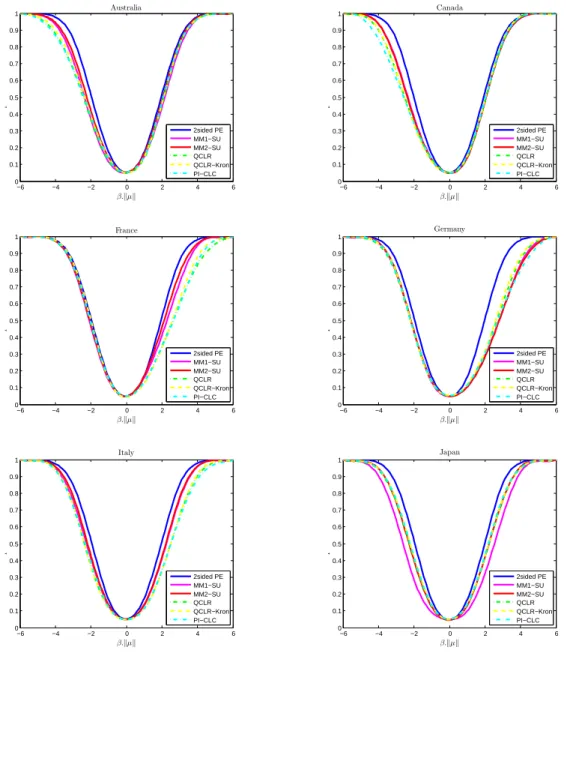
We then compare power among two-sided tests which have arguably better per-formance. Figure 4 plots power curves for the two-sided power envelope, MM1-SU, MM2-SU, CQLR, CQLR-kron, and PI-CLC tests. All tests are adequate for two-sided hypothesis testing. The PI-CLC and CQLR-kron test show some improvements over the CQLR test for some, but not all, countries. The MM1-SU test behaves near the MM2-SU test for several countries, but it has considerably lower power for Japan
and the United States7. The MM2-SU test outperforms these tests and when it
occa-7Conceivably, this power loss can be due to numerical integration over the whole real line. Power
may be improved by transforming the parameter β to the quantity θ = tan−1(dβ/cβ). This
sionally has less power, the power loss is small. This application based on real data supports our theoretical contribution and the use of the MM2-SU test in practice.
Figure 4: Power Comparison (two-sided tests)
−6 −4 −2 0 2 4 6
0 0.1 0.2 0.3 0.4 0.5 0.6 0.7 0.8 0.9 1
β.kµk
p ow er Australia 2sided PE MM1−SU MM2−SU QCLR QCLR−Kron PI−CLC
−6 −4 −2 0 2 4 6
0 0.1 0.2 0.3 0.4 0.5 0.6 0.7 0.8 0.9 1
β.kµk
p ow er Canada 2sided PE MM1−SU MM2−SU QCLR QCLR−Kron PI−CLC
−6 −4 −2 0 2 4 6
0 0.1 0.2 0.3 0.4 0.5 0.6 0.7 0.8 0.9 1
β.kµk
p ow er France 2sided PE MM1−SU MM2−SU QCLR QCLR−Kron PI−CLC
−6 −4 −2 0 2 4 6
0 0.1 0.2 0.3 0.4 0.5 0.6 0.7 0.8 0.9 1
β.kµk
p ow er Germany 2sided PE MM1−SU MM2−SU QCLR QCLR−Kron PI−CLC
−6 −4 −2 0 2 4 6
0 0.1 0.2 0.3 0.4 0.5 0.6 0.7 0.8 0.9 1
β.kµk
p ow er Italy 2sided PE MM1−SU MM2−SU QCLR QCLR−Kron PI−CLC
−6 −4 −2 0 2 4 6
0 0.1 0.2 0.3 0.4 0.5 0.6 0.7 0.8 0.9 1
β.kµk
−6 −4 −2 0 2 4 6 0 0.1 0.2 0.3 0.4 0.5 0.6 0.7 0.8 0.9 1
β.kµk
p ow er Netherlands 2sided PE MM1−SU MM2−SU QCLR QCLR−Kron PI−CLC
−6 −4 −2 0 2 4 6
0 0.1 0.2 0.3 0.4 0.5 0.6 0.7 0.8 0.9 1
β.kµk
p ow er Sweden 2sided PE MM1−SU MM2−SU QCLR QCLR−Kron PI−CLC
−6 −4 −2 0 2 4 6
0 0.1 0.2 0.3 0.4 0.5 0.6 0.7 0.8 0.9 1
β.kµk
p ow er Switzerland 2sided PE MM1−SU MM2−SU QCLR QCLR−Kron PI−CLC
−6 −4 −2 0 2 4 6
0 0.1 0.2 0.3 0.4 0.5 0.6 0.7 0.8 0.9 1
β.kµk
p ow er UK 2sided PE MM1−SU MM2−SU QCLR QCLR−Kron PI−CLC
−6 −4 −2 0 2 4 6
0 0.1 0.2 0.3 0.4 0.5 0.6 0.7 0.8 0.9 1
β.kµk
p ow er USA 2sided PE MM1−SU MM2−SU QCLR QCLR−Kron PI−CLC