FUNDAÇÃO GETULIO VARGAS
ESCOLA DE ECONOMIA DE SÃO PAULO
GUSTAVO DUARTE PIMENTA
THE DRIVERS FOR ENTRY AND EXPANSION MODES OF U.S.-BASED MNES IN BRAZIL
GUSTAVO DUARTE PIMENTA
THE DRIVERS FOR ENTRY AND EXPANSION MODES OF U.S.-BASED MNES IN BRAZIL
Dissertação apresentada à Escola de Economia de São Paulo da Fundação Getulio Vargas, como requisito para orientação ao título de Mestre em Finanças e Economia. Campo de conhecimento: Internacionalização de empresas.
Orientador: Hsia Hua Sheng
Pimenta, Gustavo Duarte.
The drivers for entry and expansion modes of U.S.-based MNEs in Brazil / Gustavo Duarte Pimenta. – 2012.
26 f.
Orientador: Hsia Hua Sheng
Dissertação (mestrado) – Escola de Economia de São Paulo
1. Empresas multinacionais - Brasil. 2. Investimentos estrangeiros - Brasil. 3. Joint ventures. I. Sheng, Hsia Hua. II. Dissertação (mestrado) - Escola de Economia de São Paulo. III. Título.
GUSTAVO DUARTE PIMENTA
THE DRIVERS FOR ENTRY AND EXPANSION MODES OF U.S.-BASED MNES IN BRAZIL
Dissertação apresentada à Escola de Economia de São Paulo da Fundação Getulio Vargas, como requisito para orientação ao título de Mestre em Finanças e Economia. Campo de conhecimento: Internacionalização de empresas.
Data da aprovação: _____/_____/_____.
Banca Examinadora:
____________________________ Prof. Hsia Hua Sheng
FGV - EESP
____________________________ Prof. Mayra Ivanoff Flora
FGV – EESP
ACKNOWLEDGEMENTS
I would like to express my special thanks to my advisors Dr. Hsia Hua Sheng and Dr. Mayra Ivanoff Lora for their important directions, encouragement and support during my dissertation work.
I would also like to express my sincere thanks to all professors and colleagues at Fundação Getulio Vargas in São Paulo for their lessons and guidance along these years.
I would like to thank my mom Herminia and my sisters Luciana and Daniela for being an example of perseverance and for teaching me that “we can be the size of our dreams.”
SUMMARY
The drivers for entry and expansion modes of multinational enterprises (MNEs) have been studied by several authors over the last decades but empirical results have been historically mixed. More recently, Hennart (2009) argued that the reason for the inconsistent results to date resided in the fact that prior theories assumed that local markets could be freely accessed based on a unilateral decision by the MNEs, and then proposes an alternative framework in which the entry and expansion modes of MNEs in foreign countries are a solution based on the relative efficiency of both markets. In this study, the proposed framework is tested against the prior theories based on investments made by U.S.-based MNEs in Brazil from 2005 to 2010. The results suggest that the local market characteristics, more specifically the concentration ratio at the firm and asset levels, are indeed important to influence the entry and expansion mode of U.S.-based MNEs in Brazil, reinforcing the argument against MNEs-centric theories. However, differently from Hennart’s proposition, we were not able to confirm the hypotheses that the MNEs skills are relevant to influence the final solution. We have also tested whether the difference in growth rate between the two countries could be a driver for MNEs to favor acquisition over greenfield given the opportunity cost of postponing the investments. The test result, based on our sample, was not able to confirm this hypothesis.
TABLE LIST
Table 1 - Sample description of investments of U.S.-based MNEs in Brazil from 2005 to 2010, excluding financial investors and plant maintenance ... 14 Table 2 - Results of the logistic regression for hypotheses 1 to 4: WOS vs. JV ... 19 Table 3 - Results of the logistic regression for hypotheses 5 to 9: Acquisition vs. Greenfield 21
ILLUSTRATION LIST
CONTENTS
1 INTRODUCTION ... 9
2 LITERATURE ... 10
2.1 LITERATURE REVIEW ... 10
2.2 VARIABLES TO TEST HENNART BUNDLING MODEL AND THE SPEED OF ENTRY DISCUSSION ... 12
3 SAMPLE DESCRIPTION ... 13
4 METHODOLOGY ... 14
5 RESULTS ... 18
5.1 RESULTS FOR HYPOTHESES 1 TO 4 ... 18
5.2 RESULTS FOR HYPOTHESES 5 TO 9 ... 20
6 CONCLUSION ... 21
9
1 INTRODUCTION
Over the last decades, several authors have tried to identify the drivers for multinational enterprises (MNEs) entry and expansion modes in foreign markets. Anderson and Gatignon’s (1986) and Johanson and Vahlne (1977) described the entry mode as a unilateral decision from the MNE based on a trade-off between the need for control and risk tolerance, the latter being a function of its degree of familiarity with the host country. Dunning (1980) added the local country perspective by defining the OLI paradigm in which the MNE would seek to combine its firm’s specific advantages (FSA) with the country’s specific advantages (CSA) to pursue its global strategy, but kept the assumption that the complementary local assets could be freely accessed by MNEs.
More recently, Hennart (2009) challenged what he called “MNE-centric theories” and proposed a model in which the entry and expansion modes are a result of an optimal assignment of equity between local firms and MNEs, taking in consideration the relative efficiency of the markets. The addition of the transactional characteristic of complementary local assets is, according to Hennart (2009), critical to influence whether and how foreign markets will be accessed by MNEs, and no consideration of this aspect in prior studies is one of the main reasons for the inconsistent empirical results to date.
Discussion of MNEs entry and expansion modes is of great relevance for Brazil, especially considering that the country has been among the top five foreign direct investment (FDI) destinations over the last years and does present market characteristics of an emerging country, which may impact entry and expansion modes of MNEs.
10
2 LITERATURE
2.1 LITERATURE REVIEW
The literature around the companies’ internationalization process has been historically MNE-centric, with most theories treating the entry and expansion modes in a host country as a unilateral decision from the MNE. Anderson and Gatingnon (1986) transaction cost framework defined entry mode as a function of the MNE trade-off between control and cost of resources commitment, the MNE decision to increase its exposure in a host market being dependent only on its willingness to run additional risks. With regards to expansion mode, Anderson and Gatingnon stated that the MNE would increase its level of ownership in foreign markets as it gained international experience, which is in line with the conclusion found in Johanson and Vahlne (1977). Barkema and Vermeulen (1998) argued that highly diversified MNEs would prefer greenfield over acquisitions, while Brouthers and Brouthers (2000) discussed the MNE’s institutional and cultural characteristics as determinants of the choice of entry mode. Therefore, despite their contributions, these theories had limited considerations on the host market characteristics.
The host country perspective is first discussed, as part of the internationalization theory, by Dunning (1980, 1988), who stated that firms will serve foreign markets in different forms (export, FDI and licensing) taking in consideration three categories of advantages, namely ownership, location and internationalization , and will access the host market in the form that best leverages those competitive advantages. However, the OLI theory does not explicitly consider the transactional characteristics of the CSA and assumes that they can be freely accessed and negotiated.
11
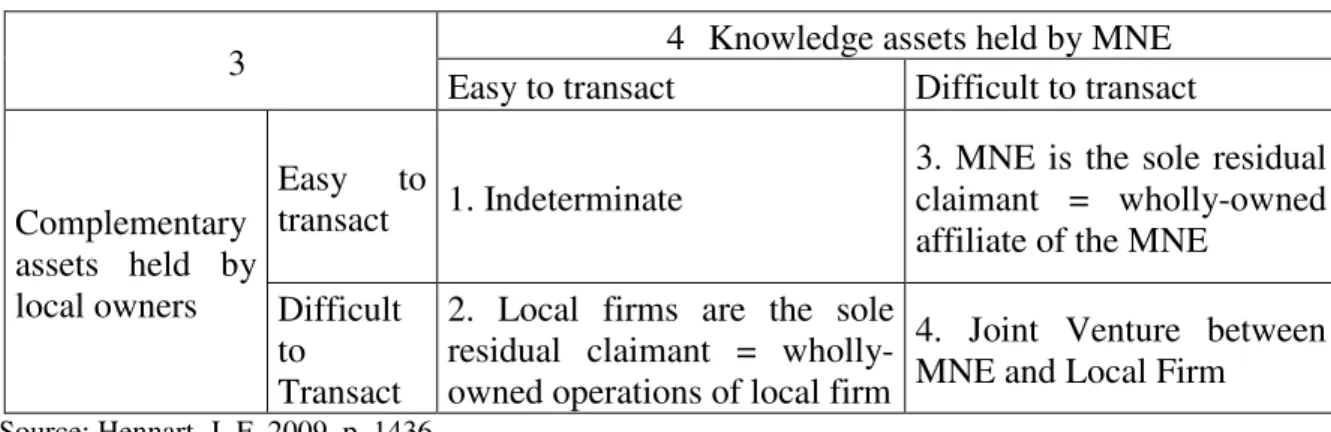
As per the model proposed, “If the market sale of the knowledge held by the MNE is subject to high transaction costs, but the MNE can acquire complementary local assets on efficient markets, then the MNE can potentially inflict higher costs on local owners of complementary assets than those owners can inflict on the MNE” (Hennart, 2009), and enter the foreign market through a WOS, as indicated in cell 3 of figure 1. On the other hand, “if the market for knowledge is efficient, and therefore, knowledge sellers can be expected to deliver as promised, but the owners of complementary local assets cannot, then the best solution is to have those owners hold the equity” (HENNART, 2009), as indicated in cell 2 of figure 1. Cell 4 in figure 1 corresponds to the case where the knowledge held by the MNE and the services of complementary local assets owned by the local firm are costly to access and the solution is a joint exposure to the equity.
Figure 1 - Optimal mode of foreign market entry
3 4 Knowledge assets held by MNE
Easy to transact Difficult to transact
Complementary assets held by local owners
Easy to
transact 1. Indeterminate
3. MNE is the sole residual claimant = wholly-owned affiliate of the MNE
Difficult to Transact
2. Local firms are the sole residual claimant = wholly-owned operations of local firm
4. Joint Venture between MNE and Local Firm Source: Hennart, J. F, 2009, p. 1436.
Following the entry mode discussion, Hennart discusses whether the entry would be established by bundling disembodied inputs obtained in markets for assets, as for example through a greenfield, or by buying the firms that control these necessary inputs. He demonstrates that the choice between greenfields and acquisitions depends on how efficient the markets for assets are in relation to those for firms. As per Hennart (2009) “acquisitions will be the most efficient solution when assets are embedded in firms in a way that they cannot be acquired separately from the entire firm, but market for firms is efficient.”
12
market for MNE knowledge improves faster than for local complementary assets, and knowledge changes from difficult to transact to easy to transact while complementary assets remain difficult to transact. In this case, the MNE will move from JVs (cell 4) to contractual relationships with local owners (cell 2) rather than to WOS (cell 3), as predicted by prior theories.
Therefore, differently from prior theories regarding foreign entry and expansion modes, Hennart considers that the relative efficiency between the MNE and the local complementary assets is the key driver to define MNEs’ internationalization mode.
2.2 VARIABLES TO TEST HENNART BUNDLING MODEL AND THE SPEED OF ENTRY DISCUSSION
In his article, Hennart describes the bundling model but does not test the variables proposed to test its relevance and applicability and suggests further work to be done on that front. Therefore, in order to test the bundling model, variables need to be defined so as to reflect the “difficulty to transact” in the local market.
For this purpose, we propose in this study consideration of the concentration ratio at the firm and asset levels to reflect the local market accessibility levels, given that highly concentrated businesses are more likely to have stronger players, with dominant position among consumers, distributors and the Government, thus imposing greater barriers for MNEs to enter the local market, as discussed by Salamon and Siegfried (1977), Porter (1980, 1985) and Timothy P. Carney (2006). This is for example the case of the Brazilian oil industry, a highly concentrated sector dominated by Petrobras and with a series of restrictions for MNEs to access the local distribution network.
13
greenfields and acquisitions may result in a solution that does not reflect the actual path pursued by MNEs, especially in high growth host markets (ANDERSSON; SVENSSON, 1994). This is the case, for example, of the acquisition of AES Atimus by Telecom Italia in Brazil in 2010. Telecom Italia’s main proposition with the transaction was to acquire AES Atimus infrastructure network, which could have been built by Telecom Italia at a much lower cost. However, being able to quickly deploy its products and reach the market before other competitors such as GVT offered a substantial value for Telecom Italia, which more than offset the substantial premium paid to acquire AES Atimus.
3 SAMPLE DESCRIPTION
The analysis will be based on the direct investments from U.S. companies in Brazil from 2005 to 2010. The reason to limit the home country to the U.S. is to avoid home bias resulting from differences in the level of economic development and potential differences in cultural approach to foreign investments, as suggested by Hennart (2007). Selection of the U.S. results from the fact that the country has been a long and important investor in Brazil and it is likely to be the ideal candidate to test the internationalization path for MNEs in the country.
Test data will be based on the SDC database from Thomson Reuters for acquisitions and joint venture transactions. For this period, SDC lists 451 acquisitions in which Brazilian companies are the target and U.S. entities are the acquirer ultimate parent nation. For the same period, 42 JVs between Brazilian and U.S. entities are listed in SDC database. For greenfield investments, we have used the Brazilian National Network of Investment Information (RENAI), an agency responsible for tracking all greenfield investments announced in Brazil. RENAI is supported by the Ministry of Development, Industry and Foreign Trade and is networked with the State Department of Industry and Trade as well as the Entrepreneurs Trade Association. Based on RENAI database from 2005-2010, we have identified 322 greenfield projects announced by U.S. companies in Brazil.
14
have also excluded financial investors, such as private equity firms, as they have a different business proposal than the usual industry investors’. As a result, the sample size reduced from 815 to 305 observations, as presented in table 1.
Table 1 - Sample description for investments of U.S.-based MNEs in Brazil from 2005 to 2010, excluding financial investors and plant maintenance
1.1 Subsidiaries’ Product Categories
SIC Industries Sample %
311 Food Manufacturing 37 12.13
312 Beverage and Tobacco Product Manufacturing 23 7.54
313 Textile Mills 1 0.33
314 Textile Product Mills 1 0.33
315 Apparel Manufacturing 6 1.97
321 Wood Product Manufacturing 1 0.33
322 Paper Manufacturing 8 2.62
323 Printing and Related Support Activities 4 1.31
324 Petroleum and Coal Product Manufacturing 10 3.28
325 Chemical Manufacturing 43 14.10
326 Plastics and Rubber Products Manufacturing 13 4.26
327 Nonmetallic Mineral Product Manufacturing 4 1.31
331 Primary Metal Manufacturing 5 1.64
332 Fabricated Metal Product Manufacturing 13 4.26
333 Machinery Manufacturing 25 8.20
334 Computer and Electronic Product Manufacturing 48 15.74
335 Electrical Equip., Appliance, and Component Manufacturing 10 3.28
336 Transportation Equipment Manufacturing 31 10.16
339 Miscellaneous Manufacturing 22 7.21
Total 305 100.00
Source: Thomson Reuters, RENAI.
4 METHODOLOGY
In order to test the internationalization theories vis-à-vis Hennart’s contributions, the following hypothesis were tested:
• Hypothesis 1: R&D-intensive MNEs will choose WOS.
15
Gatingnon and Anderson (1988) indicated that highly-skilled MNEs will prefer WOS as they can exploit their superior capabilities by themselves. Hennart argues that this may not be the case if complementary assets are sold in inefficient market as this would require the MNE to enter into a JV instead of a WOS. In order to compare both contributions, hypothesis 1 and 2 will be tested.
R&D intensiveness will be measured by the amount of R&D spending divided by the net revenues of the parent company (R&D) in the year preceding the entry. Market efficiency for complementary local assets will be measured by the difficulty to access local firms and assets in the year of entry, and will be represented by two concentration variables. The first one is the concentration ratio of the target industry, measured by IBGE through the C4 index (CONC), which represents the market share of the four largest firms in that specific sector. In this case, the greater the C4, the more concentrated the local industry and the greater the barrier to entry for MNEs, as previously described.
The second concentration variable refers to the availability of assets in disembodied forms in the local market at the time of entry and will be measured by the number of available suppliers (SUPPLY). Therefore, for the purpose of the test, if three of more suppliers for that specific asset can be found in the local market at the time of entry, the asset will be considered available in disembodied form and will be assumed to be efficient.
Additionally, in order to test interaction between R&D and local complementary asset as proposed by H2, R&D intensiveness will be interacted with concentration ratio (R&DCONC), asset supply (R&DSUPPLY) and both (R&DCONCSUPPLY). Another test variable will result from the interaction between concentration ratio and asset supply (CONCSUPPLY), which will not consider the MNE R&D level.
16
• Hypothesis 4: As firms gain more experience in a particular target country, they will not increase commitment to the country if complementary local assets are sold in inefficient markets.
Johanson and Vahlne (1977), as well as Anderson and Gatingnon (1986), state that as MNEs gains international experience, they are likely to increase the level of ownership in foreign markets. Hennart (2009) argues that this may not be the case if complementary local assets are not sold in efficient markets.
Experience in the country will be measured by the number of years that the MNEs have been operating in Brazil (YEARS) at the time of entry. Market efficiency for complementary local assets will be measured as for hypothesis 2. Additionally, in order to test the interaction between years of experience and local complementary asset as proposed by H4, the variable YEARS will be interacted with concentration ratio (YEARSCONC), asset supply (YEARSSUPPLY) and both (YEARSCONCSUPPLY).
• Hypothesis 5: R&D-intensive MNEs will prefer greenfield over acquisitions.
• Hypothesis 6: MNEs will prefer acquisitions over greenfield if assets cannot be acquired separately from the entire firm and market for firms is efficient.
Transaction cost theory indicates that R&D-intensive MNEs will prefer greenfield over acquisitions as they can more easily transfer their superior knowledge to the new plant. Hennart (2009) argues, however, that “acquisitions will be the most efficient solution to MNEs when assets are embedded in firms in a way that they cannot be acquired separately from the entire firm, but market for firms is efficient.” For the purpose of the hypothesis test, market efficiency for firm and assets will be measured as described in hypothesis 2.
17
• Hypothesis 8: Experienced MNEs will choose acquisitions over greenfield when assets cannot be acquired separately from the entire firm and market for firms is efficient.
Barkema and Vermeulen (1998) argued that MNEs’ international and product diversity influences the mode of entry, with internationally-experienced MNEs tending to prefer greenfield over acquisitions without any consideration for the relative efficiency of the market. Similarly to hypothesis 6 test, Hennart argues that this may not be the outcome if assets are embedded in firms in a way that they cannot be acquired separately from the entire firm and market for firms is efficient, and to test this hypothesis, the same variable as discussed in hypothesis 2 will be used. International experience will be measured by the number of countries where the MNE has operations in the year preceding entry (EXP).
Additionally, in order to test the interaction between international experience and local complementary asset as proposed by H8, the variable EXP will be interacted with concentration ratio (EXPCONC), asset supply (EXPSUPPLY) and both (EXPCONCSUPPLY).
• Hypothesis 9: MNEs will prefer acquisition over greenfield if opportunity cost of postponing the investment is significant
For the purpose of the hypothesis 9 test, opportunity cost (DELTAGROWTH) will be measured by the difference in growth rate between Brazil and the U.S. in the year of entry, for each specific industry. Therefore, the greater the perceived opportunity cost by postponing the investments, the more likely the MNE will choose acquisitions over greenfield.
18
zero for greenfield. The database to test the first model excludes two observations relative to minority investments, and therefore the total sample size reduces from 305 to 303 for that specific test.
5 RESULTS
5.1 RESULTS FOR HYPOTHESES 1 TO 4
The results of the binomial logistic regression for WOS versus JV are presented in table 2. A positive coefficient means that an increase in the independent variable tends to increase the probability that WOS will be chosen, and a negative coefficient means the opposite.
Equation 1 in table 2 reports the results including all the independent variables listed before. The results of equation 1 are not significant at the variables level and therefore equations 2 and 3 were tested gradually excluding the interaction variables. Equation 3 presented in table 2 is the one with the best statistical outcome as all variables are significant and the overall model presents high overall explanatory power with a chi-square of 50.675 (p < 0.001). The signs of the variables are in line with the hypotheses predictions, except for R&D/ sales, which has a negative sign, differing from H1.
19
Therefore, the model results indicate that concentration ratio at the firm and asset levels and years of experience in a country influenced the mode of entry of U.S.-based MNEs in Brazil from 2005 to 2010. As per the model, each increment of 1% in the firm-level concentration ratio (C4) reduces the chances of entry through WOS by 4%. With regards to supply, if assets are available in disembodied form in the local market, the chances for the U.S.-based MNE to enter the Brazilian market through WOS is 3.1 times the chances of entry through WOS when assets are not available. Regarding years of operations in the country, each additional year of experience increases the chances of entry through WOS by 2% while for R&D the model indicates that each increment of 1% in R&D/ sales parent ratio reduces the chances of entry through WOS by 1%, a different signal from H1 proposition.
Table 2 - Results of the logistic regression for hypotheses 1 to 4: WOS vs. JV
(WOS = 1)
Variable name Description Coefficients (p value)
1 2 3
Intercept 3.609 3.473 2.771
(<0.001) (<0.001) (<0.001)
R&D R&D/ sales parent 0.109 0.194 -0.014
(0.780) (0.350) (0.034)
SUPPLY Three or more suppliers (No = 1) -3.113 -2.418 -1.119
(0.014) (0.021) (0.014)
CONC Concentration ratio top 4 -0.011 -0.026 -0.040
(0.716) (0.310) (<0.001)
YEARS Number of years in the country 0.016 -0.007 0.022
(0.496) (0.603) (0.003)
R&DCONC Interaction R&D and CONC 0.010 0.002
(0.565) (0.606)
R&DSUPPLY Interaction R&D and SUPPLY -0.182 -0.276
(0.647) (0.159)
R&DCONCSUPPLY Interaction R&D, CONC and SUPPLY -0.009 (0.619)
CONCSUPPLY Interaction CONC and SUPPLY -0.055 -0.033
(0.107) (0.212)
YEARSSUPPLY Interaction YEARS and SUPPLY -0.014 -0.019
(0.629) (0.195)
YEARSCONC Interaction YEARS and CONC -0.001 0.000
(0.539) (0.288)
YEARSCONCSUPPLY Interaction YEARS, CONC and SUPPLY 0.001
(0.232)
Model chi-square 71.745 69.945 50.675
p value <0.001 <0.001 <0.001
n 303 303 303
20
5.2 RESULTS FOR HYPOTHESES 5 TO 9
The results of the binomial logistic regression for Acquisition versus Greenfield investments are presented in table 3. A positive coefficient means that an increase in the independent variables tends to increase the probability that acquisition will be chosen, and a negative coefficient means the opposite.
Equation 1 in table 3 reports the results including all the independent variables listed before. The results of equation 1 are not significant at the variables level and therefore equations 2 to 4 were tested gradually excluding the interaction variables and the variables with no statistical significance. Equation 4 presented in table 3 is the one with the best statistical outcome as all variables are significant and the overall model presents high overall explanatory power with a chi-square of 40.660 (p < 0.001).
The model results do not support the transaction cost theories that R&D-intensive MNEs will prefer greenfield over acquisitions (H5) as the R&D variable is not significant. The results indicate, however, that concentration ratio at the firm (CONC) and asset (SUPPLY) levels influenced the mode of entry of U.S.-based MNEs in Brazil from 2005 to 2010. As per the model, each increment of 1% in the firm-level concentration ratio (C4) reduces the chances of entry through acquisition by 3%. With regards to supply, if assets are available in the local market, the chance for the U.S.-based MNE to enter the Brazilian market through acquisition is 6.5 times the chances of entry through acquisition when assets are not available. Even though this seems a bit contradictory, as MNE would likely favor greenfield if the market for asset is efficient, in reality it is quite possible that even under this scenario MNEs could still favor acquisitions in order to accelerate their growth strategy, as previously seen in the AES Atimus/ TIM transaction.
21
(H9), the opportunity cost (DELTAGROWTH) of greenfield investments was not find to be significant to influence the establishment mode of U.S.-based MNEs in Brazil from 2005 to 2010.
Table 3 - Results of the logistic regression for hypotheses 5 to 9: Acquisition vs. Greenfield
(Acquisition = 1)
Variable name Description Coefficients (p value)
1 2 3 4
Intercept 0.199 0.136 2.107 1.971
(0.608) (0.722) (<0.001) (<0.001)
R&D R&D/ sales parent 0.093 0.038 0.001
(0.784) (0.804) (0.913)
SUPPLY Three or more suppliers (No = 1) -0.242 1.385 1.822 -1.871
(0.892) (0.171) (<0.001) (<0.001)
EXP Number of countries with operations 0.053 -0.001 -0.003
(0.243) (0.966) (0.190)
DELTAGROWTH Difference in growth Brazil vs. U.S. -0.001 -0.001 -0.002
(0.923) (0.929) (0.857)
CONC Concentration ratio four largest 0.032 -0.012 -0.035 -0.035
(0.495) (0.609) (<0.001) (<0.001)
R&DCONC Interaction R&D and CONC 0.008 0.001
(0.601) (0.798)
R&DSUPPLY Interaction R&D and SUPPLY -0.112 -0.052
(0.747) (0.707) R&DCONCSUPPLY Interaction R&D, CONC and SUPPLY -0.007
(0.643)
CONCSUPPLY Interaction CONC and SUPPLY -0.062 -0.015
(0.208) (0.549)
EXPSSUPPLY Interaction EXP and SUPPLY -0.051 0.003
(0.260) (0.772)
EXPCONC Interaction EXP and CONC -0.003 0.000
(0.191) (0.295)
EXPCONCSUPPLY Interaction EXP, CONC and SUPPLY 0.002
(0.236)
Model chi-square 47.118 45.347 42.513 40.660
p value <0.001 <0.001 <0.001 <0.001
n 305 305 305 305
Source: Own elaboration.
22
This study offers an empirical analysis of the factors that influenced the entry and expansion mode of U.S.-based MNEs in Brazil from 2005 to 2010. It compares the validity of internationalization theories vis-à-vis Hennart’s (2009) recent contribution, which states that local market characteristics are considered equally important in defining the MNE´s internationalization strategy. In our study, we proposed two variables to reflect the difficulty to access the local market, namely concentration ratio of the target industry and asset supply availability, and used those variables to test Hennart´s bundling model. The results suggested that local market characteristics were indeed important to influence the entry and expansion mode of U.S.-based MNEs in Brazil from 2005 to 2010, reinforcing Hennart’s argument against the MNEs-centric theories. However, differently from Hennart’s proposition, we were not able to confirm the hypotheses that the MNEs skills or international experience are relevant to influence the final solution.
We have also added and tested the opportunity cost variable (Biggadike, 1979; Caves 1982) as a potential driver for U.S.-based MNEs to favor acquisition over greenfield when entering Brazil, but the empirical results were not able to support our hypothesis.
Our conclusion regarding the greater importance of local market characteristics in defining the entry and expansion mode of U.S.-based MNEs in Brazil creates significant opportunities for future studies, whether by testing other local variables such as regulation and financing, or by including MNEs from other countries, as this study was limited to U.S.-based MNEs. Also, variables other than R&D could be assumed to reflect the MNE´s knowledge skills.
REFERENCES
ANDERSON, E.; GATIGNON, H. Modes of foreign entry: A transaction cost analysis and propositions. Journal of International Business Studies, v.17, n.3, p.126, 1986.
23
BARKEMA, H.; VERMEULEN, F. International expansion through start-up or acquisition: A learning perspective. Academy of Management Journal, v.41, n.1, p.7-26, 1998.
BIGGADIKE, E. R. Corporate diversification: Entry, strategy, and performance. Cambridge, MA: Harvard University Press., 1979.
BROUTHERS, K. The influence of international risk on entry mode strategy. Management International Review, v.35, n.1, p.7-28, 1995.
BROUTHERS, K.; BROUTHERS, L.; WERNER, S. Transaction cost-enhanced entry mode choices and firm performance. Strategic Management Journal, v.24, n.12, p.1239-1248, 2003.
BROUTHERS, K.; HENNART, J. F. Boundaries of the firm: Insights from international entry mode research. Journal of Management, v.33, n.3, p.395-425, 2007.
BUCKLEY, P.; CASSON, M. The optimal timing of a foreign direct investment. Economic Journal, v.91, n.361, p.75-87.
CAVES, R. Multinational Enterprise and Economic Analysis, Cambridge University Press, New York, 1982 and S. Mehra, "Entry of Foreign Multinationals into U.S. Manufacturing Industries". In: PORTER, M. (Ed.). Competition in Global Industries. Boston: Harvard Business School Press, 1986.
DUNNING, J. The theory of international production. The International Trade Journal, v.3, n.1, p.21-66, 1988.
DUNNING, J.; LUNDAN, S. Multinational enterprises and the global economy. Cheltenham: Edward Elgar, 2008.
GATIGNON, H.; ANDERSON, E. The multinational corporation’s degree of control over foreign subsidiaries: An empirical test of a transaction cost explanation. Journal of Law, Economics, and Organization, v.4, n.2, p.305-336, 1988.
GOMES-CASSERES, B. Ownership structures of foreign subsidiaries: Theory and evidence. Journal of Economic Behavior and Organization, v.11, n.1, p.1-25, 1989.
24
HENNART, J. F. Down with MNE-centric theories! Market entry and expansion as the bundling of MNE and local assets. Journal of International Business Studies, v.40, n.9, p.1432-1455, 2009.
______. Transaction costs theory and the multinational enterprise. In: PITELIS, C.; SUGDEN, R. (Eds.). The nature of the transnational. 2.ed. London: Routledge, 2000. p.72-118.
______. Explaining the swollen middle: Why most transactions are a mix of ‘market’ and ‘hierarchy’. Organization Science, v.4, n.4, p.529-548, 1993.
______. The transaction costs theory of joint ventures: An empirical study of Japanese subsidiaries in the United States. Management Science, v.37, n.4, p.483-497, 1991.
______. Can the ‘new forms of investment’ substitute for the ‘old forms’? A transaction costs perspective. Journal of International Business Studies, v.20, n.2, p.211-233, 1989.
______. A transaction costs theory of equity joint ventures. Strategic Management Journal, v.9, n.4, p.361-374,1988.
______. A theory of multinational enterprise. Ann Arbor: University of Michigan Press, 1982.
HENNART, J. F.; PARK, Y. R. Greenfield vs. acquisition: The strategy of Japanese investors in the United States. Management Science, v.39, n.9, p.1054-1070, 1993.
HENNART, J. F.; REDDY, S. The choice between mergers/acquisitions and joint ventures: The case of Japanese investors in the United States. Strategic Management Journal, v.18, n.1, p.1-12, 1997.
JOHANSON, J.; VAHLNE, J. The internationalization process of the firm: A model of knowledge development and increasing market commitments. Journal of International Business Studies, p.8, n.1, p.23-32, 1977.
______. The mechanism of internationalization. International Marketing Review, v.7, n.4, p.11-24, 1990.
25
KOGUT, B.; SINGH, H. The effect of national culture on the choice of entry mode. Journal of International Business Studies, v.19, n.3, p.411-432, 1988.
PADMANABHAN, P.; CHO, K. Decision specific experience in foreign ownership and establishment strategies: Evidence from Japanese firms. Journal of International Business Studies, v.30, n.1, p.25-44, 1999.
______. Ownership strategy for a foreign affiliate: An empirical investigation of Japanese firms. Management International Review, v.36, n.1, p.45-65, 1996.
PORTER, M.E. Competitive Strategy, Free Press, New York, 1985.
______. Competitive Strategy, Free Press, New York, 1980.
SALAMON, L.; SIEGFRIED, J. Economic Power and Political Influence: The Impact of Industry Structure on Public Policy. American Political Science Review, v.71, 1977.
SLANGEN, A.; HENNART, J. F. Greenfield or acquisition entry: A review of the empirical foreign establishment mode literature. Journal of International Management, v.13, n.4, p.404-429. 2007.
TEECE, D. Profiting from technological innovation: Implications for integration, collaboration, and public policy. Research Policy, v.15, n.6, p.285-305, 1986.
VERBEKE, A. International business strategy. Cambridge: Cambridge University Press, 2009.