❊♥s❛✐♦s ❊❝♦♥ô♠✐❝♦s
❊s❝♦❧❛ ❞❡
Pós✲●r❛❞✉❛çã♦
❡♠ ❊❝♦♥♦♠✐❛
❞❛ ❋✉♥❞❛çã♦
●❡t✉❧✐♦ ❱❛r❣❛s
◆◦ ✹✷✾ ■❙❙◆ ✵✶✵✹✲✽✾✶✵
❚❤❡ ▼✐ss✐♥❣ ▲✐♥❦✿ ❯s✐♥❣ t❤❡ ◆❇❊❘ ❘❡❝❡s✲
s✐♦♥ ■♥❞✐❝❛t♦r t♦ ❈♦♥str✉❝t ❈♦✐♥❝✐❞❡♥t ❛♥❞
▲❡❛❞✐♥❣ ■♥❞✐❝❡s ♦❢ ❊❝♦♥♦♠✐❝ ❆❝t✐✈✐t②
❏♦ã♦ ❱✐❝t♦r ■ss❧❡r✱ ❋❛rs❤✐❞ ❱❛❤✐❞
❖s ❛rt✐❣♦s ♣✉❜❧✐❝❛❞♦s sã♦ ❞❡ ✐♥t❡✐r❛ r❡s♣♦♥s❛❜✐❧✐❞❛❞❡ ❞❡ s❡✉s ❛✉t♦r❡s✳ ❆s
♦♣✐♥✐õ❡s ♥❡❧❡s ❡♠✐t✐❞❛s ♥ã♦ ❡①♣r✐♠❡♠✱ ♥❡❝❡ss❛r✐❛♠❡♥t❡✱ ♦ ♣♦♥t♦ ❞❡ ✈✐st❛ ❞❛
❋✉♥❞❛çã♦ ●❡t✉❧✐♦ ❱❛r❣❛s✳
❊❙❈❖▲❆ ❉❊ PÓ❙✲●❘❆❉❯❆➬➹❖ ❊▼ ❊❈❖◆❖▼■❆ ❉✐r❡t♦r ●❡r❛❧✿ ❘❡♥❛t♦ ❋r❛❣❡❧❧✐ ❈❛r❞♦s♦
❉✐r❡t♦r ❞❡ ❊♥s✐♥♦✿ ▲✉✐s ❍❡♥r✐q✉❡ ❇❡rt♦❧✐♥♦ ❇r❛✐❞♦ ❉✐r❡t♦r ❞❡ P❡sq✉✐s❛✿ ❏♦ã♦ ❱✐❝t♦r ■ss❧❡r
❉✐r❡t♦r ❞❡ P✉❜❧✐❝❛çõ❡s ❈✐❡♥tí✜❝❛s✿ ❘✐❝❛r❞♦ ❞❡ ❖❧✐✈❡✐r❛ ❈❛✈❛❧❝❛♥t✐
❱✐❝t♦r ■ss❧❡r✱ ❏♦ã♦
❚❤❡ ▼✐ss✐♥❣ ▲✐♥❦✿ ❯s✐♥❣ t❤❡ ◆❇❊❘ ❘❡❝❡ss✐♦♥ ■♥❞✐❝❛t♦r t♦ ❈♦♥str✉❝t ❈♦✐♥❝✐❞❡♥t ❛♥❞ ▲❡❛❞✐♥❣ ■♥❞✐❝❡s ♦❢ ❊❝♦♥♦♠✐❝ ❆❝t✐✈✐t②✴ ❏♦ã♦ ❱✐❝t♦r ■ss❧❡r✱ ❋❛rs❤✐❞ ❱❛❤✐❞ ✕ ❘✐♦ ❞❡ ❏❛♥❡✐r♦ ✿ ❋●❱✱❊P●❊✱ ✷✵✶✵
✭❊♥s❛✐♦s ❊❝♦♥ô♠✐❝♦s❀ ✹✷✾✮
■♥❝❧✉✐ ❜✐❜❧✐♦❣r❛❢✐❛✳
The Missing Link: Using the NBER Recession Indicator to
Construct Coincident and Leading Indices of Economic
Activity
∗
João Victor Issler
†Graduate School of Economics — EPGE
Getulio Vargas Foundation
Praia de Botafogo 190 s. 1100
Rio de Janeiro, RJ 22253-900
Brazil
[email protected]
Farshid Vahid
Department of Econometrics and Business Statistics
Monash University
P.O. Box 11E
Victoria 3800
Australia
[email protected]
March 2001
J.E.L. Codes: C32, E32.
∗A ck n ow l ed gm ent s: João Victor Issler acknowledges the hospitality of Monash University and Farshid Vahid acknowledges the hospitality of the Getulio Vargas Foundation. We have benefited from comments and suggestions of Heather Anderson, Antonio Fiorencio, Carlos Martins-Filho, Helio Migon, and Ajax Moreira, who are not responsible for any remaining errors in this paper. João Victor Issler acknowledges the support of CNPq-Brazil and PRONEX. Farshid Vahid is grateful to the Australian Research Council Small Grant scheme and CNPq Brazil forfinancial assistance.
†
1. I nt r oduct ion
Since Burns and Mitchell (1946) there has been a great deal of interest in making inference about the “state of the economy” from sets of monthly variables that are believed to be either concurrent or to lead the economy’s business cycles (the so called “coincident” and “leading” indicators respectively). Although the business-cycle status of the economy is not directly observable, our most educated estimate of it is the binary variable announced by the NBER Business Cycle Dating Committee. These announcements are based on the consensus of a panel of experts, and they are made some time (usually six months to one year) after a turning point in the business cycle has occurred. NBER summarizes its deliberations as follows:
“The NBER does not define a recession in terms of two consecutive quarters of decline in real GNP. Rather, a recession is a recurring period of decline in total output, income, employment, and trade, usually lasting from six months to a year, and marked by widespread contractions in many sectors of the economy.”
(Quoted from http://www.nber.org/cycles.html)
The time it takes for the NBER committee to deliberate and decide that a turning point has occurred is often too long to make these announcements practically useful. This gives importance to two constructed indices, namely the coincident index and the leading indicator index. The traditional coincident index constructed by the Department of Commerce is a combination of four representative monthly variables on total output, income, employment and trade. These variables are believed to have cycles that are concurrent with the latent “business cycle” (see Burns and Mitchell 1946). The traditional leading index is then a combi-nation of other variables that are believed to lead the coincident index. Recently, alternative “experimental” coincident and leading indices have been proposed that are based on sophis-ticated statistical methods of extracting a common latent dynamic factor from the coincident variables that comprise the traditional index; see, e.g., Stock and Watson (1988a, 1988b, 1989, 1991, 1993a), and Chauvet (1998).
The basic idea behind this paper is simple: use the information content in the NBER Business Cycle Dating Committee decisions, which are generally accepted as the chronology of the U.S. business-cycles1, to construct a coincident and a leading index of economic activity.
The NBER’s Dating Committee decisions have been used extensively to validate various models of economic activity. For example, to support his econometric model, Hamilton (1989) compares the smoothed probabilities of the “recessionary regime” implied by his Markov switching model with the NBER recession indicator. Since then, this has become a routine
exercise for evaluating variants of Markov-switching models, see Chauvet (1998) for a recent example. Stock and Watson (1993a) use the NBER recession indicator to develop a procedure to validate the predictive performance of their experimental recession index. Estrella and Mishkin (1998) use the NBER recession indicator to compare the predictive performance of potential leading indicators of economic activity. However, as far as we know, no one has actually used the NBER recession indicator to construct coincident and leading indicators. We therefore ask “Why not?”. In our opinion, this is much more appealing than imposing stringent statistical restrictions to construct a common latent dynamic factor, hoping that it represents the economy’s business cycle.
The method that we employ here is based on the following ingredients. First, we use a probit regression which has the NBER recession indicator as its dependent variable. Because we are interested in constructing indices of business-cycle activity, we only use the cyclical parts of the coincident series as the regressors to explain the NBER recession indicator. This ensures that noise in the coincident series does not affect thefinal index2. Second, we allow for the possibility of measurement error and simultaneity by using instrumental-variable methods when running the probit regression. Natural candidates for the instruments are the variables that are traditionally used to construct the leading index.
The coincident index proposed here is a simple fixed-weight linear combination of the coincident series. Likewise, our leading index is also a simple fixed-weight linear combination of the leading series. This means that coincident and leading indices will be readily available to all users, who will not have to wait for them to be calculated and announced by a third party. The indices constructed by The Conference Board — TCB, formerly constructed by the Department of Commerce, are used much more widely than other proposed indices, because of their ready availability.
We like to think that our method uncovers the “Missing Link” between the pioneering research of Burns and Mitchell (1946), who proposed the coincident and leading variables to be tracked over time, and the deliberations of the NBER Business Cycle Dating Committee who define a recession as: “... a recurring period of decline in total output, income, employment, and trade, usually lasting from six months to a year, and marked by widespread contractions in many sectors of the economy”.
Another feature of the present research effort is that it integrates two different strands of the modern macroeconometrics literature. The first seeks to construct indices of and to forecast business-cycle activity, and is perhaps best exemplified by the work of Stock and Watson (1988a, 1988b, 1989, 1991, 1993a), the collection of papers in Lahiri and Moore (1993) and in Stock and Watson (1993b), as well as by the recent work of Chauvet (1998).
2
The second seeks to characterize and test for common-cyclical features in macroeconomic data, where a business-cycle feature is regarded as a similar pattern of serial-correlation for different macroeconomic series, showing that they display short-run co-movement; see Engle and Kozicki (1993), Vahid and Engle (1993, 1997), and Hecq, Palm and Urbain (2000) for the basic theory and Engle and Issler (1995) and Issler and Vahid (2001) for applications.
The performance of our constructed coincident index is promising. In formal econometric tests it encompasses two of the most popular indices currently in use — the TCB and Stock and Watson’s coincident indices. Conversely our index is not encompassed by these others. Regarding our leading index, its behavior seems to anticipate the current state of the economy quite well.
The structure of the rest of the paper is as follows. In Section 2 we present the basic ingredients of our methodology in a non-technical way, leaving the technical details for the Appendix. Section 3 presents the coincident and leading indices, and Section 4 concludes.
2. T heor et ical under pinning of t he indexes
In this Section we explain the method that we use for constructing the coincident and leading indices of economic activity. Technical details are included in the Appendix.
2.1. D et er m i ni ng a basi s for t he cy cl i cal com p onent s of coi nci dent var i abl es
We require that the coincident index be a linear combination of the cyclical components of coincident variables. This means that in our view, the “business cycle” is a linear combination of thecyclesof the four coincident series (output, income, employment and trade), and there is no unimportantcyclical fluctuation in these variables that is excluded. This contrasts with the single latent dynamic index view of a coincident index (e.g., Stock and Watson 1989 and Chauvet 1998), which restricts the “business cycle” to be a single common cyclical factor shared by the coincident variables. In order to identify the common cycle, the single latent dynamic factor approach has to allow the coincident variables to have other idiosyncratic cyclical factors, and this provides no control over how strong these idiosyncratic cycles are relative to the common cycle; see the discussion in Appendix A.1.
Fomby 1997) as exogenous predictors. There are infinitely many linear combinations of the coincident variables that are predictable from the past, that is, that are cyclical. We use canonical-correlation analysis tofind a basis for the space of these cycles.
Canonical-correlation analysis, introduced by Hotelling (1935, 1936), has been used in multivariate statistics for a long time. It was first used in multivariate time series analysis by Akaike (1976). Akaike aptly referred to the canonical variates as “the channels of information interface between the past and the present” and he referred to canonical correlations as the “strength” of these channels. We explain the concept briefly in our context, leaving more technical details for the Appendix.
Denote the set of coincident variables (income, output, employment and trade) by the vector xt = (x1t, x2t, x3t, x4t)0 and the set of m (m≥4) “predictors” by the vector zt (this
includes lags of xt as well as lags of the leading variables). Canonical correlations analysis
transformsxtinto four independent linear combinationsA(xt) = (α01xt,α02xt,α03xt,α04xt)with
the property thatα01xtis the linear combination of xtthat is most (linearly) predictable from
zt, α02xt is the second most predictable linear combination of xt from zt after controlling for
α0
1xt,and so on3. These linear combinations will be uncorrelated with each other and they
are restricted to have unit variances so as to identify them uniquely up-to a sign change. By-products of this analysis are four linear combination ofzt,Γ(zt) = (γ01zt,γ02zt,γ03zt,γ04zt),with
the property thatγ0iztis the linear combination ofzt that has the highest squared correlation with α0ixt, for i = 1,2,3,4. Again, the elements of Γ(zt) are uncorrelated with each other,
and they are uniquely identified up-to a sign switch with the additional restriction that all four have unit variances. The regression R2 betweenα0ixt and γi0ztfori=1,2,3,4,which we
denote by λ21,λ22,λ23,λ24 ,are the squared canonical correlations betweenxtand zt.
In the present application, we call (α01xt,α02xt,α03xt,α04xt) the “basis cycles” in xt. Our view that cycles are predictable from the past information, justifies using this term. It is important to note that moving fromxttoA(xt)is just a change of coordinates. In particular,
no structure is placed on these variables from outside, and no information is thrown away in this transformation. Hence, the information content in A(xt) is neither more nor less than
the information content inxt.
The advantage of this basis change is that it allows us to determine if the cyclical behavior of the coincident series can be explained by less than four basis cycles. Note that in thefirst basis cycle, i.e. the linear combination ofxtwith maximal correlation with the past, reveals the combination of coincident series with the most pronounced cyclical feature. Analogously, the linear combination associated with the minimal canonical correlation reveals the combination
of thext with the weakest cyclical feature. We can use a simple statistical-test procedure to examine whether the smallest canonical correlation (or a group of canonical correlations) is statistically equal to zero; see Appendix A.2. If this hypothesis is not rejected, then the linear combination corresponding to the statistically insignificant canonical correlation cannot be predicted from the past, i.e. it is white-noise, and therefore can be dropped from the set of basis cycles. In that case, we can conclude that all cyclical behavior in the four coincident series can be written in terms of less than four basis cycles.
Hence, the use of linear combination ofxt’s that arenot associated with a zero canonical
correlation is equivalent to using only the cyclical components of the coincident series. Any linear combination of the significant basis cycles is a linear combination of the cyclical com-ponents of coincident variables, which is convenient for our purposes, because it implies that our coincident index will be a linear combination of the coincident variables themselves.
If the canonical-correlation tests suggest that only one cycle is needed to explain the dependence of the four coincident variables with the past, then that unique common cycle will be the candidate for the coincident index. In such a case, our coincident index will be close to the coincident index constructed through a single hidden dynamic factor approach. However, our analysis, which is reported in Section 3, shows that this was not the case. Jumping to our results, our proposed coincident index is a linear combination of three statistically significant basis cycles that explain the NBER recession indicator.
2.2. U si ng pr obi t anal y si s t o com put e coi nci dent and l eadi ng i ndi ces
One way to estimate the weights associated with each basis cycle is to estimate a simple probit model with the NBER indicator as the binary dependent variable and the basis cycles associated with the non-zero canonical correlations as explanatory variables. Since the basis cycles are linear combinations of the four coincident series, we will ultimately end up explaining the state of the economy by a linear combination of the coincident series. This was exactly our goal from the outset — use the information content in the NBER Business Cycle Dating Committee decisions to construct a coincident index of economic activity that is a simple linear combination of the coincident series.
of coincident and leading variables) as instruments for the basis cycles. Notice that canonical-correlation analysis produces estimates ofγ01zt,γ02zt,γ03zt,andγ04zt, which are the best linear
predictors for each of the basis cycles respectively.
Several alternative estimators have been proposed for the consistent estimation of parame-ters of a single equation with a limited dependent variable in a simultaneous equations model. These estimators differ in their ease of calculation versus their degree of efficiency. We use the two stage conditional maximum likelihood (2SCML) estimator proposed by Rivers and Vuong (1988). In our context, and using already the empirical results stated below, we assume that the four coincident series can be explained by three significant basis cycles{c1t, c2t, c3t}.
Denoting the NBER indicator by NBERt, the first stage of the 2SCML estimation involves
regressing {c1t, c2t, c3t} on the instruments zt and saving the residuals, which we denote by {vˆ1t,vˆ2t,vˆ3t}.In the second stage, both the basis cycles{c1t, c2t, c3t} and the residuals of the
first stage {vˆ1t,vˆ2t,vˆ3t}are included in the probit model:
Pr (NBERt=1) =Φ(β0+β1c1t+β2c2t+β3c3t+β4ˆv1t+β5vˆ2t+β6vˆ3t),
where Φ is the standard normal cumulative distribution function. The estimates of β1, β2, and β3 from the second stage probit will be the 2SCML estimates. Our coincident index is then given by4:
Coincident indext = − β1c1t+β2c2t+β3c3t
= − β1α01xt+β2α02xt+β3α03xt
= − β1α01+β2α02+β3α03 xt,
which shows that it can be expressed as a linear combination of the coincident series xt.
Similarly, our leading index can be expressed as a linear combination of the leading serieszt.
The simple probit standard errors cannot be used for inference and have to be modified as shown by Rivers and Vuong (1988). There is an added complication here because the value of the dependent variable is set by the Business Cycle Dating Committee several periods after time t and therefore, it embodies information that cannot be predicted at time t. This fact cannot be exploited in constructing a better index because future information is not available at the time when the index is computed. However, it implies that the model has a moving average error, and therefore its standard-errors have to be modified to make inference robust to dynamic misspecification. These technicalities are explained further in Appendix A.3.
In summary, our complete statistical model is the following:
4The minus sign in front of β
NBERt = 1
ify∗
t >0
0 ify∗
t ≤0
yt∗ = ψ0+ψ0xt 4×1
+ut (2.1)
xt = Π 4×mmz×t1
+εt,
where ut may be correlated withεt,ut and εtare jointly normal, and Π has rank 3.
2.3. Encom passi ng t est s for al t er nat i ve coi nci dent i ndi ces
After obtaining our coincident index, it is desirable to evaluate its performance in explain-ing the state of the economy relative to alternative coincident indices. Natural candidates of alternative indices are TCB’s (Dept. of Commerce) and Stock and Watson’s coincident indices. The first is chosen because it is a simple linear combination of the coincident series that is widely used by practitioners. The second is chosen because it is constructed using a sophisticated dynamic factor model, which is put forward as a basis for rationalizing NBER’s decisions on the state of the economy; see Appendix A.1 for more details on both indices.
In principle all three coincident indices attempt to summarize the current state of the economy. Hence, it seems natural to evaluate them with respect to their ability to predict the current state of the economy represented by the binary variable announced by the NBER Business Cycle Dating Committee. The exercise would be straightforward if the underlying models were all nested within each other. However, this is not the case, and we use non-nested tests. These can be viewed as misspecification tests for our econometric model in (2.1).
Suppose we want to compare two competing coincident indices,index1t andindex2t. The
easiest test would be to include both indices in a linear probability model, which has the NBER recession indicator as its dependent variable, i.e.,
NBERt=θ0+θ1index1t+θ2index2t+et (2.2)
If given index1t, index2t is insignificant in explaining NBERt, then index1t encompasses
index2t. If given index2t, index1t is insignificant in explaining NBERt, then index2t
encom-passes index1t.Otherwise, neither encompasses the other. If linearity is of concern, one can
add higher powers ofindex1tandindex2tto the right-hand side of equation (2.2), for example,
NBERt=θ0+θ1index1t+θ01index21t+θ001index31t+θ2index2t+θ02index22t+θ002index32t+et. (2.3)
Then,index1t encompasses index2t if we cannot reject thatθ2=θ02=θ002= 0,index2t
encom-passes index1t if we cannot reject that θ1=θ01=θ001 = 0, and neither encompasses the other
Of course, linear probability models are heteroskedastic and, in our context, the above equations are likely to have serially correlated errors because of the timing issue discussed above. Therefore, heteroskedasticity and serial-correlation robust covariance matrices should be used when testing the encompassing hypotheses. The issue of measurement errors in the coincident variables that constitute the indices can be taken care of by usingztas instruments
for the indices, and basing the encompassing tests on the generalized instrumental variable (or GMM) estimates and standard errors of the parameters.
Although a linear specification is not strictly appropriate formodellinga binary dependent variable because it can lead to predictions forPr (NBERt=1)that are outside the[0,1]
inter-val for somet, it is convenient fortestinghypotheses without making a restrictive assumption about the functional form. The encompassing test explained above, with all its complications arising out of heteroskedasticity and serial dependence of errors and measurement error in the independent variables, can be readily computed by standard econometrics software. Alterna-tively, one can take the probit specification as the correct specification under the null, and design the encompassing test along the lines of the so-called “artificial regression” approach5
described in Davidson and McKinnon (1993, pp. 523-528); we provide some technical details of the latter in Appendix A.4.
3. Calculat ing coincident - and leading-indicat or indices
3.1. I dent i fi cat i on of t he basi s cy cl es
We begin our analysis by considering the coincident series, which are defined in Table 1, and are plotted in Figure 1, where shaded areas represent the NBER dating of recession periods. All four series show signs of dropping during recessions, although this behavior is more pronounced for Industrial Production (∆lnYt) and Employment (∆lnNt). These two series also show a
more visible cyclical pattern, whereas, for example, it is hard to notice the cyclical pattern in Sales(∆lnSt)or Income(∆lnIt). Before modelling the joint cyclical pattern of the coincident
series in (∆lnIt, ∆lnYt, ∆lnNt, ∆lnSt), we performed cointegration tests to verify if the
series in(lnIt,lnYt,lnNt,lnSt)share a common long-run component. As in Stock and Watson
(1989), we find no cointegration among these variables.
Conditional on the evidence of no cointegration for the elements of(lnIt,lnYt,lnNt,lnSt), we model them as a Vector Autoregression (VAR) in first differences. Besides
(∆lnIt, ∆lnYt, ∆lnNt, ∆lnSt) and their lags, the VAR also contains the lags of
trans-formed (mostly by log first differences) leading series as a conditioning set. The latter is a sensible choice because we should expect, a priori, that these leading series are helpful in
5Indeed our test regressions in equations (2.2) and (2.3) are “artificial regressions” based on, respectively,
forecasting the coincident series. A list of these leading series is also presented in Table 1. They were used by Stock and Watson(1988a) and comprise a subset of the variables initially chosen by Burns and Mitchell (1946) to be leading indicators6.
The Akaike Information Criterion chose a VAR of order 2. Conditional on aV AR(2)we calculated the canonical correlations between the coincident series (∆lnIt, ∆lnYt, ∆lnNt,
∆lnSt) and the respective conditioning set, comprising of two lags of (∆lnIt,∆lnYt,∆lnNt,
∆lnSt) and of two lags of the leading series. The canonical-correlation test results in Table 2
allow the conclusion that there is only one linear combination of the coincident series which is white noise. Hence, the cyclical behavior of (∆lnIt,∆lnYt,∆lnNt,∆lnSt) can be
repre-sented by three orthogonal canonical factors. These factors, (c1t, c2t, c3t), were labelled as the
coincident basis cycles and are a linear combination of the coincident series. A plot of them is presented in Figure 2. Figure 3, on the other hand, presents the estimates of the linear com-binations of the leading series in the canonical-correlation analysis,(γ01zt,γ20zt,γ03zt), labelled
leading factors.
Below, we show the linear combinations of the four coincident indicators that yield the three basis cycles:
c1t
c2t
c3t
=
1.03 0.31 19.44 −0.68
−1.68 1.12 1.12 4.64 −0.27 7.78 −13.46 −2.33
×
∆lnIt
∆lnYt
∆lnNt
∆lnSt
(3.1)
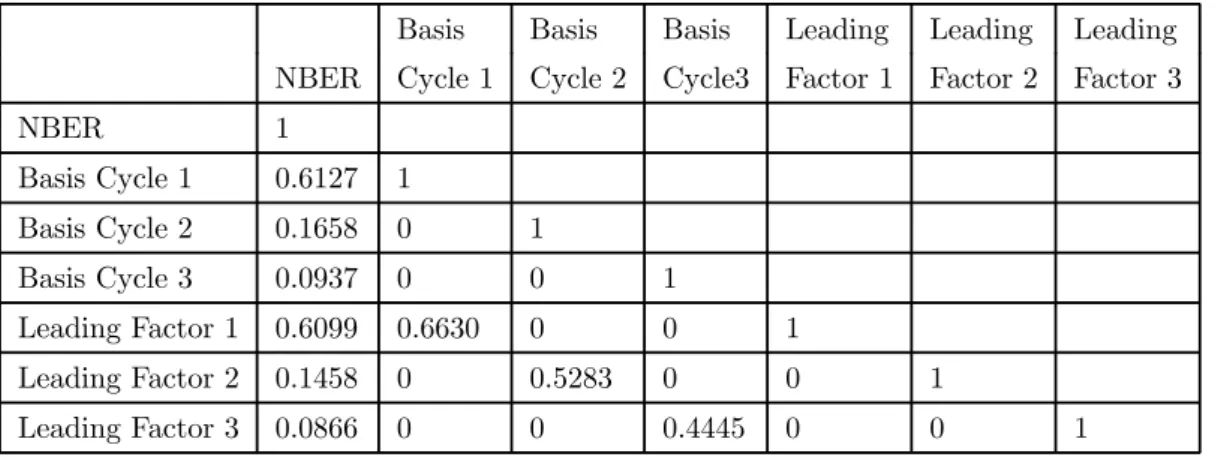
A correlation matrix for all six (coincident and leading) factors is presented in Table 3. To investigate their ability in explaining NBER recessions we include in this correlation matrix the NBER recession indicator dummy (which is equal to one during periods identified by NBER as recessions and zero otherwise). As could be expected a priori, the first factor (either coincident or leading) is the one with the highest correlation with the NBER dummy variable, followed by the second, andfinally by the third.
3.2. “ T he M i ssi ng L i nk ” : com put i ng si m pl e i ndi ces w i t h a pr obi t r egr essi on
As a basic procedure to calculate a coincident index, which is a linear combination of (∆lnIt,
∆lnYt,∆lnNt,∆lnSt), we estimate a probit regression of the NBER recession indicator on the three coincident basis cycles. The result of this probit estimation are presented in Table 4. The overall fit of this simple probit regression is 0.55. Using a cutoff probability of 0.5, this model has a 70% success rate in predicting recessions (94% success rate in estimating the correct state overall). Because the NBER recession indicator is a highly dependent series, there is some evidence of significant serial correlation in the pseudo-residuals of this regression.
However, this serial correlation cannot be used to improve the quality of the leading indicator index in real time, because NBER recession indicator is often announced with a considerable lag. For correct inference though, all reported standard errors are calculated to be robust to serial correlation and heteroskedasticity.
Since the three coincident factors are a linear combination of the four coincident series, from the estimated coefficients of this simple probit regression we can construct a “simple” coincident index which is a linear combination of the four coincident series. Using the weights in (3.1) and the estimated coefficients in the probit regression (Table 4), we arrive at the following coincident-indicator linear combination (∆CIt):
∆CIt=15.52×∆lnIt+ 50.67×∆lnYt+ 522.83×∆lnNt+17.78×∆lnSt. (3.2)
Normalizing the weights in (3.2) to add up to unity, we arrive at the following standardized coincident-indicator linear combination (∆CI0
t):
∆CIt0 = 0.03×∆lnIt+ 0.08×∆lnYt+ 0.86×∆lnNt+ 0.03×∆lnSt. (3.3)
The formula in (3.3) shows that most of the weight is given to employment. This is not surprising given our previous analysis of Figure 1, since this series has a more pronounced coherence with the NBER recession indicator.
It is interesting to compare our measure of the “simple” coincident indicator with other measures currently in the literature. The corresponding weights that are used by the Con-ference Board to calculate the coincident index7 are (0.28,0.13,0.48,0.11). Although both indices place the largest weight on employment, the weights are quite different.
The results of the encompassing test explained in equation (2.2) are reported in Table 6. They show that our simple index encompasses the TCB index (p-value of 0.46) but it is not encompassed by it (p-value <0.01)8. We also compare our simple index with the coincident
index9 (XCI) proposed by Stock and Watson (1989). The encompassing tests suggest that, at usual significance levels, our index encompasses XCI but is not encompassed by it (with respective p-values of 0.40 and <0.01)10.
3.3. “ T he M i ssi ng L i nk ” : com put i ng a m or e sophi st i cat ed i ndex
For a good reason, one may suspect that the simple probit regression is not an appropriate framework for revealing the implicit weights on the four coincident series used by the NBER Dating Committee. Coincident series are subject to constant revisions, i.e., they are mea-sured with error. Moreover, our basis cycles used in probit regressions are estimates, not the
7
actual underlying cycles. Therefore, we have to use instrumental variables to consistently estimate weights in probit regressions. As discussed above, natural candidates for instru-ments are the leading series. Notice that canonical-correlation analysis has already produced
ˆ
γ01zt,γˆ02zt,γˆ03zt which are the best linear predictors for each of the three basis cycles. We
use the two stage conditional maximum likelihood (2SCML) estimator proposed by Rivers and Vuong (1988) to obtain instrumental variable estimates for the coefficients of each basis cycle.
The 2SCML estimates are presented in Table 5. The “implicit weights” for the instrumental-variable coincident series(∆IV CIt) are:
∆IV CIt= 0.02×∆lnIt+ 0.13×∆lnYt+ 0.80×∆lnNt+ 0.05×∆lnSt. (3.4)
Equation (3.4) shows that, again, most of the weight is given to employment, and that employment and industrial production get 93% of the weight altogether. A plot of this index is presented in Figure 4. Once again, the striking difference between our weights and the TCB’s is that Income is weighed much more heavily in the TCB index than in ours, and employment is weighed more heavily in our index than in theirs.
The encompassing test that compares our coincident index with the TCB index (reported in Table 7) suggests that our index encompasses the TCB index (p-value of 0.83) but it is not encompassed by it (p-value of 0.04)11. Regarding the XCI series of Stock and Watson, the
encompassing tests suggest that, at usual significance levels, our index encompasses XCI, but is not encompassed by it (with respective p-values of 0.51 and<0.01)12.
Finally, as a by-product of this analysis, we can construct a leading index, which uses the same weights estimated by instrumental-variable probit and the leading factors(γ01zt,γ20zt,γ03zt)
weighed by their respective canonical correlations. This index is labelled∆IV LIt and is
pre-sented in Figure 5. Its behavior is very similar to that of our coincident index and it tracks reasonably well NBER recessions.
4. Conclusion
The basic idea behind this paper is simple: use the information content in the NBER Busi-ness Cycle Dating Committee decisions to construct a coincident index of economic activity. Although several authors have devised sophisticated coincident indices with the ultimate goal of matching NBER recessions, no one has used the information in the NBER decisions to construct a coincident index. A second ingredient of our method is that we use canonical correlation analysis to filter out the noisy information contained in the coincident series. As a result, ourfinal index is only influenced by the cyclical components of the coincident series.
1 1Corresponding p-values for the Davidson-McKinnon encompassing tests are 0.43 and 0.01 respectively. 1 2
Finally, in our preferred coincident index of the U.S. business cycle, we take account of mea-surement error in the coincident series by using instrumental-variable methods. The resulting index is a simple linear combination of the four coincident series originally proposed by Burns and Mitchell (1946).
As explained in the Introduction, we like to think that our method uncovers the “Missing Link” between the pioneering research of Burns and Mitchell (1946) and the deliberations of the NBER Business-Cycle Dating Committee. This is a consequence of the way we have constructed our coincident and leading indices: the coincident index is a linear combination of the four coincident series proposed by Burns and Mitchell chosen to match, using an appropriate probit regression technique, the deliberations of the NBER Business Cycle Dating Committee.
Our methodology also conveniently produces a leading index of economic activity which is a linear combination of lags of coincident and leading variables. Moreover, the probit model that produces our coincident index is in fact a model of probability of recessions. Therefore, this model can easily produce estimates of the probability of a recession.
The performance of our constructed coincident index is promising. In encompassing tests, it encompassed two currently popular constructed indices — the TCB and Stock and Watson’s coincident indices. However, it was not encompassed by any of them in formal testing. Some may object to our encompassing tests as being unfair on the grounds that our indices use the NBER recession indicator in their construction, while TCB and XCI indices don’t. Our reply to such objections would be, “Exactly. Why do TCB and XCI indices ignore this vital piece of information in their construction?”
R efer ences
Akaike, H. (1976), “Canonical Correlation Analysis of Time Series and the Use of an In-formation Criterion”, in R.K. Mehra and D.G. Lainiotis (Eds) System I dentification: Advances and Case Studies, New York: Academic Press, pp. 27-96.
Anderson, T. W. (1984), An I ntroduction to Multivariate Statistical Analysis (2nd ed.). NewYork: John Wiley and Sons.
Anderson, H. M. and F. Vahid (1998), “Testing Multiple Equation Systems for Common Nonlinear Factors”, Journal of Econometrics, 84, 1 - 37.
Balke, N.S. and T.B. Fomby (1997), “Threshold Cointegration”, I nternational Economic Review, 38, 627-647.
Chauvet, M. (1998), “An Econometric Characterization of Business Cycle Dynamics with Factor Structure and Regime Switching”,I nternational Economic Review, 39, 969 - 996.
Davidson, R. and MacKinnon, J.G.(1993), “Estimation and I nference in Econometrics,” Oxford: Oxford University Press.
Engle, R. F. and Kozicki, S. (1993), “Testing for Common Features”, Journal of Business and Economic Statistics, 11, 369-395, with discussions.
Engle, R. F. and Issler, J. V. (1995), “Estimating Sectoral Cycles Using Cointegration and Common Features”, Journal of Monetary Economics, 35, 83-113.
Estrella A. and F. S. Mishkin (1998), “Predicting U.S. Recessions: Financial Variables as Leading Indicators”, Review of Economics and Statistics, 80, 45 - 61.
Geweke, J. (1977), “The Dynamic Factor Analysis of Economic Time Series,” Chapter 19 in D.J. Aigner and A.S. Goldberger (eds) Latent Variables in Socio-Economic Models, Amsterdam: North Holland.
Hamilton, J.D. (1994),T ime Series Analysis, Princeton: Princeton University Press.
Hamilton, J.D. (1989), “A New Approach to the Economic Analysis of Nonstationary Time Series and the Business Cycle”, Econometrica, 57, 357-384.
Hecq, A., F. Palm and J.P. Urbain (2000), “Permanent-Transitory Decomposition in VAR Models with Cointegration and Common Cycles”, Oxford Bulletin of Economics and Statistics, 62, 511-532.
Hotelling, H. (1935), “The Most Predictable Criterion”,Journal of Educational Psychology, 26, 139-142.
Hotelling, H. (1936), “Relations Between Two Sets of Variates”,Biometrika, 28, 321-377.
Issler, J.V. and Vahid, F. (2001), “Common Cycles and the Importance of Transitory Shocks to Macroeconomic Aggregates,”Journal of Monetary Economics, 47, 449-475.
Lahiri, K. and G. Moore (1993), Editors, “Leading Economic I ndicators: New Approaches and Forecasting Records.” New York: Cambridge University Press.
Newey, W. and K. West (1987), “A Simple Positive Semi-Definite, Heteroskedasticity and Autocorrelation Consistent Covariance Matrix,” Econometrica, 55, 703-708.
Stock, J. and Watson, M.(1988a), “A New Approach to Leading Economic Indicators,” mimeo, Harvard University, Kennedy School of Government.
Stock, J. and Watson, M.(1988b), “A Probability Model of the Coincident Economic Indi-cator”, NBER Working Paper # 2772.
Stock, J. and Watson, M.(1989) “New Indexes of Leading and Coincident Economic Indi-cators”,NBER Macroeconomics Annual, pp. 351-95.
Stock, J. and Watson, M.(1991), “A Probability Model of the Coincident Economic Indica-tors”, in“ Leading Economic I ndicators: New Approaches and Forecasting Records,” K. Lahiri and G. Moore, Eds. New York: Cambridge University Press.
Stock, J. and Watson, M.(1993a), “A Procedure for Predicting Recessions with Leading Indicators: Econometric Issues and Recent Experiences,” in “New Research on Busi-ness Cycles, I ndicators and Forecasting,” J.H. Stock and M.W. Watson, Eds., Chicago: University of Chicago Press, for NBER.
Stock, J. and Watson, M.(1993b), Editors, “New Research on Business Cycles, I ndicators and Forecasting” Chicago: University of Chicago Press, for NBER.
The Conference Board (1997), “Business Cycle Indicators,” Mimeo, The Conference Board, downloadable from http://www.tcb-indicators.org/bcioverview/bci4.pdf.
Vahid, F. and Engle, R. F. (1993), “Common Trends and Common Cycles”, Journal of Applied Econometrics, 8, 341-360.
Vahid, F. and Engle, R.F.(1997), “Codependent Cycles,” Journal Econometrics, vol. 80, pp. 199-121.
A . Econom et r ic and st at ist ical t echniques
A .1. St at i st i cal foundat i on of T C B and X C I i ndi ces
A coincident index, which is widely used by practitioners, is the index constructed by The Con-ference Board — TCB. This coincident index is a weighted average of the coincident variables — employment, output, sales and income, where weights are the reciprocal of the standard deviation of each component’s growth rate and add up to unity; see The Conference Board (1997).
Stock and Watson’s experimental coincident index(XCI)is based on an “unobserved sin-gle index” or “dynamic factor” model; see Geweke(1977), for example. There, the growth rate of the four coincident series (output, sales, income and employment) share a common cycle,
∆XCIt, which is a latent dynamic factor that represents (the change of) “the state of the
econ-omy.” Denoting the growth rates of the coincident series in a vector xt= (x1t, x2t, x3t, x4t)0,
their proposed statistical model is as follows:
xt = β+γ(L)∆XCIt+ut,
φ(L)∆XCIt = δ+ηt,
D(L)ut = ²t, (A.1)
where φ(L) and γ(L) are scalar polynomials on the lag operator L, and D(L) is a matrix polynomial on L. The error structure is restricted so as to have E ηt
²t
ηt
²t 0
=
diag(σ2η,σ2²1, ...,σ2²4), and D(L) = diag[dii(L)], which makes innovations mutually
uncorre-lated.
The model (A.1) assumes that there is a single source of comovement among the growth rates of the coincident series — ∆XCIt. Still, these series are allowed to have their own
idiosyncratic cycle, since the vector of error terms ut is composed of serially correlated
com-ponents that are mutually orthogonal. Hence, each of the four coincident series in xthas two
cyclical components: a common and an idiosyncratic one. In this view, the “business cycle” is the intersection of the cycles in output, income, employment, and trade. Moreover, there is no guarantee that idiosyncratic cycles do not dominate the common cycle in explaining the variation of the four series in xt.
In contrast, in our view, the “business cycle” is theunionof the cycles in output, income, employment, and trade. There are no idiosyncratic cycles that can be put aside, the only part of xt that we leave out is the non-cyclical combination resulting from the
has generalized the framework in Stock and Watson by allowing a two-state mean for the latent factor ∆XCIt in (A.1), representing recession and non-recession regimes.
A .2. C anoni cal cor r el at i ons
Consider two (stationary) random vectors x0t = (x1t, x2t, ..., xnt) and zt0 = (z1t, z2t, ..., zmt),
m≥n such that:
xt zt ∼
0 0 ,
ΣXX ΣXZ
ΣZX ΣZZ .
The zero mean assumption is to simplify notation and does not involve any loss of generality. Canonical-correlation analysis seeks to rotate xt and zt so as to maximize the correlation
between their transformed images. Formally, it seeks to find matrices
A0
(n×n)=
α01 α02
.. . .. .
α0n
and Γ0
(n×m)=
γ01 γ02
.. . .. .
γ0n
such that:
1. The elements ofA0xt have unit variance and are uncorrelated with each other:
E(A0xtx0tA) =A0ΣXXA=In
2. The elements ofΓ0z
t have unit variance and are uncorrelated with each other:
E(Γ0ztzt0Γ) =Γ0ΣZZΓ=In, and,
3. The i-th element ofA0x
t is uncorrelated with thej-th element ofΓ0zt,i6=j. Fori=j,
this correlation is a called canonical correlation, denoted byλi, such that:
E(A0xtzt0Γ) =A0ΣXZΓ=Λ,
where,
Λ=
λ1 0 · · · 0
0 λ2 0 · · · 0
..
. . .. ... ..
. . .. 0 0 · · · 0 λn
, and,
The following basic results in Anderson (1984) and Hamilton (1994) are worth reporting here.
P r op osi t i on A .1. T he k-t h canonical correlat ion between xt and zt is given by k-t h
high-est root of −λΣXX ΣXZ
ΣZX −λΣZZ
= 0, denot ed by λk. T he linear combinat ionsαk and γk
associat ed wit hλk can be found by makingλ=λk in −λΣXX ΣXZ
ΣZX −λΣZZ
αk
γk = 0, considering also t he unit -variance rest rict ions in 1
and 2 above.
P r op osi t i on A .2. Let X = (x1,x2, ..., xT)0 and Z= (z1, z2, ..., zT) be samples of T
obser-vat ions of xt and zt. T hen first eigenvalues of t he mat rix H= (X0X)−1X0Z(Z0Z)−1Z0X
are consist ent est imat es of t he squared populat ional canonical correlat ions (λ21,λ22, ...,λ2n). T he corresponding eigenvect ors are consist ent est imat es of t he paramet ers in A. More-over, t he first n eigenvalues of H are ident ical t o t he first n eigenvalues of t he mat rix G = (Z0Z)−1Z0X(X0X)−1X0Z, whose corresponding eigenvect ors are consist ent est imat es
of t he element s of Γ.
P r op osi t i on A .3. T he likelihood rat io t est st at ist ic for t he null hypot hesis t hat t he smallest n−kcanonical correlat ions are joint ly zero,Hk:λk+ 1=λk+ 2=...=λn= 0,can be comput ed
using t he squared sample canonical correlat ionsλ2i,i=k+1,· · ·, n, in t he following fashion:
LR=−T
n
i=k+ 1
ln(1−λ2i).
Moreover, t he asympt ot ic dist ribut ion of t his likelihood-rat io t est st at ist ic is chi-squared, as follows:
LR−→d χ2(n−k)(m−k).
Canonical-correlation analysis can be applied in the present context for analyzing a large multivariate data set, summarizing the correlations between a group of stationary series x
and a group of stationary series z. For example, we suppose that the coincident series inxt
can be modelled using a Vector Autoregression (VAR), using its own the lags,xt−1,· · · , xt−p,
and also the lags of some other (leading) series, wt−1,· · · , wt−p, as follows:
xt=A1xt−1+· · ·+Apxt−p+B1wt−1+· · ·+Bpwt−p+εt, (A.2)
where εt is a white-noise process.
Here, we are interested in summarizing the correlations between the variables in xt and
the variables inzt= x0
t−1,· · ·, x0t−p, w0t−1,· · ·, w0t−p
0
. In this framework, the cyclical feature
in xt has to arise from the elements in zt, since εt is a white-noise process, devoid of any
A .3. I nst r um ent al -var i abl e pr obi t r egr essi ons
Denoting byc1t,· · · , ckt,(cit=αi0xt, i=1,· · · , k),thekbasis cycles associated with thefirst
knon-zero canonical correlations, the NBER business-cycle indicator is linked to them through the latent variable y∗
t:
yt∗ = β0+β1c1t+· · ·+βkckt+ut (A.3)
NBERt = 1
ify∗
t >0
0 ify∗
t ≤0
.
As argued above, because the series c1t,· · ·, ckt, are measured with error, we cannot use a
simple probit-regression procedure to estimate βi, i = 0,1,· · · , k. The possible correlation betweenc1t,· · · , ckt and the errors ut is modelled as follows,
cit = λi γ0izt +vit, i=1,· · ·, k (A.4)
ut
vt ∼
N 0, σ
2 u σ0vu
σvu Σvv
where the vit,i=1,· · · , k, are collected into ak-vector vt,λi and γ0izt for i=1,· · · , kcome
from the canonical-correlation analysis,Σvv is a k×kdiagonal variance-covariance matrix of
vt,σvu is a k×1vector of covariances between ut andvt. Because of measurement error, the
basis cyclesc1t,· · · , ckt are correlated withut. Joint normality ofutand vt implies:
ut=v0tδ+ηt
where δ=Σ−1
vvσvu,ηt∼N 0,σ2u−σvu0 Σ−vv1σvu and ηt is independent ofvt.Substituting for
utin equation (A.3), we obtain,
yt∗ = β0+β1c1t+· · ·+βkckt+vt0δ+ηt (A.5)
NBERt = 1
ifηt<β0+β1c1t+· · ·+βkckt+v0tδ
0 ifηt≥β0+β1c1t+· · ·+βkckt+v0tδ
.
Notice that, by construction, all the regressors in (A.5) are uncorrelated with the error term ηt. As usual for probit models the mean parameters θ = β0,β1,β2,β3,δ0 0 and the variance parameter σ2η =σ2u−σ0vuΣ−1
vvσvu are not separately identifiable. The convenient
normalization σ2η =1will identify the mean parameters. Obtaining the two stage conditional maximum likelihood (2SCML) estimator proposed by Rivers and Vuong (1988) entails the following steps:
1. Regress cit,i=1,· · · , k, on ztto get vit andΣvv, a consistent estimate of Σvv.
2. Fromvit,i=1,· · · , k, form vt and then run a probit regression (A.5) to get consistent
For inference onθ, ifηt is i.i.d., the following central-limit theorem holds:
√
T θ−θ −→d N 0, V θ ,
where the appropriate formula for the asymptotic covariance matrixV θ is given in Rivers and Vuong(1988, p. 354).
The error termηtin (A.5) is likely to be a moving average process since the NBER dating committee uses future information in deciding on the state of the economy. Since this future information is unpredictable at time t,it is still valid to use ztas instruments for estimation. However, autocorrelation robust standard errors have to be used for correct inference. See Newey and West (1987) or Wooldridge (1994).
A .4. Encom passi ng t est s for pr obi t r egr essi ons
Davidson and McKinnon(1993) discuss testing non-nested models in a limited-dependent vari-able framework. They start with two competing models to explain y∗
t:
H1 : E(yt∗|Ωt−1) =F1(X1t−1γ1)
H2 : E(yt∗|Ωt−1) =F2(X2t−1γ2), (A.6)
where F1(·) and F2(·) are cumulative density functions,X1t−1,X2t−1,γ1 and γ2 are
respec-tively the explanatory variables and associated coefficients present in models one and two. These models may differ either because F1(·) and F2(·) are different, because X1t−1 and
X2t−1are different, or because of both. To nest these two models in a compound model that
can serve as a basis for estimation they propose:
HC :E(y∗
t|Ωt−1) = (1−α)F1(X1t−1γ1) +αF2(X2t−1γ2), (A.7)
where γ2, the maximum likelihood estimate of γ2 under H2, is necessarily used in (A.7) for
its parameters to be identified.
Testing H1 against HC is simply a test of the null that α= 0. i.e., a test of irrelevance
of model two. BecauseH1andH2are non-linear models, a convenient transformation ofHC,
by means of a first-order Taylor expansion is usually preferable to work with for hypothesis testing. In the present context, we consider expanding the following function:
g(α,β1) = (1−α)F1(X1t−1γ1) +αF2(X2t−1γ2),
around α= 0, and β1=β1, where β1is the probit estimate of β1 underH1. Then, it can be
shown that testing α= 0in (A.7) using at-test is asymptotically equivalent to testinga= 0
using a t-test in the following normalized artificial regression:
whereF1t and f1tare respectively consistent estimates of the cumulative density and density
functions of model one, where the maximum likelihood estimate ofγ2is used in constructing
F2t, andVt−1/2is an estimate of the conditional variance ofy∗t used to normalize the variables
inHC taking into account the fact that the regression model is heteroskedastic. An analogous
B . Tables and fi gur es
Tabl e 1: C oi nci dent and L eadi ng Ser i es: D efi ni t i ons and Tr ansfor m at i ons
Series Definition Transformation
C oi nci dent Ser i es
INDUSTRIAL PRODUCTION: TOTAL INDEX (1992=100,SA) —Yt ∆ln (·)
EMPLOYEES ON NONAG. PAYROLLS: TOTAL (THOUS.,SA) —Nt ∆ln (·)
MANUFACTURING & TRADE SALES (MIL$, 92 CHAINED $) —St ∆ln (·)
PERS. INCOME LESS TRANSF. PMTS. (CHAINED, BIL 92$,SAAR) — It ∆ln (·)
L eadi ng Ser i es
MFG UNFIL.ORD.: DUR.GOODS IND., TOT.(82$,SA) = MDU/PWDMD ∆ln (·)
MANUFACT. & TRADE INVENT.:TOTAL (MIL OF CHAINED 1992, SA) ∆ln (·)
NEW PRIV. OWNED HOUSING: UNITS AUTH. BUILD. PERMITS SAAR ∆ln (·)
IND. PRODUCTION: DURABLE CONSUMER GOODS (1992=100,SA) ∆ln (·)
INT. RATE: U.S.TRS. CONST MATUR.,10-YR.(% PER ANN,NSA) ∆(·)
INT. RATE SPREAD = 3 MONTHS - 10 YEARS (FYGM3-FYGT10) NONE
NOMINAL WEIGHTED EXCHANGE RATE OF G7 (EXCL. CANADA) ∆ln (·)
EMPLOYEES ON NONAG. PAYROLLS: SERVICE-PROD.(THOUS.,SA) ∆ln (·)
Tabl e 2: Squar ed C anoni cal C or r el at i ons and C anoni cal -C or r el at i on Test
Sq. Canonical Correlations Degrees of Freedom λ2j and all smaller λ2j = 0
λ2j P-Values
0.4397 104 0.0000
0.2791 75 0.0000
0.1976 48 0.0000
0.0654 23 0.1332
Tabl e 3: C or r el at i on M at r i x for Fact or s and N B ER R ecessi on-I ndi cat or
Basis Basis Basis Leading Leading Leading
NBER Cycle 1 Cycle 2 Cycle3 Factor 1 Factor 2 Factor 3
NBER 1
Basis Cycle 1 0.6127 1
Basis Cycle 2 0.1658 0 1
Basis Cycle 3 0.0937 0 0 1
Leading Factor 1 0.6099 0.6630 0 0 1
Leading Factor 2 0.1458 0 0.5283 0 0 1
Tabl e 4: Si m pl e P r obi t R egr essi on R esul t s
Regressor Est. Coeff. Robust S.E.
c1t 33.24 3.80
c2t 10.53 2.24
c3t 3.65 2.06
Constant -0.67 0.22
Tabl e 5: I nst r um ent al -V ar i abl e P r obi t R egr essi on R esul t s
Regressor Est. Coeff. Robust S.E.
c1t 75.13 10.71
c2t 32.56 7.45
c3t 14.01 8.27
Constant -0.15 0.23
Tabl e 6: Encom passi ng Test R esul t s - Si m pl e P r obi t I ndex
Null hypothesis index1encompasses index2encompasses
Competing Coincident Indicator Models index2(p-value) index1(p-value)
Issler-Vahid (index1) vs. TCB (index2) 0.46 <0.01
Issler-Vahid (index1) vs. Stock-Watson (index2) 0.40 <0.01
Tabl e 7: Encom passi ng Test R esul t s - I nst r um ent al -V ar i abl e P r obi t I ndex
Null hypothesis index1encompasses index2encompasses
Competing Coincident Indicator Models index2(p-value) index1(p-value)
Issler-Vahid (index1) vs. TCB (index2) 0.83 <0.01
-0.03 -0.02 -0.01 0.00 0.01 0.02 0.03
65 70 75 80 85 90 95 00
Income - Transfers
-0.06 -0.04 -0.02 0.00 0.02 0.04
65 70 75 80 85 90 95 00
Industrial Production
-0.04 -0.02 0.00 0.02 0.04
65 70 75 80 85 90 95 00
Manuf. & Trade Sales
-0.010 -0.005 0.000 0.005 0.010 0.015
65 70 75 80 85 90 95 00
Employment
-0.3 -0.2 -0.1 0.0 0.1 0.2
65 70 75 80 85 90 95
Coincident Factor 1
-0.2 -0.1 0.0 0.1 0.2
65 70 75 80 85 90 95
Coincident Factor 2
-0.2 -0.1 0.0 0.1 0.2
65 70 75 80 85 90 95
Coincident Factor 3
-0.2 -0.1 0.0 0.1 0.2
65 70 75 80 85 90 95 00
Leading Factor 1
-0.2 -0.1 0.0 0.1 0.2
65 70 75 80 85 90 95 00
Leading Factor 2
-0.2 -0.1 0.0 0.1 0.2 0.3
65 70 75 80 85 90 95 00
Leading Factor 3
-0.02 -0.01 0.00 0.01 0.02
65 70 75 80 85 90 95
Growth rate of IVCI
-0.02 -0.01 0.00 0.01 0.02
65 70 75 80 85 90 95
Growth rate of the TCB index
-0.03 -0.02 -0.01 0.00 0.01 0.02 0.03
65 70 75 80 85 90 95
Growth rate of XCI
-0.03 -0.02 -0.01 0.00 0.01 0.02
65 70 75 80 85 90 95
Growth rate of IVLI