www.earth-syst-dynam.net/5/117/2014/ doi:10.5194/esd-5-117-2014
© Author(s) 2014. CC Attribution 3.0 License.
Earth System
Dynamics
Towards decision-based global land use models for improved
understanding of the Earth system
M. D. A. Rounsevell1, A. Arneth2, P. Alexander1, D. G. Brown3, N. de Noblet-Ducoudré4, E. Ellis5, J. Finnigan6,
K. Galvin8, N. Grigg7, I. Harman6, J. Lennox9, N. Magliocca5, D. Parker10, B. C. O’Neill11, P. H. Verburg12, and
O. Young13
1School of GeoSciences, University of Edinburgh, Edinburgh, UK
2Karlsruhe Institute of Technology, Institute of Meteorology and Climate Research/Atmospheric Environmental Research, Garmisch-Partenkirchen, Germany
3School of Natural Resources and Environment, University of Michigan, Ann Arbor, MI, USA
4Laboratoire des Sciences du Climat et de l’Environnement, Unité mixte CEA-CNRS-UVSQ, Gif-sur-Yvette, France 5Department of Geography and Environmental Systems, University of Maryland, Baltimore County, MD, USA
6The Centre for Australian Weather and Climate Research – A partnership between CSIRO and the Bureau of Meteorology, CSIRO Marine and Atmospheric Research, Canberra, Australia
7CSIRO Land and Water, Canberra, Australia
8Department of Anthropology, Colorado State University, Fort Collins, CO, USA 9Fondazione Eni Enrico Mattei (FEEM), Venice, Italy
10School of Planning, Faculty of Environment, University of Waterloo, Waterloo, Canada
11Climate and Global Dynamics Division & Integrated Science Program, National Center for Atmospheric Research (NCAR), Boulder, CO, USA
12Institute for Environmental Studies, Amsterdam Global Change Institute, VU University Amsterdam, Amsterdam, the Netherlands
13Bren School of Environmental Science & Management, University of California, Santa Barbara, CA, USA
Correspondence to:M. D. A. Rounsevell ([email protected])
Received: 9 July 2013 – Published in Earth Syst. Dynam. Discuss.: 27 August 2013 Revised: 10 January 2014 – Accepted: 12 January 2014 – Published: 26 February 2014
Abstract. A primary goal of Earth system modelling is to improve understanding of the interactions and feedbacks be-tween human decision making and biophysical processes. The nexus of land use and land cover change (LULCC) and the climate system is an important example. LULCC con-tributes to global and regional climate change, while climate affects the functioning of terrestrial ecosystems and LULCC. However, at present, LULCC is poorly represented in global circulation models (GCMs). LULCC models that are explicit about human behaviour and decision-making processes have been developed at local to regional scales, but the principles of these approaches have not yet been applied to the global scale level in ways that deal adequately with both direct and indirect feedbacks from the climate system. In this article, we explore current knowledge about LULCC modelling and
1 Introduction
Land use and land cover change (LULCC) is one of the key processes through which humans affect the functioning of the Earth system, contributing to global environmental change and its impacts on the provision of ecosystem services and human wellbeing (Turner II et al., 2007; Foley et al., 2005). The land system plays a fundamental role in supplying the global population with ecosystem services, including food (Brown and Funk, 2008; Fischer et al., 2005; Lobell et al., 2008), fresh water (Gerten et al., 2005), biogeochemical and biophysical climate regulation (Le Quere et al., 2009; Betts, 2000; Friedlingstein et al., 2006) and biodiversity (De Chazal and Rounsevell, 2009). The quantity and quality of ecosys-tem services supplied from land are responsive to climate change and human management in complex ways. Thus, bet-ter understanding of the inbet-terplay between land use, ecosys-tems and the global Earth system is likely to support the de-velopment of sustainable land management strategies. Cur-rent models of the climate and human systems lack, how-ever, a level of development that is necessary to account for this complex interplay.
LULCC affects climate regionally, i.e. via changes in albedo and surface energy partitioning (Pitman et al., 2009; de Noblet-Ducoudré et al., 2012), and globally, i.e. via emis-sions and uptake of long-lived greenhouse gases (GHG) (Le Quere et al., 2009). In climate models, human activities have been considered, if at all, as external drivers that provide the emissions necessary for climate or atmospheric chemistry simulation experiments, ignoring the possibility that anthro-pogenic activities not only affect the Earth system but also in turn respond to system changes. As well as LULCC ef-fects on climate, LULCC is affected by climate change both locally and regionally. For instance, climate can affect the physical suitability or economic viability of an agricultural crop in a region (Lobell et al., 2011; Gornall et al., 2010). It is less well recognised, however, that land use decisions at one location, regardless of whether they are driven by changes in the climate, economy or policy, may affect land use decisions elsewhere (Melillo et al., 2009; Tilman et al., 2011; Godfray et al., 2010; Seto et al., 2012) through a large variety of tele-connections (e.g. economics, atmospheric pollution). Hence, LULCC needs to go beyond the “local” and be understood from a global perspective.
The mechanisms through which changes in the climate or biophysical/biogeochemical processes affect societal be-haviour and individual and institutional response strategies, and vice versa, have so far not been addressed in global-scale models leaving human teleconnections affecting LULCC largely unanalysed. Integrated assessment models (IAMs) that combine representations of the economic, social and nat-ural system struggle to fulfil this role since they are top-down models that are insufficiently resolved to facilitate process understanding across the full spectrum of spatial scales and actors involved in LULCC (Verburg et al., 2012). There is
clearly a need to make progress in linking terrestrial and cli-mate system models that include representation of ecosystem management, with models of human dynamics that reflect behaviour and decision processes at multiple spatial and or-ganisational scales.
Existing global-scale models of human systems do not yet account for diversity in the types of human behaviour pro-cesses, decision-making strategies and governance structures that are known to underpin the human components of Earth system functioning. IAMs represent the globe using varia-tions among regions (of the order of 15–150) and sectors (Lawrence and Chase, 2010; Strengers et al., 2010; Verburg et al., 2012), while at the local (landscape) scale, informa-tion about the goals, motivainforma-tions and behaviours of land use actors is collected through social surveys, behavioural experiments, role-playing games and participant observa-tion (Robinson et al., 2007), These local-scale insights are translated into computational agent-based models (ABMs) (Parker et al., 2003; Murray-Rust et al., 2011; Matthews et al., 2007; Bousquet and Le Page, 2004) that represent human behaviour and decision processes within the land system. Though ABMs could, in principle, be adapted to larger spa-tial domains, e.g. globally, this has not yet been attempted in practice. If realised, such an approach would allow pertinent questions to be addressed about the relative effects of socio-economic decision making versus climate change on LULCC in a globalised world; furthermore, it would allow feedbacks between climate change and land use decision making to be identified.
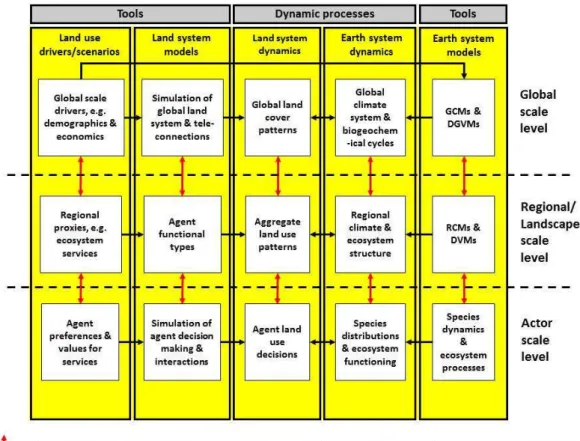
We review and discuss current knowledge about LULCC and its interactions with the climate system and how these processes are represented in models. In doing so, we identify research gaps and propose ways forward for the next gen-eration of Earth system models. The discussion tackles two fundamental research questions: how can we better represent the land system in Earth system models? How can we im-prove models of the global land system by better representing human behaviour and decision-making processes? We hy-pothesise that addressing decision-making structures explic-itly within global change assessments will improve the anal-ysis of alternative future development pathways under global change assumptions. Figure 1 schematically represents the major components of the land and climate systems and their respective interactions that are addressed in this article.
2 LULCC and climate system relationships
2.1 LULCC influences on the climate system
Fig. 1.Schematic representation of the components of the land and climate systems discussed here at different spatial scale levels.
approximate total anthropogenic carbon emissions since 1850 (Houghton, 2003; Le Quere et al., 2009). LULCC can also mitigate global climate impacts, since reforestation, afforestation or avoided deforestation can either increase the carbon sink strength of land or prevent additional C emissions to the atmosphere. Historically, LULCC has con-tributed strongly to climate warming (Le Quere et al., 2009), since the CO2 emissions arising from past LULCC activi-ties to the atmosphere have exceeded LULCC-related land carbon sinks. Around half of the observed increase in atmo-spheric N2O over the same time period has been attributed to the use of agricultural fertiliser arising from LULCC (Zaehle et al., 2011).
The climate effects arising from changes in terrestrial biogeochemical processes that affect sources and sinks of carbon- and nitrogen-containing GHGs continue to oper-ate over centuries because these gases are long-lived in the atmosphere and because changes in vegetation and soil C and N pools operate over decades and centuries. The bio-geochemical climate effects are both regional and global in nature. Human-mediated changes such as crop produc-tion also affect biophysical exchange processes at the land surface. For instance, conversion of forest into crop vege-tation decreases both surface roughness and mixing of the near-surface air (surface warming), increases the fraction of
radiation reflected back into the atmosphere (surface cool-ing), and changes the partitioning of the net radiation re-ceived at the surface into evapotranspiration (latent heat flux) and sensible heat flux (warming or cooling, depend-ing on the ratio of latent to sensible heat flux). Extreme weather episodes, such as altered monsoon patterns and the occurrence of droughts, have also been linked to biophysical LULCC processes (Schubert et al., 2004; Cui et al., 2006).
The direct biogeophysical radiative impact of LULCC since pre-industrial times has been estimated to have reduced the global average radiative forcing by 0.2±0.2 W m−2, which is small compared with the biogeochemical radiative impact of LULCC and other global climate forcings (Forster et al., 2007). Compared to biogeochemical effects, biophysi-cal climate effects are expected to be stronger regionally and realised over a period of a few months to several decades following a LULCC event (Pitman et al., 2009; Arora and Montenegro, 2011 ), since the initial changes in land cover tend to have the strongest effects on the surface radiation and energy balances. Moreover, the direction of the net biophysi-cal effects in terms of exerting a warming or cooling depends on the existing climate, vegetation and soil states, and varies regionally (Arora and Montenegro, 2011).
dynamics (e.g. Kala et al., 2011; Lobell and Bonfils, 2008; Lim et al., 2005). Where LULCC has been intensive, the re-gional impact is likely to be at least as important as GHG and aerosol forcing (Boisier et al., 2012; de Noblet-Ducoudré et al., 2012; Lawrence and Chase, 2010). These regional LULCC–climate interactions are therefore important, as the essential resources of food, water, energy, human health and ecosystem function respond to regional and local climate, and not to a global average. Human vulnerability to forc-ings such as climate change is realised locally and region-ally, and the conclusion that LULCC is a significant regional-scale driver of climate is sufficient to require its incorporation into past, present and future climate model simulations, not least for the development of local mitigation or adaptation strategies.
Quantifying the LULCC-related combined biogeochemi-cal and biophysibiogeochemi-cal climate effects is challenging, since they can either amplify (both warming or cooling) or compen-sate (one warming, one cooling) one another (Pitman et al., 2009; Arora and Montenegro, 2011; de Noblet-Ducoudré et al., 2012). Indeed there is no consensus about which met-ric to use when assessing land–climate interactions. Top-of-the-atmosphere radiative forcing, often used in climate change science, is not a complete measure (Davin et al., 2007; Davin and de Noblet-Ducoudré, 2010) and there is strong contingency on location, scale and existing climate of land–climate system interactions. Although the biogeochem-ical and biophysbiogeochem-ical impacts of LULCC have been studied increasingly in recent years, this has mostly been done in separate studies, with the combined, net effect of both on cli-mate addressed only in a few exceptional cases (Brovkin et al., 2004, 2006; Sitch et al., 2005). Given the large impact of LULCC on regional and/or global climates, and the dif-ficulties in quantifying the relative roles of biogeochemical vs. biophysical LULCC-related climate impacts, the rather rudimentary treatment of LULCC processes in Earth system models (ESMs) and their land surface modules (Arneth et al., 2010a) is surprising.
Thus, with the current representations of the surface and surface exchange processes in these models being poor (i.e. at the wrong level of complexity), incomplete (i.e. miss-ing key feedbacks) and/or over-calibrated, our understand-ing of LULCC–climate interactions is incomplete. Between-model differences in how LULCC is represented in the land surface component of ESMs have been shown to account for more than two-thirds of the regional climate response to LULCC, even though the models concerned addressed biophysical processes only (Boisier et al., 2012; de Noblet-Ducoudre et al., 2012; Pitman et al., 2009). Moreover, in the absence of specific representation of land management, for global-scale analyses of how LULCC affects ecosystem biogeochemical and biophysical processes, the natural grass-land ecosystem class in dynamic global vegetation models (DGVMs) is typically assumed to represent agricultural land. This assumption ignores the major differences that exist in
phenology, carbohydrate allocation, yields, ecosystem water balance and habitat diversity in crops or pastures compared with natural ecosystems (Schröter et al., 2005; Arneth et al., 2010b). Similarly, managed forests are often assumed to have the same structure and function as natural vegetation.
Observations of current land cover demonstrate the dom-inance of mosaic landscapes (Letourneau et al., 2012; Van Asselen and Verburg, 2012; see Fig. 3), but many land sys-tem models utilised within climate models only account for landscape heterogeneity by considering the fraction(s) of each grid cell that is covered by trees, grasses, crops, bare soil, open water etc. and solving the surface exchange for each surface fraction separately (known as “tiling”). While demonstrably better than applying a single, dominant land cover category for a particular area, tiling does not incorpo-rate the transition regions from one surface type to another or properly represent surfaces where mixing is fundamental to the operation of the surface in its entirety (e.g. savannah, suburban, crop land with wind breaks) (see Mahrt, 1996, for discussions). The sensitivity of mosaic landscapes to change is therefore largely unknown, while at the same time mosaic landscapes are often most sensitive to LULCC given their frequent occurrence near frontiers of land change (Messerli et al., 2009; Rindfuss et al., 2003; Verburg et al., 2013).
As a consequence, linking process-based models of LULCC and the Earth system is indispensable. The realism with which land cover and the relevant biophysical and bio-geochemical processes are represented in climate and Earth system must be improved. We are still at the stage of needing to undertake a thorough assessment of the role of LULCC on climate from a range of different perspectives (global, regional, adaptation, mitigation, biophysical, biochemical). This relates to historical simulations, as in some regions the largest rates of LULCC have already happened in the past. For other regions, rates of land conversion are still rather large, and will continue to be so, including both deforesta-tion and afforestadeforesta-tion. Both substantially affect global water use and runoff, as well as the exchanges of climate-relevant compounds beyond CO2 (i.e. N2O, CH4, NOx). A true un-derstanding of the role of humans in the climate system must include an in-depth analysis of the LULCC–climate interplay across space- and timescales. This is fundamental in support-ing the development of effective land-based mitigation op-tions, as well as appropriate adaptation measures (Pielke et al., 2011).
2.2 Climate change influences on LULCC
Fig. 2.Global land use systems (adapted from Van Asselen and Verburg, 2012).
to fire, and the frequency and magnitude of extreme events, including regional correlations in these events. Variables such as water availability, soil degradation, and disturbances from plant pests and diseases can all be climate-related and influence land use decisions. In addition, sea level rise driven by climate change can affect land use through not only the loss of land to inundation but also through river flooding ef-fects on crop productivity and constraints on urban develop-ment (Jongman et al., 2012; Verburg et al., 2012).
The indirect effects of climate change on land use are me-diated through socio-economic change: for example, through climate change policy. Mitigation policies may include large-scale development of bioenergy and/or carbon sequestration (Mackey et al., 2013), which could have major implications for land use regionally and even globally through indirect land use change (iLUC; LULCC in a given region that arises from drivers elsewhere, e.g. the implementation of policy). Climate change may also contribute to migration or conflict, which in turn can affect regional land use. Indirect effects can also occur beyond the region of direct climate influence
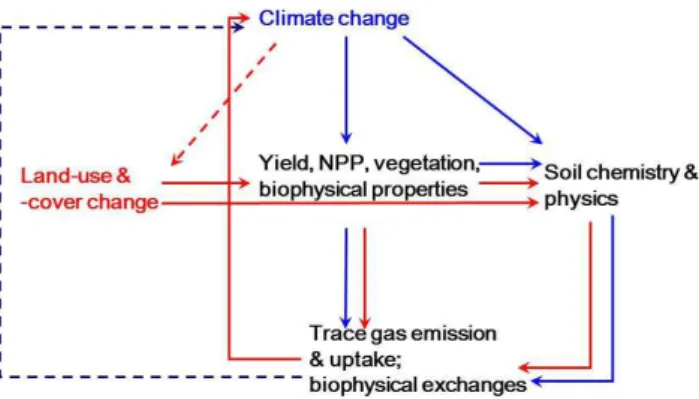
Fig. 3. Conceptual interactions of LULCC–climate impacts and feedbacks. Solid lines: impacts; dashed lines: feedbacks. Blue: LULCC–climate interactions. Climate change affects ecosystem net primary productivity (NPP) and other ecosystem properties (soil and vegetation), which affects trace gas emissions of greenhouse gases and land surface biophysical exchanges that are relevant to cli-mate. These processes feedback to the original climate change (pos-itively or negatively). Red: climate-change–LULCC interactions. LULCC has to be considered as an additional driver in the system that also affects ecosystem productivity and other ecosystem prop-erties (soil and vegetation). The associated trace gas emissions of GHGs and land surface biophysical exchanges impact on climate change. The magnitude of a feedback from climate change back to LULCC is unknown.
3 Advancing land system modelling at large scales
3.1 Improving models of the global land system by better representing human behaviour and decision-making processes
Global-scale research on Earth system functioning is dom-inated by efforts to better represent the physical and bio-geochemical processes in the climate, ocean and hydrolog-ical systems, while the contribution of social-science knowl-edge to major environmental change assessments is limited (Moran, 2010; Hulme, 2011). Although global environmen-tal change is driven primarily by human activities, the repre-sentation of human decision-making global-scale models is highly simplistic compared with the depth of representation of physical processes (Rotmans and Asselt, 1996; Tallis and Kareiva, 2006; Rounsevell and Arneth, 2011). Earth system models and macro-economic models either assume human activities as an external driver or represent human behaviour by uniform simplistic (profit-optimising) assumptions that lack representation of the huge spatial and temporal diver-sity and interaction of human behaviour and decision pro-cesses (Meijl et al., 2006; Lotze-Campen et al., 2008; Britz and Hertel, 2011). Simplification of human decision mak-ing may lead to a lack of confidence in assessment results, hamper the ability to assess how people respond to environ-mental change as a system feedback, and limit the possibil-ities of using these models in the design and evaluation of
possible alternative Earth system governance structures. A more thorough representation of human behaviour and de-cision making in Earth system models is clearly required (Lambin et al., 2006; Costanza et al., 2007; Liverman and Cuesta, 2008; Reenberg, 2009; Hulme, 2011; Rounsevell and Arneth, 2011).
Variation among individual actors – including class, eth-nicity, gender and power, as well as between regions with different cultural–historical backgrounds and governance regimes – makes it necessary to better understand regional differences and design models that incorporate regional char-acteristics (Pahl-Wostl, 2002; Wilbanks, 2002; Evans et al., 2003; Rothman et al., 2009). The importance of local context has been the subject of much social research on the underly-ing drivers of LULCC with a focus on small-scale case stud-ies rather than contributing to global-scale assessment tools (Turner II et al., 1990). More recently, new approaches have been developed to better represent variation in human be-haviour and decision making in LULCC models at local to regional scales, e.g. through ABMs (Jakeman and Letcher, 2003; Verburg, 2006; Pahl-Wostl et al., 2007; Parker et al., 2008; Piorr et al., 2009; Hersperger et al., 2010). ABMs represent individual decision making accounting for varia-tion among and interacvaria-tions between heterogeneous actors across different levels. They have been used for modelling LULCC in a wide variety of settings (Matthews et al., 2007; Brown et al., 2008; Evans and Kelley, 2008; Acosta-Michlik and Rounsevell, 2009; Valbuena et al., 2010b). Agent-based modelling is typically the domain of interdisciplinary sci-ence: while the behavioural sciences help to define decision-making structures, these interact with the geography of the physical environment (Janssen, 2003; Brown and Robinson, 2006; Young et al., 2006; Bithell et al., 2008; Collins et al., 2011).
Even if constrained profit maximisation is the appropri-ate model, assumptions of full rationality simply might not work. For example, Filatova et al. (2009) demonstrate the failings of the representative agent assumption. Moreover, profit maximisation often fails in environments where risk and resource constraints (e.g. labour) are key, and where market integration is low (i.e. subsistence agricultural con-texts). Studies on land use in residential (e.g. Nassauer et al., 2009; Hunter and Brown, 2012) and agricultural landscapes (Isham, 2002; Walters et al., 2005) provide ample evidence of spatial and social interaction effects on the way land is man-aged. Taken together, these studies demonstrate that a con-siderable part of the variance is not accounted for in profit-maximising models, which leaves considerable room for im-proving models to deal with the non-economic components of land use decision making.
ABMs have been used to analyse alternative development strategies and integrate social-science knowledge into oper-ational simulation models at the regional scale (Robinson and Brown, 2009; Rounsevell et al., 2012). Although re-cent efforts have been made to include some of the diver-sity in socio-economic conditions in global-scale economic models (Melnikov et al., 2012), the representation of land use decision making in global-scale models does not yet take sufficient stock of the progress made in regional-scale ABMs. Understanding the role of the variation in human– environment interactions across scales is needed to advance the capabilities of integrated global assessments (Verburg et al., 2011). There are clearly alternatives to ABMs in achiev-ing this, such as system dynamics models and computational general equilibrium (CGE) models (e.g. Forrester, 1971; Conrad, 2003; see also Sect. 3.3), but in our view both suffer from the same aggregation effects, which limit representation of heterogeneity and interactions. The distinction between ABMs and micro-simulation is less clear-cut, with both ap-proaches focusing on individual entities. Micro-simulation models can be useful in dealing with some of what is done in agent-based modelling. However, micro-simulation mod-els for LULCC are predominantly applied in urban envi-ronments (e.g. Huang et al., 2013), which is less appro-priate to global-scale modelling. ABMs can also be distin-guished from micro-simulation models by their emphasis on, and more elaborate options for, decision-making strategies of the individual units (agents). The preponderance of available LULCC modelling methods implies also the need to agree on standardised modelling approaches through common frame-works. An example of such a framework for ABMs known as the ODD (Overview, Design concepts and Details) has been beneficial in model development and sharing (Grimm et al., 2006; NRC, 2013).
3.2 Methods for upscaling land system models to regional and global scale levels
The simulation of local- to regional-scale LULCC has in-formed land use planning and environmental management (Verburg et al., 2004; Matthews et al., 2007; Schaldach and Priess, 2008) with different modelling techniques adapted to specific research questions and regional contexts. Validation of these models shows a wide variation in performance, de-pending on the complexity of the specific case, quality of input data, and the depth of the legend and scale of analysis (Castella and Verburg, 2007; Pontius et al., 2008). A broad categorisation of regional-scale models can be made on the basis of the focus of the simulation unit. A large group of models use spatially referenced land units that are usually pixels in a raster format. Models simulate changes in the land cover states of these pixels. The decision making of land managers is simplified by the specification of rules that gov-ern the transitions in the state of these pixels as a function of the physical and socio-economic location conditions or the state of the neighbouring pixels. In ABMs, individual deci-sion makers (or groups of decideci-sion makers) are the basic units of simulation, and thus the decision-making process is more explicitly simulated for the land parcels managed by these agents. In its most basic form, each agent is linked to a sin-gle pixel of land, which resembles pixel-based models. More advanced ABMs represent different types of agents and give specific attention to interactions between agents (at different levels) and include feedbacks between agent decision mak-ing and the environment (Brown et al., 2005; Verburg, 2006; Valbuena et al., 2010a).
Upscaling ABMs to the global level is hampered by the availability of sufficient data and knowledge of agent at-tributes for model specification and calibration (Rounsevell et al., 2012). Whilst an advantage of ABM is the representa-tion of variarepresenta-tions in decision making and interacrepresenta-tions among actors and between actors and their environment, the scal-ing of fully parameterised models is restricted by data avail-ability (Robinson et al., 2007). There are some examples of “massive” ABMs, for instance the Epicast model (Germann et al., 2006). This synthetic population model of America in-cludes 360 million agents and was designed to model avian flu spread. An Australian version with 22 million agents has been used to model the spread of dengue fever under cli-mate change (Newth and Gunasekara, 2010). These models illustrate the point that discrete ABMs of populations exhibit emergent properties that are not seen in aggregated models and which do not depend directly on the agent properties.
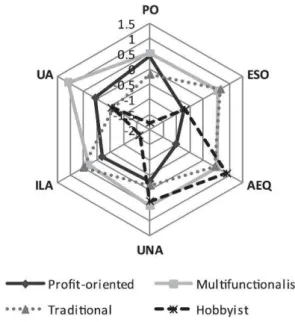
From a practical perspective, aggregation of the variation in agent decision making is inevitable (Smajgl et al., 2011). Two pathways of aggregation can be distinguished (Roun-sevell et al., 2012): (1) representation of all individual agents globally and classification of these agents according to a limited number of clearly defined decision-making strate-gies following a typology, and (2) aggregation of individual agents into generic agents that represent more generalised decision-making processes, e.g. at the community level. Ty-pologies that group agents with similar LULCC behaviour are common in ABMs, with agents being classified based on survey and census data (Valbuena et al., 2008; Boone et al., 2011; Smajgl et al., 2011; Guillem et al., 2012), as indicated, for example, in Fig. 4. Rounsevell et al. (2012) proposed the use of “human functional types” to classify agents, as an analogy to the vegetation typologies (“plant functional types”) used in global vegetation models. The way in which such typologies are empirically derived, as well as the empirical parameterisation of such models from glob-ally available information, remains a major challenge, al-though some attempts have been made to collect data that might be used for this purpose, e.g. the international house-hold survey network and the CCAFS baseline surveys (www. ihsn.org; ccafs.cgiar.org/resources/baseline-surveys). Moover, the connection of individual agents and the land re-sources they manage is difficult to establish (Rindfuss et al., 2003). These challenges may be difficult to overcome, but not impossible, and as with any model are likely to involve simplification. Simplification is, however, better than ignor-ing agent heterogeneity all together.
Although aggregate agent types do not represent real-world entities, they can represent emergent decision making at the level of communities or landscapes. LULCC case stud-ies provide insight into underlying drivers that may be used to parameterise models (Lambin and Geist, 2003; Rudel, 2008). Aggregate representations also connect more easily to the observed spatial patterns of LULCC in available global data sets that result from such aggregate decision-making
Fig. 4.An example agent typology derived from social survey in-dicating the different attitudes between types toward profit, social status and the environment. Abbreviations indicate profit orienta-tion (PO), environmental and social orientaorienta-tion (ESO), awareness of environmental quality for birds (AEQ), understanding the needs of the agri-environment scheme (UNA), importance of landscape ap-pearance (ILA) and uncertainty about the agri-environment scheme (UA) (after Guillem et al., 2012).
processes. Two ways of parameterising the decision-making processes of aggregate agents can be distinguished. The first uses detailed ABMs of individual decision making to under-stand how aggregate decision making emerges from the in-teractions between individual agents. The second approach derives aggregate decision making from meta-analysis of worldwide case studies. Both approaches require method-ological advances before they can be implemented in global-scale models, and in either case, decision-making criteria still need to be specified. Most global models use strictly eco-nomic rationale to determine decision making, even though economic criteria are not always good proxies for how people behave (Meyfroidt, 2013), particularly in more subsistence-oriented settings. Decision variability might yield differences in the ultimate land use choices that agents make in equi-librium, compared to profit-oriented models, but even if the equilibrium outcome is the same, it is almost certain to have an influence on the transient dynamics of land use change (e.g. Evans et al., 2011). There are always winners and losers arising from LULCC, which has implications for the types of change, the ecological impacts and feedbacks to human wellbeing.
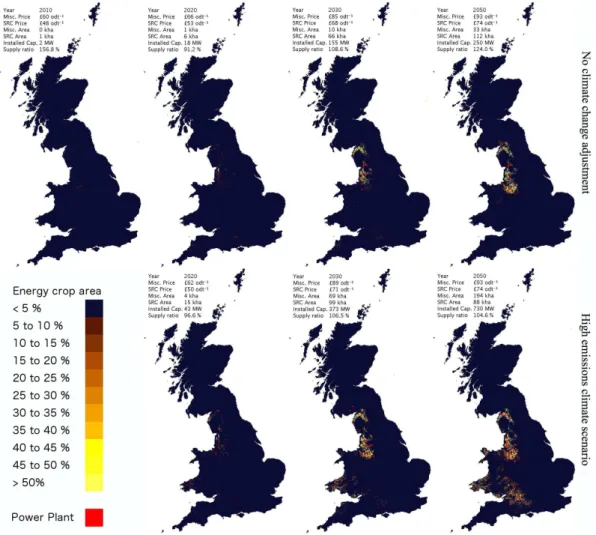
Fig. 5.Simulated future adoption of the energy cropsMiscanthus(Misc) and short-rotation coppicing (SRC) in the UK with and without climate change from 2010 to 2050.
national level for the simulated adoption of energy crops by farmers in the UK (Alexander and Moran, 2013). The ABM used in these simulations models the interactions between the heterogeneous farmers supplying energy crops and the energy plant constructors demanding these crops (Alexander and Moran, 2013). The patterns of energy crop expansion demonstrate the influence of farmer–agent interactions that control the rates of adoption in a spatial diffusion process. Productivity gains ofMiscanthusunder the climate change scenario produce a switch away from short-rotation coppic-ing and supports an increase in the total energy crop market size.
3.3 Bridging the gap between general equilibrium models and individual-based models of the land system
Global-scale assessments of LULCC frequently use com-putable general equilibrium (CGE) models that seek to de-scribe production, consumption and exchange of goods and
of resources within the economy, and by extension on the merits of one policy over another.
CGE models developed to analyse the impacts of climate policies are distinguished primarily by their representation of greenhouse gas emissions from economic activities. Early studies were focused on policies to mitigate fossil CO2 emis-sions, but recent studies have also focused on the emissions associated with LULCC (e.g. Hertel et al., 2009a). There have also been attempts to model the impacts of climate change in various sectors, including agriculture and forestry (e.g. Calzadilla et al., 2011). This requires the development of models that have better representations of land resources and uses – an area of continuing methodological innovation. Land resources may be distinguished as a factor of produc-tion in CGE models, along with labour and capital. Many models concerned with land-based production distinguish a single type of land that is used by all sectors and for which the aggregate supply is either fixed or is a prescribed func-tion of price. Some CGE models distinguish multiple types of land. The most prominent example of this is the GTAP-AEZ and similar models that distinguish land in up to 18 dif-ferent “agro-ecological zones” per model region (Hertel et al., 2009b). LULCC is then modelled as a simple function of the relative land rental rates for each use. Limited flexibility to reallocate land between different uses (especially in the short to medium run) is often modelled with nested constant elasticities of transformation: higher between more similar uses (e.g. different field crops) and lower between less simi-lar uses (e.g. pasture versus crops) (Hertel et al., 2009b).
It is important to distinguish between the limitations of the current generation of large-scale CGE models of LULCC due to data, methodological and computational constraints and any limitations of the neoclassical theories of produc-tion, consumption and general equilibrium. The theory re-quires that agents maximise utility, but it does not require that all agents be identical, nor that consumption and produc-tion decisions be separable. There are now many examples of computational models with heterogeneous households (e.g. Rausch et al., 2011). Löfgren and Robinson (1999) em-bed a model of farm household behaviour within a CGE framework in which production and consumption decisions are non-separable. Allowing for various types of spatial in-teractions in a CGE framework is much more challenging, but not impossible (e.g. Bröcker, 1998).
The potential exists to integrate CGE models with ABMs and thus exploit the advantages offered by the two approaches (for the farm-level see, for example, Schreinemachers et al., 2010). The most salient feature of ABMs from the perspective of this integration is their abil-ity to model decentralised market decisions, while taking into account agent and spatial heterogeneity and interac-tions (Nolan et al., 2009; Parker et al., 2003). Many agri-cultural ABMs represent decision processes using traditional mathematical programming approaches taken from agricul-tural economics, jointly allocating farm-level resources and
capital to determine land allocation and economically opti-mal outputs. Such models can incorporate forward-looking behaviour and fixed costs, resulting in more realistic land use transitions without the imposition of artificial constraints. They can also incorporate subsistence constraints and non-market cultural preferences, moving away from a pure profit or utility optimisation approach. ABMs can also allocate land sales and rental markets endogenously through land markets, and in doing so estimate spatially heterogeneous land rental rates (Berger, 2001; Happe et al., 2006; Parker and Filatova, 2008). Thus, ABMs can overcome some of the limitations of CGE models by modelling a wider range of land uses, ac-counting for spatially heterogeneous land suitability – which potentially varies with climate change – and endogenising land use transitions, diffusion of innovation, and land rents. However, options for coupling of CGE and ABMs have not yet been formally explored. We argue here also for the ex-ploration of novel approaches that start with a clean slate as a complementary approach that merits consideration in paral-lel with the continued development of existing methods. This would provide much-needed diversity in method develop-ment from which the next generation of LULCC modelling approaches are more likely to benefit (NRC, 2013).
3.4 Agent learning and evolution
More complex representations of adaptation and learn-ing have been represented uslearn-ing evolutionary algorithms (Holland, 1975), which include (a) some sort of mechanism for modifying the parameters or structure of a decision rule and (b) a fitness measure that scores the performance of the modified versions. In land use models, these evolutionary or genetic algorithms have been used to select and weight cri-teria that agents use in a multi-cricri-teria evaluation of alter-natives (Manson, 2006) and, more simply, to allow agents to decide on the value of a single parameter based on the decision-making performance of various alternative values (Magliocca et al., 2011). Using evolutionary algorithms to represent agent cognition requires more computation, be-cause agents need to test multiple alternative choices, as well as more data, because those choices need to be compared with a measurable outcome variable. They have the advan-tages, however, of (a) facilitating representation of decision processes (not just decisions) that evolve and adapt over time on the basis of feedback from the outcomes, and (b) per-mitting specific representation of various types of bounds on rationality (An, 2012; Manson, 2006; Meyfroidt, 2013). Other approaches are available to model adaptive learning, including Bayesian belief networks and artificial intelligence (Meyfroidt, 2013). However, so far these approaches have not been applied to the LULCC decision-making domain.
Participatory or co-modelling approaches have taken an important place alongside other sources of empirical infor-mation for ABMs (Robinson et al., 2007; Jones et al., 2009). Unfortunately, there seems little prospect of scaling such methods up to national or global scale levels. While there is substantial empirical evidence to suggest that the dominance of contingency in social decision making at small group scale can be replaced by emergent regularities at the large scale (Finnigan et al., 2012), at this stage we cannot describe the rules and typologies of these large-scale emergent social be-haviours. Computational experiments offer a promising ap-proach to identifying the implications of decision processes represented at the micro-scale for larger-scale dynamics at the level of agent groups, sectors or regions. Meanwhile, global-scale models need to be employed within scenarios to explore possible or likely future states.
3.5 The role of institutions in land system models
All models dealing with human uses of land and “natural cap-ital” include assumptions, implicitly if not explicitly, about institutions in such forms as property rights, zoning ordi-nances, and regulations dealing with pollution and other mat-ters involving actions of landowners that affect the wellbe-ing of others. Strategies are available to incorporate institu-tions into existing models or to build new models that deal with land use. One strategy emphasises comparative statics, in which land use models are run with alternative assump-tions about institutional arrangements to explore how insti-tutional differences affect the land use outcomes (Zellner et
al., 2010; Bell et al., 2012). The same approach can be used to explore the ways in which institutional rules interact with individual level behaviours, in cases where rules are enforced imperfectly or where social norms (informal institutions) ex-ert an influence on land use behaviours that interacts with for-mal institutions (e.g. Agrawal et al., 2013). The other strat-egy emphasises institutional dynamics and focuses on pro-cesses through which institutions relevant to land use form and change through time (Zellner et al., 2009). This approach assess the criteria used within the decision processes of the institutional decision makers (e.g. environmental quality or economic performance) directly, e.g. through game theory, to evaluate how institutions change in response as their per-ceptions of performance change over time.
Using the comparative statics strategy, it is possible to ex-plore any number of institutional differences. For example, rules can be introduced to provide those who use land with incentives for management of ecosystem services that are or-dinarily ignored by private owners, and regulations designed to protect non-owners from the impacts of various types of land use. A good example of the use of incentives is the es-tablishment of “current-use programmes” that grant property tax relief to landowners who leave land in a “natural” state or use land in a manner that protects habitats for wildlife, controls erosion and so forth. A recent development of in-terest in this realm features what are known as conservation easements in which landowners sell development rights to land trusts or donate these rights in return for some form of property tax relief. Key examples of regulation include mea-sures designed to minimise air and water pollution associated with land use (e.g. runoff containing fertilisers or pesticides), to minimise deforestation through establishment of protected areas or harvest quotas, or to avoid forms of development of-fensive to neighbours (e.g. loud or unsightly industrial activ-ities). The classic challenge is to strike a balance between the rights of landowners and the rights of others in such a way as to enhance social welfare without triggering what are known as “regulatory takings”.
was illustrated by Tiebout (1956), who showed that munic-ipalities within a region provide services to mobile popula-tions for which they compete through the choices they make about the services they provide.
While many of these processes have been represented ex-plicitly in the land use models cited above, an alternative op-tion would be to model instituop-tional turning points or tran-sitions in which major changes in prevailing institutions are introduced through the passage of legislation (e.g. the Clean Air Act Amendments of 1990 in the US mandating major reductions in emissions of sulfur dioxide and nitrogen ox-ides) or the negotiation of international agreements (e.g. the adoption of the 1987 Montreal Protocol, leading to dramatic reductions in the production and consumption of ozone-depleting substances). Econometric analyses can be used to reveal the quantitative effects of these turning points after the fact, as has been illustrated for the use of protected areas in the developing world (Andam et al., 2008) and the effects of the Conservation Reserve Program in the US (Lubowski et al., 2008). Both of the above simulation strategies are likely to be useful in efforts to estimate the effects of similar poli-cies in future scenarios. The comparative statics strategy may prove helpful in thinking through the probable consequences of introducing alternative tax schemes, zoning ordinances (Zellner et al., 2010) or regulatory policies and enforcement (Bell et al. 2012). Building institutional dynamics into land use models is apt to prove more challenging, but such ef-forts may turn out to be helpful in exploring how interactions among biophysical, economic and institutional forces deter-mine the trajectories of systems in which human drivers have become dominant.
3.6 Representing technology innovation and adoption in land system models
Technological innovation is a broad concept that can en-compass many different processes, techniques or devices. In partial and general equilibrium models, production func-tions govern the behaviour of individual industries within large global regions, and these functions include land as one type of input. Changes in productivity can in principle result from many different sources: increased inputs (e.g. labour), changes in management (e.g. multi-cropping, changes in tim-ing of planttim-ing/harvest), changes in management involvtim-ing new inputs such as fertilisers or irrigation, new technolo-gies such as better machinery or improved crop varieties, or changes to biophysical land productivity due to improved soils or climate change. The distinction between exogenous and endogenous productivity changes depends on the model structure. Exogenous assumptions about the productivity of land (or, in some cases, total factor productivity) will gener-ally incorporate all sources of productivity change not oth-erwise explicitly represented. For example, in a CGE model that distinguishes a separate fertiliser industry, agricultural industries can endogenously shift toward increased fertiliser
inputs, which will have the net effect of increasing the out-put produced for a given amount of land inout-puts. However if a fertiliser industry is not explicit, then shifts in output due to increased fertiliser use can be represented only implicitly through assumed exogenous changes in productivity. Thus technological change is represented differently depending on model structure.
3.7 The importance of connectivity through networks
The Earth system is increasingly interconnected through trade flows (imports/exports), human movement (migration) and information exchange (telecommunications) (Lambin and Meyfroidt, 2011; Meyfroidt et al., 2010; Seto et al., 2012). These teleconnections have important implications for LULCC globally since they affect consumption and pro-duction patterns for land-based goods and services and the means to inform different land use decisions. These global flows both influence and are affected by land use and include embodied materials in products such as water in food (Dalin et al., 2012; Porkka et al., 2012).
Economic drivers have dynamics that are determined in some important ways by the topology of trade and financial networks. Food production in modern agricultural systems, for example, is very dependent on energy for fertiliser pro-duction, farm operations, transport and processing. Oil and gas, which supply much of this energy, are internationally traded between a few producers and many importing coun-tries. Network analyses of world trade and the monetary system that enables it through markets and credit involve extremely complicated networks (e.g. Brede and Boschetti, 2009; Fagiolo et al., 2009; Schweitzer et al., 2009). Trade networks may be vulnerable to dynamic and/or topological instability. In dynamic instability, small shocks to food and primary energy availability propagate through the network and grow in amplitude. In topological instability, flows are vulnerable to the failure of critical links or nodes: for exam-ple, the interdiction by Ukraine of natural gas supplies from Russia to western Europe. Network instability becomes in-terdependent when growing perturbations in flows (dynamic instability) overload links in the network causing them to fail (topological instability).
suggests that events of this kind should be endemic given the structure of trade flows in a globalised world. Similar analyses have been performed for primary energy and for the financial system, which can be viewed as the information flow which enables physical trade flow (May et al., 2008; Schweitzer et al., 2009). Hence key economic drivers of land use at the local scale, i.e. commodity prices and availability, are fundamentally stochastic.
The level of detail in the structure of economic flows is not captured in global models. CGE models such as GTAP (Hertel, 1997) or GTAP variants such as GTEM (Pant, 2002) generally restrict themselves to dealing with a few (10–20) geographical regions, although they may have detailed rep-resentation of many economic sectors (∼50 or more) within these regions. As a result, they are explicit in calculating net-works of trade flows in each economic sector between re-gions. However, this approach precludes representation of non-linear network behaviour. CGE modelling of physical flows has been combined with physical and biological con-straints in IAMs such as IMAGE (Bouwman et al., 1996) or IGSM (Sokolov et al., 2005). When these models include explicit descriptions of LULCC, the CGE framework is in principle able to specify some of the economic drivers such as prices and terms of trade. This is currently the state of the art, but is subject not only to the shortcomings noted above but also to the other well-known problems of DSGE/CGE economic modelling, even when that is augmented by physi-cal processes in IAMs.
Social drivers are strongly influenced by social networks at small scales, and there are numerous examples of social network analyses (e.g. McAllister et al., 2011). At medium scale levels (regional to national), local land use responses to economic drivers are moderated through social networks of-ten characterised by early adaptors, followers and resisters that can be made manifest in a social network topology (e.g. Barabasi, 2002). At larger scale levels, political influ-ences described as networked processes can have major ef-fects on land use. For example, the move to economic au-tarky in the developed world between the two world wars was in stark contrast to the evolution towards global trade up to 1914 and the rapid expansion of globalisation after WW2 (Collier and Dollar, 2002). Pre-WW2, land use in European colonies was strongly influenced by the commodity prefer-ences of the homeland, while post-WW2, the institutions set up at Bretton Woods actively facilitated trade with bilateral benefits (at least in principle). We are now seeing the contin-ued working-out of this process with the legal acquisition of land in places such as sub-Saharan Africa, Australia and New Zealand to secure food supplies for centres of rapid popula-tion growth in Asia or by stateless multinapopula-tional corporapopula-tions (see Wouterse et al., 2011). Network modelling is a natural tool for capturing some of these processes, but thus far lit-tle progress has been made other than at a conceptual level, especially in representing institutional processes within gov-ernment and the private sector.
3.8 The way forward for data assimilation and synthesis
Global understanding of LULCC processes requires synthe-sis of observations and models across local and regional scales. While remote sensing and global climate modelling have revolutionised our ability to observe and model the global patterns and dynamics of biophysical systems, the hu-man systems that cause LULCC are not directly observable from space, nor can they be modelled successfully at global scales without understanding how they function locally and regionally. Thus, the assimilation and synthesis of multidis-ciplinary case study observations and models made at local and regional scales is necessary to represent land use deci-sion making in land system models (Turner II et al., 2007).
knowledge is likely to be the need for sustained support for these efforts that is adequate in enabling their capabilities to grow beyond ad hoc efforts and experiments. Nevertheless, the creation and use of online collaboration infrastructures does tend to drive enhanced data sharing, harmonisation and use to answer broader questions.
4 Conclusions
The climate change debate centres on the question of human impact. From this perspective the chief model developments over the last decades seem to have disproportionally con-centrated on reducing uncertainty and more detailed process modelling of the physical climate system with GCMs. Equal attention has not been paid to global models that investi-gate human-system processes, for instance through improved IAMs or globally applicable ABMs. The greatest uncertainty in future climate predictions lies in the range of possible emission trajectories, and not in the inherent unpredictabil-ity of the biophysical climate system given a predetermined forcing. Clearly, efforts to improve understanding of human drivers and responses require more attention. This sits in the “understanding” realm, but with clear impacts for steering future science and the “projection/prediction” issue. The hard part is that multiple representations of global LULCC cou-pled with the ESMs would be needed to address this.
In particular, the issue of LULCC as a climate driver has largely failed to gain traction to date because of (a) the in-trinsic difference in the scales at which land use decisions are made and those usually implied when discussing climate and because (b) the current rudimentary treatment in ESMs of LULCC (and terrestrial processes more generally) pro-vides little evidence to suggest that more detailed represen-tations of LULCC would lead to increases in predictability, and/or large magnitude impacts, at climate-relevant scales. However, a primary goal of Earth system modelling should be to improve understanding of the interactions and feed-backs between human decision making and biophysical pro-cesses. The need for this is driven by urgent calls for effec-tive global stewardship to be informed by such understanding (Chapin III et al., 2010). In this respect, a particularly impor-tant (and ambitious) aim is to use system understanding to enable transitions and transformations in social–ecological systems.
Our ability to anticipate future technological and social change is limited, and not necessarily within the scope of most modelling projects; hence the emphasis this paper has placed on representing technological change, innovation and social change (e.g. evolution of institutions and human be-haviour) in models. Given the importance of network con-nectivity, innovations in social systems that affect knowl-edge sharing have profound potential to shift the social norms, institutions and governance systems that ultimately shape our future landscapes and climate (e.g. enabling global
stewardship of material and energy flows). These interactions between institutions, human behaviour and system transfor-mation become paramount if modellers are to contribute the knowledge needed to shape future systems.
There will always be room for simple models as well as very complex ones – their application domain and their strengths and weaknesses depend on the question to be ad-dressed (Fulton et al., 2012). We do not know whether bet-ter representation of social processes in global models would make their predictive capacity better. Until such models do exist, it is not possible to undertake the model experiments and sensitivity analyses to support or refute the benefits of such an approach. Moreover, it is important to highlight here that modelling can have very different objectives. Models are sometimes used to make projections, and in these cases process-based models are not always the best way forward. But modelling can also be used to advance understanding of processes by constructing experiments that explore dif-ferent representations of those processes. In reviewing and evaluating different modelling strategies we have highlighted readily accessible opportunities to improve existing mod-elling capabilities, and these steps would also contribute to the more intractable challenges identified. In particular, it is clear we can learn much from comparing consequences of quite different representations of the same processes in dif-ferent models (e.g. representation of land change and climate change interactions in climate models versus land system models, or working with both ABM and CGE approaches). Existing models are helpful here as they provide a clear framework for being explicit about assumptions, developing and refining hypotheses and enabling useful analyses that re-solve questions about climate and land interactions. In this way models are used to frame falsifiable hypotheses.
In pursuit of these aims it is clear that model inter-comparison exercises and investigations into model equifi-nality do much to further our scientific understanding. There is rarely a single, unambiguous way to conceptualise and rep-resent these system effects in models, and yet model results can be profoundly sensitive to that choice of representation.
The most challenging questions raised here set the scene for longer term research opportunities. The contingent nature of human behaviour severely limits the potential for testable, quantitative predictions in social-ecological systems. For this reason, it is helpful to identify both model purposes and eval-uation methods that do not rely on quantitative prediction in order to be effective. It is very common to be drawn into dis-cussions on what is missing from a model, and continue to embellish by adding process detail. Avenues for adding what is missing are boundless, and thus it is equally important to develop ways of prioritising and working with incomplete knowledge.
representation (e.g. connectivity, non-linearities, cross-scale interactions, level of process detail) makes a significant dif-ference to our interpretation. For example, alternative models may not even agree on thedirectionof a response to a pre-scribed perturbation, let alone the magnitude; for example, will water availability in an agricultural region be higher or lower in response to climate change (Chiew et al., 2011)? In this case, the key understanding for a decision maker might be that building in resilience to a range of possible eventual-ities is more prudent than optimising for an assumed, certain outcome.
Acknowledgements. The authors would like to thank the Global Land Project (www.globallandproject.org) and CSIRO for sup-porting this work. M. D. A. Rounsevell and PV would like to acknowledge the support of the European Commission-funded VOLANTE project (FP7-ENV-265104). A. Arneth acknowledges funding from the Formas Strong Research Environment “Land use today and tomorrow”. M. D. A. Rounsevell, P. H. Verburg and A. Arneth acknowledge the support of the European Commission-funded OPERAs project (Operationalising Ecosystem Research Applications, FP7-ENV-2012-308393-2) and the project LUC4C (Land use change: assessing the net climate forcing, and options for climate change mitigation and adaptation; grant no. 603542). P. H. Verburg acknowledges support of the European Commission-funded GLOLAND project (Integrating human agency in global-scale land change models, ERC-StG-2012-311819).
Edited by: V. Lucarini
References
Acosta-Michlik, L. and Rounsevell, M. D. A.: An agent-based framework for assessing vulnerability futures, in: Chapter 9, As-sessing Vulnerability to Global Environmental Change – making research useful for adaptation decision making and policy, edited by: Patt, A. G., Schroeter, D., Klein, R. J. T., and de la Vega-Leinert, A. C., Earthscan, London, 147–171, 2009.
Agrawal, A., Brown, D. G., Rao, G., Riolo, R., Robinson, D. T., and Bommarito, M.: Interactions between Organizations and Networks in Common-Pool Resource Governance, Environ. Sci. Policy, 25, 138–146, 2013.
Alexander, P. and Moran, D.: Impact of perennial energy crops in-come variability on the crop selection of risk averse farmers, En-ergy Policy, 52, 587–596, 2013.
An, L.: Modeling human decisions in coupled human and natural systems: review of agent-based models, Ecol. Model., 229, 25– 36, 2012.
Andam, K. S., Ferraro, P. J., Pfaff, A., Sanchez-Azofeifa, G. A., and Robalino, J. A.: Measuring the effectiveness of protected area networks in reducing deforestation, P. Natl. Acad. Sci. USA, 105, 16089–16094, 2008.
Arneth, A., Harrison, S. P., Zaehle, S., Tsigaridis, K., Menon, S., Bartlein, P. J., Feichter, J., Korhola, A., Kulmala, M., O’Donnell, D., Schurgers, G., Sorvari, S., and Vesala, T.: Terrestrial biogeo-chemical feedbacks in the climate system, Nat. Geosci., 3, 525– 532, 2010a.
Arneth, A., Sitch, S., Bondeau, A., Butterbach-Bahl, K., Foster, P., Gedney, N., de Noblet-Ducoudré, N., Prentice, I. C., Sanderson, M., Thonicke, K., Wania, R., and Zaehle, S.: From biota to chem-istry and climate: towards a comprehensive description of trace gas exchange between the biosphere and atmosphere, Biogeo-sciences, 7, 121–149, doi:10.5194/bg-7-121-2010, 2010b. Arora, V. K. and Montenegro, A.: Small temperature benefits
pro-vided by realistic afforestation efforts, Nat. Geosci., 4, 514–518, 2011.
Barabasi, A.-L.: Linked, the new science of networks, Perseus Pub-lishing, Cambridge, Mass., 280 pp., 2002.
Bell, A. R., Riolo, R. L., Doremus, J., Brown, D. G., Lyon, T. P., Vandermeer, J., and Agrawal, A.: Fragmenting forests: The dou-ble edge of effective forest monitoring, Environ. Sci. Policy, 16, 20–30, 2012.
Berger, T.: Agent-based spatial models applied to agriculture: A simulation tool for technology diffusion, resource use changes, and policy analysis, Agricult. Econ., 25, 245–260, 2001. Betts, R. A.: Offset of the potential carbon sink from boreal
foresta-tion by decreases in surface albedo, Nature, 408, 187–190, 2000. Bithell, M., Brasington, J., and Richards, K.: Discrete-element, individual-based and agent-based models: Tools for interdisci-plinary enquiry in geography?, Geoforum, 39, 625–642, 2008. Bobenrieth, E. S. and Wright, B. D.: The food price crisis of
2007/2008: Evidence and implications, University of Concep-cion, Chile, and University of California, Berkeley joint meeting of intergovernmental group on oilseeds, oils and fats (30th ses-sion), intergovernmental group on grains (32nd sesses-sion), Inter-governmental group on rice (43rd session) and symposium on Value chains for oilseeds, oils and fats, grains and rice: Status and outlook, 4–6 November 2009, Santiago, Chile, 2009. Boisier, J.-P., De Noblet-Ducoudré, N., Pitman, A., Cruz, F. T.,
Delire, C., van den Hurk, B. J. J. M., Van der Molen, M. K., Müller, C., and Voldoire, A.: Attributing the impacts of Land-Cover Changes in temperate regions on surface temper-ature and heat fuxes to specifc causes. Results from the first LUCID set of simulations, J. Geophys. Res., 117, D12116, doi:10.1029/2011JD017106 2012.
Boone, R. B., Galvin, K. A., Burn Silver, S. B., Thornton, P. K., Ojima, D. S., and Jawson, J. R.: Using coupled simulation mod-els to link pastoral decision making and ecosystem services, http: //www.ecologyandsociety.org/vol16/iss2/art6/, Ecol. Soc., 16, 6, 2011.
Bousquet, F. and Le Page, C.: Multi-agent simulations and ecosys-tem management: a review, Ecol. Model., 176, 313–332, 2004. Bouwman, A. F., Kram, T., and Klein Goldewijk, K.: Integrated
modelling of global environmental change, An overview of IMAGE 2.4, Netherlands Environmental Assessment Agency, Bilthoven, 1996.
Brede, M. and Boschetti, F.: Analyzing weighted networks: An ap-proach via maximum flows, Lect. Not. Inst. Comput. Sci., 1, 1093–1104, 2009a.
Britz, W. and Hertel, T. W.: Impacts of EU biofuels directives on global markets and EU environmental quality: An integrated PE, global CGE analysis, Agr. Ecosyst. Environ., 142, 102–109, 2011.
Brovkin, V., Sitch, S., von Bloh, W., Claussen, M., Bauer, E., and Cramer, W.: Role of land cover changes for atmospheric CO2
increase and climate change during the last 150 years, Global Change Biol., 10, 1253–1266, 2004.
Brovkin, V., Claussen, M., Drieschaert, E., Fichefet, T., Kicklighter, D. W., Loutre, M. F., Matthews, H. D., Ramankutty, N., Scha-effer, M., and Sokoloy, A.: Biogeophysical effects of histor-ical land cover changes simulated by six Earth system mod-els of intermediate complexity, Clim. Dynam., 26, 587–600, doi:10.1007/s00382-005-0092-6, 2006.
Brown, D. G. and Robinson, D. T.: Effects of heterogeneity in res-idential preferences on an agent-based model of urban sprawl, Ecol. Soc., 11, 46, 2006.
Brown, D. G., Riolo, R. L., Robinson, D., North, M., and Rand, W.: Spatial process and data models: Toward integration of agent-based models and GIS, J. Geogr. Syst., 7, 1–23, 2005.
Brown, D. G., Robinson, D. T., An, L., Nassauer, J. I., Zellner, M., Rand, W., Riolo, R., Page, S. E., and Low, B.: Exurbia from the bottom-up: Confronting empirical challenges to characterizing complex systems, GeoForum, 39, 805–818, 2008.
Brown, M. E. and Funk, C. C.: CLIMATE: Food Secu-rity Under Climate Change, Science, 319, 580–581, doi:10.1126/science.1154102, 2008.
Calzadilla, A., Rehdanz, K., and Tol, R. S. J.: Trade liberalization and climate change: A computable general equilibrium analysis of the impact on global agriculture, Water, 3, 526–550, 2011. Castella, J. C. and Verburg, P. H.: Combination of process-oriented
and pattern-oriented models of land use change in a mountain area of Vietnam, Ecol. Model., 202, 410–420, 2007.
Chapin III, F. S., Carpenter, S. R., Kofinas, G. P., Folke, C., Abel, N., Clark, W. C., Olsson, P., Stafford Smith, D. M., Walker, B., Young, O. R., Berkes, F., Biggs, R., Grove, J. M., Naylor, R. L., Pinkerton, E., Steffen, W., and Swanson, F.J.: Ecosystem stew-ardship: Sustainability strategies for a rapidly changing planet, Trends Ecol. Evol., 25, 241–249, 2010.
Chiew, F. H. S., Young, W. J., Cai, W., and Teng, J.: Current drought and future hydroclimate projections in southeast Australia and implications for water resources management, Stoch. Environ. Res. Risk A., 25, 601–612, 2011.
Collier, P. and Dollar, D.: Aid Allocation and Poverty Reduction, Eur. Econ. Rev., 46, 1475–1500, 2002.
Collins, S. L., Carpenter, S. R., Swinton, S. M., Orenstein, D. E., Childers, D. L., Gragson, T. L., Grimm, N. B., Grove, J. M., Har-lan, S. L., Kaye, J. P., Knapp, A. K., Kofinas, G. P., Magnuson, J. J., McDowell, W. H., Melack, J. M., Ogden, L. A., Robertson, G. P., Smith, M. D., and Whitmer, A. C.: An integrated concep-tual framework for long-term social-ecological research, Front. Ecology Environ., 9, 351–357, 2011.
Conrad, K.: Computable General Equilibrium Models in Environ-mental and Resource Economics, in: The International Yearbook of Environmental and Resource Economics 2002/2003: A Sur-vey of Current Issues, edited bY: Tietenberg, T. and Folmer, H., Edward Elgar Publishing Ltd, Cheltenham, UK, 2003
Costanza, R., Leemans, R., Boumans, R., and Gaddis, E.: Integrated Global Models, in: Sustainability or Collapse: An Integrated His-tory and future Of People on Earth, Dahlem Workshop Report 96, edited by: Costanza, R., Graumlich, L. J., and Steffen, W., MIT press, Cambridge, MA, 417–446, 2007.
Cui, X., Graf, H.-F., Langmann, B., Chen, W. W., and Huang, R.: Climate impacts of anthropogenic land use changes on the Ti-betan Plateau, Global Planet. Change, 54, 33–56, 2006. Dalin, C., Konar, M., Hanasaki, N., Rinaldo, A., and
Rodriguex-Iturbe, I.: Evolution of the global water trade network, P. Natl. Acad. Sci., 109, 5989–5994, 2012.
Davin, E. L. and de Noblet-Ducoudre, N.: Climatic Impact of Global-Scale Deforestation: Radiative versus Nonradiative Pro-cesses, J. Climate, 23, 97–112, doi:10.1175/2009JCLI3102.1, 2010.
Davin, E. L., de Noblet-Ducoudre, N., and Friedlingstein, P.: Im-pact of land cover change on surface climate: Relevance of the radiative forcing concept, Geophys. Res. Lett., 34, L13702, doi:10.1029/2007GL029678, 2007.
De Chazal, J. and Rounsevell, M. D. A.: Land use and climate change within assessments of biodiversity loss: a review, Global Environ. Change, 19, 306–315, 2009.
de Noblet-Ducoudré, N., Boisier, J.-P., Pitman, A., Bonan, G. B., Brovkin, V., Cruz, F., Delire, C., Gayler, V., van den Hurk, B. J. J. M., Lawrence, P. J., van der Molen, M. K., Müller, C., Reick, C., Strengers, B. J., and Voldoire, A.: Determining robust im-pacts of land-use induced land-cover changes on surface climate over North America and Eurasia; Results from the first set of LU-CID experiments, J. Climate, 25, 3261–3281, doi:10.1175/JCLI-D-11-00338.1, 2012.
Eboli, F., Parrado, R., and Roson, R.: Climate Change Feedback on Economic Growth: Explorations with a Dynamic General Equi-librium Model, Environ. Develop. Econ., 15, 515–533, 2010. Ellis, E. C., Neerchal, N., Peng, K., Xiao, H. S., Wang, H., Yan,
Z., Li, S. C., Wu, J. X., Jiao, J. G., Ouyang, H., Cheng, X., and Yang, L. Z.: Estimating long-term changes in China’s vil-lage landscapes, Ecosystems, 12, 279–297, 2009.
Evans, T. P. and Kelley, H.: Assessing the transition from defor-estation to forest regrowth with an agent-based model of land cover change for south-central Indiana (USA), Geoforum, 39, 819–832, 2008.
Evans, T. P., Ostrom, E., and Gibson, C.: Scaling Issues with social data in integrated assessment modeling, Integr. Assess., 3, 135– 150, 2003.
Evans, T. P., Phanvilay, K., Fox, J., and Vogler, J.: An agent-based model of agricultural innovation, land-cover change and house-hold inequality: The transition from swidden cultivation to rub-ber plantations in Laos PDR, J. Land Use Sci., 6, 151–173, 2011. Fagiolo, G., Reyes, J., and Schiavo, S.: World Trade Web: Topolog-ical Properties, Dynamics and Evolution, Phys. Rev. E, 036115, 1–19, 2009.
FAO: Food Price Index, http://www.fao.org/worldfoodsituation/ wfs-home/foodpricesindex/en/ (last access: January 2013), 2012. Filatova, T., Parker, D. C., and van der Veen, A.: Agent-based urban land markets: Agent’s pricing behavior, land prices and urban land use change, Journal of Artificial Societies and Social Simu-lation, 12, http://jasss.soc.surrey.ac.uk/12/1/3.html, 2009. Finnigan, J., Grigg, N., and Brede, M.: Quantitative modelling