CPD
3, 1167–1198, 2007A dataset of LGM climates derived from
palaeo-glaciers
R. Allen et al.
Title Page
Abstract Introduction
Conclusions References
Tables Figures
◭ ◮
◭ ◮
Back Close
Full Screen / Esc
Printer-friendly Version
Interactive Discussion Clim. Past Discuss., 3, 1167–1198, 2007
www.clim-past-discuss.net/3/1167/2007/ © Author(s) 2007. This work is licensed under a Creative Commons License.
Climate of the Past Discussions
Climate of the Past Discussionsis the access reviewed discussion forum ofClimate of the Past
Reconstructing glacier-based climates of
LGM Europe and Russia – Part 2: A
dataset of LGM climates derived from
degree-day modelling of palaeo glaciers
R. Allen1,*, M. J. Siegert2, and A. J. Payne1
1
School of Geographical Sciences, University of Bristol, University Road, Bristol, BS8 1SS, UK 2
School of GeoSciences, University of Edinburgh, Grant Institute, King’s Buildings, West Mains Road, Edinburgh, EH9 3JW, UK
*
now at: Landmark Information Group, 5-7 Abbey Court, Eagle Way, Sowton, Exeter, EX2 7HY, UK
Received: 26 September 2007 – Accepted: 9 October 2007 – Published: 26 October 2007
CPD
3, 1167–1198, 2007A dataset of LGM climates derived from
palaeo-glaciers
R. Allen et al.
Title Page
Abstract Introduction
Conclusions References
Tables Figures
◭ ◮
◭ ◮
Back Close
Full Screen / Esc
Printer-friendly Version
Interactive Discussion
EGU
Abstract
The study of European and Russian Quaternary glacial-geological evidence during the last 15 years has generated sufficient to data to use former glacial extent as a proxy for Last Glacial Maximum (LGM) climate at a continental scale. Utilisation of such data is relevant for two reasons. First, continental to global scale proxy reconstructions of
5
past climate are an important tool in the assessment of retrospective general circula-tion model (GCM) simulacircula-tions. Second, the development of a multi-proxy approach will result in a more robust proxy based climate signal. A new and independent dataset of 36 LGM climate estimates derived from European and Russian mountain regions is presented in this paper. A simple glacier-climate model was used to establish the
opti-10
mum LGM climate conditions for each region from a suite of over 4000 model climates using the principle of zero cumulative mass balance. Clear regional trends are present in the reconstructed LGM climates; temperature anomalies north of the Alps are 2◦C and 5◦C larger than those in the western and eastern Mediterranean, respectively. In Russia the model results suggest that both the Arctic Urals and Puterana Plateau were
15
probably glaciated by small mountain glaciers during the LGM.
1 Introduction
The Last Glacial Maximum (LGM) (∼18 000 14C yr BP) is the most recent prolonged cold phase in the Earth’s history, yet terrestrial proxy evidence suggests significant re-gional variation in the degree of climate change during this time period. European
tem-20
perature anomalies (the difference between the temperature today and at the LGM), reconstructed from fossil pollen, range from−17◦C in Central Europe to−1◦C in Arctic Russia (Peyron et al., 1998; Tarasov et al., 1999). Glacial-geological evidence in North-ern Hemisphere mid-latitude mountainous regions suggests the advance of mountain glaciers was restricted during the LGM (e.g. Herail et al., 1986; Ono et al., 2005; Owen
25
CPD
3, 1167–1198, 2007A dataset of LGM climates derived from
palaeo-glaciers
R. Allen et al.
Title Page
Abstract Introduction
Conclusions References
Tables Figures
◭ ◮
◭ ◮
Back Close
Full Screen / Esc
Printer-friendly Version
Interactive Discussion Molnar, 1995). In the tropics, LGM temperature anomalies, reconstructed from fossil
pollen at low elevation, range between−2.5◦C and
−3◦C (Farrera et al., 1999). In con-trast, temperature anomalies from tropical LGM glaciers range from−6◦C to −12◦C (Mark et al., 2005). Steeper altitudinal lapse rates during the LGM may explain the differences between these anomalies (Farrera et al., 1999; Kageyama et al., 2005).
5
Regional trends in palaeoclimate, or palaeoenvironment, reconstructed from terres-trial proxy data have been used to assess General Circulation Model (GCM) simu-lations of the LGM (e.g. the Palaeoclimate Modelling Intercomparison Project (PMIP) (Joussame and Taylor. 1995) and PMIP2 collaborative projects (Harrison et al., 2002)). It is important to continue developing regional scale proxy palaeo-information because
10
it can be used to test the reliability of trends present in individual data sources; such analyses will increase the confidence in subsequent GCM comparisons. The LGM cli-mate of Europe is in particular need of such analysis as there is currently only one quantitative continental-scale dataset of the LGM climate, derived from proxy evidence (Peyron et al., 1998; Tarasov et al., 1999). The publication of a global dataset of
Qua-15
ternary glaciers (Ehlers and Gibbard, 2004a; Ehlers and Gibbard, 2004b; Ehlers and Gibbard, 2004c) has made it possible to use glacial-geological evidence to construct independent quantitative LGM climate reconstructions at the continental scale. This paper presents climate reconstructions from glacier-climate model simulations of LGM glaciers in mid-latitude Europe and Arctic Russia, using the numerical technique
out-20
lined in Allen et al. (2007a). A glossary of all acronyms used in this paper can be found in Appendix A.
2 The structure of proxy palaeoclimate datasets
To maximise the potential of proxy evidence, especially when intended for use in data-model comparison projects, it is important to consider the methodology used and the
25
CPD
3, 1167–1198, 2007A dataset of LGM climates derived from
palaeo-glaciers
R. Allen et al.
Title Page
Abstract Introduction
Conclusions References
Tables Figures
◭ ◮
◭ ◮
Back Close
Full Screen / Esc
Printer-friendly Version
Interactive Discussion
EGU
The resolution of GCMs range from 2.5◦to 5.0◦, which equates to a grid box of
∼300 km (Jost et al., 2005); as a result they cannot be expected to resolve local scale phenom-ena that would influence, and be recorded by, individual terrestrial proxy sites. Conti-nental scale coverage enables many individual proxy sites to be used to test regional trends that are resolved in GCM simulations (Kohfeld and Harrison, 2000). Second,
5
compatibility with model output; the data should be directly compatible with model out-put and ideally be accompanied by an indication of uncertainty in the results (Kohfeld and Harrison, 2000; Harrison, 2003). Third, transparent primary data which allows the location of data points and original observation to be identified and viewed (Harrison, 2003). Fourth, detailed documentation describing assumptions, data transformations,
10
and methods used. This should allow the dataset to be assessed by users and ensure that the work is replicable. Also, it will enable re-evaluation of the dataset as recon-structive techniques and mechanistic understandings improve (Harrison, 2003). Fifth, provision of metadata (e.g. site details or chronological framework), allowing users to sub-sample appropriate data for specific tasks (Kohfeld and Harrison, 2000; Harrison,
15
2003). Sixth, results presented in a site by site format (e.g. Farerra et al., 1999; Ko-hfeld and Harrison, 2000; Tarasov et al, 2000; Bigelow et al., 2003). This approach removes the possibility of erroneous interpolations, makes the data more accessible, and should enable a more reliable model-data comparison. A traditional method of presenting proxy based reconstructions has been through maps (e.g. CLIMAP Project
20
Members, 1981; Denton and Hughes, 1981), which rely on the interpretation of the available data by the map maker. This approach has two weaknesses, first, the acces-sibility of the data to the wider academic community is reduced because a knowledge of the maps background and justification for the interpolations is required and, second, the potential for errors in the data set is increased (Harrison, 2003).
25
CPD
3, 1167–1198, 2007A dataset of LGM climates derived from
palaeo-glaciers
R. Allen et al.
Title Page
Abstract Introduction
Conclusions References
Tables Figures
◭ ◮
◭ ◮
Back Close
Full Screen / Esc
Printer-friendly Version
Interactive Discussion
3 The Last Glacial Maximum cryosphere of Europe and Russia
The Eurasian Ice Sheet dominated the northern latitudes of Europe at the LGM (Hub-berten et al., 2004). Beyond the southern margins of the ice sheet many of the moun-tain ranges in mid-latitude Europe conmoun-tain glacial-geological evidence which has been attributed to the LGM (Fig. 1), and used to describe a wide range of glacial systems,
5
the largest of which was the Alpine ice cap (e.g. Florineth and Schl ¨uchter, 2000). The orographies of the Pyrenees and Caucasus Mountains enabled significant mountain glacier systems, drained by outlet glaciers up to 70 km in length to develop (Calvet, 2004; Gobejishvili, 2004). To the north and west of the Alps small ice caps (up to 500 km2) developed in the Vosges Mountains, Jura Mountains, and Massif Central
(Dri-10
cot et al., 1991; Gillespie and Molnar, 1995; Buoncristiani and Campy, 2001). Evidence of Quaternary cirque and mountain glaciers can be found in upland regions across the Mediterranean Basin and Turkey as far south as 35◦N (Fig. 1) (See Ehlers and Gibbard (2004a) and references therein for a full review).
The position of the eastern margin of the Eurasian Ice Sheet has been established
15
by Svendsen et al. (2004). They indicate the ice sheet was restricted to the present day coastal regions of northern Russian and Siberia, leaving self sourced ice masses in the upland regions of the Ural Mountains and Puterana Plateau (Fig. 1) (e.g. Boul-ton, 1979; Hubberten et al., 2004). Recent modelling work supports the interpretation that the Eurasian Ice Sheet had retreated from Arctic Russia by the LGM, owing to
20
an extremely cold and dry climate (Siegert and Marsiat, 2001). Assuming that this in-terpretation is correct, small cirque and valley glaciers would have formed in the Ural Mountains during the LGM (Astakhov, 1997; Svendsen et al., 2004, Hubberten et al., 2004), however the exact number and extent of these glaciers remains unknown. The chronology of the Late-Quaternary glaciers in the Puterana Plateau is still debated:
25
CPD
3, 1167–1198, 2007A dataset of LGM climates derived from
palaeo-glaciers
R. Allen et al.
Title Page
Abstract Introduction
Conclusions References
Tables Figures
◭ ◮
◭ ◮
Back Close
Full Screen / Esc
Printer-friendly Version
Interactive Discussion
EGU
4 Regional glacier-climate simulations of the Last Glacial Maximum
4.1 The INQUA dataset of Quaternary glaciers
In 1995 the XIV Congress of the International Quaternary Association (INQUA) com-missioned a project to establish a comprehensive dataset of the global extent and chronology of Quaternary glaciations. The European and Russian section of this
5
project was published in 2004 (Ehlers and Gibbard, 2004a) and represents the culmi-nation of work from numerous authors across many different countries and is, to date, the most comprehensive dataset of Quaternary glaciers (including the LGM) in Europe and Russia. The data contributing to this publication are contained in an accompanying ArcView GIS (Fig. 2).
10
The LGM glacier reconstructions required to constrain glacier-climate model (Allen et al., 2007a) simulations of LGM climate were constructed by overlaying the INQUA GIS dataset on top of the USGS “gtopo30 arcsec” DEM (USGS, 1996). Using this combined approach to reconstruct LGM glacier topography yielded 182 discrete LGM glacier profiles from 29 mountainous regions across Western Europe and Black Sea
15
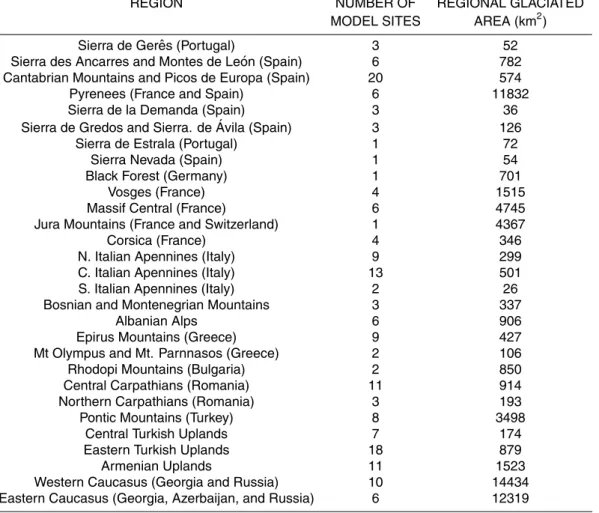
region. Results from individual glaciers within each mountain region were combined to produce a regional climate reconstruction (Table 1). Results from individual sites within the same region were combined using a weighting system reflecting the relative glaciated area of the different contributing glaciers. This regionalisation meant that the number of contributing simulations or simulated glacier area was not uniform between
20
regions, and it had to be assumed that results derived from regions with small LGM glaciers are equally as valid as those derived from the more heavily glaciated regions. As discussed in Sect. 3 the extent of LGM glaciers in the Ural Mountains and Put-erana Plateau is currently uncertain. The INQUA LGM glacier dataset (Ehlers and Gibbard, 2004a) contains no data describing LGM glaciers in the Ural Mountains, and
25
er-CPD
3, 1167–1198, 2007A dataset of LGM climates derived from
palaeo-glaciers
R. Allen et al.
Title Page
Abstract Introduction
Conclusions References
Tables Figures
◭ ◮
◭ ◮
Back Close
Full Screen / Esc
Printer-friendly Version
Interactive Discussion ent overlying palaeoclimatic conditions. This uncertainty was incorporated into the
LGM palaeoclimate dataset by creating mountain glaciers which occupied the upland reaches of each region (Table 2). This method of representing small mountain glaciers was used in both regions alongside the LGM glacier profiles described in the INQUA dataset (Ehlers and Gibbard, 2004a) (Table 2). The Puterana Plateau was modelled
5
as a single region and, owing to its length, the Ural Mountains was divided into six regions1.
4.2 Simulating the Last Glacial Maximum glacier-climate
4.2.1 Creating the model Last Glacial Maximum climate
A common endpoint for palaeo-glacier simulations is to assume that zero surface mass
10
balance equates to steady-state conditions in the glacier-climate system (e.g. Hostetler and Clark, 2000; Plummer and Phillips 2003). This assumption means that in indepen-dent glacier-climate reconstructions a unique palaeoclimate cannot be derived for each modelled glacier because both the temperature and precipitation variables are un-known at the start of the simulation and glacier mass balance is sensitive to changes
15
in both variables. To accommodate this uncertainty a domain of potential LGM cli-mates was created to drive the glacier-climate model. The boundaries of the domain were 20% and 200% of present day precipitation (anomalies of−80% to+100%) and temperature anomalies of 0◦C and−20◦C. The range in precipitation was represented by 10 precipitation totals (separated by 20%) and the range in temperature
anoma-20
lies was represented by 28 values (Allen, 2006). The climate anomalies were applied uniformly throughout the year to the CRU2.0 climate dataset (representing the clima-tology of 1961–1991) (New et al., 2002). A suite of 15 lapse rate combinations
rep-1
CPD
3, 1167–1198, 2007A dataset of LGM climates derived from
palaeo-glaciers
R. Allen et al.
Title Page
Abstract Introduction
Conclusions References
Tables Figures
◭ ◮
◭ ◮
Back Close
Full Screen / Esc
Printer-friendly Version
Interactive Discussion
EGU
resenting temperature lapse rates ranging from 6◦C/km (the environmental lapse rate ), to 10◦C/km (the dry adiabatic lapse rate) and precipitation lapse rates ranging from 0 mm/100 m and 80 mm/100 m, were used to downscale each potential LGM climate onto each LGM glacier profile. A correction factor equivalent to 120 m (Bard et al., 1990) was incorporated into the lapse rate downscaling to represent lower LGM sea
5
levels. This method produced a total of 4200 potential LGM climates, deriving the optimum LGM climates is described in Sect. 4.2.2. The majority of proxy and model evidence suggests the LGM was a period of increased aridity compared to the present day (e.g. Gillespie and Molnar, 1995; Peyron et al., 1998; Tarasov et al., 1999; Bigelow et al., 2003; Frechen et al., 2003; Kaplan et al., 2003); however, it was noted that some
10
GCM simulations predicted positive precipitation anomalies across LGM Europe (Fig. 7 in Kageyama et al., 2001). Therefore, positive precipitation anomalies were included to ensure that the dataset did not require extrapolation to be compared with alternative LGM climate reconstructions (Allen et al., 2007b).
4.2.2 Glacier-climate simulations
15
The model climates described in Sect. 4.2.1 were used to drive a glacier-climate model based on a degree day model (DDM) of glacier surface mass balance (the model and its validation is described in Allen et al., 2007a). For each pair of lapse rates the combined precipitation and temperature anomalies that satisfied the assessment cri-teria for determining the optimum result (described below) were assumed to be an
20
‘optimum’ LGM climate. Using this approach a total of 150 “optimum” LGM palaeocli-mates were derived for each region. Determining the optimum result from the domain of palaeoclimates described in Sect. 4.2.1 depended on whether the glacier-climate model was simulating mass balance over a single LGM glacier or, a region containing multiple LGM glaciers (Table 1 and Table 2). For single LGM glaciers the assumption
25
CPD
3, 1167–1198, 2007A dataset of LGM climates derived from
palaeo-glaciers
R. Allen et al.
Title Page
Abstract Introduction
Conclusions References
Tables Figures
◭ ◮
◭ ◮
Back Close
Full Screen / Esc
Printer-friendly Version
Interactive Discussion a control spatial distribution (cost functions are explained in Allen et al., 2007a). In
this application the cost function compared the size of the accumulation area of the LGM glaciers predicted by the DDM with the accumulation area of the reconstructed LGM glacier profiles. In sites containing multiple glaciers the accumulation area was calculated from the LGM glacier profiles assuming an accumulation area ratio (AAR)
5
of 0.67 (Benn and Evans, 1998). The LGM climate that returned the highest cost func-tion was assumed to be the optimum. A cost funcfunc-tion was used for sites containing multiple LGM glaciers because a cumulative mass balance would have required sep-arate glacial systems (with their different mass balance regimes) to be combined to determine the optimum LGM climate. For the Russian sites, the position and extent
10
of the ablation zone is unknown and, as the calculation of a cumulative mass balance requires the whole glacier profile, this approach could not be applied. Palaeoclimate reconstructions derived using the cumulative mass balance and cost function methods are comparable, however, because the prescribed AAR in the cost function method is assumed to apply to a steady-state glacier profile.
15
The design of the modelling approach limits the reconstructed climate variables to mean annual temperature and annual precipitation, which has implications for the re-liability of the climate results for two reasons. First, the mass balance of mid-latitude glaciers is primarily controlled by winter accumulation and summer ablation (Porter, 1977; Leonard, 1989). If the intensification of LGM winter conditions (e.g. Huijzer
20
and Vandenberghe, 1998; Peyron et al., 1998; Krinner et al., 2000) is correct, the use of present day seasonality, uniform climate anomalies, and a DDM to reconstruct LGM temperatures may lead to an under-estimate of the annual temperature anomaly. DDMs are only sensitive to changes in positive air temperature (i.e. summer temper-atures) which control ablation; therefore, the mean annual temperature anomalies
re-25
CPD
3, 1167–1198, 2007A dataset of LGM climates derived from
palaeo-glaciers
R. Allen et al.
Title Page
Abstract Introduction
Conclusions References
Tables Figures
◭ ◮
◭ ◮
Back Close
Full Screen / Esc
Printer-friendly Version
Interactive Discussion
EGU
in the DDM climate simulations would (with other things being equal) cause an over-estimate in the reconstructed temperature anomaly (because lower winter accumula-tion totals require lower temperatures to achieve steady state zero mass balance).
5 The Last Glacial Maximum glacier-palaeoclimate dataset: Europe
Optimum LGM precipitation anomalies ranged from∼1000 mm drier to∼1500 mm
wet-5
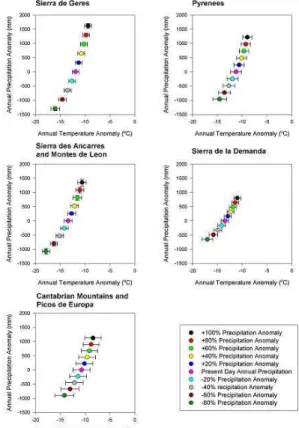
ter than the present day (equating to absolute precipitation totals between 200 mm and 3500 mm) across Europe. Temperature anomalies smaller than−20◦C were able to achieve optimum model result under all precipitation.scenarios The drier climates required larger temperature anomalies to achieve equilibrium surface mass balance (Fig. 3). Owing to the uncertainty in the LGM climate reconstructions it is difficult to
10
make definitive comparisons between regions stating that one mountain region was colder, warmer, wetter or drier than another at the LGM.
If, however, for the purposes of interpretation the precipitation anomaly is calculated in percentage terms and assumed to be constant across all regions, then relative dif-ferences can be inferred. The following results are taken from the simulations using
15
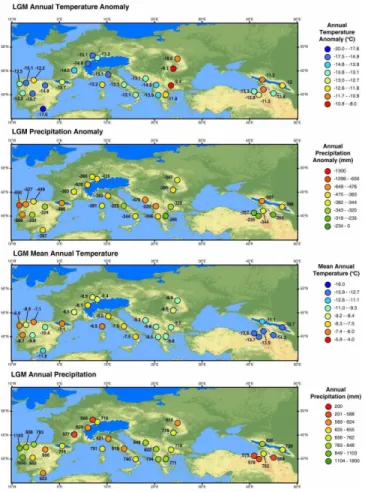
present day precipitation totals (Fig. 4). In Iberia, for example, LGM glaciated regions in close proximity to the Atlantic Ocean have smaller mean annual temperature anoma-lies, ranging from −10.7◦C to
−11.9◦C, compared to inland glaciated regions where temperature anomalies range from −13.5◦C to −15.7◦C (Fig. 1 and Fig. 4). A slight north-south gradient in LGM mean annual temperature anomalies is present between
20
the LGM glaciated regions north of the Alps and the LGM glaciated regions of Cor-sica and Italy. North of the Alps LGM temperature anomalies range from−12.0◦C to −13.9◦C, in contrast to−11.0◦C to −12.0◦C in Italy. In the Balkans and Eastern Eu-rope LGM coastal regions require larger temperature anomalies ranging from−11.6◦C to−12.5◦C; in contrast, the Romanian Carpathians and Bulgarian mountains
temper-25
ature anomalies range from −8.0◦C to −9.8◦C. Across the Eastern Black Sea LGM annual temperature anomalies range from−9.7◦C to
CPD
3, 1167–1198, 2007A dataset of LGM climates derived from
palaeo-glaciers
R. Allen et al.
Title Page
Abstract Introduction
Conclusions References
Tables Figures
◭ ◮
◭ ◮
Back Close
Full Screen / Esc
Printer-friendly Version
Interactive Discussion the same results as Fig. 4, but for precipitation anomalies of−40% and−80%,
respec-tively. Larger negative percentage precipitation anomalies cause annual temperature anomalies to increase (Figs. 5 and 6); however the relative trends between regions described in the simulation using present day precipitation totals remain.
6 The LGM glacier-palaeoclimate dataset: Russia
5
The climate anomaly results from the 0% glacial coverage simulations can be inter-preted as representing the maximum cooling of the present day climate (per precipita-tion anomaly) at the onset of glaciaprecipita-tion. In the Ural Mountains this threshold exhibits a strong latitudinal gradient (Fig. 7): In the Arctic Urals the onset of glaciation is ini-tiated after a cooling of−1◦C but a cooling of−8◦C is required in the Southern Urals
10
(assuming present day precipitation). In the Puterana Plateau the results are similar to the Arctic Urals, a cooling of only−0.5◦C is required to initiate the onset of glaciation (assuming present day precipitation) (Figure 8). In all regions, increasing the extent of LGM glaciation increases the size of the temperature anomaly required to achieve optimum cost-function conditions (Figs. 7 and 8); For example temperature anomalies
15
for the INQUA Puterana Plateau ice cap (Ehlers and Gibbard, 2004a) and prescribed 6% glacial coverage simulation (assuming present day precipitation) are−8.5◦C and −4.5◦C, respectively (Fig. 8).
7 Discussion
The characteristics of ideal proxy palaeo-datasets were described in Sect. 2 and are
20
CPD
3, 1167–1198, 2007A dataset of LGM climates derived from
palaeo-glaciers
R. Allen et al.
Title Page
Abstract Introduction
Conclusions References
Tables Figures
◭ ◮
◭ ◮
Back Close
Full Screen / Esc
Printer-friendly Version
Interactive Discussion
EGU
to previous proxy climate reconstructions across Europe (Peyron et al., 1998; Tarasov et al., 1999). It well known that the relationship between an individual glacier and the surrounding regional climate is modulated by local scale factors (e.g. Kerr, 1993; Mark et al., 2005). Therefore the LGM climate signal for each region was derived from the average of the results from the individual glacier-climate simulations. In Western
5
Europe reconstructed temperature anomalies can be divided into three main regions: north of the Alps, the Mediterranean Basin, and Eastern Europe. With a precipitation anomaly of -40%, mean temperature anomalies (±one standard deviation) for these three regions are−15±0.3◦C,
−13±0.8◦C, and−10±1◦C, respectively. The tempera-ture anomaly of−12.5±1◦C for the Eastern Black Sea region is comparable with the
10
Mediterranean Basin. In Russia, DDM simulations were used to assess the potential likelihood of LGM glaciation in the Ural Mountains and Puterana Plateau. The poten-tial decrease in temperature before the onset of glacerization in the Northern Urals is less than −3.0◦C, even under the largest negative precipitation anomalies; this sug-gests that it was unlikely that this region was not glaciated at the LGM. Supporting this
15
conclusion are data describing 20th century glaciers in the Northern Ural Mountains (e.g. Grosval’d and Kotlyakov, 1969; National Snow and Ice Data Center, 1999). In the Southern Urals, a cooling of−10◦C was possible before the DDM predicted glacieriza-tion, which suggests glaciation of the Ural Mountains during the LGM did not reach the Southern Urals. In the Puterana Plateau the present day climate can only be cooled
20
by −0.5◦C before the onset of glacierization, which combined with the existence of present day glaciers in the region (National Snow and Ice Data Center, 1999) leads to the conclusion that the Puterana Plateau must have been glaciated at the LGM. Tem-perature anomalies reconstructed from the different percentage glacial extents and INQUA ice cap range from−2.6◦C at the 1% glacial coverage to−8.6◦C from the
IN-25
CPD
3, 1167–1198, 2007A dataset of LGM climates derived from
palaeo-glaciers
R. Allen et al.
Title Page
Abstract Introduction
Conclusions References
Tables Figures
◭ ◮
◭ ◮
Back Close
Full Screen / Esc
Printer-friendly Version
Interactive Discussion no change in the present day climate of the Northern Urals, but a comparatively large
cooling over the Puterana Plateau. This distribution of temperature anomalies is not found in the pollen climate reconstructions: temperature anomalies range from−5◦C to−8◦C, and−1◦C to−3◦C in the Ural Mountains and Puterana Plateau, respectively (Tarasov et al., 1999). It is concluded, from DDM simulations and pollen data, that the
5
Ural Mountains and Puterana Plateau were both probably glaciated by small discrete mountain glaciers during the LGM as proposed by Astakhov (1997) and Svendsen et al. (2004). The second characteristic of the ideal proxy palaeo-dataset is that the data should be directly compatible with model output (Kohfeld and Harrison, 2000; Harri-son, 2003). The DDM is driven by climate variables that are directly compatible with
10
GCM output, and this relation is expanded in Allen et al. (2007b). The third charac-teristic of the ideal proxy palaeo-dataset is transparency in the primary data (Harrison, 2003). The primary data are readily available to the scientific community via the IN-QUA Quaternary glacier GIS (Ehlers and Gibbard, 2004a). The fourth characteristic is a detailed documentation describing the methods used, assumptions made, and
15
any data transformations (Harrison, 2003). Details of the DDM, meteorological base-line, data transformations and verification of the methodology can be found in Allen et al. (2007a). Details of the transformation required to make the INQUA LGM glacier dataset compatible with the other input data have been detailed in this paper. The within model results under optimum LGM climates show that the modelling approach
20
consistently predicted plausible first order glaciological and climatic conditions. The fifth characteristic for proxy datasets is the provision of adequate metadata describing specific details of the individual sites, and the chronological framework used to date the proxy evidence (Kohfeld and Harrison, 2000; Harrison, 2003). Metadata describ-ing the glacial style, glacial extent, snowline depressions, and available chronological
25
CPD
3, 1167–1198, 2007A dataset of LGM climates derived from
palaeo-glaciers
R. Allen et al.
Title Page
Abstract Introduction
Conclusions References
Tables Figures
◭ ◮
◭ ◮
Back Close
Full Screen / Esc
Printer-friendly Version
Interactive Discussion
EGU
Smith et al., 2005). Such dating is especially important when comparing palaeoclimate results from regions in which the glaciers did not reach a maximum during the global LGM (e.g. Gillespie and Molnar, 1995; Ono et al., 2005). The available dating evidence accompanying the INQUA European glacier dataset (Ehlers and Gibbard, 2004a and references therein) does not currently meet the standard of the tropical glacier studies
5
(Benn et al., 2005; Mark et al., 2005; Smith et al., 2005). Absolute dates for LGM glaciers are only available in a few regions, e.g. the Vosges Mountains, Jura Moun-tains, and Central Italian Apennines (Campy and Richards, 1988; Dricot et al., 1991; Giraudi, 2004). In the remaining regions the geological evidence is inferred as LGM from relative chronologies, e.g. Massif Central, and Romanian Carpathians (Gillespie
10
and Molnar, 1995; Urdea, 2004), or simply assumed to be LGM, e.g. the mountains of the Former Yugoslavia, and Mountain glaciations in Iberia (Straus, 1992; Marjanac and Marjanac, 2004). In several regions these non-dated reconstructions have placed the maximal glacial advance in the geological record at the LGM, which are subsequently used in the INQUA dataset (Ehlers and Gibbard, 2004a). There is a growing body of
15
evidence that suggests that the LGM glacial advance was smaller than the maximum advance found in the geological record. For example, in Greece preliminary uranium dating places the maximal glacial advance to earlier in the Last Glaciation and suggests that the LGM glaciation was less extensive (Woodward et al., 2004). Dating work has placed the LGM glaciation in the Cantabrian Mountains inside the maximal advance
20
(Sanchez and Arquer, 2002). In the Pyrenees, the glacial reconstruction prescribed to the LGM by the INQUA dataset is the maximal advance during the Last Glaciation, which has been radiocarbon dated to before the LGM (Herail et al., 1986; Andrieu et al., 1988; Jalut et al., 1988; Vilaplana and Montserrat, 1989; Jalut et al., 1992; Garc´ı a-Ruiz et al., 2003). As the INQUA glacier dataset has used the largest Late-Quaternary
25
CPD
3, 1167–1198, 2007A dataset of LGM climates derived from
palaeo-glaciers
R. Allen et al.
Title Page
Abstract Introduction
Conclusions References
Tables Figures
◭ ◮
◭ ◮
Back Close
Full Screen / Esc
Printer-friendly Version
Interactive Discussion is required because the destruction of older glacial evidence by more recent glacial
advances, periglacial activity, and post deglaciation landform erosion makes glacial-geological evidence a naturally incomplete record. It has been implicitly assumed in this modelling study that the analysis and interpretation of the glacial-geological evi-dence contributing to the INQUA dataset (Ehlers and Gibbard, 2004a) has been done
5
in a consistent manner and is correct. There are also a small number of regions where the glacier reconstruction has been incorrectly reproduced in the INQUA GIS dataset, e.g. in the Sierra Nevada Mountains the glacial extent is represented by a series of overlapping triangles that have no recognisable glacial attributes. The final character-istic is the presentation of results on a site by site basis. The glacier-climate dataset is
10
presented in a site by site format, thus ensuring that no interpolation of data has been made.
8 Conclusions
A dataset of 36 new and independent LGM European climate estimates derived from European Quaternary glaciers has been described. It was designed to be fully
inde-15
pendent of alternative LGM climate reconstructions to maximise its potential use in future LGM climate assessment studies. Regional climate estimates were constructed by combining the results of glacier-climate simulations of the individual LGM glaciers within the region. Owing to the independent nature of the dataset it was not possible to simulate a unique solution for each region, therefore a suite of optimum LGM climate
20
conditions were derived for prescribed precipitation conditions ranging from−80% to +100% of present day annual precipitation. In Europe regional trends are evident in the temperature anomalies (assuming a fixed percentage precipitation anomaly), with larger temperature anomalies found north of the Alps compared to the Mediterranean Basin (Figs. 5–7). In Northern Russia the model results suggest that both the Ural
25
CPD
3, 1167–1198, 2007A dataset of LGM climates derived from
palaeo-glaciers
R. Allen et al.
Title Page
Abstract Introduction
Conclusions References
Tables Figures
◭ ◮
◭ ◮
Back Close
Full Screen / Esc
Printer-friendly Version
Interactive Discussion
EGU
This dataset will enable glacial-geological evidence to contribute to our understand-ing of the European climate for the first time at the continental scale (Allen et al., 2007b). Moreover this work has developed and tested a new and simple method which is transferable to other regions of the world; the appropriate glacial-geological data for the rest of the world required by the glacier-climate model are available in Volumes II
5
and III of the INQUA Quaternary glacier dataset (Ehlers and Gibbard, 2004b; Ehlers and Gibbard, 2004c).
Appendix A
AAR Accumulation Area Ratio
CLIMAP Climate/Long Range Investigation Mapping and Predictions Project CRU Climate Research Unit – University of East Anglia
DDM Degree Day Model DEM Digital Elevation Model GCM General Circulation Model
GIS Geographical Information System INQUA International Quaternary Association LGM Last Glacial Maximum
PMIP Palaeoclimate Modelling Intercomparison Project USGS United States Geological Service
Acknowledgements. This work was funded by a NERC studentship. R. Allen would like to
10
thank M. Siegert and T. Payne for their support and advice during the period of this research.
References
Allen, R. J.: Reconstructing the Last Glacial Maximum Climate of Europe and Russia using the Glacial-Geological Record. PhD Thesis, School of Geographical Sciences, University of Bristol, 304pp., 2006.
CPD
3, 1167–1198, 2007A dataset of LGM climates derived from
palaeo-glaciers
R. Allen et al.
Title Page
Abstract Introduction
Conclusions References
Tables Figures
◭ ◮
◭ ◮
Back Close
Full Screen / Esc
Printer-friendly Version
Interactive Discussion Allen, R. J., Siegert, M. J., and Payne, T.: Reconstructing glacier-based climates of LGM
Eu-rope and Russia – Part 1: Numerical modelling and validation methods, Clim. Past Discuss., 3, 1133–1166, 2007a.
Allen, R. J., Siegert, M. J., and Payne, T.: Reconstructing glacier-based climates of LGM Eu-rope and Russia – Part 3: Comparison with GCM and pollen-based climate reconstructions,
5
Clim. Past Discuss., 3, 1199–1233, 2007b.
Andrieu, V., Hubschman, J., Jalut, G., and Herail, G.: Chronologie de la d ´eglaciation des Pyr ´en ´ees franc¸aises. Bulletin de l’Association franc¸aise pour l’etude de Quaternaire, 2/3, 55–67, 1988.
Astakhov, V. I.: Late Glacial Events in the Central Russian Arctic. Quatern. Int., 41/42, 17–26,
10
1997.
Astakhov, V. I.: Pleistocene ice limits in the Russian northern lowlands, in: Quaternary Glacia-tions – Extent and Chronology Part I: Europe, edited by: Ehlers, J. and Gibbard, P. L., 309–320, 2004.
Bard, E., Hamelin, B., and Fairbanks, R. G.: U-Th ages obtained by mass spectrometry in
15
corals from Barbados: sea level during the past 130 000 years, Nature, 346, 456–458, 1990. Benn, D. I. and Evans, D. J. A.: Glaciers and Glaciation. Edward Arnold, London, 734pp., 1998. Benn, D. I., Owen, L. A., Osmaston, H. A., Seltzer, G. O., Porter, S. C., and Mark, B.:
Re-constructions of equilibrium-line altitudes for tropical and sub-tropical glaciers, Quatern. Int, 138–139, 8–21, 2005.
20
Bigelow, N. H., Brubaker, L. B., Edwards, M. E., Harrison, S. P., Prentice, I. C., Anderson, P. M., Andreev, A. A., Bartlein, P. J., Christensen, T. R., Cramer, W., Kaplan, J. O., Lozhkin, A. V., Matveyeva, N. V.,. Murray, D. F., McGuire, A. D., Razzhivin, V. Y., Ritchie, J. C., Smith, B., Walker, D. A., Gajewski, K., Wolf, V., Holmqvist, B. H., Igarashi, Y., Kremenetskii, K., Paus, A., Pisaric, M. J. F., and Volkova, V. S. L.: Climate change and Arctic ecosystems:
25
1. Vegetation changes north of 55◦N between the last glacial maximum, mid-Holocene, and present, J Geophys. Res., 108, ALT 11, 2003.
Boulton, G. S.: Glacial history of the Spitzbergen archipelago and the problem of the Barents Sea ice sheet, Boreas, 8, 31–57, 1979.
Buoncristiani, J.-F. and Campy, M.: Late Pleistocene detrital sediment yield of the Jura glacier,
30
France, Quaternary Res., 56, 51–61. 2001.
CPD
3, 1167–1198, 2007A dataset of LGM climates derived from
palaeo-glaciers
R. Allen et al.
Title Page
Abstract Introduction
Conclusions References
Tables Figures
◭ ◮
◭ ◮
Back Close
Full Screen / Esc
Printer-friendly Version
Interactive Discussion
EGU
Campy, M. and Richards, H.: Modalit ´es et chronologie de la d ´eglaciation Wurmienne dans la chaˆıne Jurassieme. Bulletin de l’Association franc¸aise pour l’etude de Quaternaire, 2/3, 81–90, 1988.
CLIMAP Project Members.: Seasonal reconstruction of the Earth’s surface at the Last Glacial Maximum. Geological Society of America, Map and Chart Series, MC-36-1981, 1981.
5
Denton, G. H. and Hughes, T. J.: The Arctic ice sheet: an outrageous hypothesis, in: The Last Great Ice Sheets, edited by: Denton G. H. and Hughes, T. J., Wiley, New York, 1981. Dricot, E., Petillon, M., and Seret, G.: When and why did glaciers grow or melt in the Vosges
Mountains (France). In Klimageschichtliche Probleme der Letzten 130 000 Jahre, 1991. Ehlers, J. and Gibbard, P. L. (Eds.): Quaternary Glaciations – Extent and Chronology, Part 1:
10
Europe. Series Editor J. Rose, Developments in Quaternary Science 2, Elsevier, London, 2004a.
Ehlers, J. and Gibbard, P. L (Eds.): Quaternary Glaciations – Extent and Chronology, Part II: North America. Series Editor J. Rose, Developments in Quaternary Science 2, Elsevier, London, 2004b.
15
Ehlers, J. and Gibbard, P. L.: Quaternary Glaciations – Extent and Chronology, Part 1II: South America, Asia, Africa, Australia, and Antarctica. Series Editor J. Rose, Developments in Quaternary Science 2, Elsevier, London, 2004c.
Farerra, I., Harrison, S. P., Prentice, I. C., Ramstein, G., Guiot, J., Bartlein, P. J., Bonnefille, R., Bush, M., Cramer, W., von Grafenstein, U., Holmgren, K., Hooghiemstra, H., Hope, G.,
20
Jolly, D., Lauritzen S.-E., Ono, Y., Pinot, S., Stute, M., and Yu, G.: Tropical climates at the Last Glacial Maximum: a new synthesis of terrestrial palaeoclimate data. 1. Vegetation, lake-levels and geochemistry, Clim. Dyn., 15, 823–856, 1999.
Florineth, D. and Schl ¨uchter, C.: Alpine evidence for atmospheric circulation patterns in Europe during the Last Glacial Maximum, Quaternary Res., 54, 295–308, 2000.
25
Frechen, M., Oches, E. A., and Kohfeld, K. E.: Loess in Europe – mass accumulation rates during the Last Glacial Period, Quaternary Sci. Rev., 22, 1835–1857, 2003.
Garc´ıa-Ruiz, J. M., Valero-Garc ´es, B. L., Mart´ı-Bono, C., and Gonz ´alez-Samp ´eriz, P.: Asyn-chroneity of maximum glacier advances in the central Spanish Pyrenees, J. Quaternary Sci., 18, 61–72, 2003.
30
Gillespie, A. and Molnar, P.: Asynchronous maximum advances of mountain and continental glaciers, Rev. Geophys., 33, 311–364, 1995.
Chronol-CPD
3, 1167–1198, 2007A dataset of LGM climates derived from
palaeo-glaciers
R. Allen et al.
Title Page
Abstract Introduction
Conclusions References
Tables Figures
◭ ◮
◭ ◮
Back Close
Full Screen / Esc
Printer-friendly Version
Interactive Discussion ogy Part I: Europe, edited by: Ehlers J. and Gibbard, P. L., 215–224, 2004.
Gobejishvili, R.: Late Pleistocene (W ¨urmian) glaciation of the Caucasus, in: Quaternary Glacia-tions – Extent and Chronology Part I: Europe, edited by: Ehlers J. and Gibbard, P. L., 129– 134, 2004.
Grosval’d, M. G. and Kotlyakov, V. M.: Present day glaciers in the USSR and some data on
5
their mass balance, J. Glaciol., 8, 9–21, 1969.
Harrison, S. P.: Contributing to global change science: the ethics, obligations and opportuni-ties of working with palaeoenvironmental databases. Norsk Geografisk Tidsskrift-Norwegian Journal of Geography, 57, 1–8, 2003.
Harrison, S. P., Braconnot, P., Joussaume, S., Hewitt, C., and Stouffer, R. J.: Comparison of
10
palaeolcimate simulations enhances confidence in models. EOS, Transactions, American Geophysical Union, 83, 447, 2002.
Herail, G., Hubschman, J., and Jalut, G.: Quaternary glaciations in the French Pyrenees, Qua-ternary Sci. Rev., 5, 397–402, 1986.
Hostetler, S. W. and Clark, P. U.: Tropical climate at the last glacial maximum inferred from
15
glacier mass-balance modelling, Science, 290, 1747–1750, 2000.
Hubberten, H. W., Andreev, A., Astakhov, V. I., Demidov, I., Dowdeswell, J. A., Henriksen, M., Hjort, C., Houmark-Nielsen, M., Jakobsson, M., Kuzmina, S., Larsen, E., Lunkka, J. P., Lys ˚a, A., Mangerud, J., M ¨oller, P., Saarnisto, M., Schirrmeister, L., Sher, A. V., Siegert, C., Siegert, M. J., and Svendsen, J. I.: The periglacial climate and environment in northern Eurasia
20
during the Last Glaciation, Quaternary Sci. Rev., 23, 1333–1357, 2004.
Huijzer, B. and Vandenberghe, J.: Climatic reconstruction of the Weichselian Pleniglacial in northwestern and central Europe, J. Quaternary Sci., 13, 391–417, 1998.
Jalut, G., Monserrat Marti, J., Fontugne, M., Delibrias, G., Vilaplana, J. M., and Julia, R.: Glacial to interglacial vegetation changes in the northern and southern Pyrenees: deglaciation,
veg-25
etation cover and chronology, Quaternary Sci. Rev., 11, 449–480, 1992.
Jalut, G., Andrieu, V., Delibrias, G., Fontugne, M., and Pag `es, P.: Palaeoenvironment of the valley of Ossau (Western French Pyrenees) during the last 27 000 years, Pollen et Spores, 30, 357–393, 1988.
Joussame, S. and Taylor, K. E.: Status of the Paleoclimate Modelling Intercomparison Project
30
(PMIP), in: Proceedings of the first international AMIP scientific conference, Monterrey, Cal-ifornia, USA, 15–19 May, WRCP-92, 425–430, 1995.
CPD
3, 1167–1198, 2007A dataset of LGM climates derived from
palaeo-glaciers
R. Allen et al.
Title Page
Abstract Introduction
Conclusions References
Tables Figures
◭ ◮
◭ ◮
Back Close
Full Screen / Esc
Printer-friendly Version
Interactive Discussion
EGU
The Last Glacial Maximum climate over Europe and western Siberia: a PMIP comparison between models and data, Clim. Dyn., 17, 23–43, 2001.
Kageyama, M., Harrison, S. P., and Abe-Ouchi, A.: The depression of tropical snowlines at the last glacial maximum: What can we learn from climate model experiments?, Quatern. Int., 138–139, 202–219, 2005.
5
Kaplan, J. O., Bigelow, N. H., Prentice, I. C., Harrison, S. P., Bartlein, P. J., Christensen, T.R., Cramer, W., Matveyeva, N. V., McGuire, A. D., Murray, D. F., Razzhivin, V. Y., Smith, B., Walker, D. A., Anderson, P. M., Andreev, A. A., Brubaker, L. B., Edwards, M. E., and Lozhkin, A. V.: Climate change and Arctic ecosystems: 2. Modeling, paleodata-model comparisons, and future projections, J. Geophys. Res., 108(D19), 8171, doi:10.1029/2002JD002559,
10
2003.
Kerr, A.: Topography, climate and ice masses – a review, Terra Nova, 5, 332–342, 1993. Kohfeld, K. E. and Harrison, S. P.: How well can we simulate past climates? Evaluating the
mod-els using global palaeoenvironmental datasets, Quaternary Sci. Rev., 19, 321–346, 2000. Krinner, G., Raynaud, D., Doutrriaux, C., and Dang, H.: Simulations of the Last Glacial
Maxi-15
mum ice sheet surface climate: Implications for the interpretation of ice core air, J. Geophys. Res., 105, 2059–2070, 2000.
Leonard, E. M.: Climatic change in the Colorado Rocky Mountains: estimates based on the modern climates at Late Pleistocene equilibrium lines, Arctic Alpine Res., 21, 245–255, 1989.
20
Marjanac, L. and Marjanac, T.: Glacial history of the Croatian Adriatic and Coastal Dinarides, in: Quaternary Glaciations – Extent and Chronology Part I: Europe, edited by: Ehlers J. and Gibbard, P. L., 19–26, 2004.
Mark, B. G., Harrison, S. P., Spessa, A., New, M., Evans, D. J. A., and Helmens, K. F.: Tropical snowlines changes at the last glacial maximum: A global assessment. Quatern. Int., 138–
25
139, 168–201, 2005.
National Snow and Ice Data Center. World Glacier Inventory. World Glacier Monitoring Service and National Snow and Ice Data Center/World Data Center for Glaciology. Boulder, CO. Digital Media. 1999.
New, M., Lister, D., Hulme, M., and Makin, I.: A high-resolution data set of surface climate over
30
global land areas, Climate Res., 21, 1–25, 2002.
CPD
3, 1167–1198, 2007A dataset of LGM climates derived from
palaeo-glaciers
R. Allen et al.
Title Page
Abstract Introduction
Conclusions References
Tables Figures
◭ ◮
◭ ◮
Back Close
Full Screen / Esc
Printer-friendly Version
Interactive Discussion Owen, L. A. and Benn, D. I.: Equilibrium-line altitudes of the Last Glacial Maximum for the
Himalaya and Tibet: an assessment and evaluation of results, Quatern. Int., 138–139, 55– 78, 2005.
Peyron, O., Guiot, J., Cheddadi, R., Tarasov, P., Reille, M., de Beaulieu, J.-L., Bottema, S., and Andrieu, V.: Climatic reconstruction in Europe for 18 000 yr BP from pollen data, Quaternary
5
Res., 49, 183–196, 1998.
Plummer, M. A. and Phillips, F. M.: A 2-D numerical model of snow/ice energy balance and ice flow for paleoclimate interpretation of glacial geomorphic features, Quaternary Sci. Rev., 22, 1389–1406, 2003.
Porter, S. C.: Present and past glaciation threshold in the Cascade Range, Washington, U.S.A.:
10
Topographic and climatic controls and paleoclimatic implications, J. Glaciol., 18, 101–116, 1977.
Prentice, I. C., Guiot, J., and Harrison, S. P.: Mediterranean vegetation, lake levels and palaeo-climate at the Last Glacial Maximum, Nature, 360, 658–660, 1992.
Ramrath, A., Zolitschka, B., Wulf, S., and Negendank, J. F. W.: Late Pleistocene climatic
varia-15
tions as recorded in two Italian maar lakes (Lago di Mezzano, Lago Grande di Monticchio), Quat. Sci. Rev., 18, 977–992, 1999.
Sanchez, M. F. and Arquer, P. F.: New radiometric and geomorphological evidences of a last glacial maximum older than 18 ka in SW European mountains: the example of Redes Na-tional Park (Cantabrian Mountains, NW Spain), Geodin. Acta, 15, 93–101, 2002.
20
Siegert, M. J. and Marsiat, I.: Numerical reconstruction of LGM climate across the Eurasian Arctic, Quat. Sci. Rev., 20, 1595–1605, 2001.
Smith, J. A., Seltzer, G. O., Rodbell, D. T., and Klein, A. G.: Regional synthesis of last glacial maximum snowlines in the tropical Andes, South America, Quatern. Int., 138–139, 145–167, 2005.
25
Straus, L. G.: Iberia before the Iberians: the Stoneage Prehistory of Cantabrian Spain. Univer-sity of New Mexico Press, Albuquerque, 1992.
Svendsen, J. I., Alexanderson, H., Astakhov, V.I., Demidov, I., Dowdeswell, J. A., Funder, S., Gataullin, V., Henriksen, M., Hjort, C., and Houmark-Nielsen, M.: Late Quaternary ice sheet history of northern Eurasia, Quat. Sci. Rev., 23, 1229–1272. 2004.
30
CPD
3, 1167–1198, 2007A dataset of LGM climates derived from
palaeo-glaciers
R. Allen et al.
Title Page
Abstract Introduction
Conclusions References
Tables Figures
◭ ◮
◭ ◮
Back Close
Full Screen / Esc
Printer-friendly Version
Interactive Discussion
EGU
Clim. Dyn., 15, 227–240, 1999.
Tarasov, P. E., Volkova, V. S., Webb III, T., Guiot, J., Andreev, A. A., Bezusko, L. G., Bezusko, T. V., Bykova G. V, Dorofeyuk, N. I., Kvavadze, E. V., Osipova, I. M., Panova, N. K., and Sev-astyanov, D. V.: Last Glacial Maximum biomes reconstructed from pollen and plant macro-fossil data from northern Eurasia, J. Biogeogr., 27, 609–620, 2000.
5
Urdea, P.: The Pleistocene glaciation of the Romanian Carpathians, in: Quaternary Glaciations – Extent and Chronology Part I: Europe, edited by: Ehlers J. and Gibbard, P. L., 301-308, 2004.
USGS. 1996:http://edcdaac.usgs.gov/gtopo30/gtopo30.html, accessed 15 September 2007. van Husen, D.: LGM and Late-Glacial fluctuations in the Eastern Alps. Quatern. Int., 38/39,
10
109–118, 1997.
Vilaplana, J. M. and Montserrat. J.: Recent progress in Quaternary stratigraphy: the lake Llauset sequence in the Spanish Pyrenees, in: Quaternary Type Sections: Imagination or Reality? Balkema: Rotterdam, edited by: Rose, J. and Schl ¨uchter, C., 113-124, 1989. Woodward, J. C., Macklin, M. G., and Smith, G. R.: Pleistocene glaciation in the mountains
15
CPD
3, 1167–1198, 2007A dataset of LGM climates derived from
palaeo-glaciers
R. Allen et al.
Title Page
Abstract Introduction
Conclusions References
Tables Figures
◭ ◮
◭ ◮
Back Close
Full Screen / Esc
Printer-friendly Version
Interactive Discussion
Table 1.Number of reconstructed glacier profiles, and total glaciated area in each region used to reconstruct LGM climate estimates.
REGION NUMBER OF REGIONAL GLACIATED MODEL SITES AREA (km2)
Sierra de Ger ˆes (Portugal) 3 52 Sierra des Ancarres and Montes de Le ´on (Spain) 6 782 Cantabrian Mountains and Picos de Europa (Spain) 20 574 Pyrenees (France and Spain) 6 11832 Sierra de la Demanda (Spain) 3 36 Sierra de Gredos and Sierra. de ´Avila (Spain) 3 126
Sierra de Estrala (Portugal) 1 72 Sierra Nevada (Spain) 1 54 Black Forest (Germany) 1 701
Vosges (France) 4 1515
Massif Central (France) 6 4745 Jura Mountains (France and Switzerland) 1 4367
Corsica (France) 4 346
N. Italian Apennines (Italy) 9 299 C. Italian Apennines (Italy) 13 501 S. Italian Apennines (Italy) 2 26 Bosnian and Montenegrian Mountains 3 337
Albanian Alps 6 906
Epirus Mountains (Greece) 9 427 Mt Olympus and Mt. Parnnasos (Greece) 2 106 Rhodopi Mountains (Bulgaria) 2 850 Central Carpathians (Romania) 11 914 Northern Carpathians (Romania) 3 193 Pontic Mountains (Turkey) 8 3498
Central Turkish Uplands 7 174 Eastern Turkish Uplands 18 879
Armenian Uplands 11 1523
CPD
3, 1167–1198, 2007A dataset of LGM climates derived from
palaeo-glaciers
R. Allen et al.
Title Page
Abstract Introduction
Conclusions References
Tables Figures
◭ ◮
◭ ◮
Back Close
Full Screen / Esc
Printer-friendly Version
Interactive Discussion
EGU
Table 2.Details of model LGM mountain glaciers in the Arctic Urals and Puterana Plateau used to reconstruct potential LGM climates. The size and ELA range span the minimum and maxi-mum LGM glaciers described in the literature. The glacier profiles were derived by assuming that the accumulation area occupied the highest altitude DEM cells in each model domain.
Region Accumulation Area Size (km2) 0% 1% 2% 4% 6%
Arctic Urals 1 44 88 172 257 Arctic Urals 2 20 39 77 115 Central Urals 1 111 220 446 676 Central Urals 2 60 125 245 373 Central Urals 3 97 191 394 586 Southern Urals 322 638 1279 1967 Puterana Plateau 1471 2973 5940 11158
Equilibrium Line Altitude (m)
CPD
3, 1167–1198, 2007A dataset of LGM climates derived from
palaeo-glaciers
R. Allen et al.
Title Page
Abstract Introduction
Conclusions References
Tables Figures
◭ ◮
◭ ◮
Back Close
Full Screen / Esc
Printer-friendly Version
Interactive Discussion
CPD
3, 1167–1198, 2007A dataset of LGM climates derived from
palaeo-glaciers
R. Allen et al.
Title Page
Abstract Introduction
Conclusions References
Tables Figures
◭ ◮
◭ ◮
Back Close
Full Screen / Esc
Printer-friendly Version
Interactive Discussion
EGU
CPD
3, 1167–1198, 2007A dataset of LGM climates derived from
palaeo-glaciers
R. Allen et al.
Title Page
Abstract Introduction
Conclusions References
Tables Figures
◭ ◮
◭ ◮
Back Close
Full Screen / Esc
Printer-friendly Version
Interactive Discussion
Fig. 3.Examples of LGM climate anomaly reconstructions for mountain regions in the Iberian Peninsula. The range optimum climates for each precipitation anomaly is±1 standard
CPD
3, 1167–1198, 2007A dataset of LGM climates derived from
palaeo-glaciers
R. Allen et al.
Title Page
Abstract Introduction
Conclusions References
Tables Figures
◭ ◮
◭ ◮
Back Close
Full Screen / Esc
Printer-friendly Version
Interactive Discussion
EGU
CPD
3, 1167–1198, 2007A dataset of LGM climates derived from
palaeo-glaciers
R. Allen et al.
Title Page
Abstract Introduction
Conclusions References
Tables Figures
◭ ◮
◭ ◮
Back Close
Full Screen / Esc
Printer-friendly Version
Interactive Discussion
Fig. 5. Reconstructed LGM climates across Europe and Black Sea simulated using−40% of
CPD
3, 1167–1198, 2007A dataset of LGM climates derived from
palaeo-glaciers
R. Allen et al.
Title Page
Abstract Introduction
Conclusions References
Tables Figures
◭ ◮
◭ ◮
Back Close
Full Screen / Esc
Printer-friendly Version
Interactive Discussion
EGU
Fig. 6. Reconstructed LGM climates across Europe and Black Sea simulated using−80% of
CPD
3, 1167–1198, 2007A dataset of LGM climates derived from
palaeo-glaciers
R. Allen et al.
Title Page
Abstract Introduction
Conclusions References
Tables Figures
◭ ◮
◭ ◮
Back Close
Full Screen / Esc
Printer-friendly Version
Interactive Discussion
Fig. 7. LGM climate anomalies reconstructed over the Ural Mountains. The colours repre-sent different precipitation anomalies ranging from+100% to−80% of present day (the colour
CPD
3, 1167–1198, 2007A dataset of LGM climates derived from
palaeo-glaciers
R. Allen et al.
Title Page
Abstract Introduction
Conclusions References
Tables Figures
◭ ◮
◭ ◮
Back Close
Full Screen / Esc
Printer-friendly Version
Interactive Discussion
EGU
Fig. 8. LGM climate anomalies reconstructed over the Puterana Plateau. The colours repre-sent different precipitation anomalies ranging from+100% to−80% of present day (the colour