of Novel Benzoylphenylurea Candidate NK-17
Yongqiang Li1,2, Yaoguo Qin1, Na Yang2, Yufeng Sun1, Xinling Yang1, Ranfeng Sun2, Qingmin Wang2*, Yun Ling1*
1Key Laboratory of Pesticide Chemistry and Application, MOA, Department of Applied Chemistry, College of Science, China Agricultural University, Beijing, People’s Republic of China,2State Key Laboratory of Elemento-Organic Chemistry, Institute of Elemento-Organic Chemistry, Nankai University, Tianjin, People’s Republic of China
Abstract
Insecticidal activity ofNK-17was evaluated both in laboratory and in field. It was found that the toxicity ofNK-17againstS. exiguawas 1.93 times and 2.69 times those of hexaflumuron and chlorfluazuron respectively, and the toxicity ofNK-17 againstP. xylostellawas 1.36 times and 1.90 times those of hexaflumuron and chlorfluazuron respectively, and the toxicity of NK-17againstM. separatewas 18.24 times those of hexaflumuron in laboratory, and 5%NK-17EC at 60 g a.i ha21can controlS. exiguaandP. xylostellawith the best control efficiency of about 89% and over 88% respectively in Changsha and Tianjin in field. The insecticidal mechanism ofNK-17was explored for the first time by utilizing the fluorescence polarization method.NK-17could bind to sulfonylurea receptor (SUR) ofB. germanicawith stronger affinity comparing to diflubenzuron and glibenclamide, which suggested thatNK-17may also act on the site of SUR to inhibit the chitin synthesis in insect body and the result can well explain that NK-17 exhibited stronger toxicity against B. germanica than diflubenzuron and glibenclamidein vivo.
Citation:Li Y, Qin Y, Yang N, Sun Y, Yang X, et al. (2013) Studies on Insecticidal Activities and Action Mechanism of Novel Benzoylphenylurea Candidate NK-17. PLoS ONE 8(6): e66251. doi:10.1371/journal.pone.0066251
Editor:Sabato D’Auria, CNR, Italy
ReceivedMarch 27, 2013;AcceptedMay 2, 2013;PublishedJune 11, 2013
Copyright:ß2013 Li et al. This is an open-access article distributed under the terms of the Creative Commons Attribution License, which permits unrestricted use, distribution, and reproduction in any medium, provided the original author and source are credited.
Funding:The authors greatly acknowledge financial support for this work from the National Key Project for Basic Research (2010CB126100) and the National Natural Science Foundation of China (21132003, 21102077, 21072109) and the National 12th Five-year Key Technology R&D Program (2011BAE06B08-04). The funders had no role in study design, data collection and analysis, decision to publish, or preparation of the manuscript.
Competing Interests:The authors have declared that no competing interests exist. * E-mail: [email protected] (QW); [email protected] (YL)
Introduction
The abundance of insects belonging to the order of
Lepidop-tera, such asMythimna separata,Plutella xylostella,Spodoptera exiguaand
Hyphantria cuneaetc., are one type of the most damaging pests for crops and forests. Because they may be able to cause significant damage in the process of agricultural production, a variety of insecticides were utilized to control the Lepidoptera pests since 1950s. The insecticides brought numerous benefits, meanwhile, they have negative effects such as environmental pollution, toxicity to nontarget organisms including mammals, and the insecticide resistance increased year by year. Therefore, researchers were pushed to develop novel, highly efficient, low toxicity, friendly environmental insecticides. Benzoylphenylureas (BPUs), acting on the larval stages of the Lepidoptera insects by inhibiting chitin synthesis as an important type of insect growth regulators (IGRs), have been rapidly developed since the first benzoylphenylurea (diflubenzuron, DFB, Figure 1) was introduced to the market in 1972 [1]. Besides diflubenzuron, hexaflumuron and chlorflua-zuron (Figure 1) were some of other widely used insecticides. The 2000 ‘‘Presidential Green Chemistry Challenge’’ was awarded to Dow AgroSciences LLC for their innovation of Sentricon Termite Colony Elimination System, a new paradigm for termite control, which contained hexaflumuron as a major active ingredient [2]. Benzoylphenylureas have a unique mode of action coupled with a high degree of activity on target pests and low toxicity to nontarget organisms [3–4], thus have become a new tool for integrated pest
management. Because of the above advantages, benzoylphenylur-eas have attracted considerable attention for decades [5–15]. In
particular, we have designed and synthesized novel
benzoylphe-nylureas containing oxime ether group, and found that these benzoylphenylureas exhibited excellent larvicidal activities against
oriental armyworm and mosquito. For example, compound
NK-17 (Figure 1) exhibited excellent larvicidal activity against
mosquito, which had 90% mortality even at 0.001 mg L21[16–
17]. According to the comprehensive analysis of bioactivity, physical properties and synthetic procedure etc., we chose
compoundNK-17for further development as a novel and potent
insecticide. It is very important that evaluation of insecticidal activities is a critical step to a new insecticide candidate with independent intellectual property right before it is introduced to the market. Hence, in this paper we will study insecticidal activities of NK-17 in laboratory and in field to evaluate its application prospects.
The initial study results showed that chitin synthetase catalyzing
the incorporation of UDP-N-acetylglucosamine (UDP-NAGA) to
chitin was clearly inhibited by BPUs in vivo or in situ (isolated
integument incubated in a tissue culture medium). However, all of the subsequent studies trying to prove some action of BPUs on any
part of the chitin synthesis pathway in insects incell freesystems
(rather thanin vivoand in situ) failed [18–22]. In addition, BPUs
showed no inhibitory actions on fungal chitin synthetasein vivoas
well as incell free systems, which have roughly equivalent chitin
mecha-nism of BPUs remained unresolved. In 2004, Matsumura and co-workers reported that the benzoylurea insecticide diflubenzuron acted on the same target site on the sulfonylurea receptor (SUR)
protein as a typical sulfonylurea drug, glibenclamide, inDrosophila
melanogaster and Blattella germanica. Furthermore, such action by these chemicals is the cause of their inhibitory effect on chitin synthesis [22–23]. It is a great discovery on the action mechanism research of benzoylurea insecticides.
In recent years, more evidences have been provided that the sulfonylurea receptor (SUR) protein, the action site of DFB, attributing to the ATP-binding cassette (ABC) transporter superfamily proteins [24]. The ABC proteins execute a number of important physiological functions in the biosystems such as chemical exchange, ion channels, receptors, and signal transduc-tion etc.. SUR associates with four pore-forming (Kir6.x) potassium channel subunits (4 SUR subunits and 4 Kir6.x
subunits) to form ATP-sensitive potassium channels(KATP). Some
researches suggested that the Kir6.x subunits, which constitute the
pore of KATP, are located centrally, whereas the SUR subunits are
located peripherally [25–27]. The KATP has a unique function
among the ABC superfamily of proteins, because the Kir6.x subunits manage transport of potassium, however, the SUR subunits play are regulatory role modulating channel activity. ATP
can bind to the SUR subunits to inhibit KATPchannel activity and
regulate a series of biochemical systems, similarly, sulfonylureas, which are widely used in the treatment of type 2 diabetes mellitus as a ligand of SUR, bind to the SUR subunit in multiple locations
so as to inhibit KATPchannel activity too.
However, above research about SUR proteins involve in utilizing the isotope labeling technology. Due to the restriction by the level of laboratory condition and safety to the researchers, the isotope labeling technology cannot be quickly and easily used in usual laboratory.
The fluorescence polarization (FP) assay is based on the high affinity binding of the fluorescence probe N-Phenyl-1-naphthyl-amine (1-NPN) to a specific site of SUR. After absorbing polarized light, free 1-NPN of relatively small molecular weight emits light in all directions due to the fast tumbling rate, resulting in low polarization. When binding to the target protein SUR, the 1-NPN molecules rotate slower due to the larger combined molecular size of the complex. Consequently, they emit radiation in the same direction as that of the incident light, and exhibit higher polarization. When some compounds can displace the 1-NPN molecules from SUR, the disruption of the binding between the 1-NPN molecules and the protein can be identified by decreased polarization. Thus, the FP assay can be used for determination of small molecule chemical ligand binding affinity to SUR in vitro.
Hence, in this paper we will adopt FP method to studyNK-17
binding affinity to SUR comparing with glibenclamide and DFB and then obtain the effect-dose curves by dose-dependent validation experiments with these compounds, so ascertain the binding mechanism of diflubenzuron and glibenclamide to the
SUR, and study the action mechanism ofNK-17for the fisrt time.
Figure 1. Chemical structures of benzoylphenylureas, NK-17 and glibenclamide.
doi:10.1371/journal.pone.0066251.g001
Table 1.Insecticidal Activities against Beet Armyworm.
Insecticides Regression Equation LC50mg?L21 Rb 95% confidence limits
NK-17 0.9260.07 3.38 0.9915 2.68–4.25
Hexaflumurona 1.01
60.07 6.54 0.9924 5.45–7.84
chlorfluazurona 0.9360.04 9.09 0.9974 8.20–10.07
ahexaflumuron and chlorfluazuron were the main benzoylphenylurea chitin biosynthesis inhibitors widely used in vegetable in China as contrast pesticides.bR, correlative coefficient, its values are closer to 1 shows that the design and process of trial were better.
Materials and Methods
Insects
Beet armyworm (Spodoptera exigua,S.exigua) has been reared in
the bioassay platform of State Key Laboratory of Elemento-Organic Chemistry, Nankai University since 2008 in the standard
laboratory conditions of 2761uC, 50%,75% RH and under an
Light : Dark (L:D) 14:10 h photoperiod. Third-instar larvae were raised on the artificial diets and used in bioassay experiments.
Oriental armyworm (Mythimna separate, M. separata) has been
introduced into the bioassay platform of State Key Laboratory of Elemento-Organic Chemistry, Nankai University in 1995 under a
climatic chamber (2561uC, 60%,70% RH and under an L:D
13:11 h photoperiod). Fourth-instar larvae were raised on the artificial diets and used in bioassay experiments.
Diamondback moth (Plutella xylostella,P.xylostella) was raised on
wild cabbage (Brassica oleracea L) in the greenhouse of the bioassay platform of State Key Laboratory of Elemento-Organic Chemistry, Nankai University plants under standard laboratory
conditions (2361uC, 50%,60% RH and natural lighting).
Third-instar larvae were used in bioassay experiments.
German cockroach (Blattella germanica,B.germanica) was fed dog
food and water and maintained in cheesecloth-covered plastic, the rim of which was coated with Vaseline. The cockroach colony was
maintained at 2762uC, 6065% relative humidity and 12:12 h
(L:D).
Reagents and compounds
Chlorfluazuron (purity 98%) was purchased from Shijiazhuang Jitai Sanmu Pesticide Chemical Industry Co., Ltd. 5% chlor-fluazuron EC and hexaflumuron (purity 95%) were purchased from Jiangsu Yangnong Chemical Group Co., Ltd. 5% hexa-flumuron EC was purchased from Tianjin Shipule Pesticide Technical DEP. Co., Ltd. Tween-20 and dimethyl sulfoxide (DMSO) were purchased from Alfa Aesar China (Tianjin) Co., Ltd.NK-17(.99%) was synthesized according to our previously
reported method [16]. 5% NK-17 EC was prepared in our
research group. All other biochemical reagents including gliben-clamide and diflubenzuron were of the highest purity grade from Sigma-Aldrich Chemical Co., Ltd.
Bioassay againstS. exiguaandP. xylostellain laboratory
The bioassay ofNK-17and contrast compounds chlorfluazuron
and hexaflumuron against the beet armyworm (S. exigua) and the
diamondback moth (P. xylostella) were tested by the leaf-dip
method. For each test sample, a stock solution at a concentration
of 200 mg L21in DMSO was prepared and then diluted to the
required series concentrations with water containing Tween-20.
Leaf disks (5 cm61 cm) from fresh cabbage leaves were dipped
into the test solution for 10 s. After air-drying on a filter paper, the leaf disks were individually placed into Petri dishes (7 cm diameter). Third-instar larvae were individually transferred into the Petri dishes. Infested leaves treated with water and DMSO were provided as blank controls. Six replicates (10 larvae per replicate) were performed, and the results were expressed as mean value of replicates. Percentage mortalities were evaluated 72– 96 hours after treatment in the culture conditions and corrected with Abbott’s formula [28–30]. When the percentage mortality of the control is less than 5%, the result is directly used. However, when the percentage mortality was less than 20%, the result was corrected by V = ((X–Y)/X)*100 (V = value of corrected mortality, X = livability of the control, Y = livability of the treat).
The LC50value (median lethal concentration) was obtained using
probit analysis of the concentration-dependent mortality data by software DPS v7.05 for Window XP [31]. The biological data
againstS. exiguaandP. xylostellain laboratory are listed in Table 1
and Table 2.
Bioassay againstM. separatein laboratory
The insecticidal activities of NK-17 and the contrast
hexa-flumuron againstM. separatawere evaluated by foliar application
according to the reported procedure [28–29]. For the foliar armyworm tests, individual corn leaves were placed on moistened pieces of filter paper in Petri dishes. The leaves were then sprayed with the test solution and allowed to dry. The dishes were infested with 10 fourth-instar oriental armyworm larvae. Percentage mortalities were evaluated 96 h after treatment. Each treatment was performed three times. The biological data in Table 3 was the average value of the three tested values.
Table 2.Insecticidal Activities against Diamondback Moth.
Insecticides Regression Equation LC50mg?L21 Rb 95% confidence limits
NK-17 1.3460.09 26.73 0.9929 22.73–31.44
Hexaflumurona 1.1460.10 36.23 0.9883 29.99–43.77
chlorfluazurona 1.23
60.10 50.80 0.9900 42.91–60.15
a
hexaflumuron and chlorfluazuron were the main benzoylphenylurea chitin biosynthesis inhibitors widely used in vegetable in China as contrast pesticides.bR, correlative coefficient, its values are closer to 1 shows that the design and process of trial were better.
doi:10.1371/journal.pone.0066251.t002
Table 3.Insecticidal Activities against Oriental Armyworm.
Insecticides Regression Equation LC50mg?L21 Rb 95% confidence limits
NK-17 Y = 9.7901+2.6968x 0.017 0.9850 0.011–0.025
Hexaflumurona Y = 6.4272
+2.8013x 0.31 0.9949 0.24,0.40
aHexaflumuron was a main benzoylphenylurea chitin biosynthesis inhibitor widely used in vegetable in China as contrast pesticides.bR, correlative coefficient, its values are closer to 1 shows that the design and process of trial were better.
Evaluation of insecticidal activities againstS. exiguaand
P. xylostellain field
Field trials were obtain permits by Nankai University, and carried out between June and September during the 2011 and 2012 cropping seasons, in the Zhangjiawo vegetable production area, Xiqing district, Tianjin City, China (soil organic matter content of 2%, 42% sand, 30% silt and 28% clay, areas are public) and in Daqiao village, Yuhua district, Changsha City, Hunan Province, China (the soil: red earth, soil organic matter content of 4%, PH: 6.5, areas are public). The selected field sites are two of the most primary crop and vegetable production area in china and represent domain properties of north and south respectively. Because of consecutive cultivation and less effective rotation, the
occurrence of theS. exiguaandP. xylostelladamages was very severe
in these regions during the trials. Based on crop nutritional requirements, the field received a broadcast application of 200 kg
ha21of 15N-10P-25K as starter fertilizer.
The treat plots of the beets were designed in the random block
array. Moreover, each treat had four replicates inS. exigua field
trials. According to the results of bioassay in the laboratory, 5%
hexaflumuron EC at a dosage of 60 g active ingredient (a.i.) ha21
(IV) was applied as a reference treatment; 5% NK-17 EC was
applied at a series of dosage of 15 g a.i. ha21(I), 30 g a.i. ha21(II)
and 60 g a.i. ha21(III) in the Tianjin and Changsha trial fields. A
nontreated control was also included and had four replicates. The
P. xylostellafield trials scheme was approximately same as that ofS. exiguaexcept for the contrast agent and the crops replaced by 5% chlorfluazuron EC (V) on the cabbages respectively. We investi-gate and counted the insect numbers before spraying pesticides, 1 day, 3 days, 7 days and 14 days after applying pesticides in the all treat plots.
The data expressed as percentages were arcsine transformed to homogenize variances before analysis, and then the effects of different spraying treatments were examined using analysis of
variance (ANOVA) and when the F test was significant at P,0.05,
treatment means were compared using the Duncan’s new multiple range (DPS, v7.05 for Windows) [32].
Action mechanism study of NK-17
Bioassay against B. germanica in vivo. Insecticidal activity ofNK-17against cockroach (B. germanica) fifth-instar nymphs was assayed and compared with glibenclamide and diflubenzuron on the basis of the reported method [22] with some minor modifications. The aim of the assay was to determine the activity order of the three compounds, which would be used to compare
with the order of bioactivity(SUR binding affinity) in vitro. A series of
dilutions of each test compound were prepared in dimethylsulf-oxide (DMSO): ethanol (1:1) according to wt/vol and expressed as
mg/mL. The test was carried out by delivering a drop of test
compound (about 1.0 mL) to the foregoing three abdominal
sternites of nymphs of cockroach using a 5mL Hamilton gas-tight
syringe (Sigma-Aldrich). Seven concentrations were chosen to give the mortality percentage between 0% and 100%. Three replicates (10 nymphs per replicate) were performed for each concentration. Control cockroaches received only solvent mixture. Mortalities were recorded after 72 h. Cockroaches that could not respond to touch or always remained ventral side up when turning were considered dead. The molting symptoms was also observed and recorded in each assay.
Preparation of SUR. The integuments of cockroach were cut into small pieces and homogenized using a precisely fitted glass–glass tissue homogenizer in isotonic MES–sucrose buffer
(10 mM MES containing 250 mM sucrose and 2.5 mM MgSO4,
adjusted to pH 6.6 with NaOH). The homogenate was centrifuged for 15 min at 1000 g, and then the supernatant was further centrifuged at 10,000 g for 20 min, and the precipitate was obtained and suspended in the same buffer as the preparation of SUR [28].
NK-17 binding to SUR. To determine the superior
concen-tration for the fluorescence probe, some total volume of 3000mL
reaction solutions were prepared by adding 100 mL SUR
preparation prepared above to the proper quantity of MES– sucrose buffer containing different concentrations of N-phenyl-1-naphthylamine (1-NPN). Subsequently, ligands such as
glibencla-mide, diflubenzuron andNK-17in different concentrations was
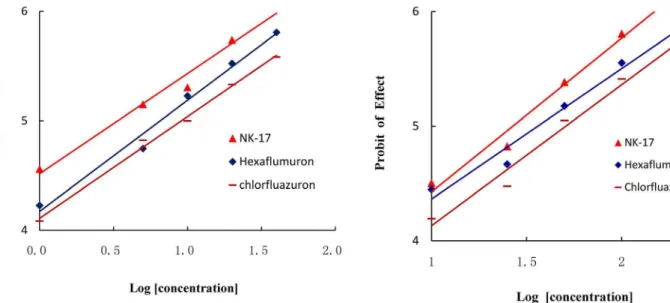
Figure 2. The concentration-effect curve of NK-17, Hexaflu-muron and Chlorfluazuron.The Y-axis is the probit of mortality of Beet Armyworm, S. exigua, The X-axis is the logarithm value of the concentration of the insecticides, at last, the nymphs were assayed by using of leaves-dip method.
doi:10.1371/journal.pone.0066251.g002
Figure 3. The concentration-effect curve of NK-17, Hexaflu-muron and Chlorfluazuron.The Y-axis is the probit of mortality of Diamondback Moth, P. xylostella, accordingly, The X-axis is the logarithm value of the concentration of the insecticides, at last, the nymphs were assayed by using of leaves-dip method.
respectively added to the mixture containing SUR, buffer and 1-NPN, and then the mixture was incubated for 1 h at room temperature. The binding affinity was assayed by FP.
The FP assay. The value of FP was measured using Cary Eclipse Fluorescence Spectrofluorimeter (Agilent). The emission wavelength was emitted at 410 nm (with a slit width of 10 nm) and the excitation wavelength was emitted at 337 nm (with a slit width of 10 nm). Polarization is expressed as:
P~
I \{GIP I
\zGIP
The IH and II represent the vertically and horizontally
polarized emission intensities, respectively, while polarized excita-tion light is vertical. The G factor is the instrumental effects and can be expressed as:
Figure 4. Evaluation of 5% NK-17 EC againstS. exigua.The trials was carried out in the cabbages in the Zhangjiawo vegetable production area, Xiqing district, Tianjin City, China, in 2011 and 2012. The 5%NK-17 EC had the better performance on controllingS. exiguain the cabbage field than the commercial insecticides 5% Hexaflumuron.
doi:10.1371/journal.pone.0066251.g004
Table 4.Effect of insecticidal progam onS. exiguain Tianjin City in 2011.
1 day after treatedb 3 day after treated 7 day after treated 14day after treated
Treatsa Effect(%)
Significance of
differencec Effect
(%)
Significance of
difference Effect(%)
Significance of
difference Effect(%)
Significance of difference
0.05 0.01 0.05 0.01 0.05 0.01 0.05 0.01
I 45.69 b A 64.41 b A 75.18 b A 83.52 b A
II 50.09 ab A 72.11 ab A 80.95 ab A 85.99 b B
III 54.50 a A 76.83 a A 84.74 a A 90.19 a B
IV 48.75 ab A 67.26 ab A 77.61 b A 84.71 b B
control - - -
-aI: 5% NK-17 EC, 15 g a.i. ha21, II: 5% NK-17 EC, 30 g a.i. ha21, III: 5% NK-17 EC, 60 g a.i. ha21NK-17; IV: 5% hexaflumuron EC, 60 g a.i. ha21.bdays after treats: the number of each plot were investigated, days after spraying insecticides.c: the significance of difference among the all treats were computed using Duncan’s new multiple range to give the level of difference in p = 0.05 and p = 0.01.
G~
IP
\
IPP
The IIH and III represent the vertically and horizontally
polarized emission intensities, respectively, while polarized excita-tion light is horizontal. The polarizaexcita-tion of each sample was
obtained from an average of 6 measurements each ofIHandII,
and five values of such a set of averages were collected.
Results and Discussion
Effects of insecticides againstS. exigua, P. xylostellaand
M. separatein laboratory
The concentration-effect curves of the bioassay results of
NK-17 and contrast compounds against S. exigua are presented in
Figure 2. The LC50values and the slope6SEM ofNK-17were
calculated according to the curve and are shown in Table 1. The
LC50(95% confidence limits) value ofNK-17againstS. exiguawas
3.38 mg L21 (2.68-4.25 mg L21), whereas the LC50 (95%
confidence limits) values of hexaflumuron and chlorfluazuron
were 6.54 mg L21 (5.45-7.84 mg L21) and 9.09 mg L21
(8.20-10.07 mg L21), respectively. Hence, the toxicity of NK-17was
1.93 times and 2.69 times respectively those of hexaflumuron and chlorfluazuron.
Similarly, in Table 2 and 3, the LC50(95% confidence limits)
value of NK-17 against P. xylostella was 26.73 mg L21
(22.73-31.44 mg L21), and the toxicity ofNK-17was 1.36 times and 1.90
times of hexaflumuron and chlorfluazuron (Figure 3). The LC50
values and the toxicity regression equations of NK-17 were
calculated according to the curve and are shown in Table 3. The
LC50(95% confidence limits) value of NK-17againstM. separate
was 0.017 mg L21(0.011-0.025 mg L21), and the toxicity of
NK-17was 18.24 times of hexaflumuron.
AsNK-17had definitely stronger toxicity than hexaflumuron
and chlorfluazuron, faster action ofNK-17than those compounds
could be observed from the mortality ofS. exigua, P. xylostellaand
M. separateat 48 h. More importantly, the investigation of toxic
symptoms showed that the action mode ofNK-17is similar, if not
identical to hexaflumuron and chlorfluazuron. The treated larvae displayed several obvious characters of moulting defects, which were a double head capsule caused by the disability to shed the old cutile, and incomplete ecdysis caused by loss of haemolymph at the joint of the new head capsule and the thoracic segments, in that the typical molting problems were observed, and some dying insects still attached to the old cuticles.
Evaluation of insecticidal activities againstS. exiguain field.
Field trials of insecticidal activities againstS. exiguawere carried
out in Tianjin and Changsha during the 2011 and 2012 cropping
seasons. The two year results of the field trials on S. exigua in
Tianjin were given in Figure 4. It showed that 5%NK-17EC at
the dose of 60 g a.i. ha21 had better control effect than the
comparison 5% hexaflumuron EC at the same dosage. The significance of difference was analyzed using Duncan’s new multiple range. The effect data of the trial of Tianjin were indicated in 2011 (Table 4), 1 day after, the control efficiency of 5% NK-17 EC at 60 g a.i. ha21 was 54.50% comparing to 48.75% of 5% hexaflumuron EC at the same conditions.
Therefore, The speed of action of 5%NK-17EC was faster than
5% hexaflumuron EC. 14 days after, the control efficiency of 5%
NK-17EC at 60 g a.i. ha21was 90.19% comparing to 84.71% of
5% hexaflumuron EC. The data of control efficiency in 2012 (Table 5) were similar, if not identical, to that in 2011, for
example, the control efficiency of 5%NK-17EC at 60 g a.i. ha21
achieved to 90.16% in 14 days comparing to 85.97% of 5% hexaflumuron EC.
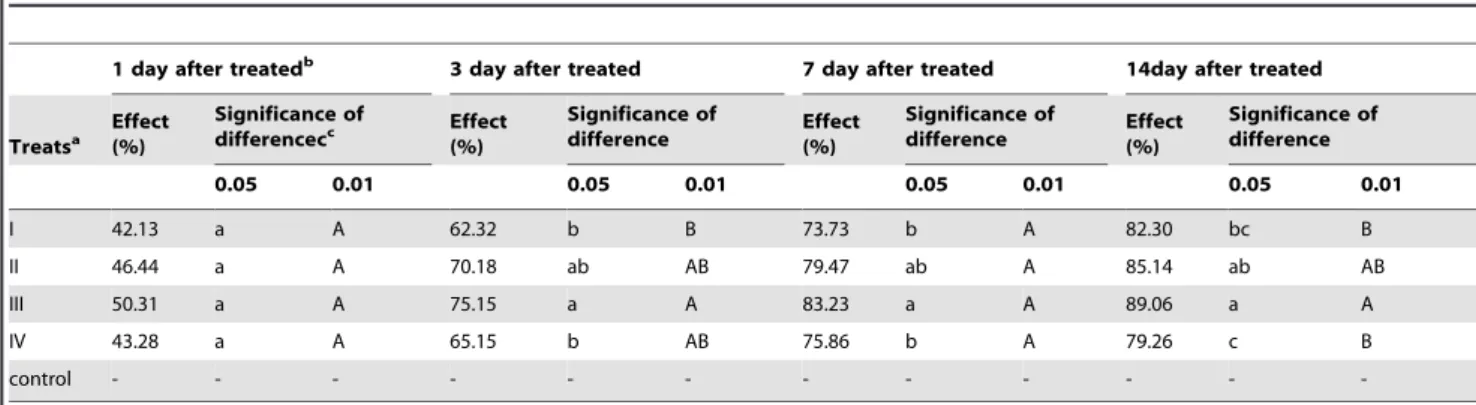
The control efficiency of the trial in Changsha was exhibited in Figure 5, and the result was almost same as Tianjin, so did the data of the trial in Changsha (Table 6). 1 day after, the control
efficiency of 5% NK-17 EC at 60 g a.i. ha21 was 50.31%
comparing to 43.28% of 5% hexaflumuron EC. Therefore, the
speed of action of 5% NK-17 EC was faster than 5%
hexaflumuron EC. 14 days after, the control efficiency of 5%
NK-17EC at 60 g a.i. ha21was 89.06% comparing to 79.26% of 5% hexaflumuron EC. The data of control efficiency in 2012 (Table 7) were similar, if not identical, to that in 2011, for
example, the control efficiency of 5%NK-17EC at 60 g a.i. ha21
achieved to 89.97% in 14 days comparing to 85.14% of 5% Hexaflumuron EC.
Hence, it was suggested that 5%NK-17EC was a promising
insecticide as alternative to the high toxic pesticides against S.
exiguaaccording to the two years and two sites trials.
Figure 5. Evaluation of 5% NK-17 EC againstS. exigua.The trials was carried out in the cabbages in Daqiao village Yuhua district, Changsha City, Hunan Province, China, in 2011 and 2012. The 5% NK-17 EC had the better performance on controllingS. exiguain the cabbage field than the commercial insecticides 5% Hexaflumuron.
doi:10.1371/journal.pone.0066251.g005
Table 6.Effect of insecticidal progam onS. exiguaChangsha City, Hunan Province in 2011.
1 day after treatedb 3 day after treated 7 day after treated 14day after treated
Treatsa Effect(%)
Significance of
differencecc Effect
(%)
Significance of
difference Effect(%)
Significance of
difference Effect(%)
Significance of difference
0.05 0.01 0.05 0.01 0.05 0.01 0.05 0.01
I 42.13 a A 62.32 b B 73.73 b A 82.30 bc B
II 46.44 a A 70.18 ab AB 79.47 ab A 85.14 ab AB
III 50.31 a A 75.15 a A 83.23 a A 89.06 a A
IV 43.28 a A 65.15 b AB 75.86 b A 79.26 c B
control - - -
-aI: 5% NK-17 EC, 15 g a.i. ha21, II: 5% NK-17 EC, 30 g a.i. ha21, III: 5% NK-17 EC, 60 g a.i. ha21NK-17; IV: 5% hexaflumuron EC, 60 g a.i. ha21.bdays after treats: the number of each plot were investigated, days after spraying insecticides.c: the significance of difference among the all treats were computed using Duncan’s new multiple range to give the level of difference in p = 0.05 and p = 0.01.
Evaluation of insecticidal activities againstP. xylostellain field
Firstly, the results of the trials in Tianjin including 2011 and
2012 controllingP. xylostellawere given at 1 day, 3 days, 7 days,
and 14 days respectively in Figure 6. It showed obviously that 5%
NK-17 EC had better control effect than the comparison 5% Chlorfluazuron EC at the all same conditions. The significance of difference was analyzed using Duncan’s new multiple range. The effect data of the trial of Tianjin were indicated in 2011 (Table 8),
1 day after, the control efficiency of 5%NK-17EC at maximum
dosage was 52.07% comparing to 44.31% of 5% Chlorfluazuron EC at the same conditions. Therefore, the speed of action of 5%
NK-17EC was faster than 5% Chlorfluazuron EC. 14 days after,
the control efficiency of 5%NK-17EC at maximum dosage was
88.64% comparing to 81.69% of 5% Chlorfluazuron EC. The data of control efficiency in 2012 (Table 9) were about identical to that in 2011, one of which indicated the control efficiency of 5%
NK-17EC at the same maximum dosage achieving to 88.91% in 14 days comparing to 83.03% of 5% Chlorfluazuron EC.
The results of the trial in Changsha were showed in Figure 7, and the evaluation of the efficiency was almost same as Tianjin, so Table 7.Effect of insecticidal progam onS. exiguaChangsha City, Hunan Province in 2012.
1 day after treatedb 3 day after treated 7day after treated 14 day after treated
Treatsa
Effect (%)
Significance of
differencec Effect
(%)
Significance of
difference Effect(%)
Significance of
difference Effect(%)
Significance of difference
0.05 0.01 0.05 0.01 0.05 0.01 0.05 0.01
I 43.49 b A 64.07 b B 76.34 b A 83.92 b B
II 48.49 ab A 71.49 a AB 82.28 ab A 85.14 b AB
III 53.01 a A 76.29 a A 85.11 a A 89.97 a A
IV 46.50 ab A 71.88 a AB 79.55 ab A 85.14 b AB
control - - -
-aI: 5% NK-17 EC, 15 g a.i. ha21, II: 5% NK-17 EC, 30 g a.i. ha21, III: 5% NK-17 EC, 60 g a.i. ha21NK-17; IV: 5% hexaflumuron EC, 60 g a.i. ha21.bdays after treats: the number of each plot were investigated, days after spraying insecticides.c: the significance of difference among the all treats were computed using Duncan’s new multiple range to give the level of difference in p = 0.05 and p = 0.01.
doi:10.1371/journal.pone.0066251.t007
Figure 6. Evaluation of 5% NK-17 EC againstP. xylostella.The trials was carried out in the Zhangjiawo vegetable production area, Xiqing district, Tianjin City, China, in 2011 and 2012. The 5% NK-17 EC had the better performance on controllingP. xylostellain the cabbage field than the commercial insecticides 5% chlorfluazuron.
did the data of the trial in Changsha in 2011 (Table 10). 1 day
after, the control efficiency of 5% NK-17 EC at the same
maximum dosage was 51.35% comparing to 43.04% of 5%
Chlorfluazuron EC. Therefore, the fast action of 5%NK-17EC
was suprior than 5% Chlorfluazuron EC. 14 days after, the control
efficiency of 5% NK-17 EC at 60 g a.i. ha21 was 87.85%
comparing to 82.88% of 5% Chlorfluazuron EC. The data of control efficiency in 2012 (Table 11) were similar, if not identical, to that in 2011, one of which showed the control efficiency of 5%
NK-17EC at the maximum dosage achieving to 88.22% in 14 days comparing to 84.37% of 5% Chlorfluazuron EC on the same conditions.
Hence, it was suggested that 5%NK-17EC was a promising
insecticide as alternative to the high toxic pesticides against P.
xylostelladepending on the results of the two years and two sites trials.
Action mechanism study of NK-17
Effects of NK-17 against B. germanica in
laboratory. Insecticidal activity ofNK-17, diflubenzuron and
glibenclamide againstB. germanica in vivowas firstly assayed. The
aim of the assay was to determine the activity order of the three compounds, which would be used to compare with the order of
bioactivity in vitro (SUR binding affinity). According to the
concentration-effect curves of the bioassay results presented in
Figure 8, the order of toxicity to B. germanica was NK-17 .
diflubenzuron.glibenclamide according to the LD50of 0.12 mg
L21, 0.23 mg L21, 0.56 mg L21, respectively. Moreover, the
molting symptom ofNK-17was identical to diflubenzuron and
glibenclamide, which suggestedNK-17may have the same action
mechanism as diflubenzuron and glibenclamide.
Affinity of NK-17 binding to SUR. As previously men-tioned, by utilizing the isotope labeling technology, diflubenzuron was testified to act on the same target site of SUR proteins as glibenclamide [22]. In this paper, we would like to adopt
fluorescence polarization (FP) method to ascertain ifNK-17could
also bind in the same site of SUR.
The FP assay is based on the high affinity binding of the fluorescence probe N-phenyl -1-naphthylamine (1-NPN) to a specific site of SUR. After absorbing polarized light, free 1-NPN of relatively small molecular weight emits light in all directions due to the fast tumbling rate, resulting in low polarization. Binding to the target protein SUR, the 1-NPN molecules rotate slower due to the larger combined molecular size of the complex. Consequently, they emit radiation in the same direction as that of the incident light, and exhibit higher polarization. When some compounds can displace the 1-NPN molecules from SUR, the disruption of the
Table 9.Effect of insecticidal progam onP. xylostellain Tianjin City in 2012.
1 day after treatedb 3 day after treated 7day after treated 14 day after treated
Treatsa Effect(%)
Significance of
differencec Effect
(%)
Significance of
difference Effect(%)
Significance of
difference Effect(%)
Significance of difference
0.05 0.01 0.05 0.01 0.05 0.01 0.05 0.01
I 40.21 a A 62.04 b B 73.72 b B 81.46 b B
II 47.01 a A 70.84 ab AB 81.05 a AB 84.92 ab AB
III 52.05 a A 75.84 a A 84.52 a A 88.91 a A
V 43.53 a A 67.03 ab AB 77.28 ab AB 83.03 b AB
control - - -
-aI: 5% NK-17 EC, 15 g a.i. ha21, II: 5% NK-17 EC, 30 g a.i. ha21, III: 5% NK-17 EC, 60 g a.i. ha21NK-17; V: 5% Chlorfluazuron EC, 60 g a.i. ha21.bdays after treats: the number of each plot were investigated, days after spraying insecticides.c: the significance of difference among the all treats were computed using Duncan’s new multiple range to give the level of difference in p = 0.05 and p = 0.01.
doi:10.1371/journal.pone.0066251.t009
Table 8.Effect of insecticidal progam onP. xylostellain Tianjin City in 2011.
1 day after treatedb 3 day after treated 7 day after treated 14day after treated
Treatsa
Effect (%)
Significance of
differencec Effect
(%)
Significance of
difference Effect(%)
Significance of
difference Effect(%)
Significance of difference
0.05 0.01 0.05 0.01 0.05 0.01 0.05 0.01
I 40.68 a A 61.60 b B 73.20 b B 80.57 b B
II 47.65 a A 70.12 a AB 80.50 a AB 84.37 b AB
III 52.07 a A 75.15 a A 83.82 a A 88.64 a A
V 44.31 a A 66.43 ab AB 76.64 ab AB 81.69 b B
control - - -
-aI: 5% NK-17 EC, 15 g a.i. ha21, II: 5% NK-17 EC, 30 g a.i. ha21, III: 5% NK-17 EC, 60 g a.i. ha21NK-17; V: 5% Chlorfluazuron EC, 60 g a.i. ha21.bdays after treats: the number of each plot were investigated, days after spraying insecticides.c: the significance of difference among the all treats were computed using Duncan’s new multiple range to give the level of difference in p = 0.05 and p = 0.01.
binding between the 1-NPN molecules and the protein can be identified by decreased polarization.
First of our work was to test and verify the feasibility of this FP assay by the competitive displacement of 1-NPN with glibencla-mide and diflubenzuron from 1-NPN-SUR. The SUR proteins of
B. germanica were prepared by the reported method with some minor modifications. However, the concentration of the SUR cannot be accurately measured without its crystal structure, because its gene has never decoded so far. Furthermore, the vesicles containing the SUR were not stable enough for the receptor to bind to the fluorescence probe after a long time.
Therefore, the binding affinity of NK-17, diflubenzuron and
glibenclamide with SUR were compared within the same set of experiments with the same vesicle preparation, and over 5 replicates must be carried out to further minimize the error.
Because of previous discussion, we had to measure the affinity of the probe binding to SUR to elucidate the dose of the probe very time (Figure 9). At beginning, the FP was quickly raised by increasing the dosage of the probe to indicate the all probe binding to the SUR in order to find the most proper concentration of the probe [33].
Figure 7. Evaluation of 5% NK-17 EC againstP. xylostella.The trials was carried out in the cabbages in Daqiao village Yuhua district, Changsha City, Hunan Province, China, in 2011 and 2012. The 5% NK-17 EC had the better performance on controllingP. xylostellain the cabbage field than the commercial insecticides 5% chlorfluazuron.
doi:10.1371/journal.pone.0066251.g007
Table 10.Effect of insecticidal progam onP. xylostellaChangsha City, Hunan Province in 2011.
1 day after treated 3 day after treated 7 day after treated 14day after treated
Treats Effect (%)
Significance of
difference Effect(%)
Significance of
difference Effect(%)
Significance of
difference Effect(%)
Significance of difference
0.05 0.01 0.05 0.01 0.05 0.01 0.05 0.01
I 40.03 a A 60.75 b B 73.63 c A 81.01 c B
II 47.39 a A 69.93 a AB 81.52 ab A 84.87 ab AB
III 51.35 a A 75.11 a A 83.74 a A 87.85 a A
V 43.04 a A 65.90 ab AB 75.55 bc A 82.88 bc AB
control - - -
-aI: 5% NK-17 EC, 15 g a.i. ha-1, II: 5% NK-17 EC, 30 g a.i. ha21, III: 5% NK-17 EC, 60 g a.i. ha21NK-17; V: 5% Chlorfluazuron EC, 60 g a.i. ha21.bdays after treats: the number of each plot were investigated, days after spraying insecticides.c: the significance of difference among the all treats were computed using Duncan’s new multiple range to give the level of difference in p = 0.05 and p = 0.01.
With the most proper concentration of the 1-NPN-SUR,
NK-17, diflubenzuron and glibenclamide as competitive ligands
binding to the SUR were assayed by FP (Figure 10). According
to the affinity result of the three compounds, the order wasNK-17
.diflubenzuron.glibenclamide, which was consistent with the
bioactivity againstB. germanica in vivo.
Conclusions
Our research on insecticidal activities ofNK-17in laboratory
and in field (two years, two trial sites) showed that the toxicity of
NK-17againstS. exiguawas 1.93 times and 2.69 times respectively those of hexaflumuron and chlorfluazuron, and the toxicity of
NK-17 against P. xylostella was 1.36 times and 1.90 times
respectively those of hexaflumuron and chlorfluazuron, and the
toxicity of NK-17 against M. separate was 18.24 times those of
hexaflumuron in laboratory. 5%NK-17EC at 60 g a.i. ha21can
controlS. exiguawith the best control efficiency of about 89% in
Changsha and Tianjin in field, which suggested that 5%NK-17
EC a promising insecticide as alternative to the high toxic
insecticide againstS. exigua. 5%NK-17EC at 60 g a.i. ha21can
controlP. xylostellawith the best control efficiency of over 88% in
Changsha and Tianjin, which suggested that 5%NK-17 EC a
promising insecticide as alternative to the high toxic pesticides
againstP. xylostella. Therefore, we conclude thatNK-17is a very
comprising insecticide candidate for controlling pests in crops, vegetables and fruits.
We explored the insecticidal mechanism ofNK-17by utilizing
fluorescence polarization method for the first time.NK-17could
bind to SUR with stronger affinity comparing to DFB and Table 11.Effect of insecticidal progam onP. xylostellaChangsha City, Hunan Province in 2012.
1 day after treatedb 3 day after treated 7day after treated 14 day after treated
Treatsa
Effect (%)
Significance of
differencec Effect
(%)
Significance of
difference Effect(%)
Significance of
difference Effect(%)
Significance of difference
0.05 0.01 0.05 0.01 0.05 0.01 0.05 0.01
I 40.86 a A 62.23 b A 74.87 b A 82.00 b B
II 45.39 a A 70.80 ab A 81.53 ab A 84.37 ab AB
III 52.26 a A 75.82 a A 84.45 a A 88.22 a A
V 42.79 a A 66.83 ab A 76.45 b A 84.37 ab AB
control - - -
-aI: 5% NK-17 EC, 15 g a.i. ha21, II: 5% NK-17 EC, 30 g a.i. ha21, III: 5% NK-17 EC, 60 g a.i. ha21NK-17; V: 5% Chlorfluazuron EC, 60 g a.i. ha21.bdays after treats: the number of each plot were investigated, days after spraying insecticides.c: the significance of difference among the all treats were computed using Duncan’s new multiple range to give the level of difference in p = 0.05 and p = 0.01.
doi:10.1371/journal.pone.0066251.t011
Figure 9. Binding of 1-NPN ligand to the sSUR.Binding of 1-NPN to the SUR protein in the MES-sucrose. As the concentration of the fluorescence probe 1-NPN was gradually elevated, the value of fluorescence polarization was according improved in the origin. When the concentration was increase to 3mM, the value of FP began to keep a balance. That indicates that the binding of 1-NPN to SUR was saturated, therefore, 3mM was used as the standand concentration in investing the comparative affinity to other ligands in the experiment.
doi:10.1371/journal.pone.0066251.g009
Figure 8. The concentration-effect curve of NK-17, Difluben-zuron and Glibenclamide.The Y-axis is the probit of mortality of cockroach, B. germanica, The X-axis is the logarithm value of the concentration of the insecticides, at last, the nymphs were assayed by using topical application technique. By passing of Probit analysis for NK-17: Slope6SEM = 0.6760.03, the LD50(95% confidence limits) value of
NK-17 was 0.12 mg?L21
(0.10–0.13 mg?L21
), whereas the LD50 (95%
confidence limits) values of diflubenzuron and glibenclamide were 0.23 mg?L21(0.21–0.25 mg
?L21) and 0.56 mg
?L21(0.42–0.75 mg ?L21),
respectively.
glibenclamide, and the result can well explained that NK-17
exhibited stronger toxicity against B. germanica than DFB and
glibenclamidein vivo. It is suggested that NK-17may act on the
site of SUR to inhibit the chitin synthesis in insect body.
Acknowledgments
We thank Prof. Xiaoming Ou (National engineering research center for Agrochemicals, hunan research institute of chemical industry, Changsha) and Prof. Xishu Gu (Tianjin institute of Plant protection, Tianjin) for helps in field trials. We thank Prof. Shangzhong Liu and Jianjun Zhang (Key Laboratory of Pesticide Chemistry and Application, MOA, Department of Applied Chemistry, College of Science, China Agricultural University) for helps in Cary Eclipse Fluorescence Spectrofluorimeter.
Author Contributions
Conceived and designed the experiments: YL XY QW YL. Performed the experiments: YL YQ NY QW YL. Analyzed the data: YL XY QW YL. Contributed reagents/materials/analysis tools: YL YQ YS RS. Wrote the paper: YL QW YL.
References
1. Van Daalen JJ, Meltzer J, Mulder R (1972) Selective insecticide with a novel mode of action. Naturwissenschaften, 59: 312–313.
2. Green Chemistry website. Available: http://www.epa.gov/greenchemistry/ pubs/pgcc/winners/dgca00.html. Accessed 2000.
3. Oberlander H, Silhacek DL (1998) Mode of action of insect growth regulators in Lepidopteran tissue culture. Pestic Sci 54: 300–302.
4. Post LC, Vincent WR (1973) A new insecticide inhibits chitin synthesis. Naturwissenschaften 60: 4312432.
5. Yang XL, Wang DQ, Chen FH, Zhang ZN (1998) The synthesis and larvicidal activity ofN-aroyl-N9-(5-aryl-2-furoyl)ureas. Pestic Sci 52: 2822286. 6. Xu XY, Qian XH, Li Z, Huang QC, Chen G (2003) Synthesis and insecticidal
activity of new substitutedN-aryl-N9-benzoylth-iourea compounds. J Fluorine Chem 121: 51–54.
7. Qian XH (1999) Quantitative studies on structure activity relationship of sulfonylurea and benzoylphenylurea type pesticides and their substituents bioisosterism using synthons activity contribution. J Agric Food Chem 47: 4415–4418.
8. Kubato S, Shono Y, Matsunaga T, Tsunoda K (2006) Laboratory evaluation of bistrifluron, a benzoylphenylurea compound, as a bait toxicant against Coptotermes formosanus (Isoptera: Rhinotermitidae). J Econ Entomol 99: 1363–1368.
9. Chen L, Ou XM, Mao CH, Shang J, Huang RQ, et al. (2007) Synthesis and bioassay evaluation of 1-(4-substitutedideneaminooxymethyl)phenyl-3-(2,6-di-fluorobenzoyl)ureas. Bioorg Med Chem 3678–3683.
10. Yoon C, Yang JO, Kang SH, Kim GH (2008) Insecticidal properties of bistrifluron against sycamore lace bug, Corythuchaciliata (Hemiptera: Tingidae). J Pestic Sci 33: 44–50.
11. Chen L, Wang QM, Huang RQ, Mao CH, Shang J, et al. (2005) Synthesis and insecticidal evaluation of propestcides of benzoylphenylureas. J Agric Food Chem 53:38–41.
12. Sun RF, Zhang YL, Chen L, Li YQ, Li QS, et al. (2009) Design, synthesis, and insecticidal activities of newN-benzoyl-N’-phenyl-N’-sulfenylureas. J Agric Food Chem 57: 3661–3668.
13. Sun RF, Zhang YL, Bi FC, Wang QM (2009) Design, synthesis, and bioactivity study of novel benzoylpyridazylureas. J Agric Food Chem 57: 6356–6361. 14. Sun RF, Liu YX, Zhang YL, Xiong LX, Wang QM (2011) Design and synthesis
of benzoylphenylureas with fluorinated substituents on the aniline ring as insect growth regulators. J Agric Food Chem 59:2471–2477.
15. Sun RF, Li YQ, Xiong LX, Liu YX, Wang QM (2011) Design, synthesis, and insecticidal evaluation of new benzoylureas containing isoxazoline and isoxazole group. J Agric Food Chem 59: 4851–4859.
16. Sun RF, Lu¨ MY, Chen L, Li QS, Song HB, et al. (2008) Design, synthesis, bioactivity, and structure activity relationship (SAR) studies of novel benzoyl-phenylureas containing oxime ether group. J Agric Food Chem 56: 11376– 11391.
17. Qian XH, Lee PW, Cao S (2010) China: Forward to the Green Pesticides via a Basic Research Program. J Agric Food Chem 58: 2613–2623.
18. Mayer RT, Chen AC (1981) Chitin synthesis inhibiting insect growth regulators do not inhibit chitin synthase. Experientia 37: 337–338.
19. Cohen E, Casida JE (1980) Inhibition ofTriboliumgut chitin synthetase. Pestic. Biochem. Physiol. 13: 129–136.
20. Meola SM, Mayer RT (1980) Inhibition of cellular proliferation of imaginal epidermal cells by diflubenzuron in pupae of the stable fly. Science 207: 985– 987.
21. DeLoach JR, Meola SM, Mayer RT, Thompson JM (1981) Inhibition of synthesis by diflubenzuron in pupae of the stable flyStomoxys calcitrans. Pestic. Biochem. Physiol. 15: 172–180.
22. Abo-Elghar GE, Fujiyoshi P, Matsumura F (2004) Significance of the sulfonylurea receptor (SUR) as the target of diflubenzuron in chitin synthesis inhibition in Drosophila melanogaster and Blattella germanica. Insect Biochem. Mol Biol 34: 7432752.
23. Matsumura F(2010) Studies on the action mechanism of benzoylurea insecticides to inhibit the process of chitin synthesis in insects: A review on the status of research activities in the past, the present and the future prospects. Pestic Biochem Physiol 97: 1332139.
24. Burke MA, Mutharasan RK, Ardehali H (2008) The Sulfonylurea Receptor, an Atypical ATP-Binding Cassette Protein, and Its Regulation of the KATP
Channel. Circ Res 102:164–176.
25. Higgins CF, Linton KJ (2004) The ATP switch model for ABC transporters. Nat Struct Mol Biol 11: 918–926.
26. Miki T, Liss B, Minami K, Shiuchi T, Saraya A, et al. (2001) ATP-sensitive K+
channels in the hypothalamus are essential for the maintenance of glucose homeostasis. Nat Neurosci 4: 507–12.
27. Harris A, Cox S, Burns D, Norey C (2003) Miniaturization of fluorescence polarization receptor-binding assays using CyDye-labeled ligands, .J Biomol Screen8410–420.
28. Chen L, Huang ZQ, Wang QM, Shang J, Huang RQ, et al. (2007) Insecticidal benzoyl phenylurea-S-carbamate: a new propesticide with two effects of both benzoylphenylureas and carbamates. J Agric Food Chem 55: 2659–2663. 29. Shang J, Sun RF, Li YQ, Huang RQ, Bi FC, et al. (2010) Synthesis and
insecticidal evaluation of N-tert-butyl-N9
-thio[1-(6-chloro-3-pyridylmethyl)-2-Figure 10. Binding of NK-17, Glibenclamide and diflubenzuron to SURs. Binding reactions were incubated for 1 h at room temperature. All measurements were done in tetraplicate; data are the average of the all repeat experiments. The affinity was assayed using fluorescence polarization. The lower FP indicates the more intensive receptor-ligand binding affinity.
nitroiminoimidazolidine]-N,N9-diacylhydrazines. J Agric Food Chem 58: 1834– 1837.
30. Abbott WS (1925) A method of computing the effectiveness of an insecticide. J Econ Entomol 18: 265–267.
31. Siegel S, Castellan NJ Jr. (1988) Nonparametric statistics for the behavioral sciences. Singapore: McGraw-Hill Book Co.
32. FAO (1979) Recommended methods for the detection and measurement of resistance of agricultural pests to pesticides: method for adult aphids; FAO method 17. FAO Plant Protection Bulletin 18, 6.