Submitted27 October 2015
Accepted 9 December 2015
Published5 January 2016
Corresponding author
Philippe Prior, [email protected]
Academic editor
Christine Josenhans
Additional Information and Declarations can be found on page 15
DOI10.7717/peerj.1549
Copyright
2016 Ailloud et al.
Distributed under
Creative Commons CC-BY 4.0
OPEN ACCESS
In planta
comparative transcriptomics
of host-adapted strains of
Ralstonia
solanacearum
Florent Ailloud1,2, Tiffany M. Lowe3, Isabelle Robène1, Stéphane Cruveiller4,5, Caitilyn Allen3and Philippe Prior1,6
1UMR Peuplements Végétaux et Bioagresseurs en Milieu Tropical, Centre de coopération International en Recherche Agronomique pour le Développement, Saint-Pierre, France
2Laboratoire de la Santé des Végétaux, Agence Nationale Sécurité Sanitaire Alimentaire Nationale, Saint-Pierre, France
3Department of Plant Pathology, University of Wisconsin-Madison, Madison, WI, United States
4Laboratoire d’Analyses Bioinformatiques pour la Genomique et le Metabolisme, Commissariat à l’Energie Atomique et aux Energies Alternatives, Evry, France
5UMR CNRS 8030 - Génomique Métabolique, Centre National de la Recherche Scientifique, Evry, France 6Département de Santé des Plantes et Environnement, Institut National de la Recherche Agronomique,
Sophia Antipolis, France
ABSTRACT
Background. Ralstonia solanacearum is an economically important plant pathogen with an unusually large host range. The Moko (banana) and NPB (not pathogenic to banana) strain groups are closely related but are adapted to distinct hosts. Previous comparative genomics studies uncovered very few differences that could account for the host range difference between these pathotypes. To better understand the basis of this host specificity, we used RNAseq to profile the transcriptomes of an
R. solanacearumMoko strain and an NPB strain underin vitroandin plantaconditions.
Results.RNAs were sequenced from bacteria grown in rich and minimal media, and from bacteria extracted from mid-stage infected tomato, banana and melon plants. We computed differential expression between each pair of conditions to identify constitutive and host-specific gene expression differences between Moko and NPB. We found that type III secreted effectors were globally up-regulated upon plant cell contact in the NPB strain compared with the Moko strain. Genes encoding siderophore biosynthesis and nitrogen assimilation genes were highly up-regulated in the NPB strain during melon pathogenesis, while denitrification genes were up-regulated in the Moko strain during banana pathogenesis. The relatively lower expression of
oxidases and the denitrification pathway during banana pathogenesis suggests that
R. solanacearum experiences higher oxygen levels in banana pseudostems than in tomato or melon xylem.
Conclusions.This study provides the first report of differential gene expression associ-ated with host range variation. Despite minimal genomic divergence, the pathogenesis of Moko and NPB strains is characterized by striking differences in expression of virulence- and metabolism-related genes.
SubjectsGenomics, Microbiology
BACKGROUND
Although the virulence mechanisms of the modelRalstonia solanacearumstrain GMI1000 have been extensively investigated in model host plants such asSolanum lycopersicum
(tomato) andArabidopsis thaliana, the genetically diverseRalstonia solanacearumspecies complex (RSSC) has a cumulative host range that includes more than 250 plant species (Genin & Denny, 2012). Very little is known about the prevalence of virulence factors in the RSSC or their contribution to disease across this wide array of hosts. Moreover, recent
in plantastudies have tended to disprove models of virulence regulation that were based onin vitrostudies (Jacobs et al., 2012;Monteiro et al., 2012).
RSSC strains cluster in four phylotypes that correspond to strain geographic origin; we focused on phylotype II, which are strains that originated in the Americas. Several groups of strains appear to have adapted to specific hosts; these are often clustered in distinct phylogenetic lineages. The best studied is the brown rot pathotype (phylotype IIB-1), which is a monophyletic group of strains that wilt potatoes in cool highland tropical and temperate zones (Cellier & Prior, 2010). Less studied groups include the Moko and not-pathogenic-to-banana (NPB) pathotypes. The Moko pathotype is a polyphyletic group (phylotype IIB3, IIB4, IIA6, IIA24, etc.) of strains that are pathogenic to banana but not to cucurbits (Cellier & Prior, 2010). The NPB pathotype is a monophyletic group very close to the IIB4 Moko lineage that has lost the ability to infect banana. However, it is highly virulent on several members of theCucurbitaceae family (Wicker et al., 2009;Wicker et al., 2007). Remarkably, most of the strains in these two groups are also pathogenic to tomato plants. Thus, the host spectrums of Moko and NPB strains include both exclusive host plants and a common host, tomato. Because NPB and IIB4 Moko strains are genetically similar but have strikingly different biological host ranges, these strains offer a compelling experimental model to pinpoint mechanisms of host specificity inR. solanacearum.
We previously used comparative genomic analysis to characterize the gene content and sequence differences between Moko and NPB strains from the IIB4 lineage. The lack of significant genomic differences between these strains, particularly with respect to virulence factors, led us to hypothesize that the different host ranges of Moko and NPB strains can be explained by differential expression of common genes (Ailloud et al., 2015).
R. solanacearum
Strain UW163
Pathotype Moko (M)
Strain IBSBF1503
Pathotype NPB (N)
Banana
[
M-Ban
]
Tomato
[
M-Tom
]
Rich
medium
[
M-CPG
]
Minimal
medium
[
M-BMM
]
Melon
[
N-Mel
]
Tomato
[
N-Tom
]
Rich
medium
[
N-CPG
]
Minimal
medium
[
N-BMM
]
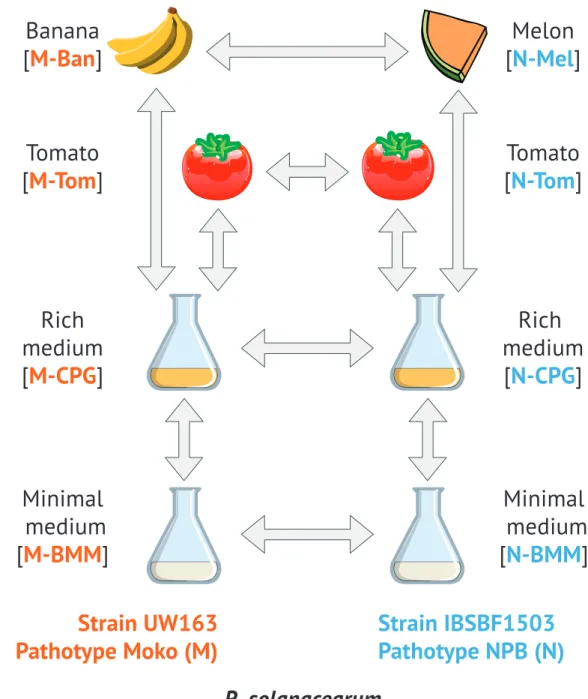
Figure 1 Experimental design.Each pictogram represents a different condition. Arrows indicate pair of
condition that have been analyzed for differential gene expression. M-CPG or N-CPG: Moko (banana) or NPB (not pathogenic to banana) strains grown in rich medium; M-BMM or N-BMM: Moko or NPB strains grown minimal medium; M-Tom or N-Tom: Moko or NPB strain extracted from tomato; M-Ban: Moko strain extracted from banana; N-Mel: NPB strain extracted from melon.
MATERIALS AND METHODS
Bacterial strains and growth conditions
and belongs to the banana Moko disease-causing pathotype. IBSBF1503 was isolated in 1999 from cucumber in Brazil; it is classified phylogenetically as phylotype IIB4 and belongs to the NPB pathotype, a pathological variant that is pathogenic on Cucurbits. Both strains were grown aerobically at 28 ◦C in Boucher’s minimal medium (BMM) (Boucher et al., 1985) or rich medium composed of casamino acid, peptone and glucose (CPG) supplemented with yeast extract (Hendrick & Sequeira, 1984).
RNA extraction for RNAseq
To observe the transcriptomic landscape of the bacterial cellsin vitro(i.e., outside plants), the two strains were grown independently in CPG or BMM to a density of
∼6×10⁸CFU/ml (O.D.=0.8). Total bacterial RNA was extracted from bacterial pellets as described (Jacobs et al., 2012). Three biological replicates were performed for each condition.
To profile the bacterial transcriptomes during plant colonization, plants were infected with 5×10⁸CFU via soil-soak inoculation as described inCellier & Prior, (2010)(Cellier & Prior, 2010). Tomato plants (wilt-susceptible cv. Bonny Best) were inoculated with either UW163 or IBSBF1503. Banana plants (Cavendish) were inoculated with UW163. Melon plants (cv. Amish) were inoculated with IBSBF1503. Bacteria were extracted from plant stems showing early wilt symptoms at a disease index (D.I.) of 1, which corresponds to wilt symptoms on<25% of leaves. RNA was extracted from bacteria centrifuged out
of plant stems as described (Jacobs et al., 2012). Only stems containing between 108and 109CFU bacteria/g of tissue were used for extraction. Three biological replicates were performed for each condition, and each replicate consisted of a pool of RNA extracted from∼15 stems.
RNA sequencing was carried out by the University of Wisconsin Biotech Center (UWBC, Madison, WI, USA). One hundred base pair single-end libraries were sequenced on an Illumina platform (HiSeq 2000). Each library was sequenced twice to provide technical replicates. Read quality was controlled with FastQC 0.10.1 (www.bioinformatics. bbsrc.ac.uk/projects/fastqc). Low-quality bases and adapters were trimmed using
Trimmomatic 0.33 (Bolger, Lohse & Usadel, 2014). RNAseq raw data (fastq) are available under BioProjectPRJNA297400for UW163 and BioProjectPRJNA297402for IBSBF1503.
Genome resequencing
Differential expression analysis
Reads from each library were mapped onto their corresponding reference genome using Bowtie2 2.2.2 (Langdon, 2015); the number of uniquely mapped reads for each coding sequence (CDS) was then counted using Bedtools 2.20.1 (Quinlan, 2014). Differential gene expression between multiple pairs of conditions was computed using edgeR 3.6.2 (Robinson, McCarthy & Smyth, 2010) and DEseq2 1.4.5 (Love, Huber & Anders, 2014). Only CDS predicted by both methods with a False Discovery Rate (FDR corrected
P-value)<0.01 and a−2>log2Fold-Change (log2FC)>2 were considered differentially expressed (DE). When comparing the Moko and NPB strains, we discarded genes
duplicated with 100% identity in only one strain. Otherwise, false positive down-regulated genes would be produced in the strain containing two copies when reads mapped to each copy were rejected during the counting phase.
RESULTS AND DISCUSSION
Initial results
Mapping indicated that bacterial RNA extraction and library preparation were efficient. For each sample, rRNA and plant RNA contamination were limited, and 60–90% of the total sequenced reads were mapped to CDS, with>10 M mapped reads per sample.
Principal component analysis (PCA) of the counts data revealed that biological and technical replicates were consistent (data not shown). Differentially expressed genes were obtained by merging the results of the edgeR and DEseq2 packages. Although there were some differences between the two sets of results, as expected, these differences were marginal (Anders et al., 2013;Guo et al., 2013). An inspection of the MA (log2FC against log-CPM) and volcano (negative log10FDR-ajustedP-value against log2FC) plots suggested no bias between the Count Per Million (CPM) and either the log2FC or the FDR-adjustedP-value.
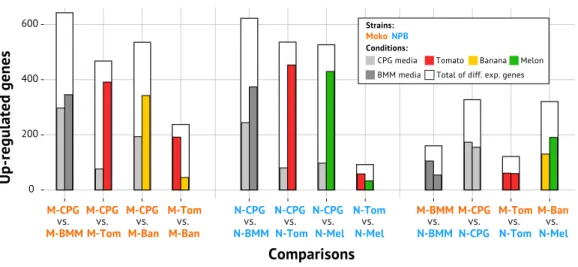
Differential gene expression was computed between multiple pairs of samples to identify the differences between the IIB4 Moko and NPB strainsin vitroandin planta
during the colonization of several hosts (Fig. 2) (Table S1). Overall, we observed many more differentially expressed genes between bacteria growing in rich CPG and minimal BMM media (∼40% of the genome) than in the plant-to-plant comparisons (10–20% of the genome).
Figure 2 Differential gene expression across all tested comparisons.Each comparison is described by three bars: the first and second inside colored bars corresponds to the number of genes differentially up-regulated in the first and second condition, respectively; the outside white bar indicates the total num-ber of differentially expressed genes in the comparison. M-CPG or N-CPG: Moko (banana) or NPB (not pathogenic to banana) strains grown in rich medium; M-BMM or N-BMM: Moko or NPB strains grown minimal medium; M-Tom or N-Tom: Moko or NPB strain extracted from tomato; M-Ban: Moko strain extracted from banana; N-Mel: NPB strain extracted from melon.
Conserved regulatory pathways in similar environments: Moko vs. NPB strains in CPG, BMM and the common host plant, tomato
Moko and NPB IIB4 strains share more than 90% of their gene content, and 80% of these common genes are perfectly identical at the nucleotide level (Ailloud et al., 2015). By comparing UW163 (Moko) and IBSBF1503 (NPB) gene expression in similar environ-ments (tomato stems, rich CPG and minimal BMM media), we were able to characterize the extent to which these small genomic differences have constitutively modified the transcriptomic profiles of these strains. Detailed results are available inTable S2.
An additional 407 genes (9% of the orthologous genes shared by the two strains) had inconsistent expression patterns in the different conditions: i.e., these genes were differ-entially expressed in one or two of the three conditions. This result could be explained by regulatory pathways that are unique to each strain and that are specifically activated by signals present in only some conditions. Of these genes, 40 were only differentially expressed during tomato infection, 220 only in CPG, and 78 only in BMM. These results could also be due to experimental bias if some parameters were not exactly identical between the Moko and NPB strains in one of the conditions.
It should be noted that mapping transcripts to distinct reference genomes for UW163 and IBSBF1503 can lead to computational bias and false positives. Here, we estimated differentially expressed genes based on homolog families shared by both strains. However, even if homolog families are correctly predicted, a locus can be fragmented or have a slightly different start position in one strain, which allows more reads to be mapped in one locus and eventually gives rise to a false positive.
Most of the genes shared by the Moko and NPB strains were expressed similarly under similar conditions. A total of 10% of the shared genes were differentially expressed, but only 1% of the differences were shared among all three conditions and could be considered constitutively different. Taken together, these results suggest that the Moko and NPB strains use very similar virulence strategies to colonize tomato plants.
Plant signal-dependent regulation across hosts and pathotypes: growth in rich medium vs. in plants
To pinpoint genes whose expression is modulated by interaction with plants, RNA extracted from each strain during infection of tomato, banana or melon were compared with RNA of the same strain extracted from rich CPG medium. CPG medium was selected as a neutral baseline for comparison with plant samples because BMM medium appears to at least partially mimic the plant environment (Rahme, Mindrinos & Panopou-los, 1992;Tang, Xiao & Zhou, 2006). Detailed results are given inTable S2.
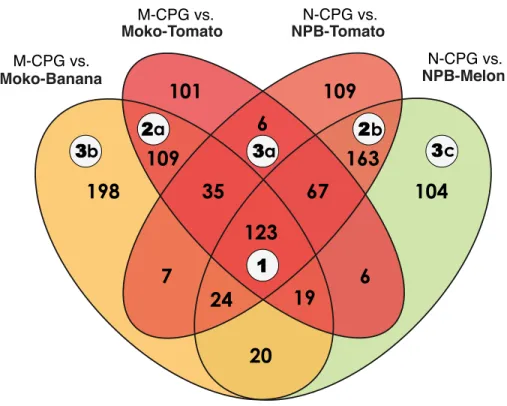
A total of 1,091 genes were differentially regulated by the plant environment in at least one comparison. These genes were classified into 3 categories in an attempt to describe the influence of each plant-by-strain combination on the pathogens’ transcriptomic landscape (Fig. 3).
Figure 3 Venn diagram of differentially expressed genes inR. solanacearumstrains growingin planta
compared to in rich medium.The numbers in circles correspond to biologically relevant categories. Category 1: genes differentially expressed in all plants compared to rich medium; Category 2: genes dif-ferentially expressed in a only a specific strain (Moko (banana): 2a; NPB (not pathogenic to banana): 2b); Category 3: genes differentially expressed in only a specific plant (tomato: 3a; banana: 3b; melon: 3c). M-CPG or N-CPG: Moko or strains grown in rich medium. Moko-Tomato or NPB-Tomato: Moko or NPB strain extracted from tomato; Moko-Banana: Moko strain extracted from banana; NPB-Melon: NPB strain extracted from melon.
catabolism was previously shown to contribute toR. solanacearumvirulence (Jacobs et al., 2012). Importantly, this category also includes 9 of the 69 T3Es shared by these two strains (ripAM,ripAT,ripAY,ripG3,ripR,ripC1,ripG4,ripAN, andripAU). Four of these T3E are part of the species complex core effectome (ripAM,ripAY,ripRandripAN) (Ailloud et al., 2015). Moreover,ripAN is one of the few genes (and the only T3E gene) with non-synonymous polymorphisms that are conserved between all sequenced Moko and NPB lineages. Although all these genes are differentially expressed in all conditions and do not diverge across strains and hosts, they provide important information about which genes are modulated by plant signals in theseR. solanacearumlineages.
in strictly anaerobic growth. Structural differences leading to different in plant oxygen levels between tomato or melon stems and banana stems, commonly referred to as pseudostems, could explain the Moko-strain-specific expression patterns of these oxygen level-related functions during banana infection.
Category 2a. A total of 109 genes were differentially expressed only in the Moko strain in both tomato and banana plants, including 20 Moko-unique genes that are not present in the NPB strain. The gene encoding the endoglucanaseegl, which degrades plant cell wall and contributes significantly to virulence, was differentially up-regulated
in plantaonly in Moko strains, possibly reflecting differences in cell wall structure between monocot and dicot plant hosts. A single T3E,ripG5, was up-regulated in the Moko strain in both tomato and banana plants. This effector is part of the core effectome and belongs to the GALA family, which contributes to adaptation to different hosts (Remigi et al., 2011).
Category 2b. A total of 163 genes were differentially expressed only in the NPB strain in both tomato and melon plants, including 34 NPB-unique not present in the Moko strain. T3SS components, regulators and 34 T3Es were up-regulated in the NPB strains in both tomato and melon plants (ripZ, ripAC, ripY, ripF1, ripH1, ripG6, ripAO, ripG7, ripD, ripAJ, ripQ, ripAR, ripP1, ripP2, ripE2, ripN, ripL, ripAP, ripAE, ripX, ripAB, ripH2, ripBC, ripH2_2, ripAX1, ripV2, ripBD, ripAW, ripO1, ripS1, ripG2, ripAS, RS_T3E_Hyp12
and apopC/ripAC-like effector). Notably, two of these effectors (ripV2andripAQ) are not present in the Moko strain. Because these T3E genes are widespread throughout the RSSC including several other Moko lineages (Ailloud et al., 2015),ripV2andripAOwere apparently lost by the IIB4 Moko lineage after its divergence from the IIB4 NPB lineage. Therefore, the differential expression of these genes is unlikely to contribute directly to the unique host range of the NPB strain.
The differential up-regulation of these 34 T3E genes in the NPB strain represents a major difference in type III system regulation between the melon-adapted and banana-adapted strains. Although experimental error cannot be excluded given the number of parameters involved, these results nevertheless appear to be robust. The T3E genes that were exclusively up-regulatedin plantafor the NPB strains (category 2b) were identified using a stringent log2FC threshold of±2, which corresponds to a 4-fold change in expression between conditions. In the Moko strain, these T3E genes were also more highly expressed in plants than in CPG medium, albeit with a fold change lower than this threshold. These data indicate a greater degree of plant-induced expression of some T3E genes in the NPB strain, not the absence of their induction in the Moko strain.
Category 3a. Surprisingly, there were only 6 genes that were specifically differentially expressed during tomato pathogenesis by both the Moko and NPB strains.
Category 3c. In total, 104 genes were differentially expressed only in the NPB strain during the colonization of melon plants. The T3EripTPS(a trehalose-6-phosphate synthase) was down-regulatedin planta, whereas the T3EripIwas up-regulated.
Overall, the differential expression of genes during plant pathogenesis compared to in liquid culture appears to be more strongly associated with strains than with hosts. These results suggest that differences in host range between the Moko and NPB strains are not due to specific adaptations to a given host but rather a reshaping of the expression profile to optimize compatibility with different hosts. Among the numerous known virulence factors ofR. solanacearum, expression of T3SS and T3E genes appears to be differentially triggered by the plant environment in the Moko and NPB strains. Recent studies show that the established model of Type III secretion regulation, shaped by experiments in culture, does not accurately describe the bacterium’s behavior inside plants (Jacobs et al., 2012;Monteiro et al., 2012;Zuluaga, Puigvert & Valls, 2013). These recent studies indicate that Type III secretion is robustly expressedin plantaeven after the pathogen has exceeded the cell density that triggers T3SS repression in culture. It is therefore difficult to draw definitive conclusions as to the functional consequences of these results, particularly considering that our data come from strains that are poorly characterized relative to the model strain GMI1000.
Host-specific differential gene expression: plant vs. plant comparisons
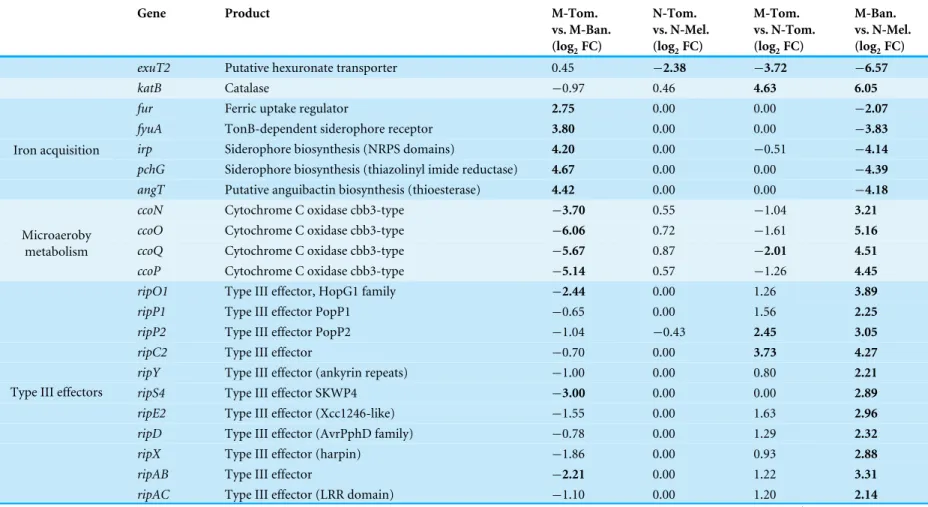
We compared gene expression across strains during pathogenesis of a shared host (tomato), the unique Moko host (banana) and the unique NPB host (melon). To assess intra-strain variations, we compared the tomato and banana transcriptomes of the Moko strain and the tomato and melon transcriptomes of the NPB tomato strain. For the Moko strain, 237 genes were differentially expressed between tomato and banana. Fewer than half as many genes (92) were differentially expressed in the NPB strain between tomato and melon samples. Next, to assess inter-strain variation, the two strains’ tomato transcriptomes were compared with one another, and the transcriptome of the Moko strain in banana was compared with that of the NPB strain in melon. The Moko and NPB strains differentially expressed 121 orthologous genes during tomato pathogenesis. When comparing banana and melon, 320 genes were found to be differentially expressed between the Moko and NPB strains. These results were then cross-referenced to identify candidate genes for host specificity (Table 1).
Table 1 Candidate genes for host-specific differential gene expression in ofR. solanacearumstrains UW163 (Moko) and IBSBF1503 (NPB).Log2FC values are indi-cated for each plant vs. plant comparison (condition 1 vs. condition 2). Bold-faced numbers indicate values within our−2>log2FC>2 threshold for differentially expressed genes. Genes with negative and positive Log2FC are up-regulated in conditions 1 and conditions 2, respectively. M-Tom or N-Tom: Moko or NPB strain ex-tracted from tomato; M-Ban: Moko strain exex-tracted from banana; N-Mel: NPB strain exex-tracted from melon.
Gene Product M-Tom.
vs. M-Ban. (log2FC)
N-Tom. vs. N-Mel. (log2FC)
M-Tom. vs. N-Tom. (log2FC)
M-Ban. vs. N-Mel. (log2FC)
exuT2 Putative hexuronate transporter 0.45 −2.38 −3.72 −6.57
katB Catalase −0.97 0.46 4.63 6.05
fur Ferric uptake regulator 2.75 0.00 0.00 −2.07
fyuA TonB-dependent siderophore receptor 3.80 0.00 0.00 −3.83
irp Siderophore biosynthesis (NRPS domains) 4.20 0.00 −0.51 −4.14
pchG Siderophore biosynthesis (thiazolinyl imide reductase) 4.67 0.00 0.00 −4.39
Iron acquisition
angT Putative anguibactin biosynthesis (thioesterase) 4.42 0.00 0.00 −4.18
ccoN Cytochrome C oxidase cbb3-type −3.70 0.55 −1.04 3.21
ccoO Cytochrome C oxidase cbb3-type −6.06 0.72 −1.61 5.16
ccoQ Cytochrome C oxidase cbb3-type −5.67 0.87 −2.01 4.51
Microaeroby metabolism
ccoP Cytochrome C oxidase cbb3-type −5.14 0.57 −1.26 4.45
ripO1 Type III effector, HopG1 family −2.44 0.00 1.26 3.89
ripP1 Type III effector PopP1 −0.65 0.00 1.56 2.25
ripP2 Type III effector PopP2 −1.04 −0.43 2.45 3.05
ripC2 Type III effector −0.70 0.00 3.73 4.27
ripY Type III effector (ankyrin repeats) −1.00 0.00 0.80 2.21
ripS4 Type III effector SKWP4 −3.00 0.00 0.00 2.89
ripE2 Type III effector (Xcc1246-like) −1.55 0.00 1.63 2.96
ripD Type III effector (AvrPphD family) −0.78 0.00 1.29 2.32
ripX Type III effector (harpin) −1.86 0.00 0.93 2.88
ripAB Type III effector −2.21 0.00 1.22 3.31
Type III effectors
ripAC Type III effector (LRR domain) −1.10 0.00 1.20 2.14
(continued on next page)
Ailloud
e
t
al.
(2016),
P
eerJ
,
DOI
Table 1(continued)
Gene Product M-Tom.
vs. M-Ban. (log2FC)
N-Tom. vs. N-Mel. (log2FC)
M-Tom. vs. N-Tom. (log2FC)
M-Ban. vs. N-Mel. (log2FC)
nirB Assimilatory nitrite reductase 0.00 0.00 −1.67 −2.37
nirD Assimilatory nitrite reductase 0.00 0.00 −2.35 −2.08
Nitrate assimilation
narK3 ATP-independent high-affinity nitrate transporter 0.00 −1.02 −1.10 −2.59
narK1 NO3-ABC transporter protein −6.88 0.84 −1.27 6.44
narK2 NO3-ABC transporter protein
−6.43 0.98 −1.37 6.05
narG NO3-reductase −5.75 0.00 −1.07 5.24
narH NO3-reductase −5.05 0.00 −1.04 4.47
narI NO3-reductase
−4.85 0.00 −1.06 4.30
narJ NO3-reductase −5.16 0.00 −1.22 4.48
narX NO3-sensor kinase −4.21 0.00 −0.96 3.34
narL NO3-response regulator
−3.62 0.45 −0.97 3.09
hmp Flavohemoprotein, NO dioxygenase −4.87 0.72 −0.58 4.99
aniA NO2-reductase −7.37 0.00 −1.55 6.29
Denitrification
norB NO reductase −5.47 0.87 −0.93 5.41
Ailloud
e
t
al.
(2016),
P
eerJ
,
DOI
in banana plants compared with tomato plants. Although the roles of these two genes in virulence are not clearly defined, they were among the most differentially expressed genes between the Moko and NPB strains under all the conditions tested, with a log2FC of up to 6, corresponding to a∼65-fold change in expression.
In the Moko strain, the ferric iron uptake regulatorfurand other genes related to siderophore biosynthesis were more highly expressed during banana pathogenesis compared with either the Moko strain in tomato or the NPB strain during melon patho-genesis. Considering that these same genes were also up-regulated by the Moko strain exclusively in banana plants compared with rich medium (category 2a), it appears that they are specifically induced by the banana environment and may contribute to bacterial fitness in this host. Iron-scavenging byR. solanacearumhas been investigated to some degree, and a previous study found that siderophores did not contribute to pathogenicity of North American IIA7 strain AW on tomato (Bhatt & Denny, 2004). However, tomato xylem is not iron limiting, and transgenic tomato plants that display iron-binding activity are more resistant toR. solanacearum, suggesting that iron availability could be a determining factor for virulence in other hosts (Bhatt & Denny, 2004). Moreover, some plant pathogenicErwiniaspecies do require siderophore production for full virulence (Dellagi et al., 1998;Expert, 1999). Further investigation of the iron content in banana xylem sap, studies of thein plantaregulation of ferric iron uptake, and determining the virulence offurmutants in Moko and NPB strains, would help determine whether siderophores contribute differentially to virulence in banana plants and thus to the distinct host ranges of these two strains.
On the other hand, theccohigh-affinity oxidase operon (cytochrome C oxidase cbb-3 type) was down-regulated during banana pathogenesis compared with either the Moko strain in tomato or the NPB strain during melon pathogenesis. This operon was also down-regulated in banana relative to its expression in medium, whereas it was up-regulated in melon for the NPB strain and in tomato for both strains (category 1). This result suggests that oxygen scavenging may be less important forR. solanacearumbanana pathogenesis than for pathogenesis of either tomato or melon.
In the NPB strain, genes encoding eleven T3Es (RipO1, RipP1, RipP2, RipC2, RipY, RipS4, RipE2, RipD, RipX, RipAB, and RipAC) were differentially up-regulated by NPB in melon plants compared with their expression by the Moko strain in banana plants.ripC2
was the only effector that was differentially up-regulated by the NPB strain in tomato plants compared with the Moko strain. The expression profiles ofripP1,ripP2,ripY,
GMI1000 from causing disease on somePetuniacultivars andArabidopsis thaliana(Lavie et al., 2002). In the Moko strain,ripO1,ripS4andripABwere also down-regulated in banana plants compared with tomato plants; their expression in the Moko strain might thus be detrimental to bacterial fitness in banana plants.
Finally, the Moko and NPB strains appeared to favor distinct nitrogen metabolic pathways in banana and melon plants. Two genes involved in nitrate assimilation, the assimilatory nitrite reductase encoded bynirBDand a nitrate uptake transporter encoded bynarK3, were differentially up-regulated by the Moko strain in banana plants compared with their expression by the NPB strain during melon pathogenesis.R. solanacearumis known to metabolize nitrate from the xylem sap, and nitrate assimilation contributes to virulence during early-stage tomato infection (Dalsing & Allen, 2014). Conversely, the denitrification genesnarHIJGKLX,aniA,norB, andhmpwere differentially up-regulated by the NPB strain in melon plants compared with their expression by the Moko strain during banana pathogenesis. In the Moko strain, these genes were also relatively less expressed in banana plants than in tomato plants. These genes encode the pathway that carries out partial denitrification (step-wise reductive conversion of nitrate to nitrous oxide) and nitric oxide detoxification; these reactions occur under low-oxygen conditions. In GMI1000, both denitrification and nitric oxide detoxification are required for wild-type virulence and growth in tomato xylem (Dalsing et al., 2015). Our finding that the denitrification pathway and high-affinity oxidase CcoN1 are both expressed at lower levels in banana than in tomato is further indirect evidence that the Moko strain experiences a lower oxygen environment in tomato xylem than in the xylem of the banana pseudostem. Direct measurement ofin plantaoxygen levels in the two hosts would conclusively test this hypothesis. The relative biological advantages of higher or lower xylem oxygen levels forR. solanacearumremain to be determined. Together, these results suggest that the colonization of the banana xylem requires metabolic adaptation byR. solanacearum.
CONCLUSIONS
In contrast with our previous comparative genomics study that found few differences in gene content and sequence between Moko and NPB strains ofR. solanacearum, this transcriptomic analysis revealed significant differences between these phylogenetically close but biologically divergent plant pathogens. The Moko and NPB strains exhibited much more divergent transcriptomic profiles than might have been predicted by their gene content, especially during bacterial wilt pathogenesis. Gene expression was generally convergent between the two pathotypes in similar environmental conditions, but
metabolic pathways are involved in the distinct host ranges ofR. solanacearumMoko and NPB strains. Furthermore, this study focused solely on the transcriptomic behavior of
R. solanacearumafter the first wilting symptoms become apparent and the vascular infection is already established. Additional studies are required to characterize the expression profiles of host-adapted strain during root colonization and pre-symptomatic disease stages as well as during incompatible interactions when the Moko strain attempts to infect melon or the NPB strain attempts to infect banana.
ADDITIONAL INFORMATION AND DECLARATIONS
Funding
The European Union (ERDF), Conseil Régional de La Réunion, the French Agence Nationale de la Recherche and CIRAD provided financial support. ANSES secured part of the doctoral fellowship awarded to F. A. (contract Number 11-237/BSL). T.M.L. was funded by NIH National Research Service Award T32 GM07215 and by Agriculture and Food Research Initiative Competitive Grant # 2015-67011-22799 from the USDA National Institute of Food and Agriculture. The funders had no role in study design, data collection and analysis, decision to publish, or preparation of the manuscript.
Grant Disclosures
The following grant information was disclosed by the authors: The European Union (ERDF).
Conseil Régional de La Réunion.
French Agence Nationale de la Recherche. CIRAD.
NIH National Research Service Award: T32 GM07215.
Agriculture and Food Research Initiative Competitive: 2015-67011-22799.
Competing Interests
The authors declare there are no competing interests.
Author Contributions
• Florent Ailloud conceived and designed the experiments, performed the experiments, analyzed the data, wrote the paper, prepared figures and/or tables, reviewed drafts of the paper.
• Tiffany M. Lowe performed the experiments, wrote the paper, prepared figures and/or tables, reviewed drafts of the paper.
• Isabelle Robène contributed reagents/materials/analysis tools, reviewed drafts of the paper.
• Stéphane Cruveiller analyzed the data.
• Caitilyn Allen conceived and designed the experiments, wrote the paper, reviewed drafts of the paper.
DNA Deposition
The following information was supplied regarding the deposition of DNA sequences: GenbankPRJNA297400
GenbankPRJNA297402.
Supplemental Information
Supplemental information for this article can be found online athttp://dx.doi.org/10. 7717/peerj.1549#supplemental-information.
REFERENCES
Ailloud F, Lowe T, Cellier G, Roche D, Allen C, Prior P. 2015.Comparative genomic analysis ofRalstonia solanacearumreveals candidate genes for host specificity.BMC Genomics16:270DOI 10.1186/s12864-015-1474-8.
Anders S, McCarthy DJ, Chen Y, Okoniewski M, Smyth GK, Huber W, Robinson MD. 2013.Count-based differential expression analysis of RNA sequencing data using R and Bioconductor.Natural Protocols8:1765–1786DOI 10.1038/nprot.2013.099.
Bhatt G, Denny TP. 2004.Ralstonia solanacearumiron scavenging by the siderophore staphyloferrin B Is controlled byPhcA, the global virulence regulator.Journal of Bacteriology186:7896–7904DOI 10.1128/JB.186.23.7896-7904.2004.
Bolger AM, Lohse M, Usadel B. 2014.Trimmomatic: a flexible trimmer for Illumina sequence data.Bioinformatics30:2114–2120DOI 10.1093/bioinformatics/btu170.
Boucher CA, Barberis P, Trigalet AP, Demery DA. 1985.Transposon mutagenesis of
Pseudomonas solanacearum: isolation of Tn5-induced avirulent mutants.Journal of General Microbiology131:2449–2457.
Cellier G, Prior P. 2010.Deciphering phenotypic diversity ofRalstonia solanacearum
strains pathogenic to potato.Phytopathology100:1250–1261 DOI 10.1094/PHYTO-02-10-0059.
Colburn-Clifford J, Allen C. 2010.A cbb(3)-type cytochrome C oxidase contributes toRalstonia solanacearumR3bv2 growth in microaerobic environments and to bacterial wilt disease development in tomato.Molecular Plant-Microbe Interactions
23:1042–1052DOI 10.1094/MPMI-23-8-1042.
Dalsing BL, Allen C. 2014.Nitrate assimilation contributes toRalstonia solanacearum
root attachment, stem colonization, and virulence.Journal of Bacteriology
196:949–960DOI 10.1128/JB.01378-13.
Dalsing BL, Truchon AN, Gonzalez-Orta ET, Milling AS, Allen C. 2015.Ralstonia solanacearumuses inorganic nitrogen metabolism for virulence, ATP production, and detoxification in the oxygen-limited host xylem environment.mBio6:e02471 DOI 10.1128/mBio.02471-14.
Dellagi A, Brisset MN, Paulin JP, Expert D. 1998.Dual role of desferrioxamine in
Expert D. 1999.WITHHOLDING AND EXCHANGING IRON: interactions between
Erwiniaspp. and their plant hosts.Annual Review of Phytopathology37:307–334 DOI 10.1146/annurev.phyto.37.1.307.
Flores-Cruz Z, Allen C. 2009.Ralstonia solanacearumencounters an oxidative environ-ment during tomato infection.Molecular Plant-Microbe Interactions22:773–782 DOI 10.1094/MPMI-22-7-0773.
Genin S, Denny TP. 2012.Pathogenomics of theRalstonia solanacearumspecies complex.
Annual Review of Phytopathology50:67–89 DOI 10.1146/annurev-phyto-081211-173000.
Gonzalez ET, Allen C. 2003.Characterization of aRalstonia solanacearumoperon re-quired for polygalacturonate degradation and uptake of galacturonic acid.Molecular Plant-Microbe Interactions16:536–544DOI 10.1094/MPMI.2003.16.6.536.
Gueneron M, Timmers AC, Boucher C, Arlat M. 2000.Two novel proteins, PopB, which has functional nuclear localization signals, and PopC, which has a large
leucine-rich repeat domain, are secreted through the hrp-secretion apparatus of
Ralstonia solanacearum.Molecular Microbiology 36:261–277 DOI 10.1046/j.1365-2958.2000.01870.x.
Guo Y, Li CI, Ye F, Shyr Y. 2013.Evaluation of read count based RNAseq analysis methods.BMC Genomics14(Suppl 8:S2) DOI 10.1186/1471-2164-14-S8-S2.
Hendrick CA, Sequeira L. 1984.Lipopolysaccharide-defective mutants of the wilt pathogenPseudomonas solanacearum.Applied and Environmental Microbiology
48:94–101.
Jacobs JM, Babujee L, Meng F, Milling A, Allen C. 2012.Thein plantatranscriptome ofRalstonia solanacearum: conserved physiological and virulence strategies during bacterial wilt of tomato.MBio3(4)DOI 10.1128/mBio.00114-12.
Langdon WB. 2015.Performance of genetic programming optimised Bowtie2 on genome comparison and analytic testing (GCAT) benchmarks.BioData Min8:1 DOI 10.1186/s13040-014-0034-0.
Lavie M, Shillington E, Eguiluz C, Grimsley N, Boucher C. 2002.PopP1, a new member of the YopJ/AvrRxv family of type III effector proteins, acts as a host-specificity factor and modulates aggressiveness ofRalstonia solanacearum.Molecular Plant-Microbe Interactions15:1058–1068DOI 10.1094/MPMI.2002.15.10.1058.
Love MI, Huber W, Anders S. 2014.Moderated estimation of fold change and dispersion for RNA-seq data with DESeq2.Genome Biology15:550
DOI 10.1186/s13059-014-0550-8.
Monteiro F, Genin S, Van Dijk I, Valls M. 2012.A luminescent reporter evidences active expression ofRalstonia solanacearumtype III secretion system genes throughout plant infection.Microbiology158:2107–2116DOI 10.1099/mic.0.058610-0.
Pitcher RS, Watmough NJ. 2004.The bacterial cytochrome cbb3 oxidases.Biochimica et Biophysica ACTA/General Subjects1655:388–399DOI 10.1016/j.bbabio.2003.09.017.
Rahme LG, Mindrinos MN, Panopoulos NJ. 1992.Plant and environmental sensory signals control the expression of hrp genes inPseudomonas syringaepv.phaseolicola.
Journal of Bacteriology174:3499–3507.
Remigi P, Anisimova M, Guidot A, Genin S, Peeters N. 2011.Functional diversification of the GALA type III effector family contributes toRalstonia solanacearumadaptation on different plant hosts.New Phytologist192:976–987 DOI 10.1111/j.1469-8137.2011.03854.x.
Robinson MD, McCarthy DJ, Smyth GK. 2010.edgeR: a Bioconductor package for differential expression analysis of digital gene expression data.Bioinformatics
26:139–140DOI 10.1093/bioinformatics/btp616.
Tang X, Xiao Y, Zhou JM. 2006.Regulation of the type III secretion system in phytopathogenic bacteria.Molecular Plant-Microbe Interactions19:1159–1166 DOI 10.1094/MPMI-19-1159.
Wicker E, Coranson-Beaudu R, Cadasse S, William MA. 2009.Emerging strains of
Ralstonia solanacearumin the French West Indies raise new challenges to tomato breeders.Acta Horticulturae808:279–286 DOI 10.17660/ActaHortic.2009.808.43.
Wicker E, Grassart L, Coranson-Beaudu R, Mian D, Guilbaud C, Fegan M, Prior P. 2007.Ralstonia solanacearumstrains from Martinique (French West Indies) exhibiting a new pathogenic potential.Applied and Environmental Microbiology
73:6790–6801DOI 10.1128/AEM.00841-07.
Zuluaga AP, Puigvert M, Valls M. 2013.Novel plant inputs influencingRalstonia solanacearumduring infection.Frontiers in Microbiology4:349