165
Pakistan Veterinary Journal
ISSN: 0253-8318 (PRINT), 2074-7764 (ONLINE)Accessible at: www.pvj.com.pk
Antimicrobial Activity of Copaifera langsdorffii Oil and Evaluation of its Most Bioactive
Fraction against Bacteria of Dog’s Dental Plaque
FA Pieri1,2,3, VO Silva1, FS Vargas3, VF Veiga Junior3 and MAS Moreira1* 1
Bacterial Diseases Laboratory, Sector of Preventive Veterinary Medicine and Public Health, Veterinary Department, Federal University of Viçosa; Av. P.H. Rolfs, s/n, CEP: 36570-000, Viçosa, MG, Brazil; 2Leônidas and Maria Deane Institute, Oswaldo Cruz Foundation. Rua Terezina, 476, Adrianópolis, CEP: 69.057-070, Manaus, AM, Brazil; 3Exact Sciences Institute, Federal University of Amazonas. Av. Rodrigo Otávio, 6200, Coroado, CEP: 69.080-005, Manaus, AM, Brazil
*Corresponding author: [email protected]
ARTICLE HISTORY (13-067) A B S T R A C T
Received: Revised: Accepted:
February 09, 2013 August 16, 2013 October 07, 2013
The aim of this study was to evaluate the inhibitory effect of copaiba oil and its resinous and volatile fractions against 20 bacterial isolates from dental plaque of dogs. The antimicrobial activities of the oil and its fractions were evaluated by the agar diffusion test with solutions at 10% concentration. The results showed antimicrobial activity for the copaiba oil solution on 16 isolates. The volatile fraction was considered statistically similar (P>0.05) to copaiba oil intact on the size of inhibition zones inhibiting 17 isolates. The resinous fraction inhibited only eight isolates, with smaller haloes when compared with those of the volatile fraction and intact oil (P<0.05). It is concluded from these results that copaiba oil is a potential phytotherapic to be used in dental plaque antimicrobial therapy of dogs and suggests that its activity is due to sesquiterpenes of the volatile fraction.
©2013 PVJ. All rights reserved Key words:
Copaiba Dogs
Medicinal plants Periodontal disease Plaque inhibition
To Cite This Article: Pieri FA, VO Silva, FS Vargas, VF Veiga Junior and MAS Moreira, 2014. Antimicrobial activity of Copaifera langsdorffii oil and evaluation of its most bioactive fraction against bacteria of dog’s dental plaque. Pak Vet J, 34(2): 165-169.
INTRODUCTION
Periodontal disease, which involves support and protective structures of the teeth, is a disease that affects most dogs, reaching about 85% prevalence in animals older than four years (Kyllar and Witter, 2005). The aetiological agent is the dental plaque that develops on the tooth surface, and the dog’s immune system reaction. Plaque is formed with the initial colonisation of the tooth surface by autochthonous bacteria, which promote the adhesion of other more virulent strains (Niemiec, 2008a). Thus, combat to microorganisms of the initial phase of dental plaque formation is a preventive action to periodontal disease (Pieri et al., 2010).
Among several ways to combat dental plaque, the most appropriate is dental brushing (Niemiec, 2008b). Another means of preventing plaque formation would be the administration of antibacterial substances that prevent the proliferation or adhesion of bacteria to the tooth surface, and thus also inhibit the development of periodontal disease (Pieri et al., 2010). A substance that is widely used by veterinarians and dentists in dental treatment is chlorhexidine, usually commercialised at a
concentration of 0.12% (Hennet, 2002). However, the use of chlorhexidine should be restricted to a few days, in short treatments, due to its side effects such as darkening of the tooth enamel, loss of taste, burning sensation in the oral cavity and oral mucosa ulcerations in longer treatments (Dantas et al., 2007).
For this reason, researchers have studied new substances with antimicrobial activity against the most important oral bacteria in the formation of dental plaque for the establishment of a new preventive therapy to be used in association with brushing for both humans and dogs (Pieri et al., 2010; Pieri et al., 2012).
Traditional medicine, based on natural products, has served as a source of alternative drugs for therapeutic use in several diseases (Kim et al., 2012). The copaiba (Copaifera
reduction in the dental plaque formation in vivo by this oil in dogs (Pieri et al., 2010), no work has been done yet to confirm the antibacterial activity in vitro against bacteria derived from the dental plaque of dogs, which are different to those found in humans.
Due to the high incidence of periodontal disease in dogs, the many undesirable effects resulting from the use of chlorhexidine, the need to find alternative treatments and the absence of data reporting the active fraction of copaiba oil against bacteria of dental in dogs, this study evaluated the antimicrobial activity of Copaifera langsdorffii oil and its volatile and resinous fractions against bacterial isolates obtained from the dental plaque of dogs.
MATERIALS AND METHODS
Obtaining the oleoresin: The oil of C. langsdorffii was extracted by adapting the technique described by Rigamonte Azevedo et al. (2006), with the perforation of the trunk of the copaiba tree, using a chainsaw with a 5/8-inch drill, in two holes. The first hole made 1m above the base of the tree and the second 1m above this. PVC pipes were placed to facilitate the flow of oil and prevent predation of the tree by parasites and microorganisms. The tree was located in the city of Alfenas-MG, Brazil, under the geographical coordinates 21º26'33"S and 46°0'55"W, and a specimen is deposited in the VIC Herbarium of Federal University of Viçosa with record number 34,894.
Chromatographic procedures: To obtain fractions in which activity is concentrated, oil was fractionated by chromatography on an ion-exchange column eluted with dichloromethane and methanol, using methods adapted from Pinto et al. (2000). Following experiments were performed with open-column chromatography eluted with hexane and ethyl acetate. The fractions were esterified with diazomethane and analysed by gas chromatography using flame ionisation detection (GC-FID) and mass spectrometry (GC-MS).
The chromatographic analyses of oil and fractions were performed on a gas chromatograph Shimadzu ® Model 2010 GC with flame ionisation detector (GC-FID) using a CP-Sil 5 CB column (100% dimethylpoly- siloxane) from Varian©, and a chromatograph model QP-2010 from Shimadzu®, with mass spectrometry detector (GC-MS) using a VF-1MS column from Varian ©.
For analysis of GC-FID, helium gas was used for drag with a flow rate of 2.0 mL/min, and the injection was performed on Split 1:10, the injector temperature at 250°C and the detector at 290°C. The programming of the oven was 60 to 240°C (3°C/min). For qualitative analysis, GC-MS was used with the same conditions as GC-FID, and for detecting technique has been applied to electron impact at 70 eV.
The analysed compounds were identified by comparing the mass spectrum with those of Wiley 7.0
conditions was used.
Antimicrobial assays: The copaiba oil-resin (C. langsdorffii), its resinous acid fraction, and the volatile no acid fraction were tested. All solutions were formulated at 100 mg/mL, solubilized with Tween 80 at 100 mg/ml. A negative control solution was used, consisting of sterile distilled water and tween 80 (100 mg/mL). Tests were performed in triplicate with two replicates.
20 bacterial isolates obtained from initial dental plaque of dogs between one- and two-years old, belonging to the bacterial collection of the Laboratory of Bacterial Diseases, Department of Veterinary Medicine, Federal University of Viçosa were used. The genera of the isolates were Aerococcus (1/20), Enterococcus (3/20),
Lactobacillus (1/20), Lactococcus (1/20), Leuconostoc
(3/20), Pasteurella (1/20), Staphylococcus (4/20) and
Streptococcus (6/20). Adapting the technique of plate cylinder diffusion in agar (Breier et al., 2002), 100 µL of bacterial culture adjusted to 0.5 MacFarland scale were seeded with the aid of Drigalski spatula in 9 cm disposable petri dishes previously prepared with a bottom layer of 10 mL of bacteriological agar from Himedia®, and a top layer of 20 mL of Brain Heart Infusion agar (BHI agar) from Himedia®. With the use of sterile 1mL pipette tips were produced, only BHI agar, orifices, one per treatment, equidistantly distributed on the plates. The volume used of each solution and negative control in wells followed 100 µL.
After preparation, the plates were incubated at 37°C for 24 h. Antimicrobial activity was represented by inhibition haloes that were measured in millimetres for later comparison. It was considered a positive result if haloes of any size were present around the orifice. Tests were performed in triplicate with two replicates.
Statistical analysis: Comparison of the fractions and the oil activities was made by analysis of variance (ANOVA). Homoscedasticity of variances was analysed by Bratlett’s test to verify the normal distributions of results and multiple comparison between the means of inhibition haloes of each treatment were analysed by Tukey-Kramer test. Two-Way ANOVA was used to compare the treatments within each isolate with Bonferroni test. All analysis was made with the use of the software Prism statistical package 5 for Windows from Graphpad®. Results were accepted as significant at P<0.05.
RESULTS
Fig. 1: GC-FID spectrum showing the chemical composition of non acid fraction obtained from the Copaifera langsdorffii oil.
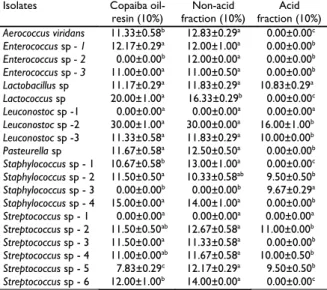
The inhibition haloes of intact copaiba oil and the acid and non acid fractions against dental plaque bacterial isolates from dogs are shown in table 1 and figure 2. The negative control with Tween 80 showed no inhibition on any isolate. This study showed antimicrobial activity in vitro by copaiba solution on dental plaque bacteria in dogs, including: one isolate of the genera Aerococcus sp.,
Lactobacillus sp., Lactococcus sp. and Pasteurella sp.; two isolates of Enterococcus sp., Leuconostoc sp.; three
Staphylococcus sp.; and five of Streptococcus sp. An isolate of Enterococcus sp. Staphylococcus sp.
Streptococcus sp. and Leuconostoc sp. were resistant (Tab. 1). The inhibition zones were similar for most of the isolates: between 10 mm and 15 mm (Fig. 2 and Tab. 1). However, two isolates, one of Lactococcus sp. and one
Leuconostoc sp. were more sensitive, with larger haloes (Tab. 1). To isolate Lactococcus sp. the haloes were 16mm and 20mm for the intact oil and non acid fraction respectively (Tab. 1). As for the isolated Leunonostoc sp., the haloes were 16mm for the acid fraction and 30mm for the other solutions tested (Tab. 1).
All data were considered not significant in Bratlett’s test (P>0.05), showing no difference in standard deviation, indicating the results for parametric analysis. In Tukey-Kramer test, the non-acid fraction showed superior results to the acid fraction (P<0.0015) (Fig. 2). The results of this fraction were considered statistically similar (P>0.05) to intact copaiba oil based on the size of inhibition zones, but as well as inhibiting all isolates that the intact oil inhibited, this fraction also inhibited one
Enterococcus isolate which was resistant to the oil (Tab. 1). The other three isolates that were resistant to oil were not inhibited by the non acid fraction. The acid fraction was able to inhibit only eight isolates with smaller haloes compared to the non acid fraction and intact oil
(P=0.0015) (Fig. 2), being three Streptococcus sp., one
Staphylococcus sp., one Lactobacillus sp. and two
Leuconostoc sp. (Tab. 1). The results of comparison between the treatments within each bacterial isolate are presents in Table 1.
DISCUSSION
As reported in the literature, copaiba oil resin is commonly characterised as consisting solely of a mixture of sesquiterpenes and diterpene acids (Barbosa et al., 2012). This distribution of fractions identified in this work, with high percentages of sesquiterpenes and high kaurenoic acid presence in the composition of the resinous fraction is expected according to the species C. langsdorffii (Paiva et al., 2002; Cavalcanti et al., 2006).
Similar to some studies of antimicrobial activity that used copaiba oil against reference strains derived from human dental plaque, this study also presented inhibition of bacterial isolates from dental plaque of dogs (Vasconcelos et al., 2008; Pieri et al., 2010; Souza et al., 2011). Pieri et al. (2012) presented results that confirm S. mutans susceptibility to copaiba. In this study was showed the activity of C. officinalis oil tested, with the MIC average of 0.78 µl/ml. This activity, however, at all concentrations tested did not show the death of bacteria being bacteriostatic.
Vasconcelos et al. (2008) evaluated the ability of antibacterial root canal sealers with copaiba oil (C. multijuga Hayne) as active principle against dental strains of Streptococcus mutans (ATCC 25175) and Streptococcus
sanguinis (ATCC 15300), important components of
Enterococcus sp - 1 12.17±0.29a 12.00±1.00a 0.00±0.00b
Enterococcus sp - 2 0.00±0.00b 12.00±0.00a 0.00±0.00b
Enterococcus sp - 3 11.00±0.00a 11.00±0.50a 0.00±0.00b
Lactobacillus sp 11.17±0.29a 11.83±0.29a 10.83±0.29a
Lactococcus sp 20.00±1.00a 16.33±0.29b 0.00±0.00c
Leuconostoc sp -1 0.00±0.00a 0.00±0.00a 0.00±0.00a
Leuconostoc sp -2 30.00±1.00a 30.00±0.00a 16.00±1.00b
Leuconostoc sp -3 11.33±0.58a 11.83±0.29a 10.00±0.00b
Pasteurella sp 11.67±0.58a 12.50±0.50a 0.00±0.00b
Staphylococcus sp - 1 10.67±0.58b 13.00±1.00a 0.00±0.00c
Staphylococcus sp - 2 11.50±0.50a 10.33±0.58ab 9.50±0.50b
Staphylococcus sp - 3 0.00±0.00b 0.00±0.00b 9.67±0.29a
Staphylococcus sp - 4 15.00±0.00a 14.00±1.00a 0.00±0.00b
Streptococcus sp - 1 0.00±0.00a 0.00±0.00a 0.00±0.00a
Streptococcus sp - 2 11.50±0.50ab 12.67±0.58a 11.00±0.00b
Streptococcus sp - 3 11.50±0.00a 11.33±0.58a 0.00±0.00b
Streptococcus sp - 4 11.00±0.00ab 11.67±0.58a 10.00±0.50b
Streptococcus sp - 5 7.83±0.29c 12.17±0.29a 9.50±0.50b
Streptococcus sp - 6 12.00±1.00b 14.00±0.00a 0.00±0.00c
Values (Mean±SD) bearing different letters in a row differ significantly (P<0.05).
Fig. 2: Antimicrobial activity of Copaifera langsdorffii oil-resin and its acid and non acid fractions against 20 bacterial isolates obtained from dogs dental plaque. Each marker refers to one isolate tested. Regarding Tukey’s test copaiba oil-resin and non acid fraction (*a) were statistically different (P=0.0015) of acid fraction (*b).
oxide (11.5%), cubenol (16.7%) and bisabolol (7.2%) and labdane diterpenes as copalic acid (2.1%), 3β -hydroxy-copalic acid (1.7%) and pinifolic acid (1.3%). Our results also presented the non acid fraction as the main constituents of tested copaiba oil.
Pieri et al. (2010) reported inhibition of S. mutans
(ATCC 25175), S. salivarius (CDC 262), S. pyogenes
(ATCC 19615) and E. faecalis (ATCC 19433) by C. officinalis oil, using the agar diffusion. Their results presented S. pyogenes as the most susceptible, with inhibition zones average of 38.8 mm, while 25.8 mm, 24.5 mm and 26.2 mm was presented to S. mutans, S. salivarius and E. faecallis respectively. This study also presented in vitro inhibition by the oil of C. officinalis of
S. mutans adherence capacity in concentrations of 6.25 µl/mL. This is a relevant result regarding that the adherence capacity of the bacteria has important role in dental plaque formation and consequently in the installation of periodontal disease.
MIC values ranging between 2 and 6 mg/mL. The results of this study show that there was inhibition of only eight bacterial isolates from dogs by the acid resinous fraction, suggesting a different susceptibility profile of dental bacteria in dogs and humans. Still this minor inhibition of acid fraction may be due the absence of copalic acid, since this fraction was composed almost exclusively by kaurenoic acid that is commonly the main acid in oil-resins of C. langsdorffii.
The mechanism of action of terpenes contained in vegetable oil over microorganisms is not yet fully understood; however, it is speculated that the disruption of cell membranes by these substances is the most likely mechanism, because of its lipophilic characteristics, increasing the permeability of microbial cells and leading to overflow of cellular contents (Cowan, 1999; Deuschle
et al., 2007). This mechanism of action was confirmed by Santos et al. (2008) who showed, with electron microscopy, the action of copaiba oil on Staphylococcus
aureus, demonstrating the cellular destruction and
overflow of cytoplasmic material of bacteria. It should be noted that the antimicrobial activity of terpene compounds from natural products probably cannot be attributed to a specific mechanism of action or just one compound due to the large number of different substances in their composition. This represents an important advantage to the use of copaiba oil as an alternative to conventional antimicrobial agents, since this diversity of compounds and mechanisms of action could act additively and synergistically against bacteria, which would hinder the emergence of resistant bacteria to treatment.
Regarding the use of copaiba oil in reducing dental plaque in dogs, Pieri et al. (2010) evaluated the ability of copaiba (C. officinalis) to inhibit dental plaque formation in an in vivo assay, showing a significant reduction in plaque formation that was statistically equal to the chlorhexidine results. The results of the present study are in accordance with the results of these researchers, since the copaiba oil had an inhibitory effect on most of the bacterial isolates from dog dental plaque with particular reference to the volatile fraction of the oil that showed higher results than the resin, suggesting that this is the main fraction involved in this plaque reduction in dogs. Conclusion: It was concluded in this study that the copaiba oil is a potential substitute to chlorhexidine to combat the bacteria in the dental plaque of dogs and consequently the prevention and treatment of periodontal disease, with potential benefits by the supposed synergistic action of various substances, and that the volatile fraction of the oil appears to be the most bioactive against these bacteria.
Personnel (CAPES) and the Brazilian National Council for Scientific and Technological Development (CNPq) for financial support.
REFERENCES
Adams RP, 2007. Identification of essential oil components by gas chromatography/mass spectrometry. 4th Ed, Allured Pub Corp, Illinois, USA, pp: 804.
Bah AA, F Wang, ZH Huang, IH Shamsi, QC Zhang, G Jilani, S Hussain,
N Hussain and E Ali, 2012. Phyto-characteristics, Cultivation and
Medicinal Prospects of Chinese Jiaotou (Allium chinense). Int J Agric Biol, 14: 650-657.
Barbosa PCS, RS Medeiros, PTB Sampaio, G Vieira, LSM Wiedemann and VF Veiga-Junior, 2012. Influence of abiotic factors on the chemical composition of copaiba oil (Copaifera multijuga Hayne): soil composition, seasonality and diameter at breast height. J Braz Chem Soc, 23: 1823-1833.
Breier AR, CV Garcia, TP Oppe, M Steppe and EES Schapoval, 2002. Microbiological assay for azithromycin in pharmaceutical formulations. J Pharmaceut Biomed, 29: 957-961.
Cavalcanti BC, LV Costa-Lotufo, MO Moraes, RR Burbano, ER Silveira, KM Cunha, VS Rao, DJ Moura, RM Rosa, JA Henriques and C Pessoa, 2006. Genotoxicity evaluation of kaurenoic acid, a bioactive diterpenoid present in Copaiba oil. Food Chem Toxicol, 44: 388-392.
Cowan MM, 1999. Plant products as antimicrobial agents. Clin Microbiol Rev, 12: 564-582.
Dantas EM, CEA Xavier, GXM Segundo, MAP Paiva and KLF Lima, 2007. Dental staining by chlorhexidine: case report. Odontologia Clin Cientif, 6: 175-178.
Deuschle RAN, T Camargo, SH Alves, CA Mallmann and BM Heizmann, 2007. Fractionation of dichlorometane extract from Senecio
desiderabilis Vellozo and evaluation of the antimicrobial activity.
Rev Bras Farmacogn, 17: 220-223.
Guimarães-Santos A, DS Santo, IR Santos, RR Lima, A Pereira, LS de Moura, RN Carvalho Jr, O Lameira and W Gomes-Leal, 2012. Copaiba oil-resin treatment is neuroprotective and reduces neutrophil recruitment and microglia activation after motor cortex excitotoxic injury. Evid Based Complement Alternat Med, 2012: 918174.
Gonçalves AL, A Alves-Filho and H Menezes, 2005. Comparative study on antimicrobial activity of some native tree extracts. Arq Inst Biol, 72: 353-358.
Hennet P, 2002. Effectiveness of a dental gel to reduce plaque in beagle dogs. J Vet Dent, 19: 11-14.
Kim SH, NS Kim, KC Lee, HB Lee and MS Kim, 2012. Treatment of multiple thoracolumbar intervertebral disc disease using electro-acupuncture and oriental herbal medicine in a dog. Pak Vet J, 32: 631-634.
Kobayashi C, TO Fontanive, BG Enzweiler, LR de Bona, T Massoni, MA Apel, AT Henriques, MF Richter, P Ardenghi and ES Suyenaga, 2011. Pharmacological evaluation of Copaifera multijuga oil in rats. Pharm Biol, 49: 306-313.
Kyllar M and K Witter, 2005. Prevalence of dental disorders in pet dogs. Vet Med-Czech, 50: 496-505.
Leandro LM, FS Vargas, PCS Barbosa, JKO Neves, JA Silva and VF Veiga Junior, 2012. Chemistry and biological activities of terpenoids from copaiba (Copaifera spp.) oleoresins. Molecules, 17: 3866-3889. Lima SR, VF Junior, HB Christo, AC Pinto and PD Fernandes, 2003. In
vivo and in vitro studies on the anticancer activity of Copaifera
multijuga Hayne and its fractions. Phytother Res, 17: 1048-53.
Niemiec BA, 2008a. Periodontal Disease. Top Companion Anim Med, 23: 72-80.
Niemiec BA, 2008b. Periodontal Therapy. Top Companion Anim Med, 23: 81-90.
Paiva LAF, LA Gurgel, RM Silva, AR Tomé, NV Gramosa, ER Silveira, FA Santos and VS Rao, 2002. Anti-inflammatory effect of kaurenoic acid, a diterpene from Copaifera langsdorffii on acetic acid-induced colitis in rats. Vascul Pharmacol, 39: 303-307.
Pieri FA, MCM Mussi, JE Fiorini and JM Schneedorf, 2010. Clinical and microbiological effects of copaiba oil (Copaifera officinalis) on dental plaque forming bacteria in dogs. Arq Bras Med Vet Zoo, 62: 578-585.
Pieri FA, CF Souza, JCM Costa, MAO Barrero, IF Espeschit, VO Silva and MAS Moreira, 2011. Inhibition of Escherichia coli from mastitic milk by copaiba oil. Semin-Cienc Agrar, 22: 1929-1934.
Pieri FA, MCM Mussi, JE Fiorini, MAS Moreira and JM Schneedorf, 2012. Bacteriostatic effect of copaiba oil (Copaifera oficinallis) against cariogenic bacteria Streptococcus mutans. Braz Dent J, 23: 36-38. Pinto AC, WF Braga, CM Rezende, FMS Garrido, VF Veiga Junior, L
Bergter, ML Patitucci and OAC Antunes, 2000. Separation of acid diterpenes of Copaifera cearensis Huber ex Ducke by Flash Chromatography Using Potassium Hydroxide Impregnated Silica Gel. J Braz Chem Soc, 11: 355-360.
Rigamonte Azevedo OC, PGS Wadt and LHO Wadt, 2006. Oil resin production potential of Copaifera spp natural populations in the Southwestern Brazilian Amazon. Rev Arvore, 30: 583-591. Santos AO, T Ueda-Nakamura, BP Dias Filho, VF Veiga Junior, AC Pinto
and CV Nakamura, 2008. Antimicrobial activity of Brazilian copaíba oils obtained from different species of the Copaifera genus. Mem Inst Oswaldo Cruz, 103: 277-281.
Souza AB, CH Martins, MG Souza, NA Furtado, VC Heleno, JP Sousa, EM Rocha, JK Bastos, WR Cunha, RC Veneziani and SR Ambrósio, 2011. Antimicrobial activity of terpenoids from Copaifera
langsdorffii Desf. against cariogenic bacteria. Phytother Res, 25:
215-220.