www.atmos-chem-phys.net/12/8751/2012/ doi:10.5194/acp-12-8751-2012
© Author(s) 2012. CC Attribution 3.0 License.
Chemistry
and Physics
Contribution of garbage burning to chloride and PM
2
.
5
in Mexico City
G. Li1,2,3, W. Lei1, N. Bei1,4, and L. T. Molina1,3
1Molina Center for the Energy and the Environment, La Jolla, CA, USA
2Key Laboratory of Aerosol, SKLLQG, Institute of Earth Environment, Chinese Academy of Sciences, Xi’an, China 3Massachusetts Institute of Technology, Cambridge, MA, USA
4School of Human Settlements and Civil Engineering, Xi’an Jiaotong University, Xi’an, China
Correspondence to:G. Li ([email protected]), L. T. Molina ([email protected]) Received: 12 May 2012 – Published in Atmos. Chem. Phys. Discuss.: 1 June 2012 Revised: 31 August 2012 – Accepted: 5 September 2012 – Published: 27 September 2012
Abstract.The contribution of garbage burning (GB) emis-sions to chloride and PM2.5 in the Mexico City
Metropoli-tan Area (MCMA) has been investigated for the period of 24 to 29 March during the MILAGRO-2006 campaign us-ing the WRF-CHEM model. When the MCMA 2006 official emission inventory without biomass burning is used in the simulations, the WRF-CHEM model significantly underesti-mates the observed particulate chloride in the urban and the suburban areas. The inclusion of GB emissions substantially improves the simulations of particulate chloride; GB con-tributes more than 60 % of the observation, indicating that it is a major source of particulate chloride in Mexico City. GB yields up to 3 pbb HCl at the ground level in the city, which is mainly caused by the burning of polyvinyl chlo-ride (PVC) in the garbage. GB is also an important source of PM2.5, contributing about 3–30 % simulated PM2.5mass on
average. More modeling work is needed to evaluate the GB contribution to hazardous air toxics, such as dioxin, which is found to be released at high level from PVC burning in labo-ratory experiments.
1 Introduction
Biomass burning (BB) is an important source of ambient PM2.5 (particulate matter with aerodynamic diameter less
than 2.5 µm) and emits approximately more than 80 % of to-tal carbonaceous aerosol mass in the atmosphere (Andreae and Merlet, 2001; Bond et al., 2004). BB aerosols not only adversely affect human health and air quality from regional
to global scales (Lighty et al., 2000; Lelieveld et al., 2001), but also contribute to the large uncertainty in the current un-derstanding of radiative forcing (IPCC, 2007). Depending on the nature of the burned biomass and the burning con-ditions, BB aerosols have varying capacities for absorbing and reflecting incident solar radiation, with a direct radia-tive forcing of +0.03±0.12 W m−2globally (IPCC, 2007). Considering microphysical interactions between aged BB aerosols and clouds (aerosol indirect effect), an even greater uncertainty is involved when trying to determine the BB aerosol climate forcing (Brioude et al., 2009; Randles and Ramaswamy, 2010; Grell et al., 2011).
Wild fires and combustion of biofuel are the two largest contributors of global BB. Recent field measurements in central Mexico by Christian et al. (2010) have shown that garbage burning (GB) may be a commonly over-looked important global source of emissions, considering the global garbage generation of about 2000 Tg year−1with half burned.
burning. Open garbage burning produces smoke and emits a wide variety of compounds including black carbon, air tox-ics and greenhouse gases (Costner, 2005, 2006). In addition to the release of toxic chemicals that are harmful to human health, the smoke from the fire can deposit chemicals on gar-den vegetables, crops and soil and eventually enter into the food chain.
Christian et al. (2010) estimated a fine particle emission factor for GB in Central Mexico of about 10.5 g kg−1and ob-served large HCl emission factor in the range of 2–10 g kg−1. They also suggested that GB is a major source of HCl and may generate as much as 6–9 Tg year−1globally. Numerous studies have attempted to evaluate the impact of BB from wild fires on local and regional air quality using chemical transport models (e.g., Wang and Christopher, 2006; Zeng et al., 2008; Tian et al., 2009). Previous studies have shown that the air quality in Mexico City is frequently influenced by open biomass burning from nearby mountains and savan-nas surrounding the city (Molina et al., 2010). However, few studies have been conducted to investigate the impact of GB on air quality due to lack of the observed emission factor and emission estimates of trace gases and particles for GB. Dur-ing the MCMA-2006 field campaign as part of the MILA-GRO (Megacity Initiative: Local and Global Research Ob-servations) project conducted in March 2006, an extensive data set relevant to emissions, transport and transformations of pollutants was obtained, including highly time-resolved ambient gas phase species and aerosols (Molina et al., 2010). In addition, during the spring of 2007, Christian et al. (2010) and Yokelson et al. (2011) measured the initial emissions of trace gases and aerosol speciation for elemental and organic carbon (EC and OC), anhydrosugars, Cl−1, NO−31, and 20 metals from several garbage fires in Central Mexico and ob-tained the emission factors of trace gases and particles for GB. All of these observations have provided an opportunity to assess the contribution of GB to the air quality in a pol-luted urban area.
The purpose of this study is to evaluate the impacts of GB on the air quality, particularly the contribution of GB on chloride and PM2.5, for Mexico City using the WRF-CHEM
model based on the measurements taken during MCMA-2006. The WRF-CHEM model and the model configuration are described in Sect. 2. Results of the modeling experiments and comparisons are presented in Sect. 3, and the Conclu-sions are given in Sect. 4.
2 Model and method
2.1 WRF-CHEM Model
In the present study, a specific version of the WRF-CHEM model (Grell et al., 2005) is used to evaluate the GB im-pacts. This version of the WRF-CHEM model is developed by Li et al. (2010, 2011a, b) at the Molina Center for
En-ergy and the Environment, with a new flexible gas phase chemical module which can be utilized in different chem-ical mechanisms, including CBIV, RADM2, and SAPRC. The gas-phase chemistry is solved by an Eulerian back-ward Gauss-Seidel iterative technique with a number of it-erations. The short-lived species, such as OH and O(1D), are assumed to be in the steady state. The solution is iter-ated until all species are within 0.1 % of their previous itera-tive values. For the aerosol simulations, the CMAQ (version 4.6) aerosol module developed by EPA, which is designed to be an efficient and economical depiction of aerosol dynam-ics in the atmosphere, is incorporated in the WRF-CHEM model (Binkowski and Roselle, 2003). In this aerosol compo-nent, the particle size distribution is represented as the super-position of three lognormal sub-distributions, called modes. The processes of coagulation, particle growth by the addi-tion of mass, and new particle formaaddi-tion are included. The new particle production rate is calculated due to binary nucle-ation of H2SO4and H2O vapor. The nucleation rate is a
pa-rameterized function of temperature, relative humidity, and the vapor-phase H2SO4concentration, following the work of
Kulmala et al. (1998), and the new particles are assumed to be 2.0 nm diameter. However, recent studies have shown that organic vapor are involved in the nucleation process (Zhang et al., 2009, 2012); further studies need to be performed to consider the contributions of organic vapors to the nucle-ation process. The wet deposition also follows the method used in the CMAQ/Models3. Surface deposition of chemical species is parameterized following Wesely (1989). The pho-tolysis rates are calculated using the FTUV (Tie et al., 2003; Li et al., 2005).
The inorganic aerosols are simulated in the WRF-CHEM model using ISORROPIA Version 1.7 (http://nenes. eas.gatech.edu/ISORROPIA/), which calculates the com-position and phase state of an ammonium-sulfate-nitrate-chloride-sodium-calcium-potassium-magnesium-water inor-ganic aerosol in thermodynamic equilibrium with gas phase precursors. The kind of thermodynamic equilibrium is deli-cately dependent on the environmental humidity and temper-ature. In this study, ISORROPIA is mainly utilized to pre-dict the thermodynamic equilibrium between the ammonia-sulfate-nitrate-chloride-water aerosols and their gas phase precursors of H2SO4-HNO3-NH3-HCl-water vapor.
primary organic aerosol (POA) components following the approach of Shrivastava et al. (2008). Detailed description about the volatility basis-set approach can be found in Li et al. (2011a). Recent studies have shown that small dicar-bonyl compounds, such as glyoxal and methylglyoxal, may play a role in the SOA formation via aerosol uptake and cloud processing (e.g., Zhao et al., 2006; Wang et al., 2010). The contributions of glyoxal and methylglyoxal to the SOA formation are also included in the SOA module. The SOA formation from glyoxal and methylglyoxal is parameterized as a first-order irreversible uptake by aerosol particles, with a reactive uptake coefficient of 3.7×10⁻³ for glyoxal and methylglyoxal (Zhao et al., 2006; Volkamer et al., 2007). Li et al. (2011a) have shown that glyoxal and methylglyoxal can contribute up to approximately 10 % of the observed SOA mass in the urban area of Mexico City. The polymerization of aldehydes also contributes to the SOA formation, depend-ing on the acidity of aerosols in the atmosphere (Zhao et al., 2005). Zhao et al. (2005) have demonstrated that aldol con-densation of the aldehydes can be important in the upper tro-posphere, but may not significantly contribute to secondary organic aerosol formation in the lower troposphere. There-fore, we have not considered the polymerization of aldehy-des to the SOA formation in the SOA module, considering that we mainly focus on the SOA formation in the lower tro-posphere.
2.2 Model configuration
Two three-day episodes are selected in the present study: (1) 24–26 March 2006, and (2) 27–29 March 2006, repre-senting typical “O3-Convection South” and “O3-Convection
North” meteorological conditions in Mexico City, respec-tively (de Foy et al., 2008), with minor impacts of wild-fire BB. O3-Convection South takes place when there is a
weak northerly wind component aloft with rain in the south-ern part of the Mexico City basin. O3-Convection North
oc-curs when there is a weak southerly wind component aloft with a gap flow and rain in the northern part of the basin. The WRF-CHEM model is configured with one grid with spacing of 3 km (99×99 grid points) centered at 19.538◦N and 99◦E (Fig. 1). Thirty-five vertical levels are used in a stretched vertical grid with spacing ranging from 50 m near the surface, to 500 m at 2.5 km and 1 km above 14 km alti-tude. It is worthy to note that comparison of the surface ob-servations with the 50-m averaged modeled concentrations in the model first layer indicates that the impact is negligi-ble because the simulated boundary layer height is at least 100 m and the vertical exchange of pollutants in the bound-ary layer is very efficient. The model employs the Lin mi-crophysics scheme (Lin et al., 1983), the Yonsei University (YSU) PBL scheme (Noh et al., 2001), the Noah land-surface model (Chen and Dudhia, 2000), the longwave radiation pa-rameterization (Mlawer et al., 1997), and the shortwave radi-ation parameterizradi-ation (Dudhia, 1989). The meteorological
initial and boundary conditions are from NCEP 1◦×1◦ re-analysis data. The chemical initial and boundary conditions are interpolated from MOZART 3-hour output (Emmons et al., 2010). For the first episode, the spin-up time of the WRF-CHEM model is one day.
The non-BB emission inventory (EI) used in the present study is the 2006 EI developed at Molina Center with the primary PM emissions (Song et al., 2010). The POA emis-sions are redistributed following the study of Tsimpidi et al. (2010). The GB EI was developed based on the garbage fire emissions factors measured during MILAGRO (Christian et al., 2010) and the literature (Lemieux et al., 2004; Akagi et al., 2011), in conjunction with a 1km×1km spatial dis-tribution of population and socioeconomic classifications in Mexico City (Hodzic et al., 2012). The uncertainty of the es-timated GB emissions is a factor of 2 or more (Hodzic et al., 2012). This GB emission inventory has recently been applied in two model-based studies to investigate the GB impacts on air quality in Mexico City (Hodzic et al., 2012; Lei et al., 2012). In order to evaluate the GB contributions to chloride, the measured emission factors of particulate chloride and HCl by Christian et al. (2010) are used in this study: 0.467 g particulate chloride and 4.82 g HCl per kg fuel burned, re-spectively.
Two case simulations are performed in this study. In the first case, only the non-BB emissions are considered in sim-ulations (hereafter referred to as B-case). In the second case (hereafter referred to as G-case), the GB emissions are in-cluded together with the non-BB emissions. The model re-sults from the B-case and G-case are compared with mea-surements obtained at the T0 urban supersite and T1 sub-urban supersite, and the GB contributions to chloride and PM2.5are evaluated.
3 Results
The WRF-CHEM model performance during the simulation period from 24 to 29 March 2006 in Mexico City can be found in Li et al. (2011a, b). In general, the WRF-CHEM model performs well in modeling the temporal variations and spatial distributions of O3 and CO compared with the
measurements at RAMA (ambient air monitoring network) sites during daytime, but the simulated nighttime O3and CO
deviate frequently from the observation due to the difficul-ties in modeling the meteorological fields at nighttime and the complexity of the nighttime chemistry (Li et al., 2011a). The simulated organic, black carbon, nitrate, and ammonium aerosols are in good agreement with the surface observations at T0 and aircraft measurements. However, the model has difficulties simulating sulfate aerosols, which are influenced by multiple sources with substantial emission uncertainties in Mexico City (Li et al., 2011b).
Fig. 1.WRF-CHEM simulation domain. Black squares represent the RAMA (Mexico City Ambient Air Monitoring Network) sites with PM2.5measurements. The red and green circles represent the T0 and T1 supersites, respectively.
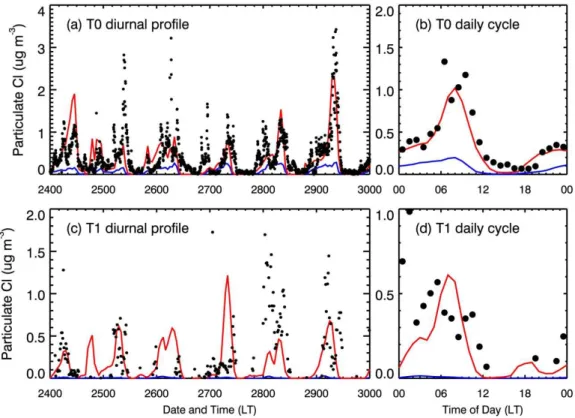
Fig. 2. Diurnal profiles of measured and simulated particulate chloride concentrations at(a)T0 and(c)T1 during the period from 24 to 29 March 2006, and diurnal cycles of measured and simulated particulate chloride concentrations at(b)T0 and(d)T1 averaged during the simulation period. Black dots: measurements; red line: the G-case with GB emissions; Blue line: the B-case without GB emissions.
2006. The particulate chloride at T0 was measured using a High-Resolution Time-of-Flight Aerosol Mass Spectrome-ter (HR-ToF-AMS) and complementary instrumentation dur-ing MILAGRO field campaign (Aiken et al., 2009). The ob-served particulate chloride shows large late night/early morn-ing spikes, especially in the early mornmorn-ing on 25, 26 and 29 March with mass concentrations exceeding 3 µg m−3. In the
Fig. 3. Simulated HCl distributions from GB at(a)09:00 and(b) 15:00 LT over Mexico City averaged during the period from 24 to 29 March 2006.
concentrations is well replicated, and the accumulation of nighttime particulate chloride concentrations and the rapid falloff of late morning particulate chloride concentrations are also reproduced. However, the G-case frequently underes-timates the observed particulate chloride spikes, especially in the early morning on 25 and 26 March, indicating either unawareness of unknown sources or uncertainties from me-teorological field simulations. Figure 2b shows the diurnal cycle of observed and simulated particulate chloride concen-trations at T0 over the simulation period. Both the B-case and G-case show good performance in simulating the partic-ulate chloride diurnal cycles, but the B-case underestimates the observed particulate chloride during the entire daily cy-cle, producing about less than 40 % of the observations. The modeled particulate chloride concentrations in the G-case are more consistent with the observations than those from the B-case, with a mean concentration of 0.41 µg m−3, very close to the observed 0.42 µg m−3. Compared the simulated chloride in the B-case and G-case, GB contributes about 0.24 µg m−3 chloride mass on average, or 60 % of the observation at T0, demonstrating that GB is a dominant source of particulate chloride in the urban area. It should be noted that Moffet et al. (2008) provided detailed studies of Cl-containing particles using single particle measurements at T0 during MILAGRO 2006. Based on spatial, temporal, physical, and chemical information on the Cl-containing particles, they concluded that these particles are produced by local waste incineration, which is consistent with the WRF-CHEM model simulations at T0.
T1 is a supersite located in the northwestern part of the Mexico City basin and used as a suburban background site
during MILAGRO field campaign (Molina et al., 2010). The simulated particulate chloride is compared to the particle-into-liquid-sampler (PILS) measurement at T1 (Fig. 2c and d). The measured particulate chloride exhibits distinct peaks during midnight and early morning. The B-case severely un-derestimates the observed particulate chloride concentrations during the entire simulation period, suggesting that the con-tribution of the non-BB emissions to the particulate chlo-ride is negligible in the suburban area. GB emissions con-siderably improve the particulate chloride simulations in the G-case, and the WRF-CHEM model generally captures the peaks during early morning, but overestimates on 27 March and underestimates on 28 and 29 March. Although the G-case includes the GB emissions, it still fails to produce the high peak between 00:00 and 02:00 LT (Fig. 2d), which is possibly caused by other particulate chloride sources, such as agricultural fires, brick-making kilns and volcanoes, which are not yet considered in the present study. Due to frequent absence of observed particulate chloride at T1 in the after-noon, only the comparison of mean particulate chloride mass in the morning is made between model and measurement. The simulated mean chloride mass from GB in the morning is about 0.26 µg m−3, which is 62 % of the observed value (0.42 µg m−3), showing that GB is a major source of
particu-late chloride in the suburban area.
Fig. 4.Diurnal profiles of measured and simulated BBOA concentrations at(a)T0 and(c)T1 during the period from March 24to 29, 2006. Diurnal cycles of measured and simulated BBOA concentrations at(b)T0 and(d)T1, and SOA concentrations at(e)T0 and(f)T1 averaged during the simulation period. Black dots: measurements; black line: simulated BBOA (POA in G-case minus POA in B-case); red line: the G-case with GB emissions; Blue line: the B-case without GB emissions.
favorable for the accumulation of HCl, high levels of HCl, up to 1∼3 ppb, are predicted near the GB emission source, and the HCl concentrations in most of Mexico City exceed 0.5 ppb. At 15:00 LT, with the transport and mixing of smoke plumes and increase of PBL height, the simulated surface HCl concentrations decrease to 0.1∼1.0 ppb in Mexico City. Based on the measurement of an open-path Fourier Trans-form Infrared (FTIR) spectrometer, Moya et al. (2003) es-timated that the HCl concentration did not exceed 2–3 ppb level in Mexico City. In addition, San Martini et al. (2006) suggested that the most likely concentrations of HCl are in
the sub-ppb range in Mexico City when the particles are aqueous from the simulations of a Markov Chain Monte Carlo model with a thermodynamic equilibrium model dur-ing the MCMA-2003 campaign (Molina et al., 2007). The WRF-CHEM simulations of HCl from GB are comparable to the above two studies, showing that GB is a major source of HCl in Mexico City.
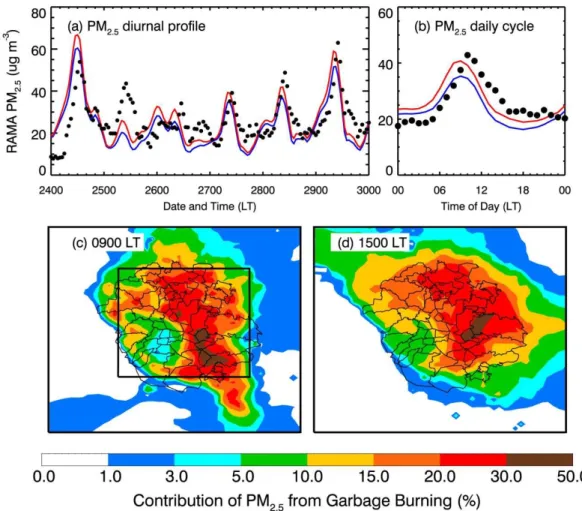
Fig. 5. (a)diurnal profile of measured and simulated PM2.5concentrations from GB averaged over RAMA sites and during the period from
24 to 29 March 2006;(b)diurnal cycles of measured and simulated PM2.5concentrations from GB averaged over RAMA sites and during the
simulation period; GB Contribution to PM2.5concentrations at(c)09:00 and(d)15:00 LT over Mexico City averaged during the simulation
period. Black dots: measurements; red line: the G-case with GB emissions; Blue line: the B-case without GB emissions.
SOA model can explain over 80 % observed SOA in the urban area, but the contributions of BB to organic aerosols are not considered in Li et al. (2011a). In the present study, the six-day episode we have chosen has been reported to have minor impacts from wild fire burning (Aiken et al., 2009; Lei et al., 2012), and the GB emissions could constitute an im-portant source of biomass burning organic aerosols (BBOA). Figure 4a presents the diurnal profiles of simulated (POA in the G-case minus POA in the B-case) and observed BBOA at T0. Although the WRF-CHEM model fails to capture the large fluctuations of the observed BBOA concentrations, in general it reproduces the observed diurnal cycle (Fig. 4b). The simulated six-day averaged BBOA mass is close to the measurement at T0, demonstrating that GB is a major source of BBOA in the urban area when wild fires around Mexico City are sparse. The WRF-CHEM model generally underes-timates the observed BBOA at T1 (Figu. c–d) and produces more than 50 % of the observations, indicating that other bio-fuel emissions, such as domestic (food cooking) and indus-trial biofuel use, could also play an important role in BBOA
concentrations in the suburban area. SOA formation due to the GB emissions also improves the SOA simulations at T0 and T1 during daytime (Figure 4e–f). GB can explain 10 % and 18 % observed SOA concentrations on average at T0 and T1, respectively. The SOA contribution due to GB emissions enhances the domain-wide organic aerosol by about 4.4 % on average, which is close to the results by Lei et al. (2012). Lei et al. (2012) estimated that the SOA from GB contributes about 5 % to organic aerosols in both the urban and suburban areas of the MCMA. Detailed evaluation of GB emissions to organic aerosols (OA) can be found in Lei et al. (2012).
Figure 5a shows the diurnal profiles of simulated and observed near-surface PM2.5 concentrations averaged over
Mexico City RAMA stations and T1. The WRF-CHEM model generally tracks the temporal variations of PM2.5
con-centrations reasonably well, but frequently underestimates during daytime, particularly between 09:00 and 11:00 LT in the morning when the observed PM2.5concentrations reach
relatively low PBL height. The nighttime simulated PM2.5
concentrations are higher than the observations (Fig. 5b), irregardless of whether the GB emissions are included or not, indicating either the failure of PBL simulations or in-efficiency of the pollutant dispersion process or problems with the emissions during nighttime (Li et al., 2011a). However, during daytime, GB emissions considerably im-prove the PM2.5simulations. On average, the B-case yields
23.1 µg m−3 PM2.5 averaged over the RAMA sites and T1,
lower than the observed 25.8 µg m−3. GB emissions in the G-case enhance the PM2.5mass by about 13 % or 3.0 µg m−3
compared to the B-case. In addition, GB emissions contribute about 3–30 % of simulated PM2.5 in Mexico City at 09:00
and 15:00 LT (Figure 5c and d), which is consistent with the conclusion reported by Christian et al. (2010) from the measurement of fine particle antimony (Sb) from GB. They compared the measured mean mass ratios of Sb/PM2.5 for
pure garbage burning and ambient air and concluded that GB could account for up to one third of the PM2.5mass in
MCMA. On average, GB emissions contribute 1.9 µg m−3or 12 % to the PM2.5mass in Mexico City (see the black box
in Fig. 5c) in the G-case. About 65 % of the enhanced PM2.5
mass from GB is contributed by OA, in which the contribu-tions from POA and SOA are 30 % and 35 %, respectively. The particulate chloride constitutes 10 % of the enhance-ment of PM2.5 mass from GB, greater than the
contribu-tions from black carbon (4 %), sulfate (0 %), nitrate (0.8 %), and ammonium (5 %) aerosols. Other unidentified particu-late species contributes about 14 % of the GB PM2.5 mass.
Using the same GB emission inventory as the present study, Hodzic et al. (2012) reported that GB represents 1–15 % of the PM2.5mass over the metropolitan area of Mexico City
with strong spatial variability; their estimate is lower than the results from the present study. There are two main reasons for the difference between the two studies. Firstly, in Hodzic et al. (2012), POA is considered physically and chemically in-ert, resulting in negligible SOA contribution from GB. In our study, POA is assumed to be semi-volatile and photochemi-cally reactive; GB considerably enhances the SOA formation in Mexico City. Secondly, Hodzic et al. (2012) did not con-sidered the contribution of chloride to the PM2.5mass, which
is not negligible according to our estimation. If the contribu-tion of SOA and chloride from GB are excluded, the results in this present study are comparable to those in Hodzic et al. (2012).
4 Summary and implication
In the present study, the WRF-CHEM model has been used to evaluate the contributions of GB to chloride and PM2.5in
Mexico City metropolitan area during the period from 24 to 29 March 2006. Based on the recently developed GB emis-sion inventory (Hodzic et al., 2012; Lei et al., 2012), the sim-ulated particulate chloride from GB can explain over 60 %
of the observation in the urban and suburban area, indicating that GB is a major source of particulate chloride in Mexico City. In addition, GB also contributes up to 3 ppb HCl, which is consistent with the measurement in Mexico City. GB is also an important source of PM2.5, constituting about 3–30 %
simulated PM2.5mass on average. It should be emphasized
that the GB emission inventory used in the present study still has large uncertainties (about a factor of 2 or more), which could potentially influence the evaluation of the contribution of GB to chloride and PM2.5in Mexico City. Sensitivity
stud-ies have shown that if the present GB emissions are decreased by 50 %, GB is not an important source of PM2.5 in
Mex-ico City, contributing about 1–14 % simulated PM2.5mass on
average, and the WRF-CHEM model substantially underes-timates the observed particulate chloride. If the present GB emissions are doubled in the WRF-CHEM simulations, the contribution of GB to the simulated PM2.5mass is about 6–
60 % and GB becomes a dominant source of PM2.5in some
areas of Mexico City. The simulated particulate chloride is much higher than the observations. Although the simulated PM2.5from GB is consistent with the measurement by
Chris-tian et al. (2010), showing the present GB emission inventory is generally reasonable, the uncertainties of GB emissions need to be further investigated to provide a bolster for the model simulations. Furthermore, meteorological conditions play a key role in determining the accumulation or disper-sion of pollutant and might significantly influence the eval-uation of the GB contribution to chloride and PM2.5(Bei et
al., 2008; 2010).
Christian et al. (2010) suggested that large HCl emis-sion factor in central Mexico results from the burning of polyvinyl chloride (PVC). A recent study by Hedman et al. (2006) showed that chloride-containing plastic waste gave rise to high emissions of polychlorinated dibenzo-p-dioxins (PCDDs) and polychlorinated dibenzofurans (PCDFs) and found PVC plastic to be a major source of dioxin. Consider-ing that dioxins have been characterized by US EPA as likely human carcinogens and are anticipated to increase the risk of cancer at background levels of exposure, further evaluation of the contribution of GB to dioxins level in Mexico City is imperative.
Acknowledgements. We are indebted to the large number of people
Academy of Sciences and the National Natural Science Foundation of China (no. 41275153). Naifang Bei is also supported by the National Natural Science Foundation of China (no. 41275101).
Edited by: A. Baklanov
References
Akagi, S. K., Yokelson, R. J., Wiedinmyer, C., Alvarado, M. J., Reid, J. S., Karl, T., Crounse, J. D., and Wennberg, P. O.: Emis-sion factors for open and domestic biomass burning for use in atmospheric models, Atmos. Chem. Phys., 11, 4039–4072, doi:10.5194/acp-11-4039-2011, 2011.
Aiken, A. C., Salcedo, D., Cubison, M. J., Huffman, J. A., DeCarlo, P. F., Ulbrich, I. M., Docherty, K. S., Sueper, D., Kimmel, J. R., Worsnop, D. R., Trimborn, A., Northway, M., Stone, E. A., Schauer, J. J., Volkamer, R. M., Fortner, E., de Foy, B., Wang, J., Laskin, A., Shutthanandan, V., Zheng, J., Zhang, R., Gaffney, J., Marley, N. A., Paredes-Miranda, G., Arnott, W. P., Molina, L. T., Sosa, G., and Jimenez, J. L.: Mexico City aerosol analysis during MILAGRO using high resolution aerosol mass spectrom-etry at the urban supersite (T0) – Part 1: Fine particle composi-tion and organic source apporcomposi-tionment, Atmos. Chem. Phys., 9, 6633–6653, doi:10.5194/acp-9-6633-2009, 2009.
Andreae, M. O. and Merlet, P.: Emission of trace gases and aerosols from biomass burning, Global Biogeochem. Cy., 15, 955–966, 2001.
Bei, N., de Foy, B., Lei, W., Zavala, M., and Molina, L. T.: Using 3DVAR data assimilation system to improve ozone simulations in the Mexico City basin, Atmos. Chem. Phys., 8, 7353–7366, doi:10.5194/acp-8-7353-2008, 2008.
Bei, N., Lei, W., Zavala, M., and Molina, L. T.: Ozone predictabili-ties due to meteorological uncertainpredictabili-ties in the Mexico City basin using ensemble forecasts, Atmos. Chem. Phys., 10, 6295–6309, doi:10.5194/acp-10-6295-2010, 2010.
Binkowski, F. S. and Roselle S. J.: Models-3 Community Multiscale Air Quality (CMAQ) model aerosol compo-nent: 1. Model description, J. Geophys. Res., 108, 4183, doi:10.1029/2001JD001409, 2003.
Brioude, J., Cooper, O. R., Feingold, G., Trainer, M., Freitas, S. R., Kowal, D., Ayers, J.K., Prins, E., Minnis, P., McKeen, S. A., Frost, G. J., and Hsie, E.-Y.: Effect of biomass burning on ma-rine stratocumulus clouds off the California coast, Atmos. Chem. Phys., 9, 8841–8856, doi:10.5194/acp-9-8841-2009, 2009. Bond, T. C., Streets, D. G., Yarber, K. F., Nelson, S. M., Woo,
J.-H., and Klimont, Z.: A technology-based global inventory of black and organic carbon emissions from combustion, J. Geo-phys. Res., 109, D14203, doi:10.1029/2003JD003697, 2004. Chen, F. and Dudhia, J.: Coupling an advanced
land-surface/hydrology model with the Penn State/NCARMM5modelingsystem. Part I: Model descrip-tion and implementadescrip-tion, Mon. Wea. Rev., 129, 569–585, 2001.
Christian, T. J., Yokelson, R. J., Cardenas, B., Molina, L. T., En-´
gling, G., and Hsu, S.-C.: Trace gas and particle emissions from domestic and industrial biofuel use and garbage burning in cen-tral Mexico, Atmos. Chem. Phys., 10, 565–584, doi:10.5194/acp-10-565-2010, 2010.
Costner, P.: Estimating releases and prioritizing sources in the con-text of the Stockholm Convention: Dioxin emission factors for forest fires, grassland and moor fires, open burning of agricultural residues, open burning of domestic waste, landfill and dump fires, The International POPs Elimination Project, Mexico, 40 pp., 2005.
Costner, P.: Update of dioxin emission factors for forest fires, grass-land and moor fires, open burning of agricultural residues, open burning of domestic waste, landfills and dump fires, International POPs Elimination Network, Mexico, 13 pp., 2006.
de Foy, B., Fast, J. D., Paech, S. J., Phillips, D., Walters, J. T., Coulter, R. L., Martin, T. J., Pekour, M. S., Shaw, W. J., Kasten-deuch, P. P., Marley, N. A., Retama, A., and Molina, L. T.: Basin-scale wind transport during the MILAGRO field campaign and comparison to climatology using cluster analysis, Atmos. Chem. Phys., 8, 1209–1224, doi:10.5194/acp-8-1209-2008, 2008. Dudhia, J.: Numerical study of convection observed during the
winter monsoon experiment using a mesoscale two-dimensional model, J. Atmos. Sci., 46, 3077–3107, 1989.
Emmons, L. K., Apel, E. C., Lamarque, J.-F., Hess, P. G., Avery, M., Blake, D., Brune, W., Campos, T., Crawford, J., DeCarlo, P. F., Hall, S., Heikes, B., Holloway, J., Jimenez, J. L., Knapp, D. J., Kok, G., Mena-Carrasco, M., Olson, J., O’Sullivan, D., Sachse, G., Walega, J., Weibring, P., Weinheimer, A., and Wiedinmyer, C.: Impact of Mexico City emissions on regional air quality from MOZART-4 simulations, Atmos. Chem. Phys., 10, 6195–6212, doi:10.5194/acp-10-6195-2010, 2010.
Grell, G. A., Peckham, S. E., Schmitz, R., McKeen, S. A., Wilczak, J., and Eder, B.: Fully coupled “online” chemistry within the WRF model, Atmos. Environ., 39, 6957–6975, 2005.
Grell, G., Freitas, S. R., Stuefer, M., and Fast, J.: Inclusion of biomass burning in WRF-Chem: impact of wildfires on weather forecasts, Atmos. Chem. Phys., 11, 5289–5303, doi:10.5194/acp-11-5289-2011, 2011.
Hedman, B., Naslund, M., and Marklund, S.: Emissions of PCDD/F, PCB, and HCB from combustion of firewood and pellets in res-idential stoves and boilers, Environ. Sci. Technol., 40, 4968– 4975, 2006.
Hodzic, A., Wiedinmyer, C., Salcedo, D., and Jimenez, J. L.: Im-pact of trash burning on air quality in Mexico City, Environ. Sci. Technol., 46, 4950–4957, 2012.
Horowitz, L. W., Waters, S., Mauzerall, D. L., Emmons, L. K., Rasch, P. J., Tie, X., Lamarque, J.-F. Schultz, M. G., Tyndall, G. S., Orlando, J. J., and Brasseur, G. P.: A global simulation of tropospheric ozone and related tracers: Description and eval-uation of MOZART, version 2, J. Geophys. Res., 108, 4784, doi:10.1029/2002JD002853, 2003.
Intergovernmental Panel on Climate Change: Climate Change 2007: The Scientific Basis. Contribution of Working Group 1 to the Fourth Assessment Report of the Intergovernmental Panel on Climate Change, edited by: Solomon, S., Qin, D., Manning, M., Chen, Z., Marquis, M., Averyt, K. B., Tignor, M., and Miller, H. L., 996 pp., Cambridge Univ. Press, New York, 2007.
Koo, B. Y., Ansari, A. S., and Pandis, S. N.: Integrated approaches to modeling the organic and inorganic atmospheric aerosol com-ponents, Atmos. Environ., 37, 4757–4768, 2003.
Lei, W., Li, G., and Molina, L.: Modeling the impacts of biomass burning on air quality in and around Mexico City, Atmos. Chem. Phys. Discuss., 12, 22891–22943, doi:10.5194/acpd-12-22891-2012, 2012.
Lelieveld, J., Crutzen, P. J., Ramanathan, V., Andreae, M. O., Bren-ninkmeijer, C. A. M., Campos, T., Cass, G. R., Fischer, H., de Gouw, J. A., Hansel, A., Jefferson, A., Kley, D., de Laat, A. T. J., Lal, S., Lawrence, M. G., Lobert, J. M., Mayol-Bracero, O. L., Mitra, A. P., Novakov, T., Oltman, S. J., Prather, K. A., Reiner, T., Rodhe, H., Scheeren, H. A., Sikka, D., and Williams, J.: The Indian Ocean Experiment: Widespread Air Pollution from South and Southeast Asia, Science, 291, 1031–1036, 2001.
Lemieux, P. M., Lutes, C. C., and Santoianni, D. A.: Emissions of organic air toxics from open burning: a comprehensive review, Prog. Energ. Combust., 20, 1–32, 2004.
Li, G., Zhang, R., Fan, J., and Tie, X.: Impacts of black carbon aerosol on photolysis and ozone, J. Geophys. Res., 110, D23206, doi:10.1029/2005JD005898, 2005.
Li, G., Lei, W., Zavala, M., Volkamer, R., Dusanter, S., Stevens, P., and Molina, L. T.: Impacts of HONO sources on the pho-tochemistry in Mexico City during the MCMA-2006/MILAGO Campaign, Atmos. Chem. Phys. Discuss., 10, 4143–4188, doi:10.5194/acpd-10-4143-2010, 2010.
Li, G., Zavala, M., Lei, W., Tsimpidi, A. P., Karydis, V. A., Pan-dis, S. N., Canagaratna, M. R., and Molina, L. T.: Simulations of organic aerosol concentrations in Mexico City using the WRF-CHEM model during the MCMA-2006/MILAGRO campaign, Atmos. Chem. Phys., 11, 3789–3809, doi:10.5194/acp-11-3789-2011, 2011a.
Li, G., Zavala, M., Lei, W., Tsimpidi, A. P., Karydis, V. A., Pan-dis, S. N., Canagaratna, M. R., and Molina, L. T.: Simulations of organic aerosol concentrations in Mexico City using the WRF-CHEM model during the MCMA-2006/MILAGRO campaign, Atmos. Chem. Phys., 11, 3789-3809, doi:10.5194/acp-11-3789-2011, 2011b.
Lighty, J. S., Veranth, J. M., and Sarofim, A. F.: Combustion aerosols: Factors governing their size and composition and im-plications to human health, J. Air Waste Manage. Assoc., 50, 1565–1618, 2000.
Lin, Y.-L., Farley, R. D., and Orville, H. D.:, Bulk parameterization of the snow field in a cloud model, J. Appl. Meteorol., 22, 1065– 1092, 1983.
Mlawer, E. J., Taubman, S. J., Brown, P. D., Iacono, M. J., and Clough, S. A.: Radiative transfer for inhomogeneous atmo-sphere: RRTM, a validated correlated-k model for the long-wave, J. Geophys. Res., 102, 16663–16682, 1997.
Moffet, R. C., Desyaterik, Y., Hopkins, R. J., Tivanski, A. V., Gilles, M. K., Wang, Y., Shutthanandan, V., Molina, L. T., Abraham, R. G., Johnson, K. S., Mugica, V., Molina, M. J., Laskin, A., and Prather, K. A.: Characterization of aerosols containing Zn, Pb, and Cl from an industrial region of Mexico City, Environ. Sci. Technol., 42, 7091–7097, 2008.
Molina, L. T., Kolb, C. E., de Foy, B., Lamb, B. K., Brune, W. H., Jimenez, J. L., Ramos-Villegas, R., Sarmiento, J., Paramo-Figueroa, V. H., Cardenas, B., Gutierrez-Avedoy, V., and Molina, M. J.: Air quality in North America’s most populous city – overview of the MCMA-2003 campaign, Atmos. Chem. Phys., 7, 2447–2473, doi:10.5194/acp-7-2447-2007, 2007.
Molina, L. T., Madronich, S., Gaffney, J. S., Apel, E., de Foy, B., Fast, J., Ferrare, R., Herndon, S., Jimenez, J. L., Lamb, B., Osornio-Vargas, A. R., Russell, P., Schauer, J. J., Stevens, P. S., Volkamer, R., and Zavala, M.: An overview of the MILA-GRO 2006 Campaign: Mexico City emissions and their trans-port and transformation, Atmos. Chem. Phys., 10, 8697–8760, doi:10.5194/acp-10-8697-2010, 2010.
Moya, M., Castro, T., Zepeda, M., and Baez, A.: Characterization of size-differentiated inorganic composition of aerosols in Mexico City, Atmos. Environ., 37, 3581–3591, 2003.
Noh, Y., Cheon, W. G., and Raasch, S.: The improvement of the K-profile model for the PBL using LES. Preprints, Int. Workshop of Next Generation NWP Models, Seoul, South Korea, Laboratory for Atmospheric Modeling Research, 65–66, 2001.
Odum, J. R., Hoffman, T., Bowman, F., Collins, D., Flagan, R. C., and Seinfeld, J. H.: Gas/particle partitioning and secondary organic aerosol yields, Environ. Sci. Technol., 30, 2580–2585, 1996.
Randles, C. A. and Ramaswamy, V.: Direct and semi-direct im-pacts of absorbing biomass burning aerosol on the climate of southern Africa: a Geophysical Fluid Dynamics Laboratory GCM sensitivity study, Atmos. Chem. Phys., 10, 9819–9831, doi:10.5194/acp-10-9819-2010, 2010.
San Martini, F. M., Dunlea, E. J., Volkamer, R., Onasch, T. B., Jayne, J. T., Canagaratna, M. R., Worsnop, D. R., Kolb, C. E., Shorter, J. H., Herndon, S. C., Zahniser, M. S., Salcedo, D., Dzepina, K., Jimenez, J. L., Ortega, J. M., Johnson, K. S., McRae, G. J., Molina, L. T., and Molina, M. J.: Implementation of a Markov Chain Monte Carlo method to inorganic aerosol modeling of observations from the MCMA-2003 campaign – Part II: Model application to the CENICA, Pedregal and Santa Ana sites, Atmos. Chem. Phys., 6, 4889–4904, doi:10.5194/acp-6-4889-2006, 2006.
Shrivastava, M. K., Lane, T. E., Donahue, N. M., Pandis, S. N., and Robinson, A. L.: Effects of gas-particle partitioning and aging of primary emissions on urban and regional or-ganic aerosol concentrations, J. Geophys. Res., 113, D18301, doi:10.1029/2007JD009735, 2008.
Song, J., Lei, W., Bei, N., Zavala, M., de Foy, B., Volkamer, R., Cardenas, B., Zheng, J., Zhang, R., and Molina, L. T.: Ozone response to emission changes: a modeling study during the MCMA-2006/MILAGRO Campaign, Atmos. Chem. Phys., 10, 3827–3846, doi:10.5194/acp-10-3827-2010, 2010.
Tian, D., Hu, Y. T., Wang, Y. H., Boylan, J. W., Zheng, M., and Russell, A. G.: Assessment of biomass burning emissions and their impacts on urban and regional PM2.5: A Georgia case study,
Environ. Sci. Technol., 43, 299–305, 2009.
Tie, X., Madronich, S., Walters, S., Zhang, R., Rasch, P., and Collins, W.: Effect of clouds on photolysis and ox-idants in the troposphere, J. Geophys. Res., 108, 4642, doi:10.1029/2003JD003659, 2003.
Tsimpidi, A. P., Karydis, V. A., Zavala, M., Lei, W., Molina, L., Ulbrich, I. M., Jimenez, J. L., and Pandis, S. N.: Evaluation of the volatility basis-set approach for the simulation of organic aerosol formation in the Mexico City metropolitan area, Atmos. Chem. Phys., 10, 525–546, doi:10.5194/acp-10-525-2010, 2010. USEPA:, An inventory of sources and environmental releases
Environmental Assessment, Office of Research and Develop-ment, Washington, DC, 677 pp., 2006.
Volkamer, R., San Martini, F., Molina, L. T., Salcedo, D., Jimenez, J. L., and Molina, M. J.: A Missing Sink for Gas-Phase Glyoxal in Mexico City: Formation of Secondary Organic Aerosol, Geo-phys. Res. Lett., 34, L19807, doi:10.1029/2007GL030752, 2007. Wang, J. and Christopher, S. A.: Mesoscale modeling of cen-tral American smoke transport to the United States, 2: Smoke regional radiative impacts on surface energy budget and boundary layer evolution, J. Geophys. Res., 111, D14S92, doi:10.1029/2005JD006720, 2006.
Wang, L., Khalizov, A. F., Zheng, J., Xu, W., Ma, Y., Lal, V., and Zhang, R.: Atmospheric nanoparticles formed from heteroge-neous reactions of organics, Nature Geosci., 3, 238–242, 2010. Wesely, M. L.: Parameterization of surface resistance to gaseous dry
deposition in regional-scale numerical models, Atmos. Environ., 23, 1293–1304, 1989.
Yokelson, R. J., Burling, I. R., Urbanski, S. P., Atlas, E. L., Adachi, K., Buseck, P. R., Wiedinmyer, C., Akagi, S. K., Toohey, D. W., and Wold, C. E.: Trace gas and particle emissions from open biomass burning in Mexico, Atmos. Chem. Phys., 11, 6787– 6808, doi:10.5194/acp-11-6787-2011, 2011.
Zhang, R., Wang, L., Khalizova, A. F., Zhao, J., Zheng, J., Mc-Grawb, R. L., and Molina, L. T.: Formation of nanoparticles of blue haze enhanced by anthropogenic pollution, Proc. Natl. Acad. Sci. USA, 106, 17650–17654, 2009.
Zhang, R., Khalizova, A. F., Wang, L., Hu, M., and Xu, W.: Nucle-ation and growth of nanoparticles in the atmosphere, Chem. Rev. 112, 1957–2011, 2012.
Zhao, J., Levitt, N. P., and Zhang, R.: Heterogeneous chemistry of octanal and 2, 4-hexadienal with sulfuric acid, Geophys. Res. Lett., 32, L09802, doi:10.1029/2004GL022200, 2005.
Zhao, J., Levitt, N. P., Zhang, R. Y., and Chen, J. M.: Heteroge-neous reactions of methylglyoxal in acidic media: implications for secondary organic aerosol formation, Environ. Sci. Technol., 40, 7682–7687, 2006.