DEMOGRAPHIC EVOLUTION OF THE SMALL TOWNS IN THE
NORTH-EAST DEVELOPMENT REGION IN
THE POST-COMMUNIST PERIOD
GABRIEL CAMARĂ
1ABSTRACT - Romania's population has declined steadily from 23.2 million in 1990 to 21.5 million inhabitants in 2007. This overall decline in population is not entirely true for the towns and cities of the North-East Region, as during the same period they recorded both decreases and increases in population due to positive natural balance. The North-East Region (partially superimposed over the historic region of the western Moldova) is considered the poorest region in the European Union and a disadvantaged area. The rural young population of Moldova is a reservoir which supplies urban areas and especially large cities. In these circumstances, the small towns of the North-East Region are seeking balance (demographic, economic, functional). This paper examines the demographic evolution of the small towns located in the area under analysis, in the post-communist period, illustrating the types of fluctuations in statistical methods as regards demographic changes and the risk of depopulation in the future, correlated with a lower overall population of Romania.
Keywords: demographic evolution, small cities, post-communist, North-East Region
INTRODUCTION
The analysis of demographic trends is an important area for the adoption of appropriate policies to prevent depopulation. The North-East Region has a special status as the poorest European Union Development Region, the east central area of this region being a disadvantaged area (Ianoş et all., 2009), while registering a generally positive natural balance during 1990-2007. This Region includes the counties of Suceava, Botoşani, Neamţ, Iaşi, Bacău, Vaslui. The motivation for choosing such a regional unit was determined by the need for a European statistical territorial unit namely NUTS2. The urban settlements considered in the present analysis are those with less than 20,000 inhabitants. In the North-East Development Region, there are 46 urban settlements (cities and towns), out of which Vatra Dornei and other 26 towns (12 in Suceava County) have less than 20,000 inhabitants.
METHODS AND TOOLS FOR ANALYSING THE DEMOGRAPHIC EVOLUTION For the analysis of the demographic trends databases provided by the National Institute of Statistics and statistical and cartographic methods (charts and Hierarchical Ascendant Classification) have been used. Maps best reflect the spatial distribution of the demographic phenomena, while the Hierarchical Ascending Classification is a statistical method to synthesize information on a certain period of time, identifying the general trend of dynamics. The quantitative indicators used were grouped into the category of demographic indicators (total population, population structure by age, population structure by sex, natural balance, migration balance).
GENERAL CONSIDERATIONS ON THE EVOLUTION OF URBAN POPULATION IN THE NORTH-EAST DEVELOPMENT REGION
Literature distinguishes three main ways of urban population growth: based on natural growth, based on increased migration growth and caused by administrative measures (Ianoş, I., Tălângă, C., 1994).
According to the data provided by the National Institute of Statistics, the urban population of the North-East Region increased by only 1.5 percent in 17 years, from 42.08% in 1990 to 43.51% in 2007. The towns analysed in this paper, many of them recently declared urban, with poor urban character in some cases (Iaţu, C., Muntele, I., 2001), have been set up to bring a significant contribution to the urban population and, moreover, to serve a given territory (as stated in the National Spatial Plan, Section 4 - Urban Network, there must be urban settlements every 20 kilometres). Some small towns were granted the town status since the 19th century (Târgu Ocna, 1846), followed by Gura Humorului (1905), Solca (1926), Slănic-Moldova (1935). In 1968, as result of the administrative reform, five other localities, situated in the eastern and in the north-eastern part of the region, were declared towns. After 2000, other 14 villages were declared towns. Săveni (town in 1920) and Darabani (town in 1926) lost their urban status in 1950 and declared urban settlements again, in 1968. In the summer of 2010, a referendum was held in the towns of Cajvana and Milişăuţi to restore the village status; the referendum was declared invalid due to the absenteeism from voting (the voting presence was only 30%).
The small towns in the North-East Development Region are represented in Figure 1.
The analysis of population structure by sex in the small towns located in the North-East
Region, in 1992 and 2007, reflects an equalization of male-female ratio in some cases and a masculinization or feminization of the population in other cases. In 1992, the number of male population was much higher than the female one in the town of Târgu Ocna, as a result of male labour force employed in the salt mine. In 2007, an increase in the share of male population was registered in several towns in Suceava County (Broşteni,
Frasin
, Milişăuţi Vatra Dornei and Siret), Iaşi (Târgu Frumos), Bacău (Slănic Moldova), often due to the emigration of females (there is an exceptional decrease in the number of females in the two resort towns – Vatra Dornei and Slanic-Moldova).As regards the populationstructure by age, in 2004, the population reveals the demographic
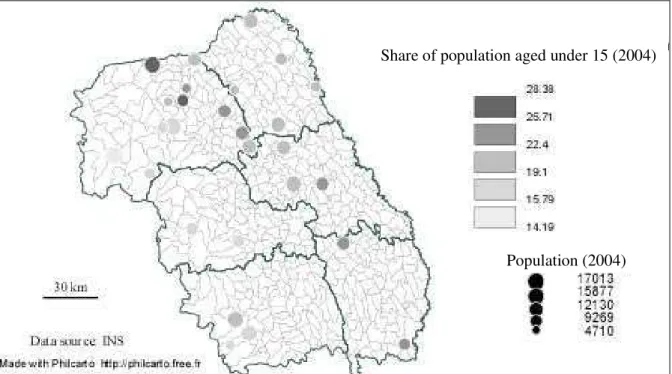
peculiarities of the region, namely the low share of the old population (excepting the towns of Roznov and Bicaz in Neamţ County, the town of Vatra Dornei in Suceava County and the town of Ştefăneşti in Botoşani County, where the number of the old population exceeds the number of the young population), as well as the high share of adult population and young adults. The young population (aged under 15) is well represented in the towns of Vaslui County and partly in Suceava County (Cajvana, Salcea Vicovu de Sus) and Iaşi (Podu Iloaiei). Adult population (15-59 years) dominates in all the small towns, while the share of old population (aged over 60) is dominated by young population in such cases.
When analysing the demographic trends by taking into consideration the age groups reported
in the analysis, it appears that the young people, aged under 15 (Figure 2), are well represented in the towns located on the central axis of the North-East Development Region, in the Suceava Plateau, the Central Plain of Moldavia and the Moldavian Plateau (Vicovu de Sus, Cajvana, Salcea in Suceava County; Podu Iloaiei in Iaşi County; Negreşti and Murgeni in Vaslui County). However, the young population is underrepresented in the eastern and western parts of the region, with the exception of the town of Vatra Dornei, where the high number of youth may lead to increased risk of demographic dependence (Iaţu C., 2006).
Figure 2.Share of population aged under 15 in the small-sized towns of the North-East Development Region (2004)
Share of population aged under 15 (2004)
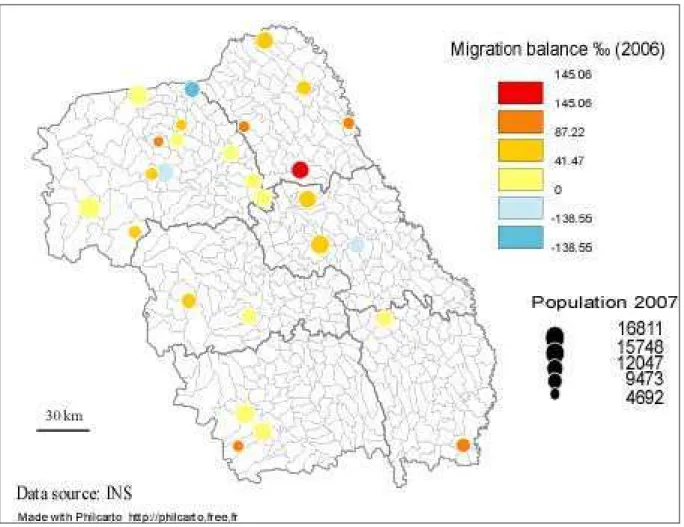
The migration balance of population (Figure 3) for the period 1990-2006 is negative for the
entire period in the case of Târgu Ocna, Gura Humorului, Broşteni, Siret, with trends of improvement in recent years. The towns with a positive migration balance recorded a positive maximum in the middle of the period between 1990 and 2000 (correlated with a negative maximum in the case of towns characterized by a negative migration balance), currently facing a decline in the value of the positive migration balance.
Figure 3.Migration balance in the small-sized towns of the North-East Development Region (2006)
In most cases, it is believed that this region has a natural balance net superior to the national average, but the reality is that the situation is heterogeneous. The analysis of the natural balance of population in the small-sized towns of the North-East Development Region (Figure 4) led, by means
of hierarchical ascendant classification, to the identification of six types of evolution in the period 1990-2006:
- strong increase - in the town of Cajvana;
- moderate increase - in the towns of Vicovu de Sus, Hârlău, Podu Iloaiei, Târgu Frumos, Negreşti; - strong decrease - in the town of Ştefăneşti;
- moderate decrease - in the towns of Târgu Ocna, Roznov, Bucecea, Vatra Dornei, Frasin, Solca;
Figure 4. Typology of the natural balance of population living in the small-sized towns of the North-East Development Region (1990-2006). Hierarchical Ascendant Classification.
CONCLUSIONS
REFERENCES
GROZA, O., GRASLAND, C., APETREI, M. (2003), Elemente de statistică geografică[Elements of
Geographical Statistics], Editura Universităţii „Al.I.Cuza”, Iaşi.
IANOŞ, I., ZAMFIR, D., PEPTENATU D., PINTILII, R. (2009), The individualisation of discontinuities in deeply disadvantaged areas of Romania in Romania, in: Romanian Review
of Regional Studies, volume 5, number 2, Cluj-Napoca.
IANOŞ, I., TĂLÂNGĂ, C. (1994), Oraşul şi sistemul urban românesc în condiţiile economiei de piaţă
[City and the Romanian Urban System in the Market Economy], Institutul de Geografie al Academiei Române, Bucureşti.
IAŢU, C. (2006), Démographie et Géographie du Travail en Roumanie post-décembriste, Sedcom
Libris, Iaşi.