Eurasian Journal of Social Sciences, 4(4), 2016, 14-34 DOI: 10.15604/ejss.2016.04.04.002
EURASIAN JOURNAL OF SOCIAL SCIENCES
www.eurasianpublications.com
T
HE
P
OWER
S
TRUGGLE IN THE
L
AYER OF
T
RANSNATIONAL
H
YDROPOLITICS
:
T
HE
C
ASE OF THE
I
LISU
D
AM
P
ROJECT
Ahmet Conker
Yildiz Technical University, Turkey Email: [email protected]
Abstract
The study analyses hydropolitical relations among state and non-state actors in the context of the layer of transnational hydropolitics by looking at the controversy over the construction of the Ilisu dam project. Turkey is fully engaged in its „hydraulic mission‟, very extensively and rapidly „developing‟ water resources throughout its territory. Some of these flows cross international borders, specifically very heavily contested Euphrates and Tigris basin. This large basin has attracted considerable academic attention, notably in regards to Turkey‟s relations with downstream neighbours, Syria and Iraq. Yet, the great bulk of the existing analysis falls prey to two broader weaknesses; a) it has narrowly applied the recently developed literature regarding the role of power in transboundary water politics, and b) it has neglected or under-emphasized how non-state actors enrol in hydropolitical processes. Informed by deep investigation of the case study regarding the recent controversy over the construction of the Ilisu dam on the Tigris River, the study proposes a conceptual framework that seeks to analyse how power dynamics are at work at different scales of hydropolitics other than inter-state relations between the riparian states and how both discursive and material power capabilities influence the outcome of interactions as well as conflictual and cooperative relations between the state and non-state actors. The application of the conceptual framework to the relations between opponents and proponents of the construction of the Ilisu dam project shows how power dynamics change over time and they strongly shape conflictual relations between the actors. By highlighting the influence of the transnational anti-dam activist networks, the study shows the relevance of including non-state actors into analysis. The study shows that such actors lack material power but are able to use discursive (ideational and bargaining) power very effectively to meet their interests.
Keywords: Ilisu Dam, Hydropolitics, Power
1. Introduction
Ahmet Conker / Eurasian Journal of Social Sciences, 4(4), 2016, 14-34
15
has become one of the most politically contested transboundary water basins among its riparian states in the MENA region.
On looking at inter-state hydropolitical relations in the Euphrates and Tigris basin, it is safe to argue that the large scale hydraulic development projects introduced by each riparian state has created concerns and resentment for the others. For example, when the Syrian government completed the Tabqa Dam on the Euphrates, the dam exacerbated the political tension between Syria and Iraq and it led to the first major inter-state crisis in the hydropolitics of the Euphrates and Tigris basin (Bari, 1977; Schultz, 1995; Yetim, 2006). Likewise, when Turkey, which is located in the pivotal position in the waters of the Euphrates and Tigris basin, announced cascades of hydraulic development projects, which is labeled as the Southeastern Anatolian Project (GAP-Turkish Acronym), the project created a big resentment between Turkey and its downstream riparian states, Syria and Iraq. Thus as the Turkish government completed these hydraulic development projects one by one during 1980s and 1990s, major diplomatic crisis erupted between Turkey and the downstream riparian states, Syria and Iraq (Kibaroglu and Unver, 2006). Particularly, water conflict was one of the issue areas between Turkey and Syria during the long standing tense relations between the two countries (Jouejati, 2005; MacQuarrie, 2004;Olson, 1997). While patterns of conflict in bilateral and trilateral relations with respect to the Euphrates and Tigris basin in inter-state level is the main theme until 2000s, there has been a notable shift from highly conflictual relations to relatively more cooperative relations in inter-state level during 2000s (Altunisik, 2006; Maden, 2011). For example, the Turkish and Syrian governments realized cooperative frameworks with respect to transboundary relations in the context of the political rapprochement during 2000s, even though the parties have not been able to achieve a comprehensive agreement to solve the problem permanently (Conker, 2014; Kibaroglu and Scheumann, 2011; Kibaroğlu, 2012). The dynamic character of the hydropolitics of the Euphrates and Tigris basin has attracted a wide-range academic attention in the literature. A great deal of scholarly works, linking transboundary water issues with conflict/war or cooperation/ peace have been done in the literature. However, looking at these studies in general, they fall prey to two broader weaknesses;i.) Even though there are a great deal of studies in water-conflict and water cooperation literature regarding hydropolitics of the Euphrates and Tigris basin, the application of the recently developed literature regarding the role of power in transboundary interaction is very limited. ii.) These studies seem to neglect the role of non-state actors in decision-making processes with respect to water issues.
The study, particularly, seeks to cover the second flaw by applying the framework of Hydro-hegemony (FHH) and related conceptual frameworks the controversial case of the Ilisu dam project, being built on Tigris River by the Turkish government. In 1997, the Turkish government announced the construction of the Ilisu Hydropower Plant (HPP) in cooperation with the private actors. During 2000s, while there have been less vocal criticisms coming from the downstream riparian states, the project has been heavily criticized and opposed by the civil society networks both in domestic and international scale. This study argues that the controversy developed around the construction of the Ilisu dam project shows it would be too narrow to look at hydropolitics of the Euphrates and Tigris basin in terms of inter-state riparian relations. The study shows that the recent conceptual frameworks such as the FHH, the framework of counter hydro-hegemony (FCHH) and the related literature developed by the group of academics namely the London Water Research Group (LWRG) do not only provide an explanatory conceptual framework in understanding transboundary water relations in inter-state level in the Euphrates and Tigris basin, it also provides a useful conceptual framework in understanding the role of non-state actors.1 In doing so, the contribution of the study is two-fold. First, it examines the role of non-state actors in hydropolitics of the Euphrates and Tigris basin by looking at the Ilisu dam dispute. Second, it applies the recent critical conceptual frameworks on transboundary water interaction analysis other than inter-state riparian relations.
1
Ahmet Conker / Eurasian Journal of Social Sciences, 4(4), 2016, 14-34
16
The structure of the paper will be as follows. In the first section, the critical conceptual frameworks developed by the LWRG will be briefly outlined. In the second section, the main empirical and conceptual flaws of these conceptual frameworks will be explained. In the third section the political developments that have occurred in the context of the Ilisu dam dispute will be explained. In the final section, the study will analyses how power relations are at work drawing upon the critical conceptual frameworks.
2. Reviewing the Framework of Hydro-Hegemony (FHH): Counter Hydro-hegemony and the Related Concepts
There have been a growing number of researchers, who are particularly based in the UK interacting with each other with some intensity to develop the Framework of Hydro-hegemony (FHH) since 2004 (Warner and Zeitoun, 2008). In this regard the first article called „ Hydro-hegemony – a framework for analysis of trans-boundary water conflicts” published by Zeitoun and Warner (2006) in Water Policy. Since then, the FHH has attracted a great deal of academic attention and a great deal of scholarly works have been devoted to further improve and/or criticise the framework (Cascao, 2009; Cascao, 2010b; Furlong, 2006; Selby, 2007; Wagerich, 2008; Warner, 2008). The main purpose of the FHH is to provide an alternative critical account other than considering transboundary water politics in terms of conflict or water-cooperation dichotomy. In doing so, the FHH sought to apply an alternative critical view on political processes in transboundary arrangements by examining different forms of power, by emphasizing the critical view on water conflict and cooperation that is to be adopted in understanding these concepts and by understanding different intensities of conflictual and cooperative patterns in transboundary water arrangements (Farnum, 2014; Julien, 2012). According to FHH orders in transboundary water arrangements may range from hierarchical settings in which there is an actor having absolute control to egalitarian settings in which there are interactions among actors in an absolute equal term. However, it is stressed by the FHH that either egalitarian or hierarchical settings can rarely be found in transboundary water arrangements. Rather most of the transboundary water arrangements are located between these two extremes, which is labelled as hegemonic orders. According to the FHH, a particular riparian state might be found in transboundary water setting enjoying certain degree of power supremacy over the others making it a pivotal state among official equals (Zeitoun and Warner, 2006).This riparian state is labelled as „basin hegemon‟ in the FHH. Basin hegemons can achieve this pivotal position in transboundary water arrangements by adopting resource capture, containment or leadership as water resource control strategies. It is this preference made by the basin hegemon which determines the form of interaction between riparian states in transboundary water arrangements (Zeitoun and Warner, 2006).
The main intellectual depth of the FHH comes from its detailed analysis of power exerted by the basin hegemon to realize these strategies as well as to get open or tacit compliance of other actors (Julien, 2012; Tawfik, 2015). Drawing upon Lukes‟s well-known tri-dimensional view on power, basin hegemons exert material and discursive (bargaining and ideational/structural) power tactics to get compliance of the other riparian states in transboundary water arrangements. Material power is the most visible form of power used by basin hegemons. Material power capabilities include military force or threat to use coercive measures, economic capacity, technical and instructional capacity to conduct large-scale hydraulic development projects. Bargaining power refers to the hegemon‟s ability to construct and promote socio-political values, practices and rules, which would limit other actors‟ abilities. Treaties, incentives, use of diplomacy, alliances, using legal enforcement mechanisms are the bargaining power tactics frequently used by basin hegemons. Finally ideational/structural power refers to actors‟ ability to promote certain discourses, narratives and storylines. Ideational power
is related with actors‟ capacity to control „ideas‟. In such cases, basin hegemon is able to
Ahmet Conker / Eurasian Journal of Social Sciences, 4(4), 2016, 14-34
17
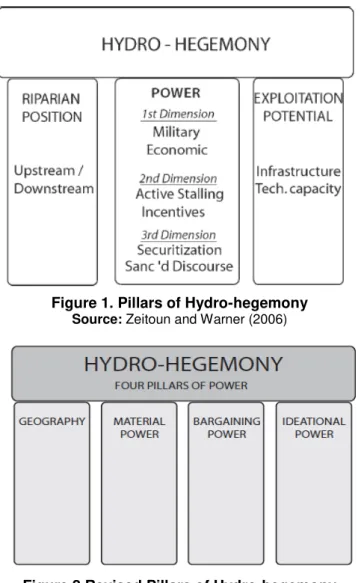
Figure 1. Pillars of Hydro-hegemony
Source: Zeitoun and Warner (2006)
Figure 2.Revised Pillars of Hydro-hegemony
Source: Cascao and Zeitoun (2010b)
Ahmet Conker / Eurasian Journal of Social Sciences, 4(4), 2016, 14-34
18
power tactics as counter-hegemonic contestation mechanisms (Cascao and Zeiton, 2010a; Zeitoun et al. 2016).
Finally, as could be seen in Figures 1 and 2 above, the FHH considers the geography (riparian position) as one of the pillars of power. Looking at the literature in general, it would be argued that the FHH puts rather more emphasis to other pillars of power in the analysis, namely material, bargaining and ideational power capabilities of actors. However, the empirical evidence derived from different transboundary water arrangements suggests that geography is not a form of power on its own. Rather, it is a form of powers that would either constraint or widen other power capabilities of actors. For instance, considering the hydropolitics of the Nile basin, cooperation without the basin hegemon-Egypt- which is located as a downstream riparian state, in this case, can be considered as an effective bargaining power tactic used by upstream riparian states. Likewise, the recent large-scale hydraulic development attempts conducted by the upstream Ethiopia brought the Egyptian government to compromise in the context of the controversial Grand Ethiopian Renaissance Dam (Tawfik, 2015). However, such power tactics are either ineffective or inapplicable for Iraq and Syria in the Euphrates and Tigris basin due to
Turkey‟s pivotal upstream position in the basin (Conker, 2014).
3. Limits of the Framework of Hydro-hegemony and Hydro-hegemony at Different Layers of Hydropolitics
The FHH and the related conceptual frameworks, in fact, provide a strong conceptual tool in understanding transboundary water politics. However, one of the main shortcomings of this literature is its state-centric view. Therefore, the FHH and the related literature miss out growing involvement of non-state actors at different scales in decision-making processes (Conker, 2014; Furlong, 2006). As Selby (2007) rightly points out there are both theoretical and empirical shortcomings of such conceptualization in understanding complex sets of relations in hydropolitics. Given the limited space, it is beyond the scope of this paper to elaborate the theoretical shortcomings derived from this state-centric view. The paper would rather look at the empirical shortcomings. On looking at the development of hydropolitics as a study area in literature, it would be argued that analyzing co-riparian relations in transboundary water arrangements constitutes the starting point. Pioneer scholarly works mainly examine inter-state relations between/among riparian states in transboundary water settings (Elhance, 1997; Frey, 1993; Gleick, 1993; Lowi, 1995; among others). Even today, the bulk of scholarly works which can be considered within the boundaries of hydropolitics, are devoted to analyze this dimension. However, considering the complex sets of relations at different scales and the growing involvement of actors from private sector, public sector and civil society in decision-making processes with respect to water issues, it would be misleading to consider hydropolitics as merely interactions between/among co-riparian states in transboundary water basins (Wagerich and Warner, 2010).
Ahmet Conker / Eurasian Journal of Social Sciences, 4(4), 2016, 14-34
19 4. Conceptual Framework
4.1. Layers of Politics of Water (Hydropolitics)
Before examining how the FHH can be applied to the layer of transnational hydropolitics, we need to identify the scope of hydropolitics as a sub-discipline within political science and international relations. As stated above, although the initially scholarly works have dealt with inter-state co-riparian relations in transboundary water interactions, empirical studies shows this constitutes one of the dimension of hydropolitics among others. Regarding what hydropolitics entails as a study area, Mollinga provides a comprehensive account. Mollinga (2001) argues that water and politics are vast subjects which compose of four main levels.2
Inter-state politics of water referring to inter-state political relations with respect to water issues
Politics of water resources policy referring to contestation over water policies and implementation between the public sector, civil society and private sector.
Everyday politics of water referring to contested nature of water utilization in society in daily activities.
Global politics of water, referring interactions among international organizations, nation-state, INGOs, Transnational Corporations to promote certain discourses, narratives, rules and practices regarding water resources management and development. Mollinga considers this dimension as an emerging layer in hydropolitics.
In addition to these layers of hydropolitics, a fifth category can be added namely „transnational hydropolitics, given the growing involvement of Transnational Corporations (TNCs), nation-wide business cooperated with nation-states in particular large-scale hydraulic development projects and creation of transnational anti-dam activist networks to oppose such projects. The cases of the Ilisu dam project in Tigris (Atzl, 2009) and the Xayaburi dam in the Lower Mekong (Hensengerth, 2015) show how inter-governmental networks are no longer the only spaces for decision-making and how actors from civil society and private sector have become active at different scales in transboundary water arrangements. It appears that the emergence of transnational hydropolitics as a new layer is a result of combination of two parallel developments in water resources management and development. The first development is the privatization of water across the globe and growing involvement of private sector in decision-making processes with respect to water since 1980s. The second development is the creation of transnational advocacy networks as response to the first development which seeks address environmental, social and cultural adverse impacts of large-scale hydraulic development projects (Conca, 2006).
4.2. Uncovering Hydro-hegemony in the Layer of Transnational Hydropolitics
After having identified transnational hydropolitics as a separate layer, the question that needs to be posed is what are the general features of the layer of transnational hydropolitics? The main features of the layer of transnational hydropolitics can be summarized as follows.
First, construction of a particular hydraulic infrastructure (mostly large-scale dams) is the main dispute in cases that can be located in transnational hydropolitics. These projects are generally large-scale hydraulic projects which would have environmental, social, and cultural and transboundary impacts on a basin. They attract international capital and involvement of
private sector both within and outside of the „host state‟.3
Those opposing the project raise concerns regarding these social, environmental and cultural adverse impacts of those projects. Second, in transnational hydropolitics, the decision-making processes are no longer taken
2Mollinga prefers to use the term „levels‟. For the sake of consistency, the term „layer‟ is used throughout
the paper.
3 Host state refers to the state in which the hydraulic development project is conducted with the
Ahmet Conker / Eurasian Journal of Social Sciences, 4(4), 2016, 14-34
20
within the boundaries of the transboundary water basin, since actors such as TNCs, international private creditors, Export Credit Agencies (ECAs), International, nation-wide and local non-governmental organizations (NGOs) are involved in decision-making processes. Therefore, while horizontal interactions are the main patterns in inter-state co-riparian relations, vertical, horizontal and diagonal complex sets of relations can be identified in transnational hydropolitics. Third, while actors and spaces for decision-making are less complex and static in the context of inter-state politics of water, actors seeking to involve in decision-making processes and sets of interactions among various actors are much more complex and dynamic in the context of transnational hydropolitics. Finally, since there are public private partnerships between the states and private actors, states apparatus is no longer the main space for decision-making in the context of transnational hydropolitics. This feature also provides opportunities for the civil society to be influential in decision-making processes on water resources development and management.
Actors in the layer of transnational hydropolitics can be analyzed within two broader categories. First, there are those opposing the constructions of a particular project due to its social, environmental and cultural adverse effects. These actors include International NGOs (INGOs) that operates outside of the host state, local and nation-wide NGOs, political parties, local governmental bodies (i.e: local municipalities), communities, paramilitary groups and individuals. Some of these actors may establish alliances and informal networks between each other to achieve their goals. Even though the opponents have a common goal of cancelling the project, they differ from each other in terms of their issue areas that they focus on. For instance some NGOs or INGOs emphasize the environmental impacts, while others focus on human rights issues (displacement of the local population affected by a certain project) or cultural issues (preservation of certain historical sites). These group of actors can be labeled as the opponents or anti-dam networks. Second, there are those supporting the project. These group of actors include national governments that seek to construct the project (the host state), infrastructure corporations such as TNCs, domestic companies, creditors such as international and domestic private banks and public banks, ECAs as credit guarantors and private consultancy companies. These groups of actors can be labeled as the proponents or the pro-dam networks. Here the host state has a primary importance since the main dispute occur between the host state and the opponents. Since it is difficult for the opponents to influence in the host state itself, they exert certain material, bargaining and ideational power tactics to the other components of the pro-dam actors.
There is a clear power asymmetry between the pro-dam and anti-dam networks favoring the former in terms of different forms of power capabilities owing to following reasons. First, geography (riparian position) might be used by relatively weaker riparian states as a form of power in inter-state riparian relations in transboundary water arrangements. However, geography as a form of power is simply unavailable for the opponents in the layer of transnational hydropolitics, since the opponents do not often possess a control of a particular territory in a transboundary water basin. Second, the host state does have the monopoly to determine and amend the legal order regarding water related issues. Therefore, the host state has the ability to change the rules of the game unilaterally. Third, pro-dam actors are also advantageous position in terms of material power. For instance, the host state also does have the monopoly to mobilize security forces for civil unrest or demonstrations that might be organized by opponents. Moreover, there is a clear power asymmetry between the proponents and opponents in terms of mobilizing financial resources.
However, this does not necessarily mean that the opponents are entirely powerless. They, too, exert certain material, bargaining and ideational power tactics to achieve their goals. In terms of material power, non-violent actions are widely used by opponents. In this regard, sources of non-violent actions such as demonstrations, protests, marching, public statements, festivals, youth camps are frequently used by the opponents.4The aim, here, is pressurizing the
4 Non-violent actions are often used by social movements to achieve defined goals. In this respect, they
Ahmet Conker / Eurasian Journal of Social Sciences, 4(4), 2016, 14-34
21
targeted groups such as TNCs, ECAs, creditors as well as raising awareness in the public level. Apart from these forms of non-violent actions, the opponents might also organize non-violent actions to physically halt the project. Occupying construction sites temporarily, blocking earthmovers, trucks or other equipment. Furthermore, certain paramilitary groups that oppose the project for different reasons might conduct violent actions such as attacking dam sites, sabotages, destroying trucks and earthmovers used for constructions, kidnapping workers can be considered within this category. Those groups might also pose a threat as a coercive tactic to halt the construction. Finally, even though have relatively limited financial resources in comparison with the proponents, they might get funding from particular organizations such as foundations.
While the material power capabilities of the opponents are limited, they might exert variety of bargaining power tactics to achieve their goals. In this regard, lobbying, or pressurizing the targeted groups, using legal instruments (i.e. appealing to national and international courts), drawing public attention and support via using conventional and alternative media sources, coalition building, empowering the other actors opposing the project are the sources of bargaining power tactics used by the opponents. Furthermore, since the opponents are able to operate both at domestic (nation-wide, local) and international scales, they benefit from changing political and institutional circumstances. This dimension can be labeled as political opportunity structures. It is argued that political opportunity structures play a vital role in success or failure of any social movements (Van Der Heijden, 1997). The concept of political
opportunity structures is defined as “Specific configurations of resources, institutional
arrangements and historical precedents for social mobilisation, which facilitate the developments of protests movements in some instances and constrain them in others” (Kitschelt 1986, p.58). In his seminal paper, Van Der Heijden (1997) argues that influental capacity of enviornmental movements and their degree of organisational capabilities are determined by political opportunity structures in a given social context. Anti-dam networks whether they are local, nation-wide or transnational are essentially social movements. In my view, changing political opportunity structures directly influence in their influential capacity. In other words, political opportunities structure either constraint or widen bargaining power capabilities of opposition networks. The degree of democratization, the salience of environmental law, formal institutional structure of state (whether it is a unitary or federal state), degree of influential capacity if civil society are main components of political opportunity structures. Apart from these generic factors, there are also case-specific factors in analysing political opportunity structures.
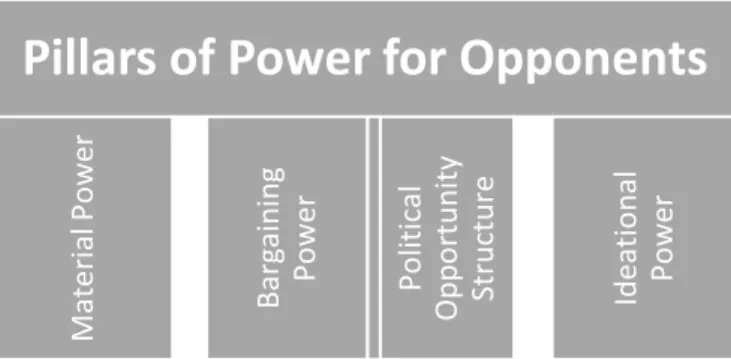
Finally, the opponents might also use variety of ideational power tactics. The ideational power tactics are not only used to halt the construction work or cancel the project, but they also serve construction of alternative sanctioned discourses, narratives, rules and practices regarding water resources development and management.5 Securitization and counter-securitization moves, refuting sanctioned discourses promoted by state elites, providing alternative plans and solution to the existing project and using frames are the main components of ideational power tactics. Based upon the conceptualization above, this paper suggests the following figure shows the revised version of power pillars for the domestic and transnational advocacy networks opposing construction of a certain hydraulic project.
As the Figure 3 shows, although opponents lack riparian position as a form of power, they might use variety of material, bargaining and ideational power tactics to achieve their goals. As it will be exemplified in the context of the Ilisu dam controversy in the following sections, these actors‟ ability to operate at domestic and international scales and their ability to engage in different components of pro-dam networks provide them certain advantages to influence in decision-making.
5Sanctioned discourse is defined as “prevailing opinions and views that have been legitimized by the
Ahmet Conker / Eurasian Journal of Social Sciences, 4(4), 2016, 14-34
22
Figure 3. Pillars of Hydro-hegemony in the Layer of Transnational Hydropolitics
Source:Author‟s own compilation
This paper labels this dimension as political opportunity structures and it considers it as one of the pillars of power. The paper argues that there is a direct correlation between political opportunity structure and bargaining power capabilities of these actors. Moreover, the paper also argues the political opportunity structures are not static but they are subject to change in the course of the conflict and changes in political opportunity structures directly constrain or increase bargaining power capabilities of opponents thereby it strongly influences in the outcome. Apart from bargaining power capabilities, the anti-dam networks also limited material power capabilities in their disposal. Finally, given that there has been a growing awareness regarding social, environmental and cultural adverse effects on large-scale dams across the world since 1970s (Conca, 2006; Khagram, 2004); these development have strengthened the discursive position of anti-dam networks. Therefore, the anti-dam networks are able to use variety of ideational power tactics to oppose large-scale dams and to impose a new sanctioned discourse.
5. The Brief History of the Ilisu Dam Controversy
In 1997, the Turkish government announced construction of the Ilisu dam project on the Tigris River as a part of the GAP. The dam would be the largest dam after the Ataturk dam built on the Euphrates, in terms of reservoir capacity and it was prospected to produce approximately GWH 3,883 electricity annually (DSI, 2009). With this magnitude, the project is the largest project, which is prospected to be built in Tigris River and it was the last remaining large-scale project to be built in the context of the GAP.
Table 1. The Different Perods of the Ilisu Dam Contreversy Periods General Features
1st Period: Before 1997
In this period, the preliminary surveys, and plans we conducted in 1950s and 1970s. Finally, the project become part of GAP Master Plan in 1989.
2nd Period: 1997-2001 The First international was composed but it was dissolved in 2001
3rd Period: 2005-2009
The Second international consortium was composed but European ECAs, private creditors and companies withdrew from consortium
4th Period: 2009-2016 The second consortium was reorganized led by the Turkish banks and companies
Source:Author‟s own compilation
Unlike the Ataturk dam, which was purely funded from national budget, the Turkish government decided to adopt a Built-Operate-Transfer (BOT) privatization model to finance the project. After the Turkish government announced that the construction of the Ilisu dam were due to start in 1997 with the involvement of the private sector, the project has heavily criticized by non-state actors.The contreversy developed around the construction of the Ilisu dam can be
Pillars of Power for Opponents
Ahmet Conker / Eurasian Journal of Social Sciences, 4(4), 2016, 14-34
23
analaysed within four different perıods. Table 1 shows these periods and their key characteristics.
5.1. The First Period: Preperation Phase
The first phase can be labelled as preparetion phase. The initial pleminary studies regarding the construction of the Ilisu dam can be traced back to 1950s. During 1950s and 1960s, the State Hydraulic Works (DSI-Turkish acronym), which is the main public institution responsible for conduct of hydraulic development projects, have done surveys in order to assess water potential of Turkey‟s water resources including the Euphrates and Tigris basin. These initial surveys conducted by the DSI constituted the basis for hydraulic projects, including the Ilisu dam project, in the Euphrates and Basin. In 1972, the initial report was prepared by the DSI regarding the construction of the Ilisu dam project and the project became part of GAP Master Plan in 1989 (DSI, 2009; Ozkaya, 2010).
5.2. The Second Period: Establishment of the 1st Consortium (1997-2001)
The Second period starts with announcement of the project in 1997. Unlike the previous large-scale hydraulic development projects such as the Keban Dam or the Ataturk Dam, which were funded by the Turkey‟s budget, the Turkish government adopted the BOT privatization model in the finance of the Ilisu dam project. This has resulted involvement of the private sector both from home-based companies and international ones. These companies established an international consortium to conduct the project and they sought for credit guarantees from their home states. Therefore, Export Credit Agencies (ECAs) from Europe and the US also become part of decision-making processes (Atzl, 2009). The composition of the first international consortium is the Balfour Beatty (UK), Skanska (Sweden), VA Tech Hydro-andritz (Austuria) and Nurol, Kiska, Temelsu (Turkey). NGOs based in various European countries launched a campaign against the construction of the project on the basis that the project would have adverse social, environmental and cultural/historical effects. Given that the Balfour Beatty was one of the important components of the first consortium and the involvement of the Export Credit Guarantee Department (ECGD), the British Export credit agency, the centre of campaign concentrated on the UK. Thus, the UK based the Kurdish Human Rights Project (KHRP), Friends of Earth (FoE) and the Corner House was actively involved in the campaign. In the context of the strong criticisms levelled at the ECAs owing their involvement in funding the project, the consortium declared that four conditions have to be met to release the necessary funding in December 1999. Those conditions include a detailed resettlement plan for the displaced people, maintaining the water quality, releasing sufficient water to the downstream riparian states and making the necessary precautions to preserve the cultural heritage of the historical Hasankeyf town (Scheumann, 2008). NGOs from the UK, US, Germany and Italy conducted fact finding missions whether the Turkish government fulfilled the above-stated criteria and they claimed that the project has still major problems. In September 2000, the Skanska, the Swedish construction company announced its withdrawal from the project followed by Balfour Beatty, Impreglio and Swiss Union bank (Scheumann, 2008).
5.3. The Third Period: Establishment of the Second Consortium (2005-2009)
Ahmet Conker / Eurasian Journal of Social Sciences, 4(4), 2016, 14-34
24
(MoU) in 6th of October in 2006. According to this agreement certain conditions, labelled as the Terms of Reference, must be met before proceedings the project. These terms of reference stipulate the Turkish government to address environmental, social and cultural impacts of the project (DSI, 2006). During 2000s, the opponents have waged a campaign in Europe to render the construction companies and the ECAs withdraw from the project. In parallel with ongoing campaigns in abroad, civil society groups also began to involve within Turkey. In this regard, the Keep Hasankeyf Alive Initiative (The Initiative hereafter), which composed of civil society groups and individuals, became part of the transnational advocacy networks against the project. Furthermore, the Nature Association, a nation-wide environmentally driven NGOs, also became active actors in the opposition networks (Conker 2014). In the period between 2007 and 2009, the community of experts made field trips to assess whether the terms of references were met or not. In spite of the significant improvements the community of experts concluded that there are still problems in terms of meeting terms of references.6 Based on this conclusion, the ECAs decided to withdraw export credit guarantee in December 2008 temporarily. They stated that if the Terms of References were not met within 6 months, they would permanently withdraw from the project. In June 2009, the Community of Experts made their final field trip and it was concluded that the terms of references have not been fully met, even though significant progress has been made. Therefore, the second international consortium was dissolved in 6th of July 2009 with the withdrawal of the ECAs.
5.4. The Fourth Period: Re-Organisation of the Second Consortium (2009-2016)
The final period starts with the reorganisation of the second consortium. The decisions made by the European actors have created a big resentment among the Turkish discursive elites. However, the decision did not stop the determination of the Turkish government to realise the project. Veysel Eroğlu, the minister of Forestry and Water Affairs, announced that the negotiations are underway between the Undersecretaries of Treasury and the Turkish private and public banks and the financial gap will be filled with the involvement of the Turkish banks. Since the financial problem was resolved, the construction that halted due to the withdrawal resumed in 27th January 2010. However, the German and Swiss companies, Zublin and Alstom respectively, also left the consortium. New consortium was led by the Nurol, the construction company based in Turkey and the Turkish companies dominated the new consortium. Since the European actors were no longer in decision-making processes, the opposition campaign waged in Europe lost a significant leverage. Therefore, even though the opposition campaign continued particularly by pressurizing the two key Turkish private banks, AK bank and Garanti Bank, they could not stop the construction work. In August 2012, the derivation channels of the project were completed and in a ceremony to celebrate this achievement, Veysel Eroğlu announced that 45% of the project was completed (AK Party, 2012). According to the recent newsfeed released by the DSI, as of June 2016, 83% of the project was realized (DSI, 2016 ). The project was expected to be finished by the end of 2016. However, it appears that even though the project is completed, the controversy developed around it is likely to continue.
6. Applying Hydro-hegemony to the Case of the Ilisu Dam Controversy
6.1. Assessing the Power Configurations between the Proponents and the Opponents in the Ilisu Dam Controversy
This final section seeks to analyze how different forms of power are at work between the proponents and opponents of the Ilisu dam project. As stated in Section 4.2, in general, power relations between the pro-dam and anti-dam networks are highly asymmetrical favoring the former. The case of the Ilisu dam is not exception from that respect. There are in fact certain advantages that the pro-dam network enjoys in terms of power capabilities. Those advantages can be summarized as follows.
6 According to the MoU signed between the DSI on behalf the Turkish government and ECAs, The
Ahmet Conker / Eurasian Journal of Social Sciences, 4(4), 2016, 14-34
25
First, there is a clear power asymmetry between the proponents and opponents in terms of geography as a source of power. Anti-dam actors do not possess the exclusive right to control particular territory. Therefore, geography (riparian position) is unavailable for the opponents as a source of power. Moreover, most of the local municipalities are run by pro-Kurdish Peoples‟ Democracy Party (HDP Turkish Acronym), which is in principle against the project and they are part of anti-dam networks7. However, given that administrative structures in water resources development and management are also very centralized, these local municipal authorities have very limited options to be involved in decision-making processes.
Second, there is an asymmetrical relation in terms of material power capabilities between the proponents and opponents of the project. Perhaps, the most obvious power gap between the two can be seen in their financial and institutional capacities. Particularly, as would be analyzed in the following sections, increasing financial capabilities and technical capacity of the Turkish government in 2000s and the Turkish construction companies have limited options for the opposition network to resist the construction work. Therefore, change in economic capabilities in the course of the controversy played a vital role in determining the outcome.
Third, there is also power asymmetry between the proponents and opponents ın terms of bargaining power capabilities. Empirical evidence derived from the Ilisu dam controversy suggests that, the Turkish government has the ability to change the rules of the game through using certain legislative processes. For instance the opponents of the project claimed that even though the Ilisu dam project is exempted from Environmental Impact Assessment (EIA) process, this does only applies to main construction work not the complementary parts.8 Therefore, these complementary works are subject to EIA process, which would enable new space for opposition to influence. However, in order to prevent the opponents to increase their influential capacity as well as to accelerate the project, the official memorandum issued by the Prime Ministry in 2012 indicated that complementary infrastructure construction works of the project will be exempted from EIA process since the master plan of the project was completed before the EIA Law came to force (Conker, 2014; Offical Gazette, 2012).
Finally, there is an also asymmetrical relation between the opponents and the proponents in terms of ideational power capabilities. Turkey is one of the prominent examples in the world how a nation-state might be engaged with hydraulic mission very extensively.9 The hydraulic mission, which has become a prevailing water resources paradigm among the Turkish discursive elites, can be traced back to the foundation of the republic. Infrastructural development is one of the founding pillars of the Turkish modernization project (Cizre, 2001). In this regard, building hydraulic development projects such as dams, HPPs, irrigation systems, ponds, regulatory infrastructures and so on is an important aspect of infrastructure modernization. Therefore, realizing the full potential of Turkey‟s water resources has become a common norm embedded in state bureaucracy. Moreover, hydraulic development is also considered by the elected politicians as a tool to sustain public support and legitimacy. Therefore, particular attention has been paid to hydraulic development regardless of which
political party is in power. For instance Süleyman Demirel, former president and prime minister,
was nicknamed as the „King of the Dams‟, as numbers of hydraulic development projects were initiated in his tenure as prime minister and president in different periods. Given that he served as a former head of the DSI before he went into politics in 1950s, he has given a particular
7
Most of the local municipalities run by the HDP are also part of the Keep Hasankeyf Alive Initiative, which is the main local NGO opposing the project. See web site of the Keep Hasankeyf Alive Initiative online at http://www.hasankeyfgirisimi.net/?page_id=2&lang=tr
8 According to the Turkish environmental law, any project planned after EIA law came to force after 7
February 1993 is subject to approval of the environmental impact assessment process. The law enables the environmental groups an important leverage to bring the case to the court on the basis that environmental criteria are not met. Since the Ilisu dam project was planned before the EIA law came to force, it is exempted from the EIA processes.
9Hydraulic Mission is defined as “…. Theoverarching rationale that underpins the state‟s desire to
Ahmet Conker / Eurasian Journal of Social Sciences, 4(4), 2016, 14-34
26
attention to hydraulic development during his political career (Demirel 2005). Likewise, Recep Tayyip Erdoğan, the president of Turkey, often emphasizes how infrastructure development projects such as building motorways, bridges, dams, have increased in unprecedented level in his long tenure as prime minister and president in almost every public speech. Furthermore, given the patron-client style relationship between the state and society and paternalistic style of governance, the conviction of the state elites for infrastructure development has not received any challenge from the society until recently (Akbulut, 2011). Therefore, challenging a sanctioned discourse promoted by the state elites and promoting an alternative discourse were not easy tasks for those who are critical to Turkey‟s hydraulic development projects. In this vein the opponents of the Ilisu dam experienced a similar difficulty to promote their sanctioned discourse in the course of the struggle both at state and public level.
However, even though there is clear power asymmetry between the proponents and opponents of the project, this does not necessarily mean that the latter is entirely powerless. As in the case of inter-riparian relations in the context of the hydropolitics of the Euphrates and Tigris basin, they too exert certain material, bargaining and ideational power tactics as coercive, leverage and liberating contestation mechanisms respectively in order to influence in decision-making processes. The final section will seek to analyze the material, bargaining and ideational power capabilities of opponents.
6.2. Analyzing the Power Struggle Between the Proponents and the Opponents in the Ilisu Dam Controversy
6.2.1. Using Coercive Contestation Mechanisms (Material Power)
Material Power capabilities which are available for opponents in their disposal are increasing their economic capacity via applying funding for projects, using various types of non-violent actions (i.e. demonstrations, marching etc.) and using violence or threat to use it. With respect to economic capabilities, NGOs opposing the project often sought funding to finance their projects and campaigns to resist the construction. For instance, ECA-Watch (Austrian based NGOs which is critical to construction) and Nature Association based in Turkey were funded by the Hermsen Foundation (Atzl, 2009). Using non-violent actions were also widely used by the opponents throughout the campaigns to halt the construction. Empirical evidence derived from the case study suggests that variety of types of non-violent actions including protests, demonstrations, marching; organizing alternative forums are used by the opponents to pressurize the targeted groups as well as to raise awareness in the issues in the public level. As a way resistance mechanism, the opponents strategically organizes demonstrations, public statements, protests in front of the buildings of creditors and construction companies in various occasions both in Turkey and abroad. Finally, the recent empirical evidence suggests that using violence or threat to use it have been used by the paramilitary groups. In this regard, the Kurdistan Workers Party (The PKK-Kurdish Acronym) has intensified its actions towards ongoing hydraulic development project in the Southeastern Anatolia region including the Ilisu dam. The PKK attacked a truck convoy which providing equipment for the construction work in February 2015 (Milliyet Daily, 2015). Approximately a month before the PKK attack was conducted, the PKK sent to sealed letter stating that if the construction works were not suspended, the PKK would target workers in the construction (Dargecit Haber Newspaper, 2014; Haberturk, 2015).
6.2.2. Using Leverage Contestation Mechanisms (Bargaining Power)
The opponents of the Ilisu dam have exerted variety of bargaining power tactics effectively in order to curb (or at least slow down) and to politicize the issue. Lobbying and pressurizing the targeted groups, using legal instruments, drawing public attention and getting public support via using media, coalition building and mobilizing stronger actors are the sources of bargaining power used by the opponents throughout the struggle.
Ahmet Conker / Eurasian Journal of Social Sciences, 4(4), 2016, 14-34
27
opponents acted strategically in choosing which actors that they target. Rather than dealing with the Turkish government, the opponents targeted the donor states to which ECAs belong and international private creditors. Here the main aim was to disband the international consortium and to prevent finance for the project (Conker, 2014).
The second source of bargaining power capability is using legal instruments particularly at the domestic scale. While the international law provides a limited leverage to the weaker riparian states in inter-state co-riparian relation in transboundary water arrangements, the ability of the opponents to appeal the case to the national courts within Turkey rendered them to use legal instruments in a more effective manner. Here, the main difficulty for the opponents stems from the fact that the project was included in the Master plan before improvement of environmental measures in the Turkish legal order. For instance, the project was exempted to prepare an Environmental Impact Assessment report, since it had been already part of master plan before the EIA Law came into force. Nevertheless, the opponents appealed to council of state and local administrative courts on the basis that the project would have devastating impacts on cultural heritage. The opponents also appealed to court to curb administrative changes made by the executive body. For instance the Initiative and the Alleonoi Initiative jointly appealed to the Council of State on the decision of principle which transfers the mandate from the Board of Conversation of Cultural and Natural Assets to the DSI regarding construction of dams having cultural, historical and natural importance. The appeal was granted by the court, which was considered as a victory for opponents. Here, while the Turkish government sought to increase its influential capacity by changing the rules of the game, the opponents sought to prevent it by using legal means.
The third source of bargaining power capability is drawing public attention and getting support from public via using media sources. In this regard, the opponents contacted with celebrities, novelists, opinion leaders to disseminate their arguments regarding the project. For instance, Mark Thomas, the British comedian, played an important role during the second period where the campaign against the dam centered on the UK. Likewise, Tarkan, the Turkish pop star, acted as an important role in the campaign led by the Nature Association in Turkey. Therefore, involvement of the prominent figures both in Turkey and abroad helped the opponents to publicize the issue both at international and domestic scales.
The fourth source of bargaining power tactic is establishing ad hoc or permanent coalitions. The ability of establishing coalitions and informal networks helped opponents share costs, expertise and knowledge. It also renders them to influence in decision-making processes at different scales. In this respect, the Initiative is itself a form of coalition building composed by actors from civil society (i.e. local NGOs, chambers, unions) and public sector (i.e. local municipalities). Apart from that, there are variety of informal networks established between the domestic NGOs, such the Nature Association, the Initiative and their international counterparts such as the Kurdish Human Rights Project (KHRP), ECA-Watch, Friends of Earth (FoE) and so on.
The fifth source of bargaining power tactic is mobilizing more powerful actors. In this regard, the KHRP and the Corner house, the leading NGOs in the UK campaign in the first period, conducted field missions in order to assess downstream impacts of the Ilisu dam and to get support from downstream riparian state (KHRP, 2002).
6.2.3. Using Leverage Contestation Mechanisms (Political Opportunity Structures)
As stated in Section 4.2, the concept of political opportunity structures provides a useful theoretical tool in understanding why bargaining power capabilities of social movements vary at different social contexts. Campaigns waged against the construction of the Ilisu dam both in Turkey and abroad are essentially social movements gathering variety of actors and establishment numbers of informal networks. The following domestic and global changes that occurred in Turkey and abroad constitute the elements of political opportunity structures.
Ahmet Conker / Eurasian Journal of Social Sciences, 4(4), 2016, 14-34
28
sector provided the Turkish government new opportunities to finance its large-scale hydraulic development projects, it has also led to creation of complex sets of decision-making processes which the government does not have the full control. This new structure enabled the opposition to influence in these spaces of decision-making. Second, growing salience of environmental law in the Turkish context and growing resentment against the rapidly growing privatized dams resulted in creation of various activist networks opposing these projects and coalition buildings among each other. In this respect, the campaign against the Ilisu dam is one of the prominent social movements against dams across Turkey. Third, there has been a quantitative and qualitative change in role and influence of civil society since 1980s (Aydin, 2005; Keyman, 2005). Particularly, struggle against hydraulic development projects has become one of the areas in which these civil society networks engage in decision-making processes since 2000s. Fourth, transnational advocacy networks against large-scale hydraulic development projects are on the rise across the globe since 1970s (Conca, 2006). There are number of cases in which advocacy networks have been established at international and domestic scales (Khagram, 2004). Experiences derived from these cases have led to promotions of new sets of norms which consider social, political, environmental and cultural impacts of hydraulic projects. Therefore, the Ilisu dam controversy does not occur in vacuum. Promotions of these global norms have also strengthened discursive power capabilities of the opponents. Regarding how these new sets of norms have impacted on the Ilisu dam controversy, Scheumann (2008) shows that the criteria regarding large-scale dams defined by the World Commission on Dams (WCD) have been reflected in environmental impact assessment stipulated by the ECAs. Whether these criteria are fulfilled by the proponents of the Ilisu dam project or not constitutes important part of arguments made by the opponents.
In my view, political opportunity structure played a vital role in increasing bargaining power capabilities of opponents of the project. Involvement of international capital and private sector made possible for the anti-dam networks to influence in decision-making processes. Therefore, it is within this political circumstance the anti-dam networks were able to influence in decision-making processes. In the constructions of previous large-scale dams such as Ataturk Dam, the Keban Dam in the Euphrates, these political circumstances were simply absent. Thus, due to involvement of international private actors such as construction companies, private banks and third party states (donor states to which ECAs belong) in decision-making, the anti-dam networks were able to disband the first consortium in the second period thereby they directly affect the outcome in transboundary politics of the Euphrates and Tigris basin. It would be argued that changing political opportunity structures further increased bargaining power capabilities of anti-dam networks during the third period. This mainly stems from the fact that whereas the international dimension of the anti-dam networks remained intact, there has been a growing involvement of opposition at domestic scale against the construction of the project. Therefore, as a result of the campaigns waged both in Turkey and abroad, the second international consortium ended up with withdrawal of ECAs, international creditors and TNCs from Europe. However, as the Turkish banks and construction companies came to a leading position in re-organization of the second consortium, the anti-dam networks have lost a significant leverage in the final period. Therefore, even though the domestic actors continued to oppose the project in the final period, their impact remained limited.
6.2.4. Using Liberating Contestation Mechanisms (Ideational Power)
Ahmet Conker / Eurasian Journal of Social Sciences, 4(4), 2016, 14-34
29
The first ideational power tactic used by the opponents is counter-securitization moves. The literature on the FHH and related conceptual frameworks informs us that the securitization theory provides a useful conceptual tool in understanding transboundary relations.10 In the FHH, securitization speech acts are considered as important components of ideational power used by basin hegemons to justify their hydraulic development endeavors (Zeitoun and Warner 2006). The securitization theory is not only used as a conceptual tool by the scholars of FHH but it is also further improved in the light of empirical evidence derived from transboundary water interactions (Warner, 2004; Zeitoun, 2007). Considering the hydraulic development conducted by the Turkish government, securitization the hydraulic infrastructure on the basis of economic and political grounds can also clearly be identified (Eder and Carkoglu, 2001). In order to counter these securitization speech acts, the opponents also conduct securitization moves. There are mainly three ways by which opponents conduct counter-securitization of the Ilisu dam project. The first way of counter securitization is securitizing the environment. Particularly those NGOs stressing the environmental impacts of the project often portray the project as threat to flora and fauna of the region due to its massive volume. The second way of counter-securitization is counter-securitization of cultural and historical heritage. The project is portrayed as a threat to destruction of the ancient Hasankeyf town (Ronayne, 2006). The third way of securitization is recasting the project as a threat in terms of issues of human rights (displacement of the local population) (Warner, 2004).
The second ideational power tactic used by the opponents is refuting the sanctioned discourses, narratives conducted by state discursive elites. In this regard, opponents emphasize the social, economic and cultural adverse impacts of previous examples of large-scale hydraulic development projects. Problems that occur in displacement of people in the previous experiences, submergence of historical sites are highlighted by the opponents to strengthen their views on the existing project (Morvaridi, 2004).
The third ideational power tactic is providing alternatives. In this vein, the opponents propose alternative energy options and methods for socio-economic development. For example, it is argued that solar energy can be used as an alternative energy resource rather than
hydropower plants to meet country‟s energy needs. Likewise, tourism it is argued can be a
proper option to galvanize socio-economic development rather than hydro-based development strategies (Eken, 2009).
Finally, opponents effectively use framings to convey their messages and arguments to a larger audience. These framings include both verbal and audio-visual sources. Regarding the verbal framings, activists who are against the project describe the project as a „cultural
genocide‟ or „monument to barbarism‟ (Kavus, 2006; Ronayne, 2006). Submergence of
Hasankeyf is equated with destruction Buddha sculptures in Afghanistan and activists demand from the world a similar sensitivity (Kavuş, 2006). Audio-visual sources are also effectively used for framings. For example, in a documentary called as Democracy, prepared for the Ilisu dam, the Tigris river on which the Ilisu dam is being built is described as „last wild free river‟ in the MENA region with effective visuals (Southgate, 2013). Likewise, visual sources (i.e. flyers) are used by the opponents. For instance, targeted the Garanti Bank, the Turkish based private bank, as one of the creditors of the project as responsible for destruction of Hasankeyf. The opponents use the Turkish National basketball team, nicknamed as 12 giant men, of which the bank is the main sponsor in this visual to convey their messages to a larger audience. In the flyer prepared by the opponents, it is illustrated the 12 giant men, which is the nickname of the Turkish national basketball team with the background of the town of Hasankeyf, submerged under water because of the Ilisu dam project. It is stated in the flyer that “will the 12 giant men
10
Ahmet Conker / Eurasian Journal of Social Sciences, 4(4), 2016, 14-34
30
submerge Hasankeyf” (Conker 2014, p.324). Here, the opponents briliantly make a link between
the Turkish national basketball team with the submergence of Hasankeyf to reach a larger audience and to pressurize the bank.
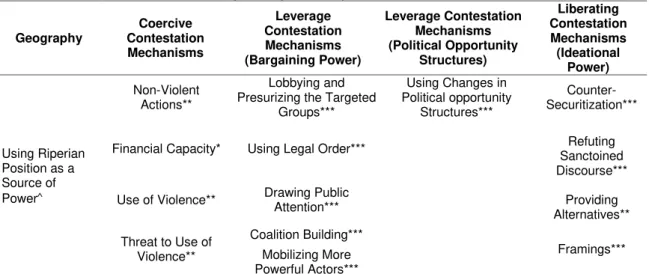
Table 2 summarizes coercive, leverage and liberating contestation mechanisms exerted by the anti-dam networks in the context of the Ilisu dam case.
Table 2. Coercive, leverage and liberating contestation mechanisms of resistance and counter hegemony used by anti-dam networks
Geography
Coercive Contestation Mechanisms
Leverage Contestation Mechanisms (Bargaining Power)
Leverage Contestation Mechanisms (Political Opportunity
Structures)
Liberating Contestation Mechanisms
(Ideational Power)
Using Riperian Position as a Source of Power
Non-Violent Actions**
Lobbying and Presurizing the Targeted
Groups***
Using Changes in Political opportunity
Structures***
Counter-Securitization***
Financial Capacity* Using Legal Order*** Refuting
Sanctoined Discourse***
Use of Violence** Drawing Public
Attention*** Providing
Alternatives**
Threat to Use of Violence**
Coalition Building***
Framings*** Mobilizing More
Powerful Actors***
Notes: Symbols used in the table refer as follows:
=no use; =mild use; =medium use; =significant useSource: Author‟s own compilation based on Zeitoun et al. (2016)
7. Conclusion
The main aim of this paper is to apply the hydro-hegemony framework and the related conceptual frameworks developed by the LWRG to the controversy developed around the construction of the Ilisu dam project.
The main contributions of this paper are two-fold. First, the paper seeks to delineate the different layers of hydropolitics as a study area and it seeks to apply the FHH and related literature to the layer of transnational hydropolitics. Second, drawing upon application of the FHH to the layer of transnational hydropolitics, the paper analyzes power relations between the pro-dam and anti-dam networks.
Ahmet Conker / Eurasian Journal of Social Sciences, 4(4), 2016, 14-34
31
networks lack material power capabilities, they are able to exert variety of discursive (bargaining and ideational) power tactics to achieve their goals.
References
AK Party, 2012. Ilısu Barajı‘nın yüzde 45’i tamam [45 per cent of the Ilisu dam is done]. [online] Available at: <https://www.akparti.org.tr/site/haberler/ilisu-barajinin-yuzde-45i-tamam/30376#1
>
[Accessed 10.07.2016].Akbulut, B., 2011.State hegemony and sustainable development: A political economy analysis of two local experiences in Turkey. Amherst: University of Massachusetts.
Altunisik, M. B., 2006. From distant neighbors to partners? Changing Syrian-Turkish relations. Security Dialogue, 37(2), pp.229-248. http://dx.doi.org/10.1177/0967010606066172 Atzl, A. 2009. The role of transnational NGO-networks in the implementation of social and
environmental standards. The Ilisu Dam Project in Turkey. Mainz: Johannes Gutenberg University.
Aydin, Z. 2005. The state, civil society and enviornmentalism. In: F. Adaman, & M. Arsel (eds.), Enviornmetalism in Turkey: Between democracy and development, pp.53-70. Aldershot: Ashgate Publishing Limited.
Bari, Z. 1977. Syrian-Iraqi dispute over the Euphrates waters. International Studies, 16(2), pp.227-244. http://dx.doi.org/10.1177/002088177701600203
Buzan, B., Waever, O., and de Wilde, J. 1998. Security: A new framework for analysis. London: Lynne Rienner Publishers Inc.
Cascao, A. 2009. Political economy of water resources management and allocation in the Eastern Nile Basin.London: King's College London.
Cascao, A., and Zeiton, M. 2010a. Counter hydro-hegemony. London: Hydro-hegemony Workshop Competing Discourse.
Cascao, A. E. and Zeitoun, M. 2010b. Power, hegemony and critical hydropolitics. In: A. Earle, A. Jagerskog, and J. Ojendal ed., Transboundary water management. Principles and Practice. London: Earthscan.
Cizre, U. 2001. Turkey's Kurdish problem: Borders, identity and hegemony. In: B. O'Leary, I. S. Lustick, and T. Callaghy (eds.), Right-sizing the State: The politics of moving borders.
Oxford: Oxford Unıversity Press. http://dx.doi.org/10.1093/0199244901.003.0008
Conca, K. 2006. Governing water.London: Massachusets Institute of Technology.
Conker, A. 2014. An enhanced notion of power for inter-state and transnational hydropolitics: An analysis of Turkish-Syrian water relations and the Ilısu Dam conflict between the opponents and proponents of the Dam. UK: University of East Anglia.
Dargeçit Haber Newspaper, 2014. PKK Ilisu Baraji için bildiri dağıttı[The PKK delivered a
statement for the Ilisu dam project][online] Availabe at: <http://www.dargecithaber.com/haber/2635-pkk-ilisu-baraji-icin-bildiri-dagitti
>
[Accessed 02.08.2016].Demirel, S., 2005. Bir ömür suyun peşinde. H. Turgut ed.Istanbul: ABC Medya Ajansı.
DSI, 2009. Ilısu Barajı ve Hidroelektrik Santrali ile Hasankeyf gerçeği [Ilisu Dam and HPP and the Hasankeyf Reality]. Ankara: Devlet Su İşleri Genel Müdürlüğü [General Directorate of State Hydraulic Works].
DSI, 2016.GAP'ın en önemli tesislerinden biri olan Ilısu Barajı ve HES Projesinde %83 Fiziki
Gerçekleşme [83 per cent of the construction work has been completed in the Ilisu dam and HPP, which is one of the most important hydraulic infrastructure of the GAP].Ankara: Devlet Su İşleri Genel Müdürlüğü [General Directorate of State Hydraulic Works].
Eder, M. and Carkoglu, A., 2001. Domestic concerns and the water conflict over the Euphrates-Tigris river basin. Middle Eastern Studies, 37(1),pp.41-71. http://dx.doi.org/10.1080/714004364 Eken, G., 2009. Büyük baraj devri bitti [The era of big dam is over]. In: D. Sevinay (ed.) Milliyet