Abstract—This manuscript aims to investigate the effect of
cryogenic in-process cooling via liquid nitrogen on the outcomes of the friction stir processing (FSP) of twin roll cast (TRC) magnesium alloy AZ31B. Friction stir processing was performed on 3mm thick sheets of TRC AZ31B at a wide range of processing parameters. The tool rotational speed was varied between 600 RPM and 2000 RPM while the tool feed rate varied between 75 mm/min and 900 mm/min. Thrust force and torque values were experimentally measured using a 4-component dynamometer. Temperature measurements were monitored during the different tests using Infrared sensors and thermocouples. The microstructure of processed samples was observed using optical microscopy. It was found that thrust force and torque values of the pre-cooled samples were 5% higher than those of the room temperature samples due to the material hardening induced by the cooling effect. Finer and more homogenous microstructure was observed for the pre-cooled samples when compared with samples processed at room temperature. The average grain size of pre-cooled samples was predicted using a relation -previously introduced by the authors- that relate grain size and the Zener-Hollomon parameter for TRC AZ31B. This equation was found to correctly predict grain diameter for in-line cooled FSP AZ31B samples at temperatures lower than room temperature.
Index Terms—Cryogenic cooling, Friction Stir Processing,
Forces, Microstructure, Zener-Hollomon
I. INTRODUCTION
RICTION Stir Processing (FSP) is a solid state hot shear stirring process that has been widely used for grain size refinement. Cooling in manufacturing processes is known to improve tool life and surface finish. When it comes to friction stir processing and friction stir welding
Manuscript received March 14, 2014; revised March 28, 2014. This publication was made possible by the National Priorities Research Program (NPRP) grant # 09-611-2-236 from the Qatar National Research Fund (a member of The Qatar Foundation).
Ali H. Ammouri is a senior research assistant at the Mechanical Engineering department at the American University of Beirut, 11-0236 Beirut, Lebanon (email: [email protected]).
Ghassan T. Kridli, is a professor at Department of Industrial and Manufacturing Systems Engineering, University of Michigan Dearborn.
(email: [email protected]).
George Ayoub is assistant Research Scientist in the Mechanical Engineering Program at Texas A&M University at Qatar (email: [email protected])
Ramsey F. Hamade is a Professor at the Mechanical Engineering department at the American University of Beirut, 11-0236 Beirut, Lebanon (phone: +961-135-0000x3481; email: [email protected]).
(FSW), cooling has some other advantages mainly related to microstructure enhancements. Reduction in the width of the heat affected zone was observed during cryogenic CO2 cooling of friction stir welded Aluminum alloy AA7010-T7651 [1]. Liquid nitrogen cooling resulted in Sub-micrometer grain size during FSP of AZ31B [2]. Water cooling during FSW of AA2219-T62 aluminum alloy was found to increase the strength and ductility of the resulting samples under tensile testing [3]. Improvement to joint strength of friction stir welded AA7075-T6 butt joints [4] and pure copper joints [5] was achieved by rapid water cooling. The cooling techniques that were just described depend on continuously flooding the processed area with the cooling fluid. Pre-cooling that is introduced in this work depend on cooling the friction stir processing setup prior to engaging the processing tool into the workpiece. The effect of starting from a temperature lower than the normal operating temperature on thrust force, torque, process temperature, and microstructure is investigated in this work.
II. EXPERIMENTAL SETUP
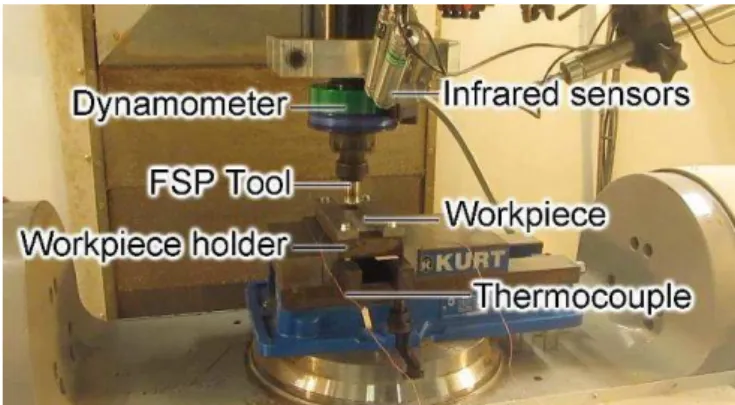
Friction stir processing of 3 mm thick TRC AZ31B sheets was performed on a HAAS-VF6 vertical machining center that was retrofit to perform friction stir processes. The sheets were firmly mounted on a 3 cm thick C30 steel backing plate using two holders. The workpiece holder was mounted to
the machine’s trunion using a KURT vice as shown in Fig 1.
Fig. 1. The FSP experimental setup mounted on the trunion of the HAAS-VF6 vertical machining center.
The FSP tool was made from SVERKER 21 (aka AISI-D2) tool steel manufactured by Uddeholms AB (SE-683 85 Hagfors, Sweden). The tool had a shoulder diameter of 19 mm, with a 6.4 mm pin diameter and a 2.7 mm pin height.
Investigating the Effect of Cryogenic
Pre-cooling on the Friction Stir Processing of
AZ31B
Ali H. Ammouri, Ghassan T. Kridli, George Ayoub, and Ramsey F. Hamade
F
Proceedings of the World Congress on Engineering 2014 Vol II, WCE 2014, July 2 - 4, 2014, London, U.K.
ISBN: 978-988-19253-5-0
ISSN: 2078-0958 (Print); ISSN: 2078-0966 (Online)
After machining the tool to its final dimensions, it was hardened as per the datasheet provided by Uddeholms.
Force measurements are collected using the Kistler’s Rotary 4-Component (Fx, Fy, Fz, and Torque) Dynamometer (Type 9123C) shown in Fig. 1. The Kistler 5223B charge amplifier acquires and amplifies the signal emanating from the dynamometer which is then collected by custom LabVIEW software through four analog input channels of a USB-6251 DAQ.
Two different temperature probes are utilized for monitoring temperatures at different locations of the setup. Thermocouples were placed at the middle of the workpiece on both sides of the top surface to log the temperature history throughout the friction stir process. Teflon pads were used as insulators between the fixture clamps and the workpiece to prevent heat loss through conduction with the clamps. The thermocouple signals were acquired through a NI USB-9213 DAQ which has built in signal conditioning for thermocouple signals.
Two OS151-USB compact non-contact infrared temperature sensors from Omega were used to monitor the FSP tool and workpiece temperatures. A laser sighting tool was used to align the sensors to the final position shown in Fig .1. The 4-20 mA output signal from the sensors was acquired by the National Instruments USB-6251 DAQ device through a CB-68LP screw connector. The signal was calibrated and logged for all the test cases considered through the developed LabVIEW software.
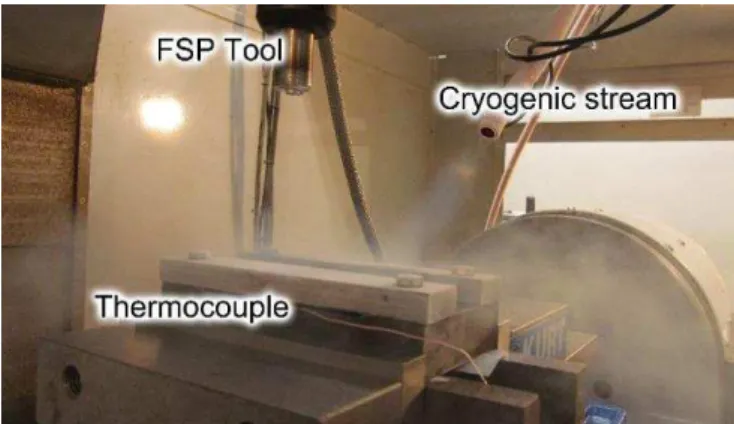
Pre-cooling was achieved by spraying cryogenic liquid nitrogen on the FSP fixture with the mounted workpiece as shown in Fig 2. The cryogenic cooling system comprises a 180 L liquid nitrogen tank with a delivery copper pipe and a control valve. Liquid nitrogen is sprayed over the area to be cooled until the temperature of the setup reached the target value of -10 ⁰C. This temperature drop would guarantee that the starting temperature of the friction stir process is around 0 ⁰C by the time the process starts. Temperature of the setup during the pre-cooling phase was monitored by the thermocouples.
Fig. 2. The pre-cooling phase of the FSP fixture.
The simulations were run according to the test matrix shown in Table 1 with and without pre-cooling. The tool rotational speed was varied from 600 RPM to 2000 RPM and the traverse feed from 75 mm/min to 900 mm/min. Three feeds were considered for each tool rotational speed to cover the applicable operating range following
recommendations by [6].
TABLEI
THE EXPERIMENTAL TEST MATRIX
Tool rotational speed, RPM
600 800 1000 1200 1400 1600 1800 2000
F
ee
d
r
at
e
,mm
/mi
n
75 (A1)
100 (B1)
100 (C1)
150 (D1)
300 (E1)
350 (F1)
400 (G1)
500 (H1) 100
(A2) 125 (B2)
150 (C2)
250 (D2)
500 (E2)
550 (F2)
600 (G2)
700 (H2) 125
(A3) 150 (B3)
200 (C3)
350 (D3)
700 (E3)
750 (F3)
800 (G3)
900 (H3)
Upon the successful completion of a friction stir process the samples were prepared for optical microscopy imagery. Samples were cut, ground, and polished on the BUEHLER Metaserv 2000 with autopol I & II. Acetic-picral solution was used to etch the samples before optical imagery on a B41 Olympus microscope with the motorized X-Y stage and Olympus XC50 digital camera. Fig 3 shows the non-uniform grain size distribution of the as received TRC AZ31B at 50x magnification. The grain sizes variance is clearly large with grains ranging from 2 to 100 µm with an average grain size of 13 µm.
Fig. 3. Micrograph of the as-received TRC AZ31B at 50x magnification.
III. RESULTS
Samples of the friction stir processed specimen for both the room temperature and pre-cooled test cases are shown in Fig 4. Test cases F2 and G3 of Table 1 which correspond to (1600 RPM - 550 mm/min) and (1800 RPM – 800 mm/min) respectively, are shown at room temperature (Fig. 4a and 4c) and with pre-cooling (Fig. 4b and 4d). The pre-cooled
samples are suffixed by a “C” to differentiate it from the room temperature samples.
(a) (b)
Proceedings of the World Congress on Engineering 2014 Vol II, WCE 2014, July 2 - 4, 2014, London, U.K.
ISBN: 978-988-19253-5-0
ISSN: 2078-0958 (Print); ISSN: 2078-0966 (Online)
(c) (d)
Fig. 4. FSP processed samples for test cases F2 and G3 of Table 1 shown at (a)-(c) room temperature and (b)-(d) with pre-cooling, respectively.
The first obvious difference between the room temperature samples and the pre-cooled ones is the improvement in the surface finish of the pre-cooled samples. Without cooling, the material at the top surface of the workpiece is heavily plasticized and thus resulting in the surface finish shown in Fig 4a and 4c. On the other hand, pre-cooling the samples resulted in decreased ductility which improved the surface quality of these samples.
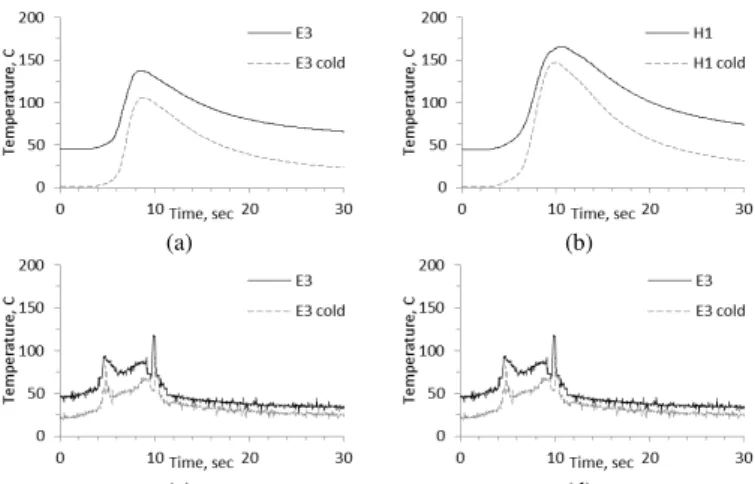
Forces, torques, temperature profiles, and microstructure of the pre-cooled samples were compared to the ambient temperature samples. The effect of pre-cooling on the temperature profile during FSP can be clearly noticed from the thermocouple and IR sensors that generated the signals shown in Fig. 5 for test cases E2 and H1. The 50 ⁰C difference in temperature shifted both pre-cooled temperature profiles (Fig. 5a and 5b) downward at the beginning. The IR signals shown in Fig 5c and 5d are
capped at the sensors’ minimum reading range (20 ⁰C). As the tool traversed through the workpiece the temperature difference decreased to around 30 ⁰C.
(a) (b)
(c) (d)
Fig. 5. Comparison between precooled and room temperature thermocouple readings of test case (a) E3 and (b) H1, and IR readings for test case (c) E3 and (d) H1.
Compared with the room temperature test cases, the pre-cooled samples had higher thrust forces and torques which is due to the material hardening induced by the cooling effect. Both the maximum plunging and steady state traverse thrust forces as well as the maximum plunging and steady state torques were slightly increased by an average ratio of 5%. Fig. 6 shows the thrust force and torque comparison for test cases E3 and H1. The effect is more obvious during the plunging phase since the workpiece is still cold. As the tool traverses along the processing line, the workpiece builds up heat and the pre-cooling effect is reduced.
(a) (b)
(c) (d)
Fig. 5. Comparison between precooled and room temperature thrust forces of test case (a) E3 and (b) H1, and torques for test case (c) E3 and (d) H1.
The effect of pre-cooling on the final microstructure of the friction stir processed samples can be seen in Figure 6. For the room temperature samples F2 and G3 shown in Fig. 6a and 6c, the average grain size was 8.0 µm and 7.7 µm, respectively. The average grain size of the pre-cooled test cases on the other hand had finer grains with an average diameter of 6.5 µm and 6 µm, respectively. The pre-cooled samples had more uniform grans size with less spread when compared to the room temperature samples. This can be noticed by examining the histograms shown in Fig. 6.
(a) (b)
(c) (d)
Fig. 6. Microstructure comparison of test cases (a) room temperature F2, (b) precooled F2, (c) room temperature G3, and (d) precooled G3.
In order to explain the refinement caused by pre-cooling the samples, Equations 2 and 3 which relate the average grain size (d) of magnesium alloys during dynamic recrystallization to the Zener-Hollomon parameter (Z) [7] were used.
ln
d
8.79 0.23ln
Z
(2)
1 1
exp
Z
QR T
(3)The Zener-Hollomon parameter is described as a temperature compensated strain rate where Q is the Proceedings of the World Congress on Engineering 2014 Vol II,
WCE 2014, July 2 - 4, 2014, London, U.K.
ISBN: 978-988-19253-5-0
ISSN: 2078-0958 (Print); ISSN: 2078-0966 (Online)
activation energy of AZ31 (130 kJ mol-1) and R the universal gas constant (8.314 J mol-1 K-1). To describe the linear relation between ln Z and ln d for AZ31B, the coefficients in Equation 2 are as proposed by Ammouri et al. [8]. Equations 2 and 3 are only valid upon the onset of DRX which occurs at temperature and strain rate values exceeding 227 ⁰C and 0.5 s-1, respectively [9].
The average temperatures and strain rates in the stir zone of the cases F2 and G3 were calculated to be (470 ⁰C and 466 ⁰C) and (98 s-1 and 104 s-1), respectively. These values were found from the results of simulations of FSP using an experimentally validated FE model [10]. Given the 30 ⁰C temperature offset of the pre-cooled samples during the traverse phase of FSP shown in Fig 4, and using the strain rate values of test cases F2 and G3 in Equations 2 and 3, the predicted grain size of the pre-cooled samples would be 6.3 µm and 5.9 µm, respectively. This decrease in grain size is caused by the increase in the Zener-Hollomon parameter described in Equation 3 due to the temperature decrease. The difference of 0.2 µm and 0.1 µm between the predictions of Equation 2 and the experimental results for test cases F2 and G3 validates the performance of this equation in predicting the average grain size during FSP.
IV. CONCLUSIONS
The effect of cryogenic pre-cooling on the friction stir processing of 3 mm thick sheets of TRC AZ31B magnesium alloy was investigated in this work. For a wide range of process parameters ranging between 600 RPM and 2000 RPM for the tool rotational speed and between 75 mm/min and 900 mm/min for the tool traverse feed, the effect of pre-cooling was examined.
It was found that pre-cooling by exposure to cryogenic fluid had the following effects on the friction stir processing of TRC AZ31B:
1. The 50 ⁰C temperature difference between the pre-cooled samples and the room temperature sample was maintained during the plunging phase of FSP and decreased to around 30 ⁰C during the traverse feed. This observation was validated via thermocouple and IR temperature sensor measurements.
2. Decreasing the operating temperature of the friction stir process resulted in a slight increase of 5% in the thrust force and torque of the pre-cooled samples. This is attributed to the increased hardness of the material caused by the temperature reduction. 3. The microstructure of both room-temperature and
pre-cooled samples was finer and more homogenous than the as received material. When comparing the room temperature samples to the pre-cooled samples, the later had finer and more homogenous microstructure.
4. The linear relation between the Zener-Hollomon parameter and the average grain size of dynamic recrystallization during FSP that has the form ln d = 8.79 - 0.23 ln Z was validated by the experimentally measured average grain size at temperatures lower than room temperature.
The above findings indicate that pre-cooling in friction stir processing can result in desirable improvements in grain structure due to in-line cooling process. These improvements are reflected via finer grain size and better surface finish when compared to samples processed at room temperature.
ACKNOWLEDGEMENT
This publication was made possible by the National Priorities Re- search Program (NPRP) Grant # 09-611-2-236 from the Qatar National Research Fund (a member of The Qatar Foundation). The statements made herein are solely the responsibility of the authors.
REFERENCES
[1] M. Jariyaboon, et al., "Effect of cryogenic cooling on corrosion of friction stir welded AA7010-T7651", Anti-Corrosion Methods and Materials, Vol. 57 Iss: 2, 2010, pp. 83-89
[2] M. Anwaruddin, “Achieving ultrafine grains in Mg AZ31B-O alloy
by cryogenic friction stir processing and machining”, MS Theses, University of Kentucky, 2011.
[3] Xu, W. F., et al. "Improvements of strength and ductility in aluminum alloy joints via rapid cooling during friction stir welding." Materials Science and Engineering: A 548, 2012, pp. 89-98.
[4] Fratini, L., G. Buffa, and R. Shivpuri. "Mechanical and metallurgical effects of in process cooling during friction stir welding of AA7075-T6 butt joints." Acta Materialia 58.6, 2010, pp. 2056-2067. [5] Xue, P., et al. "Achieving friction stir welded pure copper joints with
nearly equal strength to the parent metal via additional rapid cooling." Scripta Materialia, 64.11, 2011, pp. 1051-1054.
[6] A. H. Ammouri, A. H. Kheireddine, and R. F. Hamade, “FEM Optimization of Process Parameters and in-process Cooling in the
Friction Stir Processing of Magnesium Alloy AZ31B,” Proceedings of ASME 2013 International Mechanical Engineering Congress & Exposition, IMECE2013, 2013.
[7] Wang, Y., Lee, C., Huang, C., Lin, H., and Huang, J., “Influence from Extrusion Parameters on High Strain Rate and Low Temperature Superplasticity of AZ Series Mg-Based Alloys,”
Materials Science forum, 426, 2003, pp. 2655-2660.
[8] Ammouri, A. H., Kridli, G., Ayoub, G., and Hamade, R. F., “Relating grain size to the Zener-Hollomon parameter for friction stir processed twin-roll-cast AZ31B alloy,” under review.
[9] B. Darras, ‘‘Integrated Thermo-Mechanical Investigations of Friction
Stir Processing of Light Weight Alloys,’’ PhD Theses, University of Kentucky, 2008
[10] Ammouri, A. H. and Hamade, R. F., “Estimating Strain-rates during Friction Stir Processing of AZ31B,” unpublished work.
Proceedings of the World Congress on Engineering 2014 Vol II, WCE 2014, July 2 - 4, 2014, London, U.K.
ISBN: 978-988-19253-5-0
ISSN: 2078-0958 (Print); ISSN: 2078-0966 (Online)