FGV-EAESP/GVPESQUISA 1/73
RE L A T Ó R I O D E PE S Q U I S A Nº 14 / 20 04
RESUMO
A democracia tornou-se o regime preferido apenas no século XX. Para entender esse processo, um método puramente de escolha racional não é suficiente. O autor busca um novo fato histórico que levou a essa mudança de preferência e o encontra na Revolução Capitalista. Por parte dos capitalistas, a democracia é p regime político que melhor assegura os direitos de propriedade e o cumprimento de contratos. Por parte dos trabalhadores, é o regime que garante que os salários cresçam mais proporcionalmente em relação aos lucros. No plano internacional, atualmente, os principais países não têm inimigos dentre ou outros estados-nação. Aos poucos, a Política de globalização substitui o antigo sistema – a Diplomacia de Equilíbrio de Poderes – a medida em que a globalização é regulamentada, e o império da lei emerge no plano internacional. Globalização é inerentemente injusta para com os países pobres e em desenvolvimento, que são incapazes de competir em um mundo onde a competição prevalece em toda a parte. Tais países são simplesmente excluídos do sistema ou, frustrados, recorrem ao terrorismo. Através do debate e argumentação, será possível criar um sistema internacional legal menos injusto. E através dele, há esperança de que a idéia de um governo internacional deixe de ser mera utopia.
PALAVRAS-CHAVES
Democracy, Economic development, Capitalist Revolution.
ABSTRACT
FGV-EAESP/GVPESQUISA 2/73
RE L A T Ó R I O D E PE S Q U I S A Nº 14 / 20 04
Capitalist Revolution. On the part of the capitalists, democracy is now the political regime that best assures property rights and contracts. On the part of workers, it is the regime that more securely assures that wages increase with profits. At the international level, nowadays, the major countries do not have enemies among other nation-states. Slowly Globalization’s Politics replace the previous system, - balance of powers diplomacy - as long as globalization gets regulated, and the rule of law emerges at international level. Globalization is inherently unjust to poor countries, that are unable to compete in a world where competition prevails everywhere. Such countries are either just outside the system, or, frustrated, recur to terrorism. Through politics, i.e., through debate and argument, it will be possible to create a less unjust international law system. And also though it, there is hope that an international government ceases to be a mere utopia.
KEY WORDS
FGV-EAESP/GVPESQUISA 3/73
RE L A T Ó R I O D E PE S Q U I S A Nº 14 / 20 04
SUMMARY
I. Introduction... 5
II.Why democracy became the preferred regime only in the twentieth century ... 6
1.The Philosophers’s View ... 8
2.Liberalism before Democracy... 13
3.Democracy – ATwentieth Century Phenomenon... 16
4.Good State ... 19
5.The New Historical Fact ... 23
6.From the Liberal to the Liberal-Democratic State ... 27
7.The Rational Motives ... 30
III. From balance of powers diplomacy to globalization politics... 35
1.Nation-states have put enmities aside ... 37
2.War is no longer the way to resolve conflicts ... 39
3.Globalization is the name of the new game... 42
4.But globalization demands strong states ... 45
5.Terrorism flourishes in weak, frustrated states... 48
6.To ensure security, globalization needs to become political... 51
7.Globalization Politics demands solidarity ... 54
8.Globalization Politics assumes fair controls... 56
FGV-EAESP/GVPESQUISA 4/73
RE L A T Ó R I O D E PE S Q U I S A Nº 14 / 20 04
IV.Conclusion ... 62
FGV-EAESP/GVPESQUISA 5/73
RE L A T Ó R I O D E PE S Q U I S A Nº 14 / 20 04
DEMOCRACY AND THE CAPITALIST REVOLUTION
Luiz Carlos Bresser-Pereira
I. INTRODUCTION
This report comprehends two mutually-supplementing papers. In the first one, I study the appearance and consolidation of democracy at the level of nation-states as a consequence of the capitalist revolution; in the second, I deal with the transition from the international balance of powers diplomacy system to the globalization politics system as a consequence of the fact that the capitalist revolution was able, from the late twentieth Century, to open up all markets to global capitalism. The capitalist revolution involved changed how surplus is appropriated from violent forms under which the ruling needed to control the State in order to remain as such to market-based forms: profits and, later, high wages. At the moment this happened, room was made for the popular forces that, one way or another, always fought for democracy to gradually achieve their intent. The capitalist revolution ended – in wealthy countries – in the early twentieth century, but only after one century under the liberal regime, in which voting was the privilege of the rich, was democracy finally attained.
FGV-EAESP/GVPESQUISA 6/73
RE L A T Ó R I O D E PE S Q U I S A Nº 14 / 20 04
II.WHY DEMOCRACY BECAME THE PREFERRED REGIME
ONLY IN THE TWENTIETH CENTURY
Today democracy is the dominant political regime in developed countries and tends to be so in the countries of intermediary development. On the other hand, democracy became such a strong political value that nobody challenges it. Academics and politicians may criticize the democratic regime they live, and may have different normative ideas about the ideal democracy and how to improve it. Authoritarians may claim their regimes to be democratic when they obviously are not. But there is a broad consensus on the virtues of democracy and the evils of authoritarian regimes. The good state, the good political regime, is the democratic one. This consensus, however, is recent, as modern democracy is a recent phenomenon. Advanced democratic countries only became real democracies in the twentieth century. Why democracy became the dominant political regime so late historically? Why before, since the Greeks, philosophers preferred some form of monarchy or aristocracy to democracy? Or, when they preferred democracy, like Rousseau, they were not speaking about a representative but of a direct democracy in city-states.
We can tackle the same problem on a different standpoint. Why it is legitimate to say that the democratic political society is a recent historical phenomenon – a political regime that only became dominant in advanced countries in the twentieth century? Given a positive answer to this question, four other related questions follow. Why such broad support for democracy coming from the ruling and the ruled classes, from the rich and the poor? How did such major political change influence political theory? Are we assuming that democracy is the regime that permits modern societies to achieve social order, justice and economic well-being? If so, which was the new historical fact that made people change their minds?
FGV-EAESP/GVPESQUISA 7/73
RE L A T Ó R I O D E PE S Q U I S A Nº 14 / 20 04
to this question.1 In the following year I published a book explaining why the
transition to democracy had began in my country and why it would be successful, using that answer as a theoretical assumption. I argued that Brazil would necessarily return to democracy because the country had already completed its ‘Capitalist Revolution’. Thus, democracy was the only political regime that made sense to a capitalist economy in the long-run. In the short-run a threatened capitalist class could choose authoritarian rule. But, as long as, in a market economy, the control of the government ceases to be a survival condition for capitalists, they will first
become less resistant, and, next, favorable to the people’s demand for democracy.2
In this paper I try to develop more clearly this theoretical argument, linking the people’s or the poor’s long-term preference for democracy with the change of vision (and interests) on the part of the capitalist or the rich classes. I argue that, with the advent of capitalism, for the first time in the history of mankind the appropriation of the economic surplus ceased to depend on the control of the state by the ruling classes, because it ceased to depend directly on the use of violence. This major change opened room to democracy to become, in the twentieth century, the equivalent to the good state, the political regime more consistent with political stability.
Probably it is already clear that the theory I sketch is a historical theory, related to the classical theories of capitalist development originated in Smith and Marx and to the modernization theories coming from Weber and Parsons. Although rational interests are essential to the argument, I don’t use a pure rational choice method because it is impossible to deduce logically democracy’s recent dominance. This is a historical fact that requires a historical method. Essentially it requires to consider, besides the interests, the historical new facts that changed them, making democracy
1 I refer to
Estado e Subdesenvolvimento Industralizado. See chapter 3, where the emergence of the liberal state and
of democracy are related to the form of appropriation of economic surplus and to capitalism (Bresser-Pereira, 1977: 89).
2 See
O Colapso de uma Aliança de Classes (1978). While in the well-known studies about democratic transitions
FGV-EAESP/GVPESQUISA 8/73
RE L A T Ó R I O D E PE S Q U I S A Nº 14 / 20 04
preferable, tuning it the political regime more consistent not only with freedom (this I assume as true by definition) but also with political stability, and, so, more suited to promote political justice.
In this paper, when I speak of good political state as the democratic one, I am thinking in the Aristotelian sense of polity. Not in the ideal Platonic state, but in the possible state, in the state which is at our reach, or, at least, at the reach of rich countries, or of most advanced democracies. I am thinking in a democratic polity in which huge differences in individual wealth and individual knowledge persist, but which is already able to secure social order or political stability and basic freedom, and is capable to provide a reasonable welfare system, some equality of opportunity,
and respect for all citizens as equals in rights. Nevertheless, I understand this polity
as being democratic because it (1) is a constitutional regime assuring the rule of law, (2) because it assures freedom of association, of speech and of information, (3) because government members are regularly chosen through free and competitive elections, and (4) because it assures the universal right of voting and being voted, or, in other words, because it has an inclusive conception of citizenship that take in the women and the poor as equals in rights. In other words, I understand as democratic a political regime that broadly satisfies Dahl’s criteria to define a
poliarchy.3
1.The Philosopher’s View
Most political philosophers had as basic criterion to define the good state: political stability. Thus, they were against democracy because they realized, in their time, that monarchy or aristocratic monarchy, in spite of all its problems, was abler than democracy to keep the regime stable, to assure social and political order. While democracy was constantly victim of factions and demagogues, the good monarch
3 See Dahl, 1971: 1989: 233. Yet, note that, although I believe that Dahl’s distinction between modern democracy
FGV-EAESP/GVPESQUISA 9/73
RE L A T Ó R I O D E PE S Q U I S A Nº 14 / 20 04
could assure stability to a nation. Monarchy rather than democracy was the “good polity”.
There are ideas and expressions that come and go. “Good government” and “good state” fall in this category. They were popular among classical philosophers but lost acceptance in modern times. Yet, the questions – What is a good government? What
is the good state or the good political system? – are central to political theory.4
Science avoids to be normative, but political philosophy or theory has no other alternative but besides saying what is, to say what must or should be, and political scientists cannot avoid value judgment when doing research. We are often asking ourselves if the government in office is doing well or not, if the state institutions are adequate or not. We have a lot of critical remarks to offer, and, sometimes, suggestions. We know that good government makes a difference, and that good institutions – good laws, sound costumes, well structured organizations – are essential for life in society.
In the past the normative view about the good political regime was clear: it should be monarchical or aristocratic, not democratic. The maximum that could be admitted was the Aristotelian ‘mixed regime’, where some aspects of democracy were combined with authoritarian rule. The Greek philosophers dealt with this question straightly. Since their objective, when discussing politics, was the good life or happiness, and since they believed that state institutions and governments have a major influence in producing these results, they were either outright authoritarian and advocated a king philosopher, as was the case of Plato, or, were more realistically, like Aristotle and Polibius, and contented themselves with a mixed regime, where the oligarchic (government of the rich) and democratic (government of the people) elements were present. They did not distinguish the state from
4 When dealing with this question in the English language we have a problem. American English usually uses the
FGV-EAESP/GVPESQUISA 10/73
RE L A T Ó R I O D E PE S Q U I S A Nº 14 / 20 04
government, the political institutions and organization from the political rulers. But
both Plato and Aristotle, in The Republic and in The Politics, claimed that justice
was the objective of the state, and that, to justice be achieved, institutions should be stable, the rule of law observed, and governments’ members should possess moral virtues and practical wisdom. Presently there is almost no doubt on the distinction of the state as constituted of institutions and a state apparatus, from the government or administration – the politicians and senior civil servants that take the main decisions within the state, and their decision process in a given period of time.
The good political society for Aristotle was not the ideal state. He may also refer to an ideal state, but what interested him was the possible state, the mixed political
government, the polity (politeia).5 He asks himself: “What is the best constitution
and is the best life for the majority of states and the majority of men?” Before responding the question, however, he makes clear the realistic and historical form of his reasoning. “We have in mind men whose virtues do not rise above that of ordinary people, and whose education do not depend on the luck either of their natural ability or of their resources; and who do not have an ideally perfect constitution, but, first, a way of living in which as many as possible can join, and, second, a constitution within the compass of the greatest number of states”. Made this caveat, he responds: the best constitution is the mixed constitution; it is the polity, it is the mixed political regime, which borrows institutions from democracy and oligarchy. But the polity is more democratic than oligarchic, and being oligarchic, has substantial aristocratic aspects. “It is those mixtures which lean more
towards democracy which are generally called polities”.6
Thus, to Aristotle, democracy was not the good political regime. We may say that this is true because he was a realist. Yet, if we take Plato, whose idealism was radical, the same is true. Or, more precisely, because Plato was more idealistic than Aristotle, he rejected democracy with stronger vehemence. Aristotle knew that
5 Aristotle used
politeia is several senses. Miller Jr. (1995: 252-253), for instance, says that it may be translated as
“constitution or political regime”, or as “polity or republic”, but adds: “polity is used commonly for certain
constitutions which resemble or tend towards democracy”. I understand “polity” or politeia in the Aristotelian times
as the mixed political regime that tends to democracy, and in our times, “polity” as the good state.
FGV-EAESP/GVPESQUISA 11/73
RE L A T Ó R I O D E PE S Q U I S A Nº 14 / 20 04
politics involved compromise, acknowledge that the regime that the Greeks decide to call democracy had broad support in his time in Athens, and saw some qualities in democracy provided that democratic institutions were moderate, while Plato saw only evils in democracy, opting for the government of the king-philosophers.
Today, Greek democracy would not be viewed as true democracy, given the exclusion of women, foreigners, and the existence of slaves. Yet, it was an extraordinary political event – as the whole Greek civilization was an exceptional historical phenomenon. For some time, in the Roman republic, we had a repetition of the Greek democracy. Dahl explains the emergence of the Greek democracy in the seventh century band with an argument related to war technology. In the seventh century before Christ the infantry, with its hoplites, proved to be superior to the horse and the chariot. While only the rich or the aristocracy could afford such weapons, the authoritarian character of the regime was assured. In the moment that the technology changed, the people or the commoners, armed with inexpensive weapons – helmet, shield, corselet, greaves, and spear –, became strategic in war. Time was open to democracy. In the Roman legions, although the military organization had already changed, a light and fast infantry continued to be the superior war alternative, and the republic prevailed. It was only when the citizens’ militia were replaced by professional and mercenary soldiers, that this peculiar social-military basis for the republic or the democracy got disrupted. The times for the aristocratic and military rules were back. In the Middle Age, changes in military
technology once again vested superiority to the mounted knight.7 Only many
centuries later, with the great liberal revolution, we would again hear of democracy.
After the Greek democracy and the Roman republic, which offered opportunity for creative political thought, the concern with the good state reappears in Augustine, but in a theological way. The good political society is the city of God – a fully hierarchical and theocratic political regime. Not surprisingly, in the Middle Age, the explicit concern about the good state fainted away. With Thomas of Aquinas and the rediscovery of Aristotle, Plato and Augustine authoritarian perspective lose ground,
FGV-EAESP/GVPESQUISA 12/73
RE L A T Ó R I O D E PE S Q U I S A Nº 14 / 20 04
but we are still far from democracy or even from a secular conception of the good political society.
FGV-EAESP/GVPESQUISA 13/73
RE L A T Ó R I O D E PE S Q U I S A Nº 14 / 20 04
2.Liberalism before Democracy
Yet, political philosophers are still far from democracy. Now they live in absolute monarchies, and they see no other alternative but an aristocratic and monarchic regime. But, since the reason that the Greek and the Romans have used to explain and justify politics was reestablished, the idea of a fully authoritarian and theocratic state was out. Or, more precisely, it was restricted to religious thought and to conservatives who continued to base their legitimation system on tradition, while a new breed of political philosophers emerged: the enlightened or the liberal philosophers. The two social classes that now shared power and wealth in Europe, the aristocracy and the bourgeoisie, were now politically represented by conservatism and liberalism.
FGV-EAESP/GVPESQUISA 14/73
RE L A T Ó R I O D E PE S Q U I S A Nº 14 / 20 04
social bond, which Hobbes calls covenant, Locke trust, and Rousseau, social
contract”.8
In the French Revolution, particularly, there was a radical democratic project, inspired in ideas originally developed by Rousseau and Kant, but such project proved at that time self-defeating, particularly in the hands of the Jacobins. Habermas, writing on the French Revolution, and on the dialectics between liberalism and democracy, emphasizes that “democracy and human rights form the universalist core of the constitutional state that emerged from the American and
French Revolutions in different variants”.9 Such universalist core, however, such
“unrenounceable project”, in Harbermas’ normative words, would take a century to begin to become reality. After the liberal revolutions some liberals turned republicans, others remained monarchists –constitutional monarchists –but they had something in common: they did not support democracy. On the contrary, democracy often was identified by them with the worst excesses of the French Revolution. Parting from the historical experience, liberal political philosophers – take for instance Benjamin Constant – remained hostile to democracy, with the instability and the disorder that popular regimes would entailed, given – they believed – the inherent incapacity of the people to govern. Even Rousseau, who is usually identified with the modern interest in democracy, was not really in favor of what I am calling here modern democracy or representative democracy. Being a citizen of the republican city-state of Geneva, he only believed in direct democracy. In large empires, or nation-states in the modern terminology, he had the same view of Montesquieu: government was much more complex and difficult, and there would be no alternative to some kind of despotism. The basic threshold that divides a liberal state from a liberal-democratic state – the universal inclusion of women and all subjects to the normative power of the state, except the children and the fool, as citizens – would not be accepted by Rousseau, as Dahl remarks: “There (in the
Social Contract) Rousseau occasionally appears to be asserting an unqualified right
to membership in the demos. Rousseau makes it clear that he means no such thing.
8 Touraine (1994: 115).
FGV-EAESP/GVPESQUISA 15/73
RE L A T Ó R I O D E PE S Q U I S A Nº 14 / 20 04
Though, he lauds Geneva, even though its demos consisted of only a small minority of the population. Children were, of course, excluded. But so were women. What is
more, a majority of adult males were also excluded from the Genevan demos”.10
The liberals, that are the dominant political philosophers since the eighteenth century, are liberals but not democratic till the twentieth century. They fear democracy. They fear the people. They accept the liberal politicians’ policy of conceding voting rights to the people gradually, slowly. The reason for this, according to Bobbio, is in the conflict between reason and democracy. “In the great tradition of the Western political thought, which began in Greece, the assessment of democracy, viewed as one of the three ideal forms of government, has been preponderantly negative. Assessment that is based on the verification that the democratic government, more than the others, is dominated passions. As can be
seen, exactly the opposite to reason.”11
In the second part of the nineteenth century, however, things began to change. Democracy, that used to be a pejorative word, gradually changed of nature. Writing in the mid 1960s, Macpherson emphasized such change with a grain of irony:
Democracy used to be a bad word. Everybody who was anybody knew that democracy, in its original sense of the rule by the people, would be a bad thing – fatal to individual freedom and to all graces of civilized living. That was the position taken by pretty nearly all men of intelligence from the earliest historical times down to about a hundred years ago. Then, within fifty years, democracy became a good thing. Its full acceptance into the ranks of respectability was
apparent by the time of the First World War.12
Yet, even in the first part of the twentieth century, the assessment of political philosophers of democracy remained relatively negative. The classical texts of Weber on parliamentarism, and of Schumpeter on democracy, which are often used
10 Dahl (1989: 123).
11 Bobbio (1991: 26).
FGV-EAESP/GVPESQUISA 16/73
RE L A T Ó R I O D E PE S Q U I S A Nº 14 / 20 04
to introduce modern thought on democracy, are not texts of who believes in
democracy.13 Both were liberal rather than democrats. One developed his thinking
on the matter in a moment in which his country, Germany, was making its difficult and protracted transition to a liberal regime, not a democratic one. The other could already see the working of liberal democracy in the United States, but he was too much impressed by the Nazism, Stalinism, and the World War II in Europe to believe in democracy. Schumpeter is usually identified with a minimalist and procedural concept of democracy, but he is less than that: his ‘democracy’ is rather formal, the people will vote but since it is unable to rule, political power will be exerted between elections by the political, entrepreneurial, and military elites independently of the people’s wishes or demands.
It is only in the twentieth century that major political philosophers like Raymond Aron, Hannah Arendt, Norberto Bobbio, Jürgen Habermas, and John Rawls start to see democracy, or liberal democracy, as the best political regime.
3.Democracy – A Twentieth Century Phenomenon
It was not by accident. Only throughout the nineteenth century democracy became, gradually, equivalent to good state, as it indicated to be the more stable political regime – the political regime that were more on the interest of the poor as well as of the rich. Since the liberal revolutions the capitalist class feared that democracy would allow workers opt for socialism. But, as I will discuss ahead, this fear gradually diminished as workers or more broadly the poor did not demonstrate so aggressive. Thus, in the beginning of the twentieth century we have the first democracies. As Dahl asserts, “although some of the institutions of poliarchy appeared in a number of English-speaking and European countries in the nineteenth
FGV-EAESP/GVPESQUISA 17/73
RE L A T Ó R I O D E PE S Q U I S A Nº 14 / 20 04
century, in no country did the demos become inclusive until the twentieth
century”.14
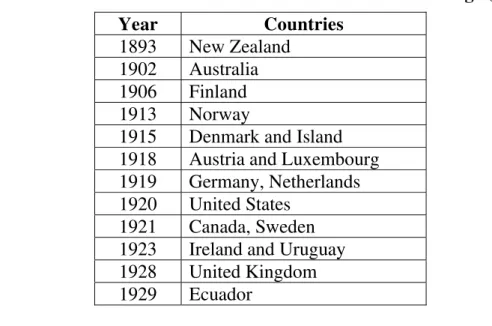
In that century, democracy or poliarchy, with the four minimum characteristics referred above, became finally dominant in the more economically advanced countries. Table 1 present the first countries to adopt the universal suffrage up to the 1940s. The first country that did that was New Zealand, in 1893. The adoption of the universal right to vote does not mean that a country completed its transition to democracy, but in most advanced countries this was clearly the case. Such countries were constitutional regimes under the rule of law for long. Freedom of thought and association and regular elections existed also for some time. When the propertyless and the women finally were entitled to vote, the minimum conditions for democracy materialized. As Santos observes, the number of voters doubles or more than
doubles in most countries in the year that universal electoral suffrage is adopted.15
It is interesting to observe in this table that developing countries that certainly had not finished their capitalist revolution, and whose political regimes were probably not democracies, assured, nevertheless, universal right to vote. This is the case particularly of some Latin American countries. Indeed, the capitalist revolution is not a condition for democracy; it is just a condition for a consolidated democracy. Given international pressure from developed countries, or the natural tendency of local elites in developing countries to import institutions from abroad, certain or all characteristics of a poliarchy may appear in countries in which economic surplus continues to be appropriate mainly through the state, and so do not present the economic and social conditions to have a stable democracy. Several Latin American countries fall in this case. On the other hand, there are cases in which a country which had already completed its capitalist revolution, took more time than the usual to change to democracy. This is the case of some successful Asian countries. And there is the case of countries, like Germany, that made its transition to democracy
14 Dahl (1989: 234).
FGV-EAESP/GVPESQUISA 18/73
RE L A T Ó R I O D E PE S Q U I S A Nº 14 / 20 04
after completing its capitalist revolution, but given some particular historical circumstances later fell back to authoritarian rule.
Dahl speaks of three periods of poliarchy growth: 1776-1930, 1950-59, and the 1880s. Huntington, probably inspired in this phraseology, propose his three waves
of democratization.16 In each wave, some countries made dully their transition to
democracy, after having completed their Capitalist Revolution, while other which just following the wave. After these three periods of democratization, besides the English speaking countries, and the European countries, we had all Latin American, and many other countries in the other continents under democratic rule. Democracy had become the dominant political regime.
Why took so long the transition from authoritarian rule to democratic one, and the correlated change from an authoritarian to a democratic view of how to organize and direct the political society? If the seed of democracy was in liberalism, why liberal ideas became dominant in the nineteenth century, but only a century later the democratic perspective acquired the same status?
Table 1: The First Countries Assure Universal Suffrage (up to the 1940s)
Year Countries
1893 New Zealand
1902 Australia 1906 Finland 1913 Norway
1915 Denmark and Island
1918 Austria and Luxembourg
1919 Germany, Netherlands
1920 United States
1921 Canada, Sweden
1923 Ireland and Uruguay
1928 United Kingdom
1929 Ecuador
FGV-EAESP/GVPESQUISA 19/73
RE L A T Ó R I O D E PE S Q U I S A Nº 14 / 20 04
1931 Sri Lanka
1932 Brazil 1934 Cuba 1937 Philippines
1942 Dominican Republic
1944 Jamaica
1945 Italy, Bulgaria, Hungary
1946 France, Japan, Turkey,
Poland, Albany, Romany, Panama, Malta
1947 Argentina, Venezuela,
Pakistan,
1948 Belgium, Israel, South Korea,
Suriname
1949 Chile, Costa Rica
Source: Santos (1998).17
Our question was, why political philosophers only in the twentieth century preferred democracy? Now, as it is clear that this preference is related to the transition from liberal to liberal democratic regimes, the question is, why democracy was only adopted by the more advanced capitalist economies only in the twentieth century?
4.Good State
A response to these questions, ignoring history, would be that democracy eventually became the dominant political regime because the democratic state is intrinsically the good state. Because democracy is the political system that better meets de criteria defining the good state. Yet, such abstract response would make little sense, unless we assumed that all thinkers before the twentieth century were wrong. Another response would be that the concept of good state has changed. Indeed, this
17 Santos (1998) and the Laboratório de Estudos Experimentais which compiled the data used as sources Dieter
Nohlen, org. Encyclopedia Electoral Latinoamericana y del Caribe (San José da Costa Rica: Instituto
FGV-EAESP/GVPESQUISA 20/73
RE L A T Ó R I O D E PE S Q U I S A Nº 14 / 20 04
happened. Finer (1997: 79-87), in his monumental study of the history of governments, adopted five criteria to evaluate the good polity: defense ability, internal law and order, taxation, not extortion, provision of public works and welfare, rights and citizenship. Some of these criteria remain important, other not. Defense, for instance, remains crucial to major countries, not to small ones. One cannot anymore say that “the ability of the polity to defend its population against invasions, plunder, or enslavement by outside enemies is primordial and a polity
that cannot do this has, pro tanto, failed”, unless this ability presupposes military
support coming from strong neighbors or from a solidary international community. On the other hand, it is significant that Finer, evaluating ancient governments, did not include social justice among his criteria. Maybe he did that because philosophers could write on justice, could ask for social justice, but real social justice was something that they could not realistic aspire given the well-established institutions like slavery and servitude. The same is true of democracy. Commenting the ‘rights and citizenship’ criterion, “Athens’s democratic concept of such citizenship and participation was rejected in Europe till 200 years ago and never
ever surfaced everywhere”. 18
Thus, it would not be reasonable to appraise a government and a state in the Antiquity, or in the Middle Age, or in the times of the Absolute State, using as gauge the fact that it was democratic or not. None was. Some states could more than others respect the rule of law. Some monarchs or princes could be more or less benevolent, but all people behind him were subjects, not citizens. Democracy was out of question. Since the twentieth century, however, when the democracy became a real possibility, the democratic criterion turned central to define the good state. The general explanation for this is in Marx’s proposition that men only pose collectively problems to themselves when they have some possibility of solving them. In other words, men are sufficiently realistic not to define tasks to themselves that are unattainable.
18 Finer (1997: 79, 87). Although this phrase is in the “Conceptual Prologue”, this is the prologue of his first
FGV-EAESP/GVPESQUISA 21/73
RE L A T Ó R I O D E PE S Q U I S A Nº 14 / 20 04
Before discussing which historical new fact made democracy within reach, realistically, we must know why the democratic state is the good state. The answer to this question depends on what we expect of the state. Do we expect much or little? If we expect too much, we will most likely be utopians, or even revolutionaries, to whom the key to individual happiness and the common good is in the realm of politics. As Michael Ignatieff (1984: 19) says, “utopians thought is a dream of the redemption of human tragedy through politics”. If we expect very little, we will be either conservative, or ultraliberal. If we are satisfied with the present institutions, or believe that we should return to a time were institutions were simpler and more tied to tradition, we will be conservative. If we believe that the state should limit itself to the objective of maintaining order, or of guaranteeing property rights and contacts, we will be ultra-liberal (or just liberal, in the European sense).
I do not believe that one can say, a priori, what is the good state. Besides reasoning
city-FGV-EAESP/GVPESQUISA 22/73
RE L A T Ó R I O D E PE S Q U I S A Nº 14 / 20 04
state or the empire, continuously being threatened by war and domestic discord. The Greeks privileged order because the political regime was intrinsically unstable. The polity was under permanent threat of being destroyed by a foreign enemy, which could be a nearby city, or a distant empire, and by the internal disputes among political groups or factions.
That is why they preferred monarchy to aristocracy, and aristocracy to democracy, although they had clear to themselves that the corruption of monarchy is the worse of all regimes – tyranny, and of aristocracy, the second worse – oligarchy. Still they accepted such risks and favored monarchy or aristocracy, because at their time democracy was the more unstable from the three regimes.
Today the good state is, first of all, the democratic state. Even for the developing countries, democracy became the more desirable regime. Not far from now, elites in advanced and developing countries had their doubts about that. In Latin America, for instance, the advanced democracies supported authoritarian regimes and even authoritarian coups for fear of communism. Not anymore. Developed countries may still support authoritarian regimes in Asia or in Africa, but only for lack of a real democratic alternative.
FGV-EAESP/GVPESQUISA 23/73
RE L A T Ó R I O D E PE S Q U I S A Nº 14 / 20 04
5.The New Historical Fact
The Capitalist Revolution was the historical new fact that made democracy viable, and, eventually, desirable. After it, or due to it, the nation-states were able to develop three basic institutions – the constitutional system, the modern state apparatus, and the market. The market economy for the first time became dominant, and, so, the economic surplus ceased to be mainly appropriated by dominant groups through the use of violence, or the control of the state, and started to take the form of profits and interests. Mankind, for the first time, had the possibility of creating and consolidating democratic institutions.
History may be seen as a cyclical process, or as a process of rise and fall of civilizations. Or as a process that has some direction, that proceeds by stages or phases reasonably detectable, that may show advances and setbacks, but heads toward progress. I will not discuss this question here. I just say that I opt for the third alternative. With this, I am not opting for a naïve view of progress. I know that economic growth and political development are not linear processes. I know that even in the more advanced societies, that experienced more progress, injustice and privilege is everywhere. I know that the risks that modern democracies face are enormous. But it is impossible to me not to recognize that mankind advances. And in this advance, the basic mark is the Capitalist Revolution.
FGV-EAESP/GVPESQUISA 24/73
RE L A T Ó R I O D E PE S Q U I S A Nº 14 / 20 04
What I want to emphasize here are two things. First, after it economic development becomes self-sustained, as Furtado demonstrated. While in pre-capitalist times the ruling class would invest the economic surplus in weapons and armies that assured its dominance through war and violence, and in temples and monuments that legitimated its political power, the new capitalist class will invest in merchandize, machines and equipment, and will be permanently and necessarily involved in technical progress. In a first moment, in the phase of merchant capitalism, capital accumulation is the motive that introduces rationality in production. In a second time, however, in industrial capitalism, technical progress becomes a survival condition for business enterprises in competitive markets. Economic growth since
then, although experiencing cyclical crises, will turn self-sustained.19
Second, and more decisive, the form of appropriation of the economic surplus changes radically. In pre-capitalist times, the appropriation of the economic surplus depended on the control of political power, because such appropriation depended on the high degree of the use or the threat of violence. In pre-capitalist societies distribution of income is essentially a political question. Thus, the control of the ‘state’ (I put in quotes the word because we are far from the modern state), or political power becomes crucial. To obtain wealth and prestige one had first to be politically powerful. The economic surplus was originally appropriate through war. Through it the dominant groups were able to collect the war booty, to enslave the defeated, or to impose heavy taxes on the acquired colonies. As society changes from tribal form to more complex organizations, like the city-state and the empire, taxation becomes increasingly important. Through it the military aristocracy, with the support of a patrimonial bureaucracy and a religious hierarchy, appropriates the economic surplus from peasants and merchants. Religious legitimacy was always an essential part of the process, but the very existence of empires and dominant oligarchies depended on their capacity to hold political power and wage war.
In such a system, political power is so crucial that elites cannot indulge in democracy. To be economically rich means to be politically dominant. There is no
FGV-EAESP/GVPESQUISA 25/73
RE L A T Ó R I O D E PE S Q U I S A Nº 14 / 20 04
separation between the public and the private, as long as the control of the public patrimony is the privileged means to achieve property and wealth. The poor, that Aristotle identified as the sponsors of democracy, will often press for freedom, for civic and political rights, but elites will resist ferociously. They will recur to all forms of violence, because violence is the form of securing the economic surplus. Since markets exist only marginally, there is no other condition to portion wealth and income but the control of the state. Occasionally the people, or the merchants may gain some power, and establish some form of democracy, or of republic, but the new regime will soon be wiped out given the enormous interests involved in political power.
After the Capitalist Revolution, this situation changed dramatically. Now we have a market system, where exchange value is dominant. Now economic theory is able to define the economic criteria that rule income distribution between rents, profits, and wages. Between rents and profits, we have the Ricardian theory of diminishing returns; between profits and wages, the Marx’s surplus value theory; between wages and wages and profits, we have at least three competing theories: the classical theory, assuming subsistence wages as given and making profits the residuum, the inverted classical theory assuming the long run rate of profit given and making
wages the residuum, and the marginal utility theory.20 I am not returning to this
debate. The crucial is that the market, a blind and relatively self-controlled mechanism, does the main job in distributing surplus. Or, as Marx signaled, profits are the result of an exchange of equivalent values in the market. Thus, its realization does not require the direct use of violence. Capitalists just require the guarantee of property rights and contracts, or, more generally, the rule of law.
When the Capitalist Revolution is completed and profits started to be regularly achieved in the market, it became the form per excellence of appropriating the economic surplus. Since then, the state ceases to be crucial to the dominant economic groups. It remains relevant, but not anymore a sine-quae-non condition for the elite’s existence. Thus, the new capitalist class can indulge in democracy, or,
FGV-EAESP/GVPESQUISA 26/73
RE L A T Ó R I O D E PE S Q U I S A Nº 14 / 20 04
what is probably more correct, it lacks the necessary strength and or motivation to keep the authoritarian rule. And philosophers may view democracy as possible. As Dunn observes, the “dismal of the viability of democracy was a fair summary of a European intellectual consensus which reached back at least to the Principate of Augustus, it was a consensus which disappeared with surprising speed between
1776 and 1850 in Europe itself.”21
Thus, the Capitalist Revolution was the new historical fact that made possible modern democracy. I probably first understood this when I read, in a 1976 Furtado’s book, that:
“Two forms of appropriating surplus seem to have existed since the beginning of the
historical times. On one side is what we call the authoritarian form, which consists
in the extracting surplus through coercion. On the other side we have the mercantile
form, that is, the appropriation of surplus through exchange… The surplus utilized
to appropriate another surplus is a capital, what entitles us to say that all
socioeconomic formations in which surplus is predominantly captured through
exchange belongs to the genus capitalism.22
Furtado was not discussing the rise of democracy, but in this contrast between the authoritarian and the mercantile forms of appropriating surplus was the seed of the theory I am presenting here. Such inspiration had a clear origin in Marx, as most basic ideas about capitalism have, although he was never a Marxist. As Hobbes could not predict that, from his social contract theory, the liberal state would rise as a non-predicted outcome, nor could Marx predict that from his theory of capitalism and surplus value as an exchange of equivalents would emerge the democratic state.
Be clear that the Capitalist Revolution opened room for the liberal and later the democratic state but did not led to this final outcome directly. The transition of the bourgeoisie from an authoritarian to a liberal, and later to a democratic ideology took long. The control of the state remained naturally a central political objective
21 Dunn (1979: 8).
FGV-EAESP/GVPESQUISA 27/73
RE L A T Ó R I O D E PE S Q U I S A Nº 14 / 20 04
for the bourgeoisie for two reasons: because it continues to play an important role in income distribution; and because its role in assuring public order remains central. Markets do not allocate resources in a fully efficient way, and are blind or unjust in distributing income. During and immediately after the Capitalist Revolution the role of the state is to deepen the income concentration already existing, as the state continues to be controlled by the aristocracy now associated with the bourgeoisie. That probably explains why Marx was so severe in relation to the state, viewed by him just as a tool serving the bourgeoisie. At the same time, a liberal order is established, which guarantees free markets and accentuates the income concentration.
6.From the Liberal to the Liberal-Democratic State
In this moment, with the Capitalist Revolution, the absolutist state is giving place to the liberal state, not yet to the democratic state. In the countries that first completed the Capitalist Revolution it will take near 100 years for the liberal state to change into the liberal-democratic state. The new dominant bourgeoisie is not intrinsically democratic. It is intrinsically liberal. Although in the liberal ideas are the seed of democracy, liberals, in name of freedom, fought intensely democracy. The argument was that freedom and equality would be contradictory. That equality of rights – which is a condition for democracy – would be intrinsically inconsistent with civic liberties. From the equality of rights democracy would go directly to the majority’s dictatorship and the refusal of freedom.
FGV-EAESP/GVPESQUISA 28/73
RE L A T Ó R I O D E PE S Q U I S A Nº 14 / 20 04
origin, what is again correct. Yet, it is impossible to agree with him when explaining what means the ‘common origin’: “The two are historically tied together because in the forms in which they have arisen, we shall see that both are
manifestations of constitutional liberalism”.23 Constitutional liberalism is not the
cause but the consequence of capitalism. The new capitalist class required, more than anything else, the rule of law, institutions that guarantee property rights and contracts. When capitalists and entrepreneurs were demanding free trade and assigned the state two basic roles – to maintain public order and to defend the country against the foreign enemy – they were saying how important for them was constitutional liberalism. This realization, that is clear already in Marx, gained a
modern currency in the works of North.24
The transition from a non-market to a market economy and a liberal polity took centuries and culminated with the Capitalist Revolution. This one normally occurred under the absolute state – the classical exception being the United States – and was the direct factor leading to the political transition from such state to the liberal state. As the first transition involved conflicts, compromises, and alliances, which eventually led aristocratic elites to share power with the bourgeoisie, the second one brought necessarily the gradual inclusion of workers in the political process. As Furtado observes, “the civic liberties which protect the citizen against all forms of arbitrary power, and the representative government with a popular basis, which assures that liberties and opens room to social conquests, involve a historical
process that transcends capitalism”.25
The great eighteenth century revolutions, although often presented as democratic revolutions, were actually liberal revolutions. Their major intellectual figures had as model the Roman republic rather than the Greek democracy. When they were not just against democracy, in name of liberalism, they had a practical problem: how to establish a democratic system in large countries in which Greek direct democracy was impossible. In other words, they had to think in representative democracy.
23 Lindblom (1977: 162-163).
24 See North (1985, 1986, 1990).
FGV-EAESP/GVPESQUISA 29/73
RE L A T Ó R I O D E PE S Q U I S A Nº 14 / 20 04
Madison, for instance, that was hotly against direct democracy, was for the republic, by which he meant representative democracy. For him the representative government was not a practical imposition derived from the large number of citizens, but a superior form of government, the ideal way to avoid the turbulence and instability caused by factions in direct democracies. The effect of the representative government, according to Madison, is “to refine and enlarge the public views by passing them through the medium of a chosen body of citizens,
whose wisdom may best discern the true interest of their country”.26
While claiming the superiority of representative over direct democracy, Madison was not suggesting that through it would be possible to limit the right to suffrage, and, in such way, to control the people. But it was exactly that all the liberal regimes did in the nineteenth century. Some began with quasi-universal right to vote, but by mid nineteenth century all imposed severe limits to full citizenship. Not only to women, but also to the poor was denied the right to vote. This, more than any other factor, distinguished the liberal state from the liberal-democratic state that finally comes into being in most advanced countries in early twentieth century. This was the main control mechanism that permitted the new dominant class to keep under control the popular demands. Modernly, Bobbio remarks that democracy is not contradictory to liberalism provided that we do not adopt an ethical but a
procedural concept of democracy.27 In other words, a procedural concept of
democracy makes it realistic as the concept of liberalism is. Classical liberal demands freedom of thought and trade, not full freedom. An ethical or substantive concept of democracy would require immediately full economic equality or, at least, full equality of opportunity – what would be inconsistent with liberal ideas. What was not realistic in early twentieth century, when democracy or poliarchy finally begins to define the political regime in the more developed countries.
26 Madison (1787: 46-47).
FGV-EAESP/GVPESQUISA 30/73
RE L A T Ó R I O D E PE S Q U I S A Nº 14 / 20 04
7.The Rational Motives
Gradually, however, we saw the transition from liberal to democratic polities. Why this happened? Although this subject is already beyond the objectives of the present paper, I just want to say that, on one hand democracy was the outcome of the workers’ or the poor’s demand for it. On this subject, Therborn essay remains the
basic reference.28 On the other hand, the rich began gradually to realize that the poor
did not, really, present a threat to their rule as long as they did not have a real alternative to the capitalist system. For long this was not self-evident, as long as the Marxist critique made liberalism artificially inconsistent with socialism, or with social rights, and that the socialist challenge seemed real. In the twentieth century, however, the socialist ideals took the perverse form of a bureaucratic, statist system. When, in 1989, Soviet Union collapsed, the socialist ideal was dead for long, and the immense majority of the workers in the advanced democracies felt no attraction for it. The poor had understood that there is no real alternative to capitalism.
Przeworski wrote the classical analysis of the class compromise that characterizes modern capitalism. He starts from the assumption that if workers are given the right to vote, they should, in principle, vote rationally for a socialist government. Yet, they don’t, because on one hand, as long as they have the control of investments, “capitalists are thus in a unique position in the capitalist system: they represent the future universal interests while interests of all other groups appear as particularistic and hence inimical to future developments”. On the other hand, because workers do not have the assurance that “moving to socialism would immediately and continuously improve workers’ material conditions. On the contrary, they are not certain that socialism is more efficient that capitalism, and, anyway, if it is, the transition to socialism may involve a deterioration of workers welfare. Since “workers have the option of improving their material condition by cooperating with capitalists, the socialist orientation cannot be deduced from the material interests of workers”. The alternative of a class compromise was open to workers. Or, concludes Przeworski, “a class compromise is possible only on the condition that workers have
FGV-EAESP/GVPESQUISA 31/73
RE L A T Ó R I O D E PE S Q U I S A Nº 14 / 20 04
a reasonable certainty that future wages will increase as a function of current
profits”.29
Note that when Przeworski speaks of socialism, he is really speaking of what I call statism, or technobureaucratic mode of production, since that was the only
alternative then existing.30While he developed this extraordinary political analysis
showing that it would not be necessarily rational on the part of workers to opt for statism, and that they could make a compromise with capitalists if their wages increased with profits, I was developing an economic analysis, a model of economic growth in which I inverted the classical distribution of income: profits were the determinant variable, constant in the long-run, exactly because there was no alternative to capitalism and the economic system and its institutions had no alternative but to adopt strategies, particularly technical progress, that avoid the long-term decline of the profit rate. In this historical and economic model, while the rate of profit was kept constant, the wage rate increases with productivity, if we assume technical progress as neutral. This was a historical model because, indeed, the advanced capitalist economies were able to increase wages proportionally to
productivity increase since mid nineteenth century.31
The fact that workers, eventually, had no other better alternative than to make a compromise with capitalists, was perceived not only by workers, but also by capitalists. And, as long as they understood this, they saw less and less reason to fear democracy. On the contrary, they became increasingly confident on democracy. Democracy could mean to guarantee social rights, besides the civil and the political rights. It could require that wages increases, but this would not hurt as long as wage increases did not threat the long run profit rate. On the contrary, wage increases could sustain the profit rate to the extent that they uphold effective demand. And, on top of this, democracy made the rule of law much more secure – and nothing is more important for business activity than a stable constitutional and legal system.
29 Przeworski (1985: 139, 177, 180).
30 See Bresser-Pereira (1977).
FGV-EAESP/GVPESQUISA 32/73
RE L A T Ó R I O D E PE S Q U I S A Nº 14 / 20 04
Thus, as it became rational to the workers or the poor to compromise with capitalism, and to fight for democracy and social rights, it became also rational to capitalists to go ahead of classical liberalism and ask also for democracy. Soon, as workers limit their demands, and capitalists understand the trade-offs they are involved, democracy, fully institutionalized, becomes the political regime that better assures political stability. Thus, the regime that is most favorable to business as well as to workers. The times in that democracy was salvaged by greedy factions, and showed rather turbulence and instability than freedom, were over. A new, and in this case, real social contract had been established, between workers, the professional middles classes that emerge in between to manage organizations, and the capitalists. The fight for justice, the condemnation of corruption and privilege, the possibility of drawing models of capitalism that may be more efficient and more just continue a major political task, but democracy became established as the universally preferred political regime.
FGV-EAESP/GVPESQUISA 33/73
RE L A T Ó R I O D E PE S Q U I S A Nº 14 / 20 04
Sooner capitalists, professional middle class representatives, and workers would demand – as indeed they demanded and got – democracy.
The several transitions that lead a pre-capitalist society to a democracy are complex. There are no simple rules to guide the Capitalist Revolution, as there is not for the transition from the absolute to the liberal state, later, from the liberal state to the liberal-democratic state, and finally to the social-democratic or welfare state, today dominant particularly in Europe. The advanced countries count with the democratic institutions and with a strong and active civil society to limit policy mistakes and advance ahead. The intermediary countries have poorer democratic institutions, and not a such active civil society, but, anyway, they will have to manage the deepening of democracy. The more serious challenge is in the countries that did not complete – some did not even began – their Capitalist Revolution. They still are on the hand of corrupt and incompetent elites, and society has scarce means to control such elites. They will have to depend on foreign support and guidance, but we know how limited is international aid and cooperation.
FGV-EAESP/GVPESQUISA 34/73
RE L A T Ó R I O D E PE S Q U I S A Nº 14 / 20 04
Democracy better assures social order, because it protects property rights and enforces contracts, two essential conditions for the market economies to work and grow. Second, because the emergence of social rights and of the welfare state reduce extreme inequalities, and limit exclusion, thus further contributing to order. Third, because the existence of political rights gives a reasonable opportunity to individuals and groups to have some voice and even to participate from government. In a first moment, elite groups alternate in power; later, power starts to be shared, bit by bit, with the workers and the professional middle classes, while public opinion becomes a political reality.
Instead of saying that democracy became possible after the Capitalist Revolution, one may examine the relations between economic development and democracy. The classical paper on the subject is by Lipset, where he clearly shows that the more
advanced is an economy, the more democratic it will tend to be.32 Yet, the
explanations that he gives to the fact are unconvincing. He uses modernization theory, and speaks specially of the importance of education, which, indeed, is important, but not enough to explain the consolidation of democracy. Other educated people did not change their political regime into democracy. Many other studies were made in this area, but the most interesting is probably the one conducted by Przeworski et all for the period 1950-1990. In this book the authors demonstrate that, “if there is a threshold at which development is supposed to dig the grave for an authoritarian regime, it is clear that many dictatorships must have passed it in good health.” Yet, they continue, “where they are established, democracies are much more likely to endure in more highly developed countries”. In general, above a certain level, which would be around US$ 6,000, the probability that a democratic country would fall into dictatorship is practically zero. Yet, the authors prefer not to conclude that economic development causes democracy. But their findings give a strong support to my position. A country that achieves more than US$ 6,000 of income per capita almost certainly already completed its Capitalist Revolution. We may have exceptions, as the Middle-East oil countries, but such exception only confirms the hypothesis. Although having an income per
FGV-EAESP/GVPESQUISA 35/73
RE L A T Ó R I O D E PE S Q U I S A Nº 14 / 20 04
capita very high, such countries definitively did not complete their capitalist revolution, they do not count with a full market economy, they did not clearly separate the public from the private, they do not count with a large middle class, and an active civil society.
III. FROM BALANCE OF POWERS DIPLOMACY TO
GLOBALIZATION POLITICS
The events of September 11th did not just put an end to the Cold War, but to the old
Balance of powers Diplomacy. Although the conflict between the United States and the Soviet Union ended in 1989 with the collapse of one of the contenders, analysts and international policy makers continued to behave as if the world was still torn
between two conflicting superpowers. After the tragedy of September 11th, however,
it became clear that the remaining superpower’s foreign policies, as well as those of the other, intermediate, powers, had to be substantially revised; that there is a need to think and develop more seriously a new international order. The basic assumption on which the old order was based – that conflicts could be solved by war or the threat of war – no longer makes sense. Although military prowess remains a relevant factor in international relationships, it is clear that the history of international relationships can no longer be reduced to the chronicle of war or threatened war between empires or nation-states. Even if the fundamental role of diplomacy is still to prevent war.
September 11th showed that the source of the main threats faced by the USA and
FGV-EAESP/GVPESQUISA 36/73
RE L A T Ó R I O D E PE S Q U I S A Nº 14 / 20 04
persists in some regions and among certain ethnic groups, particularly in the Middle-East.
The new and obvious enemy that looms behind the September 11th events is
international terrorism, although it is unlikely that any country will dare to foster and support it after the American attack on Afghanistan. Some countries may be sympathetic the United States’ leadership, while others may resist indignantly, but no country can mount a real threat against the U.S. or other important democratic nations. The Balance of powers, or Great Conflicting Powers Diplomacy is over. The question now is what kind of international order will arise to replace it, having in mind the change in the threats that global powers face. I believe that globalization — so far an economic phenomenon with important consequences in the fields of development and distribution — will require more political guidance than ever before. I propose that, under the circumstances, the old notion of an international government, that always seemed utopic to realistic and political theorists, is now a real possibility. We will continue to witness resistance to it in the United States, but its unilateral policies and purely hegemonic behavior, as we have seen in the Bush
administration, will pose an increasing conflict with its true national interests.33
The central problem faced by nation-states in regard to foreign matters in no longer war or the threat of war, but how to best take advantage of the opportunities international trade and finance have to offer. The question that political leaders must face is how to win and not to lose within an international context marked essentially by trade games of the win-win type, but where some tend to win more than others. Therefore, instead of diplomacy being defined by political and military conflict, we will increasingly see a globalized diplomacy in which the rules of foreign trade and finance, as well as immigration rules and the multicultural life within each nation-state, will be the core issues. In other words, a new international order that has been emerging since the end of the World War Two and the establishment of the United
Nations, has come into evidence after the events of September 11th. The old world
33 This is the only reference I will make to the Bush administration here, as this paper has a long term pesrpective.
FGV-EAESP/GVPESQUISA 37/73
RE L A T Ó R I O D E PE S Q U I S A Nº 14 / 20 04
order was the Diplomacy of Conflicting Powers; in this essay, I call the new emerging order Globalization Politics. The replacement of 'diplomacy' with 'politics’ is no accident; it has a meaning I will explain ahead. The conflict between important nation-states demanded diplomatic activity; the globalized world will still require diplomacy but, more than this, it will demand political action. Diplomacy and politics have never been opposite activities, but they will become ever more similar, if not one single thing, in the new world order.
1.Nation-states have put enmities aside
For centuries, international relationships were faced as real or virtual shocks between superpowers: France against England, Spain against France, Spain against England, Germany against France, England against the Ottoman Empire, the Austrian Hungarian Empire against Napoleon’s France, the Ottoman Empire against the Austrian Hungarian Empire, and so forth. The Cold War was the last chapter of this Diplomacy of Conflicting Powers — a period during which the conflict remained “cold” and did not evolve into war, as long as we disregard the many regional wars of the second half of the twentieth Century, and which, at different degrees, reflected a shift of the conflict between the US and the USSR to the Third World context. When the Berlin Wall fell and the Soviet Union crumbled, analysts immediately realized that one single superpower was left, but this did not prevent them from looking for the new great power that would become the next adversary of the United States. China was the obvious candidate, due to its size and dynamic economy. Others were suggested as well. But given China’s interest in peaceful
trade and the violence implicit to Huntington’s hypothesis of civilizations shock,34
international relations analysts were forced to search for new threats. They introduced the class of rogue nations as the new enemy against which the US would
FGV-EAESP/GVPESQUISA 38/73
RE L A T Ó R I O D E PE S Q U I S A Nº 14 / 20 04
have to protect themselves, and the national antimissile shield strategy was
instituted to face the possibility of a strike by one such small country.35
These analyses made little sense, as they applied the logic of the Cold war to international situations that were very different. Scholars and policy makers were unable or unwilling to consider the new historic circumstances and insisted in applying traditional thought frameworks to understand changing realities. In this case, there was an incentive to acknowledge that current facts were connected to
military interests. But although dramatic events such as those of September 11th
cannot change dogmatic interests and visions, they can certainly make historic changes less ambiguous.
After September 11th, it became clear that the United States no longer have among
nation-states enemies that threaten their hegemonic power. The Taliban administration’s rush to detach itself from the attack on the very day it happened was very significant. Nowadays, no country in the world poses a real military, economic or ideological threat to the United States, not only because they lack the power to do so and know they can be leveled in hours in the event of an attack, but because the very logic of international relations prevents this. Some countries are better friends than others. Some smaller nations, like Iraq or North Korea ,as well as Afghanistan prior to the Taliban’s demise, can be considered unfriendly and although they may come under threat by American power, not one of them poses or has posed a real danger to the US. They know full well that, should an attack against the US be mounted, legitimate retaliation will be immediate and overwhelming. They already knew this before the Taliban regime tumbled. On the day of the terrorist attacks on the Twin Towers and the Pentagon, the Afghani government was the first to declare that it had nothing to do with the strike. Although the war may have come as an early response to terrorism, it will not be the main strategy to fight and defeat it.
35 The rogue nations, later defined by President Bush as members of the “axis of evil” are Iraq, Iran, North Korea,
FGV-EAESP/GVPESQUISA 39/73
RE L A T Ó R I O D E PE S Q U I S A Nº 14 / 20 04
It would be a mistake to conclude that the US no longer have enemies against nation-states as a result of its military prowess. I believe a more general and relevant reason exists to the end of the Conflicting Nations Politics, which also applies to other intermediate powers such as China and Russia, or France, Germany and England, or Italy and Spain, or Brazil and Mexico. Among intermediate powers, only India and Pakistan still see each other as enemies, which they are because of the Cashmere conflict. As soon as this conflict is overcome, the two countries will join the prevailing ranks of competing, rather than warmongering, countries. Among smaller nations, the conflict between Israelis and Palestinians still poses the greatest danger. There are other territorial conflicts between smaller nations, particularly in Africa, but the new and emerging international diplomacy will have to face them on reasonably impartial terms if they are to be solved.
Regional conflicts pose an unacceptable threat to economic security. In a globalized world, where respect for property rights is essential, there must be a solution to these conflicts – some sort of compromise, in most cases. International arbitration will, therefore, become ever more frequent. With the end of the balance of powers politics, this arbitration can and should be reasonably impartial. The parties will not accept decisions to be made based on different criteria, and will continue to challenge them. Biased interventions will sooner or later give rise to new conflicts. The fact that arbiters impose their decisions is not a problem – courts, which are unbiased in principle, impose their decisions, too – but the crux of the matter is that the decision they impose must have some legitimate relationship with the concept of justice. This is the kind of arbitration we witnessed when the great powers intervened in the Bosnia and Kosovo war.