DIFFUSION OF SINGLE OXIDATION POND
by
Ruo-Yuan SONG*, Yong-Fang QIAN, Lai-Jiu ZHENG, Yu-Ping ZHAO, Xiao WANG, and Ju WEI
School of Tex tile and Ma te rial En gi neer ing, Dalian Poly tech nic Uni ver sity, Dalian, Liaoning, China
Orig i nal sci en tific pa per DOI: 10.2298/TSCI1603849S
The hy drau lic char ac ter is tic of an ox i da tion pond was stud ied by the tracer ex per i -ment, and an em pir i cal for mula of Peclet num ber was ob tained, which can be well ap plied to the model of plug flow re ac tor with lon gi tu di nal dif fu sion.
Key words: oxidation pond, trace experiment, mathematical model, Peclet number
In tro duc tion
Ox i da tion pond is one kind of wastewater treat ment es tab lish ments, and is widely ap -plied to treat mu nic i pal sew age and var i ous in dus trial wastewaters in many coun tries [1, 2]. The hy dro dy namic of ox i da tion pond is an im por tant as pect as it sig nif i cantly af fects the per for -mance of the pond. Re cently, the ad vance ment of com pu ta tional re sources has fa cil i tated the use of CFD mod els as a pre dic tive tool for mix ing be hav ior in ox i da tion pond sys tems [3, 4]. How ever, in view of com bin ing hy drau lic be hav ior with a ki netic pro cess model, the com pu ta -tional load is too high for prac ti cal use [5]. Tracer study is a wide spread and ef fec tive method for eval u at ing the hy drau lics of pond sys tems. The hy drau lic char ac ter is tic of the ox i da tion pond is unideal. For anom a lous dif fu sion be hav ior, it can be well de scribed by the dis crete frac tional model [6], the plug flow re ac tor with lon gi tu di nal dif fu sion (PFD) and con tin u ous stirred tank re ac tor model [7]. Peclet num ber is a crit i cal pa ram e ter for study ing fluid dif fu sion be hav ior, and is widely used in ther mal en gi neer ing [8, 9]. Be cause Peclet num ber is very dif fi cult to be ex actly pre dicted, a sim ple and ef fec tive method was pro posed to as cer tain Peclet num ber value by test ing the hy drau lic res i dence time dis tri bu tion of ox i da tion ponds. The em pir i cal for mula of Peclet num ber was es tab lished by fit ting data ob tained from tracer ex per i ments. This em pir i cal for mula could be ap plied in PFD model com mend ably, and the ac cu racy of this math e mat i -cal model was also checked by op er at ing data from Xianhe ox i da tion pond of Sinopec Shengli Oil field company.
Ex per i men tal
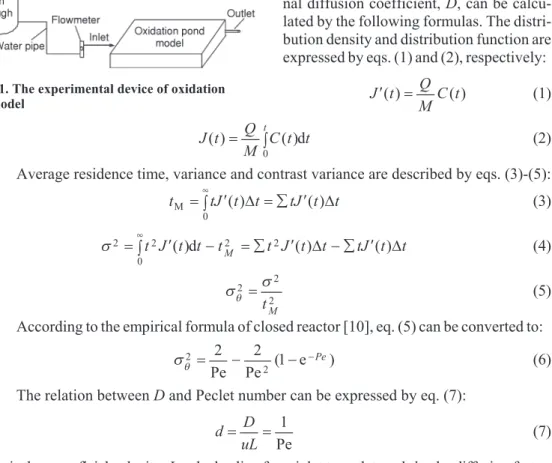
In or der to study the hy drau lic prop er ties, an ox i da tion pond model de vice was in -stalled and shown in fig. 1. The size of pond de vice was 2.4 × 1.2 × 0.11 m. The acid red was cho sen as the tracer, and to tal 30 tracer ex per i ments were car ried out. Six dif fer ent kinds of ar
range ment from in let to out let were con sid -ered, and five tracer ex per i ments were done in each ar range ment. The lon gi tu di -nal dif fu sion co ef fi cient, D, can be cal cu lated by the fol low ing for mu las. The dis tri -bu tion den sity and dis tri -bu tion func tion are ex pressed by eqs. (1) and (2), re spec tively:
¢ =
J t Q MC t
( ) ( ) (1)
J t Q
M C t t
t ( )= ò ( )d
0
(2)
Av er age res i dence time, vari ance and con trast vari ance are de scribed by eqs. (3)-(5):
tM =òtJ t¢( )Dt= å ¢tJ t( )Dt 0
4
(3)
s2 2
0
2 2
=4òt J t t¢( )d -tM = åt J t¢( )Dt- å ¢tJ t( )Dt (4)
s s
q2
2
2
=
t
M
(5)
Ac cord ing to the em pir i cal for mula of closed re ac tor [10], eq. (5) can be con verted to:
s
q2 2
2 2
1
= - -
-Pe Pe ( e )
Pe (6)
The re la tion be tween D and Peclet num ber can be ex pressed by eq. (7):
d D uL
= = 1
Pe (7)
where u is the su per fi cial ve loc ity, L – the beeline from in let to out let, and d – the dif fu sion fac tor. The rel a tive pa ram e ters were cal cu lated and shown in tab. 1. All of Peclet num ber val -ues were less than 10, which in di cated that back mix ing was se vere in this re ac tor model.
Mod el ing and ver i fi ca tion
Com bin ing the con se quences of tracer ex per i ments and the pre vi ous find ings about em pir i cal for mula of dif fu sion co ef fi cient [11], it was con firmed that the wa ter depth, H, dis -tance from in let to out let, L, and flow ve loc ity, u, were very im por tant fac tors in hy drau lic prop -er ties. Thus, they w-ere cho sen to as c-er tain the D value. Af ter fit ting rel a tive data by us ing a MATHCAD soft ware, the em pir i cal for mula about D was ob tained and shown as eq. (8). Ap ply -ing F test to check the sig nif i cance level of this for mula, the con se quence in di cated that it was highly sig nif i cant:
D =104.623H1.085u1.938L0.0052 (8)
In view of eqs. (7) and (8) can be con verted to:
Pe= L
H u
0 9948
4 623 1 085 0 938 10
.
. . . (9)
Ap ply ing the PFD model, the math e mat i cal model of ox i da tion pond in zero or der re -ac tion was es tab lished. In first or der re -ac tion, the fluid mass trans fer equa tion is ex pressed:
¶ ¶ ¶ ¶ ¶ ¶ C t C x u D
C x kC
+ = 2
-2 (10)
where u is the lon gi tu di nal mean flow rate, k – the pol lut ant re moval rate con stant, C – the re ac -tant con cen tra tion, x – the lon gi tu di nal dis tance, and t – the re ac tion time. Un der steady-state and zero or der re ac tion con di tion, eq. (10) can be con verted to:
d d d d 2 2 C x u D C x k D
- = (11)
Equa tion (11) can be solved to:
C kx
u
ux D
=a +a
-1 2e / (12)
where a
1 and a2 are the con stants, and they can be con firmed by the bound ary con di tion of the closed type re ac tor [12]:
f(0–) = ƒ(0+) = 1 (13)
Ta ble 1. Cal cu lat ing re sults of ex per i men tal pa ram e ters
No. tM [min] sq2 Pe u 10
–4 [ms–1] d D 10–4 [m2s–1]
d d f z( )1 0
= (14)
where z is the dimensionless length, z = x/L, L – the length of ox i da tion pond, and ƒ – the re sid ual ra tio of pol lut ant. When z = 1, si mul ta neous eqs. (12)-(14) can be trans formed to:
C
C C
kT
C kT
C kT
e Pe
Pee Pe
0 0 0 0
1 1 1 1
= - - + - (15)
where T is the ap par ent res i dence time, T = L/u, Ce – the pol lut ant con cen tra tion at out let, and C0 – the pol lut ant con cen tra tion at in let.
The rel a tive er ror be tween mea sured chem i cal ox y gen de mand (COD) val ues and pre dicted val ues was listed in tab. 2. The con se quence in di cated that the cal cu lated val ues could re -flect ture val ues well, and the rel a tive er ror was less than 7.5%.
Ta ble 2. Com pare be tween pre dicted value and mea sured value of COD [mgL–1]
No. COD0 Mea sured CODe Pre dicted CODe Rel a tive de vi a tion
1 2 3 4
188.4 180.0 175.0 189.2
107.0 105.0 86.4 145.0
102.7 112.6 82.5 144.8
4.02% 7.24% 4.51% 0.14%
Con clu sion
Ac cord ing to the hy drau lic res i dence time dis tri bu tion ex per i ments and com pre hen sive anal y sis for the ox i da tion pond model, an em pir i cal for mula about Peclet num ber was ob -tained by fit ting data. The length from in let to out let, depth of wa ter, and ve loc ity of flow were ma jor in flu ence fac tors. Ba sis of PFD model, the math e mat i cal model of ox i da tion pond in zero or der re ac tion was es tab lished. The op er at ing data of Xianhe ox i da tion pond was used to ver ify this model, and the con se quence of low COD rel a tive de vi a tion in di cated that this math e mat i cal model can be ap plied to de sign the real ox i da tion ponds.
Ref er ences
[1] Naddafi, K., et al., Per for mance Eval u a tion of Wastewater Sta bi li za tion Ponds in Arak-Iran, Iranian Jour -nal of En vi ron men tal Health Sci ences & En gi neer ing, 6 (2009), 1, pp. 41-46
[2] Ragush, C. M., et al., Per for mance of Mu nic i pal Waste Sta bi li za tion Ponds in the Ca na dian Arctic, Eco -log i cal En gi neer ing, 83 (2015), Oct., pp. 413-421
[3] Alvarado, A., et al., CFD Study to De ter mine the Op ti mal Con fig u ra tion of Aer a tors in a Full-Scale Waste Sta bi li za tion Pond, Wa ter Re search, 47 (2013), 13, pp. 4528-4538
[4] Shilton, A., et al., Com par i son of Com pu ta tion Fluid Dy nam ics Sim u la tion Against Tracer Data from a Scale Model and Full-Sized Waste Sta bi li za tion Pond, Jour nal of En vi ron men tal En gi neer ing, 134 (2008), 10, pp. 845-850
[5] Alvarado, A., et al., A Compartmental Model to De scribe Hy drau lics in a Full-Scale Waste Stabilization Pond, Wa ter Re search, 46 (2012), 2, pp. 521-530
[6] Qin, Y.-M., et al., Dis crete Frac tional Dif fu sion Model with Two Mem ory Terms, Ther mal Sci ence, 19 (2015), 4, pp. 1177-1181
[7] Huang, Z. L., Dis per sion Num bers for Waste Sta bi li za tion Ponds (in Chi nese), Acta Scientiae Circumstantiae, 13 (1993), 3, pp. 255-261
[9] Ozdemir, M., et al., An Ap proach to Ob tain the Heat Trans fer Co ef fi cient of Aque ous Su crose So lu tions in Ag i tated Boil ing Ves sels, Ther mal Sci ence, 19 (2015), 3, pp. 1025-1036
[10] Nameche, T. H., et al., Hy dro dy namic Stud ies and Modelization for Aer ated La goons and Waste Sta bi li -za tion Ponds, Wa ter Re search, 32 (1998), 10, pp. 3039-3045
[11] Dorego, N. C., et al., Char ac ter iza tion of Hy drau lic Flow Pat terns in Fac ul ta tive Aer ated La goons, Wa ter Sci ence & Tech nol ogy, 34 (1996), 11, pp. 99-106
[12] Wehner, J. F., et al., Bound ary Con di tions of Flow Re ac tor, Chem i cal En gi neer ing Sci ence, 6 (1956), 2, pp. 89-93