X-RAY PHOTOELECTRON SPECTROSCOPY STUDY OF
INTERACTION OF Np
5+WITH GOETHITE
a
-FeOOH
by
Yury A. TETERIN
1, Stepan N. KALMYKOV
2, Alexander P. NOVIKOV
3,
Yury A. SAPOZHNIKOV
2, Labud VUKCHEVICH
4,
Anton YU. TETERIN
1, Konstantin I. MASLAKOV
1, Igor O. UTKIN
1,
Ikule B. Hasanova
2, and Natalia S. SHCHERBINA
2Received on September 19, 2003; accepted in revised form on May 25, 2005
Neptunyl NpO2n+ com plexes on the sur face of goethite a-(FeOOH) re sulted from the in ter ac tion of neptunyl ni trate (NpO2NO3, 10-6 M) in the aque ous me dia with the
back ground elec tro lyte (NaClO4) of ionic force 0.1 M (pH = 7.0 ± 0.2) were formed
and stud ied with the Xray pho to elec tron spec tros copy. The Xray pho to elec tron spec -tros copy ionic and el e men tal quan ti ta tive anal y sis of the goethite and prod ucts of its in ter ac tion with neptunyl and plutonyl ni trates was car ried out. It was es tab lished that dur ing the stud ied neptunyl ni trate – goethite in ter ac tion Np4+ and Np6+ com pounds
did not to form, while the com plexes of neptunyl group NpO21+ con tain ing Np5+ ions
with ox y gen, wa ter and/or car bon ate ions in the equa to rial planes did.
Key words: goethite, X-ray pho to elec tron spectroscopy, ac ti nide, neptunyl
INTRODUCTION
Determination of physical and chemical states of radionuclides in the environment is one of the critical problems in the radioecology [1, 2]. It will help understand radionuclide absorption and migration mechanisms for development of technology of radioactive waste fixation, com pact -ing, and disposal. X-ray photoelectron spectroscopy has proved to be the most adequate method for determination of radionuclide physical and chemical states [2]. This work conducted the X-ray photoelectron spectroscopy (XPS) study of
goethite (a-FeOOH) and products of its interaction with neptunyl and plutonyl nitrates in aqueous media in order to understand the sorption and interface (natural water – mineral) interaction.
Migration behaviour of radionuclides depends on their physical and chemical states in the environment [1]. The processes on the border mineral-environment like oxidation-reduction, sorption and complex formation in many respects determine the radionuclides mobility. Neptunium in the environment presents basically as neptunyl NpO2+. Since it has a low charge, it is relatively chemically inactive. Under the environment influence this ion can transit into one of Np4+ or Np(VI)O22+ forms [3].
Goethite (a-FeOOH) is a prevalent natural mineral of high sorption ability to heavy metal ions and radionuclides. The present work studied the sorption mechanisms and Np(V)O2+ complexes on the surfaces of this mineral with the liquid-liquid extraction and X-ray photoelectron spectroscopy methods. The liquid-liquid extraction can separate neptunium ions of differentoxidation states. XPS is the most adequate method for determination of radionuclide physical and chemical states. Earlier this method was used for the study of Cr6+® Cr3+ reduction on goethite surface [4], which was explained by the presence of Fe2+ traces, as well as
Scientific paper UDC: 539.194...164
BIBLID: 1451-3994, 20 (2005), 1, pp. 38-44
Authors' addresses: 1
Russian Research Center “Kurchatov Institute”
1, Kurchatov square, Moscow 123182, Rus sian Federation 2
M. V. Lomonosov Moscow State University, Chemical Dept., GSP-2, Leninskie Gory Moscow 119992, Rus sian Federation
3Vernadsky Institute of Geochemistry and Analytical Chemistry GSP-1, 19, Kosigina, Moscow 117975, Rus sian Federation 4Faculty of Natural Sciences and Mathematics,
University of Montenegro
P. O. Box 211, 81000 Podgorica, Serbia and Montenegro
for the study of uranyl interaction with hydroxyl-and fluorine-apatite in aqueous media [5].
EXPERIMENTAL
The goethite sam ple a-FeOOH (Sam ple I) was syn the sized from Fe(NO3)3 by the tech nique de scribed in [6]: 50 g of Fe(NO3)3,×9H20 were solved in 825 ml of twice-dis tilled wa ter and added to 200 ml of 2.5 M so lu tion of KOH. The so lu tion was mixed dur ing 24 hours at 60 °C. The re sid uum was sev eral times washed in twice-dis tilled wa ter and ac e tone and dried at 40°C dur ing 2 days. For sorp tion ex per i ments, sus pen sion of a-FeOOH was pre pared.
Sam ple II was pre pared from goethite aFeOOH sus pen sion (Sam ple I) of the known con -cen tra tion (0.0374 g, which cor re sponded to 1.6.×1018 nm2 of the free sur face and 5.2 ×10⁻⁶
M of sorp tion cen ters) in the cen tri fuge test-tube. Af ter this the back ground elec tro lyte (NaClO4) of the ionic force 0.1 M was added. Then the stan dard 237Np5+ so lu tion (NpO2NO3,×nH2O) was added so that the to tal con cen tra tion was about 10-6
M. The so lu tion was kept at pH = 7.0 ± 0.2 and con stantly mixed dur -ing sev eral days in ni tro gen at mo sphere. The par ent so lu tion was sep a rated by a cen tri fuge at about 100 ro ta tions per sec ond. Af ter the sorp tion, the aliquot of the par ent so lu tion was col lected. The sorp tion de gree and nep tu nium dis tri bu tion in the par ent so lu tion was de ter mined by chem i cal meth ods de scribed in [3] (method of liq uid ex trac tion). The sat u ra tion was done sev eral times. The ex trac tion of nep tu nium showed the pres ence of only 237Np5+. A 30% sat u ra -tion of goethite sur face was reached. It cor re sponded to about 1.53 ×10⁻⁶ M of 237Np5+. The same sorp tion ex per i ment was done 3 times. Af ter the sorp tion and sep a ra tion from the par ent so lu tion, the sam ples were dried in the vac uum for 3035 hours. A sim i lar tech -nique was em ployed for prep a ra tion of Sam ple III, where plu to nium (242Pu5+) in form of PuO
2NO3× ×nH2O was used. De spite the fact that the spec trom e -ter sen si tiv ity did not al low to de tect the Pu4f XPS peak, the pres ent work gives the char ac ter is tic of the sam ple sur face and eval u ates the pos si ble plu to nium con tents. These data also en ables to eval u ate the er rors of the XPS mea sure ments.
XPS spec tra of the stud ied solid-state sam ples were taken with an MK II VG Sci en tific spec trom e ter at ~1.3 ×10⁻⁷ Pa at a room tem per a ture. Over all res o lu -tion mea sured as the Au4f7/2 elec tron line full width at half max i mum was better than 1.2 eV. Elec tron bind ing en er gies (Eb) are given rel a tive to that of the C1s elec -trons from ad ven ti tious hy dro car bons at the sam ple sur face de fined as 285.0 eV. The er ror in de ter mi na tion of Eb was 0.1 eV, and that of line in ten si ties – 10% [7]. Sam ples for the XPS stud ies were pre pared as thick lay
-ers of ultradisp-ersed but not ground pow d-ers on the ad he sive tape at tached to the ti ta nium sub strates.
For all sam ples the quan ti ta tive el e men tal anal y sis was car ried out us ing the fol low ing ra tio: ni/nj = (Si/Sj)(kj/ki), where ni/nj is the rel a tive
con cen tra tion of con sid ered at oms, Si/Sjis the rel
a tive in ten sity of the core elec tron lines of these at -oms, and kj/ki is an ex per i men tal sen si tiv ity co ef fi -cient. The pres ent work used the fol low ing co ef fi cients: 1.00 (C1s), 2.8 (O1s), 8.0 (Fe2p3/2), 0.55 (Fe3s), 9.20 (Na1s), 2.92 (Cl2p), 40.0 (Np4f7/2), 44.0 (Pu4f7/2) [8]. The sen si tiv ity co ef fi cients for nep tu nium and plu to nium were ob tained by ex trap o la tion of the cor re spond ing co ef fi cients for tho rium and ura nium [8]. For nep tu nium this value within the 20% er ror agrees with ki(Np4f7/2) = 49.2 for Cs2NpO2Cl4 sin gle crys tal [7]. XPS spec tra from some nep tu nium com pounds were used for in ter pre ta tion of those from the stud ied Sam ples II and III (tab. 1).
RESULTS AND DISCUSSION
The tech nique of de ter mi na tion of phys i cal and chem i cal states of radionuclides in the en vi ron -ment used in this work is based on the tra di tional XPS pa ram e ters (core elec tron bind ing en er gies and line in ten si ties) and fine spec tral struc ture pa ram e -ters such as: rel a tive in ten si ties of the Fe3d and Np5f elec trons weakly par tic i pat ing in the chem i cal bond, rel a tive bind ing en er gies of the outer (OVMO) and in ner (IVMO) va lence mo lec u lar orbitals, multiplet split ting DEms [eV] of the core lev els, dy namic ef fect re lated fine spec tral struc ture pa ram e ters, rel a tive bind ing en er gies of shake-up sat el lites DEsat[eV] [7, 10]. These spec tral data pro -vide the im por tant in for ma tion about phys i cal and chem i cal states of iron and actinides on the sur face of the stud ied sam ples.
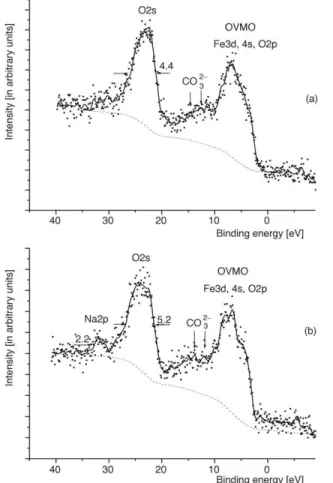
Low binding energy spectral range. Valence band of goethite a-FeOOH (Sample I) lies in the binding energy range 0-40 eV and consists of the OVMO (0-15 eV) and IVMO (15-40 eV) lines (fig. 1a). The peak in the O2s binding energy range is relatively wide G(O2s) = 4.4 eV, while the structured O1s peak is only 2.6 eV wide. This evidences that the O2s atomic orbital (AO) participate in the formation of molecular orbitals (MO). Indeed, the uncertainty ratio DEDt ~ h/2p, where DE – full width at half maximum of the level from which an electron was removed, Dt – lifetime of the hole and h – Plank’s constant, gives that if the O2s level had been atomic, it would have been narrower than the O1s one. However, the experimental data contradict it. Therefore, the O2s level is not atomic, it is MO related.
-tronic lev els of the neigh bor ing iron and ox y gen. The OVMO struc ture is mainly due to the Fe3d,4s – O2p in ter ac tion, while the IVMO struc ture – Fe3p,3d,4s – O2s in ter ac tion [9]. Since iron elec tronic con fig u ra -tion is {Ar}3d64s2, where {Ar} – ar gon elec tronic con fig u ra tion, and the Fe3d photoemission crosssec -tion is much higher than the O2p one [11], the OVMO in ten sity is ex pected to come from the Fe3d5 elec trons of the ba sic Fe3+ state (fig. 1a). Un for tu nately, this spec trum does not al low a cor rect quan ti ta -tive eval u a tion of the Fe3d in ten sity and the num ber of the Fe3d elec trons. The low in tense struc ture at 12-14 eV can be at trib uted to the MO elec trons of the car bon ate CO32
--group [9].
The low bind ing en ergy spec tra from prod uct of goethite-nep tu nium in ter ac tion (Sam ple II) ex hibit some changes due to the sur face changes un der the in -flu ence of the so lu tion (fig. 1b). In this case the Np5f peak is ex pected at Eb» 2.5 eV. The in ten sity (area) of this peak is pro por tional to the num ber of the Np5f elec trons weakly par tic i pat ing in the chem i cal bond, and quan ti ta tively char ac ter izes nep tu nium ox i da tion state in com pounds. Un for tu nately, this peak is fee bly vis i ble due to the low nep tu nium con cen tra tion. The low in tense Na2p peak is ob served at Eb = 32.2 eV. Go ing from Sam ple I to Sam ples II and III, a shoul der at the lower bind ing en ergy side at 5 eV be comes more dis tinc tive. For Sam ple II un like for Sample III, a cer tain wid en ing of the line in the O2s range was ob -served.
Table 1. Neptunium oxidation states (Npn+) and electron binding energies (E
b, eV) for Samples I, II, III, and
neptunium compounds [7]
Sample(a) Npn+ MO Fe2p
3/2,1/2(b) Fe3s Np4f7/2,5/2 O1s C1s
Sample I (a-FeOOH)
6.9 22.9 711.6 (719.8) 725.1 (733.4) (743.3)
93.6
101.0 530.3 531.5 285.0288.6
Sample II (a-FeOOH + Npn+)
Np5+ 7.1 23.7 711.9 (720.2)
725.5 (733.4) (743.1)
94.2 101.2
403.6 415.2 530.5 531.5 533.1 285.0288.3
Sample III (a-FeOOH + Pun+)
6.4 23.4 712.0 (720.2) 725.5 (733.4) (743.0)
94.5
101.5 530.4 531.7 533.7
285.0 289.0
NpO2 Np4+ 402.5 414.3 529.7 284.5
RbNpO2(NO3)2×2H2O Np
5+ 2.9 (Np5f)
5.4 27.0 403.6 415.3 531.5533.5 285.0
Cs2NpO2(CH3COO)3 Np
5+ 2.3 (Np5f)
4.3 27.2
403.0 414.6 531.5 285.0 288.3
Cs3NpO2Cl4 Np
5+ 2.5 (Np5f)
4.9 26.2 403.4 415.2 531.6
285.0
Cs2NpO2Cl4 Np
6+ 3.3 (Np5f)
5.3 25.8 404.6 416.4 531.9
285.0
NaNpO2(CH3COO)3 Np
6+ 3.4 (Np5f)
5.9 24.2 26.0
405.2 417.0 532.0 285.0 288.8
(a) Samples I, II, and III were prepared on the adhesive tape, the other samples – in in dium (b)
Satellite binding energies are given in parenthesis
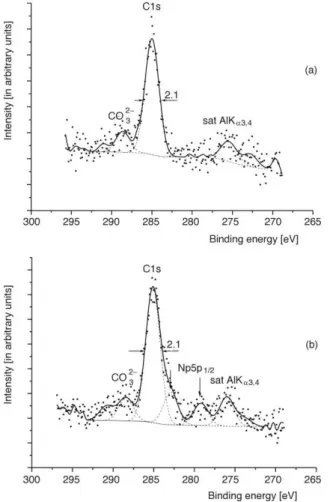
Core elec tron spec tral range. The sam ple sur face can con tain ab sorbed hy dro car bon, ox y gen and wa ter mol e cules. The avail able sur face clean ing was not used in this work to avoid sam ple de struc tion. The C1s spec -trum of Sam ple I (a-FeOOH) con sists of the ba sic peak at Eb = 285.0 eV (sat u rated hy dro car bons), which is the ref er ence peak used for cal i bra tion, a peak at Eb = 288.6 eV (CO32- group) and a peak at Eb = =j275.4 eV due to AlKa3,4 sat el lites (fig. 2a). These
sat el lites are lo cated on the lower bind ing en ergy side from the ba sic lines at 9.8 eV (7.33%) and 11.9 eV (3.66%) for AlKa3 and AlKa4 re spec tively, the rel a tive
sat el lite in ten si ties are given in pa ren the sis [12]. For Sam ple II (a-FeOOH + NpO2NO3) low in tense ex tra lines at Eb = 279.1 eV and Eb = 282.8 eV are ob -served. They can be par tially at trib uted to the Np5p1/2 re lated struc ture due to the dy namic ef fect [7]. In this
case, the dy namic ef fect can be con sid ered as a phe -nom e non re sult ing in the ex tra two-hole state (Np5p65d85fn+1) in ad di tion to the ba sic one-hole state (Np5p55d105fn) due to the gi gan tic Koster--Cronig elec tronic tran si tions be tween the core and outer lev els [7]. It leads to the com plex fine struc ture in the Np5p spec trum in the bind ing en ergy range 275–285 eV (fig. 2b).
The O1s spec trum from Sam ple I con sists of a wid ened [G(O1s)=2.6 eV] peak at Eb= 530.9 eV. This peak can be de com posed into the two com po -nents of about the same in ten si ties (fig. 3a). The peak at Eb = 530.3 eV can be at trib uted to ox ide, and the one at Eb = 531.5 eV – to hy drox ide. It agrees with the cor re spond ing bind ing en er gies 530.1 eV and 531.8 eV for a-FeOOH [12]. Dur ing the in ter ac tion of goethite with NpO2NO3 in the wa ter me dia, a re dis tri bu tion of ox y gen states on the sur face was ob -served (fig. 3b). An ex tra wa ter re lated peak Eb = =l533.1 eV ap pears. A sim i lar, al though sig nif i cantly less in tense, ex tra peak was ob served also for Sam ple III with very low plu to nium con tents (for mula III). While con tents of the two main ox y gen ion types in Sam ple I and III are about the same, the ox ide-re lated ox y gen in Sam ple II shows a ten dency to de crease (for mu las I-III). One of the rea sons for the de crease of in ten sity at Eb = 530.5 eV can be, for ex am ple, the changes in the sam ple sur face un der the in flu ence of the so lu tion.
De spite the sur face con tam i na tion with hy dro -car bons, the core elec tron peaks are ob served in tense. The math e mat i cal pro cess ing of the Fe2p spec tra shows that these spec tra are struc tured and can not be
Fig ure 2. C1s XPS spec tra from: (a) – goethite a-FeOOH (Sam ple I), (b) – prod uct of in ter ac tion of goethite with NpO2NO3 in aque ous me dia (Sam ple II)
Fig ure 3. O1s XPS spec tra from: (a) – goethite a-FeOOH (Sam ple I), (b) – prod uct of in ter ac tion of goethite with NpO2NO3 in aque ous me dia (Sam ple
de com posed in the sep a rate com po nents cor rectly be cause the Fe2p spec tra ex hibit with the high prob a bil -ity both multiplet split ting due to the pres ence of the un cou pled Fe3d5 elec trons in the ground state and the shake up sat el lites due to the ex tra ex ci ta tions of elec -trons within the va lence MOs dur ing the Fe2p photoemission [10, 12].
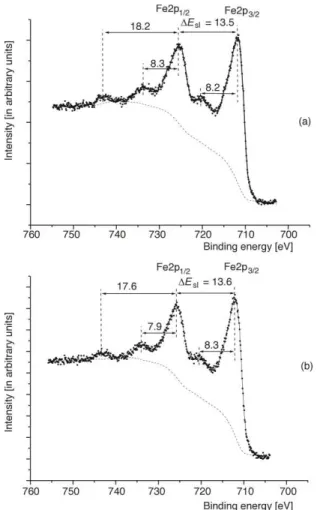
The Fe2p3/2 bind ing en ergy (Sam ple I) of 711.6 eV is slightly higher than the cor re spond ing value 711.0 eV for a-FeOOH given in [12]. The spin-or bit split ting from this spec trum is DEsl = =j13.5 eV and com pa ra ble with DEsl =13.2 eV for me tal lic iron [13]. On the higher bind ing en ergy side from the ba sic peaks the typ i cal sat el lites at DEsat1 = 8.2 eV and DEsat2 = 18.2 eV (fig. 4a, tab.) are ob served. Go ing to the spec tra from Sam ples II and III, a shift (DEb = 0.3 eV and DEb = 0.4 eV re -spec tively) of the Fe2p3/2 peak to ward the higher bind ing en ergy and some changes in the spec tral struc ture are ob served (fig. 4b, tab.1). This shift can be due to the changes in iron ox i da tion state un der the in flu ence of the so lu tion.
The Fe3s spec trum from goethite a-FeOOH (Sam ple I) in stead of a sin gle sharp peak shows a com plex fine struc ture (fig. 5a). With the high
prob a bil ity this spec trum shows the multiplet split -ting of DEms = 7.4 eV. This split ting is pro por tional to 2S + 1, where S – to tal spin of the ion, or to the num ber of the un cou pled Fe3d5 elec trons [10, 12]. The in ten sity ra tio of the dou blet has to be I1/I2 = =j(S + 1)/S, i. e. 7/5, which agrees with the ex per i men tal value. In re al ity, the struc ture of this spec -trum is more com plex. Since the con di tion
Eb(Fe3s) » 2Eb(Fe3p) is sat is fied, there is a cer tain prob a bil ity of an ex tra state af ter the photoemission of the Fe3s elec tron (dy namic ef fect [10, 12, 14]). It re sults in for ma tion of the Fe3+ fi nal states like: Fe3s13p63d5 (one-hole state) and Fe3s23p43d6 (ex -tra two-hole state). It can com pli cate sig nif i cantly the spec tra, which in creases the er ror of the multiplet split ting mea sure ment. As an ex am ple of the pos si ble struc ture, the pres ent work gives the de com po si tion of this spec trum (fig. 5a). Since the dy namic ef fect has a res o nance na ture, as it was shown for bar ium com pounds [14], the dy namic ef -fect re lated struc ture can de pend on the na ture and lo ca tion of ligand ions around iron. De spite this, the Fe3s spec trum en ables to mea sure the multiplet split ting and de ter mine the num ber of the un cou -pled elec trons with a rea son able er ror. This split ting
Fig ure 4. Fe2p XPS spec tra from: (a) – goethite a-FeOOH (Sam ple I), (b) – prod uct of in ter ac tion of goethite with NpO2NO3 in aque ous me dia (Sam ple
II)
Fig ure 5. Fe3s XPS spec tra from: (a) – goethite a-FeOOH (Sam ple I), (b) – prod uct of in ter ac tion of goethite with NpO2NO3 in aque ous me dia (Sam ple
for Sam ples II and III was mea sured to be DEms = =j7.0 eV (fig. 5b, tab.1). The dif fer ence in the spec -tral struc tures of Sam ples I and II can be at trib uted to a cer tain change in iron sur round ing on the sur -face un der the in flu ence of the so lu tion (fig. 5). In ionic ap prox i ma tion this spec tral struc ture shows that Fe3+ ions pres ent on the sam ple sur faces.
The Np4f spec trum con sists of the spin-or bit dou blet (DEsl = 11.6 eV) of rel a tively sharp peaks (fig. 6a). The bind ing en ergy Eb(Np4f7/2) = 403.6 eV is closer to those 403.4 eV and 403.6 eV in Cs3NpO2Cl4 and RbNpO2(NO3)2×2H2O con tain ing Np5+ ions (tab. 1). The Na1s peak is ob served at Eb(Na1s) = =j1073.1 eV (Sam ple II), while the Cl2p one of per -chlor ate group ClO41- and the N1s one of NO31 -group are nor de tected (i. e. Cl and N con cen tra tions are less than 1 at.%). At Eb(Cl2p3/2) = 199.6 eV (Sam -ple II) a low in tense Cl2p peak was ob served. It can be at trib uted to NaCl (for mula II). The Pu4f7/2 bind ing en ergy and spin-or bit split ting are Eb(Pu4f7/2) = =j428.7 eV and DEsl(Pu4f5/2) = 12.5 eV for Cs2PuO2Cl4 sin gle crys tal. How ever, the spec trum from Sam ple III in this bind ing en ergy range does not show this dou blet (fig. 6b), which in di cates in suf fi cient (un de tect able by XPS) plu to nium con tents. On the ba sis of this data the up per bor der of plu to nium con cen
tra tion on the sur face of Sam ple III was eval u ated (for -mula III).
Re sults of the quan ti ta tive anal y sis. The er ror in de ter mi na tion of quan ti ta tive el e men tal and ionic com -po si tions of the stud ied sam ples (Sam ples I, II, III) grows be cause of the com plex spec tral struc ture due to the multiplet split ting and sec ond ary elec tronic pro -cesses (many-body per tur ba tion and dy namic ef fect) and can ex ceed 10%. Since many-body per tur ba tion re sults in the shake up sat el lites on the higher bind ing en ergy side from the ba sic peaks, the sat el lite in ten si ties can be par tially taken into ac count (fig. 4). How ever, it is dif fi cult to take into ac count the dy namic ef fect re -lated de crease of in ten sity. But the dy namic ef fect does not in flu ence sig nif i cantly on the con sid ered spec tra. Since the Fe2p spec trum is com pli cated, the pres ent work used the Fe3s peak for the quan ti ta tive anal y sis. The sam ple sur faces were found to have the fol low ing com po si tions rel a tive to one iron ion:
(Sam ple I)
Fe1.00OI1.12(O)OII1.12(OH1–)CI0.23(CH3–)CII0.04(CO32–)
(Sam ple II)
Fe1.00OI0.91(O)OII1.03(OH1–)OIII0.26(H2O)Np0.003 (Np6+)Na
0.08Cl0.03CI0.28(CH3–)CII0.03(CO32–)
(Sam ple III)
Fe1.00OI0.92(O)OII0.92(OH1–)OIII0.04(H2O)Pu(<0.0001) CI
0.55(CH3–)CII0.05(CO32–)
where OI(O), OII(OH1–), and OIII(H
2O) – ox y gen ions of ox ide, hydroxyl group, and wa ter. The ob served ox y gen ex cess in Sam ple I and II can be par tially at trib uted to ox y gencon tain ing mol e cules ab -sorbed on the sur face and high mea sure ment er ror. De spite the fact that nep tu nium con cen tra tion in Sam ple II is about 1/1000 (» 0.1 at.%), the XPS method al lows a re li able de ter mi na tion of nep tu -nium ox i da tion state (fig. 6a). The in ter ac tion of goethite with neptunyl ions can be sug gested to take place via hy drox ide oxygens of goethite lo cated in the equa to rial plane of NpO25+ ion.
CON CLU SIONS
(1) Neptunyl NpO2n+ com plexes on the sur -face of goethite aFeOOH re sulted from the in ter -ac tion of neptunyl ni trate NpO2NO3 (10–6 M) in the aque ous me dia with the back ground elec tro lyte (NaClO4) of ionic force 0.1 M (pH = 7.2 ± 0.2) were formed and stud ied with the Xray pho to elec -tron spec tros copy.
(2) The XPS ionic and el e men tal quan ti ta tive anal y sis of the goethite and prod ucts of its in ter ac -tion with neptunyl and plutonyl ni trates was car ried Fig ure 6. An4f XPS spec tra from the prod uct of in
-ter ac tion of goethite with AnO2NO3 in aque ous me
out. It was es tab lished that dur ing the stud ied neptunyl ni trate – goethite in ter ac tion Np4+ and Np6+ com pounds did not to form, while the com -plexes of neptunyl group NpO2+ con tain ing Np5+ ions with ox y gen, wa ter and/or car bon ate ions in the equa to rial planes formed.
AC KNOWL EDGE MENT
The work was sup ported by ISTC No 1358, RFBR No. 02-03-32693, DOE (Pro ject M6RAS0008) and State pro gram Lead ing sci en -tific schools (No. 1763).
REFERENCES
[1] Pompe, S., Bubner, M., Denecke, M. A., Reich, T., Brachmann, A., Geipel, G., Nicolai, R., Heise, K. N., Nitsche, H., A Com par i son of Nat u ral Humic Ac ids with Syn thetic Humic Acid Model Sub -stances, Char ac ter iza tion and In ter ac tion with Ura nium (VI), Radiochimica Acta, 74 (1996), pp. 135-140
[2] Teterin, Yu. A., Ivanov, K. E., Baev, A. S., Nefedov, V. I., Gaipel, G., Reich, T., Nische, H., XRay Pho -to elec tron Study of the Interaction of UO2(ClO4)2 with Cal cite and Diabase Min er als in Wa ter So lu -tions, Suface In ves ti ga tion, 13(1998), pp. 613-622
[3] Choppin, G. R., Bond, A. H., De ter mi na tion of the Forms of the Ac ti nide Ex is tence in Var i ous De grees of Ox i da tion (in Rus sian), Zhurnal Analiticheskoi
Himii, 51(1966), 12, pp. 1240-1251
[4] Abdel-Samad, H., Wat son, P. R., An XPS Study of the Ad sorp tion of Chromate on Goethite (a-FeOOH) , Ap plied Sur face Sci ence, 108 (1997),
pp. 371-377
[5] Teterin, Yu. A., Teterin, A. Yu., Dementiev, A. P., Lebedev, A. M., Utkin, I. O., Melihov, I. V., Nefedov, V. I., Berdonosova, D. G., Bek-Uzarov, D., Vuk~evi}, L., XPS Study of Uranil Group In ter ac tion with Hydroxilapatite and Fluoropatite in Aqueons So lu -tion (in Rus sian), Zhurnal Strukturnoi Himii, 41
(2000), 4, pp. 747-752
[6] Atkinson, R. J., Posner, A. M., Quirk, J. P., Ad sorp -tion of Po ten tial – De ter min ing Ions at the Fer ric Ox ide – Aque ous Elec tro lyte In ter face., J. Phys. Chem., 71(1967), 3, pp. 550-558
[7] Teterin, Yu. A., Baev, A. S., Mashirov, L. G., Suglobov, D. N., Struc ture of XPS Spec tra of Cs3NpO2Cl4 and Cs2NpO2Cl4 Monocrystals (in Rus sian), Doklady Akademii Nauk SSSR, 276 (1984), 1, pp. 154-159
[8] ***, Au ger and XRay Pho to elec tron Spec tros -copy Sur face Anal y sis (in Rus sian) (Eds. D. Briggs, M. P. Sich), Mir, Mos cow, 1987, p. 598
[9] Scofield, H., Hartree-Slat er Subshell Photoionization Cross-Sec tions at 1254 and 1487 eV, J. Elec tron
Spectrosc. Relat. Phenom., 8 (1976), pp. 129-137
[10] Teterin, Yu. A., Gagarin, S. G., In ner Va lence Mo -lec u lar Orbitals in Com pounds and the Struc ture of X-Ray Pho to elec tron Spec tra, Rus sian Chem i cal
Re view, 65 (1996), 10, pp. 825-847
[11] Teterin, Yu. A., Teterin, A. Yu., XRay Pho to elec -tron Spec tra Struc ture of Lanthanide Com pounds,
Rus sian Chem i cal Re view, 71 (2002), 5, pp.
347-381
[12] Nefedov, V. I., X-Ray Pho to elec tron Spec tros copy of Chem i cal Com pounds (in Rus sian), Mos cow, Himiya, 1984, p. 256
[13] Fuggle, J. C., Core Level Bind ing En er gies in Met -als, J. Elec tron Spectrosc. Relat. Phenom., 21 (1980), pp. 275-281
[14] Yarzhemsky, V. G., Teterin ,Yu. A., Sosulnikov, M. I., Dy namic Dipolar Re lax ation in XRay Pho to elec tron Spec tra of Ba4p Subshell in Bar ium Com -pounds, J. Elec tron Spectrosc. Relat. Phenom., 59 (1992), pp. 211-222
Jurij A. TETERIN, Stepan N. KALMIKOV, Aleksandar P. NOVIKOV, Jurij A. SAPO@WIKOV, Labud VUK^EVI], Anton J. TETERIN, Konstantin I.
MASLAKOV, Igor O. UTKIN, Ikule B. HASANOVA, Natalija S. [^ERBINA
ISPITIVAWE INTERAKCIJE Np5+ SA GETITOM a-FeOOH METODOM RENDGENOM INDUKOVANE FOTOELEKTRONSKE SPEKTROSKOPIJE
Neptunil NpO2n+ kompleksi na povr{ini getita a-(FeOOH), nastali iz interakcije neptunil nitrata (NpO2NO3, 10
-6 M) u vodenoj sredini, sa osnovnim elektrolitom (NaClO
4) jonske ja~ine 0.1 M (pH = 7.0 ± 0.2), bili su nagra|eni i ispitivani metodom rendgenom indukovane
fotoelektronske spektroskopije. Izvr{ena je elementarna kvantitativna analiza getita i produkata wegove interakcije sa neptunil i plutonil nitratima. Utvr|eno je da se tokom ispitivawa interakcije neptunil nitrat – getit, ne grade Np4+ i Np6+ jediwewa. Kompleksi
neptunil grupe NpO21+ koji sadr`e Np5+ jone sa kiseonikom, vodom i/ili karbonatnim jonima, grade ta jediwewa u ekvatorijalnim ravnima.
Kqu~ne re~: getiti, rendgenom indukovana fotoelektronska spektroskopija, aktinidi,