AMTD
5, 1317–1354, 2012The scientific basis for a satellite mission
to retrieve CCN
D. Rosenfeld et al.
Title Page Abstract Introduction Conclusions References Tables Figures
◭ ◮
◭ ◮
Back Close Full Screen / Esc
Printer-friendly Version Interactive Discussion
Discussion
P
a
per
|
Dis
cussion
P
a
per
|
Discussion
P
a
per
|
Discussio
n
P
a
per
|
Atmos. Meas. Tech. Discuss., 5, 1317–1354, 2012 www.atmos-meas-tech-discuss.net/5/1317/2012/ doi:10.5194/amtd-5-1317-2012
© Author(s) 2012. CC Attribution 3.0 License.
Atmospheric Measurement Techniques Discussions
This discussion paper is/has been under review for the journal Atmospheric Measurement Techniques (AMT). Please refer to the corresponding final paper in AMT if available.
The scientific basis for a satellite mission
to retrieve CCN concentrations and their
impacts on convective clouds
D. Rosenfeld1, E. Williams2, M. O. Andreae3, E. Freud1, U. P ¨oschl3, and N. O. Renn ´o4
1
Institute of Earth Sciences, The Hebrew University of Jerusalem, Jerusalem 91904, Israel
2
Dept. of Civil and Environmental Engineering, Massachusetts Institute of Technology (MIT), 77 Massachusetts Avenue, Cambridge, MA, 02139, USA
3
Biogeochemistry Department, Max Planck Institute for Chemistry, P.O. Box 3060, 55020 Mainz, Germany
4
College of Engineering, University of Michigan, 1531C Space Research Building, 2455 Hayward St., Ann Arbor, MI 48109, USA
Received: 25 January 2012 – Accepted: 25 January 2012 – Published: 10 February 2012 Correspondence to: D. Rosenfeld ([email protected]),
E. Williams ([email protected]), M. O. Andreae ([email protected]), N. O. Renn ´o ([email protected])
AMTD
5, 1317–1354, 2012The scientific basis for a satellite mission
to retrieve CCN
D. Rosenfeld et al.
Title Page Abstract Introduction Conclusions References Tables Figures
◭ ◮
◭ ◮
Back Close Full Screen / Esc
Printer-friendly Version Interactive Discussion
Discussion
P
a
per
|
Dis
cussion
P
a
per
|
Discussion
P
a
per
|
Discussio
n
P
a
per
|
Abstract
The cloud -mediated radiative forcing is widely recognized as the main source of uncer-tainty in our knowledge of the anthropogenic climate forcing and in our understanding of climate sensitivity. Current outstanding challenges are (1) global measurements of cloud condensation nuclei (CCN) in the cloudy boundary layer from space, and, (2)
5
disentangling the effects of aerosols from the thermodynamic and meteorological ef-fects on the clouds. Here we present a new concept for a way to overcome these two challenges, using relatively simple passive satellite measurements in the visible and IR. The idea is to use the clouds themselves as natural CCN chambers by retrieving simultaneously the number of activated aerosols at cloud base,Na, and the cloud base
10
updraft speed. The Na is obtained by analyzing the distribution of cloud drop eff ec-tive radius in convecec-tive elements as a function distance above cloud base. The cloud base updraft velocities are estimated by double stereoscopic viewing and tracking of the evolution of cloud surface features just above cloud base. In order to resolve the vertical dimension of the clouds, the field of view will be 100 m for the microphysical
15
retrievals, and 50 m for the stereoscopic measurements. The viewing geometry will be 30 degrees off nadir eastward, with the Sun in the back at 30 degrees off zenith westward, which requires a Sun synchronous orbit at 14:00 LST. Having measured si-multaneously the thermodynamic environment, the vertical motions of the clouds, their microstructure and the CCN concentration will allow separating the dynamic from the
20
AMTD
5, 1317–1354, 2012The scientific basis for a satellite mission
to retrieve CCN
D. Rosenfeld et al.
Title Page Abstract Introduction Conclusions References Tables Figures
◭ ◮
◭ ◮
Back Close Full Screen / Esc
Printer-friendly Version Interactive Discussion
Discussion
P
a
per
|
Dis
cussion
P
a
per
|
Discussion
P
a
per
|
Discussio
n
P
a
per
|
1 Introduction
1.1 Uncertainty in aerosol cloud-mediated forcing drives the climate uncertainty
The effects of aerosols on clouds are recognized by the IPCC (2007) as the largest sources of uncertainty in the quantification of anthropogenic perturbations to the
5
Earth’s energy balance. Therefore the reduction of this uncertainty is necessary for improving our understanding of the present climate and for the reduction of the un-certainties in the prediction of future climates (e.g. Andreae et al., 2005; Kiehl, 2007). The uncertainty in aerosol cloud-mediated radiative forcing is composed of two large and highly uncertain opposite effects from shallow and deep clouds (Rosenfeld et al.,
10
2012b). This underlines the importance of conducting global measurements of the aerosol effects on clouds. This paper introduces a new concept for doing these kinds of measurements from a space, showing the feasibility of what has been considered impossible until now.
1.2 Ways by which aerosols affect cloud microphysical, precipitation and
15
radiation properties
Aerosols are extremely important to cloud radiative forcing because cloud droplets are nucleated on pre-existing aerosols that serve as cloud condensation nuclei (CCN). The cloud droplet concentrations,Nd, that form near cloud base depend on the supersatu-ration (S) activation spectrum, CCN(S), and on the cloud base updraft speed,wb. The
20
CCN that actually nucleate cloud droplets in specific clouds are referred to as activated CCN, and their number density before dilution by mixing with ambient non-cloudy air is denoted asNa. The mixing with ambient air reducesNatoNd. This number determines the variability of the fundamental properties of the clouds at a given meteorological sit-uation. The albedo of clouds with a given value of vertically-integrated liquid water
25
AMTD
5, 1317–1354, 2012The scientific basis for a satellite mission
to retrieve CCN
D. Rosenfeld et al.
Title Page Abstract Introduction Conclusions References Tables Figures
◭ ◮
◭ ◮
Back Close Full Screen / Esc
Printer-friendly Version Interactive Discussion
Discussion
P
a
per
|
Dis
cussion
P
a
per
|
Discussion
P
a
per
|
Discussio
n
P
a
per
|
reducing coalescence and inhibiting rain production (Gunn and Phillips, 1957; Squires, 1958). The dynamic response to the rain suppression lengthens the life-time and in-creases the cloud cover of marine stratocumulus (Albrecht, 1989; Rosenfeld et al., 2006). In deep convective clouds rain forms eventually, but the aerosol-induced delay in its formation to greater heights was shown to cause cloud invigoration and additional
5
electrification (Andreae et al., 2004; Rosenfeld et al., 2008). The aerosol-induced ver-tical growth and the consequent expansion of the anvils into cirrus inflicts large positive radiative forcing (Koren et al., 2010), in contrast to the strong negative forcing that is caused by the aerosol effect on shallow clouds (e.g. Albrecht, 1989). In the context of tropical cyclones the invigoration of clouds at the periphery of the storms occurs at the
10
expense of a reduction in the amount of air converging into the storm center, hence re-ducing the maximum wind speeds (Rosenfeld et al., 2012a). The aerosols were found even to affect the potential of deep convective clouds to produce large hail and torna-does, where clouds with added pollution aerosols become potentially more damaging (Rosenfeld and Bell, 2011). The impact of aerosols on cloud invigoration and the
verti-15
cal distribution of latent heating can also modulate regional and large scale circulation systems, as observed by Bell et al. (2008).
1.3 Uncertainties in global measurements of cloud-mediated radiative forcing by aerosols
Based on this brief summary of aerosol effects on clouds, it is evident that having
20
accurate measurements of CCN activation spectra as a function of water vapor super-saturation – CCN(S), is vital for a quantitative understanding of the weather systems and the aerosol impacts on Earth energy budget and climate. This information is nec-essary for disentangling the effects of aerosols from those of the green house gases on the Earth energy budget, and hence for understanding climate change and climate
25
prediction.
AMTD
5, 1317–1354, 2012The scientific basis for a satellite mission
to retrieve CCN
D. Rosenfeld et al.
Title Page Abstract Introduction Conclusions References Tables Figures
◭ ◮
◭ ◮
Back Close Full Screen / Esc
Printer-friendly Version Interactive Discussion
Discussion
P
a
per
|
Dis
cussion
P
a
per
|
Discussion
P
a
per
|
Discussio
n
P
a
per
|
measurable quamtities into CCN(S) is still challenging. The radiative forcing caused by impacts of aerosol on clouds is inferred from satellite observations where aerosol optical properties are compared to cloud radiative properties. This practice is inac-curate, mainly because of the poor ability to convert the aerosol optical depth (AOD) into concentrations of cloud condensation nuclei (CCN) that actually interact with the
5
clouds (Andreae, 2009). The inaccuracies are caused by the fact that aerosols are not measured at the same height as the cloud base, cloud contamination (i.e. clouds enhancing the aerosol signals), and aerosol swelling in the moist environment near the clouds. Inaccuracies in the cloud properties are caused by mixing clouds that feed from the boundary layer with clouds that have elevated bases above the boundary
10
layer, hence not interacting with the aerosols there. Another yet unresolved challenge is correct retrieval of the properties of ensembles of convective clouds. A serious lim-itation is the inability of the aerosols and clouds in conditions of high fractional cloud coverage to be retrieved simulataneously. As a result, the practice of relating retrieved cloud to retrieved aerosol properties is plagued by large random errors in both
param-15
eters. Mathematically, adding random noise to two physically linearly related variables (e.g. Y =aX) causes the correlation to decrease and the slope to tend toward zero. Therefore, the large observational errors in the dependence of clouds on aerosol prop-erties have likely caused an underestimate of the slopes of their relationships, which is defined to be the observed aerosol indirect effect (AIE). This error might explain the
20
low estimates of the observed AIE as compared to results of model simulations (e.g. Quass et al., 2009; Penner et al., 2011).
2 A new proposed concept for measuring AIE
This paper introduces a new concept for measuring simultaneously CCN(S) and the microphysical and dynamical properties of the clouds for assessing quantitatively the
25
AMTD
5, 1317–1354, 2012The scientific basis for a satellite mission
to retrieve CCN
D. Rosenfeld et al.
Title Page Abstract Introduction Conclusions References Tables Figures
◭ ◮
◭ ◮
Back Close Full Screen / Esc
Printer-friendly Version Interactive Discussion
Discussion
P
a
per
|
Dis
cussion
P
a
per
|
Discussion
P
a
per
|
Discussio
n
P
a
per
|
(CHASER) is based on this concept (Renno et al., 2012). The satellite has two main instruments: the Multi Spectral Imager (MSI) that will have a field of view of 100 m by 102.4 km at the center of the ground track for all wavelengths. The satellite view will point 30◦offnadir eastward with the Sun at 30◦offzenith on the west, at local solar time of 14:00 LST. The MSI will have 12 spectral bands in the visible, near IR and thermal
5
IR, as shown in Table 1.
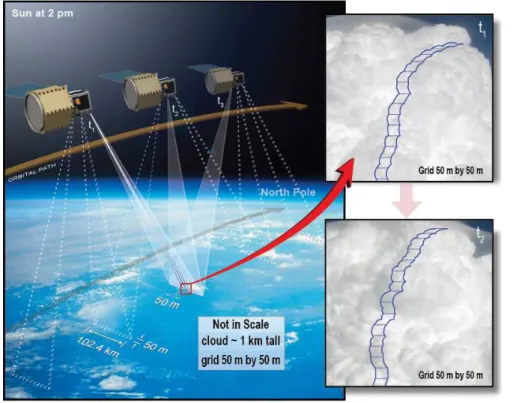
Cloud vertical motions will be obtained by using a sequence of stereoscopic images that map the evolution of the cloud surface. The Multi Angle Imager (MAI) onboard CHASER has this capability. The MAI consists of three visible high resolution cameras. The center camera points 30◦offnadir eastward. The other two cameras point 30◦ off
10
nadir across-track (eastward) and±30◦ offnadir along-track with respect to the center
camera to achieve a stereo geometry with the Sun at the back as illustrated in Fig. 1. The field of view of each camera is 50 m by 102.4 km, with a spatial resolution of 50 m at their ground center track. The three cameras cross scan the same ground track, providing a sequence of three images 1 min apart, from three different viewing angles.
15
The idea of vertical microphysical profiling from space was introduced by Rosenfeld and Lensky (1998), using the Advanced Very High Resolution Radiometer (AVHRR), observing the temperature and particle effective radius (re) at the tops of convective clouds at various stages of vertical development. This idea was improved to a proposed side scanning satellite (Martins et al., 2011), and further developed with enhancing the
20
resolution and with the addition of the MAI for CHASER (Renno et al., 2012).
Traditionally, CCN are measured in laboratory or field experiments by a cloud cham-ber where known water vapor supersaturation (S) is applied to an air sample and the activated cloud droplets are counted. Here we view clouds as natural cloud cham-bers where the number of nucleated aerosols into cloud droplets, Na, and S can be
25
AMTD
5, 1317–1354, 2012The scientific basis for a satellite mission
to retrieve CCN
D. Rosenfeld et al.
Title Page Abstract Introduction Conclusions References Tables Figures
◭ ◮
◭ ◮
Back Close Full Screen / Esc
Printer-friendly Version Interactive Discussion
Discussion
P
a
per
|
Dis
cussion
P
a
per
|
Discussion
P
a
per
|
Discussio
n
P
a
per
|
as a function of S. This is used to map CCN in the cloudy boundary layer globally. This is important because this maps CCN andwb, the fundamental physical entities determining Na, which in turn determine the rest of the cloud properties (e.g. cloud drop effective radius and initiation of rain as a function of height above base). Retriev-ingNa and cloud base updraft velocitiess is required for disentangling the impacts of
5
dynamics from microphysics on the various cloud properties.
The concept of using ground-based cloud observations for retrieving CCN was orig-inally proposed by Feingold et al. (1998). They retrieved CCN using measurements of
wbwith vertically pointing Doppler cloud radar, andNdestimated from a combination of cloud radar and passive microwave measurements. Obtaining the size distribution of
10
the aerosols by Lidar or other measurements can provide the CCN supersaturation ac-tivation spectrum. This method was applied to ground based measurements of marine stratocumulus clouds at Point Reyes to obtain the aerosol effects on cloud radiative forcing (McCominsky and Feingold, 2011). They showed that the variability in liquid water path (LWP) that occurs due to 3-D effects and cloud mixing tends to reduce the
15
measured strength of the albedo effect.
The proposed methodology represents a significant advancement, as it can use satellite measurements and therefore provide a global coverage of retrieved CCN and cloud properties. Furthermore, variability in LWP for a cloud with a given depth andNd
is not a source of error for this methodology.
20
3 Naas a fundamental extensive cloud property
The number of activated aerosols at cloud base,Na, is determined by the aerosol size distribution, chemical composition, and water vapor supersaturation at cloud base. The latter is determined by CCN(S) and the updraft speed at cloud base. In a hypothetical cloud parcel rising adiabatically, the diameters of the cloud droplets grow in proportion
25
AMTD
5, 1317–1354, 2012The scientific basis for a satellite mission
to retrieve CCN
D. Rosenfeld et al.
Title Page Abstract Introduction Conclusions References Tables Figures
◭ ◮
◭ ◮
Back Close Full Screen / Esc
Printer-friendly Version Interactive Discussion
Discussion
P
a
per
|
Dis
cussion
P
a
per
|
Discussion
P
a
per
|
Discussio
n
P
a
per
|
diameter, and ρL is the water density. Na can be readily calculated because qLa is a known thermodynamic function of the cloud depthD(the vertical distance above cloud base). Real clouds are far from being adiabatic, of course, but fortunately the mixing and dilution of convective clouds occurs in a way that leaves thervas if the clouds were nearly adiabatic. This occurs because clouds mix nearly inhomogeneously (e.g. Paluch
5
and Baumgardner, 1989). That is, cloud droplets directly exposed to mixing evaporate completely leaving the remaining droplets unaffected. This leads to a reduction ofNd
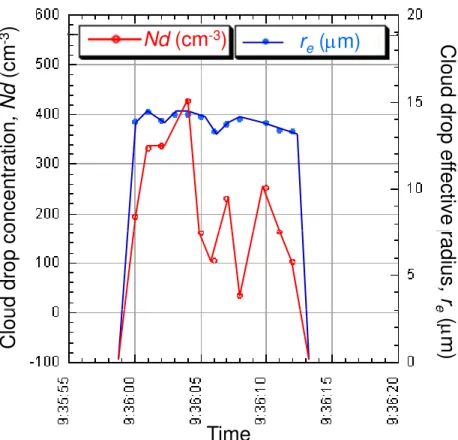
and of the cloud water content,qL, but mixing does not affectrv. Examples from aircraft measurements are shown in Figs. 2–4. Another fortunate fact is the highly repeatable tight linear relationship between rv and cloud droplet effective radius re (see Fig. 5),
10
a parameter that can be measured by satellites (Nakajima and King, 1990). Freud et al. (2011) explain this methodology in more detail.
Based on this physical description,Nais the most fundamental microphysical prop-erty of a convective cloud. It determines the rate at which the droplets grow with cloud depth and in turn the rate at which they are converted into precipitation-sized particles.
15
It also affects the radiative properties of the clouds, as higher concentrations reduce the droplet sizes for a given amount of cloud water (Twomey, 1977).Nareflects not only CCN(S), but also the updraft velocities, as manifested in the actual supersaturation that these CCN were exposed to. However, direct measurement ofNa is usually not pos-sible because entrainment of sub-saturated ambient air into the cloud decreases the
20
cloud droplet concentrations by evaporation and dilution. Even the cores of deep con-vective clouds, where aircraft measurements are normally avoided due to the strong vertical motions and icing hazards, are prone to entrainment. This is mainly because of the fairly small horizontal extent and the strong turbulence in and near the convective cloud towers.
AMTD
5, 1317–1354, 2012The scientific basis for a satellite mission
to retrieve CCN
D. Rosenfeld et al.
Title Page Abstract Introduction Conclusions References Tables Figures
◭ ◮
◭ ◮
Back Close Full Screen / Esc
Printer-friendly Version Interactive Discussion
Discussion
P
a
per
|
Dis
cussion
P
a
per
|
Discussion
P
a
per
|
Discussio
n
P
a
per
|
4 Nacontrols the height for the onset of warm rain
The droplet condensational growth is determined by the number of activated CCN (Na) and the height above cloud base, D. When the droplet effective radius (re) exceeds
∼14 µm, considerable precipitation mass is likely to form in growing convective clouds regardless of the extent of entrainment and mixing. This is because the low droplet
5
concentrations and liquid water content in the diluted parts of the cloud, which slow the coalescence rate, is compensated by the extra time and potential spectrum broaden-ing due to typically weaker updrafts and preferred (partial) evaporation of the smaller droplets upon mixing. Additionally, the rate of droplet coalescence is proportional to
∼re5 which practically implies the existence of a threshold re above which efficient 10
warm rain formation can occur, and also because the vertical profile of re, even in diluted clouds, closely follows the theoretical adiabatic condensational growth curve. The small observed deviations are mainly caused by deviations from purely inhomoge-neous mixing which cause partial droplet evaporation. Consequently, the minimal cloud depth for precipitation formation (Dp) must theoretically change nearly linearly withNa 15
because the adiabatic water content increases nearly linearly withDp, with a slope that depends on the cloud base parameters. This means that in highly polluted clouds or where strong cloud-base updrafts occur (i.e. highNa), clouds may need to grow well above the freezing level, even in tropical atmosphere, before precipitation forms either by warm or by mixed-phase processes. For full detail see Freud and Rosenfeld (2012).
20
5 RetrievingNd from satellites
Satellite retrieval of the column number of cloud droplets [cm−2] is based on the re-trieved vertical liquid water path (LWP). When LWP is given, the vertically averaged cloud droplet number densityNd can be estimated. Indirect measurements of Na by satellite and lidar retrievals were previously applied to shallow marine stratiform clouds,
25
AMTD
5, 1317–1354, 2012The scientific basis for a satellite mission
to retrieve CCN
D. Rosenfeld et al.
Title Page Abstract Introduction Conclusions References Tables Figures
◭ ◮
◭ ◮
Back Close Full Screen / Esc
Printer-friendly Version Interactive Discussion
Discussion
P
a
per
|
Dis
cussion
P
a
per
|
Discussion
P
a
per
|
Discussio
n
P
a
per
|
(Bennartz, 2007; Brenguier et al., 2000; Schuller et al., 2003; Snider et al., 2010). These retrievals had large uncertainties mainly due to violation of the adiabatic as-sumption and were not always validated with direct measurements. Furthermore, this methodology is not applicable to convective clouds due to their largeer departure from the assumption that they are close to adiabatic as compared to marine startocumulus,
5
and also due to the variable cloud top heights and depths at scales smaller than the typical satellite sensor resolution.
The fact thatNdis vertically averaged and is subject to an unknown extent of dilution with ambient air renders it to be related only loosely to CCN. In contrast, Na is the fundamental property representing the combined effects of CCN(S) and cloud base
10
updraft velocity,wb, which in turn determine other cloud properties. Consequently, the objective of this study is to introduce a method by which satellite observations of clouds can be used for retrievingNaand its precursors, CCN(S) andwb.
6 The scientific basis for retrievingNa
Recent studies based on airborne measurements in deep convective clouds show that
15
the cloud droplet effective radius (re) anywhere in the cloud is a strong function of the number of activated CCN (Na) and the distance above cloud base (D). The entrainment of sub-saturated air from the surroundings of the cloud and the mixing with the cloudy air, although reducing the cloud droplet concentrations and the liquid water content by evaporation and dilution, apparently do not have a strong effect on re. The common
20
explanation is that the mixing is strongly inhomogeneous, i.e. that the cloud droplets at the edges of a blob of entrained sub-saturated air quickly and completely evaporate while increasing the vapor content in the entrained air, until it is saturated and cannot evaporate additional droplets. This lowers the droplet concentrations but leaves the shape of the droplet size spectra unchanged and hence does not affect re. This is
25
AMTD
5, 1317–1354, 2012The scientific basis for a satellite mission
to retrieve CCN
D. Rosenfeld et al.
Title Page Abstract Introduction Conclusions References Tables Figures
◭ ◮
◭ ◮
Back Close Full Screen / Esc
Printer-friendly Version Interactive Discussion
Discussion
P
a
per
|
Dis
cussion
P
a
per
|
Discussion
P
a
per
|
Discussio
n
P
a
per
|
mainly by condensation. When droplet coalescence is active and warm rain forms, then the unique relation between the vertical profile ofre andNa weakens. Therefore the derivation ofNais expected to be most accurate forrevalues smaller than∼13 µm.
Errors in the measurements ofre and departures from the extreme inhomogeneous assumption would affect the determination of Na and therefore the effects of mixing
5
would need to be accounted for.
Accurate measurements of re require vertical resolutions of the order of 100 m. Moreover, accurate measurements of re as a function of the vertical distance above cloud base,D, require the minimization of 3-dimensional effects. The reduction of this effect can be accomplished by making measurements of re at wavelengths of about
10
3.7 µm because the strong absorption of radiation by water at this wavelength re-duces 3-dimensional effects (Rosenfeld et al., 2004; Painemal and Zuidema, 2011). At shorter wavelengths where absorption is weaker (1.6 and 2.1 µm), a larger fraction of the light exiting a measured cloud pixel has been scattered by cloud particles inside and outside of the intended cloud measurement volume. Therefore, measurements
15
at 3.7 µm are inherently more accurate for retrievingNathan measurements at 1.6 or 2.1 µm.
Taking into account the deviation from the extreme inhomogeneous mixing scenario when derivingNafrom the vertical profile ofreis not straightforward. Freud et al. (2011) showed that with the inhomogeneous mixing assumption Na was over-estimated on
20
average by∼30 %. This is because the measuredre needs to be extrapolated to its
adiabatic value (and converted to rv) before Eq. (1) can be applied. How much to add to the measuredredepends mainly on the amount of entrainment and the relative humidity (RH) of the entrained air. The RH may be estimated from the measurements of the absorption of the water vapor (in the 1120–1150 nm band) near the edges of
25
AMTD
5, 1317–1354, 2012The scientific basis for a satellite mission
to retrieve CCN
D. Rosenfeld et al.
Title Page Abstract Introduction Conclusions References Tables Figures
◭ ◮
◭ ◮
Back Close Full Screen / Esc
Printer-friendly Version Interactive Discussion
Discussion
P
a
per
|
Dis
cussion
P
a
per
|
Discussion
P
a
per
|
Discussio
n
P
a
per
|
the measured cloud top temperatures at the various heights. This is expected to be much more accurate than the alternatives of forecast/reanalysis or derived by satellite inversion techniques (e.g. Singh and Bhatia, 2006 and the references therein).
Here we retrieveNausing the following algorithm:
1. Retrieve re(D), the vertical profile of re as a function of vertical distance above
5
cloud base.
2. Convert the satellite retrieved re torv, using the very tight and invariable linear relations between the two, as shown in Fig. 2 here and more fully Fig. 5 of Freud and Rosenfeld (2012).
3. Invoke the assumption of inhomogeneous mixing, which at the extreme means
10
thatrvequalsrva, the adiabaticrv. This allows retrievingNain the following way:
Na=3/(4qLaρLπrva3) (1)
4. CorrectNa for the extent of homogeneous mixing and the resultant reduction of
rv with respect torva. This is done based on the relative humidity near the cloud. This procedure will be tuned by analysis of already available aircraft
measure-15
ments (Freud et al., 2011).
Instead of correcting for the extent of homogeneous mixing (step 4 above), it can be assumed that the highestre values from each level in the cloud (there will be a range ofre values for each level because of the high resolution of the retrievals) represent the least diluted cloud elements, and therefore are close to the adiabaticre. Therefore
20
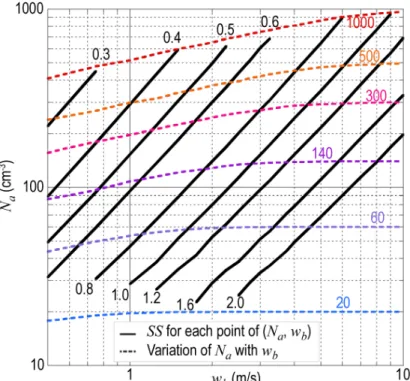
Eq. (1) may be used for derivingNa (after replacing re withrv) from the fitting of the bestre profile to the highestre values at each level. This profile would resemble the enveloping curve shown in Fig. 2 (dark grey), which was calculated for an assumedNa. Charts like the one shown in Fig. 3 can be used for obtainingNawhenre(D) is retrieved. This way for derivingNadoes not require accounting for the mixing inhomogeneity, so it
25
AMTD
5, 1317–1354, 2012The scientific basis for a satellite mission
to retrieve CCN
D. Rosenfeld et al.
Title Page Abstract Introduction Conclusions References Tables Figures
◭ ◮
◭ ◮
Back Close Full Screen / Esc
Printer-friendly Version Interactive Discussion
Discussion
P
a
per
|
Dis
cussion
P
a
per
|
Discussion
P
a
per
|
Discussio
n
P
a
per
|
number ofre values from each profile, and therefore may be more sensitive to noise in the data so the resultantNawould be biased in case the utilizedrevalues would be from cloud elements that are far from adiabatic.
The increase in re with cloud depth during the droplet condensational growth de-pends onNaand the mixing ratio of the water vapor at cloud base. When rereaches
5
∼14 µm in the convective clouds, warm rain starts to form (e.g. Rosenfeld, 1999, 2000;
Rosenfeld and Gutman, 1994; Gerber, 1996). As a result, if the cloud base temper-ature and pressure are known, the cloud depth at whichre reaches the 14 µm warm rain threshold (Dp) depends only onNa. But since the mixing ratio of the adiabatic wa-ter increases nearly linearly with cloud depth,Na andDpshould be linearly related for
10
constant cloud base properties. Freud and Rosenfeld (2012) demonstrated this simple relationship with a small number of deep convective clouds over Israel and India. It would be interesting to see whether this relationship between Dp and Na holds for a larger number of cases in different parts of the world, based on the proposed method-ology to deriveNa from space. If it holds, then it would be very useful to include this
15
simple parameterization in coarse-resolution models that do not resolve single clouds. The objective retrieval of CCN requires the ability to retrieve re accurately for the smallest possible fair weather boundary layer clouds and still resolve their vertical mi-crostructure. There is retrieved based on the observed extent of absorption of solar radiation in the clouds. Because 3.7 µm radiation is absorbed in water 10 times more
20
strongly than 2.2 µm radiation, clouds are more opaque at 3.7 µm and hence less af-fected by light arriving from outside of the measuring volume. The smallest practical size that can be used with little interference from adjacent cloud volume at 3.7 µm is about 100 m (Rosenfeld et al., 2004). Taking into account the 3-D effects that are in-herent to such small convective clouds allows the retrieval ofrein convective clouds to
25
AMTD
5, 1317–1354, 2012The scientific basis for a satellite mission
to retrieve CCN
D. Rosenfeld et al.
Title Page Abstract Introduction Conclusions References Tables Figures
◭ ◮
◭ ◮
Back Close Full Screen / Esc
Printer-friendly Version Interactive Discussion
Discussion
P
a
per
|
Dis
cussion
P
a
per
|
Discussion
P
a
per
|
Discussio
n
P
a
per
|
7 The scientific basis for obtaining the updraft velocity near cloud base
Cloud vertical motions can be obtained in principle by using a sequence of stereo-scopic images that map the evolution of the cloud surface. The Multi Angle Imager (MAI) onboard CHASER has this capability. Two stereoscopic views 1 min apart can in principle provide the vertical component of the cloud surface evolution, by tracking
pro-5
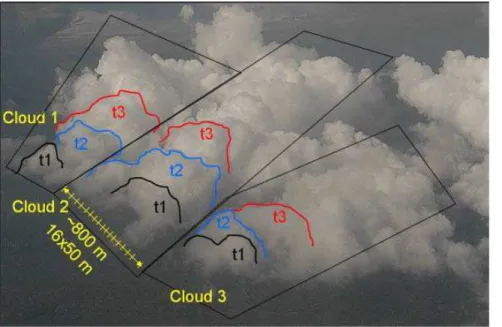
tuberances at the cloud envelope. Tracking such protuberances near cloud base with an oblique view from the side can provide the vertical motion of these features, which approximates the mean updraft at cloud base. An illustration of such cloud features is given in Fig. 6. The challenge here is separating the observed movement into hori-zontal and vertical components. This can be assisted by the independent knowledge
10
of the height for the central view of the cloud surface. This height can be obtained from the cloud temperature as measured by the MSI that is aligned with the center camera of the MAI. The cloud surface temperature can be uniquely related to cloud surface height in convective clouds, when using the moist adiabatic lapse rate and the cloud base temperature. Systematic bias errors in the height-temperature relations in
15
the same cloud cluster would not affect the accuracy of the retrieval, and the vertical lapse rate is rather constant, as determined by known thermodynamic factors that do not vary much within the domain.
The accuracy of the height retrieval by two Multi-angle Imaging SpectroRadiometer (MISR) cameras is about 300–500 m (Hovarth and Davis, 2001; Moroney et al., 2002).
20
The MISR has a horizontal nadir resolution of 275 m, versus the 50 m footprint of the MAI. This alone should bring down the error by a factor of 5, resulting in an accuracy of 60–100 m. The offnadir tilt of the MAI viewing geometry and the height reference provide additional significant improvement in the accuracy. Using a fixed reference height of a flat cloud base at the top of a well-mixed boundary layer for all three views
25
AMTD
5, 1317–1354, 2012The scientific basis for a satellite mission
to retrieve CCN
D. Rosenfeld et al.
Title Page Abstract Introduction Conclusions References Tables Figures
◭ ◮
◭ ◮
Back Close Full Screen / Esc
Printer-friendly Version Interactive Discussion
Discussion
P
a
per
|
Dis
cussion
P
a
per
|
Discussion
P
a
per
|
Discussio
n
P
a
per
|
The calculation of the supersaturation of the water vapor pressure near cloud base requires the determination of the updraft speed at cloud base (wb). It is assumed that the vertical speed of cloud protuberances near cloud base is approximately equal to the updraft speed. The challenge is to separate the horizontal and the vertical components of the motion. This is accomplished by the procedure described next.
5
In order to separate the vertical and horizontal components it is necessary to assume something as being fixed. In the situation of a well-mixed boundary layer from which convective clouds develop, the base of the clouds is flat at the convective condensation level, as determined by thermodynamic considerations. This height varies at a negligi-ble rate compared to the vertical motions within the clouds. Therefore, cloud surface
10
elements that are close to the base can be assumed to have the same horizontal mo-tion as the cloud base. Under such assumpmo-tion, all the relative angular displacement of the cloud surface with respect to the cloud base can be ascribed to the vertical dimen-sion. The mean horizontal wind has to be taken into account from the average motion of cloud bases.
15
In more general terms, the base of convective clouds is flat and at constant height. This provides a fixed reference for the MAI’s three views of a single cloud and allows the horizontal motion at cloud base to be determined. The knowledge of the horizontal motion at the cloud base allows the separation of the horizontal and vertical compo-nents of the motion of cloud protuberances measured by MAI.
20
The accuracy of the vertical speed retrieval is approximately equal to the vertical motion of one pixel of∆z=50 m between measurements∆t=60 s apart, resulting in
∆z/∆t=0.8 m s−1. Tracking at least 10 pixels of a single protuberance increases the accuracy of the calculation to∼0.2 m s−1. This provides measurements with the
neces-sary accuracy for calculatingS even in marine stratocumulus clouds. However, a more
25
AMTD
5, 1317–1354, 2012The scientific basis for a satellite mission
to retrieve CCN
D. Rosenfeld et al.
Title Page Abstract Introduction Conclusions References Tables Figures
◭ ◮
◭ ◮
Back Close Full Screen / Esc
Printer-friendly Version Interactive Discussion
Discussion
P
a
per
|
Dis
cussion
P
a
per
|
Discussion
P
a
per
|
Discussio
n
P
a
per
|
8 CombiningNaandWbfor obtaining the CCN spectra
Earlier researchers used CCN spectra extensively because they can be obtained di-rectly from in situ measurements with cloud chambers. Often, these CCN spectra were parameterized using a power law of the form CCN(S)=CCN (1 %)×Sb, such that the spectra could be represented by a CCN concentration normalized toS=1 %, and an
5
exponent b. More recent studies have moved away from this approach for two rea-sons. First, it was found that the power law was often a poor approximation for the observed CCN spectra, and therefore,b-values could not be reliably associated with specific aerosol types (Gunthe et al., 2009; Rose et al., 2010). The second and more important reason is that this representation treats CCN as a “black box” by using a
10
parameterization that does not contain any fundamental physical properties, and thus it is not amenable to prognostic modeling.
Current CCN research shows that the activation of an aerosol particle at a specific
S is predominantly determined by the number of water-soluble molecules or ions that it contains. The number of soluble molecules or ions, in turn, depends on the aerosol
15
volume and composition (the number of soluble molecules per unit volume). The vol-ume of the aerosol particle is specified by its dry diameter while the composition is specified by the hygroscopicity parameter,κ (Petters and Kreidenweis, 2007). In this approach, the CCN properties of aerosols can be related directly to their basic physical and chemical properties, and therefore are amenable to prognostic modeling.
State-of-20
the-art in situ measurements are based on size selection of aerosol particles followed by their activation to CCN in a cloud chamber, so that the dependence of activation on size and composition can be studied separately (Rose et al., 2008, Su et al., 2010).
These data are most beneficial for improving our understanding of how aerosols af-fect climate if they are used to test and improve the prognostic aerosol models that
25
AMTD
5, 1317–1354, 2012The scientific basis for a satellite mission
to retrieve CCN
D. Rosenfeld et al.
Title Page Abstract Introduction Conclusions References Tables Figures
◭ ◮
◭ ◮
Back Close Full Screen / Esc
Printer-friendly Version Interactive Discussion
Discussion
P
a
per
|
Dis
cussion
P
a
per
|
Discussion
P
a
per
|
Discussio
n
P
a
per
|
concentrations as a function of particle size (d) and composition (Reutter et al., 2009). Figure 7 illustrates the relation betweenS and Na calculated as a function of the up-draft speed near the cloud base (wb), which can be described byS=3.78wb0.64N−0.4
a .
These calculations indicate that overestimates of 20 % inNacauseS to be underesti-mated by 7 %, whereas overestimates of 20 % inwb causeS to be overestimated by
5
12 %. Since the error of the estimates ofNa andwbis∼10 % to 20 %, the error in the calculation ofS is∼10 %.
Since aerosol particle size and composition affect CCN activation and can vary in-dependently of one another, there is no unique way to convert a CCN(S) spectrum into a CCN(d, S) spectrum that would allow the retrieval of the desired functions: Na(d)
10
and κ(d). That is, the particle number concentration and hygroscopicity cannot be retrieved as a function of size without additional assumptions. Fortunately, recent re-search has yielded considerable information aboutκ from both theoretical studies and laboratory and field measurements. This research shows that submicron aerosols, which constitute essentially almost all CCN, can usually be represented as linear
mix-15
tures of an organic component with κ≈0.1 to 0.2 and an inorganic component with
κ≈0.6 (Gunthe et al., 2009; Rose et al., 2011). Where appropriate, an additional sea
salt component with aκ≈1.3 can be introduced. This approach has provided a global
model ofκdistributions that is in very good agreement with observations (Pringle et al., 2010). A comparison with observations shows that modeled and observedκ agree to
20
≤0.05 for 10 out of 14 stations. Field campaigns have also shown thatκdoes not
usu-ally change strongly with size over the size range relevant to CCN active in convective clouds (0.05–0.5 µm).
Onceκ is known or assumed, the distribution CCN(S) can be inverted to a distribu-tion CCN(d) because for each κ there is a functional relationship between the
super-25
AMTD
5, 1317–1354, 2012The scientific basis for a satellite mission
to retrieve CCN
D. Rosenfeld et al.
Title Page Abstract Introduction Conclusions References Tables Figures
◭ ◮
◭ ◮
Back Close Full Screen / Esc
Printer-friendly Version Interactive Discussion
Discussion
P
a
per
|
Dis
cussion
P
a
per
|
Discussion
P
a
per
|
Discussio
n
P
a
per
|
size interval (Su et al., 2010). An alternative approach would be to apply a model that predicts both aerosol size distribution and κ on the basis of on aerosol source/sink and transport processes, such as the Global Model of Aerosol Processes (GLOMAP) (Spracklen et al., 2005a, b, 2010) Although the size distributions have larger errors associated with them thanκ has, both can be used as priors with specified weights
5
and uncertainties, and an optimal κ and CCN(d) can be derived from the CCN(S) spectrum.
9 Using the retrieved CCN and cloud properties for disentangling thermodynamics from aerosol effects
Marked contrasts in the behavior of moist convection has long been recognized. These
10
various contrasts have been increasingly well quantified on a global basis by satellite observations over the last twenty years, and are summarized in Table 2. Large hail (Williams et al., 2005), lightning activity (Christian et al., 2003) and upper level cirrus cloud (Kent et al., 1995) are all substantially more prevalent over land than over ocean. In contrast, the prevalence of warm rain showers, in which ice particles are absent, is
15
found over oceans (Williams and Stanfill, 2002; Liu and Zipser, 2009).
The traditional physical explanations for these contrasts, also reported in Table 2, are generally based on thermodynamic differences between land and ocean, which in turn are linked to contrasts in the surface properties (Table 3) of crustal materials and liquid water. The stronger heating of the land surface is responsible for greater
air-20
surface temperature contrast and greater instability there (Williams and Renno, 1993), and for the larger updrafts at both cloud base height (Williams and Stanfill, 2002) and at higher levels of deep convection (Jorgenson and LeMone, 1989). The relatively re-cent upsurge of interest and observational attention to atmospheric aerosol (Molini ´e and Pontikis, 1995; Rosenfeld and Woodley, 2003; Hicks et al., 2005) has led to
alter-25
AMTD
5, 1317–1354, 2012The scientific basis for a satellite mission
to retrieve CCN
D. Rosenfeld et al.
Title Page Abstract Introduction Conclusions References Tables Figures
◭ ◮
◭ ◮
Back Close Full Screen / Esc
Printer-friendly Version Interactive Discussion
Discussion
P
a
per
|
Dis
cussion
P
a
per
|
Discussion
P
a
per
|
Discussio
n
P
a
per
|
that the two effects are difficult to distinguish from each other (Williams et al., 2002; Williams and Stanfill, 2002). New satellite-based methods are needed to address both explanations.
The plausibility of two possible explanations is underscored by the firmly established contrast in cloud condensation nuclei concentrations between land and ocean that is
5
found in many regions (Table 3). Oceanic air is often clean, while continental air is polluted in many areas (Schaefer and Day, 1998). This difference (Table 2) is widely attributed to the prevalence of aerosol sources over land (by smoke from fire, air pollu-tion, emissions from vegetapollu-tion, and lofting of mineral dust and by volcanic eruptions), and the weaker aerosol sources over the sea. The general contrast in CCN
concen-10
trations between polluted and clean regions is an order of magnitude (Andreae, 2009). But as certain as the contrast between mostly polluted land and clean ocean in CCN is the land/ocean contrast in cloud base height (Williams and Satori, 2004; Williams et al., 2005), a quantity entirely independent of CCN concentrations. The thickness of warm cloud (difference between freezing level height and cloud base height) is necessarily
15
generally greater over ocean and favors coalescence and the removal of cloud water as warm rain. The thermodynamic effect of thicker warm cloud over oceans mimics the aerosol effect there of cleaner air, smaller CCN concentration, larger cloud droplets and increased coalescence. Over oceans, the surface sensible heat flux is smaller and so the cloud base updraft strength is smaller (Table 3), nucleating smaller fraction
20
of the aerosols into cloud droplets and allowing more time for coalescence and again favoring warm rain (Table 2).
Considering now the other three phenomena in Table 2 – lightning, large hail and upper tropospheric cirrus cloud – all three depend on the supply of condensate to the upper cloud. Lightning is mediated by graupel colliding with ice crystals. This graupel
25
AMTD
5, 1317–1354, 2012The scientific basis for a satellite mission
to retrieve CCN
D. Rosenfeld et al.
Title Page Abstract Introduction Conclusions References Tables Figures
◭ ◮
◭ ◮
Back Close Full Screen / Esc
Printer-friendly Version Interactive Discussion
Discussion
P
a
per
|
Dis
cussion
P
a
per
|
Discussion
P
a
per
|
Discussio
n
P
a
per
|
The disentanglement of thermodynamic and aerosol contributions to land/ocean con-trasts in moist convection will require the simultaneous measurement of thermody-namic variables (CAPE, sensible heat flux, cloud base height, updraft speed) and the CCN at cloud base height, on the same set of clouds, comparing cloud properties over clean and polluted continental and marine regions. Then sensitivity analyses can be
5
performed based on partial derivatives with respect to key thermodynamic and aerosol variables to quantify the various contributions.
Compelling evidence for a role for anthropogenic aerosol in the competition with ther-modynamics in modifying moist convection is found in recent findings on the “weekend effect” (Bell et al., 2009; Rosenfeld and Bell, 2011). In parallel with aerosol
measure-10
ments showing a deficit concentration on weekends are findings that lightning, hail and tornadoes are all suppressed (by 10–20 %) over weekends relative to week days. In the absence of evidence for changes in thermodynamic quantities on the weekly time scale over continents, a distinct role for aerosol remains.
Thermodynamic explanations have been favored in explaining the dependence of
15
lightning activity on island area (Williams et al., 2004), the semiannual variation of global lightning activity (Williams, 1994) and the interannual variation of lightning ac-tivity, both regionally (Hamid et al., 2001; Yoshida et al., 2007) and globally (Williams, 1992; Satori et al., 2009). Comprehensive studies of aerosol effects on lightning activity on the interannual time scale are lacking.
20
More recent efforts to distinguish thermodynamic from aerosol contributions in ex-plaining local variations in oceanic lightning activity, arriving at the conclusion that aerosol effects are dominant, can be found in Yuan et al. (2011).
10 Summary
The scientific basis for a satellite mission to retrieve CCN and investigate their
im-25
AMTD
5, 1317–1354, 2012The scientific basis for a satellite mission
to retrieve CCN
D. Rosenfeld et al.
Title Page Abstract Introduction Conclusions References Tables Figures
◭ ◮
◭ ◮
Back Close Full Screen / Esc
Printer-friendly Version Interactive Discussion
Discussion
P
a
per
|
Dis
cussion
P
a
per
|
Discussion
P
a
per
|
Discussio
n
P
a
per
|
properties, and infers the number of activated CCN,Na, from the vertical evolution of the retrieved cloudrein convective elements. TheNacan be retrieved with an accuracy of about 20 %. To achieve this, multispectral measurements of the sun-illuminated side of the clouds at a resolution of 100 m are planned by the proposed CHASER satellite mission (Renno et al., 2012).
5
The concentration of CCN can be obtained if the maximum vapor supersaturation at cloud base height,S, is known. This, in turn, can be obtained from cloud base updraft speed, which can be retrieved from very high resolution (50 m) dual stereoscopic im-ages at oblique view of 30 degrees offnadir for the center camera. The analysis with the benefit of knowledge that cloud base is flat over a well mixed boundary layer can
10
yield vertical motionswbnear cloud base with an accuracy of 0.2–0.5 m s−1. A bias er-ror of 20 % inwbcausesS to be biased by 12 % in the same direction. A 20 % bias error inNa causesS to be biased by 7 % in the opposite direction. This allows the retrieval of the supersaturation activation spectra of the CCN with an accuracy of 10–20 %. The hygroscopicity parameter of the aerosol,κ, can be obtained from emission sources and
15
aerosol transport models at an accuracy of 0.1–0.2. This allows the calculation of the size spectra of the CCN aerosols, which is an essential aerosol property for simulating aerosol effects on cloud microstructure and precipitation forming processes.
The aerosol properties are retrieved from the cloudy boundary layer, where other satellite-based methods of direct aerosol measurements are blind. This method is also
20
free of problems that have plagued direct aerosol measurements, such as swelling of the particles at high RH, cloud contamination, and aerosols that are not at the same level as the cloud base.
Retrieving the vertical microstructure and thermodynamic properties of the clouds as well as the horizontal and vertical cloud motions allows obtaining simultaneous CCN
25
AMTD
5, 1317–1354, 2012The scientific basis for a satellite mission
to retrieve CCN
D. Rosenfeld et al.
Title Page Abstract Introduction Conclusions References Tables Figures
◭ ◮
◭ ◮
Back Close Full Screen / Esc
Printer-friendly Version Interactive Discussion
Discussion
P
a
per
|
Dis
cussion
P
a
per
|
Discussion
P
a
per
|
Discussio
n
P
a
per
|
This will make it possible to have a major improvement in the accuracy of aerosol indirect radiative forcing and reduce substantially the magnitude of our uncertainty, which presently dominates the overall uncertainty in the magnitude of anthropogenic climate forcing.
Acknowledgements. The idea of retrieving CCN from space was stimulated by the discussions 5
at the working group of remote sensing cloud-aerosol-precipitation-climate interactions, spon-sored by the International Space Science Institute in Bern, Switzerland. We thank NASA Glenn Research Center, the University of Michigan, and DLR for supporting the development of the CHASER Mission concept. Many engineers, managers and technical staffplayed important roles on the development of CHASER. We also thank Vanderlei Martins whose cloud side 10
scanner inspired the development of the CHASER mission.
References
Albrecht, B. A.: Aerosols, cloud microphysics and fractional cloudiness, Science, 245, 1227– 1230, 1989.
Andreae, M. O.: Correlation between cloud condensation nuclei concentration and aerosol 15
optical thickness in remote and polluted regions, Atmos. Chem. Phys., 9, 543–556, doi:10.5194/acp-9-543-2009, 2009.
Andreae, M. O., Rosenfeld, D., Artaxo P., Costa, A. A., Frank, G. P., Longo, K. M., and Silva-Dias, M. A. F.: Smoking rain clouds over the Amazon, Science, 303, 1337–1342, 2004. Andreae, M. O., Jones, C. D., and Cox, P. M.: Strong present-day aerosol cooling implies a hot 20
future, Nature, 435, 1187–1190, 2005.
Bell, T. L., Rosenfeld, D., Kim, K.-M., Yoo, J. M., Lee, M. I., and Hahnenberger, M.: Midweek increase in U.S. summer rain and storm heights suggests air pollution invigorates rainstorms, J. Geophys. Res., 113, D02209, doi:10.1029/2007JD008623, 2008.
Bell, T. L., Rosenfeld, D., and Kim, K.-M.: Weekly cycle in lightning: Evidence of storm invigo-25
ration by pollution, Geophys. Res. Lett., 36, L23805, doi:10.1029/2009GL040915, 2009. Bennartz, R.: Global assessment of marine boundary layer cloud droplet umber concentration
from satellite, J. Geophys. Res., 112, D02201, doi:10.1029/2006JD007547, 2007.
Ra-AMTD
5, 1317–1354, 2012The scientific basis for a satellite mission
to retrieve CCN
D. Rosenfeld et al.
Title Page Abstract Introduction Conclusions References Tables Figures
◭ ◮
◭ ◮
Back Close Full Screen / Esc
Printer-friendly Version Interactive Discussion
Discussion
P
a
per
|
Dis
cussion
P
a
per
|
Discussion
P
a
per
|
Discussio
n
P
a
per
|
diative properties of boundary layer clouds: Droplet effective radius versus number concen-tration, J. Atmos. Sci., 57, 803–821, 2000.
Christian, H. J., Blakeslee, R. J., Boccippio, D. J., Boeck, W. L., Buechler, D. E., Driscoll, K. T., Goodman, S. J., Hall, J. M. Koshak, W. J., Mach, D. M., and Stewart M. F.: Global frequency and distribution of lightning as observed from space by the Optical Transient Detector, J. 5
Geophys. Res., 108, 4005, doi:10.1029/2002JD002347, 2003.
Feingold, G., Yang, S., Hardesty, R. M., and Cotton, W. R.: Retrieving cloud condensation nucleus properties from Doppler cloud radar, microwave radiometer, and lidar, J. Atmos. Ocean. Tech., 15, 1189–1196, 1998.
Freud, E. and Rosenfeld, D.: Linear relation between convective cloud drop num-10
ber concentration and depth for rain initiation, J. Geophys. Res., 117, D02207, doi:10.1029/2011JD016457, 2012.
Freud, E., Rosenfeld, D., and Kulkarni, J. R.: Resolving both entrainment-mixing and num-ber of activated CCN in deep convective clouds, Atmos. Chem. Phys., 11, 12887–12900, doi:10.5194/acp-11-12887-2011, 2011.
15
Gerber, H.: Microphysics of marine stratocumulus clouds with two drizzle modes, J. Atmos. Sci., 53, 1649–1662, 1996.
Gunn, R. and Phillips, B. B.: An experimental investigation of the effect of air pollution on the initiation of rain, J. Meteorol., 14, 272–280, 1957.
Gunthe, S. S., King, S. M., Rose, D., Chen, Q., Roldin, P., Farmer, D. K., Jimenez, J. L., 20
Artaxo, P., Andreae, M. O., Martin, S. T., and P ¨oschl, U.: Cloud condensation nuclei in pristine tropical rainforest air of Amazonia: size-resolved measurements and modeling of atmospheric aerosol composition and CCN activity, Atmos. Chem. Phys., 9, 7551–7575, doi:10.5194/acp-9-7551-2009, 2009.
Hamid, E. F, Kawasaki, Z. I., and Mardiana, R.: Impact of the 1997–98 El Nino event on lightning 25
activity over Indonesia, Geophys. Res. Lett., 28, 147–150, 2001.
Hicks, E., Pontikis, C. A., Nathou, N., and Asselin de Beauville, C.: Thunderstorms in the vicinity of the island of Guadeloupe as related to land-ocean contrast in lightning activity, Chapter 8 in Recent Progress in Lightning Physics, edited by: Pontikis, C., Research Signpost, Trivan-drum, India, 2005.
30
AMTD
5, 1317–1354, 2012The scientific basis for a satellite mission
to retrieve CCN
D. Rosenfeld et al.
Title Page Abstract Introduction Conclusions References Tables Figures
◭ ◮
◭ ◮
Back Close Full Screen / Esc
Printer-friendly Version Interactive Discussion
Discussion
P
a
per
|
Dis
cussion
P
a
per
|
Discussion
P
a
per
|
Discussio
n
P
a
per
|
IPCC: Climate change 2007 – The scientific basis, Contribution of working group I to the Fourth Assessment Report of the Intergovernmental Panel on Climate Change, Cambridge Univer-sity Press, Cambridge, 2007.
Jorgenson, D. P. and LeMone, M. A.: Vertical velocity characteristics of oceanic convection, J. Atmos. Sci., 46, 621–640, 1989.
5
Kent, G. S, Williams, E. R., Wang, P. H., McCormick, M. P., and Skeens, K. M.: Surface temperature-related variations in tropical cirrus clouds as measured by SAGE II, J. Climate, 8, 2577–2594, 1995.
Kiehl, J. T.: Twentieth century climate model response and climate sensitivity, Geophys. Res. Lett., 34, L22710, doi:10.1029/2007GL031383, 2007.
10
Koren, I., Remer, L. A., Altaratz, O., Martins, J. V., and Davidi, A.: Aerosol-induced changes of convective cloud anvils produce strong climate warming, Atmos. Chem. Phys., 10, 5001– 5010, doi:10.5194/acp-10-5001-2010, 2010.
Liu, C. and Zipser, E. J.: “Warm Rain” in the Tropics: Seasonal and regional distributions based on 9 years of TRMM data, J. Climate, 22, 767–779, 2009.
15
Martins, J. V., Marshak, A., Remer, L. A., Rosenfeld, D., Kaufman, Y. J., Fernandez-Borda, R., Koren, I., Correia, A. L., Zubko, V., and Artaxo, P.: Remote sensing the vertical profile of cloud droplet effective radius, thermodynamic phase, and temperature, Atmos. Chem. Phys., 11, 9485–9501, doi:10.5194/acp-11-9485-2011, 2011.
McComiskey, A. and Feingold, G.: The scale problem in quantifying aerosol indirect effects, 20
Atmos. Chem. Phys., 12, 1031–1049, doi:10.5194/acp-12-1031-2012, 2012.
Molini ´e, J. and Pontikis, C.: A climatological study of tropical thunderstorm clouds and lightning frequencies on the French Guyana Coast, Geophys. Res. Lett., 22, 1085–1088, 1995. Moroney C., Davies, R., and Muller, J.-P.: Operational retrieval of cloudtop heights using MISR
data, IEEE T. Geosci. Remote, 40, 1532–1540, 2002. 25
Painemal, D. and Zuidema, P.: Assessment of MODIS cloud effective radius and optical thick-ness retrievals over the Southeast Pacific with VOCALS-Rex in-situ measurements, J. Geo-phys. Res., 116, D24206, doi:10.1029/2011JD016155, 2011.
Penner, J. E., Xu, L., and Wang, M.: Satellite methods underestimate indirect climate forcing by aerosols, P. Natl. Acad. Sci., 108, 13404–13408, doi:10.1073/pnas.1018526108, 2011. 30
AMTD
5, 1317–1354, 2012The scientific basis for a satellite mission
to retrieve CCN
D. Rosenfeld et al.
Title Page Abstract Introduction Conclusions References Tables Figures
◭ ◮
◭ ◮
Back Close Full Screen / Esc
Printer-friendly Version Interactive Discussion
Discussion
P
a
per
|
Dis
cussion
P
a
per
|
Discussion
P
a
per
|
Discussio
n
P
a
per
|
P ¨oschl, U., Martin, S. T., Sinha, B., Chen, Q., Gunthe S. S., Huffman, J. A., Borrmann, S, Farmer, D. K., Garland, R. M., Helas, G., Jimenez, J. L., King, S. M., Manzi, A, Mikhailov, E., Pauliquevis, T., Petters, M. D., Prenni, A. J., Roldin, P., Rose, D., Schneider, J., Su, H., Zorn, S. R., Artaxo, P., and Andreae M. O.: Rainforest Aerosols as Biogenic Nuclei of Clouds and Precipitation in the Amazon, Science, 329, 1513–1516, 2010.
5
Pringle, K. J., Tost, H., Pozzer, A., P ¨oschl, U., and Lelieveld, J.: Global distribution of the ef-fective aerosol hygroscopicity parameter for CCN activation, Atmos. Chem. Phys., 10, 5241– 5255, doi:10.5194/acp-10-5241-2010, 2010.
Quaas, J., Ming, Y., Menon, S., Takemura, T., Wang, M., Penner, J. E., Gettelman, A., Lohmann, U., Bellouin, N., Boucher, O., Sayer, A. M., Thomas, G. E., McComiskey, A., Feingold, G., 10
Hoose, C., Kristj ´ansson, J. E., Liu, X., Balkanski, Y., Donner, L. J., Ginoux, P. A., Stier, P., Grandey, B., Feichter, J., Sednev, I., Bauer, S. E., Koch, D., Grainger, R. G., Kirkev ˚ag, A., Iversen, T., Seland, Ø., Easter, R., Ghan, S. J., Rasch, P. J., Morrison, H., Lamarque, J.-F., Iacono, M. J., Kinne, S., and Schulz, M.: Aerosol indirect effects – general circulation model intercomparison and evaluation with satellite data, Atmos. Chem. Phys., 9, 8697– 15
8717, doi:10.5194/acp-9-8697-2009, 2009.
Renno, N. O, Williams, E., Rosenfeld, D., Fisher, D. G., Fischer, J., Kremic, T., Agrawal A., An-dreae, M. O., Bierbaum, R., Blakeslee, R., Boerner, A., Bowles, N., Christian, H., Dunion, J., Horvath, A., Huang, X., Khain, A., Kinne, S., Lemos, M. C., Penner, J., P ¨oschl, U., Quaas, J., Seran, E., Stevens B., and Wagner T.: CHASER: An Innovative Mission Concept to Measure 20
the Effects of Aerosols on Clouds and Climate, B. Am. Meteor. Soc., in review, 2012. Reutter, P., Su, H., Trentmann, J., Simmel, M., Rose, D., Gunthe, S. S., Wernli, H., Andreae, M.
O., and P ¨oschl, U.: Aerosol- and updraft-limited regimes of cloud droplet formation: influence of particle number, size and hygroscopicity on the activation of cloud condensation nuclei (CCN), Atmos. Chem. Phys., 9, 7067–7080, doi:10.5194/acp-9-7067-2009, 2009.
25
Rose, D., Nowak, A., Achtert, P., Wiedensohler, A., Hu, M., Shao, M., Zhang, Y., Andreae, M. O., and P ¨oschl, U.: Cloud condensation nuclei in polluted air and biomass burning smoke near the mega-city Guangzhou, China – Part 1: Size-resolved measurements and impli-cations for the modeling of aerosol particle hygroscopicity and CCN activity, Atmos. Chem. Phys., 10, 3365–3383, doi:10.5194/acp-10-3365-2010, 2010.
30
burn-AMTD
5, 1317–1354, 2012The scientific basis for a satellite mission
to retrieve CCN
D. Rosenfeld et al.
Title Page Abstract Introduction Conclusions References Tables Figures
◭ ◮
◭ ◮
Back Close Full Screen / Esc
Printer-friendly Version Interactive Discussion
Discussion
P
a
per
|
Dis
cussion
P
a
per
|
Discussion
P
a
per
|
Discussio
n
P
a
per
|
ing smoke near the mega-city Guangzhou, China – Part 2: Size-resolved aerosol chemical composition, diurnal cycles, and externally mixed weakly CCN-active soot particles, Atmos. Chem. Phys., 11, 2817–2836, doi:10.5194/acp-11-2817-2011, 2011.
Rosenfeld, D.: TRMM observed rst direct evidence of smoke from forest fires inhibiting rainfall, Geophys. Res. Lett., 26, 3105–3108, 1999.
5
Rosenfeld, D.: Suppression of rain and snow by urban and industrial air pollution, Science, 287, 1793–1796, 2000.
Rosenfeld, D. and Bell, T. L.: Why do tornados and hailstorms rest on weekends?, J. Geophys. Res., 116, D20211, doi:10.1029/2011JD016214, 2011.
Rosenfeld, D. and Gutman, G.: Retrieving microphysical properties near the tops of potential 10
rain clouds by multispectral analysis of AVHRR data, Atmos. Res., 34, 259–283, 1994. Rosenfeld, D. and Lensky, I. M. : Satellite-based insights into precipitation formation processes
in continental and maritime convective clouds, B. Am. Meteor. Soc., 79, 2457–2476, 1998. Rosenfeld, D. and Woodley, W. L.: Closing the 50-year circle: From cloud seeding to space and
back to climate change through precipitation physics, Chap. 6, Cloud Systems, Hurricanes, 15
and the Tropical Rainfall Measuring Mission (TRMM), edited by: Tao, W.-K. and Adler, R., Meteorol. Monogr., vol. 51, 59–80, 2003.
Rosenfeld, D., Kaufman, Y. J., and Koren, I.: Switching cloud cover and dynamical regimes from open to closed Benard cells in response to the suppression of precipitation by aerosols, Atmos. Chem. Phys., 6, 2503–2511, doi:10.5194/acp-6-2503-2006, 2006.
20
Rosenfeld, D., Lohmann, U., Raga, G. B., O’Dowd, C. D., Kulmala, M., Fuzzi, S., Reissell, A., and Andreae, M. O.: Flood or Drought: How Do Aerosols Affect Precipitation?, Science, 321, 1309–1313, 2008.
Rosenfeld, D., Woodley, W. L., Khain, A., Cotton, W. R., Carri ´o, G., Ginis, I., and Golden, J. H.: Aerosol effects on Intensity of Tropical Cyclones, B. Am. Meteor. Soc., in press, 2012a. 25
Rosenfeld, D., Donner, L. J., Wood, R., and Sherwood, S. C.: Uncertainties in aerosol cloud-mediated radiative forcing: two large and highly uncertain opposite effects from shal-low and deep clouds, Position paper in the WCRP book on climate change, in review, Springer, available at: http://conference2011.wcrp-climate.org/documents/Rosenfeld cloud aerosol V9.pdf, 2012b.
30
Satori, G., Williams, E., and Lemperger, I.: Variability of global lightning activity, Atmos. Res,, 91, 500–507, 2009.