• Nenhum resultado encontrado

Real exchange rate misalignments : an application of Markov switching models

N/A
N/A
Protected

Academic year: 2017

Share "Real exchange rate misalignments : an application of Markov switching models"

Copied!
57
0
0

Texto

(1)

Frederico

Estrella

Carneiro

Valladares

Real

Exchange

Rate

Misalignments:

an

application

of

Markov

Switching

Models

Versão

Final

de

dissertação

de

Mestrado

apresentada

como

quesito

parcial

à obtenção

do

grau

de

Mestre

em

Economia,

Curso

de

Pós-Graduação

em

Economia,

Escola

de

Pós-Graduação

em

Economia

Orientador:

Prof.

Maria

Cristina

Terra

(2)

Real

Exchange

Rate

Misalignments:

an

application

of

Markov

Switching

Models

Frederico

Estrella

Carneiro

Valladares1

EPGE

- Fundação

Getulio

Vargas

Orientadora:

Maria

Cristina

Trindade

Terra2

(EPGE

/ FGV-RJ)

1 fred®fgvmail.br

(3)

Contents

1

Introduction

1

2

Real

exchange

rate

misalignments

estimation

5

2.1

RER

misalignments:

a brief

overview

5

2.2

Real

Exchange

Rates

Indexes

7

2.3

Economic

Fundamentais

9

2.4

Equilibrium

RER

estimation

- Cointegration

Procedures

11

3

Real

Exchange

Rates

Misalignments

and

MSM

18

3.1

Markov

Switching

Model

implementation

19

3.2

Results

22

(4)

Agradecimentos

Esta

dissertação

cie

mestrado

representa

a conclusão

de

uma

fase

de

aprendizado

cujo

início

precede

a própria

entrada

no

mestrado.

Ao

longo

deste

período,

algumas

pessoas

e instituições

tiveram

um

papel

importante

no

meu

crescimento

pessoal

e intelectual.

Expresso

aqui

minha

gratidão

em

relação

a várias

delas.

Algumas

foram

fonte

de

inspiração

enquanto

outras

forneceram

importantes

lições

para

a vida.

Os

professores

Fernando

de

Holanda

Barbosa

e Renato

G.

Flores

Jr.

foram

responsáveis

pelo

reforço

do

meu

profundo

interesse

por

questões

aplicadas,

quando

solidamente

fundamentadas

na

teoria

econômica.

O

professor

Affonso

Celso

Pastore

demonstrou

uma

capacidade

incomensurável

de

surpreender-me

positivamente.

Maria

Cristina

Trindade

Terra

representa

mais

que

simplesmente

urna

orientadora

do

presente

trabalho.

O

agradável

e frutífero

convívio

acadêmico,

que

ultrapassou

os

limites

desta

dissertação,

permitiu

meu

aprofundamento

em

um

ramo

da

ciência

econômica

e o aprimoramento

de

minhas

habilidades

analíticas.

Integrantes

das

equipes

da

Secretaria

do

Mestrado

e do

Núcleo

de

Computação

da

EPGE

forneceram

apoio

sistemático

à boa

realização

das

atividades

acadêmicas.

Os

funcionários

da

por

taria

da

FGV

merecem

um

agradecimento

especial

pela atenção,

disponibilidade

e respeito

que

nunca

faltaram.

Alguns

colegas

foram

uma

fonte

contínua

de

discussões

acadêmicas

e contribuíram

para

o ap

rimoramento

do

presente

trabalho.

Destaque

especial

deve

ser

dado

aos

amigos

Bernardo

de

Mota

e Guilherme

Norman

Leal

Veiga

da

Rocha.

Minha

irmã

Juliana

exerceu

um

papel

fundamental

em

todo

este

processo.

Seu

apoio,

incentivo

e principalmente

confiança

colaboraram

para

que

esta

caminhada

fosse

mais

suave.

Agradeço

aos

meus

pais

pelo

apoio ao

longo

da

vida

e pelo

despertar,

desde

cedo,

em

relação

aos

benefícios

do

conhecimento.

Aos

meus

tios

Maria

Emilia

e Tarcísio,

o meu

agradecimento

pela

confiança

incondicional

e pelo

apoio

em

momentos

incertos.

Agradeço

ao

governo

brasileiro

que,

mesmo

diante

de

um

país

com

crescente

escassez

de

recursos,

ofertou

parte

do

financiamento

deste

período

de

estudo.

O

Banco

BBM

forneceu

apoio

financeiro

(5)

1

Introduction

A special

interest

on

exchange

rate

inovements

carne

up

after

Bretton

Woods

collapse

and

the

advent

of

flexible

exchange

rate

regimes

governing

the

most

important

world

currencies.

The

higher

degree

of

volatility

of

the

nominal

exchange

rate

was

almost

completely

transmitted

to

the

real

exchange

rate

(RER)

reflecting

a low

pass-through

levei

from

depreciation

to

infiation,

at

least

in

the

short

run.

Many

economic

models

relying

on

PPP

as

an

equilibrium

condition,

having

it being

derived

as

an

outcome

or

a possible

violation,

could

be

easily

found

at

that

time.

Whenever

PPP

is

admited

to

fail

the

existence

of

real

exhange

rate

(RER)

misalignments

are

being

implicitly

assumed.

that

is,

departures

from

an

equilibrium

RER

value

occur.

RER

misalignments

can be

found

in

the

core

of

many

of

the

most

studied

open

economy

macroeconomics

and

international

finance

issues.

Dornbusch

(1976).

for

instance,

shows

that

differential

speeds

of

adjustments

between

commodity

and

asset

markets

produce,

in

response

to

nominal

shocks,

short-run

deviations

from

PPP.

In

the

same

framework,

real

shocks

can

produce

a change

in

the

long

run

equilibrium

RER.

Calvo

and

Rodriguez

(1977)

and

Mussa

(1982)

are

also

examples

of

this

class

of

models.

This

question

becomes

substantially

relevant

when

the

role

and

possible

effects

of

RER

movements

over

economic

and

social

outcomes

are

taken

into

account.

Let

RER

be

the

relative

cost

between

a

common

basket

of

international

and

domestic

goods,

measured

in

the

same

numeraire.Hence,

it

can

be

understood

as

the

true

indicator

of

the

incentives

to

the

economic

agents

regarding

the

production

and

consumption

decisions

between

domestic

and

international

goods.

Therefore,

RER

movements

- under

a few

theoretical

conditions

- can

affect

both

national

savings

and

domestic

absorption

with

real

economic

effects.

This

question

has

also

been

addressed

in

another

perspective.

Accordingly

to

Engel

(2001).

a

developing

literature

on

border

effects

have

documented

that

PPP

deviations

may

be

a source

of

inemciencies

that

may

cause

welfare

costs

when

consumers

pay

different

prices

for

being

located

in different

countries.

The

author

- adding

to

Engel

and

Rogers

(1999)

and

Devereaux

and

Engel

(1998)

- explores

this

issue

focusing

on

a set

of

European

cities

and

points

out

some

sources

of law

of

one

price

failure:

barriers

to

trade.

transport

costs,

nontraded

inputs,

price

stickiness

and

local

currency

pricing.

In

another

fashion.

persistent

exchange

rate

misalignments

can

generate

severe

macroeconomic

disequilibria

usually leading

to

costly

externai

imbalances

corrections.

Both

theoretical

and

empirical

literatures

on

speculative

attacks,

for

example,

attach

a significant

position

to

RER

appreciations.

Following

Krugman

(1979)

seminal

work,

first

generation

speculative

attacks

models

modified

versions

allowing

PPP

deviations

were

developed.1

This

advance

leads

to

RER

(6)

appreciation

as

an

empirical

regularity

that

should

be

seen

in

the

run-up

of

such

events.

Evidences

of

RER

appreciations

as

an

early

warning

indicator

of

possible

currency

crisis

episodes

have

been

recently

widely

documented.2

A

broad

range

of

studies

has

been

developed

in

the

recent

decades

in

order

to

discuss

whether

and

how

purchasing

power

parity

(PPP)

hypothesis

is a reasonable

assumption.

As

stated

in

Rogoff

(1996),

few

studies

suppose

that

PPP

holds

in

the short-run

(continuously).3

In

fact.

the

literature

has

been

concentrated

on

whether

there

exists

reversion

of

real

exchange

rates

towards

a long-run

inean.

The

underlying

idea

on

this

approach

is

to investigate

if real

exchange

rate

misalignments

(appreciations

and

depreciations)

around

a long-run

equilibrium

value

vanish.

Goldfajn

and

Valdes

(1999)

go

beyond

this

question

and

assumes

that

RER,

as

a rule,

reverts

to

a time-varying

long

run

equilibrium

value.

The

authors

are

especially

concerned

about

how

(instead

of

whether)

real

appreciations

revert to

the

equilibrium

levei.

Two

main

questions

are

addressed

in

their

paper.

The

first

is related

to

the

construction

of

an

acceptable

methodology

in

order

to

characterize

movements

on

observed

RER

as

deviations

from

an

equilibrium

value.

The

second

issue

posed

in

the

paper

is the

assessment

of

how

these

appreciations

episodes

end,

that

is,

which

component

of

the

RER

(nominal

exchange

rate

or

price

levei

differential),

after

a maximum

degree

of

overvaluation

has

been

achieved,

is the

main

responsible

for

the return

to

the

equilibrium

value.

A

preliminary

obstacle

when

dealing

with

the

first

question

is exactly

the

design

of

a suitable

empirical

proxy

for

the

equilibrium

real

exchange

rate

(ERER)

and

the

authors

point

out

the

inexistence

of

a consensus

in

the

literature

as

how

this

should

be

performed.

Two

alternative

methods

for

this

task

are

employed:

a plain

Hodrick-Prescott

filter

on

observed

RER

and

the

estimation

of a

long

run

relationship

between

RER

and

economic

fundamentais

using

cointegration

techniques.

Subsequently,

an

overvaluation

series

is

constructed

involving

the

observed

RER

and

the

predicted

value

for

both

mentioned

methodologies.

When

the

overvaluation

index

is

above

a certain

threshold,

the

associated

period

is

classified

as

an

appreciation

episode.

An

important

drawback

of

this

approach

is that

the

threshold

used

to

identify

appreciations

is largely

arbitrary.

Consequently,

the

methodology

used

to

classify

observations

may

be

quite

ad-hoc.

The

authors

implicitly

acknowledge

this

problem

on

the defmition

of

the

overvaluation

bourid

and

study,

using a

statistical

framework,

the

number

and

dynamics

of

appreciations

for

multiple

limits.

As

expected,

they

found

that

the

number

of

appreciations

is a negative

function

of

the

appreciation

threshold.

An

index

indicating

the extent

at

which

an

RER

appreciation

reversion

is

due

to

devaluation

of

the

literature

on

speculative

attacks

on

exchange

rates.

-'Scc,

for

example,

Eichcngrccn,

Rose

and

Wyplosz

(1995).

Kaminsky.

Lizondo

and

Reinhart,

(1998).

(7)

or

nominal

exchange

rate

depreciation

is

bnilt

to

analyze

the

second

issue

and

some

conclusions

are derived.

Firstly,

the

probability

of

a smooth

return

(when

nominal

factors

contribute

to

less

than

fifty

percent

of

the

total

reversal

effects)

decreases

heavily

when

the

size

of

the

appreciation

is

taken

into

consideration.

Médium

and

large

appreciations

are

remarkably

up

to

be

reverted

by

nominal

factors

instead

of

cumulative

inflation

differentials.

Furthermore,

another

apposite

finding

is that

RER

appreciations,

when

in

a médium

stage.

are

inclined to

have

a higher

degree

of

persistence.

When

an

episode

reaches a

higher

degree

of

overvaluation,

the

probability

of

return

to

the

equilibrium

value

does

increase.

The

same

is valid

for

lower

overvaluation

events.

The

present

work

does

not

deal

with

the

latter

issue.

It

is

mainly

focused

on

the

question

of

the

characterization

of

both

real

appreciations

and

depreciations

episodes,

trying

to

set

up

a methodology

that

do

not

depend

on

individual

discretion

on

the

classification

of

whether

a

departure

from

equilibrium

RER

is

big

enough

to

be

considered

a meaningful

economic

episode

(real

appreciation

and

depreciation).

Firstly,

equilibrium

RER

series

are

constructed

using

Goldfajn

and

Valdes

(1999)

methodology

(cointegration

with

fundamentais)

for

a large

subset

of

countries

covered

in

their

paper.4

After

the

departures

from

equilibrium

RER

(inisaligiiments)

have

been

obtained,

a Markov

Switching

Model

(MSM)

is used

to

model

the

misalignments

series

as

stochastic

autoregressive

processes

governed

by

two

states

representing

different

means.

This

specific

econometric

characterization

allows

testing

the

plausibility

of

two

states

without

an

user

defined

ad-hoc

threshold.

In

theory,

each

mean

can be

interpreted

as

signaling

the

existence

of

appreciations

or

depreciations

episodes.

Some

important

although

controversial

results

however

are

found.

In

first

place,

the

MSM

cannot

be

considered

an

adequate

model

to

describe

ali

countries

misalignment

processes.

Some

estimations

do

not

present

statistical

evidence

that

different

regimes should

be

considered

for

misalignments.

Moreover,

the

misalignments

processes

characteristics

jointly

with

the

supposed

probabilistic

structure

favors

the

detection,

in

some

cases,

of

tranquility

and

crises

regimes

in

spite

of

the

expected

appreciation

and

depreciation

outcomes.

Nevertheless,

the

results

obtained

seem

to

indicate

that

the

threshold

issue

discussed

above

is relevant.

Alternative

regimes

are

found

for

some

of

those

countries

whose

departures

from

ERER

are

not

large,

using

Goldfajn

and

Valdes

(1999)

- hereafter

GV

- metric.

Hence,

and

endogenously

determined

limit

for

appreciations/depreciations

that

takes

into

consideration

the

series

behavior

across

time

seems

to

be

adequate.

Additionally,

evidence

of

a different

behavior

of

RER

departures

under

different

'With

the

benefit of

additional

data.

the

period

covered

is extended

up

to

1998.

This

allows

reporting

a

supplemental

period

characterized

by

large

capital

intlows

to

developing

countries

succeeded

by

a series

of

financial

crisis.

Calvo,

Leiderman

and

Reinhart

(1996)

discusses

the

itnpacts

on

developing

countries

of the

large

capital inflows

of

the

first

docade

of

the

19Ü0's

and

suggests

real

appreciations

as

one

of

the

general

consequences

usually

observed

(8)

regimes

is found.

Lower

mean

misalignments

are

reported

as

having

higher

persistence

than

higher

mean

misalignments.

One

of

the

striking

features

of

the

MSM

model

is that,

at

each

point

of

time,

the

current

state

of

the

underlying

series

is

unknown

and

statistical

inference

about

the

likelihood of

being

on

a

specific

state

can

be

made.

As

a result,

as

in

GV,

it is

also

possible

to

markedly

establish

starting

and

ending

points

for

real

appreciation

and

depreciation

episodes.

A

comparison

between

both

methods

is

made

for

the

whole

set

of

countries

and

some

reniarkable

differences

appear.

Maybe,

partially

influenced

by

the

abovementioned

tranquility

/crises

pattern,

both

the

number

and

average

duration

of

misalignments

episodes

are

higher

than

those

figures

calculated

by

GV.

This

dissertation

is

organized

as

follows.

In

the

next

chapter,

a histórica!

perspective

on

the

debate

concerning

PPP

hypothesis

is

undertaken

in

order

to

depict

the

reasons

leading

to

the

empirical

definition

of

equilibrium

RER

implemented.

Subsequently,

the

estimation

of

the

equilibrium

RER

using

cointegration

techniques

is

presented.

The

third

chapter

deals

with

the

implementation

of

the

MSM

on

the

misalignment

series.

The

comparison

of

the

results

obtained

(9)

2

Real

exchange

rate

misalignments

estimation

An

important

effort

on

RER

misalignments

studies

relies

on

the

proper

estimation

of the

equilibrium

real

exchange

rate.

The

empirical

definitiori

here

employed

is,

to

a certain

extent.

the

culmination

of

a wide

debate

on

PPP

deviations.

A

brief

review

of

such

discussion

is

presented

below.

Subsequently,

the

methodology

used

to

obtain

the

misalignments

series

for

the

whole

set

of countries

is

properly

presented.

2.1

RER

misalignments:

a brief

overview

In

addition

to

the

economic

relevance,

the

PPP

set

of

studies

was

clearly

boosted

for

another

reason.

A

set

of

advances

in

econometric

techniques,

such

as

unit

roots

and

cointegration,

enabled

new

ways

of

empirically

testing

such

assumption.0

A

consensus

lias

not

been

achieved

so

far

in

the

literature

and

there

is

plenty

of

mixed

evidence

to

sustain

or

reject

PPP

hypothesis.

If

PPP

holds,

a mean

reversion

process

should

characterize

real

exchange

rate,

thus

allowing

innovations

to

die

out.

However,

empirical

support

for

a random

walk

behavior

of

RER

has

been

extensively

established

in

earlier

studies

on

unit

roots

method.

Darby

(1982)

and

Adler

and

Lehmann

(1983)

are

examples

of

such

initial

controversy.

The

former

establishes

that

the

log

of

RER

for

selected

countries

- obtained

through

more

than

one

category

of

price

levei

- is

a stationary

and

invertible

autoregressive

process.

The

latter

finds

support

for

a martingale

behavior -

in

both

flexible

and

fixed

period

regimes

- indicating

that

PPP

deviations

are

characteristically

cumulative

and

highly

persistent.

A

myriad

of

works

trying

to

leave

behind

the

low

power

attribute

of

unit

root

tests

that

leads

to

a systematic

failure

of rejecting

the

unit

root

null

hypothesis

- was

developed

subsequently.

Some

were

focused

on

extending

the

period

of

analysis.

increasing

the

number

of

observations

[See,

for

example,

Frankel

(1986)

and

Lothian

and

Taylor

(1996)].

Another

group

applied

cross-sectional

analysis to

reach

power

improvement.

The

precursor

of

this

idea

is Hakkio

(1984)

and,

subsequently,

multivariate

unit

root

tests

were

used,

both

supposing

the

same

speed

of

convergence

towards

the

long

run

mean

to

ali

countries

(Abuaf

and

Jorion

(1990)

for

example)

or

profiting

of

correlations

among

the

individual

series

(Flores,

Jorion.

Preaumont,

Szafarz,

1999).

Another

set

of

papers,

applying

cointegration

techniques,

followed

Engle

and

Granger

(1987)

developments.

The

decompositiori

the

real

exchange

rate

on

its

components

(nominal

rates

and

price

leveis)

allows

testing

for

the

existence

of

a long-run

linear

relationship

connecting

these

variables

that

results

in

a (covariance)

stationary

process.

Intuitively,

over

a sumcient

long

period

of

time,

'The

analysis

here

is based

on

Froot

and

Rogoff

(1994)

which

is a comprehensive

review

of

this

growing

literature.

(10)

changes

in

the

nominal

exchange

rate,

for

example,

should

be

offset

by

a combination

of

adjiistments

in

domestic

price

levei

and

externai

price

levei.

Initially,

these

tests

were

accomplished

through

Engle

and

Granger

univariate

methodology.

Typically,

domestic

and

foreign

price

leveis differential

are

regressed

on

the

nominal

exchange

rate

and

the

residuais

are

tested

for

the

presence

of

an

unit

root.

Cointegration

arises

when

the

unit

root

hypothesis

is rejected

implying

that

that

mentioned

suitable

linear

combination

among

the

variables

exists.

Hence,

deviations

from

PPP

vanish

over

time

and

PPP

hypothesis

cannot

be

rejected.

This

procedure

has

been

followed

by

multivariate

cointegration

methods

- inainly

those

related

to

Johansen

(1988)

tests

- that

either

overtakes

the

problem

of

choosing

a dependent

variable

posed

in

univariate

tests

and

allows

the

estimation

of

more

than

one

cointegrating

vector.

However,

" by

allowing

for

non-proportional

relationships,

these

methods

do

not

address

the

issue

of

whether

real

rates

are

mean-reverting"

(Flores,

Jorion,

Preaumont,

Szafarz,

1999,

p.

336,

italics

in

the

original).6

A

consensus

on

such

issue

has not

been

achieved

so

far.

Engel

(2000),

for

example,

using

long

data

series,

states

that

long

run

PPP

may

not

hold.

Bayoumi

and

MacDonald

(1999)

finds

support

to

the

view

that

nominal

shocks

effects

on

RER

may

revert

in

the

short

run

while

real

factors

may

have

a lasting

influence

on

the

levei

of

the

equilibrium

RER.

A

special

section

of

the

literature,

usually

interested

in

predicting

nominal

and

real

exchange

rates

behavior

in

the

long

run,

assumes

that

RER

series

are

permanently

affected

by

shocks

and

adopts

the

idea

that

the

equilibrium

real

exchange

rate

changes

over

time.

[See, for

example,

Mark

(1990)

and

Chinn

and

Meese

(1995)].

As

a consequence,

the

idea

of a long

run

mean

levei

underlying

PPP

is abandoned.

The

exchange

rate

continues

to

return

to

a target

levei

although

it is not

the

PPP

anymore.

The

core

inspiration

for

such

change

can

be

attributed

to

Balassa

(1964)-Samuelson

(1964)

effects.

In

this case,

a trend

in

the

equilibrium

real

exchange

rate

can

be

derived

from

differences

of

productivity

growth

rates

of

tradeables

and

nontradeables

sectors

among

different

countries.

The

key

idea

is

that

in

a country

in

which

tradeables

sector

productivity,

relatively

to

nontradeables,

grows

steadily

faster

than

its

partners,

the

price

of

non-tradeables

goods

has

a

tendency

to

increase,

thus

entailing

a long-run

real

exchange

rate

appreciation.7

A

natural

extension

to

this

approach

is

to

allow

equilibrium

exchange

rate

to

be

a function

of

other

economic

factors

- hereafter

denominated

fundamentais

- that

have

an

effect

on

the

equilibrium

RER

and

try

to

derive

a long

run

equilibrium

relationship

among

ali

these

variables.

(lTaylor

(1988),

Enders

(1988),

Mark

(1990),

Kim

(1990),

and

Cheung

and

Lai

(1993)

are

some

of the

studies

that

use

cointegration

techniques

to

test

PPP.

'Two

hypothesis

are

crucial

to

this

result:

free

capital

mobiliTy

between

both

countries

and

sectors

and

lack

of

labor

mobility

between

countries,

even

though

it

is

allowcd

to

move

from

a sector

to

another.

[See

Obstfeld

and

(11)

This

is precisely

one

of

the

practices

adopted

in

Goldfajn

and

Valdes

(1999)

and

also

used

in

the

present

work.

Basically,

the

method

basically

consists

of estimating

a cointegrating

relation

between

observed

RER

and

a chosen

set

of

economic

fundamentais.

Implicitly,

there

is the

assumption

that

the

RER

can

be

decomposed

into

a permanent

coniponent,

that

is,

a non-stationary

1(1)

series

and

another element

that

has

a stationary

behavior.

The

integrated

coniponent

represents

those

changes

in

the

RER

that

do

not

vanish

over

time,

namely,

changes

in

the

ERER.

The

1(0)

elements

are

the

short-run

misalignments

that

disappear

over

time.

Once

a cointegrating

vector

has

been

found,

its

possible

to

construct

equilibriuin

RER

series

applying

the

cointegrating

vector

to

the

fundamental

series.

At

each

point

of

time,

an

equilibriuin

value

to

the

RER

is

reached

and

the

difference

between

the

observed

RER

and

the

calculated

equilibriuin

RER

is

the

exchange

rate

misalignment.

A

relevant

question

is the

economic

meaningfulness

of

such

procedure.

Frequently,

equilibriuin

real

exchange

rates

are

derined

as

those

values

that

are

consistent

with

a sustainable

current

account

imbalance.

Thus,

by

the

definition

of

balance

of

payments

(BP),

this

relation

can

also

be

seen

as

that

one

that

is

compatible

with

a sustainable

permanent

capital

inflow.

For

that

reason,

factors

that

in

some

way

change

economic

incentives,

altering

the

BP

path,

are

entitled

to

be

taken

into

consideration

as

appropriate

fundamentais.

Mark

and

Choi

(1997),

for

example,

proposes

and

tests

a comprehensive

set

of

fundamentais

that

should

in

some

cases

influence

RER

in

the

short

run

or

conversely

in

the

long

run.

The

unit

root

(permanent)

coniponent

of

the

RER

is also

estimated

by

cointegration

methods

and

the

transitory

coniponent

is said

to

contain

significant

predictive

power

for

four-year

ahead

changes

in

RER.

One

of

the

main

results

is that

real

exchange

rate

movements

are

dominated

in

the

short

run

by

noise

but,

in

the

long

run,

RER

is

ultimately

governed

by

fundamentais.

2.2

Real

Exchange

Rates

Indexes

The

first

step

on

equilibriuin

RER

estimation

is

the

construction

of

a suitable

RER

proxy

that

captures

the

effects

intended

to

be

studied.

As

mentioned

in

GV,

the

scope

of

such

effort

is

to

provide

a measurement

of

movements

in

relative

price

of

nontradeables

that

are

not

driven

by

fundamentais

as

well as

departiires

from

the

law

of

one

price

(deviations

of

the

domestic

prices

of

tradeables

from

their

international

values).

Consider

the

following

decomposition

of

the

price

levei

index

between

tradeables

and

nontradeables

goods:

(12)

where

a is

the

proportion

of

tradeables

goods

in

the

economy.

As

in

GV,

taking

logs of

(3)

and

substituting

in

(2)

for

both

home

and

foreign

price

indexes.

we

have:

ln(Q)

=q

= a (pt*

- Pt)

+ (l-a)

{p*n

- pn)

(2)

The

cointegrating

relation

to

be

estimated

accounts

for

changes

in

the

price of

nontradeables

that

are

driven

by

fundamentais.

Hence,

the

residuais of

such

regressions

very

close

to

the

misaligiiments

- represent the

departures

from

law

of

one

price

in

tradeables

and

movements

on

nontradeables

prices

that

are

not

related

to

fundamentais.

The

preceding

discussion

is relevant

on

the empirical

definition

of

the

RER

to

be

implemented.

WPI

based

indexes,

with

a smaller

share

of

nontradeables

goods

in

its

composition,

minimize

the

effects

of

these

prices

on

the

observed

RER

variations.

This

is a desired

feature

although

regressing

RER

on

fundamentais

is

a source

of

control

for

such

variables.

Whenever

possible

- in

terms

of

availability

or

reliability

- WPIs

were

used.

In

other

cases,

they

are

replaced

with

CPIs

as

specified

in

GV.

Most

of

the

work

here

performed

is similar

to

that

present

in

GV.8

The

monthly

data

required

for

this

task

- average

monthly

nominal

exchange

rates

and

price

indexes

- were

mainly

obtained

from

November

2001

International

Financial

Statistics

CD-ROM

covering

a period

ranging

from

January

1960

through

December

1998.ü

Ali

series

were

giaphically

examined

in

order

to

avoid

data

glitches.

As

in

GV,

price

indexes

missing

values

for

some

short

periods

of

time

were

obtained

via

interpolation.

The

price

indexes

reported

in

Goldfajn

and

Valdés

(1996)

were

used

as

a guide

to

the

construction

of

the

present

series.

Some

of

them

mainly

WPIs

- were

not

available

in

the

2001

database.

Many

of

the

missing

indexes

could

be

found,

however,

in

earlier

versions

of

IFS,

contemporaneous

to

the

researchers

investigation

begirming

(June

and

November

1996,

for

example).

Whenever

available,

the

original

series

were

used.

In other

cases,

they

were

substituted

by

alternative

series,

usually

CPIs.10

Bilateral

exchange

rates

for

each

country

were

calculated

for

those

countries

encompassing

more

than

4%

of total

trade.11

Subsequently,

after

a suitable

normalization

of these

series

to

avoid

scale

problems

(Jan/1990

=

100),

a multilateral

real

exchange

rate

was

obtained

for

each

country,

' An

important

remark

must

be

done.

Engel

(1999)

also

provides

a similar price

index

decomposition

and

applies

it to

the

US

real

exchange

rate

changes.

He

finds

support

to

the

preponderance

of

traded

goods

on

exchange

rate

misalignments.

"Relative.

pnc.es

of

nontraded

goods

appe.ar

to

account

for

almost

none

of

the

movements

of

US

real

exchange

rates"

[Engel,

1999,

507],

This

result,

as

properly

mentioned

by

the

auf.hor,

is quite

surprisingly.

Further

investigation

is required

on whether

it can be

extended

to

other

countries.

9 The

series

nomenclature

is presented

in Appendix

I.

'"I

do

thank

Gustavo

Gonzaga

for

kindly

providing

these

CD-ROM's.

(13)

properly

weighting

the

bilateral

series

by

their

respective

relevance

on

trade.12

2.3

Economic

Fundamentais

In

accordance

with

GV,

four

economic

fundamentais

are

used

to

capture

changes

in

RER

attributable

to

structural

rather

than

transitory

factors:

terms

of

trade,

opemiess,

government

size

and

international

interest

rate.

The

impacts

of

these

fundamentais

on

RER

as

well

the

characteristics

of

the

data

used

as

proxies

to

these

economic

factors

are

shortly

addressed

below.

Terms

of

Trade

(TOT):

The

usual

simplification

that

ali

countries

produce

the

same

varieties

of

tradeables

goods

is not

reasonable

in

practice.

In

fact,

the

goods

a country

exports

has

a degree

of

differentiation

from

those

it

imports.

Obstfeld

and

RogofT

(1996)

draw

attention

to

the

point

that

terms

of

trade

- the

relative

price of

exports

to

imports

- are

one

of

the

main

channels

of

global

transmission

of

macroeconomic

shocks.

The

outcomes

of

these

relative

price

changes

over

RER

are

associated

to

adjustments

on

nontradeables

prices

due

to

demand

shifts.

Following

Diaz-Alejandro

(1982)

long-established

approach,

a negative

(permanent)

TOT

shock

- that

is,

an

increase

in

import

prices

compared

to

export

prices

- imparts

a nontradeables

price

decrease

caused

by

the

fali

in

real

incoine.

A

real

depreciation

is

attained

in

equilibrium.

We

assume

this

line

of

reasoning

in

the

subsequent

analyses

everi

though

an

opposite

result

can

be

reached

depending

on

whether

income

or

substitution

effects

prevail.13

The

main

source

for

TOT

data

used

is the

World

Development

Report

from

World

Bank,

completed

with

IFS

exports

and

imports

prices

when

possible.

As

these

data

are

available

in

annual

basis,

the

same

course

of

action

of

GV

to

convert

it to

monthly

data

was

employed,

that

is.

yearly

data

was

linearly

interpolated

using

June

as

the

basis

month.14

12The

weights

usod

are

those

reported

in

Goldfajn

and

Valdcs

(199G).

The

rcsulting

multilatcral

RER

was

considered

available

for

a specific

month

only

when

ali

bilateral

series

were

available

for

that

month.

The

multilatcral

exchange

rate

for

Madagascar,

for

cxample,

takes

the

following

form:

n

JJ,J

= {USA,

JAP,

GER,

FRA}

where

a;

is the

trade

weight

for

each

partner

described

above.

uSen

(1994)

provides

an

overview

of the

dynamic

etfeets

related

to

TOT

shocks.

De

Gregorio

and

Wolf

(1994),

assessing

those

factors

that

affect

RER

in

the

short-run,

decomposed

RER

movements

on

changes

related

to

the

relative

prices

of

nontraded

- such

as

Balassa-Samuelson

(BS)

effects

- and

those associated

with

changes

in

the

relative

prices

of

traded

goods

(i.e.,

TOT).

They

conclude

that

BS

effects

might

be

up

to

be observed

mainly

in

the

long-run

while

TOT

does have

a substantial

influence

on

RER

in

shorter

periods.

Rogoff

(1996)

suggests

that.

in

spite

of

evidence

of

BS

effects

to

the

yen-dollar

rate,

it

does

not

seem

to

have

to

be

true

to

other

industrialized

countries

[See

also

Froot

and

Rogotf

(1991)].

On

the

contrary,

Hsieh

(1982).

De

Gregorio.

Giovamiini

and

Krueger

(1994)

and

Obstfeld

(1993)

agree

that

this

effect

may

be

realistic

for

some

other

countries.

as

Germany

for

instance.

(14)

Openness

(OPEN):

This

variable

is,

to

some

extent,

a measure

that

indicates

the

degree

to

which

the

country

is

affected

by

the

international

environment

- how

much

it

is

connected

to

the

rest

of

the

world.

Here,

it

is

proxied

by

the

sum

of

exports

and

imports

over

GDP.

A

real

depreciation

is observed

in

equilibrium

when

openness

levei

is higher.

The

reason

is quite

simple:

a trade

liberalization

reduces

domestic

prices

of

tradeables

causing

a demand

shift

from

nontraded

goods

towards

those

that

are

traded.

Nontradeables

prices

must

fali10

and

a real

depreciation

is

reached

in

equilibrium.

Size

of

Government

(GOV):

A

permanent

change

in

the

size

of

government

affects

RER

whenever

it triggers

demand

swings

from

tradeables

to

nontradeables.

Countries

where

government

spending

is

likely

to

fali

more

heavily

on

nontraded

goods

relative

to

private

spending

should

experience

equilibrium

RER

appreciations

following

an

increase

in

the

size

of

government.

There

is

some

controversy

in this topic,

however.

Rogoff

(1992)

argues

that

as

long

as

capital

and

labor

are

fully

mobile

cross

sectors,

this

effect

might be

transitory.

Essentially,

supply

factors

in

place

of

demand

factors

should

exhibit

a long

run

effect

on

RER.

Goldfajn

and

Valdés

(1999)

uses,

as

proxies

for

the

last

two

fundamentais,

the

statistics

provided

by

Penn

World

Tables

(PWT

5)

identified

as

Openness

and

Real

Government

share

of

GDP

for

the

period

between

1960-1992.

From

1992

to

1994,

World

Bank

data

is

used.

We

take

benefit

of

a new

set

of

data

covering

a period

up

to

1998

(PWT

6.0).

Besides

the

time

extension,

another

benefit

follows:

the use

of

two

sources

of

data

is avoided.

PWT

data

is

constructed

departing

from

International

Comparison

Program

(ICP)

research

where

a common

basket

of

goods

is

defined

to

a large

range

of

countries.

Price

leveis

for

the

economic

aggregates

(consumption,

government

spending,

investment

and

net

foreign

balance)

are

constructed

in

order

that

national

statistics

become

comparable

both

across

time

and

countries.

As

a result,

for

each

country,

this

measure

tracks

government

spending

on

a specific

consumption

basket

(constant

prices)

along

a period

of

time.

Therefore,

the

size

of

government

consumption

in

the

GDP

considers

the

relative

price

system

in

a particular

year.

Ali

series

were

compared

for

the

overlapping

periods

and

remarkable

divergences

in

some

cases

were

found

related

to

levei

as

well

as

dynamics.

The

disparities

on

the

series

leveis

are

related

to

different

relative

price

systems

among

aggregates

as

a conseqiience

of

different

starting

points

(PWT

5.6

data

is

measured

in

1985

prices

and

PWT

6.0

has

1996

as

basis).

The

constant

price

share

of

government

spending,

for

a particular

year

is different

when

valued

in

1996

international

dollars

than

when

valued

in

1985

international

dollars.

This

difference,

however,

does

not

influeiice

the

estimation

of

the

cointegrating

vector

in

order

to

establish

the

long-run

relationship

between

RER

and

fundamentais.

The

discrepancies

does

have

significant

econometric

consequences

which

will

be

discussed

in

the

next

section.

Imagem

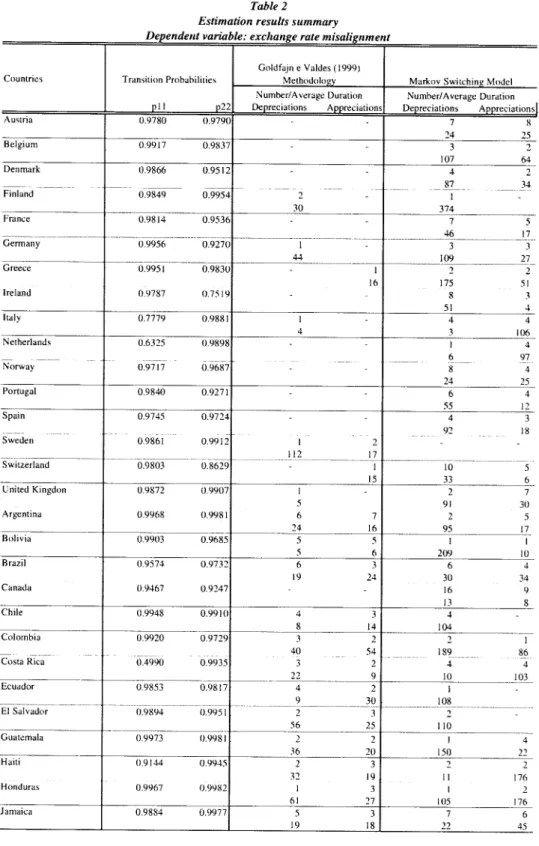
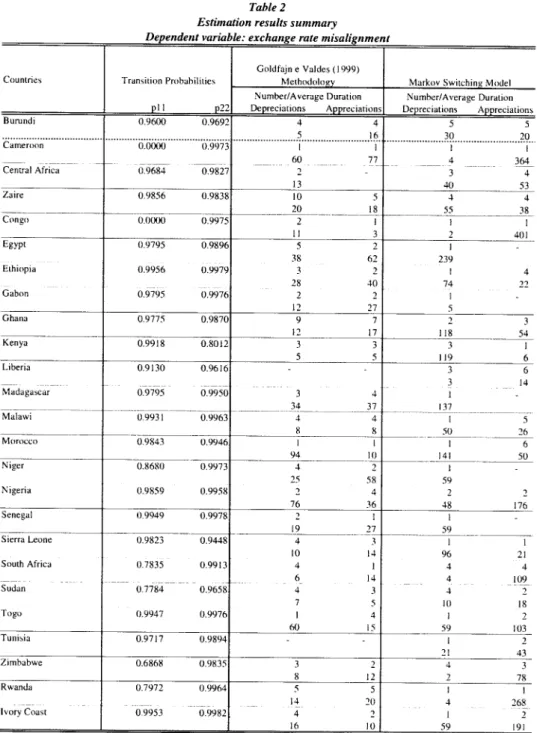
Table 2 Estimation results summary

Referências

Documentos relacionados

We find that the Hamilton’s Markov switching model and Lam’s model both following an AR(2) process (MS-AR(2) and MSG-AR(2)) present the best fit to the Brazilian business cycle

Colaboram também para esse ciclo os processos de gramaticalização, tendo em vista o fato de itens, de variadas classes gramaticais, adquirirem conteúdo negativo de forma gradual

One of the ways to tackle autocorrelated data is the concept of stochastic modeling of time series using autoregressive integrated moving average models, the ARIMA model.. The concept

We show that the disruption of the oocyte epigenome, mainly through increased levels of histone H3 lysine 4 trimethylation (H3K4me3), a euchromatic mark associated with

A Fiat vai lançar no mercado um novo modelo automóvel, o Punto EVO. Este modelo vai desempenhar um papel muito importante no desempenho da marca no nosso país, pois actua no

A RSE não deve ser entendida pelas empresas como algo que estas fazem para além das suas actividades normais, mas sim como uma forma de gestão, isto é, preocupações de âmbito

A.. parte dos trabalhos acadêmicos realizados no âmbito da Geografia, informações totalizantes so- bre a realidade, na maior parte das vezes, estão fora do alcance do pesquisador,

We retain the Markov property of the typical Bayesian spatial models: given the neighborhood graph, disease rates follow a conditional autoregressive model.. However, the