______________________________
Corresponding author: Milica Fotiri , Faculty of Agriculture, Nemanjina 6, 11080 Belgrade-Zemun, Serbia, tel: +381 11 2615315/457 e-mail: [email protected]
UDC 575:634.747
Original scientific paper
SELECTION OF BLACK ELDERBERRY (Sambucus nigra L.) AND
EVALUATION OF ITS FRUITS USABILITY AS BIOLOGICALLY VALUABLE FOOD
Evica MRATINI and Milica FOTIRI
Faculty of Agriculture, Belgrade, Serbia
Mratini E. and M. Fotiri (2007): Selection of black elderberry (Sambucus nigra L.) and evaluation of its fruits usability as biologically valuable food . – Genetika, Vol. 39, No. 3, 305-314.
agents and pests, as well as adaptability to adverse conditions are a recommendation for organic-based production.
Key words: black elderberry, berry, flowering period, inflorescence, fruit quality selection, ripening
INTRODUCTION
Quality human diet is impossible to imagine without fruits and fruit products.
However, in fruit production, in intensifying it, the problem of cultivar susceptibility to disease agents and pests is becoming increasingly important. This is the reason why fruit growing presupposes the application of high amounts of chemical substances (pesticides, fungicides, etc.), which diminishes fruit biological value.
Hence, domestication or introduction into culture of wild fruit crops can be considered one of the methods for improving fruits as food.
Black elderberry (Sambucus nigra L.) belongs to the species of the genus Sambucus, which grows in Serbia and Montenegro. It is a fruit crop of high quality fruit whose diverse cultivars are already grown on plantations in highly developed countries (USA, Switzerland, Denmark, Austria, etc.) (MÜLLER, 1976; STRAUSS &
NOVAK, 1971; BROOKS, 1998). In Denmark its yield levels can be as high as 50
t/ha (McKAY, 2001).
Since black elderberry is encountered only in natural populations of Serbia and Montenegro, the aim of the present work was to select this fruit species, so as to grow and utilize its fruits as biologically valuable food. The isolated selections could be used (together with others) as bio-ameliorative species for bare soil forestation.
MATERIAL AND METHOD
Selection of black elderberry from spontaneous population was conducted in the period 1991-1993 at three locations: Belgrade – in Batajnica, Grocka – in Vin a, and sub-Kopaonik – in the villages of Velika Grabovica and Kriva Reka. The locations chosen differ in ecological and orographic characteristics.
In the present paper the selection criteria used were as follows: uniformity of flowering, simultaneous ripening of berries in inflorescence, inflorescence and berry size, high yield level and resistance to disease agents and pests. According to determined criteria, individual positive selection was conducted by isolating and marking the genotypes.
Five genotypes were isolated and thereafter analyzed using standard methods:
• Physiological characteristics (period of fruit flowering and ripening) by
registering the date of flowering initiation and termination, i.e. mean date of fruit ripeness.
• Physical characteristics of inflorescence and berry – by measuring length
and weight in average sample comprising 30 inflorescences and 100 berries.
• Fruit chemical properties were determined on an average sample at the
stage of full ripeness: 1. dry matter - by refractometer; 2. sugars – Bertrand method;
3. total acids – by titrimetric method, calculations being done for malic acid content;
4. juice pH value – by pH-meter
5. total mineral matter – by roasting in a roasting furnace at 5500C; 6. vitamin C – by iodine method;
7. total colored matter – by measuring absorption on Beckman spectrophotometer.
Variability components for inflorescence characteristics were determined by monofactorial variance analysis (JOVANOVI et al., 1992). Coefficients of genetic and phenotypic variation (CVg and CVf), as relative indicators of those
characteristics variability, were found using method of SINGH and CHOUDHARY
(1976). Coefficient of heritability in a broader sense (h2) was calculated according to BOROJEVI (1992) method as the ratio of genetic to phenotypic variance. Values
of variability components and coefficient of heritability are expressed in percent.
RESULTS AND DISCUSSION
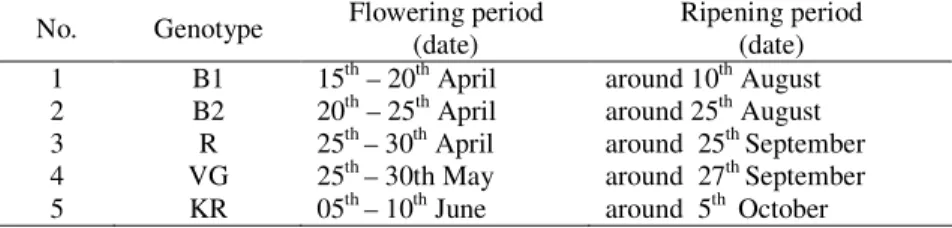
Black elderberry flowers after leafing. Of the isolated genotypes, the earliest flowering was recorded in genotypes from Batajnica – B1 and B2 and the latest in the genotype from Kriva Reka – RK (Tab. 1).
The analysis of the table indicates that there is a positive interdependence between flowering period and location altitude as well as a very short flowering period of all isolated genotypes, which complies with the results of MÜLLER
Table 1. Average flowering and ripening period of isolated black elderberry (Sambucus nigra L.) genotypes
Positive interdependence is also noticeable between ripening and flowering period. The earliest ripening was observed in genotypes B1 and B2 (Aug. 10 and 25) and the latest in genotypes from Kriva Reka (around Oct. 5).
Tab. 2 shows physical characteristics of inflorescences and berries. The data given are average values for the sample of 30 inflorescences, measurements being done during fruit ripening period.
The analysis of the table evidences that the largest inflorescences were exhibited by genotype R (14.32 cm average width and 15.88 cm height). The lowest inflorescence width was demonstrated by genotype KR (10.67 cm), while genotype B2 had the lowest inflorescence height (7.28 cm). The data are in agreement with those reported by GRLI (1989) for the region of Croatia, but they approximate the lower limit of inflorescence size variation, as reported by HEGI (1961).
In studied genotypes the length of inflorescence stem ranged from 5.14 cm (genotype B1) to 7.71 cm (genotype VR), and the number of primary stalks from 4.20 cm (genotype B1) to 5.28 cm (genotypes VG and KR).
The number of berries per inflorescence is noticed to vary a lot per studied genotype -from 131 in genotype KR to 280 in genotype VG. In wild black elderberry, studied in Poland, the number of berries per inflorescence ranged from 100-220, whereas cultivars had between 143 and 380 berries per inflorescence (WA BI SKA & PUCZEL,2002).
In genotype VG average berry weight is also very pronounced (0.21 g), while in all other studied genotypes it falls within the limits average for non-selected elderberry (JANDA, 1980). JOHNSON et al. (1985) reported that average fruit weight in wild elderberry was 0.0784 g. WA BI SKA &PUCZEL (2002) found that berry weight in wild elderberry ranged from 0.132 – 0.190 g, and in grown cultivars from 0.176 – 0.33 g. ATKINSON &ATKINSON (2002) reported that berry weight of black elderberry picked from 20 locations in Great Britain amounted to 0.118 g.
No. Genotype Flowering period (date) Ripening period (date)
Table 2. Inflorescence and berry characteristics of isolated black elderberry (Sambucus nigra L.) genotypes
Analysis of variance and individual LSD-tests evidenced very significant differences in inflorescence characteristics between studied genotypes (Tab. 2). Since phenotypic value of a certain characteristic is a sum of genetic effects and those of the environment, it is important to know which part of phenotypic values is conditioned by hereditary basis and which one by environmental conditions. Comparisons of all studied inflorescence characteristics (Tab. 3) showed that inflorescence height had the highest coefficient of both genetic and phenotypic variation (CVg=34.27%; CVf=34.32%), however, the lowest number of primary stalks in inflorescence (CVg=1.75%; CVf=1.96%).
Table 3. Coefficients of genetic (CVg), phenotypic variation (CVf) and coefficients of
heritability in a broader sense (h2) for inflorescence characteristics in isolated
black elderberry (Sambucus nigra L.) genotypes
No. Property
Clone
Inflores width (cm)
Inflores height (cm)
Length of infloresc stem (cm)
Number of primary stalks
Number of berries per inflorescence
Berry weight (g)
1 B1 12.53 8.01 5.14 4.20 242 0.15
2 B2 11.44 7.28 5.33 4.88 210 0.17
3 R 14.32 15.88 6.46 5.04 146 0.13
4 VG 12.50 15.26 7.71 5.28 280 0.21
5 KR 10.67 14.47 5.56 5.28 131 0.15
LSD 0,05 0.933 0.481 0.236 0.251 33.50 0,01 1.368 0.704 0.346 0.367 49.10
Property CVg
(%)
CVf (%)
h2 (%)
Length of infloresc. stem (cm) 17,53 17,88 95,98
Infloresc. height (cm) 34,27 34,32 98,73
Infloresc. width (cm) 2,15 2,18 97,38
Number of primary stalks 1,75 1,96 79,99
In studied inflorescence characteristics the values for coefficient of heritability are markedly high. The highest value was found for the number of berries in inflorescence (98.99%) and the lowest for the number of primary stalks in inflorescence (79.99%). Such values of coefficients of heritability for inflorescence characteristics evidence small effects of the environment on manifesting those characteristics. In addition, they indicate that it is possible to improve those characteristics by selection and employ studied genotypes in future breeding activities.
Of chemical properties, studies were conducted on the most important parameters which determine fruit quality – contents of dry matter, sugars, total acids, pH value, total mineral matter content, vitamin C and total colored matter (Tab. 4).
Dry matter content varied between 14.80% (in genotype B2) and 17.19% (in genotype VG). Comparisons of those data with the ones in literature indicate that dry matter content in genotypes B1, B2 and KR falls within the limits average for non-selected elderberry (MRATINI & KOJI , 1998), however, dry matter content in genotypes R and VG is slightly higher than mentioned.
Table 4. Fruit chemical properties of isolated black elderberry (Sambucus nigra L.) genotypes
On the other hand, total sugars content ranging from 8.90% (genotype B1) to 11.50% (genotype GV) is higher only in genotypes R and VG than average for non-selected elderberry.
Organic acids content is fairly uniform and ranges from 1.03% (genotype R) to 1.15% (genotype B1). Those results are in agreement with the ones reported by MÜLLER (1976) and are at the average level for non-selected elderberry, as pointed out by MRATINI &KOJI (1998).
Like acids content, pH value is very uniform and varies from 4.00 (in genotypes B1 and KR) to 4.10 (in genotypes B2, R and VG). The data obtained for this parameter are slightly higher than those reported by MÜLLER (1976) for black
elderberry cultivar Don, where pH value is 3.80.
Black elderberry fruit is very rich in total mineral matter, which is confirmed by the results obtained for the studied genotypes. Mineral matter content varies slightly depending on the genotype – from 0.90% (in genotypes B1
No. Property
Clone Dry matter (%) Total sugar content (%) Invert sugar content (%) Organic acids content (%) pH value Mineral matter content (%) Vitamin C content (mg%) Total colored matter content (g/l)
1 B1 15.20 8.90 6.20 1.15 4.00 0.90 20.00 1.39
2 B2 14.80 9.20 5.70 1.00 4.10 0.98 23.00 1.67
3 R 16.75 11.20 5.60 1.03 4.10 0.91 27.00 1.41
4 VG 17.19 11.50 6.78 1.04 4.10 0.99 35.00 2.58
and KR) to 0.99% (in genotype VG) and complies with the reports of a majority of authors (GRLI ,1989;MÜLLER,1976;MRATINI &KOJI , 1998 and others).
Vitamin C content, a very important biological value parameter of elderberry fruit quality, ranges from 13.00 mg% (genotype B2) to 35.00 mg% (genotype VG). Comparisons between data indicate positive interdependence of this parameter and altitude of location where genotypes come from. Our data coincide with reports of KAACK &AUSTED (1998) who found that average vitamin
C content in 13 studied cultivars was from 6-25 mg%.
Comparisons of our results with those from literature allow us to conclude that in all isolated elderberry cultivars this parameter is either higher (BUKVI , 1995) or at the level average for non-selected elderberry (MRATINI & KOJI ,1998).
Total colored matter content varied between 1.39 g/l (genotype B1) and 2.58 g/l (genotype VG). It can be stated that in all studied genotypes this content is markedly high, because compared to the most colored fruit of small fruits – blackberry – it is higher several times (ANDROS, 1941). According to NAKAJAMA
et al. (2004), there are four types of anthocyanins in elderberry and their concentration amounts to 635-1969 mg% (ATKINSON & ATKINSON, 2002). The
USDA report (2003) indicated that in raw elderberry fruit anthocyanidin content ranged from 379.15 to 1067.33 mg%, while flavonol content was between 29 and 60 mg%.
Lastly, considering all analyzed chemical parameters of elderberry fruit quality, it can be concluded that black elderberry fruit falls into the category of biologically high-quality fruits (BULATOVI &NIKETI , 1974), therefore it could be processed into various products, such as preserves, stewed fruit, syrups, juices, jams etc.
This statement and the fact that isolated genotypes are high-yielding, extremely resistant to disease agents and pests, but of modest demands for cultural practices, all this recommend them for organic-based production.
CONCLUSION
The analysis of biological-technological characteristics of 5 selected black elderberry (Sambucus nigra L.) genotypes leads to the conclusions as follows:
1. Flowering proceeded in the period from mid-April (genotype B1) to the 1st decade of June (genotype KR).
2. Fruit ripening lasted from the 1st decade of August (genotype B1) to the 1st decade of October (Genotype KG).
3. Positive interdependence was perceived between fruit flowering and ripening period.
4. Genotype R demonstrated the largest inflorescences whose average breadth was 14.32 cm and average height 15.88 cm.
6. Analysis of variance and individual LSD-tests indicated very significant differences in inflorescence characteristics between studied genotypes. 7. The highest coefficients of genetic and phenotypic variation
(CVg=34.27%; CVf=34.32%) were found for the characteristic of inflorescence height, while the highest value of coefficient of heritability was for the number of berries in inflorescence (98.99%).
8. All isolated genotypes demonstrated biologically high quality fruit, so they can be used for various forms of processing.
9. Genotype VG demonstrated best quality fruit for all analyzed chemical parameters (17.19% dry matter, 11.50% total sugars, 10.4% organic acids, 0.99% total mineral matter, 35 mg% vitamin C, and 2.58 g/l total colored matter).
10. All isolated genotypes can be recommended for growing in organic-based production, because they are yielding, resistant to disease agents and pests and of very modest cultural practices requirements.
Received February 9th
2007 Accepted August17th
, 2007
REFERENCES
ANDROS,M. (1941): Vitamin C content of wild fruit product. Analyst 66,.358-362
ATKINSON,D.M.andE.ATKINSON (2002): Sambucus nigra L. Journal of Ecology 90, 895–923. BOROJEVI ,S. (1992): Principi i metode oplemenjivanja bilja. Nau na knjiga, Beograd.
BUKVI , BRANKA (1995): Ispitivanje hemijskog sastava plodova nekih vrsta samoniklog vo a i mogu nost njihove prerade, 1-20 deo projekta Mogu nost koriš enja samonikolog vo a na podru ju Majdanpeka. Poljoprivredni fakultet Beograd.
BULATOVI ,S. and GORDANA NIKETI (1965): Prilog razradi metode za ocenjivanje proizvodno - tehnološke vrednosti sorte vo a, Arhiv za poljoprivredne nauke, sv.60.130-180.
GRLI ,LJ. (1989): Samoniklo jestivo bilje, Nakledni zavod Hrvatske, Zagreb. HEGI, G. (1961): Illustrieste Flors von Mittel-Europa, Lehman, Munchen.
JANDA,LJ. et al. (1980): Neke karakteristike cvasti i ploda zove (Sambucus nigra L.) u zapadnoj Srbiji, Jugoslovensko vo arstvo 14, 53-54, 275-279.
JOHNSON,R.A.,M.F.WILLSON,J.N.THOMPSON andR.I.BERTIN. (1985): Nutritional values of wild fruits and consumption by migrant frugivorous birds. Ecology 66: 819-827.
JOVANOVI ,B., PRODANOVI, S. and MALETI ,R. (1992): Estimates of enviromental effects in comparative veriaety trials. Review of Research Work at the Faculty of Agriculture 37 :167-172.
KAACK K.andAUSTED T. (1998): Interaction of vitamin C and flavonoids in elderberry (Sambucus nigra L.) during juice processing. Plant Foods Hum Nutr.52(3):187–198.
MRATINI ,EVICA and KOJI ,M. (1998): Samonikle vo ne vrste Serbije, Institut za istraživanja u poljoprivredi “Srbije” 510-513.
MÜLLER, W. (1976): Schwarzer Holunder als Internsivkultur, Obst und Weinbau, N0 2,17-27.
MÜLLER,W. undJ.MEYER (1976): Vermehrung von Schwarzem Holunder, Obst und Weinbau, N0
3, 128-132.
NAKAJIMA,J.,I.TANAKA,S.,SEO,M.YAMAZAKI andK. SAITO (2004): C/PDA/ESI-MS Profiling and Radical Scavenging Activity of Anthocyanins in Various Berries. Journal of Biomedicine and Biotechnology 5, 241–247.
NIKETI ,G,G.HRAZDINA (1972): Quantitative analyses of the anthocyanin, content in grape juices and wines, L'ebensm, -Wiss. Technology, vol. 5, 5.
SINGH R.K. and B.D. CHOUDHARY. (1976): Biometrical techniques in genetics and breeding. International Bioscience Publishers, Hissar (India).
STRAUSS,E. undR.NOVAK, (1971): Anbauver-suche mit Holunder (Sambucus nigra). Mitteil-lungen Klosterneuburg XXI 5, 415-426.
USDA Database for the Flavonoid Content of Selected Foods. (2003): Beltsville Human Nutrition, Baltimore, MD, USA.
SELEKCIJA CRNE ZOVE (SAMBUCUS NIGRA L.) I OCENA UPOTREBLJIVOSTI PLODOVA KAO BIOLOŠKI VREDNE HRANE
Evica MRATINI iMilicaFOTIRI
Poljoprivredni fakultet, Beograd, Srbija
I z v o d
Selekijom crne zove (Sambucus nigra L.) iz prirodnih populacija izdvojeno je 5 genotipova (B1, B2, R, VG i RK), u cilju njihve domestifikacije. Kod izdvojenih genotipova prou ene su najvažnije biološko-tehnološke osobine i vreme cvetanja zrenja ploda. Cvetanje se odvijalo u periodu polovine aprila-I dekade juna, a zrenje od I dekade avgusta do I dekade oktobra. Najkrupnije cvasti na ene na ene su kod genotipa R (sa pre nikom od 14,32cm). Najviše bobica po cvasti (prose no 280), najkrupnija bobica (prose no 0,21g) i najbolji kvalitet ploda (sa 17,19% suve materije 11,5% še era, 35mg vitamina c i 2,58 g/l ukupnih bojenih materija) ispoljio je genotip VG. Kod svih izdvojenih genotipova plod je ispoljio biološki visok kvalitet, što ga preporu uje kao dobru sirovinu za razli ite vidove prerade. Njihova dobra rodnost, izražena otpornost prema prouzrokova u bolesti i šteto ina, kao i adaptivnost na lošije uslove, preporu uje ih za gajenje po principu organske proizvodnje.