Sala¨un, Fu, and Hall´e (Eds.): Fourth International Workshop on Testing, Analysis and Verification of Web Software EPTCS 35, 2010, pp. 39–50, doi:10.4204/EPTCS.35.4
c X. Fu
This work is licensed under the Creative Commons Attribution License.
for Web Applications
Xiang Fu Hofstra University Hempstead, NY 11549 [email protected]
This paper proposes a relational constraint driven technique that synthesizes test cases automatically for web applications. Using a static analysis, servlets can be modeled as relational transducers, which manipulate backend databases. We present a synthesis algorithm that generates a sequence of HTTP requests for simulating a user session. The algorithm relies on backward symbolic image computation for reaching a certain database state, given a code coverage objective. With a slight adaptation, the technique can be used for discovering workflow attacks on web applications.
1
Introduction
Modern web applications usually rely on backend database systems for storing important system infor-mation or supporting business decisions. The complexity of database queries, however, often complicates the task of thoroughly testing a web application. To manually design test cases involves labor intensive initialization of database systems, even with the help of unit testing tools such as SQLUnit [25] and DBUnit [8]. It is desirable to automatically synthesize test cases for web applications.
There has been a strong interest recently in testing database driven applications and database man-agement systems (see e.g., [12, 4, 20]). Many of them are query aware, i.e., given a SQL query, an initial database (DB) instance is generated to make that query satisfiable. The DB instance is fed to the target web application as input, so that a certain code coverage goal is achieved. The problem we are trying to tackle is one step further – it is a synthesis problem: given a certain database state (or a relational constraint), acall sequenceof web servlets is synthesized to reach the given DB state. This is motivated by the special architecture of web applications. Unlike typical desktop software systems, the atomic components of a web application, i.e.,web servlets, are accessible to end users. In addition, cookies and session variables are frequently used for session maintenance and user tracing. Thus web application testing is usually session oriented (see, e.g., [22, 11]). Unlike unit testing general database driven applications, an intermediate database state has to be resulted from a call sequence and cannot be initialized at will. We are interested in synthesizing such a call sequence. The technique could also be leveraged to detect workflow attacks [3, 7], where an “unexpected” call sequence can cause harm to the business logic of a web application (e.g., shipping a product without charging credit card).
could lead to the required intermediate database state. Symbolic constraint solving is currently used for performing backward/forward symbolic image computation of transducers. Best effort constraint solving (restricted to finite model and finite scope), based on Alloy Analyzer [17], is used to generate parameters of each HTTP request in the call sequence.
Although there does not exist an implementation for the proposed technique, we plan to illustrate its effectiveness and feasibility using a case study.§2 presents a motivating example.§3 introduces the path transducer model. §4 discusses symbolic image computation of relational algebra. The call sequence algorithm is presented in§5. §6 adapts the algorithm for discovering workflow attacks. §7 discusses related work and concludes.
2
Motivating Example
This section introducesSimpleScarf, a case study example used throughout the paper.SimpleScarfis adapted from the Scarf conference management system [26]. It is comprised of five servlets for managing the membership of a conference. Each servlet is implemented as a PHP file that accepts HTML requests and generates HTML responses.
These servlets are briefly described as follows. Later we will present the formal relational trans-ducer model for each of them. (1)Showsessions.phpdisplays the list of paper sessions that are as-sociated with the current user. (2) Insertsession.phpadds a new paper session to the system. (3)
Addmember.phpinserts a new member into a paper session. (4)Generaloptions.phpcreates a new user of the system. (5)Login.phpauthenticates the log-in process. Once a user successfully logs in, the servlet sets a session variable called “user” for tracking the user session.
There is a backend database with three relations: (1) Users(uname,enc wd)contains information about a user: the user name and the encrypted password; (2)Sessions(sid,sname)has two attributes: the paper session id and session name; and (3) Member(sid,uname) describes the members of a pa-per session. To simplify the scenario, the data type of each column isvarchar. For relation Member, there are two foreign key dependency constraints: (1) sid on Sessions, and (2) uname on Users. Throughout the paper, each relation or servlet is denoted using the first character of its name, e.g.,
Showsessions.phpdenoted bySandUsersdenoted byU.
As an example, Listing 1 presents a fragment ofShowsessions.php. The servlet consists of two parts: (1) a branch statement which examines a user’s login status, by checking the value of session variable “uname”; and (2) a loop that reads the information retrieved by aSELECTstatement to generate a list of paper sessions related to the user.
Coverage Goal: line 45 in Listing 1. We are interested in two questions: (1) what is the database state or relational constraint that leads the execution of Showsessions.phpto line 45? (2) what is the call sequence that generates the desired database state? Later, we will show that an algorithm can automatically synthesize a call sequenceIGALSand the HTML parameters in each HTTP request.
3
Path Transducer Model
1<? php
2 i n c l u d e o n c e ( ” h e a d e r . php ” ) ;
3 p r i n t ”<d i v s t y l e = ’ f l o a t : r i g h t ’>” ; 4 i f ( !i s s e t( $ SESSION [ ’ uname ’ ] ) )
5 p r i n t ”<a . . .>Not l o g g e d i n</a><br> ” ; 6 e l s e
7 p r i n t ” Logged i n a s ” $ SESSION [ ’ uname ’ ] . . 8 p r i n t ”</ d i v><br>” ;
12 $ r e s u l t = q u e r y ( ”SELECT s e s s i o n i d . . . ” ) ; 13 i f (mysql num rows( $ r e s u l t ) == 0 ) {
14 p r i n t ( ” S o r r y , . . . ” ) 15 }
16 $ c u r d a y = −1;
44 w h i l e ( $row = m y s q l f e t c h a r r a y ( $ r e s u l t ) ) {
45 $day = d a t e( ” F j ” , $row [ ’ s t a r t t i m e ’ ] ) ; . . .
90}
Listing 1: Fragment of Showsessions.php
along the execution path. Note that each servlet may have an infinite set of such transducers. During a static analysis, we can bound loop iterations and recursive call depth for achieving a finite set.
Because each transducer only models one path, it is essentially a transition rule that is expressed as a Boolean combination of relational expressions. The first order relational logic [1] is suitable for expressing uninterpreted functions and next state variables and relations. Here a primed variable (i.e., with a single quote) represents the value of the variable in the next state. Input parameters are preceded with a dollar sign, e.g., $u,$p,$srepresent the input parametersuname,password,session namein a HTTP request. Session variables are denoted using #, e.g., #urepresents the session variableuname. If in a transition rule, a session variable or relation does not have the primed form, then its value remains the same after the execution of the transition. Relations are generally represented as sets of tuples.
Definition 3.1 A path transducer is a tuple(D,Dom,~V,~A) whereD is the data schema (a finite set of
relation schema), Domis an infinite but countable domain for D,~V is a finite set of session variables
(letting~V′be the set of primed variables), and~Ais a Boolean combination of terms. Each term has one of the following forms:
1. (equality) u=E(~v,Dom), whereu∈~V∪~V′andEis an expression on the current state of variables and constants fromDom.
2. (satisfiability check)SAT(Ψ)whereΨis a relational algebra formula onD.
Notice that in the equality form, a primed variable (next state) is allowed to appear on the LHS (left hand side) only. The syntax (expressiveness) ofE is affected by the decision procedure used in analysis. Currently, we allow Presburger arithmetic [19] and Simple Linear String Equation [13]. Unin-terpreted functions are allowed with first order relational logic onD, but not with Presburger arithmetic.
A relational constraint is defined similarly as a transducer. It is a Boolean combination of equality and satisfiability terms, except that no primed variable occurs. It is formally defined as below.
Definition 3.2 Let A be the set of relational algebra formulae over D. Let ϕ1,ϕ2 ∈A then all of
the following also belong toA: (1) (selection) σi=xϕ1 wherei∈N and x∈~V∪Dom; (2) (projection)
πi1,i2,...,ikϕ1wherei1,i2, ...,ik ∈N; (3) (cross-product)ϕ1×ϕ2; (4) (union) ϕ1∪ϕ2; and (5) (difference)
Var Type Meaning Var Type Meaning
#u Session Var User Name $sI HTTP Param session name for Insertsessions.php
$sA HTTP Param session name for Addmember.php $uA HTTP Param user name for Addmember.php
$pG HTTP Param password for Generaloptions.php $uG HTTP Param uname for Generaloptions.php
$pL HTTP Param password for Login.php $uL HTTP Param uname for Login.php
f HTTP Param encryption function r HTTP Param password safety constraint U Relation Users S Relation Sessions
M Relation Members
Figure 1: Table of Notations
We now list one sample path transducer for each of the five servlets. We first describe the function of a servlet and then formally define it as a transition rule. Figure 1 summarizes the semantics of all notations to be used in the formulae.
Showsessions.php: The servlet first checks the existence of a session variable “uname” (represented by #u), and then verifies if there is at least one session of which #uis a member. If the condition evaluates totrue, the servlet executes a loop that displays the session name by retrieving information from table
Sessions(S). Because the loop does not have any side effects (e.g., updating databases), the operations onSare not included in the path condition during symbolic execution. The following constraint is used to represent the transducer.
#u6=null ∧ SAT(σ2=#uM) (1)
HereSAT tests if the input (a relational algebra formula) is satisfiable. For convenience, we omitted the formula #u′ =#u ∧ S′=S ∧ M′=M ∧ U′=U (i.e., maintaining the values of all variables and relations), but it needs to be encoded in implementation.
Insertsessions.php: The servlet inserts a new session record into relation S. It accepts one input parameter $sI (the session name). The primary keysid is automatically incremented by the system.
The action is modeled using the standard set union operator. It is also an example of integer constraints involved in the application.
S′=S∪ {(|S|+1,$sI)} (2)
Addmember.php: The servlet takes two parameters: user name ($uA) and session name ($sA). Then it
looks up for the corresponding session id, and then inserts a tuple into relationM(Membership). Here we assume that the prime key constraint is valid (every record inShas a distinctsid). So at any time, at most one new record is inserted intoM.
M′=M∪π1(σ2=$sA(S))× {($uA)} (3)
Generaloptions.php: The transducer adds a user to the system. It takes two parameters: user name ($uG) and password ($pG). f is an uninterpreted function that represents the encryption procedure. All
uninterpreted functions are assumed to be deterministic.
U′=U∪ {($uG,f($pG))} ∧ r($pG) (4)
can define it asr(x) =x.contains(“#”) ∧ |x|>7. The solution of string constraints can be handled by string analysis (see e.g., [13]).
Login.php: The servlet takes two parameters: uname ($uL) and password ($pL), and then verifies their
existence in the database. It updates the session variable #uwith the value of $uL, so that the user session
can now be traced by #u. The servlet assumes that #uis not set before the login activity. Also note that ($uL,f($pL))∈U is a syntactic sugar forSAT(σ1=$uLσ2=f($pL)(U)).
($uL,f($pL))∈U ∧ #u′=$uL ∧ #u=null (5)
3.1 Discussions
We outline the idea of extracting path transducer models, though an implementation does not exist yet. Symbolic execution [21] is the major technical approach, and Halfond’s recent work [16] in interface extraction can be leveraged. A servlet is treated as a program, which takes global input (the GET and POST variables). These global variables are replaced by symbolic literals. When an assignment occurs, the variable on LHS (left hand side) is associated with a symbolic expression. Then, at a branch deci-sion, the jump to one of the branches is made randomly (so that it guarantees that each branch will be covered). When entering a branch, the corresponding condition is joined with the currentpath condition. Clearly, the path condition records the conjunction of all conditions that the initial input has to meet to reach the current execution location. Some known system calls (e.g., those to backend databases) are intercepted and replaced with the corresponding symbolic expression. Others (unhandled) are abstracted as uninterpreted functions. Eventually when the symbolic execution completes, the path transducer is the conjunction of three components: (1) the path condition, (2) assignments that change values of global session variables, and (3) operations that update the contents of database relations. String analysis plays an important role in deciding the precision of the translation from symbolic string expressions to rela-tional algebra formulae. Given a string expression (consisting of constant words and string variables) that represents a SQL query, populating the string variables with “benign” values generates a real SQL query which can be parsed to a SQL syntax tree and then be translated into relational algebra formulae (with variables reloaded). Note that here we ignore SQL injection attacks.
4
Relational Constraint
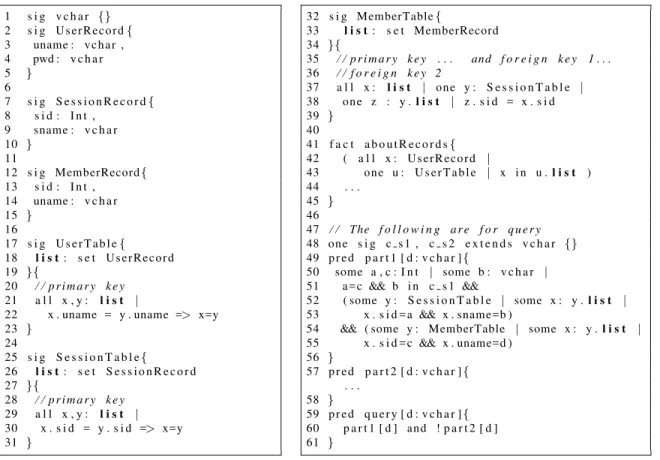
This section introduces the preliminary results about relational constraints. Inspired by the work on testing DBMS by Khurshid et al. [20], we translate a relational algebra formula to a relational logic formula and then use Alloy Analyzer [17] to find a model in a finite scope. Our initial experiments show that primary and foreign key constraints can be conveniently modeled. Within a small scope, Alloy can quickly find solutions that satisfy a relational constraint.
LetD,~V,Domrepresent the data schema, set of session variables, and the data domain, respectively.
Given a transducerT = (D,Dom,~V,~A), we say a state ofT is a database instance ofD and a valuation
of all variables in~V. Given two states sand s′, we writes′∈T(s) ifs′ is the result of applying all the assignments ofT ons, i.e.,T(s,s′) evaluates to true. Note that there might be multiple states resulting from the same transition and input state. Ifs′ is the only such post-state, we writes′=T(s). We now define the notion of symbolic image computation.
Definition 4.1 LetT = (D,Dom,~V,~A) be a path transducer andI is a relational constraint overD and
~
Post(T,I) ={s′ |s′ ∈T(s) ∧ s∈I}. WhenI istrue, we simply writePre(T,I)and Post(T,I) as
Pre(T)andPost(T), respectively.
The complexity of generating a relational constraint that representsPre(T,S)is in polynomial time. This can be easily inferred from the fact that a transducerT is a collection of assignments on relations and variables. Simply replace all primed variable and relation by its RHS. Note that we do not have a similar result for post-image. We now proceed to a finite scope solution for the satisfiability problem. We illustrate the idea using an example.
1 s i g v c h a r {}
2 s i g U s e r R e c o r d{
3 uname : v c h a r , 4 pwd : v c h a r 5 }
6
7 s i g S e s s i o n R e c o r d{
8 s i d : I n t , 9 sname : v c h a r 10 }
11
12 s i g MemberRecord{
13 s i d : I n t , 14 uname : v c h a r 15 }
16
17 s i g U s e r T a b l e{
18 l i s t: s e t U s e r R e c o r d 19 }{
20 / / p r i m a r y k e y
21 a l l x , y : l i s t |
22 x . uname = y . uname => x=y 23 }
24
25 s i g S e s s i o n T a b l e{
26 l i s t: s e t S e s s i o n R e c o r d 27 }{
28 / / p r i m a r y k e y
29 a l l x , y : l i s t |
30 x . s i d = y . s i d => x=y 31 }
32 s i g MemberTable{
33 l i s t: s e t MemberRecord 34 }{
35 / / p r i m a r y k e y . . . and f o r e i g n k e y 1 . . .
36 / / f o r e i g n k e y 2
37 a l l x : l i s t | one y : S e s s i o n T a b l e |
38 one z : y .l i s t | z . s i d = x . s i d 39 }
40
41 f a c t a b o u t R e c o r d s{
42 ( a l l x : U s e r R e c o r d |
43 one u : U s e r T a b l e | x i n u .l i s t ) 44 . . .
45 }
46
47 / / The f o l l o w i n g a r e f o r q u e r y
48 one s i g c s 1 , c s 2 e x t e n d s v c h a r {}
49 p r e d p a r t 1 [ d : v c h a r ]{
50 some a , c : I n t | some b : v c h a r |
51 a = c && b i n c s 1 &&
52 ( some y : S e s s i o n T a b l e | some x : y .l i s t |
53 x . s i d = a && x . sname =b )
54 && ( some y : MemberTable | some x : y .l i s t |
55 x . s i d = c && x . uname=d ) 56 }
57 p r e d p a r t 2 [ d : v c h a r ]{
. . . 58 }
59 p r e d q u e r y [ d : v c h a r ]{
60 p a r t 1 [ d ] and ! p a r t 2 [ d ] 61 }
Figure 2: Sample ALLOY Specification
Example 4.2 Assume that we are interested in performing the following query: list all users who are members of session “s1” but not of session “s2”. This query can be expressed using the following relational algebra formula:
π4(σ2=′s1′σ1=3(S×M))−π4(σ2=′s2′σ1=3(S×M))
The second part of the Alloy specification encodes the query. It essentially follows the idea of converting a relational algebra to a first order logic query. The predicate queryencodes the desired difference operation. By running the query for exactly 1 instance of each data relation and 3 instances of data records for each relation, a database instance is generated in 78ms to satisfy the query, on a laptop PC with 4GM memory and 3GHz CPU. It is shown as below:
1. SessionTable: {(vchar3,c s1)} 2. MemberTable: {(vchar3,vchar2)} 3. UserTable: {(vchar2,vchar3)}
Here all foreign key constraints are followed, e.g., thesidcolumn (vchar3) of the only record of
MemberTableis the same as the one inSessionTable.c s1 denotes the constants1, and it is the value of thesname of theSessionRecord. For simplicity, the uninterpreted function f (encryption) is not encoded in this example. It is available in the Alloy model for Step 5 in§5.
5
Call Sequence Synthesis
This section introduces the synthesis algorithm that generates a test case composed of a sequence of HTTP requests. The purpose is to reach a certain database state for achieving coverage goals. We begin with some formal definitions needed for discussions later.
Definition 5.1 An HTTP request r is a tuple (u,~p) where uis the base URL, and ~p is a finite set of parameters. Each parameter is a tuple(n,v)wherenis the name of the parameter andvis its value.~p[n] denotes the value of parametern.
Definition 5.2 A call sequence is a finite sequence of HTTP requestsr1, ...,rn. We call the corresponding
HTTP responsess1, ...,sn. Eachsi is a string that represents the contents of the HTML file returned.
A call sequence is also written as(r1,s1),(r2,s2), ...,(rn,sn)when HTTP responses need to be considered.
We call a responsebad, if it contains error messages such asHTTP 505 internal error.
5.1 Call Sequence Synthesis Algorithm
Figure 3 presents a heuristic algorithm that synthesizes a call sequence of web servlets. Its input includes (1) initial database states specified using a relational constraintS0, (2) a finite set of transducersT, and
(3) the objective states represented using relational constraintϕ.
As shown in Figure 3, the backtracking algorithm attempts to simulate the changes of system states, using pre-image computations. HereSis a stack which stores the call sequence. Each element ofSis a tuple which records the current servlet being attempted and the corresponding system states (represented using a relational constraint). Every iteration of the backtracking loop tries to identify a new servlet which modifies the system state, geared towards the direction of initial statesS0. The current system states
(represented usingϕ) are compared withS0using function getModified. It tries to extract the set of
variables and relations whose “value domain” change between the two sets of symbolic states. The value domain of a variablevin constraintϕ1is formally defined using formulaϕ1(v) ={a|s∈ϕ1 ∧s[v] =a}.
Heres[v]is the value of variablevin states. Clearlyϕ1(v)can be computed using existential elimination
of all other variables/relations in the formula ofϕ1. If a finite scope is given, this can be achieved using
first order relational logic in Alloy [17]. Once the “difference” of the two symbolic constraintsϕ1andϕ2
is identified and pushed to stackS. If none is found, the search process backtracks. It proceeds until the initial state constraintS0has some intersection with the current system state; or the algorithm fails and
returns an empty stack.
We use a case study to illustrate the effectiveness of the algorithm. Applying the algorithm to real-world examples remains as our future work. The heuristics works better withINSERTstatements than
UPDATEstatements.
1 //S0: desired initial states,ϕ: desired path condition,T: a finite set of path transducers
2 Procedure CallSeqGen(T,S0,ϕ)
3 LetS= [(⊥,ϕ)]
4 //Sis a stack which stores the intended call sequence to return 5 //Each element ofSis a tuple of (action, current state) 6 while(S0 ∩ϕ= /0 and|S| ≥1){
7 Letϕ1andϕ2be the states stored in the top 2 elements ofS. If|S|=1, letϕ2betrue
8 LetM1= getModified(ϕ1,S0)
9 LetM2= getModified(ϕ2,S0)
10 Find a path transducers∈T which modifies some targetv∈M1−M2andPre(s,ϕ)6=false
11 If no servlet is available then backtrack: 12 remove the first element ofS; continue 13 ϕ:=Pre(s,ϕ);S:= (s,ϕ)◦S
14 }
15 returnS
16 //return a set of session variables and relations that are changed between the two sets of states represented byϕ1andϕ2
17 Procedure getModified(ϕ1,ϕ2)
18 LetR={}//Ris the set of variables and relations to return 19 foreachv∈V∪D: //vcould be a session variable or relation
20 Letϕ1(v) ={a|s∈ϕ1 ∧s[v] =a}//heresis a state belong toϕ1ands[v]is the value ofvins
21 Letϕ2(v) ={a|s∈ϕ2 ∧s[v] =a}
22 ifϕ1(v)−ϕ2(v)6=/0 orϕ2(v)−ϕ1(v)6=/0:R=R+{v}
23 returnR
Figure 3: Call Sequence Generation Algorithm
5.2 Case Study
The coverage goal is to reach line 45 in Listing 1. We would like to synthesize a call sequence that reaches the line. The initial stateS0is expressed using formula #u=null ∧ S=M=U =/0, i.e., the
database is empty and none of the global session variables is set. The target constraintc0is represented
by relational constraint #u6=null ∧ SAT(σ2=#uM), i.e., tableMhas one record whose second attribute
“uname” has the value #u(the user name contained in session variable #uname). This is essentially the pre-condition of a path transducer ofShowsessions.phpthat reaches line 45.
Step 1: We start with the path transducer of Showsessions.php. The first step is to compute the pre-image of the transducer.
Pre(#u6=null∧SAT(σ2=#uM)∧S′=S∧U′=U∧M′=M∧#u′=#u,true) (6)
N4: #u6=null∧SAT(σ2=#uM)
The synthesis algorithm cannot terminate here, because the goalS0 ∩ N46=/0 is not met. We need to
determine which is the action beforeShowsessions.php. The candidates areLogin.phpwhich resets #u and Addmember.php which updates M. Without loss of generality, we choose Login.phpas the preceding action ofShowsessions.php.
Step 2: The current call sequence isLS(Login.phpand thenShowsessions.php). The post condition ofLisN4. We can compute its pre-image as follows.
Pre( ($uL,f($pL))∈U∧#u=null∧#u′=$uL ∧U′=U∧S′=S∧M′=M∧
#u′6=null∧SAT(σ2=#u′M′))
Here the first row is the transition rule forLogin.php, and the second row is the primed form ofN4.
We use the one parameter version of thePrefunction here, and the post-image has to be primed. The same algorithm results in the following pre-image. Note that here $uLand $pLare the input parameters
(uname and pwd) ofLogin.php.
N3:($uL,f($pL))∈U∧#u=null∧$uL6=null∧SAT(σ2=$uLM)
Step 3: Next,Addmember.phpis identified by the heuristic algorithm as the preceding action. The pre-image is computed as below. As usual, the first row is the transition rule and the second row is the primed form ofN3. Notice that $uL is the input parameter for Login.php. It is treated as a symbolic
literal (its value cannot change during the execution). We do not have to “prime” it in the post-image.
Pre( M′=M∪(π1(σ2=$sA(S))× {($uA)})∧U
′=U ∧S′=S∧#u′=#u∧
($uL,f($pL))∈U′ ∧#u′=null∧$uL6=null∧SAT(σ2=$uLM
′))
Here $uA and $sA are the input parameters (uname and session name) of theAddmember.php. The
pre-image computation results in the following state constraint:
SAT(σ2=$uL(M∪(π1(σ2=$sA(S)))× {($uA)}))∧($uL,f($pL))∈U∧#u=null∧$uL6=null
Step 4: The pre-image computation is listed as below forGeneraloptions.php(to add a user). Here $uGand $pGare the input parameters (uname and pwd).
Pre( U′=U∪ {($uG,f($pG))} ∧r($pG)∧M′=M∧S′=S∧#u′=#u∧
SAT(σ2=$uL(M ′ ∪(π1(σ
2=$sA(S
′)))× {($u
A)})) ∧($uL,f($pL))∈U′ ∧#u′=null∧$uL6=null)
It results in the following:
SinceS0 ∩ N1=/0, The heuristic algorithm has to proceed to modify tableS.
Step 5: Using constraintN1as the post condition ofInsertsession.php, we have:
Pre( S′=S∪ {(|S|+1,$sI)} ∧M′=M∧U′=U ∧#u′=#u∧
r($pG)∧SAT(σ2=$uL(M ′ ∪(π1(σ
2=$sA(S
′)))× {($u
A)}))∧($uL,f($pL))∈U′∪ {($uG,f($pG))} ∧#u′=null∧$uL6=null)
This leads to the final constraintN0:
N0:r($pG)∧SAT(σ2=$uL(M∪(π1(σ2=$sA(S∪{(|S|+1,$sI)})))×{$uA}))∧($uL,f($pL))∈U∪{($uG,f($pG))} ∧#u=null∧$uL6=null
If we testS0 ∩ N0, the following is an assignment which provides satisfiability:
M=S=U=/0∧$uL=$uG=$uA=a∧$pG=$pL=b∧$sI=$sA=c∧#u=null
Herea,b,c are three constants generated by the model finder. The constraint r(b) can be discharged separately using a string constraint solver like [27] and [13]. When the string constraintr(b)is ignored, Alloy Analyzer is able to generate the model in 1.07 seconds and solve the model in in 57ms. In the model generated by Alloy, constantsais equal toc, and the encryption function is properly modeled in Alloy and it has the property:∀a,b: f(a) = f(b)⇔a=b.
6
Detecting Workflow Attack
This section briefly discusses the extension of the algorithm for detecting workflow attacks [3]. Since web servlets are openly accessible to end users, hackers could potentially access the web application and violate its intended “workflow” logic (e.g., shipping a product before payment is handled). Such an attack can cause great financial losses. To model the “intended” workflow of a web application, we could apply string analysis like [6] and collects the URLs that are contained in the HTML generated by a servlet. Then, a workflow attack can be defined formally.
Definition 6.1 An enhanced path transducer is a tupleT = (D,Dom,~V,~A,~L,U)whereD,Dom,~V,~Aare
as defined in Definition 3.1.~Lis a set of transducers thatT can navigate to. U is the base URL where the corresponding servlet is deployed.
Given a collection of path transducers, we use~L(U)to denote the union of the~Lcomponents of all path transducers who haveUas the base URL.
Definition 6.2 Given a web application that consists ofT, a finite set of path transducers, a workflow
attack is a call sequence(r1,s1), ...,(rn,sn)where none of the responses is bad and there existsi∈[1,n−
1]s.t.ri+1[0]6∈~L(ri[0]). Herer[0]to refer to the first element, i.e., the request URL, of a requestr.
TheCallSeqGenalgorithm in Figure 3 can be slightly modified to discover workflow attacks. The inputs to the algorithm are: (1)T, the collection of enhanced path transducers; (2)S0:∀v∈V v=null,
the initial state where all session variables arenull(database is not necessary to be empty); and (3)
trueas the desired post condition. Then at line 10 of Figure 3, append an additional condition shown as below when selectings:
|S|=2⇒s′6∈~L(s)
7
Related Work and Conclusion
This work is closely related to testing database applications, e.g., code coverage and database unit testing [9, 12, 5]. Recently, query aware database generators are reported to significantly improve the size and quality of test cases (see [20, 4]). Our work goes one more step beyond database generation – we synthesize the call sequence of web application servlets.
The general satisfiability problem for relational database is undecidable [1]. In practice, one has to adopt either approximation or solving decidable fragments. Emmi, Majumdar, and Sen generate database input for programs in [12], and a decidable fragment of SQL is handled, which does not allow join and negation. In [4], a reverse query processing technique is developed, which introduces approximation when handling negation. In [20], Khaleket al. translate SQL queries to relational logic formula, and use Alloy Analyzer [17] to perform model finding. We adopt a similar approach to that of Khalek’s.
Extracting the interface of a web servlet has been investigated by Halfond and Orso [14, 15], where static analysis is used to identify the parameters accepted by a web application. In [16], they went a step further to collect path conditions as web servlet interfaces. In this paper, the interface extraction concentrates on the manipulation of backend databases. Each web application servlet is modeled as a set of path transducers, which is inspired by the relational transducer model [2] introduced by Abiteboulet al. for modeling electronic commerce. Automated verification of relational transducers is discussed in [23, 10]. The problem is in general undecidable.
Testing web applications has its unique challenges. Due to the existence of server states, e.g., session variables and HTTP cookies, a test case of web applications usually consists of a sequence of HTTP requests. This is often called session based testing [22, 11, 24]. In the aforementioned work, HTTP sessions are either manually created or collected by parsing Apache server log. The technique presented in this paper synthesizes test cases automatically. It has the potential to improve code coverage.
We have outlined a framework for automatically generating test cases of web applications. The key idea is to first extract the interface of each web servlet as a set of single path relational transducers. Then we could solve symbolic constraints on relational databases and synthesize a call sequence of web servlets. Our future work includes the implementation of the proposed technique and investigation of more efficient constraint solving techniques.
References
[1] S. Abiteboul, R. Hull, and V. Vianu. Foundations of Databases. Addison-Wesley, 1995.
[2] S. Abiteboul, V. Vianu, B. Fordham, and Y. Yesha. Relational transducers for electronic commerce. Journal
of Computer and System Sciences, 61:236–269, 2000.
[3] Davide Balzarotti, Marco Cova, Viktoria Felmetsger, and Giovanni Vigna. Multi-module vulnerability analy-sis of web-based applications. InProceedings of the 14th ACM conference on Computer and communications
security (CCS07), pages 25–35, 2007.
[4] C. Binnig, D. Kossmann, and E. Lo. Reverse query processing. InProceedings of IEEE 23rd International
Conference on Data Engineering, pages 506–515, 2007.
[5] Nicolas Bruno and Surajit Chaudhuri. Flexible database generators. InProceedings of the 31st international
conference on Very large data bases (VLDB), pages 1097–1107, 2005.
[7] Marco Cova, Davide Balzarotti, Viktoria Felmetsger, and Giovanni Vigna. Swaddler: An approach for the anomaly-based detection of state violations in web applications. InProceedings of the 10th
Interna-tional Symposium on Recent Advances in Intrusion Detection (RAID), pages 63–86, Queensland, Australia,
September 5–7, 2007.
[8] DBUnit. http://www.dbunit.org/.
[9] Yuetang Deng, Phyllis Frankl, and David Chays. Testing database transactions with agenda. InProceedings
of the 27th international conference on Software engineering (ICSE), pages 78–87, 2005.
[10] Alin Deutsch, Liying Sui, and Victor Vianu. Specification and verification of data-driven web services. In
PODS ’04: Proceedings of the twenty-third ACM SIGMOD-SIGACT-SIGART symposium on Principles of
database systems, pages 71–82, 2004.
[11] Sebastian Elbaum, Gregg Rothermel, Srikanth Karre, and Marc Fisher II. Leveraging user-session data to support web application testing.IEEE Trans. Softw. Eng., 31(3):187–202, 2005.
[12] M. Emmi, R. Majumdar, and K. Sen. Dynamic test input generation for database applications. InProceedings
of the 2007 international symposium on Software testing and analysis (ISSTA), pages 151–162, 2007.
[13] X. Fu and C.C. Li. Modeling regular replacement for string constraint solving. InProc. of the 2nd NASA
Formal Methods Symposium, pages 67–76, 2010.
[14] W. Halfond and A. Orso. Improving Test Case Generation for Web Applications Using Automated Interface Discovery. InProceedings of the European Software Engineering Conference and ACM SIGSOFT
Sympo-sium on the Foundations of Software Engineering (ESEC/FSE 2007), Dubrovnik, Croatia, September 2007.
[15] W. Halfond and A. Orso. Automated Identification of Parameter Mismatches in Web Applications. In
Proceedings of the ACM SIGSOFT Symposium on the Foundations of Software Engineering (FSE 2008),
pages 181–191, Atlanta, Georgia, USA, November 2008.
[16] William G. J. Halfond, Saswat Anand, and Alessandro Orso. Precise interface identification to improve testing and analysis of web applications. InISSTA, pages 285–296, 2009.
[17] D. Jackson. Alloy 3 Reference Manual.http://alloy.mit.edu/reference-manual.pdf.
[18] Daniel Jackson. Automating first-order relational logic. InProceedings of the 8th ACM SIGSOFT
interna-tional symposium on Foundations of software engineering (FSE), pages 130–139, 2000.
[19] W. Kelly, V. Maslov, W. Pugh, E. Rosser, T. Shpeisman, and D. Wonnacott. The Omega library interface guide. Technical Report CS-TR-3445, Department of Computer Science, University of Maryland, College Park, March 1995.
[20] S. A. Khalek, B. Elkarablieh, Y. O. Laleye, and S. Khurshid. Query-aware test generation using a rela-tional constraint solver. InProceedings of the 2008 23rd IEEE/ACM International Conference on Automated
Software Engineering, pages 238–247, 2008.
[21] J. C. King. Symbolic execution and program testing.Communications of the ACM, 19(7):385–394, 1976. [22] Sreedevi Sampath, Valentin Mihaylov, Amie Souter, and Lori Pollock. A scalable approach to user-session
based testing of web applications through concept analysis. InProceedings of the 19th IEEE international
conference on automated software engineering, pages 132–141, 2004.
[23] Marc Spielmann. Verification of relational transducers for electronic commerce. J. Comput. Syst. Sci., 66(1):40–65, 2003.
[24] Sara Sprenkle, Emily Gibson, Sreedevi Sampath, and Lori Pollock. Automated replay and failure detection for web applications. InProceedings of the 20th IEEE/ACM international Conference on Automated software
engineering (ASE), pages 253–262, 2005.
[25] SQLUnit.http://sqlunit.sourceforge.net/.
[26] Paul Tarjan and Nick McKeown. Stanford conference and research forum.http://scarf.sourceforge. net, 2006.