A. Banerjee, O. Danvy, K.-G. Doh, J. Hatcliff (Eds): David A. Schmidt’s 60th Birthday Festschrift
EPTCS 129, 2013, pp. 341–357, doi:10.4204/EPTCS.129.21
with Abstract Interpretation
Francesco Logozzo Microsoft Research, Redmond, WA, USA
Matthieu Martel
Universit´e de Perpignan Via Domitia, DALI, Perpignan, France Universit´e Montpellier II & CNRS, LIRMM, UMR 5506, Montpellier, France
We consider the problem of synthesizing provably non-overflowingintegerarithmetic expressions or Boolean relations among integer arithmetic expressions. First we use a numerical abstract domain to infer numerical properties among program variables. Then we check if those properties guarantee that a given expression does not overflow. If this is not the case, we synthesize an equivalent, yet not-overflowing expression, or we report that such an expression does not exists.
The synthesis of a non-overflowing expression depends on three, orthogonal factors: the input expression (e.g., is it linear, polynomial, . . . ?), the output expression (e.g., are case splits allowed?), and the underlying numerical abstract domain – the more precise the abstract domain is, the more correct expressions can be synthesized.
We consider three common cases: (i) linear expressions with integer coefficients and intervals; (ii) Boolean expressions of linear expressions; and (iii) linear expressions with templates. In the first case we prove there exists a complete and polynomial algorithm to solve the problem. In the second case, we have an incomplete yet polynomial algorithm, whereas in the third we have a complete yet worst-case exponential algorithm.
1
Introduction
Unwarranted integer overflows are a common source of bugs even for the most experienced program-mers. Programmers have the tendency of forgetting thatmachineintegers behave differently than math-ematicalintegers and that apparently innocuous expressions may lead to hard to debug bugs in the pro-gram. Consider for instance the statement below, whereyis a negative 32-bits integer
x = -y; (1)
One may then expect that x is always a positive value, and also that x6=y. However, this is false. Whenyis the minimum value −231, thenx=−231=y, i.e., the result of the negation of a negative integer is negative! This is not an artificial example. TheMath.absfunction in the standard Java library implements the absolute function value function according to the commonmathematical definition (if the input is non-negative return it, otherwise return its negation). As a consequence, Math.absmay return a negative value, very likely breaking most callers relying on the (somehow obvious) fact that the absolute value is always non-negative.
The mismatch between the mathematical interpretation and the machine interpretation comes by the fact that the expression evaluation may originate in anarithmetic overflow: the result of the expression may be too large (or too small) to be exactly represented onbbits.
(e.g., Intervals [3], Pentagons [9], Octagons [12]) to infer ranges and relations among program variables at each program point. Then, they use such information to prove that the evaluation of an arithmetic expression may never result into an overflow. If they cannot prove it, they emit a warning. For instance, in the example abovecccheckwarns about the possible negation of theMinValue.
In this paper, we want to push it a step further. We envision static analysis tools not only reporting possible arithmetic overflows, butalsosuggesting fixes for them. The suggested fixes areverified repairs in the sense of [8]. A verified repair is an expression which is equivalent to the original one when interpreted over the mathematical integersZ, but which does not overflow when evaluated according to the given programming language semantics.
In general, the repair depends on three orthogonal factors:
(i) the input expression language,I,
(ii) the output expression language,O,
(iii) the available semantic information,S,i.e., the underlying abstract domain and the abstract state
inferred by the analyzer.
For instance, let us consider the repairing of (1) where the input and output expression language are arithmetic expressions withonlythe 4 operations. The semantic information is
S ={y∈[−231,−1]}.
Under these conditions, there is no way to repair the expression. Our algorithm in Sec. 4 will prove that there is no way to fix the expression (1). Nevertheless, if we change the hypotheses, allowing the output languageO to include expression casting, then-((long) y)is a verified repair for-yunderS. The
arithmetic overflow disappears as 231 is exactly representable in 64 bits1, and the semantics coincides with that overZ. Alternatively, we can imagine adding the conditional expression toO. Then
y==MinValue?0: −y
is a repair in that the expression is guaranteed to not overflow, but it isnot a verified repair as the Z interpretation and the machine one disagree.
Example 1 Let us consider the code in Fig. 1, returning a sub-array of arr made up of count elements from indexstart. The careful programmer added preconditions (using CodeContracts, [4]) to protect its code against buffer overruns: the starting index and the count should be non-negative (to avoid buffer underflows) and the subsegment to extract should be included in the original array (to avoid buffer overflows). However, whenstart andcount are very large,start + countmay result into an arithmetic overflow,i.e., it evaluates to a negative value. As a consequence, the third precondition is trivially satisfied (an array length is always non-negative), but the program will probably go wrong, because of some buffer underflow later in the execution.
Again, sound static analysis tools likecccheckwill spot the possible arithmetic overflow in the ex-ample above. Our goal here is to synthesize an arithmetic expression matching the intent of the program-mer (i.e., the semantics overZ). The algorithm we introduce in Sec. 5 will synthesize the expression:
start <= arr.Length - count (2)
int[] GetSubArray(int[] arr, int start, int count) {
Contract.Requires(0 <= start); Contract.Requires(0 <= count);
Contract.Requires(start + count <= arr.Length); // ... rest of the code omitted ...
}
Figure 1: A parameter validation incorrect because of overflows.
which is guaranteed to be arithmetic overflows-free. The reason for that is that the abstract element
S ={start∈[0,231−1],count∈[0,231−1],arr.Length∈[0,231−1]}
implies that
arr.Length−count
can never be too small to cause an arithmetic overflow.
In general, on machine arithmetics (2)is notequivalent to the third postcondition of Fig. 1. Therefore, the repair cannot be done in a purely syntactic way, but it requires some semantic knowledge.
Example 2Let us considerI =O to be the language of arithmetic additions. For simplicity, let us
assume to have 4 bits signed integers. As a consequence−8 and 7 are respectively the smallest and the largest representable natural numbers. The sum
x1+x2+x3+x4+x5+x6+x7 (3)
with the semantic knowledge
S ={x1∈[−2,3],x2∈[−1,0],x3∈[1,2],x4∈[−3,−1],x5∈[−3,−2],x6∈[−1,1],x7∈[2,4]}
may overflow when addingx6to the partial sum — assuming left-to-right evaluation order.
Our algorithm in Sec. 4 will automatically synthesize the following sum:
x3+x7+x4+x5+x2+x6+x1 (4)
which is a verified repair, as (3) and (4) coincide with theZinterpretation, but (4) does not overflow.
2
Preliminaries
Syntax. Without any loss of generality we assume a strongly typed while-languageWwith expressions E. Expressions are either arithmeticexpressions (e.g., 5∗x+1) orrelationalexpressions (e.g.,x+2<
3∗y). Variables are declared to belong to some integral typeMb. Expressions are well typed, too.
An integral type can be a signed or unsigned integer ofbbits. The smallest representable unsigned value overbbits is 0 and the largest is 2b−1. The smallest representable signed is−2b−1and the largest one is 2b−1−1. We denote byM
b andMbthe smallest and the largest values ofMb. When clear from
the context, we will omit the subscriptb.
Semantics. A program state either denotes an error or maps variables to values,i.e.,
Σ={err} ∪(Vars→Z).
The only way to reach the error state err is by means of an arithmetic overflow — for the sake of simplicity we treat division by zero as a particular case of overflow. We assume a semantic evaluation function
eval∈E×Σ→Z∪ {err}.
The functionevalrespects a fixed left-to-right evaluation of arithmetic expressions (like C# or Java, but unlike C).
If an arithmetic overflow is encountered during the evaluation ofe∈Einσ∈Σtheneval(e,σ) =err.
We define the relation|=notOverflow∈℘(℘(Σ)×E)as
S|=notOverflowe⇐⇒ ∀σ∈S.eval(e,σ)6=err.
Theconcretesemantics of a programPassociates each program pointpc∈PPwith the set of reach-able states⊆Σ. Formally:JPK∈PP→℘(Σ).
An abstract domain hA,⊑i over-approximates sets of states. In the abstract interpretation
frame-work, this is formalized by a Galois connection,i.e., by two monotonic functionsα,γsuch that
∀S∈℘(Σ).S⊆γ◦α(S)and∀a∈A.α◦γ(a)⊑a.
Theabstractsemantics ofPassociates each program point with asoundapproximation of the reachable states. Formally,JPKa∈PP→A is such that
∀pc∈PP.JPK(pc)⊆γ(JPKa(pc)).
3
The Problem
In order to define the problem of repairing (or synthesis) of non-overflowing expressions, we should make all the underlying assumptions explicit.
First, we assume the programPis analyzed using a sound static analyzer with an underlying abstract domainA [3, 19].
Second, we denote the set of potential arithmetic overflows byA={hpp,ei |pc∈PP}.
Third, we defineO, the subset ofAfor which we cannot prove the absence of overflows,usingthe abstract domainA:
Usually, static analyzers stop here: They simply report the assertions Oas possible overflows. We want to move it a step further.
We want to propose a verified repair for the expressions in O. In general, we cannot hope to re-pair arbitrary arithmetic expressions, so we focus our attention on a given set of input expressionsI.
Examples ofI are sums with unary coefficientsU={e|e=∑ixi}and linear arithmetic with integer
coefficientsL={e|e=∑iai·xi,ai∈Z}. The repaired, or non-overflowing output expression belongs
to a set of expressionsO.
We require thatI ⊆O⊆W,i.e., the output expressions are at least as expressive as the input ones,
and both of them are expressible in our programming language. We assume that the expressions inI
andOare side-effect free.
Our problem is to find for each expressioneinOan equivalent expression inO which is provably
non-overflowing according to the semantic information inferred by the static analyzer at program point pp. Formally, we want an algorithmic characterization of the set of repairs:
RhI,O,Ai={hpp,e′i | hpp,ei ∈O,e∈I,e′∈O,e≡Ze′,γ(JPKa(pp))|=notOverflowe′}
where≡Z denotes the equivalence of expressions when they are interpreted over natural numbers and
notmachine numbers. In practice, we are interested in non-trivial solutions toR, or in non-trivial under-approximations ofR. An example of a trivial solution is the brute-force generation of all the possible parsingse′of an expressione∈I followed by testinge′whether or not may overflow. This solution is
exponential in the size ofe, a situation we want to avoid. An example of a trivial under-approximation is the empty set —i.e., no expression is repaired.
4
Linear Expressions with Integer Coefficients
We begin by focusing our attention on the very common case whenI =O =L, i.e., the input and
the output languages are linear expression withintegercoefficients. We assume the underlying abstract domainA to be the abstract domainIntv of intervals [3]. In this section we show that there exists a
completeandpolynomialalgorithm forRhL,L,Intvi– Algorithm 1.
The first step of Algorithm 1 is a pre-processing step to get rid of multiplications of an integer constant to a variable. Given an expressione∈L,i.e.,
e=
n
∑
i=1ai·xi withai∈Zand 1≤i≤n
each term of the sumai·xiis replaced by the corresponding sum:
ai·xi=xi+. . .+xi
| {z }
ai times
.
Without loss of generality, we assume that all theaiare positive. Otherwise:
(i) ifaiis zero, then it is trivial to removexi,
(ii) ifaiis negative, then we record it by negating the intervalS(xi).
The pre-processed expression is then in the form of∑ki=1yi wherek=∑ni=1ai andyi are variables
Algorithm 1Sum Refactoring
Require: An expressione∈Land a mapS ∈Vars→Z×Z
Ensure: A permutation π ∈[1,k]→[1,k] indicating in which order to add the elements yi to avoid overflows, or fail if it does not exist.
1: Transformeinto a sum such thate=∑ki=1yi 2: CreateY>0,Y<0andY⊤
3: R←Y>0∪Y<0
4: s←[0,0];i←1;π=λj.j
5: whileR6=/0do
6: if∃ j∈Rsuch thats+S(yj)⊆Mthen
7: s←s+S(y
j);R←R\j
8: π(i)← j;i←i+1
9: else
10: Fail
11: end if 12: end while 13: for all j∈Y⊤do
14: s←s+S(y
j);π(i)← j;i←i+1
15: ifs6⊆Mthen
16: Fail
17: end if 18: end for
After pre-processing, Algorithm 1 partitions the (indexes of the) variables appearing in the expression into three sets: the positive variablesY>0, the negative variablesY<0, and the variables that can be positive, negative, or zeroY⊤. Letxandxdenote respectively the lower and upper bounds of an intervalx. Then
we can formally define the above sets as:
Y>0={i|1≤i≤k,yi>0},Y<0={i|1≤i≤k,yi<0},Y⊤={i|1≤i≤k,yi≤0 ∧ yi≥0}.
We use the shortcutR=Y>0∪Y<0for the set of variables that do contain zero.
The main loop of Algorithm 1 constructs a permutation of terms in the input sum such that the partial sumsis kept as far as possible fromMandM. Initially, the partial interval sumsis set to[0,0]andπis set to the identity function. The algorithm iteratively selects an elementyiwithi∈Rsuch thats+yi⊆M (while loop of Line 5). The indexiis removed fromRand the value ofyi is added to partial (interval) sums. The permutationπ records which term is selected at each iteration. If, at some iteration, there exists no termyi withi∈Rsuch thats+yi∈Mthen the algorithm fails. We will see in Property 4 that, in this case, there exists no solution. Once all the elements with indexes inR have been selected, the algorithm selects the elements whose indexes belong toY⊤in any order (for loop of Line 13). If the sum
is not included inMthen the algorithm fails.
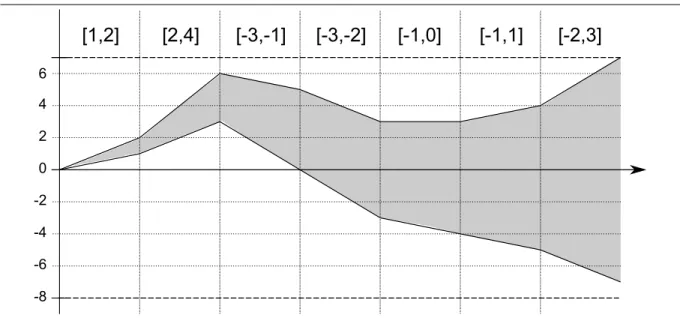
Example 3Let us consider the Ex. 1, withb=4. In this caseM4= [−8,7]and an overflow arises when the termx6∈[−1,1]is added since the partial sum evaluates to[−9,3]6⊆M4. In Algorithm 1,Y>0=
{3,7},Y<0={4,5}andY⊤={1,2,6}. One output of the algorithm is (the permutation corresponding
to) the sum:x3+x7+x4+x5+x2+x6+x1.
[1,2]
[2,4]
[-3,-1]
[-3,-2]
[-1,0]
[-1,1]
[-2,3]
2 4 6
0
-2
-4
-6
-8
Figure 2: The graphical evolution of the partial sums of the repaired expression in Ex. 4.
the interval[0,0], and it greedily selects variables such that the current partial sum gets closer, e.g., to M. When any value inY>0causes the partial sum to go aboveM, then elements fromY<0 are selected. Graphically this means that the interval is heading towardM. The algorithm continues untilR0is empty, or it is not possible to “correct” the partial sum. An interesting yet unexpected result is the following one, stating that the algorithm is complete,i.e., if there exists a solution toRhL,L,Intvithen our algorithm finds it. If it fails, there is no way to repaireusingS.
Property 1(Completeness)LetJPKa(pp) =S be an abstract element belonging toIntv. If Algorithm
1 fails then there exists no permutationπ∈[1,k]→[1,k]of the elements of the sum such that the partial
sums of∑ni=1yπ(i)do not overflow, i.e. there is noe’∈Lsuch thate≡Ze’andγ(S)|=notOverflowe’.
Proof First, let us focus on the while loop of Line 5. We show that if Algorithm 1 fails at Line 10 then any parsing of the sum leads to an overflow. More precisely, if∃Y′andY′′such thatY′∪Y′′= [1,k],
Y′∩Y′′=/0,s=∑i∈Y′yi⊆Mand∀i∈Y′′,s+yi6⊆Mthen∑ki=1yi6⊆M.
LetY′′={b1, . . . ,bm}and let us focus on the upper bound. If∀i, 1≤i≤m, s+ybi >Mthen
s+yb
1 > M
s+yb2 > M ..
. ...
s+ybm > M.
Their sum implies that
ms+
∑
b∈Y′′
yb>mM. (5)
Using the fact thats=∑i∈Y′yi and thatY′∪Y′′= [1,k], Equation (5) can be transformed as follows:
ms+∑b∈Y′′yb>mM
⇔ (m−1)s+s+∑b∈Y′′yb>mM
⇔ (m−1)s+∑a∈Y′ya+∑b∈Y′′yb>mM
Now, let us assume thats≤M. From the previous equation it follows that
k
∑
i=1yi>mM−(m−1)s≥mM−(m−1)M.
Therefore,∑ki=1yi>M, which is a contradiction. The same arguments holds for the lower boundM. Concerning the for loop of Line 13, any elementyi withi∈Y⊤ makes the bounds ofsgrow (except
for the trivial case of adding [0, 0]). Consequently, if we cannot fix the variables inR, there is no way we can fix the initial set of variables. The interval sum is deterministic, so the partial sum after the while loop of Line 5 is always the same interval, no matter which parsing is inferred. In the loop of Line 13, the width of the interval for the partial sum can only grow at each step with one of the two bounds strictly moving towardMorM. As a consequence, if some parsing fails then all the parsings fail.
Property 2(Complexity)For a linear expression withO(k)variables, Algorithm 1 performsO(k2) operations.
Proof Constants are bounded and, consequently, the preprocessing may only add a constant multi-plicative factor. So the number of terms in the sums given to Algorithm 1 is asymptotic linear in the number of variables of the source expressions. The while loop of Line 5 is executedO(k)times and the selection of jat Line 6 is done inO(k). The for loop of Line 13 being linear ink, the global complexity of the algorithm isO(k2).
5
Relations among Linear Expressions
We extend the results of the previous section when the considered expressions are comparisons of linear arithmetic expressions with unary coefficients. We consider the set
B={e1♦e2|e1,e2∈L,♦∈ {=, 6=, <, >, ≤,≥}}
for input and output expressions. We use the abstract domain Intv for the semantic knowledge. The Algorithm 2 computes anunder-approximation toRhB,B,Intviinpolynomialtime.
We first need to define some functions used by the algorithm. The (distance from zero) function d∈Z×Z→Zis such that
d([x,x]) =max |x|,|x|.
We letd(e)denoted(evalIntv(e,JPKa(pp)), whereevalIntv is themostprecise evaluation ofeusing
unboundedinterval arithmetics [13]. The function
select(X)∈℘(Z×Z)→(Z×Z)∪ {fail}
selects an intervalx∈Xsuch thatM6∈xand∀y∈X.d(y)≤d(x). If such an interval does not exist, then
select(X) =fail.
Given an (abstract) environment mapping variables to intervalsS ∈Vars→(Z×Z), we assume, without losing generality, thatS is injective — the Algorithm can be easily extended otherwise.
Finally, we let φS0,S ∈Vars→E denote the sign of a variable. It is defined asφS0,S(x) =xif
S0(x) =S(x);φS0,S(x) =−1∗xifS0(x) =−S(x)and undefined otherwise.
Algorithm 2Boolean Expressions Refactoring
Require: Two sets of variablesA,B, a Boolean expressionb=e1♦e2such thate1=∑a∈Aaande2=
∑b∈Bband an interval mapS0.
Ensure: A solution to the overflowing problem, or fail if it does not exist
1: M ←/0;e′
1←e1;e′2←e2;S ←S0
2: while¬Algorithm1(e′1,S)∨¬Algorithm1(e′2,S)do 3: ifd(e′1)≥d(e′2)then
4: α←select(S(A\M))
5: ifα =failthen
6: Fail
7: end if
8: y←S−1(α)
9: A←A\ {y};B←B∪ {y}; 10: else
11: β ←select(S(B\M)) 12: ifβ =failthen
13: Fail
14: end if
15: y←S−1(β)
16: A←A∪ {y};B←B\ {y}
17: end if
18: e′1←∑a∈Aa;e′2→∑b∈Bb
19: M ←M∪ {y}
20: S →S[y7→ −S] 21: end while
22: return ∑a∈AφS0,S(a)♦∑b∈BφS0,S(b)
which variables have been moved on the left or right side. On entry it is trivially the empty set. The arithmetic expressionse′1,e′2are the current approximations for the solution, andS records the ranges
for variables. On entry, those variables are set to the input parameters.
The Algorithm 2 iterates as long as at least one of the expressions e′1 ore′2 overflows — we use Algorithm 1 to check it. It first selects the expression which is further away from zero — roughly, the expression which causes the largest overflow. Then, it selects the addendum that contributes most to the overflow, and moves it on the other side of ♦. This is reflected by the updates toA andB. The memoization setM remembers which terms have already been moved. This forbids the same term to
be moved twice. Finally,S is updated to remember thatyis negated. The algorithm fails ifselectfails,
that is if no more term can be moved to the other side of the relation. Otherwise, a new expression is returned, where variables moved to one side or another of♦are negated.
Example 4 Let us consider the evaluation of the Boolean expression x1+x2≤x3+x4+x5 with simplified 4 bits integers and with the semantic information:
S0=S ={x1∈[−1,1],x2∈[−2,0],x3∈[1,2],x4∈[2,3],x5∈[5,6]}.
An overflow arises in the evaluation of the right hand side of the relation since:
Let us apply Algorithm 2. At the first step,B={x3,x4,x5},M =/0. Thereforeselect(S(B\M)) = [5,6]sinced(x5) =6. The memoization set is updated toM={x5}and the relation is transformed into
x1+x2+x5≤x3+x4.We record the fact thatx5appears in a negated context by updating the semantic information:
S ={x1∈[−1,1],x2∈[−2,0],x3∈[1,2],x4∈[2,3],x5∈[−6,−5]}.
Now, x1+x2+x5∈[−9,−4]6⊆[−8,7]. Therefore, the evaluation of the left operand may lead to an overflow, and so the loop is entered again. The functionselect(S(A\M))selects[−2,0], that is the
interval corresponding tox2. The new expression isx1+x5≤x3+x4+x2,with
S ={x1∈[−1,1],x2∈[0,−2],x3∈[1,2],x4∈[2,3],x5∈[−6,−5]}.
The algorithm stops since the expression does not overflow. The expressionx1−x5≤x3+x4−x2 is then returned to the caller.
Property 3For a relation between two linear expressions withO(n)variables, Algorithm 2 performs O(n3)steps.
Proof Each variable is moved at most once from one side of the relation to the other. Then the while loop of Line 2 is repeatedO(n)times. Theselectfunction isO(n) but the Algorithm 1 isO(n2). The global complexity is thenO(n3).
6
Exploiting Relational Information
We extend the results of Sect. 4 by usingOct, the abstract domain of Octagons [12] as the underlying semantic knowledge. Intuitively, having a more precise abstract domain enables the inference of more relations among variables and as a consequence more arithmetic expressions can be repaired. On the other hand, it also makes the search space for the problem larger. We show that there exists an algorithm to solveRhI,O,Octiexactly,i.e., if an expression can be repaired, then our algorithm finds it.
WithOct, constraints are either in the forma≤x≤b(non-relational constraints) ora≤x±y≤b (relational constraints). In the following we will use an interval notation to denote those constraints:
S(x) = [a,b]andS(x+y) = [a,b].
Example 5Let us consider variablesx, y, zof typeM4, the sumx+y+z, and the semantic infor-mationS:
{x∈[−2,2],y∈[−1,3],z∈[−1,4],x+y∈[−2,3],y+z∈[−2,4],x+z∈[−1,5]}.
If we ignore the relational constraints then we cannot propose a fix for the expression. In fact, Algo-rithm 1 will fail because:
[−2,2] + [−1,3] + [−1,4]6⊆[−8,7].
We assume the application of the same preprocessing steps of the previous sections (multiplications by constants are expanded into sums, variables are only added – subtraction is captured in S).
Fur-thermore, for the sake of simplicity, we also assume that all the variables are different — variables with multiple occurrences are renamed.
0
{x} {y} {z}
{x,y} {y,z}
{x,z}
{x,y,z} [-2,2]
[-1,3]
[-2,3]
[-1,4] [-2,4]
[-1,4]
[-1,5]
[-2,2] [-1,4]
[-2,2]
[-2,2] [-1,4]
[-1,3] [-1,3] [-1,3]
[-2,4] [-2,3]
[-1,5]
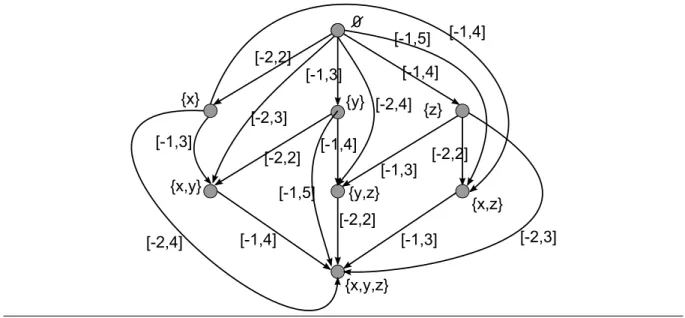
Figure 3: Graph describing the ways of summingx,y,zwith the information of Ex. 6.
relational information inS. We do not explicitly build the graph — it is of exponential size. Instead, we
memorize only the current path corresponding to a non overflowing partial sum. The nodes correspond to partial sums of variables. The weight (an interval) attached to an edgeeindicates the value which must be added to the partial sum when one or two variables are added. In general, there exists several paths from a source node to a destination node depending on which constraints we use to add the variables. For instance, in Ex. 6, we have a path corresponding tox+ (y+z)and another path corresponding to (x+y) +zwhose weights are[−4,6]and[−3,7], respectively.
Formally, given an input set of variablesX={x1, . . .xn}and the semantic informationS, we define
the graphG= (V,E)as follows:
• V =℘(X): the nodes ofGare sets of variables,
• the entry node is /0 and the exit node isX,
• (v1,v2)∈Eifv2=v1∪ {xi}for somev1⊆Xand some variablexi∈X. In this case,W (v1,v2)
=
S(xi),
• (v1,v2)∈E ifv2=v1∪ {xi,xj}for somev1⊆X and some pair of variablesxi andxj, withi6= j.
In this case,W (v1,v2)=S(xi+xj).
Example 6Let us consider the arithmetic expression and the semantic information of the Ex. 6. The Figure 3 shows the corresponding graph G. With G, we can derive the non-overflowing expressions (x+y)+zorx+(y+z). The expressiony+(x+z)is not a repair – it may overflow under the knowledge encoded byS.
Letv1, . . .vk be a sequence of vertices in G. Then, −→v = (v1, . . .vk) is a path ifv1= /0 and for alli such that 1≤i<k,(vi,vi+1)∈E;−→v yv′ is the path extended with vertexv′;dest(−→v) =vk is the last
vertex in a non-empty path;succ(v)are the successors of vertexv,succ(−→v) =succ(dest(−→vk)), are the
successors of a (non-empty) path.
The function Repair, Algorithm 3, performs a depth-first search inG. The input toRepairis path
−
→v inG. Intuitively, −→v describes a way of summing the variables in v
Algorithm 3Sum Refactoring with Relational Information Require: A path−→v onGand an octagonS
Ensure: A path indicating how to compute the total sum without overflows, or fail if it does not exists
1: FunctionRepair(−→v) 2: N ←succ(−→v);−→r ← −→v
3: whileN 6=/0∧dest(−→r)6=Xdo
4: v′←pickOne(N)
5: ifS |=notOverflow∑v∈−→vyv′xthen
6: −→r ←Repair(−→v yv′) 7: end if
8: N ←N \ {v′}
9: end while
10: ifdest(−→r) =X then 11: return −→r 12: else
13: Fail 14: end if
unboundedinterval sum of the weights of the edges:
W(−→x) = k−1
∑
j=1W (vj,vj+1).
Algorithm 3 visitsGwithout explicitly building it. The setN is initialized to the set of successor
nodes of the current path. The algorithm iterates untilN is empty (in which case the algorithm fails) or
the exit nodeXis reached (in which case the algorithm succeeds). In the main loop, a new node from the unexplored successorsN is picked via the functionpickOne. Heuristically, we wantpickOneto return
the nodev′ minimizingW (xn,x′). If the new partial sum corresponding to the path−→v yv′ does not overflow, then the exploration continues from such a path. Otherwise, the exploration continues with another successor inN.
Example 7 Let us apply Algorithm 3 to Ex. 6. The initial value for Repair is /0, i.e. the path corresponding to the entry node. We have
N ={x},{y},{z},{x,y},{x,z},{y,z} .
The functionpickOneselects{x}sinced((/0,{x})) =2 is minimal. Therefore, it invokesRepairon the path (/0,{x}). It choses{x,y} as successor. At the next recursive call, when it addszto the path, it
detects an overflow since
[−2,2] + [−1,3] + [−1,4]6⊆[−8,7].
The algorithm backtracks and finds the path
(/0,{x},{x,y,z})
whose weight is[−2,2] + [−2,4]⊆[−8,7].
Proof Algorithm 3 performs a search into a graphGwhich describes all the ways of summing the variables of the expression. Then, if a solution exists, it is included inGand the algorithm necessarily finds it.
The Algorithm 3 can be generalized to any template-based numerical abstract domain [18]. In this case, we have additional constraints of form
a≤a1·x1+. . .+an·xn≤b (6)
where thexi, 1≤i≤nare variables of the program and wherea,band the coefficientsai, 1≤i≤nare
constants. The preprocessing transforms each termai·xi intox(i1)+x(i2)+. . .+x(ai i)and the graph used
by Algorithm 3 can be extended with new edges(v1,v2)such that
v2=v1∪ [
1≤i≤n
[
1≤j≤ai
x(j)i !
for somev1⊆X and for the constraint of Equation (6). In this case, the weight associated to the new edge(v1,v2)isS(x1+. . .+an·xn).
7
Experimental Results
We have a prototype OCAML implementation that we used to validate and to experiment with the algo-rithms presented in the previous sections. We use 32 bits signed integers,i.e.,M32∈[−231,231−1].
For the algorithms 1 and 2, we use the variablesx1, . . . ,x6with
S ={x1∈[0,229],x2∈[−229,0],x3∈[−229,229],x4∈[1,1],x5∈[−1,−1],x6∈[−1,1]}.
There is nothing special aboutS, we generated it randomly.
To evaluate Algorithm 1, we consider all the expressions in the form of e=∑6i=1ai·xi andai∈ {0,1,2,4}for 1≤i≤6. Overall, there are 3402 of such expressions. UnderS, 1093 expressions do not
overflow, 2268 cannot be repaired, and 43 can be repaired.
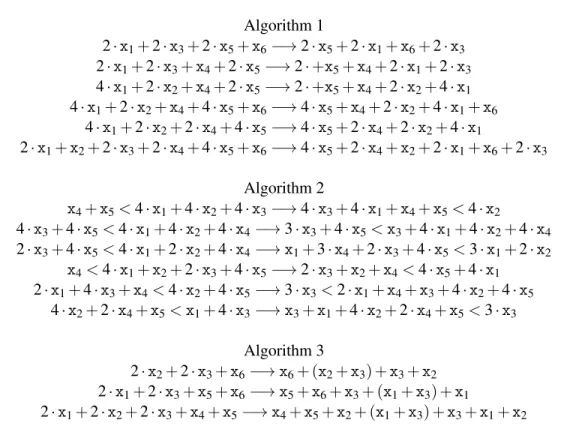
Algorithm 1 proves it in a very little time: Theoveralltime to analyze, suggest a repair or prove that such repair does not exists is of 120ms. We report some of the repairs discovered by the algorithm in Fig. 4.
In order to evaluate Algorithm 2, we consider all the inequalities in the form of∑5i=1ai·xi<∑5i=1ai·xi
such that:
(i) ai∈ {0,1,2,4}, for 1≤i≤5,
(ii) a given variablexiappears at most in one side of the equation,
(iii) each side of the equation owns at least one term with coefficientai6=0.
There exist 7290 of such expressions, and only 213 are not repaired by Algorithm 2. Theoverall time to explore all such expressions and to suggest a repair, if any, is of 202ms. Example of repairs are in Figure 4.
To evaluate Algorithm 3, we add toS the relational information:
S(x1+x3) =S(x1+x2) = [−229,229].
With this information, we can repair some more expressions than with Algorithm 1 — with a negligible additional cost. Such cases are in Fig. 4.
Algorithm 1
2·x1+2·x3+2·x5+x6−→2·x5+2·x1+x6+2·x3 2·x1+2·x3+x4+2·x5−→2·+x5+x4+2·x1+2·x3 4·x1+2·x2+x4+2·x5−→2·+x5+x4+2·x2+4·x1 4·x1+2·x2+x4+4·x5+x6−→4·x5+x4+2·x2+4·x1+x6
4·x1+2·x2+2·x4+4·x5−→4·x5+2·x4+2·x2+4·x1
2·x1+x2+2·x3+2·x4+4·x5+x6−→4·x5+2·x4+x2+2·x1+x6+2·x3
Algorithm 2
x4+x5<4·x1+4·x2+4·x3−→4·x3+4·x1+x4+x5<4·x2
4·x3+4·x5<4·x1+4·x2+4·x4−→3·x3+4·x5<x3+4·x1+4·x2+4·x4 2·x3+4·x5<4·x1+2·x2+4·x4−→x1+3·x4+2·x3+4·x5<3·x1+2·x2
x4<4·x1+x2+2·x3+4·x5−→2·x3+x2+x4<4·x5+4·x1 2·x1+4·x3+x4<4·x2+4·x5−→3·x3<2·x1+x4+x3+4·x2+4·x5
4·x2+2·x4+x5<x1+4·x3−→x3+x1+4·x2+2·x4+x5<3·x3
Algorithm 3
2·x2+2·x3+x6−→x6+ (x2+x3) +x3+x2 2·x1+2·x3+x5+x6−→x5+x6+x3+ (x1+x3) +x1
2·x1+2·x2+2·x3+x4+x5−→x4+x5+x2+ (x1+x3) +x3+x1+x2
Figure 4: Some of the repairs produced by the implementation of our algorithms. For Algorithm 3, more repairs are enabled because of a more refined semantic knowledge.
8
Related Work
The dynamic analysis community has been interested for a while to the problem of repairing faulty programs, i.e. programs failing some test cases [16]. Their approaches can be abstracted as follows. When a bug is found in a programP, a modified programP’is generated such thatP’behaves asPon a certain set of tests but it does not manifest the bug. The repaired programP’is generated searching a program in the set of program transformations/mutations ofP–e.g., applying a set of templates [15, 21, 7, 17]. This approach has many drawbacks. First, it requires running the program, first to find the bug in Pand then to generate and check the candidates for P’. This may not be practical because the test suite can be very large – in real software up to several hours. As a consequence the search forP’ isde factoimpossible for a largeP. Second, the whole program may not be available – this is the case for instance when developing libraries. Third, the repair is as good as the test suite itself:e.g., how can we be sure that an arithmetic overflow has been removed for all the possible inputs and not just for the particular test case? Fourth, the generated repairs are often counter-intuitive, and not realistic, in that they perturb the semantics of the original program in the “good” runs [20]. We differentiate from those approaches because our approach is completely static, it exploits the semantic information inferred by the static analyzer, and the repair is guaranteed to only improve the good executions, while removing overflows (“bad” executions).
auto-matically generate such fixes.
The bases for our paper are [8] and [10, 11]. In [8] we introduced the concept of verified repair, the idea is that one can generate a program repair from the semantic information inferred by the static analyzer, and verify that it improves the program by removing bad behaviors while increasing good ones, up to some level of abstraction. We proposed some fixes for common bugs, including a greedy incomplete algorithm to fix overflowing expressions. Here we improve over such an algorithm, by first making clear the concept of input and output language, and that of the underlying semantic information used to repair the overflowing expression. Furthermore, in the present paper we present three algorithms for repairing expressions in common cases, and we formally study their properties (complexity and completeness). In [10, 11] we considered the problem of generating (an approximation of) the most precise arithmetic expression over floating-point values [14]. The problem of improving a floating-point expression presents a slightly different challenge than the one considered here in that, in general, the expressions cannot be entirely repaired. Because the floating-point arithmetic introduces roundoff errors, it is in general impossible to find an equivalent expression which computes the exact result,i.e., the result that we would obtain with real numbers. A verified repair then is an expression which is equivalent to the original one when interpreted over the real numbers and which is more accurate than the original expression in the sense that it returns a value closer to the mathematical result when evaluated with floating-point numbers.
9
Conclusions
It is our firm belief that we need to bring static analysis tools to the next level, to make them more practical. They should not limit themselves to find (or prove the absence of) bugs, but they should actively help the programmers by providing suggestions to improve their program, by removing the bug or by proposing better design choices.
In this paper, we considered the particular yet relevant problem of repairing integer expressions start-ing from the warnstart-ings and the invariants inferred by an abstract interpretation-based static analyzer. We characterized the three elements in the problem: (i) the input language for expressions (“which expres-sion should I repair?”); (ii) the output language for the expresexpres-sions (“how am I allowed to repair an expression?”); and (iii) the semantic information (“what do I know about the values of the expression?”). Then we focused our attention on three common cases, the repairing of: (i) linear expressions with in-tervals; (ii) Boolean expressions containing linear ones with inin-tervals; and (iii) linear expressions with templates. We showed that in the first case, quite surprisingly, there exists a complete polynomial algo-rithm to solve the problem, whereas in the second we have a polynomial yet incomplete one, and in the third we have a complete but worst-case exponential one.
References
[1] Bruno Blanchet, Patrick Cousot, Radhia Cousot, J´erˆome Feret, Laurent Mauborgne, Antoine Min´e, David Monniaux & Xavier Rival (2003):A static analyzer for large safety-critical software. In Ron Cytron & Rajiv Gupta, editors:PLDI, ACM, pp. 196–207. Available athttp://doi.acm.org/10.1145/781131.781153.
[3] Patrick Cousot & Radhia Cousot (1977):Abstract Interpretation: A Unified Lattice Model for Static Analysis of Programs by Construction or Approximation of Fixpoints. In Robert M. Graham, Michael A. Harrison & Ravi Sethi, editors:POPL, ACM, pp. 238–252. Available athttp://doi.acm.org/10.1145/512950. 512973.
[4] Manuel F¨ahndrich, Michael Barnett & Francesco Logozzo (2010):Embedded contract languages. In Sung Y. Shin, Sascha Ossowski, Michael Schumacher, Mathew J. Palakal & Chih-Cheng Hung, editors:SAC, ACM, pp. 2103–2110. Available athttp://doi.acm.org/10.1145/1774088.1774531.
[5] Manuel F¨ahndrich & Francesco Logozzo (2010): Static Contract Checking with Abstract Interpretation. In Bernhard Beckert & Claude March´e, editors:FoVeOOS,Lecture Notes in Computer Science6528, Springer, pp. 10–30. Available athttp://dx.doi.org/10.1007/978-3-642-18070-5_2.
[6] Martin Glinz, Gail C. Murphy & Mauro Pezz`e, editors (2012): 34th International Conference on Software Engineering, ICSE 2012, June 2-9, 2012, Zurich, Switzerland. IEEE. Available athttp://ieeexplore. ieee.org/xpl/mostRecentIssue.jsp?punumber=6218989.
[7] Claire Le Goues, Michael Dewey-Vogt, Stephanie Forrest & Westley Weimer (2012): A systematic study of automated program repair: Fixing 55 out of 105 bugs for$8 each. In Glinz et al. [6], pp. 3–13. Available at
http://dx.doi.org/10.1109/ICSE.2012.6227211.
[8] Francesco Logozzo & Thomas Ball (2012): Modular and verified automatic program repair. In Gary T. Leavens & Matthew B. Dwyer, editors: OOPSLA, ACM, pp. 133–146. Available athttp://doi.acm. org/10.1145/2384616.2384626.
[9] Francesco Logozzo & Manuel F¨ahndrich (2008): Pentagons: a weakly relational abstract domain for the efficient validation of array accesses. In Roger L. Wainwright & Hisham Haddad, editors: SAC, ACM, pp. 184–188. Available athttp://doi.acm.org/10.1145/1363686.1363736.
[10] Matthieu Martel (2007):Semantics-Based Transformation of Arithmetic Expressions. In Hanne Riis Nielson & Gilberto Fil´e, editors: SAS,Lecture Notes in Computer Science4634, Springer, pp. 298–314. Available athttp://dx.doi.org/10.1007/978-3-540-74061-2_19.
[11] Matthieu Martel (2009):Program transformation for numerical precision. In Germ´an Puebla & Germ´an Vi-dal, editors:PEPM, ACM, pp. 101–110. Available athttp://doi.acm.org/10.1145/1480945.1480960. [12] Antoine Min´e (2006): The octagon abstract domain. Higher-Order and Symbolic Computation19(1), pp.
31–100. Available athttp://dx.doi.org/10.1007/s10990-006-8609-1.
[13] Ramon E. Moore, R. Baker Kearfott & Michael J. Cloud (2009):Introduction to Interval Analysis. SIAM, doi:10.1137/1.9780898717716.
[14] Jean-Michel Muller, Nicolas Brisebarre, Florent de Dinechin, Claude-Pierre Jeannerod, Vincent Lef`evre, Guillaume Melquiond, Nathalie Revol, Damien Stehl´e & Serge Torres (2010):Handbook of Floating-Point Arithmetic. Birkh¨auser. Available athttp://dx.doi.org/10.1007/978-0-8176-4705-6.
[15] Jeff H. Perkins, Sunghun Kim, Samuel Larsen, Saman P. Amarasinghe, Jonathan Bachrach, Michael Carbin, Carlos Pacheco, Frank Sherwood, Stelios Sidiroglou, Greg Sullivan, Weng-Fai Wong, Yoav Zibin, Michael D. Ernst & Martin C. Rinard (2009): Automatically patching errors in deployed software. In Jeanna Neefe Matthews & Thomas E. Anderson, editors:SOSP, ACM, pp. 87–102. Available athttp://doi.acm.org/ 10.1145/1629575.1629585.
[16] Mauro Pezz`e, Martin C. Rinard, Westley Weimer & Andreas Zeller (2011): Self-Repairing Programs (Dagstuhl Seminar 11062). Dagstuhl Reports 1(2), pp. 16–29. Available athttp://dx.doi.org/10. 4230/DagRep.1.2.16.
[17] Hesam Samimi, Max Sch¨afer, Shay Artzi, Todd D. Millstein, Frank Tip & Laurie J. Hendren (2012): Auto-mated repair of HTML generation errors in PHP applications using string constraint solving. In Glinz et al. [6], pp. 277–287. Available athttp://dx.doi.org/10.1109/ICSE.2012.6227186.
[18] Sriram Sankaranarayanan, Henny B. Sipma & Zohar Manna (2005): Scalable Analysis of Linear Systems Using Mathematical Programming. In Radhia Cousot, editor: VMCAI,Lecture Notes in Computer Science
[19] David A. Schmidt (2009):Abstract Interpretation From a Denotational-semantics Perspective.Electr. Notes Theor. Comput. Sci.249, pp. 19–37, doi:10.1007/978-3-642-04164-8-14.
[20] Yi Wei, Yu Pei, Carlo A. Furia, Lucas Serpa Silva, Stefan Buchholz, Bertrand Meyer & Andreas Zeller (2010):Automated fixing of programs with contracts. In Paolo Tonella & Alessandro Orso, editors:ISSTA, ACM, pp. 61–72. Available athttp://doi.acm.org/10.1145/1831708.1831716.