S CIE
NT OR
U
M
ACTA
Acta Sci. Pol., Technol. Aliment. 10(1) 2011, 97-107
ISSN 1644-0730 (print) ISSN 1889-9594 (online)
© Copyright by Wydawnictwo Uniwersytetu Przyrodniczego w Poznaniu
Corresponding author – Adres do korespondencji: Dr in . Joanna Sadowska, Department of
Hu-EVALUATION OF THE EFFECT OF DIET COMPOSITION
AND B-GROUP VITAMINS SUPPLEMENTATION
ON SELECTED CALCIUM METABOLISM PARAMETERS
IN FEMALE RATS
Joanna Sadowska
West Pomeranian University of Technology in Szczecin
Background. The aim of the study was to observe the effects of a modified diet, in which whole grains of cereals had been isocalorically substituted with wheat flour (type “500”) and saccharose, and supplementation with B-group vitamins, on selected calcium metabo-lism parameters in female rats.
Material and methods. The experiment was carried out on 36 female rats aged 6 months. Animals were fed two different diets. Groups I and II received clean tap water to drink, while group III had water solution of group-B vitamins.
Results. An analysis of the outcomes of the diet modifications allowed concluding that the females fed on the modified feed, either supplemented or non-supplemented, excreted more calcium with urine and exhibited its lower concentrations in blood plasma, as com-pared with the females fed on the standard feed. No significant differences, however, were observed in plasma ionized calcium concentrations in the studied animals, which implies that the regulation mechanism of its bio-active form concentrations is preserved. It has been found that the applied supplementation of the modified diet promoted bone calcium release inducing plasma alkaline phosphatase activity in this group of animals. Supple-mentation was also accompanied by a shift in calcium distribution manifested by its in-creased concentrations in erythrocytes.
Conclusions. Change in diet composition and supplementation were found to signifi-cantly affect calcium metabolism of the rats examined. Observed intracellular calcium ac-cumulation may have been an underlying cause of an increased adipose tissue accumula-tion in B-group vitamin supplemented animals, which had been observed in previous studies.
INTRODUCTION
The results of the studies indicate that only a small fraction of the population are aware of the principles of proper nutrition and are concerned to follow them on a day-to-day basis [Brzozowska 2001]. However, due to a growing awareness of nutritional issues, there is an increasing percentage of people who struggle to change their diet into a better one. Such changes rarely lead to diet improvement in terms of its composition, while mineral and/or vitamin supplementation of the diet is a more commonplace be-haviour. A survey by the National Food and Nutrition Institute carried out in Poland in 2000 revealed that 20% of the population applied diet supplementation [Szponar et al. 2004]. In France or the United Kingdom supplementation is more popular, up to 50% of adults take at least one dietary supplement [Harrison et al. 2004, Touvier et al. 2006]. Supplementation is perceived by consumers as an easy way to preserve health, as well as to stay both physically and mentally fit.
These findings underlie our motivation to undertake studies on an effect of diet composition and its supplementation with B-group vitamins on the lipid/carbohydrate metabolism. The experiments, carried out using an animal model in our Department of Human Nutritional Physiology, have revealed that B-group vitamin supplementation promoted a growth in visceral adipose tissue, as well as in the fat of the liver and mus-cles [Friedrich and Goluch-Koniuszy 2007, Friedrich and Sadowska 2005 b, 2008]. Supplementation also led to a reduced feed consumption and, in consequence, to a lower intake of many important nutritional components, such as calcium [Friedrich and Sadowska 2005 b].
Numerous epidemiological studies have revealed a linkage between obesity inci-dence and dietary calcium intake. Such associations were first observed by McCarron et al. [1984] in the NHANES-I study. Similar findings were reported by Carruth et al. [1999], Skinner et al. [1999], and Teegarden et al. [1999]. There has been no explana-tion given, however, to the observed effects; no conclusions have been drawn and the information was announced as a peculiarity only.
Studies by Zemel et al. [2000], who investigated the role of intracellular calcium and the regulation of its concentration, were first to provide the physiological grounds for explaining the relationship between calcium intake and body weight (adipose tissue accumulation).
Hence in the presented study, we experiment on model animals to learn about the ef-fects of diet composition and its B-group vitamin supplementation on selected calcium metabolism parameters.
MATERIAL AND METHODS
Materials
Methods
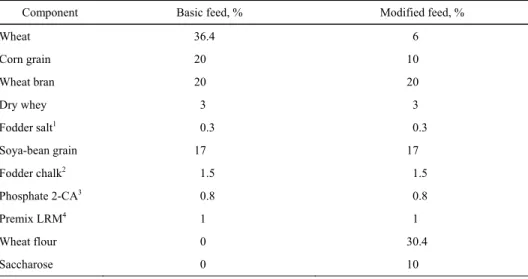
The experiment, approved by the Local Ethical Committee in Szczecin (permit no. 3/2006), was carried out in the vivarium of the Department of Human Nutritional Physiology, on 36 SPRD-strain female rats aged 6-8 months, of initial body weight 248 ±19.4 g. Following a week long conditioning in the vivarium environment (tem-perature 21-22°C, 12 h/12 h light/dark cycle), the animals were randomised and sorted into three (n = 12) groups of equal body weight, fed ad libitum on pelleted feeds com-posed of the same components, besides those differentiating, produced by the Feeds and Concentrates Plant in Kcynia, Poland, after having implemented the procedure 5.14.5, “Cleaning of machines and devices”. Group I was fed standard feed (Labofeed H), while groups II and III received modified feed, in which 83.5% of wheat was substituted with wheat flour (type “500”), and 50% of corn grain was substituted with saccharose. The percentage of the remaining components was unchanged (Table 1). All diets were based on the balanced modification of the AIN-93 diet formulation [Reeves et al. 1993].
Table 1. Component composition of feeds used in the experiment
Component Basic feed, % Modified feed, %
Wheat 36.4 6
Corn grain 20 10
Wheat bran 20 20
Dry whey 3 3
Fodder salt1 0.3 0.3
Soya-bean grain 17 17
Fodder chalk2 1.5 1.5
Phosphate 2-CA3 0.8 0.8
Premix LRM4 1 1
Wheat flour 0 30.4
Saccharose 0 10
1Mainly NaCl. 2Mainly CaCO3. 3CaHPO4.
4Vitamin-mineral composition used in animals feeds.
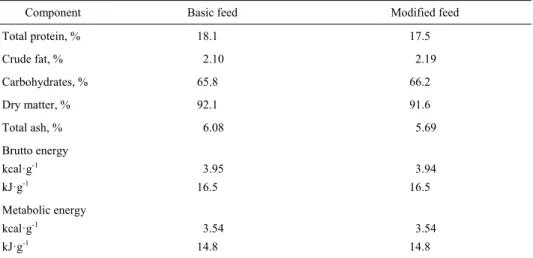
In order to establish the chemical composition of the feeds, basic chemical assays were carried out. We measured the concentration of total nitrogen, converted to quantity of protein, raw fat, dry matter, and ash. The content of carbohydrates was derived from the difference between dry matter and the remaining solid components. The metabolic energy was calculated using commonly applied energy equivalents (Table 2).
Table 2. Chemical composition of feeds used in the experiment
Component Basic feed Modified feed
Total protein, % 18.1 17.5
Crude fat, % 2.10 2.19
Carbohydrates, % 65.8 66.2
Dry matter, % 92.1 91.6
Total ash, % 6.08 5.69
Brutto energy
kcal·g-1 kJ·g-1
3.95 16.5
3.94 16.5
Metabolic energy kcal·g-1
kJ·g-1
3.54 14.8
3.54 14.8
Table 3. Content of vitamins B and calcium in 100 g of diet
Component Basic feed, mg Modified feed, mg
Thiamin (B1) 0.225 0.092
Riboflavin (B2) 0.080 0.042
Pyridoxine (B6) 0.156 0.050
Nicotinate (PP) 1.684 0.562
Calcium 1 110 1 050
Groups I and II received tap water to drink, while group III had water solution of group-B vitamins (B1, B2, B6, and PP) obtained from available pharmaceutical products (Polfa, Kutno, Poland). The supplemented vitamins were administered in 3- to 5-fold higher quantity compared to the difference between their content in the standard and the modified feeds (3.249 mg thiamine, 1.083 mg riboflavin, 2.694 mg pyridoxine, and 9.58 mg nicotinic acid amide per 1 kg of feed), calculated in relation to amount of feed con-sumed by the animals. The rats received drinking tap water surplus ad libitum.
Used scheme of the experiment partly reflected the change of the diet composition and supplementation used by people observed in last decades.
The experiment lasted for seven weeks; the amount of feed consumed, water solu-tions of vitamins and water drunk by the animals were recorded daily, whereas once a week the animals were weighed. During the 6th week of the experiment, the animals were placed in metabolic cages; following a 48-hour conditioning, a 24-hour urine col-lections were done in order to determine the concentrations of creatinine (kinetic spec-trophotometry) and calcium (atomic absorption spectrometry).
Blood hemolysates were obtained through addition of 9 ml of deionized water to 1 ml of blood. The remaining blood was centrifuged, at 2000 g for 10 min at 5°C (MPW 350-R, MPW Med. instruments, Warsaw, Poland).
Calcium concentrations were measured in the resulting plasma and whole blood hemolysate by means of atomic absorption spectrometry. Calcium concentrations in the red cells were calculated indirectly, by method based on the concentrations law, which required determining the packed cell volume index, as well as calcium concentrations in both plasma and whole blood [Duda and Przybyszowski 1977, Kozielec et al. 2006]. Blood plasma was also assayed for the concentrations of albumins (spectrophotometry), alkaline phosphatase – ALP (kinetic spectrophotometry), gamma-glutamyl transpepti-dase – GGTP (kinetic spectrophotometry), as well as ionized calcium (using a ion selec-tive electrode).
The right femoral bones were collected from the animals as well. The bones were dry-mineralized, and calcium concentration was determined using atomic absorption spectrometry.
The resulting data were tested for normality of distribution and processed statisti-cally by means of the Statistica software package, using the Duncan test at the signifi-cance level α = 0.05 [Statsoft 2005].
RESULTS AND DISCUSSION
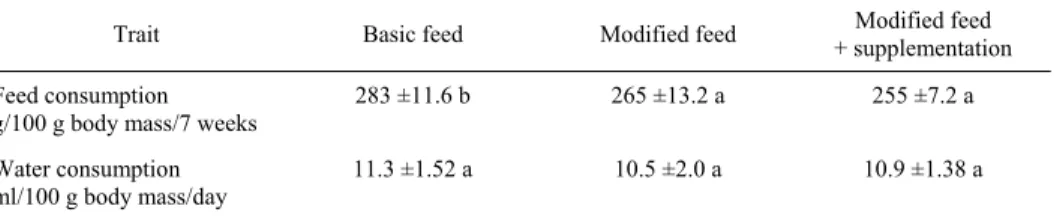
Analysis of the results revealed a significant effect of the diet composition on the feed intake by the females. The modifications in the composition of the diet signifi-cantly reduced the amount of feed consumed as expressed per 100 g of body weight (Table 4). The water consumption was comparable among groups of animals (Table 4).
Table 4. Effect of diet type and supplementation on feed and water consumption in rats (x̅ ±SD; n = 36)
Trait Basic feed Modified feed Modified feed + supplementation
Feed consumption g/100 g body mass/7 weeks
283 ±11.6 b 265 ±13.2 a 255 ±7.2 a
Water consumption ml/100 g body mass/day
11.3 ±1.52 a 10.5 ±2.0 a 10.9 ±1.38 a
a, b – means denoted with the same letters are not significantly different, p < 0.05.
modified feeds, which due to altered composition also becomes short of some vitamins and minerals, is an adverse effect, as the intake of not only basic nutritional compo-nents, but also of those of regulatory character, drops considerably.
Reduced feed consumption, containing besides less quantity of calcium, may have been one of the causes underlying the observed lower blood plasma calcium levels in the rats fed on the modified, either supplemented or non-supplemented feed (Ta-ble 5).
The calcium concentration did not, however, fall outside the physiological range, which for these animals is 1.33-3.25 mmol/l [Carpenter et al. 2001].
A lower plasma calcium level in the supplemented animals may have also resulted from a lower concentration of albumins observed in this group (Table 6).
Table 5. Effects of diet type and supplementation on chosen indicators of calcium metabolism in rats (x̅ ±SD; n = 36)
Indicator Basic feed Modified feed Modified feed + supplementation
Plasma calcium concentration, mmol·l-1 2.67 ±0.08 b 2.51 ±0.09 a 2.43 ±0.08 a
Ionised plasma calcium concentration, mmol·l-1 0.84 ±0.04 a 0.86 ±0.03 a 0.86 ±0.1 a
Erythrocyte calcium concentration, mol·l-1 4.71 ±0.35 a 4.98 ±0.42 a 5.71 ±0.28 b
Bone calcium content, mg·g d.m.-1 241 ±12.3 a 246 ±11.6 a 238 ±6.5 a
Urinary calcium excretion, mmol· mol creat.-1·24 h-1 0.604 ±0.13 a 0.890 ±0.15 b 0.840 ±0.13 b
Plasma alcaline phosphatase concentration, u·l-1 87.6 ±6.02 a 119 ±9.0 c 99.0 ±4.12 b
a, b, c – means in line denoted with the same letters are not significantly different, p < 0.05.
Table 6. Effects of diet type and supplementation on plasma albumin concentration and plasma GGTP concentration in rats, (x̅ ±SD; n = 36)
Indicator Basic feed Modified feed Modiffied feed + supplementation
Plasma albumin concentration, g·l-1 45.8 ±3.33 b 43.1 ±2.01 b 40.5 ±2.09 a
Plasma GGTP concentration, u·l-1 11.0 ±3.15 a 10.4 ±2.54 a 9.31 ±1.32 a
a, b – means in line denoted with the same letters are not significantly different, p < 0.05.
A decrease in blood plasma calcium concentration contributes to the release of para-thormone, which enhances osteolysis and induces the synthesis of vitamin D3, which in turn stimulates small intestine calcium absorption. The presented studies revealed a lower, though statistically non-significantly, bone calcium concentration in the females fed on the modified and vitamin-supplemented feed, in which plasma total calcium was lowest (Table 5). In the plasma of the animals that received the modified, either non-supplemented or non-supplemented feed, we observed also a higher activity of alkaline phosphatase, as compared with that observed in the animals fed on the standard feed (Table 5).
The total activity of alkaline phosphatase involves several isoenzymes, which hydro-lyse phosphates in an alkaline environment. The highest ALP concentrations occur in osteoblasts and hepatocytes; hence, its elevated level accompanies enhanced bone remodelling or hepatic disorders. The distinguishing factors in terms of the origin of plasma alkaline phosphatase include the plasma concentration of gamma-glutamyl transpeptidase, which increases along with ALP activity growth observed in liver dis-eases [Zilva and Pannall 1979]. In the presented studies, no changes in GGTP activity were recorded (Table 6), which implies an increase in the activity of the bone-originating fraction of plasma alkaline phosphatase of the studied animals. Some of the analyses indicate also that the hepatic-origin fraction in blood plasma of rats represents a small percentage of ALP, therefore it has been accepted that a vast majority of ALP activity in blood is of bone origin [Gołębiewska et al. 2000, Koyama et al. 1998].
In juvenile, growing organisms, an increase in the bone fraction of alkaline phos-phatase activity is attributed to the development and growth of the skeletal system; in adult forms, however, this effect is associated with a disturbed balance of bone re-modelling processes. If resorption processes prevail over osteogenesis, the mineral density of bone decreases, which is accompanied by an increase in repairing activities of the osteoblasts, which in turn is reflected in an increased activity of alkaline phatase [Rahnama et al. 2002]. Consequently, the increased activity of alkaline phos-phatase reflects acceleration of bone formation as a result of its enhanced resorption which possibly leads to osteomalacia [Marcinkowska-Suchowierska et al. 1992, Ro-magnoli et al. 1998]. Consequences of enhanced osteolysis should include an increased blood plasma calcium concentration. In the discussed experiment, however, we have not observed such an effect. What has been confirmed, however, is the enhanced urinary excretion of calcium in the animals fed on the modified, either B-group-vitamins sup-plemented or non-supsup-plemented feed (Table 5), which may have also contributed to the observed lower plasma calcium concentrations in these animals.
Glucocorticoids affect the functioning of many organs, including the kidney. Gluco-corticoids stimulate glomerular filtration and diuresis, whereas renal tubular reabsorp-tion of calcium decreases, which leads to increased calciuria. Glucocorticoids also affect calcium management through reduction of its small intestine absorption, inhibiting the synthesis of the calcium-binding protein (CaBP) [Doga et al. 2008]. This activity is independent from vitamin D3. On the other hand, the increased urinary excretion of calcium observed in vitamin-supplemented females is difficult to explain. It may have been due to a change in the composition of fatty acids in the visceral adipose tissue, as observed by Friedrich and Sadowska [2005 a], which occurs as a result of vitamin supplementation of the diet. The mentioned authors observed an increase in the level of arachidonic acid present in the visceral fat of group B vitamin-supplemented animals. This acid inhibits the transformation of cholesterol into aldosterone, which in conse-quence leads to an increased urinary excretion of sodium [Goodfriend et al. 1995, Elliott and Goodfriend 1993]. The increased amount of excreted sodium is one of the factors determining an elevated excretion of calcium in urine [Kleeman et al. 1964], especially if the diet lacks calcium [Nordin and Policy 1987]. This effect could have been intensi-fied by the oxidative stress, which had been observed during group B vitamins supple-mentation by Friedrich et al. [2005], and which reduces the affinity of mineralocorticoid receptors to aldosterone stimulating urinary loss of calcium [Fiebeler and Luft 2005].
We have also found a significant effect of the applied supplementation on an in-crease in calcium concentration in erythrocytes (Table 5). Calcium is characterised by a sharp gradient of transmembrane concentration; it concentrates mainly in the extracel-lular spaces and cells contain only a small fraction of calcium that can be found outside. This makes calcium an ideal messenger, which serves as a quick cell activator. A vast majority of intracellular calcium is found in the organelles (mitochondria and micro-somes). A deficiency or excess in intracellular calcium is not always reflected by a dis-tinct clinical symptom typical for calcium metabolism disorders. Slowly developing disturbances trigger compensation mechanisms which enable long term maintenance of homeostasis. Research shows, however, that an increase in intracellular calcium of erythrocytes is linked with an elevated risk of hypertension [Orlov et al. 1988]. Cal-cium, through affinity to some kinases or specific proteins, may induce also many metabolic processes inside the cell. The intracellular increase in calcium concentration may lead to insulin resistance, accelerates the rate of lipogenesis and accumulation of triaglycerols in both adipose tissue and muscles [Zemel 1995]. Therefore, calcium man-agement disorders may have been a possible cause underlying the increased accumula-tion of visceral and intramuscular adipose tissue, found in previous studies under group-B vitamins supplementation of animal diet.
CONCLUSIONS
The analysis of the results allowed concluding that:
1. The applied modification of diet composition had an effect on calcium manage-ment in female rats, leading to a decrease in its blood plasma concentration and in-creased calciuria.
3. The applied supplementation of the diet with B-group vitamins promoted calcium storing in erythrocytes, which may lead to arterial hypertension and insulin resistance; however, explanation of the mechanisms of the observed changes in calcium distribu-tion require further studies.
REFERENCES
Archer Z.A., Rhind S.M., Findlay P.A., Kyle C.E., Thomas L., Marie M., Adam C.L., 2002. Contrasting effects of different levels of food intake and adiposity on LH secretion and hypo-thalamic gene expression in sheep. J. Endocrinol. 175, 383-393.
Brzozowska A., 2001. Food fortification and diet supplementation – benefits and risk. Food Sci. Technol. Qual. 29, 16-28.
Carpenter J.W., Mashima T.Y., Rupiper D.J., 2001. Exotic animal formulary. W.B. Saunders Com., Philadelphia.
Carruth B., Skinner J., Coletta F., 1999. Dietary and anthropometric factors predicting body fat in preschool children. Scand. J. Nutr. 43, 53S.
Doga M., Mazziotti G., Bonadonna S., Patelli I., Bilezikian J.P., Canalis E., Giustina A., 2008. Prevention and treatment of glucocorticoid-induced osteoporosis. J. Endocrinol. Invest. 31, 53-58.
Duda K., Przybyszowski A., 1977. Potassium and sodium concentrations in erythrocytes: Normal values, methods of determination and clinical significance. Pol. Przegl. Chir. 49, 1289-1295. Elliott M.E., Goodfriend T.L., 1993. Mechanism of fatty acid inhibition of aldosterone synthesis
by bovine adrenal glomerulosa cells. Endocrinology 132, 2453-2460.
Fiebeler A., Luft F.C., 2005. The mineralocorticoid receptor and oxidative stress. Heart Fail. Rev. 10, 47-52.
Friedrich M., 1995. Effects of diet enrichment with glucose and casein on blood cortisol concen-tration of calves in early postnatal period. Arch. Vet. Pol. 35, 117-125.
Friedrich M., Goluch-Koniuszy Z., 2007. Effects of diet composition and vitamin B supplementa-tion on the concentrasupplementa-tion of lipids and lipoproteins in rat serum. Pol. J. Hum. Nutr. Metab. 34, 1052-1057.
Friedrich M., Sadowska J., 2005 a. Effects of diet composition and vitamin B supplementation on fatty acid profile in perivisceral adipose tissue of rat. Pol. J. Hum. Nutr. Metab. 32, 302-315. Friedrich M., Sadowska J., 2005 b. Effects of diet supplementation with B-complex vitamins on
fatty tissue accumulation in rats. Pol. J. Food Nutr. Sci. 55, 189-194.
Friedrich M., Sadowska J., 2007. The effects of diet composition and vitamins B supplementation on the concentration of corticosterone and aldosterone and the water balance in rat. In: Con-ference Materials “The quality and health-promotion property of the food”. PTT Lublin, 28. Friedrich M., Sadowska J., 2008. Effect of diet composition and supplementation with selected
vitamins B on amount and distribution of fat tissue and blood concentration of lipid compo-nents in rat. EJPAU Food Sci. Technol. 11, #9.
Friedrich M., Sadowska J., Sawicka A., 2005. The effect of supplementing the diet with B vita-mins on the composition of fatty acids in a fat tissue of peri-organs and on the processes of fatty acid peroxidation in rat. Food Sci. Technol. Qual. 45, 139-150.
Gołębiewska M., Citko A., Franciszek R., Wołczyński S., 2000. The estimation of the ossteous metabolism at toothless postmenopausal women. Prot. Stomat. 50, 316-325.
Goodfriend T.L., Lee W.M., Ball D.L., Elliott M.E., 1995. Specificity and mechanism of fatty acid inhibition of aldosterone secretion. Prostagl. Leukot. Essent. Fatty Acids 52, 145-149. Harrison R.A., Holt D., Pattison D.J., Elton P.J., 2004. Are those in need taking dietary
Kleeman C.R., Bohannan J., Bernstein D., Ling S., Maxwell M.H., 1964. Effect of variations in sodium intake on calcium excretion in normal humans. Proc. Soc. Exp. Biol. Med. 115, 29-32. Koyama I., Yakushijin M., Nakajima T., Hokari S., Kawai S., Oh-Ie K., Inoue I., Negishi K.,
Katayama S., Komoda T., 1998. Reduced alkaline phosphate activity in diabetic rat bone: a re-evaluation. Comp. Biochem. Physiol. B, Biochem. Mol. Biol. 121, 417-423.
Kozielec T., Karakiewicz B., Chlubek D., Noceń I., 2006. Influence of taking drugs on selected bioelements concentration by the erythrocyte, serum and urine analysis in psychoactive drugs users. Fam. Med. Prim. Care Rev. 8, 278-284.
Labriola L., Wallemacq P., Gulbis B., Jadoul M., 2009. The impact of the assay for measuring albumin on corrected ('adjusted') calcium concentrations. Nephrol. Dial. Transplant. 24, 1834- -1838.
Marcinkowska-Suchowierska E., Lisawa A., Marowska J., Lorencewicz Z., Tałałaj M., Brzo-zowski R., Lorenc R., 1992. Biochemical markers of the reconstruction of the bone and their usefulness to the diagnostics of the osteoporosis. Wiad. Lek. 45, 647-654.
McCarron D.A., Morris C.D., Henry H.J., Stanton J.L., 1984. Blood pressure and nutrient intake in the United States. Science 224, 1392-1398.
Nordin B.E.C., Policy K.J., 1987. Metabolic consequences of the menopause. A cross-sectional, longitudinal and intervention study on 557 normal postmenopausal women. Calcif. Tissue Int. 41, S1-S60.
Orlov S.N., Pokudin N.I., Postnov Y.V., 1988. Calcium transport in erythrocytes of rats with spontaneous hypertension. J. Hypertens. 6, 829-837.
Rahnama M., wiątkowski W., Zaręba S., 2002. Assessment of the alkaline (ALP) and acid phos-phatase (ACP) in the blood serum of rats during experimental postmenopausal osteoporosis. Rocz. PZH 53, 283-291.
Reeves P.G., Nielsen F.H., Fahey G.C., 1993. AIN-93 purified diets for laboratory rodents: final report of the American Institute of Nutrition ad hoc writing committee on the reformulation of the AIN-76 rodent diet. J. Nutr. 123, 1939-1951.
Romagnoli E., Minisola G., Carnevale V., Scillitani A., Frusciante V., Aliberti G., Minisola S., 1998. Assessment of serum total and bone alkaline phosphate measurement in clinical prac-tice. Clin. Chem. Lab. Med. 36, 163-168.
Skinner J., Carruth B., Coletta F., 1999. Does dietary calcium have a role in body fat mass accu-mulation in young children. Scand. J. Nutr. 43, 45S.
StatSoft, 2005. STATISTICA (data analysis software system). Version 7.1. www.statsoft.com. Szponar L., Sto K., Ołtarzewski M., 2004. Food supplements – the possibilities of their use
for prevention of some dietary deficiencies. Pol. J. Hum. Nutr. Metab. 31 (suppl. 1, part I), 252-254.
Teegarden D., Lin Y.C., Weaver C.M., Lyle R.M., McCabe G.P., 1999. Calcium intake relates to change in body weight in young women (Abstract). FASEB J. 13, A873.
Touvier M., Kesse E., Volatier J.L., Clavel-Chapelon F., Boutron-Ruault M.C., 2006. Dietary and cancer – related behaviors of vitamin/mineral dietary supplement users in a large cohort of French women. Eur. J. Nutr. 45, 205-214.
Zemel M.B., 1995. Insulin resistance vs. hyperinsulinemia in hypertension: insulin regulation of Ca2+ transport and Ca2+ regulation of insulin sensitivity. J. Nutr. 125, 1738S-1743S.
Zemel M.B., Shi H., Greer B., Dirienzo D., Zemel P.C., 2000. Regulation of adiposity by dietary calcium. FASEB J. 4, 1132-1138.
OCENA WPŁYWU SKŁADU DIETY
I ZASTOSOWANEJ SUPLEMENTACJI WITAMINAMI Z GRUPY B
NA WYBRANE WSKAŹNIKI GOSPODARKI WAPNIEM U SAMIC SZCZURA
Wst p. Celem badań była ocena wpływu zmiany składu diety, w której pełne ziarna zbó
zostały zastąpione izokalorycznie mąką pszenną (typ 500) i sacharozą, i jej suplementacji witaminami z grupy B na wybrane wska niki metabolizmu wapnia u samic szczura.
Materiał i metody. Badania przeprowadzono na 36 samicach szczura w wieku 6 miesię
-cy. Zwierzęta ywiono dwiema paszami o ró nym składzie. Do picia grupy I i II otrzy-mywały czystą wodę, grupa III otrzymywała roztwór witamin z grupy B.
Wyniki. Analizując wpływ zmiany składu diety, stwierdzono, e samice ywione paszą
zmodyfikowaną, zarówno suplementowaną, jak i niesuplementowaną, wydalały większe ilo ci wapnia z moczem, przy mniejszym jego stę eniu w osoczu krwi w porównaniu z samicami ywionymi paszą podstawową. Nie stwierdzono jednak istotnych ró nic w stę eniu wapnia zjonizowanego w osoczu badanych zwierząt, co wskazuje na zacho-wanie mechanizmu regulacji stę enia jego formy biologicznie aktywnej. Stwierdzono,
e zastosowana suplementacja diety zmodyfikowanej sprzyjała uwalnianiu wapnia z ko-ci, wpływając na wzrost aktywno ci fosfatazy zasadowej w osoczu krwi zwierząt tej grupy. Po zastosowaniu suplementacji obserwowano tak e zmiany dystrybucji wapnia, manifestujące się wzrostem jego stę enia w erytrocytach.
Wnioski. Zmiana składu diety i zastosowana suplementacja wywarły istotny wpływ
na gospodarkę wapniem u badanych samic. Stwierdzone wewnątrzkomórkowe groma-dzenie wapnia mogło być przyczyną, obserwowanego we wcze niejszych badaniach, zwiększonego gromadzenia tkanki tłuszczowej u zwierząt suplementowanych witaminami z grupy B.
Słowa kluczowe: suplementacja, witaminy z grupy B, metabolizm wapnia, szczur
Accepted for print – Zaakceptowano do druku: 4.10.2010