ISSN 1546-9239
© 2011 Science Publications
Corresponding Author: S. Syath Abuthakeer, PSG College of Technology, Coimbatore, India 610
Static and Dynamic Performance Improvement of Conventional
Computer Numerical Control Machine Tool Bed with Hybrid Welded Steel
1S.S. Abuthakeer, 1P.V. Mohanram and 2G. Mohankumar
1Department of Mechanical Engineering, PSG College of Technology, India 2Park College of Engineering and Technology, India
Abstract: Problem statement: The advancements in machine tools to maximize the production by increasing spindle speeds have caused vibration in machine tools. The two functional requirements of machine tool bed for machine tools are high structural stiffness and high damping, which cannot be satisfied simultaneously if conventional metallic materials such as cast iron are employed. Hence there is a need to replace cast iron with alternate materials. Approach: The objective of this study is to improve the stiffness, natural frequency and damping capability of machine tool bed using a composite material containing welded steel and polymer concrete. Welded steel material has high stiffness but low damping and polymer concrete has high damping but low stiffness. So in this study, a machine tool bed made of sandwich structures of welded steel and polymer concrete is designed and manufactured. Modal and static analyses were conducted numerically and experimentally to determine the modal frequencies, damping ratio, deformation and strain. Results: The results at first mode showed that the natural frequency improved by 24.7% and damping ratio was 2.7 times higher than cast iron. The comparison of strain and deformation also showed significant improvement. Conclusion: This study proposed a hybrid welded steel bed as a replacement for cast iron as a machine tool bed material and the results showed that the static and dynamic characteristics were superior to cast iron.
Key words: CNC machine tool, cast iron bed, hybrid welded bed, static performance, dynamic performance, functional requirements, sandwich structures, conventional materials dynamic performances, various points, modal analysis, material properties
INTRODUCTION
Machine tools play an important role in manufacturing industry. The productivity, precision and durability of machine tools have increased considerably in the past few decades, with an accompanying decrease in their metal content. This significantly increases the requirements on the operational and technological properties of the materials employed (Shevchuk, 2008). Surface roughness is a major consideration in modern Computer Numerical Control (CNC) machine (Tian-Syung Lan, 2010). It is desirable that the negative effects such as vibration and noise in the machine tools used today be brought to a minimum level. The desirable properties of machine tool include high static stiffness for bending and torsion, good dynamic characteristics, good dimensional stability, low coefficient of expansion, low cost and low material requirements ( Rahman et al., 2001). Materials used in manufacturing machine tools, especially when viewed in terms of their mechanical characteristics, have a great importance in comparison to other construction
materials and this will continue in the future. But when viewed in terms of properties such as chemical resistance, ease of production, workability, stiffness and damping, conventional materials such as cast iron are least preferred (Kalpakjian and Schmid, 2009; Acherkan et al., 2000) Cast iron, a traditional material used in the manufacture of structural components of a machine tool possesses these characteristics to an acceptable level. But its inherent disadvantages include high cost, poor torsional rigidity due to thin walls; difficulty in producing the finished product etc. have lead the researchers to look for alternative materials either to supplement or to completely replace cast iron for the fabrication of machine tool structures (Rahman
et al., 1990). Many materials have been found to have
and natural frequencies (Rahman et al., 1993). Attempts were made to identify the optimal composition of epoxy concrete and fabricate a ultra precision machine tool bed made of epoxy concrete (Hyun Surk Kim et al., 1995).
A machine tool bed made of Steel Fiber reinforced Polymer Concrete (SFPC) was fabricated and analyzed to estimate their static and dynamic properties. It was found that SFPC is much more superior to cast iron in dynamic and thermal properties (Xu Ping and Yu Ying-hua, 2008). The vertical and horizontal frames of a high speed CNC milling machine were designed and manufactured with sandwich composite structures that are adhesively bonded to welded steel structures. The hybrid structure had a mass reduction of 30% as compared to conventional steel structures. The damping factor also was increased by 1.5~5.7 times than those of the conventional structures (Suh et al., 2002). Damping properties of polymer concrete and cast iron were measured and compared. It was found that the polymer concrete bed has a damping ratio higher than that of gray cast iron (Corte´s and Castillo, 2007). The feasibility of polymer concrete in the manufacture of machine tool beds was investigated and it was found that damping ratio of polymer concrete was approximately 4 to 7 times higher than that of cast
iron (Sezan Orak, 2000). In this study a hybrid welded steel bed is designed and
fabricated with polymer concrete base to replace the conventional cast iron bed as the best way to obtain both high stiffness and damping is to employ sandwich structures made of high stiffness and high damping materials. The bed made of cast iron has inherent disadvantages such as low stiffness, pollution causing foundry materials and difficulty in producing the finished product. The hybrid bed consists of welded steel which has high stiffness and low weight and polymer concrete which has high damping capacity. The static and dynamic performances of both the cast iron and hybrid bed are analyzed experimentally and numerically. The results are compared and the experiments are validated using numerical results.
The hybrid bed showed improved static and dynamic performances when compared with cast iron.
MATERIALS AND METHODS
In this study, a machine tool bed made of sandwich structures of welded steel and polymer concrete is
Experimental modal analysis of cast iron bed: Modal analysis is the study of the dynamic properties of a structure under vibration excitation. With modal analysis, engineers can extract the modal parameters (dynamic properties) of a structure. The modal parameters, including natural frequency, damping ratio and mode shape, are the fundamental elements that describe the movement and response of a structure to ambient excitation as well as forced excitation (Syath Abuthakeer et al., 2010). The experimental setup consisted of an impact hammer, a charge accelerometer, signal conditioner and data acquisition as shown in Fig. 1. This experimental setup was used to find the modal characteristics of the cast iron bed. The excitation by impact was given to bed by impact hammer and thus the response was obtained experimentally. The frequency versus acceleration curve was used to determine modal parameters i.e., natural frequency and damping factor. Natural frequencies of cast iron bed are determined from Fig. 2 as shown in Table 2. The damping ratios are calculated for different modal frequencies using the half power bandwidth method (Singeresu S. Rao, 2009). The damping ratio is calculated by using the Eq. 1.
= (f2-f1)/ (2*fn) (1)
Where: (f2-f1) = fn =
Represent the half power band width and the corresponding natural frequency, respectively.
Experimental static analysis of cast iron bed: The objective of analysis of static behavior is to determine the strain of lathe bed. The beds are assumed to be simply supported and loaded using hydraulic jack. Strain gauges are placed on right and left side on the bed near the area where load is applied.
612 Fig. 1: Experimental setup for modal analysis of cast
iron bed
Fig. 2: Response of cast iron bed
Fig. 3: Experimental setup for static analysis of cast iron bed
Fig. 4: Numerical modal analysis of cast iron bed
Numerical analysis of cast iron bed: The modeling of the cast iron bed is done in Pro-E Wildfire 5.0. Numerical analysis is performed in ANSYS 12.0 software.
Numerical modal analysis of cast iron bed: Modal analysis is used to determine the natural frequencies, mode shapes of the cast iron bed. Applying the conditions specified below, the natural frequencies of the bed can be obtained. Material properties are as in Table 1. The modal analysis results obtained in ANSYS is as shown in Fig. 4. Natural frequencies of the cast iron bed and comparison with experimental values and the error percentage are shown in Table 5.
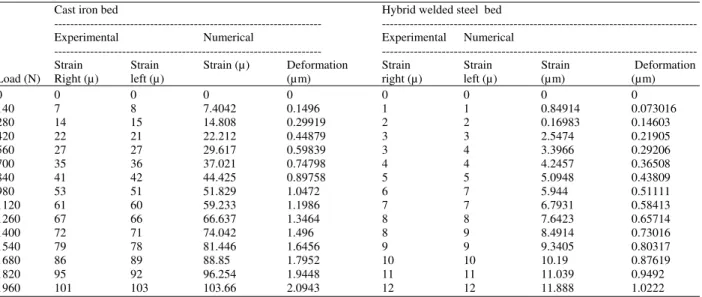
Numerical static analysis of cast iron bed: The model after meshing is subjected to various boundary conditions and the loads are specified as shown in Table 5. The machine tool bed is fixed at ten places by bolted supports so they are modeled as fixed supports. The static test is conducted by gradually increasing the loads and measuring strain at various points on the lathe bed. The comparison of numerical and experimental tests results are shown in Table 5 and are found to be closer to each other. The strain plot and the total deformation plot for 140 N are shown in Fig. 5.
Fig. 5: Total deformation and strain plot of 140 N of cast iron bed
Fig. 6: Experimental setup for modal analysis of hybrid welded steel bed
Fig. 7: Response of hybrid welded steel bed
Experimental modal analysis: The experimental modal tests are used to determine the modal frequencies of the machine tool bed. This will help to identify if the natural frequency coincide with operating frequency which in turn will help to control vibration. The setup is shown in Fig. 6. The results are shown in Fig. 7.
The test procedure is similar to that conducted on cast iron bed.
Fig. 8: Experimental setup for static analysis of hybrid welded steel bed
Fig. 9: Numerical modal analysis of hybrid welded
steel bed
614 Fig. 10: Total strain and deformation plot of 140 N for
hybrid welded steel bed
Fig. 11: Comparison of modal frequencies
Fig. 12: Comparison of damping ratios
Fig. 13: Comparison of numerical deformation
Fig. 14: Comparison of experimental strain
Table 1: Material properties of cast iron
Properties Cast iron
Density 7200 kg m³−1
Young’s modulus 2.1 e+11 Pa
Specific Heat 434 J kg−1 °C
Thermal Conductivity 60.5 W m−1 °C
Poisson’s ratio 0.3
Table 2: Comparison of natural frequencies of the cast iron bed Experimental Numerical Error Damping
natural natural percentage ratio,
Mode frequency (Hz) frequency (Hz)
1 830 898.42 8.24 0.0060
2 1130 1179 4.33 0.0035
3 1260 1256.4 -0.28 0.0039
4 1320 1394.5 5.64 0.0057
Table 3: Material properties of welded steel and polymer concrete
Properties Steel Polymer concrete
Density 7850 kg m³−1 2300 kg m³−1
Young’s modulus 2.1 e+11 Pa 3 e+10 Pa Specific Heat 434 J kg−1 °C 780 J kg −1°C Thermal Conductivity 60.5 W m−1 °C 0.72 W m−1°C
Poisson’s ratio 0.3 0.18
Table 4: Comparison of natural frequencies of the hybrid welded steel bed
Experimenta lnumerical
natural natural Error Damping
Mode frequency (Hz) frequency (Hz) percentage ratio,
1 1030 934.63 -9.259 0.017
2 1215 1192.6 -1.843 0.0041
3 1390 1409.7 1.417 0.0036
4 1725 1905.6 10.46 0.0029
Numerical analysis of hybrid welded steel bed: Numerical tests are used to validate the experimental results. The hybrid bed is designed in Pro-E Wildfire 5.0 and analyzed in ANSYS software. The material properties used for both the static and modal analysis are shown in Table 3.
140 7 8 7.4042 0.1496 1 1 0.84914 0.073016
280 14 15 14.808 0.29919 2 2 0.16983 0.14603
420 22 21 22.212 0.44879 3 3 2.5474 0.21905
560 27 27 29.617 0.59839 3 4 3.3966 0.29206
700 35 36 37.021 0.74798 4 4 4.2457 0.36508
840 41 42 44.425 0.89758 5 5 5.0948 0.43809
980 53 51 51.829 1.0472 6 7 5.944 0.51111
1120 61 60 59.233 1.1986 7 7 6.7931 0.58413
1260 67 66 66.637 1.3464 8 8 7.6423 0.65714
1400 72 71 74.042 1.496 8 9 8.4914 0.73016
1540 79 78 81.446 1.6456 9 9 9.3405 0.80317
1680 86 89 88.85 1.7952 10 10 10.19 0.87619
1820 95 92 96.254 1.9448 11 11 11.039 0.9492
1960 101 103 103.66 2.0943 12 12 11.888 1.0222
Numerical modal analysis: Numerical modal analysis is used to determine the natural frequencies of the machine tool bed. The bed is fixed at the bottom using bolts and they are modeled as fixed supports. The numbers of modes are specified. The modal analysis results are shown in Fig. 9 and comparison of experimental and numerical values are shown in Table 4.
RESULTS
The comparison of numerical and experimental modal tests prove that natural frequencies of hybrid welded steel bed is higher limiting the probability of resonance as shown in Fig. 11. The damping ratio of the hybrid welded steel bed was 3.5 times that of cast iron as shown in Fig. 12. The comparison of numerical deformation values as shown in Table 5 and the graphical representation in experimental and numerical values are shown in Table 4.
DISCUSSION
Numerical static analysis: The static analysis requires loads acting on different parts of the machine tool. Due to experimental constraints, the load is applied at the area assuming that the carriage is near tailstock as shown in Fig. 8. The strain and total deformation plot 140 N is as shown in Fig. 10. The strain and deformation values are tabulated as shown in Table 5.
Fig. 13 shows that the deformation in welded steel bed is very low compared to cast iron which implies an increase in stiffness of the machine tool bed. The comparison of numerical and experimental strain values of cast iron and hybrid welded steel as shown in Table 5 and Fig. 14 shows that the latter has lesser strain and hence improved static performance.
CONCLUSION
In this study an attempt has been made to replace cast iron as a lathe bed material with a hybrid bed made of welded steel and polymer concrete core thereby improving the static and dynamic performances of the lathe bed. Numerical modal and static analyses are conducted on the CAD model of the lathe beds. Experimental modal and static analyses are conducted on the fabricated models of the lathe beds to determine natural frequencies, damping ratios and strain respectively. The comparison of numerical and experimental values is compared using graphs and was found to match with each other. The comparison was also made between the values of strain and natural frequencies of cast iron and hybrid welded steel bed which proved the superiority of hybrid welded steel over cast iron. The tests confirm the suitability of welded steel bed as a suitable replacement to cast iron as a material for machine tool structures.
REFERENCES
Acherkan, N., N. Ignatyev, Y. Mikheyev and V. Khomyakove, 2000. Machine Tool Design. Volume 4 Mir Publications, Moscow. pp: 496. 3, ISBN:0898750490
616 Kim, H.S., K.Y. Park and D.G. Lee, 1995. A study on
the epoxy resin concrete for the ultra-precision machine tool bed. J. Mat. Proc. Tech., 48, 1995, pp: 649-655. DOI:10.1016/0924-0136(94)01705-6 Suh, J.D. and D.G. Lee, 2008. Design and manufacture
of hybrid polymer concrete bed for high speed CNC milling machine. Int. J. Mech. Mat. Design, 4: 113-121, doi: 10.1007/s10999-007-9033-3
Kalpakjian, S. and S.R. Schmid, 2009. Manufacturing Engineering and Technology. 4th Edn., Pearson Education, Inc., pp: 1157. ISBN: 978-81-7758-170-6,2009
Rahman, M. and M.A. Mansur, 1990. Development and evaluation of ferrocement legs of a lathe. Int. J. Mach. Tool. Manuf., 30: 629-636. DOI:10.1016/0890-6955(90)90012-8
Rahman, M., M.A. Mansur and K.H. Chua, 1993. Evaluation of a lathe with ferrocement bed. CIRP Annals-Manuf. Technol., 42: 437-440. DOI: 10.1016/S0007-8506(07)62480-9
Rahman, M., M.D. Abul, Mansur and M.D.K., 2001. Bazul, Non-conventional materials for machine tool structures. Int. J. JSME., 44: 1-11, DOI: 10.1299/jsmec.44.1
Orak, S., 2000. Investigation of vibration damping on polymer concrete with polyester resin. Ceme. Conc. Resea., 30: 171-174. DOI: 10.1016/S0008-8846(99)00225-2
Shevchuk, S.A., 2008. Cast iron in machine tools.
Russian. Eng. Rese., 28: 901-903. DOI: 10.3103/S1068798X08090153
Rao, S.S., 2009. Mechanical Vibrations. 4th Edn., Pearson Education, pp: 1104.ISBN: 13:9780132128193
Suh, J.D., D.G. Lee and R. Kegg, 2002. Composite machine tool structures for high speed milling machines,” CIRP Annals – Manuf. Technol., 51: 285-288. DOI: 10.1016/S0007-8506(07)61518-2 Abuthakeer, S.S., G. Mohankumar and P.V. Mohanram,
2010. Prediction and control of cutting tool vibration in CNC lathe with ANN. Nat. J. Technol., 6: 74-86. ISSN-0973-1334
Lan, T.S., 2010. Parametric deduction optimization for surface roughness. Am. J. Applied Sci., 7: 1248-1253. ISSN 1546-9239