Ciência Rural, v.47, n.10, 2017.
Fluid-dynamic behavior of flaxseed fluidized and spouted bed
Comportamento fluidodinâmico de sementes de linhaça em leito fluidizado e jorro
Elza Brandão Santana1* Maria da Conceição da Costa Valente1 Lorena Gomes Corumbá2 Elisangela Lima Andrade1 Cristiane Maria Leal Costa3 Lênio José Guerreiro de Faria1
ISSNe 1678-4596
Received 07.04.16 Approved 06.14.17 Returned by the author 08.08.17 INTRODUCTION
Flaxseed (Linum usitatissimum L.) is the
fruit of flax, a plant belonging to the family Linaceae.
According to the official grain grading guide of
the CANADIAN GRAIN COMMISSION (CGC)
of 2016, there are two types of flaxseed: ordinary flax (flaxseed) and Solin, which presents yellow integument and is known as golden flaxseed in Brazil
(MORRIS and VALSEY-GENSER, 2003). Several
benefits have been attributed to the consumption of
flaxseed (C: 18:3, ω-3) owing to high amounts of
a-linolenic fatty acid, lignans, fibers, or gum (GUI
et al., 2012).
The quality management of seeds is of great importance in adding commercial and economic value. This relies on certain care, including minimizing the mechanical damage that occurs
during processing (SILVEIRA & VIEIRA, 1982). According to CARVALHO & NAKAGAWA (1988),
mechanical damage might ruin essential seed structures, increase susceptibility to microorganisms
1Programa de Pós-graduação em Engenharia de Recursos Naturais da Amazônia (PRODERNA), Universidade Federal do Pará (UFPA),
66075-110, Belém, PA, Brasil. E-mail: [email protected]. *Corresponding author.
2Faculdade de Engenharia, Universidade Federal do Pará (UFPA), Campus Salinópolis, Salinópolis, PA, Brasil.
3Programa de Pós-graduação em Engenharia Química (PPGEQ), Universidade Federal do Pará (UFPA), Belém, PA, Brasil.
ABSTRACT: Processing of particles in a moving bed, such as a fluidized bed or a spouting bed, is commonly used in the operations of drying,
coating, and granulation of particulate systems. This process has applications in the chemical, pharmaceutical and, presently, agronomical industries, especially for seed treatment/coating. This research aimed to analyze the fluid-dynamic behavior of fluidized and spouting beds with different air temperatures and loads of flaxseeds (Linum usitatissimum L.), with estimates of the fluid-dynamic parameters correlated to each process. The parameters were compared with the values obtained from classical correlations in the literature, with indications of associated percentages of deviation. Influence of fluid dynamics on the physiological quality of seeds was assessed by germination tests and the germination speed index. An analysis of the results indicated that seed processing was adequate for processing in dynamically active beds; however, temperatures above 50ºC in both beds caused significant reductions in the physiological quality of the seeds. Processing in a fluidized bed presented a smaller reduction of the physiological properties of the flaxseed.
Key words: Linum usitatissimum L., dynamic bed, physiological quality, germination, fluid-dynamic parameters.
RESUMO: O processamento de partículas em leitos móveis, como o leito fluidizado e o leito de jorro, são comumente empregados em secagem,
recobrimento e granulação de sistemas particulados, com aplicações nas indústrias química, farmacêutica, e atualmente na agronômica, em especial no tratamento/revestimento de sementes. Este trabalho tem como objetivo analisar o comportamento fluidodinâmico, em leito fluidizado e jorro, das sementes de linhaça (Linum usitatissimumL.), para diferentes cargas de sementes. Obter as curvas fluidodinâmicas dos leitos: fluidizado e de jorro, estimando os parâmetros fluidodinâmicos correlacionados a cada processo. No leito fluidizado foram determinados: a velocidade de mínima fluidização, queda de pressão na máxima e mínima fluidização, expansão do leito e, porosidade de mínima fluidização e, para o leito de jorro, foram estimados a velocidade de mínimo jorro, queda de pressão máxima e queda de pressão no mínimo jorro. Estes parâmetros foram comparados com os valores obtidos de correlações clássicas da literatura, sendo observados baixos desvios percentuais para os mesmos. Avaliou-se a influência da fluidodinâmica sobre a qualidade fisiológica das sementes através dos testes da germinação e do índice de velocidade de germinação.
Palavras-chave: linhaça, fluidodinâmica, leito de jorro, leito fluidizado.
and sensitivity to fungicides, and reduce germination. In this context, unitary operations in moving-bed reactors such as fluidized and spouted bed dryers have been efficient in optimizing seed processing because they provide a strong solid-fluid contact and; consequently, high rates of heat and mass transfer. A fluidization technique became known in 1940 for the cracking of coal, but it was not until the 1970s that studies on seed processing and coating in fluidized beds were developed, as KUNII & LEVENSPIEL
(1991) reported.
The National Research Council of
Canada coined the term “spouted bed” in 1954. GISHLER & MATHUR (1957) described it as a system applied to large diameter and/or very dense particles whose main fluid-dynamic characteristic is to split the particulate solid flow in three clearly
distinct regions: spout, annulus, and fountain. The
processing of particulates in moving beds has been
used for seed coating (COSTA et al., 2010) in order to
create a barrier against fungi proliferation (GORIM & ASCH, 2012). It has been used for drying pulp to
produce powdered fruits (ROCHA et al., 2011), and
for studying the fluid-dynamic behavior applied to seed treatment in these beds (NASCIMENTO et al., 2015). It showed the importance of the characteristic parameters of beds in order to learn about the fluid-dynamic behavior and, hence, to identify the ideal conditions for processing and mixture of particulates.
This study assessed the fluid-dynamic behavior in fluidized and spouted beds with different loads of flaxseed by obtaining the characteristic fluid-dynamic curve of each bed and, based on statistical analyses and analyses of variance (ANOVA), evaluated the influence of these beds on the physiological quality of the seeds at different temperatures.
MATERIALS AND METHODS
This study assessed a brown variety of flaxseed (Linum usitatissimum L.) obtained from
small farmers in Giruá, State of Rio Grande do Sul, Brazil, in November 2015. The seeds were submitted to pre-drying under ventilation at 35ºC for 4h to reduce moisture. Then, they were stored in plastic containers at 7ºC in 60% relative humidity in a laboratory at the Federal University of Pará, Brazil.
Seed characterization
The determination of the absolute specific mass (ρabs), which is defined as the ratio of the mass
of a solid and the total volume of particles (including pore volume and excluding interparticle spaces) to the
apparent specific mass (ρap)s of flaxseed was performed
in triplicate using the comparison pycnometer method as recommended by WEBB & ORR (1997), with 25-mL pycnometers and hexane as a comparison liquid. The tabulated data of the specific mass of the liquid, together with its mass value added to the pycnometer, is the liquid volume contained in the seeds, hence determined as the difference of seed volume in the pycnometer, which supports obtaining the specific mass.
Specific bulk mass was determined according to a method described by HOLDICH (2002). Seeds were packed in a container of known volume, and then the mass of the particles was weighted in this volume using a 0.0001-g precision scale. The mean Sauter diameter of the particle (dp) was determined by a particle size analysis using Tyler/Mesh sieves with the following openings: 8, 9, 10, and 12mm. A stirrer (Produtest, 220V-5ª) was used at 80rpm for 15min (McCABE et al., 1993). The angle of repose was estimated using the rotary drum method, which was measured after grain flow on a flat surface until reaching static equilibrium, hence considering the angle formed by the free surface and the horizontal plane. Then, grains were sorted according to their flowability, as described by JONG et al. (1999). Sphericity (φ) of the particle was calculated from the estimate of the geometric dimensions of the seeds (a, b, and c) in the three mutually perpendicular axes of the solid by the largest axis. Measurements were conducted with a digital caliper (Minolta Md 80-200mm) with 100 replicates,
according to MOHSENIN (1970).
The seed quality testing determined the physical purity of the seeds. The samples were weighed and sorted according to different components such as
pure seeds, other seeds, and inert waste. Results were expressed as a percentage of pure seeds. The weight of
1,000 seeds was determined using eight replicates of 100 seeds, with each sample weighed individually. The mean of the replicates was multiplied by 10. The results were expressed in grams. The germination rate (GR) was tested using germination plates with 300 seeds each, maintained at 25ºC for seven days. The result was expressed as a percentage of germinated seeds, which were counted from root growth after seven days (BRASIL, 2009). Taking advantage of the conditions of the germination test, the germinated seeds were counted on a daily basis, and GR was calculated using the relation proposed by MAGUIRE (1962).
Fluid-dynamic equipment
to a 4-cv blower through a 2-in galvanized iron pipe. The fluidized bed was composed of an acrylic cylinder with an inner diameter of 16cm, coupled to a plenum chamber that has a stainless-steel distribution plate in the upper portion. The cone used in the spouted bed is 15cm high and has an air inlet with a diameter of 2.54cm at an angle of 60º.
Fluid dynamics
The fluid-dynamic behavior was determined by measuring the increasing and decreasing incoming air flow repeatedly. Pressure drop graphs as a function of gas superficial velocity were created from these data. Velocity range used in the fluidized bed was between 0.57 and 0.66m s-1, and
between 16.96 and 12.34m s-1 in the spouted bed.
Fluid-dynamic parameters that were estimated and compared with the fluidized bed were as follows: (a) The minimum fluidization pressure drop, calculated by using the equation (1) of ZUIDERWEG (1967): ΔP = Lmf (1-εmf). (b) (ρp−
ρf)g, the minimum fluidization velocity using the
correlations described, respectively, in (2) Remf = [25.72+0.0365 Ar]½-25.7 by RICHARDSON (1979)
and (3) Remf = [27.22+0.0408 Ar]½-27.2 by GRACE
(1982). (c) The minimum fluidization porosity and the minimum fluidization height for the following seed loads: 0.40, 0.60, and 0.80kg.
The evaluated spouted-bed parameters were as follows: the maximum spouting pressure drop using the correlation described in equation (4) ΔPmax = H(ρp-ρf)(1-ε)g by PALLAI & NÉMETH
(1969), and the minimum spouting velocity using
the correlations shown in equation (5) (Rei)mj = 0.051 (Ar)0.59 (D
i/Dc) 0.10 (H
mj/Dc)
0.25 described by
MUKHELENOV & GORSHTEIN (1965), and (6) Umj = (1/1.74) [(dp/Dc) (Di/Dc)
⅓ (2gH
mj ((ρp-ρf)/
ρf)
½-0.25] reported by ABDELRAZEK (1969). The
following seed loads were used: 1.59, 2.44, and
2.95 kg. ΔP and ΔPmax are the minimum fluidization
pressure drop in the fluidized bed, and the maximum spouting pressure drop (Pa), respectively. ρp and ρf
are the specific masses of the particulate and fluid (kg m-3), and dp is the particulate diameter (μm). L
mf, H, and Hmj are, respectively, the heights of the fluidized
bed under minimum fluidization, in the static bed, and the minimum spouting bed (m). εmf is the minimum
fluidization porosity. Remf and Reimj are the Reynolds
number calculated from the conditions of minimum fluidization and Di, respectively. Ar is the Archimedes
number. Dc and Di are, respectively, the column
diameter and air inlet diameter (m), g is gravitational acceleration (m/s2), U
mf and Umj are the minimum
fluidization velocity and minimum spouting velocity (m/s), respectively.
Experimental design
All experiments were carried out with a seed load of 1.59kg for 90min. The experimental design was a randomized complete block design, which investigated the influence of factors such as temperature (35, 50, and 65ºC in treatments) and bed type (seeds treated in fluidized and spouted bed in blocks), in triplicate, totaling 36 experimental units. Seeds not submitted to beds were used as controls for the physiological parameters of germination (GERM, %) and the germination rate (GR, days-1).
The means were submitted to an analysis of variance (ANOVA) at a significance level of 5% (α = 0.05). When significant, these were compared using the Tukey test at a significance level of 5%, with the aid
of the software Statistica, version 13.1. To validate
the conclusions using ANOVA, the homogeneity of variances (Bartlett’s and Levene’s test) and normality of variance (Kolmogorov-Smirnov and Anderson-Darling) tests were performed with the experimental data at α = 0.05 (not shown in this article).
RESULTS AND DISCUSSION
Characterization of raw material
The following values were reported for the
estimated results of flaxseed characterization: absolute specific mass 1.28g cm-3 (CV = 8.66%), apparent
specific mass 1.11g cm-3 (CV = 8.22%), and specific
bulk mass 0.64g cm-3 (CV = 0.02%). In view of these
results, the actual specific mass presented a value close to that obtained by COŞKUNER & KARABABA (2007), from 1.00 to 1.11g cm-3. The sphericity of the
seeds was 0.54 (CV = 9.92%), the mean Sauter diameter was 1.74μm (CV = 0.49%), and the angle of repose was 34.75º. This indicated that particles had good fluidity, which favored their flow ability in relation to the dynamics (JONG et al., 1999). An evaluation of seed quality showed that the GR was 98% (CV = 2.04%), a result superior to that observed by FLOSS (1983), in which the GR of flaxseed was 80%. The batch also had 85.0% of pure seeds (CV = 2.48%) and 1,000 seeds weighted 0.52 g (CV = 2.31%).
Seed classification is of great importance, both from the agronomic standpoint since it aids the selectivity and quality control (MOHSENIN, 1970),
and the technological point of view since it provides
Analysis of fluid-dynamic behavior
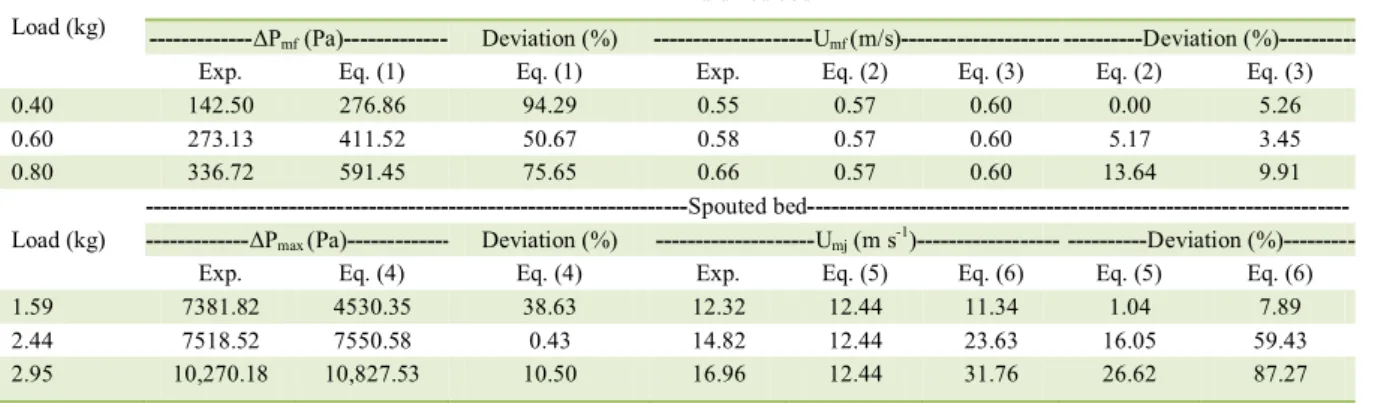
The fluid-dynamic parameters of the fluidized bed were estimated using the fluid-dynamic curve that was obtained (Table 1). The minimum fluidization porosity (εmf) showed lower values such
as 0.29 (0.40kg), 0.26 (0.60kg), and 0.20 (0.80kg) at each load increase. The minimum fluidization height
(Hmf) showed values such as 0.03 m (0.40kg), 0.04m
(0.60kg), and 0.06m (0.80kg). Although, the porosity
decreased, this effect caused no resistance to the
passage of the fluidization air that could compromise the fluid dynamics with the increase of seed load. The minimum fluidization pressure drop (ΔPmf)
directly influenced the seed mass. Nevertheless, a comparison between the experimental and calculated
values showed high deviation values, indicating
that equation (1) does not adequately describe the experimental data. ALMEIDA & ROCHA (2002) also reported marked deviations when studying fluid dynamics in fluidized and spouted beds for the fluidization of broccoli seeds.
An analysis of the results for minimum fluidization velocity presented a mean value of 0.59±0.05m s-1. The evaluated correlations showed
that Umf values, compared with the experimental data,
had small deviations (>20%). This demonstrated, according to KUNII & LEVENSPIEL (1991), that such correlations adequately describe the fluid-dynamic behavior of fluidized beds under minimum fluidization conditions. ALMEIDA & ROCHA (2002) also observed this behavior while fluidizing broccoli seeds.
In the spouted-bed study, small porosity variations were observed for the seed bed in case of minimum spouting porosity (εmj) in relation to
seed loads such as 0.48 (1.59kg), 0.46 (2.44kg), and
0.44 (2.95kg). These variations are a result of the sphericity of the seeds and the packaging of solids in the bed. That is, it is a function of the manner that the particles are settled in the bed, which can result in a larger void fraction in case of a smaller seed load. The analysis of fluid-dynamic parameters (Table 1) in relation to the maximum pressure drop shows an increased pressure drop with a solid load in the bed, presenting satisfactory deviations (below 10%) for loads of 2.44 and 2.95kg. ALMEIDA & ROCHA (2002) and NASCIMETO et al. (2015) also observed this fluid-dynamic behavior in fluidized and spouting beds when fluidizing broccoli and millet seeds, respectively. It was also observed that the minimum spouting velocity increased as the seed load in the bed increased. The same deviations were reported only in the 1.59-kg load for both equations (5) and (6), suggesting that the processing/fluid dynamics of flaxseed in the spouting bed is best conducted in that seed load. NASCIMENTO et al. (2015) observed a similar behavior in the fluid-dynamic behavior of millet seeds.
Statistical analysis
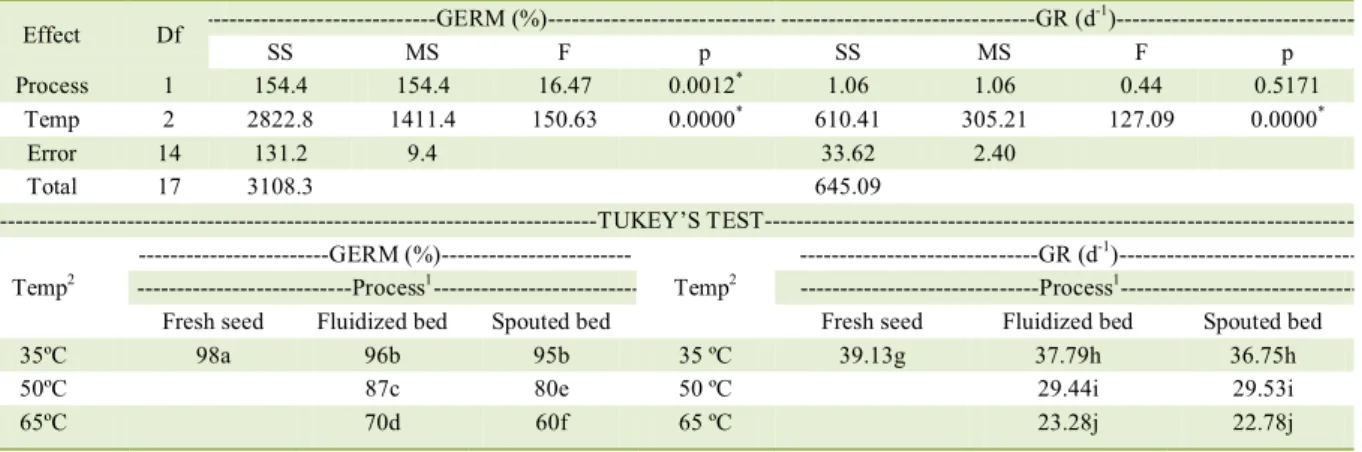
The variances obtained were homogeneous, and there is no evidence of a lack of normality. Table 2 also shows the comparison between mean values of the physiological parameters of flaxseed processed in moving beds in relation to the temperature. Based on Tukey’s test, at α=0.05, a significantly decreased means was observed with increased temperature, thus showing effectively different means. Statistically, equal means were also reported for both beds at 35ºC for the GERM response, and at all temperatures and beds evaluated
for the GR response.
Table 1 - Comparison between fluid-dynamic parameters of flaxseed in fluidized and spouted beds.
Load (kg)
---Fluidized bed---
---ΔPmf (Pa)--- Deviation (%) ---Umf (m/s)------Deviation (%)
---Exp. Eq. (1) Eq. (1) Exp. Eq. (2) Eq. (3) Eq. (2) Eq. (3)
0.40 142.50 276.86 94.29 0.55 0.57 0.60 0.00 5.26
0.60 273.13 411.52 50.67 0.58 0.57 0.60 5.17 3.45
0.80 336.72 591.45 75.65 0.66 0.57 0.60 13.64 9.91
Load (kg)
---Spouted bed
---ΔPmax (Pa)--- Deviation (%) ---Umj(m s-1)---Deviation (%)
---Exp. Eq. (4) Eq. (4) Exp. Eq. (5) Eq. (6) Eq. (5) Eq. (6)
1.59 7381.82 4530.35 38.63 12.32 12.44 11.34 1.04 7.89
2.44 7518.52 7550.58 0.43 14.82 12.44 23.63 16.05 59.43
Physiological analysis after fluid dynamics
The physiological results of the flaxseed analyzed by Tukey’s test (Table 2) showed that the evaluated bed types decreased GERM and GR when compared to data for fresh seeds. It is also observed that these parameters are mainly decreased in the spouted bed, which can be explained by the solid-fluid intense interaction this bed type causes in the particles. This intensifies the friction between seeds and the seed-bed wall, which can damage seeds and favor poor quality parameters.
Nevertheless, concerning the bed type used, only GERM showed statistically significant differences above 50ºC. That is, above this temperature, the GR of flaxseed is no longer agronomically acceptable since FLOSS (1983) reported that it should be 80%. ALMEIDA & ROCHA (2002) reported a similar result at room temperature when the physiological quality of broccoli seeds was analyzed in fluidized and spouted beds. These
researchers reported no decreased GR, indicating
that seeds could produce normal seedlings under laboratory conditions.
CONCLUSION
Flaxseed showed good fluid-dynamic behavior that was appropriate for processing in dynamically active beds. However, temperatures above 50ºC caused significantly decreased seed quality in both beds. In addition, data on the conservation of
seed quality after processing indicated that the GR was slightly superior (87%) in a fluidized bed at 50ºC.
ACKNOWLEDGEMENTS
The authors are grateful to Conselho Nacional de
Desenvolvimento Científico e Tecnológico (CNPq) (Process 400624/2014-1) for their financial support of this research.
REFERENCES
ABDELRAZEK, I.D. An analysis of thermo-chemical deposition in spouted beds. Ph. D. (Thesis) - Univ. of Tennessee, Knoxville,
145 p., 1969.
ALMEIDA, C.; ROCHA, S.C.S. Fluid-dynamic of broccoli seeds in fluidized and spouted beds. Sci Agric, v.59, p.645-652, 2002.
Available from: <http://www.scielo.br/pdf/sa/v59n4/a04v59n4. pdf>. Accessed: Jan. 16, 2016.
BRASIL. Ministry of Agriculture and Supply. Germination test.
In: Rules for seeds analysis. Brasília: SNAD/DNDV/CLAV, 398
p., 2009. Available from: <http://www.agricultura.gov.br/assuntos/ insumos-agropecuarios/arquivos-publicacoes-insumos/2946_ regras_analise__sementes.pdf>. Accessed: Oct. 21, 2015.
CANADIAN GRAIN COMMISSION. Official grain grading
guide flaxseed. 556 p., 2016. Available from: <https://www. grainscanada.gc.ca/oggg-gocg/oggg-gocg-2016-eng.pdf>.
Accessed: Dec. 16, 2015.
CARVALHO, N.M. de; NAKAGAWA, J. Seeds: science,
technology and production. 3.ed. Fundação Cargill, 424 p., 1988.
COŞKUNER, Y.; KARABABA, E. Some physical properties of flaxseed (Linum usitatissimum L.). J
Food Eng, v.78, p.1067-1073, 2007. Available from:
Table 2 - ANOVA and Tukey’s test.
---ANOVA---Effect Df ---GERM (%)--- ---GR (d
-1
)---SS MS F p SS MS F p
Process 1 154.4 154.4 16.47 0.0012* 1.06 1.06 0.44 0.5171
Temp 2 2822.8 1411.4 150.63 0.0000* 610.41 305.21 127.09 0.0000*
Error 14 131.2 9.4 33.62 2.40
Total 17 3108.3 645.09
---TUKEY’S TEST
---Temp2
---GERM (%)--- Temp2
---GR (d-1)---
---Process1--- ---Process1---
Fresh seed Fluidized bed Spouted bed Fresh seed Fluidized bed Spouted bed
35ºC 98a 96b 95b 35 ºC 39.13g 37.79h 36.75h
50ºC 87c 80e 50 ºC 29.44i 29.53i
65ºC 70d 60f 65 ºC 23.28j 22.78j
<http://ac.els-cdn.com/S0260877406000136/1-s2.0- S0260877406000136-main.pdf?_tid=945dae86-658a-11 e 7 - b b 0 3 - 0 0 0 0 0 a a c b 3 6 2 & a c d n a t = 1 4 9 9 7 0 3 3 3 3 _ ae2d4de4fcc4f517b11194a2b122ec01>. Accessed: Dec. 16, 2015.
doi: 10.1016/j.foodeng.2005.12.017.
COSTA, C.M.L. et al. Effect of process variables on efficiency and particle growth of Spilanthes oleracea seeds coating. Mater
Sci Forum, v.660-661, p.419-425, 2010. Available from: <https:// www.scientific.net/msf.660-661.419>. Accessed: Dec. 14, 2015.
doi: 10.4028/www.scientific.net/MSF.660-661.419.
FLOSS, E.L. Flax, cultivation e utilização. Passo Fundo: UPF,
Faculdade de Agronomia, 39p., 1983. Available from: <https:// core.ac.uk/download/pdf/33886333.pdf>. Accessed: Jun. 09, 2015.
GISHLER, P.E.; MATHUR, K.B. Method of contacting solid particles with fluids. Ottawa: National Research Council of
Canada, 1957. U.S Patent n.2.786.280, 1957. Available from: <http://www.freepatentsonline.com/2786280.pdf>. Accessed:
Aug. 12, 2015.
GORIM, L.; ASCH, F. Effects of composition and share of seed coatings on the mobilization efficiency of cereal seeds during germination. J Agro Crop Sci, v.198, p.81-91, 2012.
Available from: <http://onlinelibrary.wiley.com/doi/10.1111/ j.1439-037X.2011.00490.x/full>. Accessed: Dec. 08, 2015. doi: 10.1111/j.1439-037X.2011.00490.x
GRACE, J.R. Fluidized bed hydrodynamics. In: Hetsroni, G., ed.
Handbook of multiphase systems. New York: Hemisphere and
McGraw-Hill, p.8-6, 1982.
GUI, B. et al. Distribution of cyclolinopeptides in flaxseed
fractions and products. J Agric Food Chem, v.60,
p.8580-8589, 2012. Available from: <https://www.researchgate.net/ profile/Youn_Shim/publication/230684344_Distribution_of_ Cyclolinopeptides_in_Flaxseed_Fractions_and_Products/ links/02e7e5345d4c5c485c000000.pdf>. Accessed: Dec. 12, 2015. doi: 10.1021/jf3023832.
HOLDICH, R.G. Fundamentals of particle technology. Midland
Information Technology and Publishing, p.45-54., 2002.
JONG, J.A.H. et al. Properly determine powder flowability to maximize plant output. Chem Eng Prog, v. 95,
p.25-34, 1999. Available from: <https://www.researchgate.net/ profile/Hendrikus_Finkers/publication/265737451_Properly_ Determine_Powder_Flowability_to_Maximalize_Plan_Output/ links/541ab4940cf2218008bfdaf1.pdf>. Accessed: Oct. 11, 2015.
KUNII, D.; LEVENSPIEL, O. Fluidization engineering. New
York: John Wiley, 491 p. 1991.
MAGUIRE, J.D. Speed of germination: aid in selection and evaluation for seedling emergence and vigor. Crop Sci, v. 2,
p.176-177, 1962. Available from: <https://dl.sciencesocieties. org/publications/cs/abstracts/2/2/CS0020020176/preview/pdf>.
Accessed: Aug. 08, 2015.
McCABE, W.L. et al. Unit operations of chemical engineering.
5.ed. New York: McGraw-Hill, 1154 p., 1993.
MOHSENIN, N. Physical properties of plant and animal
materials. New York: Gordon and Breach Science Publisher, p.
587-593, 1970.
MORRIS, D.H.; VAISEY-GENSER, M. Flaxseed. Enc
Food Sci Nutr, v. 10, p.2525-2531, 2003. Available from: < h t t p : / / w w w. s c i e n c e d i r e c t . c o m / s c i e n c e / a r t i c l e / p i i / B012227055X014024>. Accessed: Sept. 08, 2015. doi: 10.1016/B0-12-227055-X/01402-4.
MUKHLENOV, I.P.; GROSHTEIN, A.E. Investigation of a spouting bed. Khim Prom, v.41, p.443, 1965.
NASCIMENTO, L.D. et al. Fluid-dynamics evaluation in a conical spouted bed and characterization of foxtail millet seeds. Particuology,
v. 23, p.75-81, 2015. Available from: <http://www.sciencedirect. com/science/article/pii/S1674200115001091?via%3Dihub>. Accessed: Aug. 12, 2015. doi: 10.1016/j.partic.2015.01.009.
PALLAI, I.; NEMETH, J. Analysis of flow in a spouted bed apparatus by the so called phase diagram. In: International Congress Chemical Engineer (CHISA), v. 3, 1969.
RICHARDSON, J.F.; JEROMINO, M.A.D.S. Velocity-voidage relations for sedimentation and fluidization. Chem Eng Sci, v. 34, p.1419-1422, 1979.
ROCHA, S.C.S. et al. Drying of tropical fruit pulps: Spouted bed process optimization as a function of pulp composition. Drying
Technol,v. 29, p.1587-1599, 2011. Available from: <https://www.
researchgate.net/publication/233008311_Drying_of_Tropical_ Fruit_Pulps_SpoutSp_Bed_Process_Optimization_as_a_ Function_of_Pulp_Composition>. Accessed: Aug. 07, 2015. doi:
10.1080/07373937.2011.585442.
SILVEIRA, J.F.; VIEIRA, M.G.G.C. Beneficiamento de sementes.
InformeAgropecuário,v. 8, p.50-56, 1982.
WEBB, P.A.; ORR, C. Analytical methods in fine particle technology. Norcross: Micromeritics Instrument Corporation, 301
p., 1997.