International Journal of Advanced Biotechnology and Research (IJBR) ISSN 0976-2612, Online ISSN 2278–599X, Vol-7, Special Issue3-April, 2016, pp335-344 http://www.bipublication.com
Research Article
The effect of density and inflorescence removing on yield and yield
components of potato (
Solanum tuberosum
L.)
Ali Nasrollahzadeh Asl
Assistant prof., Department of Agronomy, College of Agriculture,
Khoy Science and Research Branch, Islamic Azad University, Khoy, Iran.
Email: [email protected]
ABSTRACT
This experiment was conducted to assess the effect of florescence removing and plant density on yield of potato as factorial based on the randomized complete block design with two factors and three replications in a farm located in Majid Abad region of Khoy province, Iran during spring of 2014. The first factor was florescence removing at two levels of florescence removing and not removing florescence; second factor included density at 6 levels of 3/5, 4/5, 5/5, 6/5, 7/5 and 8/5 plants per square meter. The obtained results indicated that florescence removing and density had a significant effect on tuber size, tuber weight, number of leaves, number of branches and tuber yield. The tuber yield increased to 3/7 tons per hectares when florescence was removed and the most tuber yield was equal to 39/63 tons per hectares under conditions of density of 6/5 plants per square meter and removed florescence.
Keywords: density, removing florescence, potato, yield
INTRODUCTION
Potato (Solanum tuberosum L.) is a crop with an important role in human nutrition. This plant is considered as world's fourth main crop after wheat, corn and rice and has an important role in nutrition of people all around the world (Gumul et al, 2011). It would be vital to increase efficiency of agricultural products due to the increasing population and decreasing food products. Farming, plant breeding and physiologic methods such as density of appropriate planting, changes in physiologic systems including reducing respiration, eliminating additional and useless storage, increasing in leaf area index, and increasing the growing plant season can be applied to increase potato yield per unit area (Rezaee & Soltani). Florescence and real seeds of potato grow out of the soil at the same time of growth of rhizomes and tubers in soil and tubers and flowers compete to attract Assimilates (Almekinders &
Formation of florescence in sugar beet is undesirable at first year, because growth of root would be stopped due to the formation of stalk and performance of root and sugar will be reduced due to the hard and woody root. Some manipulated figures by experts are using to prevent from flowering of sugar beet (Khajepoor, 2004). Formation of florescence in tobacco also would transfer glucose and nitrogen from leaves to formed seed so that the result will be reducing quality of leaves and rapid yellowing of leaves of stem base; hence, florescence removing is a common forced issue in tobacco planting (Khajepoor, 2004). The most efficient sources of potato are leaves and stems and the main sources are tuber, root and rapid growing tissues (Robert & Dwelle, 1990). Majority types of potatoes produce flower and fruit while these fruits are physiologic source that consume created nutrients in physiologic source of leaves; therefore, flowerless and fruitless types will be useful in manipulation (Fisher et al, 2002). According to the report of Almekinders & Struik (1996), flowers and tubers would compete to acquire Assimilates and pruning of flowers or berries would increase transferred Assimilates into underground structures and increase tuber yield. Paul et al (1989) believe that there is a competition between vegetative and
reproductive organs in plants. In this field, Nazari (2010) and Tekalign (2005) conducted some experiments and reported that tuber yield would be increased to 9 and 18 percent when the florescence of potato was removed.
Contrary to tuber, florescence has no nutrition value in this plant and usually falls. This part contains a part of photo assimilate material; therefore, florescence removing can effect on increase of tuber yield. This experiment was implemented in order to assess the effects of florescence removing on tuber yield within different densities.
Materials and Methods
This experiment was implemented in region of Mjid Abad located 5 kilometers in west of Khoy province, Iran in 2014. The soil characteristics of experimented farm includes depth of 30 cm, 24% clay, 14% silt and 35% sand based on conducted studies. These lands contain loamy soil. Electrical conductivity of flower extract has been equal to 0/38 ds/m; hence, there is no salinity. PH level of soil is approximately equal to 8. The amount of organic matters of soil has been few and equal to 0/7 percent (Table 1). Height of this region is 889 meters above sea level and longitude and latitude are 44°, 89´ E, and 38°, 54´ N.
Table 1. Results of soil analysis of experiment place
Salinity
(ppm) PH
Saturation
(%)
Lime
(%) Clay
(%) Silt
(%) Sand
(%)
Tissue
(%)
Organic
carbon
(%)
Nitrogen
(%)
Potassium
(ppm)
Phosphor
(ppm)
0/38 8 37 10 24 41 35 Loam 0/7 0/08 245 12/4
This experiment was conducted as two-factor factorial based on the randomized complete block design with replications. The factor of florescence removing was considered at two levels of florescence removing and not removing florescence and second factor included density at 6 levels of 3/5, 4/5, 5/5, 6/5, 7/5 and 8/5 plants per square meter. Type of potato seed was Agria. This type usually has various thick and mast stems, large, bright green leaves and numerous and purple inflorescences, pale yellow and elongated-oval
combine fertilizers and soil so that the land became flat. Some furrows were created at 75 cm distances from each other. There was terracing and separation of replications of experiments and a hill was considered as unsown in order to separate Crete form each other, and each experimental Crete included four planted rows with length of 5 meters. Planting operation of potato was conducted in 30 April 2011. Potato tubers were disinfected before planting using Mancozeb fungicide at a dose of 3 per thousand and were planted by hand in the middle of hill at depth of 10 Cm and within distance of 75 Cm from each other. When potato plants were grown to 20 Cm, plants were soiling along with added 100 Kg urea fertilizer per hectare as slippage. There was a flowering 35 days after growth of plants and florescence was removed by hand from peduncle part of considered Crete at the start of flowering (formation of flower buds). Different traits of potato including height of potato plant, numbers of branches per plant, numbers of leaves per plant, numbers of tubers per plant, tuber size and tuber weight through random selection of 7 plants from middle rows of each Crete and omitting half a meter from sides; potato harvesting was calculated at a level of 3 meters per square after removing margins (side rows and half a meter from sides of middle rows). Finally, data were analyzed through MSTATC software based on factorial experiment and randomized complete block design and averages were compared through Duncan test at probability level of 5%.
RESULTS AND DISCUSSION Number of branches per plant
There was a significant effect of florescence removing on number of branches per plant at probability level of 5% (Table 2). The maximum number of branches per plant was equal to 16/47 in
each treatment of florescence removing (Table 3). Apical meristem tissue of aboveground partssuch as growing buds, flower buds and growing florescence on the stem are the main centers for Auxin synthesis. Auxins have an effective role in apical dominance, apical bud is deterrent factor of other buds’ growth, and growth hormones especially Auxins can strongly control number of side stems. Therefore, removal of apical bud means removal of Auxin source that can increase number of stems and leaves (Lahooti et al, 2003; Sarmadnia & Koochaki, 1993). Florescence removing in tobacco caused an increase in growth and number of side branches through removing apical dominance of stem (Khajepoor, 2004). Nasrollahzade et al (2003) and Nazari (2010) conducted some experiments and reported a significant increase in number of branches per plant due to florescence removing of potato. It seem that florescence removing decreases apical dominance of stem through destroying Auxin source so that side buds grow and number of branches of potato increases.
There was a significant effect of density in number of branches per plant at probability level of 5% (Table 2). The largest number of branches per plant was equal to 16/36 numbers in density of 3/5 plants per square meter and the lowest number of branches was equal to 13/55 numbers in density of 8/5 plants per square meter (Table 3). There is more space for plant within lowest densities so that empty spaces prepare an appropriate space for side growth of the plant because of low competition. In high density, plant tries to reach more light and grow to more height because there would be little light reaching to the lower parts of plant and there is no enough ability to increase number of side stems.
Means of Squares
Tuber weight
Tuber yield per plant
Tuber yield per hectare Source of
variation
d f
Number of branches per
plant
Number of leaves per plant
Number of tuber per
plant
Tuber size
Table2. Variance analysis of different traits of potato affected by florescence removing and density *, ** significant differences at probability levels of 5% and 1%
Bussan et al (2007) and Jamaati (2009) conducted some experiments on density of potato and reported an effect of plant density on number of produced stems per plant; in addition, plant density could change growth way of stems and competition to access to light would be increased because of increased plant density; on the other hand, the height of stem increases if the length of internodes increases.
Table 3. Comparison of means of the effect of florescence removing and density on different traits of potato
Tuber yield per square meter (Kg) Tuber
yield per pant (g) Tuber weight
(g) Tuber size
(Cm) Number of
tubers per pant Number of
leaves per plant Number
of branches per plant Experimental Factor
28.71 b 511.8 b
74.73 b 5.18 b
6.64 a 44.11 b
13.41 b Not
florescence removing
florescence
32.42 a 592.5 b
91.17 a 6.47 a
6.42 a 51.52 a
16.47 a florescence
removing
Means within a column followed by the same letter are not significantly different according to Duncan’s multiple range test (0.05) 26.69 c 762.9 a
99.26 a 6.75 a
7.68 a 52.34 a
16.36 a 3.5
Density
30.14 bc 669.9 b
92.84 ab 6.19 b
7.23 b 50.58 ab
15.81 ab 4.5
33.34 ab 606.1 c
90.05 ab 5.92 bc
6.72 c 48.01 abc
15 abc 5.5
36. 33 a 559 c
86.96 b 5.76 c
6.44 c 46.7 abc
14.6 abc 6.5
29.16 c 388.9 d
66.93 c 5.37 d
5.84 d 45.94 bc
14.36 bc 7.5
27.75 c 326.5 e
61.71 c 4.97 e
5.27 e 43.36 c
13.55 c 8.5
Means within a column followed by the same letter are not significantly different according to Duncan’s multiple range
tests(0.05)
Number of leaves per plant
There was a significant effect of florescence removing on number of leaves per plant at probability level of 1% (Table 2). The maximum number of leaves per pant was observed equal to 51/52 under condition of florescence removing (Table 3). As it was observed, florescence removing would increase number of side branches as well as number of leaves per plant. Apical bud, flower buds and growing florescence on the stem are Auxin sources and deterrent factors of other buds’ growth through a strong control on number of side branches. Therefore, removal of apical bud means removal of Auxin source that can increase
number of stems and leaves (Lahooti et al, 2003; Sarmadnia & Koochaki, 1993). Nasrollahzade et al (2003) reported that florescence removing in potato had significantly made an increase in number of branches and leaves per potato plant. The most efficient sources in potato are leaves and stems; hence, the yield will be increased if the plant is rapidly reach to its desired index of leaf area because of the increase in leaf area (Robert & Dwelle, 1990). Increased branching per plant would lead to increased leaf area index and effective yield of plant (Beukema & Vanderzag, 1990).
The effect of planting density on number of leaves per plant was significant at probability level of 5%
Florescence 1 10.17* 104.05* 0.136 15.02** 2433.7** 58564** 2.88**
Density
5 6.19* 63.34* 4.72** 2.336** 1365.9** 16656** 0.792**
Density × florescence 5 0.565 5.76 0.072 0.033 140.75 5426.05 0.400**
Experimental error 2
2 1.998 20.478 0.067 0.101 60.77 2646.6 0.097
Coefficient of Variation
(Table 2). The largest number of leaves per plant was observed equal to 52/34 numbers within density of 3/5 plants per square meter and the lowest number of leaves per plant was observed to 43/36 numbers within density of 8/5 plants per square (Table 3). Reduced number of leaves per plant through increased planting density has been a result of reducing number of stem per plant. There have been some researches in field of the effect of plant density on morphologic traits of potato. Accordingly, increased density would reduce the growth space for plants so that the number of branches and leaves per potato plant would be reduced, but number of stems per square would be increased (Ifenkwe & Allen, 1978; Rashidi, 2009). Bussan et al (2007) and Jamaati (2009) conducted some experiments on density of potato and reported an effect of plant density on number of produced stems per plant; in addition, plant density could change growth way of stems and competition to access to light would be increased because of increased plant density; on the other hand, the height of stem increases if the length of internodes increases.
Bussan et al (2007) reported that an effect of plant density on number of produced stems per plant; in addition, plant density could change growth way of stems as well as reducing number of stems per plant so that the competition to access to light would be increased because of increased plant density; on the other hand, the height of stem increases if the length of internodes increases. The dry matter per plant will be reduced because of increased plant density, reduced space and increased competition between plants, but the produced dry matter will be increased per square meter.
Number of tubers per plant
There was an insignificant effect of florescence removing on number of tubers per plant (Table 2). Since potato tubers were formed at the time of florescence removing, there was not any effect of florescence removing on number of tubers. Koochaki et al (1997) reported that start point of tuber formation in potato plant occurs during a
two-week period then buds of flower are formed. Ahmad and Sagar (1982) declared that number of tubers of each plant is determined at the time of tuber formation without any change in number of tuber in future.
Yield of potato includes two parts of number of tubers and average weight of tubers per plant (Rezaee & Soltani, 2001). The conducted experiment by Ahmad and Sagar (1982) indicated that number of tubers per plant is approximately fixed but its weight will be increased during time. Majority of potato tuber formed at first two of three weeks will gain their final size at the end of growth period but tubers that are produced later will transfer their sources in favor of other tubers of mother plant because of long-term competitive with initial tubers (Moadab Shabestari & Mojtahedi, 2008).
The effect of plant density on number of tubers per plant was significant at probability level of 1% (Table 2). The number of tubers per plant gradually decreased with increasing plant density per unit area and the largest number of tubers per plant was equal to 7/68 within density of 3/5 plants per square meter and the lowest number of tuber per plant was equal to 5/27 tubers within density of 8/5 plants per square meter (Table 3).
There will be more space for tubers and the number of tubers per plant will be increased when density is reduced. According to Allen and Wurr (1992), the number of produced tubers per plant will be reduced if the competition in use of space, light, water and nutrient matters increases. According to conducted studies by other researchers, increased density has significant effect on number of produced tubers per plant so that number of produced rhizomes and tubers per plant will be increased when density increases (Rashidi, 2009; Bussan et al, 2007).
Tuber size
and the lowest tuber size per plant was equal to 5/18 Cm when florescence was not removed (Table 3). Flowering period in potato starts at the same time of growth period of tubers; hence, there is an intense competition between tubers in terms of Assimilate consumption and florescence removing can make an increase in tuber size due to the removal of competitor part. Koochaki et al (1997) indicated that growth period of tuber in potato occurred during 30-60 days through a linear method at the time of flower formation on the main stem and branches. Florescence and real seeds of potato grow out of the soil at the same time of growth of rhizomes, tubers in soil; tubers, and flowers compete to attract Assimilates, and Pruning of flowers or berries would increase Assimilates transition to underground structures to increase the size and yield of tuber (Almekinders & Struik, 1996, Framarzi Trans, 2011). According to obtained results from experiment by Ahamd and Sagar (1982), the number of tubers per plant will be fixed while their size and volume increases. Florescence removing can increase tuber yield through increasing tuber size.
Nasrollahzade et al (2005) reported that florescence removing would increase Photosynthesis area of the plant as well as tuber size in potato through removing a competitor distance with tubers and increasing number of branches and leaf area index.
According to the obtained results from variance analysis, the effect of planting density on tuber size was significant at probability level of 1% (Table 2). The largest tuber size per plant was equal to 6/75 Cm within planting density of 3/5 and the lowest tuber size per plant was equal to 4/97 Cm within planting density of 8/5 plants per square meter (Table 3).
Planting density per unit area is an important factor affecting relevant traits to tuber yield. The obtained results of this study indicated that increased planting density caused a reduction in average size of produced tubers. Apparently, the more the plant density and competition between plants in terms of environmental resources, the
lower the growth of plants, the lower transferred photosynthetic matter to tubers and the lower tuber size will be obtained (Georgakis et al, 2002). In conducted studies by Gorgani and Damavandi (2004), Rashidi (2009) and Bussan et al (2007), planting density had an effect on volume and size of tuber so that volume and size of tubers per plant reduced when density of plant increased.
Tuber weight
There was a significant effect of florescence removing on tuber weight at probability of 1% (Table 2). The maximum tuber weight was observed equal to 91/17 g when florescence was removed and the lowest tuber weight equal to 74/73 g when florescence was not removed (Table 3).
Flowering period in potato is equal to growth period of tubers so that there is an intense competition between them in terms of Assimilate consumption and florescence removing can increase tuber weight because of removal of competitor distance. Koochaki et al (1997) reported that growth step of tubers in potato is equal to formation of flowers on the main stem and branches. Almekinders and Struik (1996) and Faramarzi et al (2011) reported that flowers and tubers of potato compete to attract Assimilates so that flower removing would transfer Assimilates to underground structures and increase tuber weight. According to the obtained result from variance analysis, the effect of planting density on tuber weight was significant. (Table 2). The heaviest tuber weight was equal to 99/26 g within density of 3/5 plants per square meter and the lowest tuber weight was equal to 61/71 g within density of 8/5 plants per square meter (Table 3).
Tuber yield per plant
The effect of florescence removing on tuber yield per plant was significant at probability level of 1% (Table 2). The highest tuber yield per plant was equal to 592/54 g in treatment of florescence removing and the lowest tuber yield per plant was equal to 511/87 g in treatment of not removing florescence (Table 3). Since there is an increase in size and average weight of tuber per plant in treatment of florescence removing, the tuber yield per plant will be increased, florescence removing would make and increase in number of branches because of removal of apical dominant of stem; therefor, photosynthetic area of plant will be increased and more Assimilates are produced and transferred to tubers. Flowering period in potato starts at the same time of growth period of tubers; hence, there is an intense competition between tubers in terms of Assimilate consumption and florescence removing can make an increase in tuber size due to the removal of competitor part. Almekinders and Struik, (1996) and Framarzi (2011) confirmed this result in their experiments and reported that florescence and tubers of potato compete to attract Assimilates and Pruning of flowers or berries would increase Assimilates transition to underground structures to increase the yield of tuber. Vince-prue (1975) declared that initial growth of flower needs a considerable amount of available Assimilates in order to produce mature flowers. Paul et al (1989) believe that there is an inter-plant competition between vegetative and reproductive organs of plants. According to conducted studies by Ho and Hewitt (1986), the leaves that are near to the florescence of tomato are the main source of Assimilate for fruits.
The effect of planting density on tuber yield was significant at probability level of 1% (Table 2). The maximum tuber yield per plant was equal to 762/9 g within density of 3/5 plants per square meter and the minimum yield of tuber per plant was equal to 326/5 g within density of 8/5 plants per square meter (Table 3). According to Allen and Wurr (1992), the number and size of produced
tubers per plant will be reduced if the competition in use of space, light, water and nutrient matters increases. In conducted studies by Gorgani and Damavandi (2004), Rashidi (2004) and Bussan et al (2007), planting density had an effect on volume and size of tuber so that tuber yield per plant was reduced when density of plant increased.
Tuber yield per hectare
The effect of florescence removing on tuber yield per hectare was significant at probability level of 1% (Table 2). The largest tuber yield per hectare was equal to 32/4 tones in treatment of florescence removing and the lowest tuber yield per hectare was equal to 28/7 tones in treatment of not removing florescence (Table 3). Florescence removing made an increase of 13% in tuber yield compared to the treatment without florescence removing. Nazari (2010) and Tekalign (2005) conducted some experiments and reported that tuber yield would be increased to 9 and 18 percent when the florescence of potato was removed. Increase in yield is the main target considered in production of farming plants and this target is achieved through different seed and farm improving methods in accordance with some physiologic parameters. The ability of source and power of economic destinations can be named in relation with increase in yield through physiologic methods (Sarmadnia & Koochaki, 1993; Paul et al, 1989). The reason for increased yield under conditions of florescence removing can be removal of a competitor destination with the main destination (tubers) so that florescence and real seeds of potato grow out of the soil at the same time of growth of rhizomes and tubers in soil (Koochaki et al, 1997; Rezaee & Soltani, 2001). According to reports, flowers and tubers of potato compete to attract Assimilates and Pruning of flowers or berries would increase Assimilates transition to underground structures to increase the yield of tuber (Almekinders and Struik, 1996; Framarzi, 2011).
probability level of 1% (Table 2). The most tuber yield per hectare was equal to 36/33 tones within density of 6/5 plants per square meter and the lowest tuber yield per hectare was equal to 26/69 tones within density of 3/5 plants per square meter (Table 3). Although the most tuber yield per plant was observed in density of 3/5 plants per square meter but the most tuber yield per hectare was obtained in density of 6/5 plants per square meter, because environmental resources have not been efficiently used in low density; therefore, tuber yield was increased when density increased to 6/5 plants per square meter and environmental sources was more efficiently used but the tuber yield per unit area was decreased in density of more than 6/5 plants per square meter due to the more
competition for environmental sources and shading of plants on each other. Maher (1996), Asl Gorgani and Damavandi (2004) and Shahzad Jamaati et al (2009) reported based on their experiments that tuber yield was increased when density was increased but it was reduced at very high densities due to the increased competition.
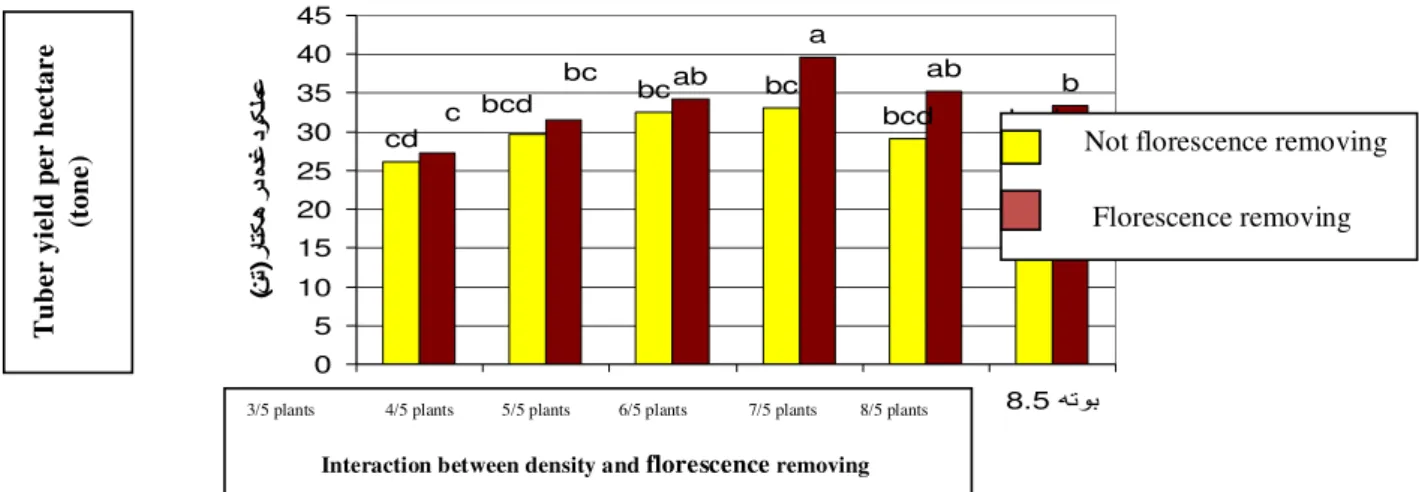
There was a significant interaction between density and florescence removing on tuber yield per hectare and at probability level of 1% (Table 2). The most tuber yield per hectare was equal to 39/63 tones within density of 6/5 plants per square meter under conditions of florescence removing (Diagram 1).
cd
bcd bc bc
bcd bcd
c
bc ab
a
ab
b
0 5 10 15 20 25 30 35 40 45
3.5 ﮫﺗﻮﺑ 4.5 ﮫﺗﻮﺑ 5.5 ﮫﺗﻮﺑ 6.5 ﮫﺗﻮﺑ 7.5 ﮫﺗﻮﺑ 8.5 ﮫﺗﻮﺑ
ﻦ ﯾذآ ﻞ ﮔ فﺬﺣ و ﻢﮐاﺮﺗ ﻞﺑﺎﻘﺘﻣ ﺮﺛا
(
ﻦﺗ
)
ر
ﺎﺘﮑ
ھ
رد
هﺪ
ﻏ
دﺮ
ﮑﻠ
ﻤﻋ
ﻦ ﯾذآ ﻞﮔ فﺬﺣ مﺪﻋ ﻦ ﯾذآ ﻞﮔ فﺬﺣ
Figure 1. Interactional effect of density and florescence removing on tuber yield per hectare
In density of 6/5 plants per square meter, plants have used the maximum level of environmental resources at the lowest level of competition; on the other hand, florescence removing has caused transition of photosynthetic matters of plants to tubers instead of transition to flowers that have no economic value. The mentioned factors have maximized yield per unit area.
REFERENCES
1. Ahmed, CH. M. S., and G. R. Sagar, (1982), Effects of a mixture of NAA + BA on tubers
and growth rates of tuber of( solanum tuberosum L.), Potato Res. 24: 267-278
2. Allen, E. J. and D. C. E. Wurr, (1992), Plant density, In P: M. Harris (ed.) The potato crop, Champan and Hall, London. Pp: 728-793 3. Almekinders, C. G. M. and P. C. Struik, (1996),
shoot development and flowring in potato (Solanum tuberosum L) Potato Res. 39: 581-607
4. Asl Gorgani, R & Damavandi, A., (1383), the effect of number and density of plant on yield and yield components potato tubers, Journal of Agricultural Science, Volume 14, Issue. 3, pp. 41-50
T
ube
r
y
ie
ld
p
er
h
ec
ta
r
e
(t
o
ne
) Not florescence removing
Florescence removing
3/5 plants 4/5 plants 5/5 plants 6/5 plants 7/5 plants 8/5 plants
5. Beukema, H. P. and D. E. Vanderzag, (1990), introduction to potato production, Pudoc Wageningen
6. Bussan, A. J., P. D. Mitchell, M. E. Copas and M. J. Drilias, (2007), evaluation of the effect of density on potato yield and tuber size distribution. Crop Sci. 47: 2462-2472
7. Cornelia, J. and M. Almekinders, (1992), flowering and true seed production in potato (Solanum tuberosum L.), effects of stem density and pruning of lateral stems. Potato Res. 34: 379-388
8. Cornelia, J., and M. Almekinders, (1991), flowering and true seed production in potato (Solanum tuberosum L.), effects of inflorescence position, nitrogen and harvest date of berries, Potato Res., 34: 365-377 9. Dehdar, B. (2007), effect of seed germination
and plant density on yield and agronomic traits of six commercial types of potato in Ardebil, Journal of Seed and Plant, Volume 23, Issue. 1, Pp. 126-131
10.Faramarzi, A., S. Shahrokhi, S. Mehrpouya and D. Hasan Panah, (2011), evaluation of inflorescence removing and salinity anti-stress matter application effects on potato, Solanum tuberosum (cv. Agria) yield, International Conference on Biology, Environment and Chemistry IPCBEE vol.24 IACSIT Press, Singapoore
11.Fisher, D. G., K. L. Deahl and M. V. Rainforth, (2002), amateur potato Breeders manual, 69: 53-61.
12.Georgakis, D. N., D. I. Karafyllidis, N. I. Stavropoulos, E. X. Nianiou and I. A. Vezryroglou, (2002), effect of planting densityand size of potato seed-minitubers on the size of the produced potato seed tuber. Available on the hort, org/ books/ 462/462-149, htm http://www.acta 13.- Gumul, D., R. Ziobro, M. Noga, and R. Sabat,
(2011), Characterization of five potato cultivars according to their nutritional and pro-health components. Acta scientiarum polonorum. Technologia alimentaria. 1: 73-81.
14.Ho, L. C. and J. D. Hewitt, (1986), fruit development, In: J. G. Atherton and J. Rudich (Eds), The tomato crop, A scientific basis for improvement, Chapman and Hall, London, UK, pp. 201-239
15.Ifenkwe, O. P. and E. J. Allen, (1978), effects of row width and planting density on growth and yield of two main crop potato varienties, Number of tubers, total and graded tields and their relationships with above ground stem densities. J. Agric. Sci. Comb. 91: 279-289 16.Jam, A., Ebadi, A., Amini, A., Dehdar, B.,
(2008), the effect of density and size of tuber on some quantitative and qualitative traits of potato, Journal of Research and Development in Agriculture and Horticulture, Volume 4, Issue. 81, pp. 19-29
17.Khajehpoor, M. R. (2004), industrial plants, Isfahan University Press. P. 564
18.Koochaki, A. M., et al, (1997), relationship between crop, soil and water (Translator), University of Mashhad Press, P. 560
19. Lahooti, M., M., et al, (2003), biochemistry and physiology of plant hormones, Mashhad University Press, P. 359
20.Maher, M. J., (1996), the effect of planting density on the production of potato minituber under protection. Proceedings of the Agricultural Research Forum, March 23 and 24,UCD
21.Moadab Shabestari, M., Mojtahedi, M., (2008), Crop Physiology (translation), Tehran University Press, P. 235
22.Mojabi, A., (1994), the application of plant growth regulators in agriculture, Razi University Press, P. 125
23.Nasrollahzadeh Asl, A., et al, (2005), the effect of inflorescence removal on yield and tuber size of potato, Journal of Agricultural Science. Volume 15, Issue 3, Pp. 77-83
25.Paul, C., J. Geertsema , and M.G. Constanh ,(1989), effects of shoot , root and stolon temperature on the development of the potato (solanum tubarosum L.)plant 3 developmant of tubers. Potato Res. 32: 151-158
26.Rashidi, V., (2009), effects of plant distance and tuber size on yield and yield components of potato, NEW AGRICULTURAL SCIENCE Magazine, Issue 16, Pp. 18-26
27.Rezaee, A., & Soltani, A., (2001), potatoes planting (Translation), University of Mashhad Pub., P. 177
28.Robert, B. and B. Dwelle, (1990), Source/Sink relationships during tuber Growth, AM. Potato. J. 67: 829-833
29.Roozbahani, A., Mirzaee, M.M., (2006), effects of plant density and different amounts of nitrogen fertilizer as slippage on the yield of potatoes in Damavand, Journal of New agricultural Findings, First Year, Issue 1, Pp. 13-21
30.Sarmadnia, Gh. H., Koochaki, V., (1993), Physiology of Crop Plants (Translation), Mashhad University Press, P. 468
31.Shahzad Jamaati, S. A., et al, (2009), effect of plant density and nitrogen levels on protein percentage, the concentrations of nitrates in potato tubers, Electronic Journal of Crop Production, Volume II, Issue III, page 151-164 32.Siadat, S. A., et al, (2000), effect of planting
pattern and plant density on yield and some morphological characteristics of three varieties of potato tubers in Ardabil, Journal of Agricultural Sciences, Volume 6. Pp. 91-111 33.Tekalign, T., (2005), Growth and productivity
of potato as influenced by cultivar and reproductive growth: I. Stomata conductance, rate of transpiration, net photosynthesis and dry matter production and allocation. Sci. Hortic. 105: 13- 27
34.Vince-prue, D., (1975), Photoperiodism in plants, McGraw-Hill, London, UK