Identification of Medically Actionable
Secondary Findings in the 1000 Genomes
Emily Olfson1, Catherine E. Cottrell2,3, Nicholas O. Davidson4, Christina A. Gurnett5, Jonathan W. Heusel2, Nathan O. Stitziel6,7, Li-Shiun Chen1, Sarah Hartz1,
Rakesh Nagarajan2,3,8, Nancy L. Saccone3, Laura J. Bierut1*
1Department of Psychiatry, Washington University School of Medicine, St Louis, Missouri, United States of America,2Department of Pathology and Immunology, Washington University School of Medicine, St Louis, Missouri, United States of America,3Department of Genetics, Washington University School of Medicine, St Louis, Missouri, United States of America,4Division of Gastroenterology, Department of Medicine,
Washington University School of Medicine, St Louis, Missouri, United States of America,5Department of Neurology, Washington University School of Medicine, St Louis, Missouri, United States of America,
6Cardiovascular Division, Department of Medicine, Washington University School of Medicine, St Louis, Missouri, United States of America,7Division of Statistical Genomics, Washington University School of Medicine, St Louis, Missouri, United States of America,8Chief Informatics Officer, Pierian DX, St Louis, Missouri, United States of America
Abstract
The American College of Medical Genetics and Genomics (ACMG) recommends that clini-cal sequencing laboratories return secondary findings in 56 genes associated with medi-cally actionable conditions. Our goal was to apply a systematic, stringent approach consistent with clinical standards to estimate the prevalence of pathogenic variants associ-ated with such conditions using a diverse sequencing reference sample. Candidate variants in the 56 ACMG genes were selected from Phase 1 of the 1000 Genomes dataset, which contains sequencing information on 1,092 unrelated individuals from across the world. These variants were filtered using the Human Gene Mutation Database (HGMD) Profes-sional version and defined parameters, appraised through literature review, and examined by a clinical laboratory specialist and expert physician. Over 70,000 genetic variants were extracted from the 56 genes, and filtering identified 237 variants annotated as disease caus-ing by HGMD Professional. Literature review and expert evaluation determined that 7 of these variants were pathogenic or likely pathogenic. Furthermore, 5 additional truncating variants not listed as disease causing in HGMD Professional were identified as likely patho-genic. These 12 secondary findings are associated with diseases that could inform medical follow-up, including cancer predisposition syndromes, cardiac conditions, and familial hypercholesterolemia. The majority of the identified medically actionable findings were in individuals from the European (5/379) and Americas (4/181) ancestry groups, with fewer findings in Asian (2/286) and African (1/246) ancestry groups. Our results suggest that med-ically relevant secondary findings can be identified in approximately 1% (12/1092) of individ-uals in a diverse reference sample. As clinical sequencing laboratories continue to
implement the ACMG recommendations, our results highlight that at least a small number of potentially important secondary findings can be selected for return. Our results also a11111
OPEN ACCESS
Citation:Olfson E, Cottrell CE, Davidson NO, Gurnett CA, Heusel JW, Stitziel NO, et al. (2015) Identification of Medically Actionable Secondary Findings in the 1000 Genomes. PLoS ONE 10(9): e0135193. doi:10.1371/journal.pone.0135193
Editor:Kai Wang, University of Southern California, UNITED STATES
Received:May 18, 2015
Accepted:July 19, 2015
Published:September 2, 2015
Copyright:© 2015 Olfson et al. This is an open access article distributed under the terms of the
Creative Commons Attribution License, which permits unrestricted use, distribution, and reproduction in any medium, provided the original author and source are credited.
Data Availability Statement:All relevant data are within the paper and its Supporting Information files.
confirm that understudied populations will not reap proportionate benefits of genomic medi-cine, highlighting the need for continued research efforts on genetic diseases in these populations.
Introduction
The use of exome and genome sequencing is swiftly increasing in medicine. In addition to identifying specific findings related to the indication for sequencing, these assays that assess a large portion of our genes may uncover other clinically relevant variants. These variants may be deliberately searched for (secondary findings) or accidentally discovered (incidental find-ings) during the course of sequencing [1]. Though the concept of secondary and incidental findings is not new to medicine [2] or genetics [3], the likelihood of uncovering these findings
has dramatically increased with genomic sequencing [4,5].
In March 2013, the American College of Medical Genetics and Genomics (ACMG) recom-mended that clinical sequencing laboratories return pathogenic variants in 56 genes associated
with 24 medically actionable conditions [6,7]. These recommendations prompted a heated
debate. Critics emphasize the patient’s right to choose to receive these findings and object to a mandatory duty to assess and report results [8–10]. They highlight that the predictive value of disease-associated variants in the general population is unknown, and that variants may be
identified at a high frequency, leading to undue anxiety and unnecessary procedures [9,10].
The ACMG board has subsequently modified its recommendation to include an“opt out”
option. Proponents of the recommendations argue that for well-established pathogenic vari-ants associated with the proposed conditions, surveillance and intervention may be lifesaving [11,12]. Furthermore, similar to other areas of medicine, sequencing laboratories have a responsibility to comprehensively evaluate test results. The ACMG working group acknowl-edges that there are limited data to fully support their recommendations and advises regular
review and update of the list [6,7].
Uniformly, there is a call for more research on the ACMG recommended genes and
condi-tions in the general population [6,9–11]. This genetic and ethical landscape motivated us to
test a stringent approach for identifying clinically relevant secondary findings associated with the ACMG list in the 1000 Genomes dataset [13], a diverse sequencing reference sample. Our goal was to estimate the likelihood of observing secondary findings with substantial evidence for disease association to provide insight into the potential implications of these controversial recommendations.
Materials and Methods
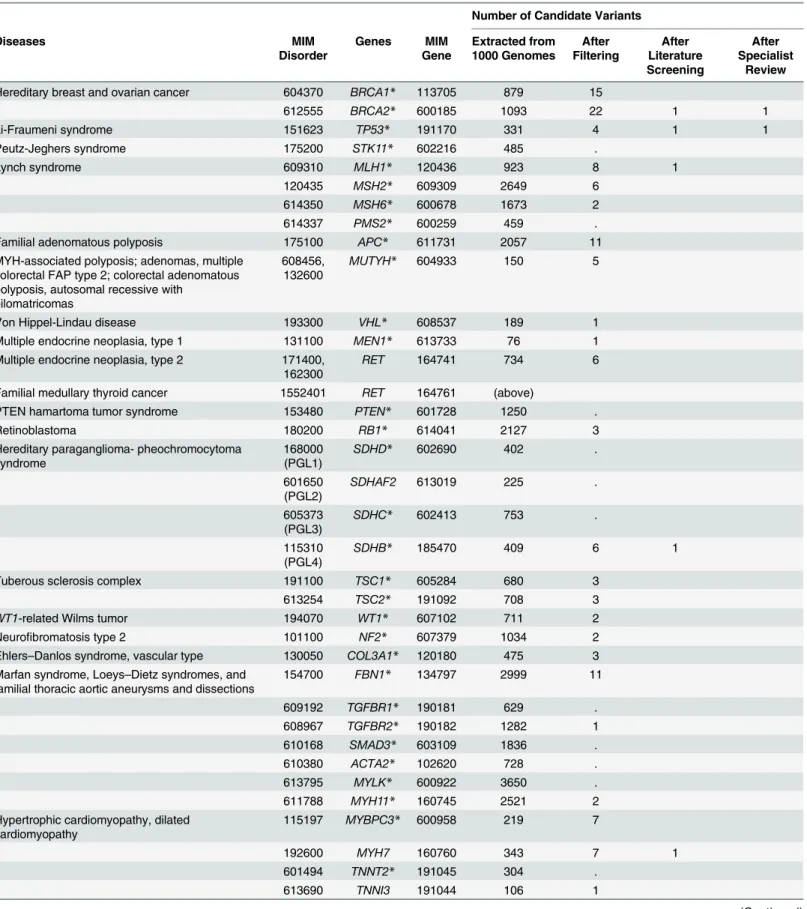
Our analysis focused on identifying actionable pathogenic and likely pathogenic variants in the 56 ACMG genes (Table 1). Because prevalence estimates of these conditions range from 1/200 to 1/1,000,000 (S1 Table), the probability of an individual in the 1000 Genomes dataset having one of these conditions is low. Thus, a threshold with high specificity for identifying secondary findings is critical to reduce false positive results that may lead to unnecessary procedures and altered life planning. Our approach emphasizes specificity by integrating informatics filtering, literature review, and expert evaluation.
by K08DA030398 and R01DA038076 from NIH. Dr. Hartz was supported by K08DA032680, KL2TR000450, and UL1TR000448 from NIH. Dr. Saccone was supported by R01DA026911 from NIH. Dr. Bierut was supported by P01CA089392, U19CA148127, P30CA091842, R01DA036583, R01DA025888 and U10AA008401 from NIH. The NIH and other funding sources did not have a role in study design, data collection and analysis, decision to publish or preparation of the manuscript. Dr. Nagarajan is the Chief Informatics Officer for Pierian Dx and Drs. Cottrell and Heusel are consultants for Pierian Dx. Pierian Dx provided support in the form of salaries for authors RN, CEC and JH, but did not have any additional role in the study design, data collection and analysis, decision to publish, or preparation of the manuscript. The specific roles of these authors are articulated in the‘author contributions’section.
Table 1. Number of candidate variants after different review stages.
Number of Candidate Variants
Diseases MIM
Disorder
Genes MIM
Gene
Extracted from 1000 Genomes
After Filtering
After Literature Screening
After Specialist
Review
Hereditary breast and ovarian cancer 604370 BRCA1* 113705 879 15
612555 BRCA2* 600185 1093 22 1 1
Li-Fraumeni syndrome 151623 TP53* 191170 331 4 1 1
Peutz-Jeghers syndrome 175200 STK11* 602216 485 .
Lynch syndrome 609310 MLH1* 120436 923 8 1
120435 MSH2* 609309 2649 6
614350 MSH6* 600678 1673 2
614337 PMS2* 600259 459 .
Familial adenomatous polyposis 175100 APC* 611731 2057 11
MYH-associated polyposis; adenomas, multiple colorectal FAP type 2; colorectal adenomatous polyposis, autosomal recessive with
pilomatricomas
608456, 132600
MUTYH* 604933 150 5
Von Hippel-Lindau disease 193300 VHL* 608537 189 1
Multiple endocrine neoplasia, type 1 131100 MEN1* 613733 76 1
Multiple endocrine neoplasia, type 2 171400, 162300
RET 164741 734 6
Familial medullary thyroid cancer 1552401 RET 164761 (above)
PTEN hamartoma tumor syndrome 153480 PTEN* 601728 1250 .
Retinoblastoma 180200 RB1* 614041 2127 3
Hereditary paraganglioma- pheochromocytoma syndrome
168000 (PGL1)
SDHD* 602690 402 .
601650 (PGL2)
SDHAF2 613019 225 .
605373 (PGL3)
SDHC* 602413 753 .
115310 (PGL4)
SDHB* 185470 409 6 1
Tuberous sclerosis complex 191100 TSC1* 605284 680 3
613254 TSC2* 191092 708 3
WT1-related Wilms tumor 194070 WT1* 607102 711 2
Neurofibromatosis type 2 101100 NF2* 607379 1034 2
Ehlers–Danlos syndrome, vascular type 130050 COL3A1* 120180 475 3 Marfan syndrome, Loeys–Dietz syndromes, and
familial thoracic aortic aneurysms and dissections
154700 FBN1* 134797 2999 11
609192 TGFBR1* 190181 629 .
608967 TGFBR2* 190182 1282 1
610168 SMAD3* 603109 1836 .
610380 ACTA2* 102620 728 .
613795 MYLK* 600922 3650 .
611788 MYH11* 160745 2521 2
Hypertrophic cardiomyopathy, dilated cardiomyopathy
115197 MYBPC3* 600958 219 7
192600 MYH7 160760 343 7 1
601494 TNNT2* 191045 304 .
613690 TNNI3 191044 106 1
1,000 Genomes Sample
Phase 1 of the 1000 Genomes dataset provides low coverage whole-genome sequencing (aver-age 5x) and high cover(aver-age exome-sequencing (aver(aver-age 80x) on 1,092 unrelated individuals from 14 different populations in 4 major ancestry groups; Europe, East Asia, Africa, and the Americas [13]. These populations were selected based on scientific, ethical, and practical con-siderations with the goal of building a resource illustrating the spectrum of geographic genetic variation. Our analysis focused on examining the 56 well-established ACMG genes in the 1,092 individuals in Phase 1 of the 1000 Genomes dataset.
Ethics Statement
The 1000 Genomes dataset is coded data, which is publically available and unrestricted online through an open access policy. The Washington University Human Research Protection Office determined that this project did not involve activities that were subject to Institutional Review Board oversight.
Table 1. (Continued)
Number of Candidate Variants
Diseases MIM
Disorder
Genes MIM
Gene
Extracted from 1000 Genomes
After Filtering
After Literature Screening
After Specialist
Review
115196 TPM1 191010 445 .
608751 MYL3 160790 273 2
612098 ACTC1 102540 128 .
600858 PRKAG2 602743 5343 .
301500 GLA* 300644 94 .
608758 MYL2 160781 148 .
115200 LMNA* 150330 591 2
Catecholaminergic polymorphic ventricular tachycardia
604772 RYR2 180902 11765 6 1 1
Arrhythmogenic right-ventricular cardiomyopathy 609040 PKP2* 602861 1413 7 1 1
604400 DSP* 125647 637 8
610476 DSC2* 125645 426 3
607450 TMEM43 612048 278 1
610193 DSG2* 125671 660 3
Romano-Ward Long QT Syndromes Types 1,2, and 3, Brugada Syndrome
192500 KCNQ1* 607542 5974 3
613688 KCNH2* 152427 403 4 1 1
603830, 601144
SCN5A* 600163 1452 18 2
Familial hypercholesterolemia 143890 LDLR* 606945 645 19 5 1
603776 APOB 107730 653 4
PCSK9 607786 446 3
Malignant hyperthermia susceptibility 145600 RYR1 180901 2335 20
CACNA1S 114208 1237 2
Total 70,435 237 15 7
*Genes for which novel, expected pathogenic variants should be returned.
Filtering of Variants
Informatics filtering strategies similar to those proposed by Berg and colleagues [14] narrowed
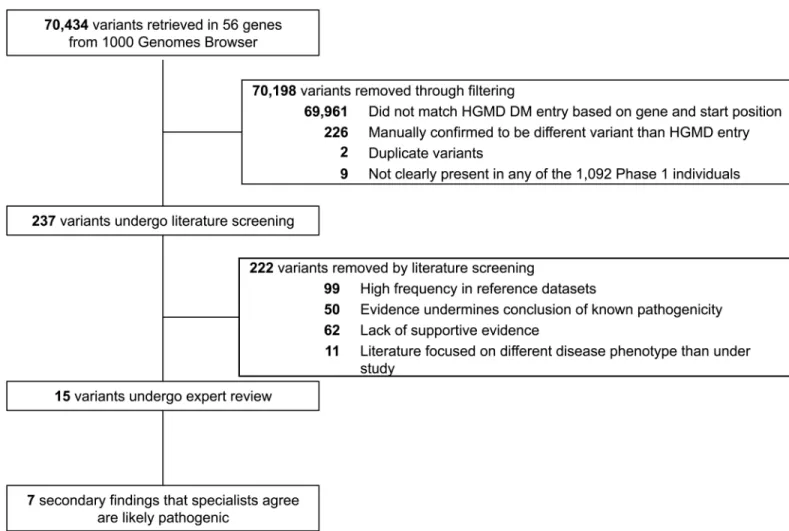
down the number of candidate variants (detailed inFig 1). Briefly, variants in the 56 genes
were downloaded in October 2013 from the 1000 Genomes Browser based on Ensembl version 73 (http://browser.1000genomes.org/index.html). MySQL was used to intersect the down-loaded variants with the Human Gene Mutation Database (HGMD) Professional (2.2012) [15]. These variants were filtered by selecting variants labeled disease-causing by HGMD, com-bining duplicate entries, and eliminating variants retrieved from the 1000 Genomes Browser, but not occurring in the 1,092 Phase 1 individuals.
Screening of Candidate Variants with Literature Review
Filtered candidate variants were vetted for disease association through critical appraisal of the literature from HGMD Professional [15], ClinVar [16], Google, PubMed, and other relevant databases [17–19]. Variant frequency in the 1000 Genomes and the NHLBI Exome Sequencing Fig 1. Flow of candidate variants through informatics filtering, literature review, and expert evaluation.Candidate variants in 56 genes associated with 24 actionable conditions from the 1000 Genomes dataset were narrowed down to identify 7 secondary findings that specialists agree are pathogenic or likely pathogenic.
Project was also considered with the literature review [20]. Details on all filtered variants along
with notes and references from the review are available inS2 Table.
First, variants with an allele frequency greater than expected for the associated disorder in either the NHLBI Exome Sequencing Project (ESP) and/or Phase 1 of the 1000 Genomes were removed. General population disease frequencies were estimated from GeneReviews, the Genetics Home Reference, and the literature review (S1 Table). Similar to Dorschner et al. [21], we assumed that if a variant was found more commonly in reference datasets than expected given the frequency of the associated disease, it is unlikely to cause a high-penetrance pheno-type. However, because of the possibility of ancestry-specific disease-causing variants, we used a cautious threshold at this stage. We assumed that the occurrence of multiple variants within each reference dataset followed a Poisson distribution, and specific variants were excluded if
the number of occurrences exceeded the 95thcumulative probability percentile with an event
rate equal to the expected number of pathogenic variants with the associated disorder (unless this number was 3 or less and then we used a cut off of 4 variants). Although we sought to incorporate information on population-specific frequencies of diseases and variants from the literature, we found that this additional information did not prevent the exclusion of variants using our cautious threshold.
Second, primary literature was evaluated for several lines of evidence against the pathoge-nicity of each variant to remove false positive results. Variants with similar frequencies in case-control studies, those often seen in healthy individuals, those that did not segregate with the disease in an affected family, those described to coexist with multiple deleterious variants, and those occurring in trans to a single deleterious variant without the expected phenotypic effects of biallelic alteration were removed from consideration. Cancer predisposition variants without
loss of heterozygosity in multiple tumors were removed. ForBRCA1andBRCA2, we removed
variants with an odds of neutrality greater than 100:1 based on Myriad Genetic Laboratories published data [22], however, the vast majority of Myriad data are not publicly available. For Lynch syndrome variants, we required microsatellite instability within the majority of reported
tumors. For variants inMUTYHassociated with recessive polyposis and colorectal cancer, we
excluded those that did not co-occur with another potentially pathogenic mutation as the ACMG guidelines recommend only searching for individuals with biallelic alteration [6].
Third, as we set the threshold for inclusion, we recognized the potential life-changing impli-cations of returning secondary findings, and so we required a minimum level of supportive evi-dence for non-synonymous, splice site, and synonymous variants to be considered an
actionable secondary finding. Similar to the classification system of pathogenic secondary find-ings employed by Ng et al. [23] and Dorschner et al. [21], we required that the variant was identified in at least three unrelated affected individuals, exhibited segregation consistent with
a probability1/16 in at least one family, or occurred in at least one de novo event in a trio.
For truncating mutations identified in HGMD Professional that occurred in genes in which the
ACMG specified that expected pathogenic variants should be returned (starred inTable 1), we
only required a truncating mutation in one unrelated case.
Finally, variants identified in literature focusing on conditions other than the specified ACMG conditions were removed.
Verification of Pathogenic Variants
Concordance between a clinical laboratory specialist and an expert physician was required to
call variants pathogenic or likely pathogenic. All experts were asked to consider the draft
Molecular Pathology”in their evaluation (https://www.acmg.net/docs/Standards_Guidelines_ for_the_Interpretation_of_Sequence_Variants.pdf). This consensus statement supports a five tiered variant classification system: 1) pathogenic, 2) likely pathogenic, 3) uncertain signifi-cance, 4) likely benign, and 5) benign. Specifically, the consensus statement endorses that “pathogenic”implies causative for disease, and likely pathogenic implies more than 90% cer-tainty that a variant is disease-causing.
A clinical laboratory specialist with board certification in cytogenetics and molecular genet-ics (CEC) evaluated all remaining variants after literature screening. The clinical laboratory specialist employed genomic browsers including UCSC and Ensembl, genetic databases [18, 19,24], and protein prediction software [25–27]. This methodology is standard for clinical
reporting [28,29]. Expert physicians with medical specialties relevant to the remaining
dis-ease-associated variants also examined the pathogenicity evidence. Specifically, physicians with specialties in gastroenterology (NOD), neurology and pediatrics (CG), pathology (JWH), and cardiovascular medicine (NOS) were provided with the primary literature on variants in their
respective fields and asked whether each variant was“actionable”and“pathogenic.”
Additional Expected Pathogenic Variants
For 45 of the 56 genes (starred inTable 1), the ACMG recommendations suggest that expected
pathogenic variants should also be sought and returned to patients. For these 45 genes, we additionally examined variants that were predicted to cause a truncation, but were not listed as disease-causing in HGMD Professional. ANNOVAR was used to examine vcf files, and trun-cating mutations were identified with refGene and ensGene using Genome Build 19. Identified mutations were required to cause truncation in all listed Ensembl HGVS isoforms. Predicted truncating mutations were then evaluated with literature review and ClinVar. We required that a“pathogenic”truncating mutation had been previously described 3' of the variant under review in the coding sequence for one of the ACMG conditions in either ClinVar or another database, as nonsense mediated decay may not be predicted in transcripts with distal alter-ations. Expected pathogenic variants were reviewed by the clinical laboratory specialist.
Results
Computationally filtered variants
We retrieved 70,435 variants in the 56 disease-associated genes from the 1000 Genomes Browser. After querying HGMD Professional based on gene and chromosome position for var-iants labeled disease-causing and restricting to varvar-iants that matched the exact base change, 237 variants remained for manual review (Fig 1).
Among the 1,092 Phase 1 genomes, our HGMD filtering strategy yielded 1.48 variants per person (Table 2). Across the four major ancestry groups, the average number of variants per person ranged from 1.13 among Asian Americans to 1.67 among the Americas individuals. These findings underscore that filtering using HGMD Professional dramatically reduced the number of candidate secondary variants per genome.
Table 2. Distribution of variants per person after filtering, literature screening, and specialist review.
Variants per person African (n = 246) the Americas (n = 181) East Asian (n = 286) European (n = 379) Total (n = 1,092)
Afterfiltering 1.463 1.668 1.133 1.667 1.481
After literature screening 0.012 0.011 0.010 0.021 0.015
After specialist review 0.004 0.006 0.003 0.011 0.006
Literature screened variants
Literature appraisal further decreased the number of filtered variants by 15 fold (Table 1, Fig 1). More than one-third of the variants (99/237) were removed because of a higher fre-quency in reference datasets than expected based on the population prevalence and mode of
inheritance of these conditions (details inS1 Table).Fig 2Aillustrates that these 99 variants
accounted for the majority of variants per person among the 237 filtered candidate variants across the four ancestry groups. Specifically, the number of variants removed per person in this step of the literature screening was 1.43 (86% of total 1.67) in the Americas, 1.41 (85% of total 1.67) in European, 1.31 (90% of total 1.46) in African, and 0.79 (70% of total 1.13) in East Asian ancestry groups.
An additional 50 variants were eliminated because the literature evidence undermined the conclusion of known pathogenicity, including high incidence in healthy individuals, lack of
segregation with disease, and co-occurrence with known deleterious variants (Fig 1).Fig 2B
illustrates that the number of variants per person removed due to evidence against pathogenic-ity varied across the ancestry groups. Specifically, the number of variants removed per person in this step of the literature screening was 0.18 (16% of 1.13) in East Asians, 0.12 (7% of 1.67) in Europeans, 0.12 (7% of 1.67) in the Americas, and 0.05 (4% of 1.46) in Africans.
Fig 2. Results of literature screen of 237 filtered candidate variants.These graphs compare the number of variants per person at different stages of the literature screen across the four major ancestry groups in the 1000 Genomes dataset. A) Compares the contribution of variants that were removed because of a high frequency in reference datasets to all of the other filtered variants. B) Compares the contribution to variants per person of all of the filtered variants that did not have a high frequency in reference datasets. Specifically, it compares the contribution of variants with evidence against a conclusion of pathogenicity, a lack of supportive evidence, literature on a different disorder, or those that were retained for specialist review.
We removed 62 variants that lacked a minimum level of supportive evidence in the litera-ture (Fig 1). Across ancestry groups, the number of variants per person removed due to paucity of evidence was similar (Fig 2B): 0.13 (11% of 1.13) in East Asians, 0.08 (6% of 1.46) in Afri-cans, 0.08 (5% of 1.67) in Europeans, and 0.08 (5% of 1.67) in the Americas. Finally, 11 variants were removed where the literature focused on a different disease phenotype than under study.
Overall, manual literature screening dramatically reduced the number of filtered variants per person from 1.48 to 0.015 (Table 2). After literature screening, 15 variants remained and were reviewed by the clinical laboratory specialist and expert physicians (Fig 1). The specialists independently agreed that 7 of these variants met the high threshold for being pathogenic or likely pathogenic and actionable (Table 3).
Known pathogenic and likely pathogenic variants identified by clinical
specialists
ABRCA2truncating variant p.Glu3390occurred in one individual from the 1000 Genomes
ASW population (Americans of African Ancestry in SW USA). Previously reported in a case of ovarian cancer, this genetic variant was shown to have a functional effect in a series of bio-chemical experiments [30]. Based on strong functional support and the nature of the alteration,
Table 3. Pathogenic variants that the clinical laboratory specialist and expert physicians agree should be disclosed as secondary findings.
Gene Genomic change (protein change)
dbSNP Identifier
1000 Genomes
Exome Variant Server
ClinVar Predictions of Clinical Specialist (CEC)
Predictions of Expert Physicians; Notes (expert initials)
BRCA2 Chr13: 32972575G>T (p.Glu3309*)
rs80359251 1 (AFRa) 4 (AA) Pathogenic/
Likely pathogenic
Likely Pathogenic Pathogenic; Exhibits a functional role in several experiments and characterized as pathogenic by multiple databases (JWH)
TP53 Chr17: 7577120G>A (p.Arg273His)
rs28934576 1 (EURb) 0 Pathogenic Pathogenic Pathogenic; Second most frequently
reported TP53 mutation in COSMIC, and extensive functional support (JWH)
SDHB Chr1: 17359573C>T (p.Arg90*)
rs74315366 1 (EUR) 0 Pathogenic/ Likely pathogenic
Likely pathogenic Likely pathogenic; Segregates with disease in three small families (CG)
RYR2 Chr1:
237608788C>T (p.Arg420Trp)
rs190140598 1 (EUR) 0 Not in database Likely pathogenic Likely pathogenic; Multiple probands and biochemical evidence that this is functional; Lacking strong transmission data (NOS)
PKP2 Chr12:
32949042G>Ae rs111517471 1 (ASN
c) 0 Pathogenic/
Likely pathogenic
Likely pathogenic Likely pathogenic; Identified in multiple individuals with some evidence of segregation (NOS)
KCNH2 Chr7:
150648826T>C (p.Leu552Ser)
rs199472918 1 (EUR) 0 Pathogenic/ Likely pathogenic
Likely pathogenic Likely pathogenic; Identified in multiple families and probands, but with incomplete penetrance (NOS)
LDLR Chr19: 11200235G>A (p.Trp4*)
rs201016593 1 (AMRd) 0 Not in database Likely pathogenic Pathogenic; Expected type of mutation to cause disease, independent reports and biochemical support (NOS)
a
AFR, African. b
EUR, European. c
ASN, East Asian. d
AMR, the Americas. e
Splice variant.
the clinical laboratory specialist classified this variant as likely pathogenic, and the expert phy-sician (JKH) independently confirmed that the variant was pathogenic for hereditary breast and ovarian cancer.
ATP53nonsynonymous variant p.Arg273His was identified in one individual in the CEU
population (Utah Residents (CEPH) with Northern and Western European ancestry). Malkin et al. [31] identified this variant in a proband diagnosed with soft-tissue sarcoma and gastric carcinoma as well as in the proband’s son diagnosed with rhabdomyosarcoma at age 11. Fagin et al. [32] found this variant in 5 out of 6 anaplastic thyroid carcinomas. Described as a hotspot
mutation, this variant is the second most frequently reportedTP53mutation in the catalogue
of somatic mutations in cancer (COSMIC), and several independent groups have provided functional support. Both the clinical laboratory specialist and expert physician (JKH) thought this variant was pathogenic for Li-Fraumeni syndrome.
ASDHBtruncating variant p.Arg90occurred in one individual in the GBR population
(British in England and Scotland). Located in a hypermutable CpG dinucleotide, Astuti et al. [33] showed that this variant segregated in 3 unrelated small families suffering from pheochro-mocytoma and paragangliomas. Based on the literature review and the nature of the alteration, both the clinical laboratory specialist and the expert physician (CG) classified this variant as likely pathogenic.
ARYR2nonsynonymous variant p.Arg420Trp occurred in one individual in the CEU
popu-lation. Bruce et al. [34] identified this variant in two unrelated families in Italy with several cases of juvenile onset cardiac death, but with incomplete penetrance. Because this variant was also identified in several other independent cases and functionally characterized as abnormal, the clinical laboratory specialist and the expert physician (NOS) classified the variant as likely pathogenic for catecholaminergic polymorphic ventricular tachycardia.
APKP2splice region variant c.2489+1G>A occurred in one individual in the CHB
popula-tion (Han Chinese in Beijing, China). Cox et al. [35] found this variant in 6 unrelated Dutch cases of right ventricular dysplasia/cardiomyopathy. Given that other studies report additional independent cases with some limited transmission data, both the clinical laboratory specialist and the expert physician (NOS) classified the variant as likely pathogenic.
AKCNH2nonsynonymous variant p.Leu552Ser was found in an individual from the FIN
population (Finnish in Finland). Described as a Finnish founder mutation, this variant was documented by Piippo et al. [36] in 6 unrelated Long QT syndrome Finnish families. Ten of 35 heterozygous individuals were symptomatic (mean QTc of the 35 individuals was 466 ± 47 ms) and all 43 non-carrier family members were non-symptomatic (mean QTc 416 ± 23 ms). Fur-thermore, two homozygous siblings experienced severe symptoms (2:1 AV block immediately
after birth andtorsades de pointesat age 2). Computational prediction programs further
sup-ported this variant’s pathogenicity, and the clinical laboratory specialist and expert physician (NOS) confirmed that it was likely pathogenic.
ALDLRtruncating variant p.Trp4was found in one individual from the CLM population
(Colombians in Medellin, Colombia). Nonsense variants withinLDLRcodon 4 have been
described in a Spanish family, a Chinese individual, and a Colombian individual with familial
hypercholesterolemia [37,38]. Based on literature review and the nature of the alteration, the
clinical laboratory specialist classified the variant as likely pathogenic, and the expert physician (NOS) confirmed that the variant was expected to be pathogenic.
Additional expected pathogenic variants
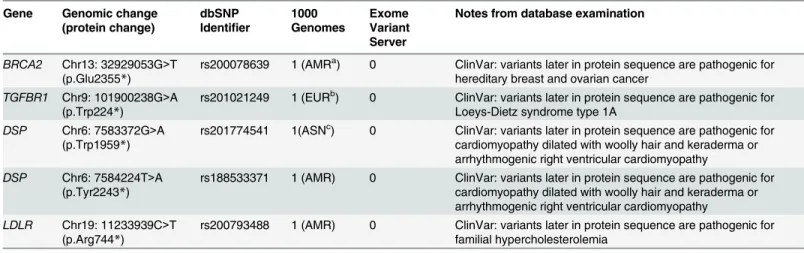
Five additional expected pathogenic variants were identified that were not listed as
disease-causing in HGMD Professional (Table 4). These truncating variants occur inBRCA2,TGFBR1,
DSP(n = 2), andLDLR, and ClinVar suggests that mutations located 3’in the coding sequence
of these genes are pathogenic for the ACMG conditions of hereditary breast and ovarian can-cer, Loeys-Dietz syndrome type 1A, arrhythmogenic right ventricular cardiomyopathy, and familial hypercholesterolemia, respectively. All of these variants are located within the first 90% of the protein sequence (range of 45%-87%) and therefore are expected to lead to non-sense mediated decay. Due to the nature of these alterations, these variants represent returnable secondary findings according to the ACMG recommendations.
Discussion
Our goal was to apply a stringent approach to identify clinically important secondary findings using a diverse reference sample. We focused on the 56 ACMG genes associated with 24 action-able conditions [6]. Our results demonstrate that 12 individuals in Phase 1 of the 1000
Genomes dataset (1%) carry a returnable secondary finding using this standard. The patho-genic and likely pathopatho-genic variants identified here are associated with cancer predisposition syndromes, cardiac conditions, and familial hypercholesterolemia, which are diseases with available, potentially life-saving interventions.
Four individuals were identified in the 1000 Genomes dataset with secondary findings
asso-ciated with cancer predisposition syndromes (Tables3and4). Likely pathogenicBRCA2
vari-ants were found in 2 individuals, which is consistent with the estimated general population prevalence of 1/400 of hereditary breast and ovarian cancer syndrome [39]. We also identified
one pathogenic variant inTP53associated with Li-Fraumeni syndrome, which has an
esti-mated prevalence of 1/5,000-1/20,000 and is characterized by several classic tumors, including soft tissue sarcomas, breast cancer, brain tumors, adrenocortical carcinomas, and leukemias [40]. Finally, one individual had a likely pathogenic variant for hereditary paraganglioma-Table 4. Additional expected pathogenic variants that meet criteria for disclosure as secondary findings.
Gene Genomic change (protein change)
dbSNP Identifier
1000 Genomes
Exome Variant Server
Notes from database examination
BRCA2 Chr13: 32929053G>T (p.Glu2355*)
rs200078639 1 (AMRa) 0 ClinVar: variants later in protein sequence are pathogenic for
hereditary breast and ovarian cancer
TGFBR1 Chr9: 101900238G>A (p.Trp224*)
rs201021249 1 (EURb) 0 ClinVar: variants later in protein sequence are pathogenic for
Loeys-Dietz syndrome type 1A
DSP Chr6: 7583372G>A (p.Trp1959*)
rs201774541 1(ASNc) 0 ClinVar: variants later in protein sequence are pathogenic for
cardiomyopathy dilated with woolly hair and keraderma or arrhythmogenic right ventricular cardiomyopathy
DSP Chr6: 7584224T>A (p.Tyr2243*)
rs188533371 1 (AMR) 0 ClinVar: variants later in protein sequence are pathogenic for cardiomyopathy dilated with woolly hair and keraderma or arrhythmogenic right ventricular cardiomyopathy
LDLR Chr19: 11233939C>T (p.Arg744*)
rs200793488 1 (AMR) 0 ClinVar: variants later in protein sequence are pathogenic for familial hypercholesterolemia
a
AMR, the Americas. b
EUR, European. c
ASN, East Asian.
pheochromocytoma syndrome, a very rare condition, for which early detection through sur-veillance and removal of tumors may minimize complications related to mass effects, catechol-amine hypersecretion, and malignant transformation [41].
Beyond cancer predisposition syndromes, we identified 6 individuals with secondary find-ings associated with cardiac conditions. Given that these diseases may first present with sudden death, early surveillance and intervention are critical. First, one individual in the 1000
Genomes possessed a truncating variant predicted to cause Loeys-Dietz syndrome type 1A, a connective tissue disorder associated with vascular abnormalities (increased risk of arterial aneurysms and dissections) along with skeletal manifestations [42]. Second, three individuals in the 1000 Genomes had likely pathogenic variants associated with Arrhythmogenic Right-Ventricular Cardiomyopathy (ARVC). Although ARVC has an estimated prevalence of 1/ 1,000-1/1,500, it often exhibits reduced penetrance (with estimates as low as 20–30%), possibly explaining our recognition of 3 disease-associated variants in the 1000 Genomes dataset [43, 44]. Characterized by progressive fibrofatty replacement of the myocardium, ARVC predis-poses individuals to ventricular tachycardia and sudden death. Third, one individual in the 1000 Genomes had a likely pathogenic variant associated with catecholaminergic polymorphic ventricular tachycardia (CPVT), which has an estimated prevalence of 1/10,000 and is charac-terized by episodes of ventricular tachycardia often triggered by exercise, possibly leading to ventricular fibrillation and sudden-death [45]. Finally, we identified one individual with a sec-ondary finding for long QT syndrome, which has an estimated prevalence of 1/2,500 among whites [46] and is characterized by QT prolongation and T-wave abnormalities on ECG with
risk oftorsades de pointes[47].
Lastly, two individuals had likely pathogenic truncating variants inLDLRassociated with
heterozygous familial hypercholesterolemia, which is consistent with the estimated population prevalence of 1/200-1/500 [48]. Characterized by elevated LDL cholesterol levels from birth, this condition increases risk of premature coronary heart disease. Early diagnosis and
treat-ment with statins can decrease coronary heart disease events and mortality [49,50].
Overall, this study identifies 12 pathogenic and likely pathogenic variants in the 1000 Genomes dataset, which if recognized and returned could guide medical follow-up for individ-uals and their families. This confirms that medically relevant secondary findings can be identi-fied in an unselected cohort.
Beyond assessing the general frequency of secondary findings, this study provides insight into the frequency of candidate variants in a range of populations. After computational filter-ing, the average number of variants per person ranged from 1.67 among Europeans to 1.13 among East Asians (Table 2). After literature and expert review, 4 of the 7 identified known secondary findings were observed in individuals of European ancestry, and 1 was found in each of the other ethnic groups (African, the Americas, and East Asian) (Table 3). Examination of secondary findings in the Exome Sequencing Project also identified these findings in
Euro-pean Americans at over three times the rate as African Americans [21,51]. These observations
Previous reports have predicted substantially higher frequencies of pathogenic variants in the 1000 Genomes dataset. Surveys based on the pilot of the 1000 Genomes project found that each genome typically contains 100 loss-of-function variants [52] and 40–110 variants classi-fied by HGMD Professional as disease-causing (of which 0–8 are predicted to be highly damag-ing) [53]. A study of the 1,092 Phase 1 genomes found on average 294 previously identified pathogenic variants in the homozygous state in each individual using HGMD [54]. More recently, Daneshjou et al. [55] examined the 1,092 Phase 1 genomes along with 178 additional genomes and found that, after excluding the most common variant, 20% of all analyzed genomes possessed designated ClinVar pathogenic variants in the ACMG genes. Our estimate is considerably lower because we employed a purposefully stringent approach for prioritizing clinically meaningful findings that involved manual curation.
Studies that employ informatics filtering and strict manual review support our observation that a small number of variants for actionable conditions can be prioritized. Johnston et al. [56] employed filtering and manual review to assess 37 genes associated with cancer predisposition syndromes in 572 predominantly white ClinSeq research participants, identifying 8 individuals with pathogenic variants that warranted follow-up. Ng et al. [23] examined 870 ClinSeq research participants for 63 genes associated with cardiomyopathies and arrhythmias and iden-tified 6 individuals with pathogenic variants. More recently, Amendola et al. [51] examined 112 actionable genes in the 6,503 participants enrolled in the National Heart, Lung, and Blood Institute Sequencing Project, identifying 113 individuals with pathogenic, likely pathogenic, or expected pathogenic variants. Proportionate to the number of genes studied, these estimates of 0.014 [56], 0.007 [23], and 0.017 [21] secondary findings per person are on the same order of magnitude as our estimate of 0.011. These estimates from independent samples indicate that a small number of disease-associated variants can be selected from sequence data.
An important limitation of this study is that the informed consent process for the 1000 Genomes project prevents the return of individual research results [57]. This inability to return results with potentially lifesaving interventions underscores a drawback of studies that stress collection of de-identified samples. In designing future genetic studies, including the recent Precision Medicine Initiative [58], investigators need to consider offering a path for returning medically important results identified through the research process to participants. In many surveys, the public strongly favors opportunities to receive individual genetic research results [59,60]. In addition, return of results is necessary to understand the penetrance and expressiv-ity of the identified secondary findings through medical follow-up. As emphasized by the
ACMG [6] and others [9,10], more research on the long term phenotypic effects of presumed
pathogenic variants identified in the general population is needed to fully understand the costs and benefits of returning secondary findings.
modified as knowledge of genetic diseases increases and guidelines regarding return of second-ary and incidental findings continue to evolve.
Our experience of evaluating secondary findings highlights some of the current challenges faced by clinical laboratories in implementing the ACMG recommendations. Although HGMD Professional [15] is useful for filtering candidate variants (Fig 1), our results confirm previous reports that it contains variants designated as disease-causing that upon further review have uncertain pathogenicity for the purposes of secondary finding identification [14, 21,56]. Our process of secondary finding evaluation required several steps of time-consuming manual review. Informatics filtering led to 237 HGMD disease-causing variants, which each underwent literature screening, requiring approximately 1.5 hours per variant (range of 0.5 to 3 hours). Fifteen candidate variants passed literature review and were evaluated by both a clini-cal laboratory specialist and an expert physician. Expert review took approximately 1 hour per variant for each specialist (range of 20 minutes to 4 hours). From the time that this project was initiated in 2013, the speed of variant review has dramatically improved with the development of new appraisal resources and additional experience of the authors in variant evaluation. Future efforts to develop standardized resources with well-curated variants to facilitate the fast and accurate identification of pathogenic secondary findings that meet current standards for return in clinical settings will make the implementation of precision medicine more efficient.
Variant appraisal is also complicated by the different thresholds specialists have for identify-ing pathogenic variants. Our method used a conservative clinical approach by requiridentify-ing that both a clinical laboratory specialist and expert physician independently agreed that the second-ary findings were pathogenic/likely pathogenic. Although initially there was some discordance in classification between the experts, further discussion with the expert reviewers led to agree-ment for all candidate variants that passed the literature screen. The ACMG [28] and others [29] have released standardized guidelines for variant evaluation that will aid specialists in
assessing pathogenic variants (seehttps://www.acmg.net/ACMG/Publications/Laboratory_
Standards___Guidelines/ACMG/Publications/Laboratory_Standards___Guidelines.aspx? hkey=8d2a38c5-97f9-4c3e-9f41-38ee683bcc84). Our experience illustrates that differences in manual curators can lead to differences in variant categorization, highlighting the importance of continued efforts to specify how specialists should combine data from multiple sources to accurately and reliably identify secondary findings.
Conclusions
Supporting Information
S1 Table. General population prevalence estimates of the ACMG conditions and the devel-opment of frequency thresholds in reference datasets.Population prevalence estimates of the ACMG conditions were taken from several datasets, including GeneReviews and the Genetics Home Reference. Based on the lowest estimated general population disease prevalence and the mode of inheritance, we calculated the maximum estimated pathogenic variants per person for
each disease. From this“pathogenic variants per person”estimate, we were able to calculate an
expected number of pathogenic variants for each disease in the NHLBI Exome Sequencing Project and the 1000 Genomes. Assuming that the occurrence of multiple variants within each reference dataset followed a Poisson distribution, we calculated a threshold number of variants
that exceeds the 95thcumulative probability percentile with an event rate equal to the expected
number of pathogenic variants in that dataset. Keeping with our cautious approach, we removed variants associated with each disease that occurred more frequently than this upper bound 95th percentile in each dataset. Details on all filtered variants along with notes and
refer-ences of the literature review are available inS2 Table.When the number of expected people
exceeding the 95th cumulative probability percentile was small (3 or less), we used a minimum cut off of 4 individuals to prevent the removal of possible population specific variants.
(DOCX)
S2 Table. Characteristics of 237 Filtered Variants from Literature Review.Candidate vari-ants identified by informatics filtering were examined for disease association through critical appraisal of the literature. Variant frequency in reference datasets was considered with the liter-ature review. This table provides detailed information on all 237 variants, including notes from that literature review and PubMed Identification numbers of all articles examined.
(XLS)
Author Contributions
Conceived and designed the experiments: EO CEC LSC SH RN NLS LJB. Performed the exper-iments: EO. Analyzed the data: EO CEC NOD CAG JWH NOS. Contributed reagents/materi-als/analysis tools: RN LJB. Wrote the paper: EO CEC NOD CAG JWH NOS LSC SH RN NLS LJB.
References
1. ANTICIPATE and COMMUNICATE Ethical Management of Incidental and Secondary Findings in the Clinical, Research, and Direct-to-Consumer Contexts. Presidental Commision for the Study of Bioethi-cal Issues. 2013. Available:http://bioethics.gov/sites/default/files/FINALAnticipateCommunicate_ PCSBI_0.pdf.
2. Vernooij MW, Ikram MA, Tanghe HL, Vincent AJ, Hofman A, Krestin GP, et al. Incidental findings on brain MRI in the general population. N Engl J Med. 2007; 357(18):1821–1828. PMID:17978290
3. Wolf SM, Lawrenz FP, Nelson CA, Kahn JP, Cho MK, Clayton EW, et al. Managing incidental findings in human subjects research: analysis and recommendations.J Law Med Ethics. 2008; 36(2):219–248, 211. doi:10.1111/j.1748-720X.2008.00266.xPMID:18547191
4. Kohane IS, Masys DR, Altman RB. The incidentalome: a threat to genomic medicine. JAMA. 2006; 296 (2):212–215. PMID:16835427
5. Wolf SM. The past, present, and future of the debate over return of research results and incidental find-ings. Genet Med. 2012; 14(4):355–357. doi:10.1038/gim.2012.26PMID:22481182
6. Green RC, Berg JS, Grody WW, Kalia SS, Korf BR, Martin CL, et al. ACMG recommendations for reporting of incidental findings in clinical exome and genome sequencing. Genet Med. 2013; 15(7): 565–574. doi:10.1038/gim.2013.73PMID:23788249
8. Wolf SM, Annas GJ, Elias S. Point-counterpoint. Patient autonomy and incidental findings in clinical genomics. Science. 2013; 340(6136):1049–1050. doi:10.1126/science.1239119PMID:23686341
9. Ross L, Rothstein MA, Clayton E. Mandatory extended searches in all genome sequencing:“incidental findings,”patient autonomy, and shared decision making. JAMA. 2013; 310(4):367–368. doi:10.1001/ jama.2013.41700PMID:23917281
10. Klitzman R, Appelbaum PS, Chung W. Return of secondary genomic findings vs patient autonomy: Implications for medical care. JAMA. 2013; 310(4):369–370. doi:10.1001/jama.2013.41709PMID: 23917282
11. Green RC, Lupski JR, Biesecker LG. Reporting genomic sequencing results to ordering clinicians: Inci-dental, but not exceptional. JAMA. 2013; 310(4):365–366. doi:10.1001/jama.2013.41703PMID: 23917280
12. McGuire AL, Joffe S, Koenig BA, Biesecker BB, McCullough LB, Blumenthal-Barby JS, et al. Point-counterpoint. Ethics and genomic incidental findings. Science. 2013; 340(6136):1047–1048. doi:10. 1126/science.1240156PMID:23686340
13. Abecasis GR, Auton A, Brooks LD, DePristo MA, Durbin RM, Handsaker RE, et al. An integrated map of genetic variation from 1,092 human genomes. Nature. 2012; 491(7422):56–65. doi:10.1038/ nature11632PMID:23128226
14. Berg JS, Adams M, Nassar N, Bizon C, Lee K, Schmitt CP, et al. An informatics approach to analyzing the incidentalome. Genet Med. 2013; 15(1):36–44. doi:10.1038/gim.2012.112PMID:22995991
15. Stenson PD, Ball EV, Howells K, Phillips AD, Mort M, Cooper DN. The Human Gene Mutation Data-base: providing a comprehensive central mutation database for molecular diagnostics and personal-ized genomics. Hum Genomics. 2009; 4(2):69–72. PMID:20038494
16. Landrum MJ, Lee JM, Riley GR, Jang W, Rubinstein WS, Church DM, et al. ClinVar: public archive of relationships among sequence variation and human phenotype. Nucleic Acids Res. 2014; 42: D980–
985. doi:10.1093/nar/gkt1113PMID:24234437
17. OMIM (Online Mendelian inheritance in man) Baltimore: Johns Hopkins University, Certer for Medical Genetics. 2012. Available:http://omim.org/.
18. Fokkema IF, den Dunnen JT, Taschner PE. LOVD: easy creation of a locus-specific sequence variation database using an "LSDB-in-a-box" approach. Hum Mutat. 2005; 26(2):63–68. PMID:15977173
19. Beroud C, Collod-Beroud G, Boileau C, Soussi T, Junien C. UMD (Universal mutation database): a generic software to build and analyze locus-specific databases. Hum Mutat. 2000; 15(1):86–94. PMID: 10612827
20. Exome Variant Server, NHLBI GO Exome Sequencing Project (ESP) Seattle, WA. 2014. Available: http://evs.gs.washington.edu/EVS/.
21. Dorschner MO, Amendola LM, Turner EH, Robertson PD, Shirts BH, Gallego CJ, et al. Actionable, pathogenic incidental findings in 1,000 participants' exomes. Am J Hum Genet. 2013; 93(4):631–640. doi:10.1016/j.ajhg.2013.08.006PMID:24055113
22. Easton DF, Deffenbaugh AM, Pruss D, Frye C, Wenstrup RJ, Allen-Brady K, et al. A systematic genetic assessment of 1,433 sequence variants of unknown clinical significance in the BRCA1 and BRCA2 breast cancer-predisposition genes. Am J Hum Genet. 2007; 81(5):873–883. PMID:17924331
23. Ng D, Johnston JJ, Teer JK, Singh LN, Peller LC, Wynter JS, et al. Interpreting Secondary Cardiac Dis-ease Variants in an Exome Cohort. Circ Cardiovasc Genet. 2013; 6(4):337–346. doi:10.1161/ CIRCGENETICS.113.000039PMID:23861362
24. Szabo C, Masiello A, Ryan JF, Brody LC. The breast cancer information core: database design, struc-ture, and scope. Hum Mutat. 2000; 16(2):123–131. PMID:10923033
25. Kumar P, Henikoff S, Ng PC. Predicting the effects of coding non-synonymous variants on protein func-tion using the SIFT algorithm. Nat Protoc. 2009; 4(7):1073–81. doi:10.1038/nprot.2009.86PMID: 19561590
26. Adzhubei IA, Schmidt S, Peshkin L, Ramensky VE, Gerasimova A, Bork P, et al. A method and server for predicting damaging missense mutations. Nat Methods. 2010; 7(4):248–249. doi:10.1038/ nmeth0410-248PMID:20354512
27. Gonzalez-Perez A, Lopez-Bigas N. Improving the assessment of the outcome of nonsynonymous SNVs with a consensus deleteriousness score, Condel. Am J Hum Genet. 2011; 88(4):440–449. doi: 10.1016/j.ajhg.2011.03.004PMID:21457909
29. Plon SE, Eccles DM, Easton D, Foulkes WD, Genuardi M, Greenblatt MS, et al. Sequence variant clas-sification and reporting: recommendations for improving the interpretation of cancer susceptibility genetic test results. Hum Mutat. 2008; 29(11):1282–1291. doi:10.1002/humu.20880PMID:18951446
30. Kuznetsov SG, Liu P, Sharan SK. Mouse embryonic stem cell-based functional assay to evaluate mutations in BRCA2. Nat Med. 2008; 14(8):875–881. doi:10.1038/nm.1719PMID:18607349
31. Malkin D, Jolly KW, Barbier N, Look AT, Friend SH, Gebhardt MC, et al. Germline mutations of the p53 tumor-suppressor gene in children and young adults with second malignant neoplasms. N Engl J Med. 1992; 326(20):1309–1315. PMID:1565144
32. Fagin JA, Matsuo K, Karmakar A, Chen DL, Tang SH, Koeffler HP. High prevalence of mutations of the p53 gene in poorly differentiated human thyroid carcinomas. J Clin Invest. 1993; 91(1):179–184. PMID: 8423216
33. Astuti D, Latif F, Dallol A, Dahia PL, Douglas F, George E, et al. Gene mutations in the succinate dehy-drogenase subunit SDHB cause susceptibility to familial pheochromocytoma and to familial paragan-glioma. Am J Hum Genet. 2001; 69(1):49–54. PMID:11404820
34. Bauce B, Rampazzo A, Basso C, Bagattin A, Daliento L, Tiso N, et al. Screening for ryanodine receptor type 2 mutations in families with effort-induced polymorphic ventricular arrhythmias and sudden death: early diagnosis of asymptomatic carriers. J Am Coll Cardiol. 2002; 40(2):341–349. PMID:12106942
35. Cox MG, van der Zwaag PA, van der Werf C, van der Smagt JJ, Noorman M, Bhuiyan ZA, et al. Arrhyth-mogenic right ventricular dysplasia/cardiomyopathy: pathogenic desmosome mutations in index-patients predict outcome of family screening: Dutch arrhythmogenic right ventricular dysplasia/cardio-myopathy genotype-phenotype follow-up study. Circulation. 2011; 123(23):2690–2700. doi:10.1161/ CIRCULATIONAHA.110.988287PMID:21606396
36. Piippo K, Laitinen P, Swan H, Toivonen L, Viitasalo M, Pasternack M, et al. Homozygosity for a HERG potassium channel mutation causes a severe form of long QT syndrome: identification of an apparent founder mutation in the Finns. J Am Coll Cardiol. 2000; 35(7):1919–1925. PMID:10841244
37. Hobbs HH, Brown MS, Goldstein JL. Molecular genetics of the LDL receptor gene in familial hypercho-lesterolemia. Hum Mutat. 1992; 1(6):445–466. PMID:1301956
38. Garcia-Garcia AB, Ivorra C, Martinez-Hervas S, Blesa S, Fuentes MJ, Puig O, et al. Reduced pene-trance of autosomal dominant hypercholesterolemia in a high percentage of families: importance of genetic testing in the entire family. Atherosclerosis. 2011; 218(2):423–430. doi:10.1016/j. atherosclerosis.2011.07.106PMID:21868016
39. Petrucelli N, Daly MB, Feldman GL. BRCA1 and BRCA2 Hereditary Breast and Ovarian Cancer. In: Pagon RA, Bird TD, Dolan CR, Stephens K, Adam MP, editors. GeneReviews. Seattle WA: University of Washington, Seattle; 1993.
40. Schneider K, Zelley K, Nichols KE, Garber J. Li-Fraumeni Syndrome. In: Pagon RA, Adam MP, Ardin-ger HH, Bird TD, Dolan CR, Fong CT, et al., editors. GeneReviews(R). Seattle WA: University of Washington, Seattle; 1993.
41. Kirmani S, Young WF. Hereditary Paraganglioma-Pheochromocytoma Syndromes. In: Pagon RA, Adam MP, Ardinger HH, Bird TD, Dolan CR, Fong CT, et al., editors. GeneReviews(R). Seattle WA: University of Washington, Seattle; 1993.
42. Loeys BL, Dietz HC. Loeys-Dietz Syndrome. In: Pagon RA, Adam MP, Ardinger HH, Bird TD, Dolan CR, Fong CT, et al., editors. GeneReviews(R). Seattle WA: University of Washington, Seattle; 1993.
43. McNally E, MacLeod H, Dellefave-Castillo L. Arrhythmogenic Right Ventricular Dysplasia/Cardiomyop-athy. In: Pagon RA, Adam MP, Ardinger HH, Bird TD, Dolan CR, Fong CT, et al., editors. GeneReviews (R). Seattle WA: University of Washington, Seattle; 1993.
44. Sen-Chowdhry S, Syrris P, McKenna WJ. Genetics of right ventricular cardiomyopathy. J Am Coll Car-diol. 2005; 16(8):927–935.
45. Napolitano C, Priori SG, Bloise R. Catecholaminergic Polymorphic Ventricular Tachycardia. In: Pagon RA, Adam MP, Ardinger HH, Bird TD, Dolan CR, Fong CT, et al., editors. GeneReviews(R). Seattle WA: University of Washington, Seattle; 1993.
46. Schwartz PJ, Stramba-Badiale M, Crotti L, Pedrazzini M, Besana A, Bosi G, et al. Prevalence of the congenital long-QT syndrome. Circulation. 2009; 120(18):1761–1767. doi:10.1161/
CIRCULATIONAHA.109.863209PMID:19841298
47. Alders M, Mannens M. Romano-Ward Syndrome. In: Pagon RA, Bird TD, Dolan CR, Stephens K, Adam MP, editors. GeneReviews. Seattle WA: University of Washington, Seattle; 1993.
49. Versmissen J, Oosterveer DM, Yazdanpanah M, Defesche JC, Basart DC, Liem AH, et al. Efficacy of statins in familial hypercholesterolaemia: a long term cohort study. BMJ. 2008; 337:a2423. doi:10. 1136/bmj.a2423PMID:19001495
50. Neil A, Cooper J, Betteridge J, Capps N, McDowell I, Durrington P, et al. Reductions in all-cause, can-cer, and coronary mortality in statin-treated patients with heterozygous familial hypercholesterolaemia: a prospective registry study. Eur Heart J. 2008; 29(21):2625–2633. doi:10.1093/eurheartj/ehn422 PMID:18840879
51. Amendola LM, Dorschner MO, Robertson PD, Salama JS, Hart R, Shirts BH, et al. Actionable exomic incidental findings in 6503 participants: challenges of variant classification. Genome Res. 2015; 25 (3):305–315. doi:10.1101/gr.183483.114PMID:25637381
52. MacArthur DG, Balasubramanian S, Frankish A, Huang N, Morris J, Walter K, et al. A systematic survey of loss-of-function variants in human protein-coding genes. Science. 2012; 335(6070):823–828. doi: 10.1126/science.1215040PMID:22344438
53. Xue Y, Chen Y, Ayub Q, Huang N, Ball EV, Mort M, et al. Deleterious- and disease-allele prevalence in healthy individuals: insights from current predictions, mutation databases, and population-scale rese-quencing. Am J Hum Genet. 2012; 91(6):1022–1032. doi:10.1016/j.ajhg.2012.10.015PMID: 23217326
54. Cassa CA, Tong MY, Jordan DM. Large numbers of genetic variants considered to be pathogenic are common in asymptomatic individuals. Hum Mutat. 2013; 34(9):1216–1220. doi:10.1002/humu.22375 PMID:23818451
55. Daneshjou R, Zappala Z, Kukurba K, Boyle SM, Ormond KE, Klein TE, et al. PATH-SCAN: a reporting tool for identifying clinically actionable variants. Pac Symp Biocomput. 2014:229–240.
56. Johnston JJ, Rubinstein WS, Facio FM, Ng D, Singh LN, Teer JK, et al. Secondary variants in individu-als undergoing exome sequencing: screening of 572 individuindividu-als identifies high-penetrance mutations in cancer-susceptibility genes. Am J Hum Genet. 2012; 91(1):97–108. doi:10.1016/j.ajhg.2012.05.021 PMID:22703879
57. McEwen JE. Ethical considerations for investigators proposing samples for inclusion in the 1000 Genomes Project. 2012. Available:http://www.1000genomes.org/sites/1000genomes.org/files/docs/ Informed%20Consent%20Background%20Document.pdf.
58. Collins FS, Varmus H. A new initiative on precision medicine. N Engl J Med. 2015; 372(9):793–795. doi:10.1056/NEJMp1500523PMID:25635347
59. Bollinger JM, Scott J, Dvoskin R, Kaufman D. Public preferences regarding the return of individual genetic research results: findings from a qualitative focus group study. Genet Med. 2012; 14(4):451–
457. doi:10.1038/gim.2011.66PMID:22402755
60. Murphy J, Scott J, Kaufman D, Geller G, LeRoy L, Hudson K. Public expectations for return of results from large-cohort genetic research. Am J Bioeth. 2008; 8(11):36–43. doi:10.1080/
15265160802513093PMID:19061108