ACPD
10, 9253–9289, 2010Functional group composition of ambient and source
organic aerosols
J. Dron et al.
Title Page
Abstract Introduction
Conclusions References
Tables Figures
◭ ◮
◭ ◮
Back Close
Full Screen / Esc
Printer-friendly Version
Interactive Discussion Atmos. Chem. Phys. Discuss., 10, 9253–9289, 2010
www.atmos-chem-phys-discuss.net/10/9253/2010/ © Author(s) 2010. This work is distributed under the Creative Commons Attribution 3.0 License.
Atmospheric Chemistry and Physics Discussions
This discussion paper is/has been under review for the journal Atmospheric Chemistry and Physics (ACP). Please refer to the corresponding final paper in ACP if available.
Functional group composition of ambient
and source organic aerosols determined
by tandem mass spectrometry
J. Dron1,*, I. El Haddad1, B. Temime-Roussel1, J.-L. Jaffrezo2, H. Wortham1, and N. Marchand1
1
Universit ´e d’Aix-Marseille – CNRS, Laboratoire Chimie Provence (UMR6264), ´Equipe
Instrumentation et R ´eactivit ´e Atmosph ´erique, 3 place Victor Hugo, 13331 Marseille Cedex 3, France
2
Universit ´e Joseph Fourier – Grenoble 1 – CNRS (UMR5183), Laboratoire de Glaciologie et G ´eophysique de l’Environnement, 54 Rue Moli `ere, BP 96, 38 402 St Martin d’H `eres
Cedex, France
*
now at: Laboratoire d’Analyses Radiochimiques et Chimiques (B ˆat. 152), CEA Cadarache, 13108 St-Paul-lez-Durance, France
Received: 8 December 2009 – Accepted: 16 March 2010 – Published: 13 April 2010
Correspondence to: J. Dron ([email protected])
ACPD
10, 9253–9289, 2010Functional group composition of ambient and source
organic aerosols
J. Dron et al.
Title Page
Abstract Introduction
Conclusions References
Tables Figures
◭ ◮
◭ ◮
Back Close
Full Screen / Esc
Printer-friendly Version
Interactive Discussion
Abstract
The functional group composition of various organic aerosols (OA) is being investi-gated using a recently developed analytical approach based on atmospheric pressure chemical ionisation-tandem mass spectrometry (APCI-MS/MS). The determinations of the three functional groups’ contents are performed quantitatively by neutral loss 5
(carboxylic and carbonyl groups) and precursor ion (nitro groups) scanning modes of a tandem mass spectrometer. Major organic aerosol sources are studied: vehicular emission and wood combustion for primary aerosol sources; and a secondary organic aerosol (SOA) produced through photo-oxidation of o-xylene. The results reveal sig-nificant differences in the functional group contents of these source aerosols. The 10
laboratory generated SOA is dominated by carbonyls while carboxylics are prepon-derate in the wood combustion particles. On the other hand, vehicular emissions are characterised by a strong nitro content. The total amount of the three functional groups accounted for 1.7% (vehicular) to 13.5% (o-xylene photo-oxidation) of the organic car-bon. The diagnostic functional group ratios are then used to tentatively differentiate 15
sources of particles collected in an urban background environment located in an Alpine valley (Chamonix, France) during a strong winter pollution event. The three functional groups under study account for a total functionalisation rate of 2.2 to 3.8% of the or-ganic carbon in this ambient aerosol, which is also dominated by carboxylic moieties. In this particular case study of a deep alpine valley during winter, we show that the 20
nitro- and carbonyl-to-carboxylic diagnostic ratios can be a useful tool to distinguish the sources. In these conditions, the total OA concentrations are highly dominated by wood combustion OA. This result is confirmed by an organic markers source apportion-ment approach which assesses a wood burning organic carbon contribution of about 60%. Finally, examples of functional group mass spectra of all aerosols under study 25
ACPD
10, 9253–9289, 2010Functional group composition of ambient and source
organic aerosols
J. Dron et al.
Title Page
Abstract Introduction
Conclusions References
Tables Figures
◭ ◮
◭ ◮
Back Close
Full Screen / Esc
Printer-friendly Version
Interactive Discussion
1 Introduction
It is now well known that climate and air quality are significantly affected by the compo-sition of the atmospheric organic aerosol (OA) (Kanakidou et al., 2005; IPCC, 2007). However, in spite of the wide range of analytical techniques employed, our knowledge and understanding of the physico-chemistry, formation mechanisms, sources and tox-5
icity of the atmospheric OA are still very incomplete (Fuzzi et al., 2006). The OA is a complex environmental matrix composed of thousands of organic compounds includ-ing a significant fraction of high molecular weight compounds (Pio et al., 2001; Graber and Rudich 2006). Its chemical characterisation is generally only achieved, at best, for 20% by mass using molecular analysis techniques, mainly owing to the insufficient res-10
olution and identification capabilities offered by chromatographic systems (Cappiello et al., 2003; Hamilton et al., 2005; Decesari et al., 2006). On the other hand, total carbon analysis and aerosol mass spectrometer analysis (AMS) provide a complete description of the POM, but only limited information relative to the chemical composi-tion (Ruellan and Cachier, 2001; Cao et al., 2005; Lanz et al., 2008). Although huge 15
progresses have been accomplished during the last decade regarding OA chemical characterisation, analytical efforts should be pursued to improve the chemical compo-sitional dataset and reduce the uncertainties related to the organic fraction chemistry of atmospheric aerosol. In particular, functional group analysis appears as a valuable approach in order to better assess the processes involved in new emerging issues rea-20
garding OA, such as chemical aging of both primary and secondary OA (Donahue et al., 2009; Hallquist et al., 2009).
The usual analytical technique for functional group analysis is Fourier-Transform InfraRed spectroscopy (FTIR). However, this technique suffers from relatively weak robustness in quantitative determination and difficulties in separating carbonyls from 25
ACPD
10, 9253–9289, 2010Functional group composition of ambient and source
organic aerosols
J. Dron et al.
Title Page
Abstract Introduction
Conclusions References
Tables Figures
◭ ◮
◭ ◮
Back Close
Full Screen / Esc
Printer-friendly Version
Interactive Discussion et al., 2008), and using solid-state13C-NMR for the determination of carboxylic acids
(Sannigraphi et al., 2007). The NMR methods still present difficulties for precise sig-nal assignment in complex mixtures as well as high detection limits, especially using
13
C-NMR. However, recent applications of 1H-NMR to the functional group chemical characterisation of atmospheric aerosol samples gave promising results for the study 5
of the secondary organic aerosol (SOA) formation (Moretti et al., 2008) and for source attribution of marine, biomass burning and SOA impacted atmospheric aerosols (Dece-sari et al., 2007).
Recently, tandem mass spectrometry (MS/MS) was applied to develop quantitative methods for the analysis of carboxylics, carbonyl and nitro functional groups (Dron et 10
al., 2007, 2008a, b). These MS/MS methods combine high sensitivity and good accu-racy, and additionally make it possible to obtain an apparent molecular weight profile of the compounds bearing the functional group under study. In the present study, these analytical methods are applied to characterise the carboxylic, carbonyl and nitro content of various aerosols. We studied some major sources of fine organic aerosol, 15
i.e. vehicular exhaust, wood combustion and SOA formed through photo-oxidation of o-xylene under laboratory conditions. On the other hand, we investigated the func-tionalisation of ambient atmospheric aerosols collected in a suburban site of an alpine valley in winter (Chamonix, France). All of these types of aerosols are compared in terms of molecular weight profiles, functional group distributions, and functionalisation 20
ACPD
10, 9253–9289, 2010Functional group composition of ambient and source
organic aerosols
J. Dron et al.
Title Page
Abstract Introduction
Conclusions References
Tables Figures
◭ ◮
◭ ◮
Back Close
Full Screen / Esc
Printer-friendly Version
Interactive Discussion
2 Experimental
2.1 Sampling sites and conditions
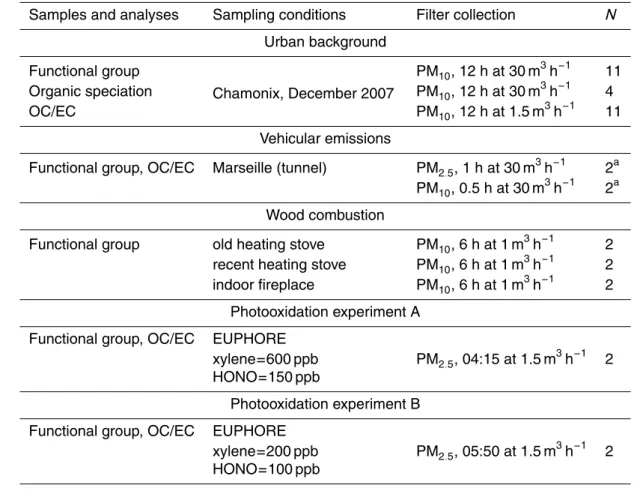
Samples from various experiments and field campaigns are studied; the sampling con-ditions and the analyses performed on the sample series are synthesized in Table 1.
2.1.1 Secondary organic aerosols
5
A series of 4 secondary organic aerosol (SOA) samples were collected during o-xylene photo-oxidation experiments initiated with HONO, in the EUPHORE simulation cham-ber (European Photoreactor, Valencia – Spain, Becker et al., 1996). Experiment A was carried out at high initial concentration levels in o-xylene and HONO (600 ppbv o-xylene, 150 ppbv HONO). Two filters were collected during the whole time of ex-10
periment A which lasted for 04:15. Experiment B was carried out at moderate initial concentrations (200 ppbvo-xylene, 100 ppbv HONO). Two samples were collected dur-ing the whole time of experiment B, which lasted for 05:50. Particles were collected on 47 mm quartz fiber filters (QM-A, Whatman) at a flow rate of 1.5 m3h−1
, downstream a charcoal-impregnated denuder was used to remove the volatile organic compounds 15
(Eatough et al., 1999).
2.1.2 Emission sources aerosols
Aerosols emitted by the combustion of the same sets of wood in 3 different burning devices are studied. The sets of wood were composed of beechwood logs (50 cm long and at least 6 cm large) containing 16% humidity. The wood combustion devices were 20
heating stoves, one recent and one old model, both used for personal heating, and an indoor fireplace. In each case, 47 mm quartz fiber filters (QM-A, Whatman) were col-lected at reduced and nominal (optimal) combustion efficiencies. These 6 aerosol sam-ples were collected in the chimney outlets on the roofs of residential homes, through a heated rod (125◦C) at a flow rate of 1 m3
h−1
ACPD
10, 9253–9289, 2010Functional group composition of ambient and source
organic aerosols
J. Dron et al.
Title Page
Abstract Introduction
Conclusions References
Tables Figures
◭ ◮
◭ ◮
Back Close
Full Screen / Esc
Printer-friendly Version
Interactive Discussion Organic aerosol emitted by road traffic in a roadway tunnel was also considered. A
full description of the sampling site and the sample collection procedures is presented in El Haddad et al. (2009). Briefly, the sampling site was located in a French road-way tunnel (Tunnel, Marseilles) where heavy-duty trucks are prohibited and speed is limited to 50 km h−1. PM2.5 and PM10 samples were collected on two separate days,
5
on 150 mm quartz fiber filters (QM-A, Whatman) by means of a DA-80 high volume sampler operating at a flow rate of 30 m3h−1. The final 4 samples assigned to a func-tional group determination were two separate combinations of 12 PM2.5filters and two
separate combinations of 9 PM10filters, all collected between 07h00 and 08h00,
there-fore, reflecting whole day emissions in the roadway tunnel, i.e. including both fluid and 10
dense traffic episodes.
2.1.3 Urban background aerosols
Eleven consecutive samples were collected at an urban background site located in the Chamonix Alpine valley (France) from 11–18 December 2007. The sampling site (Clos de l’Ours) is described by Marchand et al. (2004). The Chamonix valley is narrow and 15
surrounded by elevated mountains reaching 3000 to 4800 m above sea level (m a.s.l.) and is characterised by some of the steepest slopes in the Alps. The field campaign was conducted during an atmospheric pollution event characterised by high concen-trations in PM10 (avg. 35 µg m−3
, max. 100 µg m−3
), NO (avg. 107 ppb, max. 640 ppb) and NO2(avg. 71 ppb, max. 177 ppb) associated with low temperatures (avg.−11.2◦C,
20
min.−15.6◦C, max.−3.5◦C) and strong inversion layers.
PM10 were collected on 150 mm quartz fiber filters (QM-A, Whatman) using a DA-80 high volume sampler (30 m3h−1). The sampling was split into 12 h periods, from 06:00 to 18:00 (UTC) for daytime samples, and from 18:00 to 06:00 (UTC) for nighttime samples. The filters collected during the nights of 11 and 12 December 2007 were put 25
measure-ACPD
10, 9253–9289, 2010Functional group composition of ambient and source
organic aerosols
J. Dron et al.
Title Page
Abstract Introduction
Conclusions References
Tables Figures
◭ ◮
◭ ◮
Back Close
Full Screen / Esc
Printer-friendly Version
Interactive Discussion ments were collected on Whatman QM-A at a flow rate of 1.5 m3h−1on the same time
basis as the filters assigned for functional group determination. All filters used in this study were previously fired for 2 h at 500◦C to lower the blank levels. All samples were stored at−18◦C in aluminium foil sealed in polyethylene bags until analysis.
2.2 Functional group analyses
5
The functional group analyses were carried out on a triple quadrupole mass spectrom-eter (Varian 1200L) equipped with an atmospheric pressure chemical ionisation (APCI) source and a high-performance liquid chromatography device (HPLC, Varian Prostar 210). The analytic techniques enable the quantitative determination of the carboxylic, carbonyls and nitro functional groups. They are based on the ability of the functional 10
groups under study to lose a specific neutral molecular fragment (neutral loss scan-ning) or to produce a characteristic ion (precursor ion scanscan-ning) in the collision cell (Dron et al., 2007, 2008a, b). Mass spectra were recorded between m/z 115 and m/z 800, except for the photo-oxidation experiments which were limited in the high masses tom/z 600. Calibration samples were analysed within each sequence. Filter 15
blanks were checked for each functional group determination and the results were all below detection limits.
The filters were extracted using an accelerated solvent extractor (ASE, Dionex) with a solvent mixture of methanol/hexane (2:1,v/v, HPLC-grade from Sigma-Aldrich) and under the following conditions: 100◦C and 100 bar during a 5 min static time. The 20
extracts were then evaporated to a volume of 0.5 mL at room temperature and under a gentle stream of nitrogen by means of an automatic concentrator (TurboVap II). The samples were finally dissolved with methanol to a final volume of 3.5 mL.
A 300 µL fraction of the extracts was first submitted to the derivatisation of the car-boxylic functional groups into their corresponding methyl esters, by adding 300 µL of 25
a boron trifluoride methanolic solution (BF3/methanol 14%, v/v, Sigma-Aldrich) and
chromato-ACPD
10, 9253–9289, 2010Functional group composition of ambient and source
organic aerosols
J. Dron et al.
Title Page
Abstract Introduction
Conclusions References
Tables Figures
◭ ◮
◭ ◮
Back Close
Full Screen / Esc
Printer-friendly Version
Interactive Discussion graphic separation, into the APCI chamber at a flow rate of 0.5 mL min−1, and the
anal-ysis was performed by recording the total ion current (TIC) measured by scanning the neutral loss of methanol (CH3OH, 32 amu) from the fragmentation of the protonated methyl esters. In order to avoid any interference or unwanted compounds, a mass spectrum obtained by neutral loss scanning of 32 amu (NL 32) was also recorded be-5
fore derivatisation, and the corresponding signal was subtracted from the one recorded after derivatisation (Dron et al., 2007).
The determination of the carbonyl functional groups, i.e. aldehyde and ketone groups, was carried out after derivatisation with pentafluorophenylhydrazine (PFPH, Sigma-Aldrich). 150 µL of a 0.1 M methanolic solution of PFPH were added to 450 µL 10
of the initial sample extract, and the mixture was left to react 18 h at room tempera-ture. The analysis was then performed by directly injecting the solution into the APCI chamber at a flow rate of 0.5 mL min−1, and monitoring the neutral loss of 181 amu (NL 181) from the fragmentation of the protonated hydrazone derivatives. A mass spectrum of the same sample obtained by NL 181 before derivatisation was recorded and sub-15
tracted from the spectrum obtained after the PFPH derivatisation (Dron et al., 2008a). A final fraction of the sample extract was analysed in order to determine the con-centration in nitro functional groups. The sample was directly injected in the ionisation source at a flow rate of 0.5 mL min−1, negatively ionised, and the nitro compounds were simply determined by monitoring the precursor ions of the NO−2 product ion, m/z 46 20
(PAR 46) (Dron et al., 2008b).
The detection limits of the analytical procedures were 0.005 mM, 0.004 mM, and 0.001 mM for carboxylic acids, carbonyls and nitros, respectively. According to the 30 m3h−1flow rate during the 12 h sampling conditions and a sample volume of 3.5 mL, these detection limits correspond to atmospheric concentrations of 0.05 nmol m−3, 25
ACPD
10, 9253–9289, 2010Functional group composition of ambient and source
organic aerosols
J. Dron et al.
Title Page
Abstract Introduction
Conclusions References
Tables Figures
◭ ◮
◭ ◮
Back Close
Full Screen / Esc
Printer-friendly Version
Interactive Discussion the literature using H-NMR for carboxylic (Tagliavini et al., 2006) and carbonyl
moi-eties (Moretti et al., 2008), respectively. Quantitative functional group analyses of nitro compounds has not been reported in OA since Gordon et al. (1988) and was only per-formed using FT-IR until the development of our quantitative MS/MS method (Dron et al., 2008b). In the present study, OC concentrations ranged in Chamonix from 9 to 5
34 µg m−3 (Table 2) leading to actual detection limits below 0.001% in terms of func-tionalisation rates in this case.
2.3 Organic tracers
Four composite samples, representative of 4 days among the 6 days of the sampling period in Chamonix, were solvents extracted and analysed by gas chromatography-10
mass spectrometry (GC-MS, Thermo Trace GC 2000 coupled to a Polaris Q ion trap mass spectrometer), following the recommendation of the Desert Research Institute for the analysis of semi-volatile organic compounds (DRI, 2003). Before extraction, samples were spiked with known amounts of isotope-labelled standards, tetracosane-d50 and cholesterol-d6. They were extracted by ASE with a dichloromethane/acetone 15
mixture (1:1, v/v) using the same temperature and pressure conditions as previ-ously. One fraction was directly injected for the quantification of the hopanes and steranes. A second fraction (50 µL) was derivatised before the GC/MS analysis with 50 µL of N,O-bis(trimethylsilyl)-trifluoroacetamide (BSTFA, Sigma-Aldrich) containing 10% trimethylchlorosilane (TMCS) in order to convert the organic acids and alcohols 20
into their trimethylsilyl esters and ethers, respectively. The two fractions were analysed using the same GC-MS conditions, i.e. electron impact ionisation at 70 eV and chro-matographic separation on a TR-5MS capillary column (ThermoElectron). The quan-tification of the organic compounds was performed using authentic standards, and the compounds for which no authentic standard was available were quantified using the 25
ACPD
10, 9253–9289, 2010Functional group composition of ambient and source
organic aerosols
J. Dron et al.
Title Page
Abstract Introduction
Conclusions References
Tables Figures
◭ ◮
◭ ◮
Back Close
Full Screen / Esc
Printer-friendly Version
Interactive Discussion
2.4 OC/EC
Samples collected at Chamonix and in the roadway tunnel were analysed for EC and OC using the Thermo-Optical Transmission (TOT) method with a Sunset Lab anal-yser. The newly developed EUSAAR2 temperature program proposed by Cavalli et al. (2010) was used. The EUSAAR2 method includes temperatures of up to 570◦C for 5
the analysis of OC in 100% He, and up to 870◦C for the analysis of EC in 98% He+2% O2.
3 Results and discussion
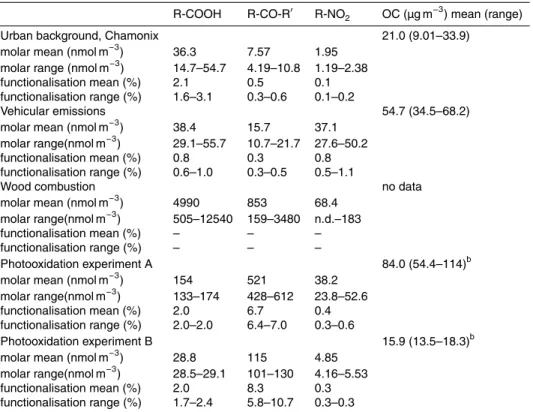
The quantitative results of the 3 functional groups measurements are presented in Table 2, as molar concentrations and functionalisation rates for all the samples under 10
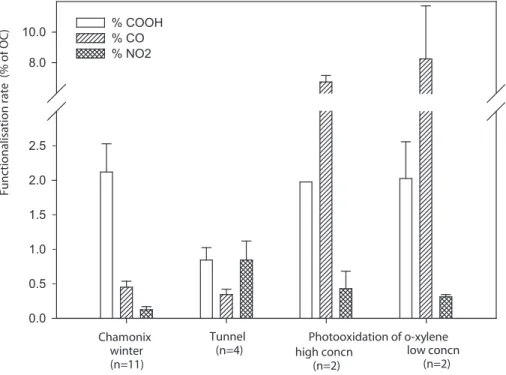
study. The carboxylic, carbonyl and nitro functionalisation rates are also reported in Fig. 1. The functionalisation rates, expressed in % of OC, are calculated using Eq. (1),
Functionalisation rate(%)=([functional group]/[OC])×100 (1) where [functional group] is the molar concentration of the concerned functional group and [OC] the molar concentration of OC in the aerosol, both expressed in mol m−3. 15
Figure 1 shows that the relative contributions of the three functional groups are signifi-cantly different from one aerosol source to another.
3.1 Functional groups fingerprints of aerosol sources
The primary vehicular exhaust particles collected in the tunnel are characterised by a low functionalisation rate ranging from 1.7 to 2.2% of OC (Table 2). As a result, only 20
ACPD
10, 9253–9289, 2010Functional group composition of ambient and source
organic aerosols
J. Dron et al.
Title Page
Abstract Introduction
Conclusions References
Tables Figures
◭ ◮
◭ ◮
Back Close
Full Screen / Esc
Printer-friendly Version
Interactive Discussion functionalisation rate is twice lower, ranging from 0.3 to 0.5% (Table 2). Compared to
the other samples, the large nitro content may be linked to the high temperatures of the combustion processes occuring in the vehicle engines (Matthews, 1980; Eberhardt et al., 2003) and can be partially attributed to nitro-PAHs, previously identified in diesel exhaust OA (Heeb et al., 2008). The low content in functional groups containing oxy-5
gen atoms (carbonyl and carboxylic acid) is also consistent with the moderate water soluble organic carbon (WSOC) fraction measured, which accounts for 20% of the OC measured inside the tunnel (El Haddad et al., 2009) and with the hydrophobic prop-erties of fresh vehicular exhaust soot particles previously described in the literature (Weingartner et al., 1997).
10
In contrast, wood combustion particles are characterised by high carboxylic and car-bonyl concentrations which can reach 12 µmol m−3and 3.5 µmol m−3, respectively (Ta-ble 1). These concentrations are 2 to 3 orders of magnitude larger than those mea-sured inside the tunnel, highlighting the large emissions of organic matter produced by wood combustion compared to vehicular exhaust (Schauer et al., 1999, 2001, 2002). 15
It also shows the significant fraction of highly polar organic compounds (essentially lignin pyrolysis products for the carboxylic and carbonyl moieties, Nolte et al., 2001) and humic-like substances (Graber and Rudich, 2006) associated with these emis-sions. An important variability of the functional groups concentrations is also observed according to the combustion conditions. As no OC data were available for wood smoke 20
samples, this variability should be observed through the carbonyl-to-carboxylic and nitro-to-carboxylic ratios (Table 3). Nitro functional groups are not detected in the par-ticles emitted by wood combustion in open fire, for both combustion efficiencies, while the particles formed in the heating stoves (old and recent) present nitro-to-carboxylic ratios between 0.01 and 0.1. For comparison purposes, this ratio is close to 1 for the 25
ACPD
10, 9253–9289, 2010Functional group composition of ambient and source
organic aerosols
J. Dron et al.
Title Page
Abstract Introduction
Conclusions References
Tables Figures
◭ ◮
◭ ◮
Back Close
Full Screen / Esc
Printer-friendly Version
Interactive Discussion operating conditions for nitro-to-carboxylic ratios in the cases of heating stoves. The
carbonyl-to-carboxylic ratio presents relevant characteristics as well. In the wood com-bustion samples, it is systematically and significantly higher for nominal comcom-bustion efficiencies than for reduced combustion conditions. In addition, at high efficiencies, the ratios are significantly lower for open fire emissions than in the heating stoves. 5
Finally, the highest [R-CO-R′]/[R-COOH] ratio is observed for the roadway traffic emis-sions. Consequently, increasing the combustion efficiency would possibly favour the production of nitros and carbonyls compared to carboxylic acids. This confirms that primary combustion aerosols may be characterised by their functional group contents according to the combustion process involved.
10
SOA formed through photo-oxidation of o-xylene exhibit a very different functional group fingerprint. For these experiments, OC is deduced from PM concentrations as-suming that PM is only made up of organic matter (OM). On the basis of the structure of the main compounds detected in similar photo-oxidation experiments (Forstner et al., 1997; Aiken et al., 2008), a ratio OM/OC=1.75 is used in this study to estimate the 15
OC concentrations. Whereas the functional groups molar concentrations reported in Table 2 are very dependent upon the initial concentrations in o-xylene and HONO, the functionalisation rates are similar for the 2 experimental conditions under study. This shows that the initial concentrations in o-xylene and HONO has no significant influence on the functionalisation of the SOA formed, at least in the range of concentrations cov-20
ered in this study. The total functionalisation rates of the o-xylene photo-oxidation SOA are particularly high, with approximately 1/9 OC atoms in experiment A and 1/11 OC atoms in experiment B functionalised by carboxylic, carbonyl or nitro groups. The SOA samples are strongly dominated by carbonyl groups (Fig. 1), which represent about 75% of all the functional groups determined here. This result is in good agreement 25
ACPD
10, 9253–9289, 2010Functional group composition of ambient and source
organic aerosols
J. Dron et al.
Title Page
Abstract Introduction
Conclusions References
Tables Figures
◭ ◮
◭ ◮
Back Close
Full Screen / Esc
Printer-friendly Version
Interactive Discussion
3.2 Chamonix urban background aerosol
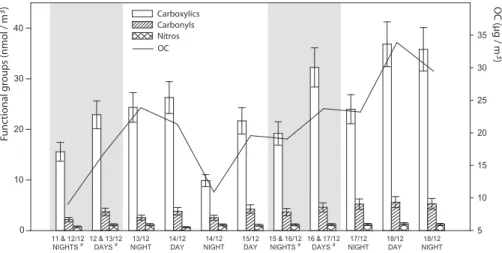
The total functionalisation rates, considering the three functional groups under study, range from 2 to 4% for the particles collected in Chamonix (Table 2). All the samples are dominated by carboxylic moieties, with carbonyls and nitros being 2 to 5 times less concentrated (Fig. 2). Moretti et al. (2008) measured by H-NMR similar molar con-5
centrations in urban background aerosols collected in Bologna (Italy) in the May–June period. They reported total carboxylic concentrations ranging from 5 to 50 nmol m−3 and total carbonyl concentrations from 4 to 35 nmol m−3. The corresponding function-alisation rates were from 6 to 20% and from<3 to 11% of water soluble organic carbon (WSOC) for carboxylic acids and carbonyls, respectively. This is higher than what is 10
measured in the present study, but it shall be noted that WSOC is a very variable frac-tion of OC, generally representing 30 to 80% of OC and, in addifrac-tion, includes most exclusively the oxygenated fraction of OC (Decesari et al., 2006; Duarte et al., 2007; Salma et al., 2007). The differences may also result from the sampling period and location especially considering the singularity of the valley of Chamonix during winter 15
characterised by high primary emissions from both road traffic and residential heating (Marchand et al., 2004) associated to unfavourable conditions for SOA formation and chemical aging due to low temperatures (−3.5 to −15.6◦C), low solar irradiance and a lack of long range transport of the aerosol. The relatively low carbonyl content in Chamonix OA compared to the high carbonyl functionalisation rates measured for the 20
photo-oxidation experiments (6 to 11%) supports the assumption that the Chamonix winter OA is mainly of primary origin. Another recent study (Liu et al., 2009) carried out in the area of Mexico City and using FTIR reported functionalisation rates of 5 to 30% for carboxylic acids and 0 to 1% for carbonyls, pointing out that a significant difference can be observed from one sampling site to another.
25
ACPD
10, 9253–9289, 2010Functional group composition of ambient and source
organic aerosols
J. Dron et al.
Title Page
Abstract Introduction
Conclusions References
Tables Figures
◭ ◮
◭ ◮
Back Close
Full Screen / Esc
Printer-friendly Version
Interactive Discussion concentrations, and the correlation coefficients are R2=0.84 andR2=0.79 (n=11),
re-spectively. These observations are illustrated in Fig. 2, representing the evolution of the atmospheric concentrations for the three functional groups, together with the OC concentration during the whole sampling period. This result implies that the carboxylic acid and the carbonyl functionalisation rates are fairly constant during the sampling pe-5
riod and that no significant differences are observed between day and night samples. Therefore, we can assume that the sources of the aerosol are homogeneous over the measurement period and that the photo-oxidation processes do not significantly change the composition of the organic fraction of the aerosol in the conditions en-countered during the sampling campaign. The carboxylic and carbonyl concentrations 10
measured here are then principally subjected to the evolution of OC concentrations. To a lesser extent, these correlations highlight the reliability of the functional groups analytical procedures newly developed.
The nitro functional group is the least represented in the Chamonix aerosols and the concentrations are relatively stable, ranging from 1.2 to 2.4 nmol m−3. Such stability in-15
duces a lack of linear correlation with the OC content. In these conditions, the function-alisation rate for nitro groups also presents significant variations during the sampling period, ranging from 0.07 to 0.23%. Although a fraction of the nitro compounds may be formed through radical-initiated reactions of organic compounds (Reisen and Arey, 2005), no correlation between NOxand nitro functionalisation rates is further observed.
20
This suggests a primary origin of the nitro compounds measured in this study.
3.3 Sources discrimination using functional group fingerprints
As discussed above, the functionalisation rates for carboxylic acids, carbonyl and ni-tro functional groups reveal sni-trong differences according to the nature of the aerosol source. Therefore, it is interesting to test the ability of these functional groups’ fin-25
age-ACPD
10, 9253–9289, 2010Functional group composition of ambient and source
organic aerosols
J. Dron et al.
Title Page
Abstract Introduction
Conclusions References
Tables Figures
◭ ◮
◭ ◮
Back Close
Full Screen / Esc
Printer-friendly Version
Interactive Discussion ing can be neglected as a first approximation. In addition, vehicular emissions and
wood combustion can be considered as the two principal primary sources of urban background aerosol in winter (Schauer and Cass, 2000; Zheng et al., 2002) and in an Alpine valley (Marchand et al., 2004; Sandradewi et al., 2008). The photo-oxidation of o-xylene appears as well as a fair approximation for SOA formation in such condi-5
tions (high NOx concentrations: 178.4 ppb in average, low O3concentrations: 3.2 ppb
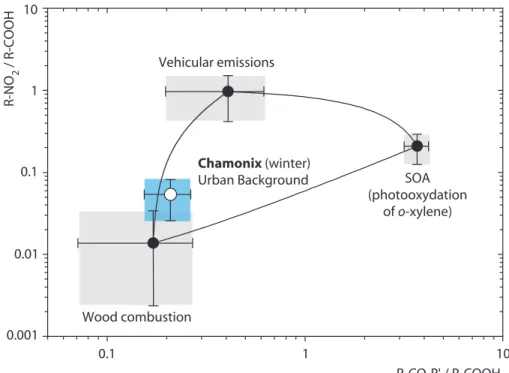
in average, and low biogenic activity, as measured during our sampling campaign) (Finlayson-Pitts and Pitts 2000; Atkinson and Arey, 2003). The functional groups’ fin-gerprints of the 3 sources under study and of the urban background aerosol collected in Chamonix, in winter 2007, can be visualised altogether according to their carbonyl-10
to-carboxylic and nitro-to-carboxylic functional group ratios, as presented in Fig. 3. The functional group ratios of the 3 aerosol sources are clearly separated, forming a triangle (points are connected by plain lines in Fig. 3) in which the point corresponding to the Chamonix functional group fingerprint is included. Assuming that the functional groups fingerprints of the three sources described in this study are representative of 15
the emissions and aerosol formation processes inside the Chamonix valley, and that no heterogeneous chemical process has significantly modified the composition of the organic fraction during the aerosol atmospheric residence time, a large contribution of wood burning to the ambient OA can be assessed. This is in agreement with the wide use of wood combustion in the valley and with previous results at the same location 20
(Marchand et al., 2004; Jaffrezo et al., 2005; Aymoz et al., 2007). The predominance of the wood combustion contribution in such environments is also in good agreement with the sources apportionment studies performed by Sandradewi et al. (2008), which attributed 88% of OA to wood burning emissions and by Favez et al. (2009) in sim-ilar Alpine valleys during winter. The contribution of vehicular exhaust emissions to 25
ACPD
10, 9253–9289, 2010Functional group composition of ambient and source
organic aerosols
J. Dron et al.
Title Page
Abstract Introduction
Conclusions References
Tables Figures
◭ ◮
◭ ◮
Back Close
Full Screen / Esc
Printer-friendly Version
Interactive Discussion Lewandowski et al., 2008).
The results, obtained in the present study, must still be taken with care, due to the hypothesis that the 3 aerosol sources considered must represent all the major sources of the OC in the Chamonix valley. The chemical profile of the vehicular emissions can differ between the Chamonix and the Marseilles tunnel traffic, as the wood combus-5
tion emissions may be affected by the wood nature (Schauer et al., 2001; Oros and Simoneit, 2001; Fine et al., 2002) and the combustion processes (Table 2). Finally, considering o-xylene photo-oxidation in the presence of NOx as representative of the total urban background SOA in terms of functional group distributions cannot be as-sessed, as it is the first quantitative functional group determination of SOA produced 10
in simulation chamber. However, photo-oxidation in the presence of NOxis considered as the principal source of SOA (Kleindienst et al., 2007).
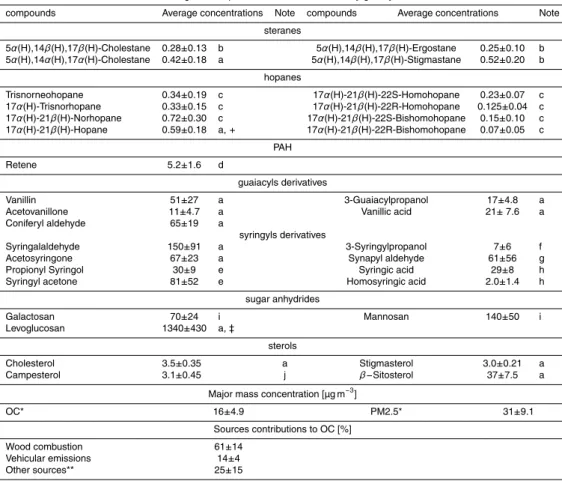
In order to assess the relevance of functional groups ratios as a diagnostic tool to distinguish sources, a source apportionment approach using organic markers has been performed. Table 4 reports the average concentrations of the selected organic markers 15
quantified in the Chamonix aerosol during the same sampling campaign, including hopanes and steranes emitted by vehicular emissions and different wood combustion markers such as levoglucosan, retene, sterols, and guaiacyl and syringyl derivatives. The contributions of these two major sources (OCsource, expressed in µg m−
3
) can be calculated following Eq. (2),
20
OCsource=[M]/([M]/OC)source (2)
where [M] is the concentration of a source-specific marker determined in the ambient samples (expressed in ng m−3) and ([M]/OC)source is the fractional abundance of the considered organic marker to OC in the source aerosol (expressed in mg g−1).
Because of its ubiquity in all wood combustion aerosols, the levoglucosan is widely 25
used for estimating the amount of OC from wood or biomass combustions in the am-bient aerosol. The (levoglucosan/OC)wood ratio, determined by Fine et al. (2002), is
ACPD
10, 9253–9289, 2010Functional group composition of ambient and source
organic aerosols
J. Dron et al.
Title Page
Abstract Introduction
Conclusions References
Tables Figures
◭ ◮
◭ ◮
Back Close
Full Screen / Esc
Printer-friendly Version
Interactive Discussion 42 mg g−1 is found for softwood combustions, while a higher ratio of 136 mg g−1 is
found for hardwood combustions. The wood type used predominantly for the com-bustion can be determined using the other wood comcom-bustion markers. The syringyl derivatives and β-sitosterol are found, to a much greater extent, in the hardwood smokes. Accordingly, a (β-sitosterol/OC)wood ratio of 2.9 mg g−
1
is reported for hard-5
wood combustions, while a much lower ratio of 0.2 mg g−1
is reported for softwood combustions (Fine et al., 2002). In contrast, retene is an alteration product of the resin acids found in conifers (softwood), and is exclusively emitted from softwood com-bustions ((retene/OC)softwood=5.1 mg g−1
) (Fine et al., 2002). The high concentrations of syringyl derivatives andβ-sitosterol (β-sitosterol/OC=2.3 mg g−1) and the low con-10
centration of retene (retene/OC=0.33 mg g−1) found in the samples from Chamonix suggest that the aerosol is mainly produced by hardwood combustion. The results presented for functional groups’ determinations, performed considering beechwood (hardwood) combustion in various heating devices are, thus, well suited to estimate the wood combustion contribution in the Chamonix valley. Considering the average (lev-15
oglucosan/OC) ratio, the mean wood combustion contribution is estimated to 61% of OC (OCwood=9.9 µg m−
3
). Comparable contributions of wood combustions to OC con-centrations (50–80%) are found in winter using the same methodology, at background sites in Europe (Puxbaum et al., 2007; Favez et al., 2009). These results confirm the prominence of wood combustion in the Chamonix aerosol.
20
The contribution of the vehicular emissions to OC is calculated using Eq. (2) and hopane as a specific marker of vehicular emissions (Rogge et al., 1993). The same tunnel samples were used for functional groups analyses and for the determination of the (hopane/OC)road ratio of 0.206 mg g−1 used here (El Haddad et al., 2009). The average contribution of the vehicular emissions to the OC is estimated to 14% 25
(OCvehicles=2.27 µg m− 3
). The remaining OC (20.2%) is attributed to the SOA contribu-tion along with other minor primary sources.
ACPD
10, 9253–9289, 2010Functional group composition of ambient and source
organic aerosols
J. Dron et al.
Title Page
Abstract Introduction
Conclusions References
Tables Figures
◭ ◮
◭ ◮
Back Close
Full Screen / Esc
Printer-friendly Version
Interactive Discussion obtained in source apportionment by MS/MS functional group analysis must be
con-firmed and supported by the study of additional aerosol sources and by longer at-mospheric measurement series in various environments, especially during summer. Chemical aging of the aerosol must also be investigated in terms of modifications in the functionalisation rates. Recent studies have shown a rapid and significant evolu-5
tion of the organic fraction of primary aerosol (wood combustion and diesel emissions) due to photo-oxidation processes (Sage et al., 2008; Grieshop et al., 2009; Favez et al., 2009). These chemical modifications can greatly affect the functional group distribution and, thus, the ability of functional groups to distinguish the aerosol sources.
3.4 Apparent mass distributions of functional groups
10
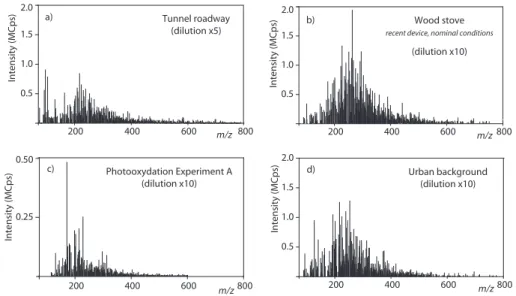
The mass spectra recorded are an additional source of information offered by APCI-MS/MS functional group analysis. They provide a visualisation of the apparent mass distribution of all the detected ions bearing the functional group under study. Examples of mass spectra recorded in the NL 32 mode for the quantification of total carboxylic acids for each aerosol category are presented in Fig. 4. Their global aspects are quite 15
similar, and the average molecular weights of the detected compounds are around m/z200 for the SOA and vehicular exhaust particles, and aroundm/z260 for the wood combustion and Chamonix aerosols. A 15 amu subtraction is necessary in obtaining the carboxylic molecular weight from the corresponding methyl ester derivatives. These results are particularly close from the 248 g mol−1average molecular weight calculated 20
by a thermodynamic method recently applied to a biomass burning aerosol (Asa-Awuku et al., 2008). Ions are detected at nearly every m/z ratios in the vehicular exhaust, wood combustion and urban background aerosols (Fig. 4), attesting to the extreme chemical complexity of OA. All of the aerosols studied here also present a large fraction of peaks abovem/z300, which could characterise a large HULIS content (Dron, 2008). 25
ACPD
10, 9253–9289, 2010Functional group composition of ambient and source
organic aerosols
J. Dron et al.
Title Page
Abstract Introduction
Conclusions References
Tables Figures
◭ ◮
◭ ◮
Back Close
Full Screen / Esc
Printer-friendly Version
Interactive Discussion studies proposed wood combustion as a major source of HULIS (Lukacs et al., 2007;
Asa-Awuku et al., 2008; Baduel et al., 2009). The samples from wood combustion and from Chamonix urban background contain the largest amounts of high molecular weight compounds, which is consistent with the results indicating wood combustion primary particles as the main component of the aerosol in the Chamonix Valley. 5
As for carboxylic acids, the mass spectra recorded for the determination of carbonyls and nitros are relatively similar in terms of apparent mass distributions whatever the sample. Carbonyls are also detected up tom/z 500, but nitro functional groups are not detected abovem/z300. This indicates that the high molecular weight compounds encountered in atmospheric OA such as HULIS contain significant amounts of car-10
boxylic and carbonyl groups. They do not present detectable levels of nitro functional groups, as reported by other studies pointing out that HULIS are mainly composed of oxygenated functional groups (Havers et al., 1998; Reinhardt et al., 2007) together with organosulfates and organonitrates (Reemtsma et al., 2006).
4 Conclusions
15
The MS/MS functional group analysis was applied to the characterisation of the OA from primary and secondary sources, and from an ambient aerosol. The detection limits and the good quantitative accuracy offered by the new MS/MS functional group analytical methods make them a powerful and complementary tool for the character-isation of the OA. In the present study, the carboxylic, carbonyl and nitro functional 20
groups could be detected at the nmol m−3 level. Carboxylics represented about 2.0% of the organic carbon in the SOA and ambient samples, but only 0.8% in the vehicular emissions OA. The aerosol sources showed characteristic functional groups distribu-tions, in particular with a high carbonyl content in the o-xylene laboratory generated SOA (6 to 11% of OC) and a high nitro content in the vehicular emissions (0.8% of 25
ACPD
10, 9253–9289, 2010Functional group composition of ambient and source
organic aerosols
J. Dron et al.
Title Page
Abstract Introduction
Conclusions References
Tables Figures
◭ ◮
◭ ◮
Back Close
Full Screen / Esc
Printer-friendly Version
Interactive Discussion a good agreement with an organic tracer approach performed on the same samples.
The results presented here offer interesting perspectives in OA characterisation. The MS/MS functional group analysis methods are theoretically applicable to all chemical functional groups. For instance, the additional determination hydroxyl, organonitrates and organosulfates groups would provide very valuable compositional data and knowl-5
edge relative to the aerosol chemistry. Aerosol aging may also be investigated through the systematic measurement of functional groups in different locations and during sig-nificant time periods. The study of aerosol sources can also be completed with addi-tional sources to provide a better accuracy in evaluating the source contributions of an ambient aerosol.
10
In addition to the quantitative results, the MS/MS technique for functional group de-termination provides a second type of information through the recorded mass spectra. For instance, the molecular weight distribution of the detected compounds may reveal qualitatively the content of humic-like substances inside the sample under study.
Acknowledgements. This work has been supported by ADEME (Agence De l’Environnement
15
et de la Maitrise de l’Energie) and by the “Region Provence Alpes Cote d’Azur” and the Ministry of the Environment of France through the research program PRIMEQUAL2 (grant no. 0001135, FORMES project) and the research grant for J. Dron. The authors also thank the Centre Na-tional de la Recherche Scientifique (CNRS) and the Institut NaNa-tional des Sciences de l’Univers (INSU) for their financial supports.
20
The authors also acknowledge the whole scientific group of the simulation chamber EUPHORE
and the different partners involved in the EUPHORE experiments (LISA, CNRS-University of
Cr ´eteil; and ICARE, CNRS Orl ´eans).
The authors are finally thankful to the LCME laboratory (University of Savoie), the INERIS
institute and the ATMO-PACA air quality survey association for their implications in the different
25
ACPD
10, 9253–9289, 2010Functional group composition of ambient and source
organic aerosols
J. Dron et al.
Title Page
Abstract Introduction
Conclusions References
Tables Figures
◭ ◮
◭ ◮
Back Close
Full Screen / Esc
Printer-friendly Version
Interactive Discussion
References
Aiken, A. C., DeCarlo, P. F., Kroll, J. H., Worsnop, D. R., Huffman, J. A., Docherty, K. S., Ulbrich,
I. M., Mohr, C., Kimmel, J. R., Sueper, D., Sun, Y., Zhang, Q., Trimborn, A., Northway, M., Ziemann, P. J., Canagaratna, M. R., Onasch, T. B., Alfarra, M. R., Pr ´ev ˆot, A. S. H., Dommen, J., Duplissy, J., Metzger, A., Baltensperger, U., and Jimenez, J. L.: O/C and OM/OC Ratios
5
of Primary, Secondary, and Ambient Organic Aerosols with High-Resolution Time-of-Flight Aerosol Mass Spectrometry, Environ. Sci. Technol., 42, 4478–4485, 2008.
Atkinson, R. and Arey, J.: Atmospheric degradation of volatile organic compounds, Chem. Rev., 103, 4605–4638, 2003.
Asa-Awuku, A., Sullivan, A. P., Hennigan, C. J., Weber, R. J., and Nenes, A.: Investigation of
10
molar volume and surfactant characteristics of water-soluble organic compounds in biomass burning aerosol, Atmos. Chem. Phys., 8, 799–812, 2008,
http://www.atmos-chem-phys.net/8/799/2008/.
Aymoz, G., Jaffrezo, J. L., Chapuis, D., Cozic, J., and Maenhaut, W.: Seasonal variation of
PM10main constituents in two valleys of the French Alps. I: EC/OC fractions, Atmos. Chem.
15
Phys., 7, 661–675, 2007,
http://www.atmos-chem-phys.net/7/661/2007/.
Baduel, C., Voisin, D., and Jaffrezo, J.-L.: Water-soluble atmospheric HULIS in urban
environ-ments, Atmos. Chem. Phys. Discuss., 9, 21561–21579, 2009, http://www.atmos-chem-phys-discuss.net/9/21561/2009/.
20
Becker, K. H., Hjorth, J., Laverdet, G., Millan, M. M., Platt, U., Toupance, G., and Wildt, J.: De-sign and technical development of the European photoreactor and first experimental results, EV5V-CT92-0059, 1996.
Blando, J. D., Porcja, R. J., and Turpin, B. J.: Issues in the quantitation of functional groups by FTIR spectroscopic analysis of impactor-collected aerosols samples, Aerosol Sci. Technol.,
25
35, 899–908, 2001.
Camredon, M., Aumont, B., Lee-Taylor, J., and Madronich, S.: The SOA/VOC/NOx system: an
explicit model of secondary organic aerosol formation, Atmos. Chem. Phys., 7, 5599–5610, 2007,
http://www.atmos-chem-phys.net/7/5599/2007/.
30
ACPD
10, 9253–9289, 2010Functional group composition of ambient and source
organic aerosols
J. Dron et al.
Title Page
Abstract Introduction
Conclusions References
Tables Figures
◭ ◮
◭ ◮
Back Close
Full Screen / Esc
Printer-friendly Version
Interactive Discussion
organic and elemental carbon during fall and winter of 2003 in Xi’an, China, Atmos. Chem. Phys., 5, 3127–3137, 2005,
http://www.atmos-chem-phys.net/5/3127/2005/.
Cappiello, A., De Simoni, E., Fiorucci, C., Mangani, F., Palma, P., Trufelli, H., Decesari, S., Facchini, M. C., and Fuzzi, S.: Molecular characterization of the water-soluble organic
com-5
pounds in fogwater by ESIMS/MS, Environ. Sci. Technol., 37, 1229–1240, 2003.
Cavalli, F., Viana, M., Yttri, K. E., Genberg, J., and Putaud, J.-P.: Toward a standardised thermal-optical protocol for measuring atmospheric organic and elemental carbon: the EU-SAAR protocol, Atmos. Meas. Tech., 3, 79–89, 2010,
http://www.atmos-meas-tech.net/3/79/2010/.
10
Decesari, S., Facchini, M. C., Fuzzi, S., and Tagliavini, E.: Characterization of water-soluble organic compounds in atmospheric aerosol: A new approach, J. Geophys. Res., 105, 1481– 1489, 2000.
Decesari, S., Fuzzi, S., Facchini, M. C., Mircea, M., Emblico, L., Cavalli, F., Maenhaut, W., Chi, X., Schkolnik, G., Falkovich, A., Rudich, Y., Claeys, M., Pashynska, V., Vas, G., Kourtchev,
15
I., Vermeylen, R., Hoffer, A., Andreae, M. O., Tagliavini, E., Moretti, F., and Artaxo, P.:
Char-acterization of the organic composition of aerosols from Rond ˆonia, Brazil, during the LBA-SMOCC 2002 experiment and its representation through model compounds, Atmos. Chem. Phys., 6, 375–402, 2006,
http://www.atmos-chem-phys.net/6/375/2006/.
20
Decesari, S., Mircea, M., Cavalli, F., Fuzzi, S., Moretti, F., Tagliavini, E., and Facchini, M. C.: Source attribution of water-soluble organic aerosol by nuclear magnetic resonance spec-troscopy, Environ. Sci. Technol., 41, 2479–2484, 2007.
Donahue, N. M., Robinson, A. L., and Pandis, S. N.: Atmospheric organic particulate matter: From smoke to secondary organic aerosol, Atmos. Env., 43, 94–106, 2009.
25
DRI Desert Research Institute: Analysis of Semi-volatile Organic Compound by GC/MS, DRI Standard Operating Procedure no 2-750.5 (revision 05), 1–25, 2003.
Dron, J., Eyglunent, G., Temime-Roussel, B., Marchand, N., and Wortham, H.: Carboxylic acid functional group analysis using constant neutral loss scanning-mass spectrometry, Anal. Chim. Acta, 605, 61–69, 2007.
30
ACPD
10, 9253–9289, 2010Functional group composition of ambient and source
organic aerosols
J. Dron et al.
Title Page
Abstract Introduction
Conclusions References
Tables Figures
◭ ◮
◭ ◮
Back Close
Full Screen / Esc
Printer-friendly Version
Interactive Discussion
Dron, J., Abidi, E., El Haddad, I., Marchand, N., and Wortham, H.: Precursor ion scanning-mass spectrometry for the determination of the nitro functional groups in atmospheric partic-ulate organic matter, Anal. Chim. Acta, 618, 184–195, 2008b.
Dron, J.: Analyse fonctionnelle par spectrom ´etrie de masse tandem: application aux arosols organiques atmosphriques, PhD thesis (248 pp.), Universit ´e de Provence, 169–183, 2008.
5
Duarte, R., Santos, E., Pio, C., and Duarte, A.: Comparison of structural features of water-soluble organic matter from atmospheric aerosols with those of aquatic humic substances, Atmos. Environ., 41, 8100–8113, 2007.
Eberhardt, O., Gr ¨unert, A., and Ballschmiter, K.: Simulation of the atmospheric pattern of
alkylnitrates by the reaction of alkanes with NO2/HNO3, Geophys. Res. Abstr., 5, 11001,
10
2003 (EGS-AGU-EUG Joint Assembly, Nice, France, April 2003).
El Haddad, I., Marchand, N., Dron, J., Temime-Roussel, B., Quivet, E., Wortham, H., Jaffrezo,
J.-L., Baduel, C., Voisin, D., Besombes, J.-L., and Gille, G.: Comprehensive primary particu-late organic characterization of vehicular exhaust emissions in France, Atmos. Environ., 43, 6190–6198, 2009.
15
Eatough, D. J., Obeidi, F., Pang, Y., Ding, Y., Eatough, N. L., and Wilson, W. E.: Integrated and
real-time diffusion denuder sample for PM2.5, Atmos. Environ., 33, 2835–2844, 1999.
Favez, O., El Haddad, I., Piot, C., Bor ´eave, A., Abidi, E., Marchand, N., Jaffrezo, J.-L.,
Be-sombes, J.-L., Personnaz, M.-B., Sciare, J., Wortham, H., George, C., and D’Anna, B.: Inter-comparison of source apportionment models for the estimation of wood burning aerosols
20
during wintertime in an Alpine city (Grenoble, France), Atmos. Chem. Phys. Discuss., 10, 559–613, 2010,
http://www.atmos-chem-phys-discuss.net/10/559/2010/.
Feczko, T., Puxbaum, H., Kasper-Giebl, A., Handler, M., Limbeck, A., Gelencs ´er, A., Pio, C., Preunkert, S., and Legrand, M.: Determination of water and alkaline extractable atmospheric
25
humic-like substances with the TU Vienna HULIS analyser in samples from six background sites in Europe, J. Geophys. Res., 112, D23S10, doi:10.1029/2006JD008331, 2007.
Fine, P. M., Cass, G. R., and Simoneit, B. R. T.: Chemical characterization of fine particle emissions from the fireplace combustion of woods grown in the southern United States, Environ. Sci. Technol., 36, 1442–1451, 2002.
30
ACPD
10, 9253–9289, 2010Functional group composition of ambient and source
organic aerosols
J. Dron et al.
Title Page
Abstract Introduction
Conclusions References
Tables Figures
◭ ◮
◭ ◮
Back Close
Full Screen / Esc
Printer-friendly Version
Interactive Discussion
Forstner, H. J. L., Flagan, R. C., and Seinfeld, J. H.: Secondary organic aerosol from the photo-oxidation of aromatic hydrocarbons: molecular composition, Environ. Sci. Technol., 31, 1345–1358, 1997.
Fuzzi, S., Andreae, M. O., Huebert, B. J., Kulmala, M., Bond, T. C., Boy, M., Doherty, S. J., Guenther, A., Kanakidou, M., Kawamura, K., Kerminen, V.-M., Lohmann, U., Russell, L. M.,
5
and P ¨oschl, U.: Critical assessment of the current state of scientific knowledge, terminology, and research needs concerning the role of organic aerosols in the atmosphere, climate, and global change, Atmos. Chem. Phys., 6, 2017–2038, 2006,
http://www.atmos-chem-phys.net/6/2017/2006/.
Gordon, R. J., Nirupam, T. J., and Brij, S. P.: Characterization of aerosol organics by diffuse
10
reflectance Fourier Transform Infrared spectroscopy, Environ. Sci. Technol., 22, 672–677, 1988.
Graber, E. R. and Rudich, Y.: Atmospheric HULIS: How humic-like are they? A comprehensive and critical review, Atmos. Chem. Phys., 6, 729–753, 2006,
http://www.atmos-chem-phys.net/6/729/2006/.
15
Grieshop, A. P., Logue, J. M., Donahue, N. M., and Robinson, A. L.: Laboratory investigation of photochemical oxidation of organic aerosol from wood fires 1: measurement and simulation of organic aerosol evolution, Atmos. Chem. Phys., 9, 1263–1277, 2009,
http://www.atmos-chem-phys.net/9/1263/2009/.
Hallquist, M., Wenger, J. C., Baltensperger, U., Rudich, Y., Simpson, D., Claeys, M., Dommen,
20
J., Donahue, N. M., George, C., Goldstein, A. H., Hamilton, J. F., Herrmann, H., Hoffmann,
T., Iinuma, Y., Jang, M., Jenkin, M. E., Jimenez, J. L., Kiendler-Scharr, A., Maenhaut, W., McFiggans, G., Mentel, T. F., Monod, A., Pr ´evt, A. S. H., Seinfeld, J. H., Surratt, J. D., Szmigielski, R., and Wildt, J.: The formation, properties and impact of secondary organic aerosol: current and emerging issues, Atmos. Chem. Phys., 9, 5155–5236, 2009,
25
http://www.atmos-chem-phys.net/9/5155/2009/.
Hamilton, J. F., Webb, P. J., Lewis, A.C., and Reviejo, M.M.: Quantifying small molecules in sec-ondary organic aerosol formed during the photo-oxidation of toluene with hydroxy radicals, Atmos. Environ., 39, 7263–7275, 2005.
Havers, N., Burba, P., Lambert, J., and Klockow, D.: Spectroscopic characterization of
humic-30
like substances in airborne particulate matter, J. Atmos. Chem., 29, 45–54, 1998.
ACPD
10, 9253–9289, 2010Functional group composition of ambient and source
organic aerosols
J. Dron et al.
Title Page
Abstract Introduction
Conclusions References
Tables Figures
◭ ◮
◭ ◮
Back Close
Full Screen / Esc
Printer-friendly Version
Interactive Discussion
Mosimann, T., Kasper, M., and Mayer, A.: Secondary effects of catalytic diesel particulate
filters: conversion of PAHs versus formation of nitro-PAHs, Environ. Sci. Technol., 42, 3773– 3779, 2008.
IPCC (International Panel on Climate Change). Forster, P., Ramaswamy, V., Artaxo, P., Berntsen, T., Betts, R., Fahey, D.W., Haywood, J., Lean, J., Lowe, D.C., Myhre, G., Nganga,
5
J., Prinn, R., Raga, G., Schulz, M., and Van Dorland, R.: Changes in atmospheric con-stituents and in radiative forcing, in: climate change 2007: the physical science basis, contri-bution of working group I to the fourth assessment report of the Intergovernmental Panel on Climate Change. Cambridge University Press, Cambridge, United Kingdom and New York, NY, USA, 2007.
10
Jaffrezo, J.-L., Aymoz, G., Delaval, C., and Cozic, J.: Seasonal variations of the water soluble
organic carbon mass fraction of aerosol in two valleys of the French Alps, Atmos. Chem. Phys., 5, 2809–2821, 2005,
http://www.atmos-chem-phys.net/5/2809/2005/.
Kanakidou, M., Seinfeld, J. H., Pandis, S. N., Barnes, I., Dentener, F. J., Facchini, M. C., Van
15
Dingenen, R., Ervens, B., Nenes, A., Nielsen, C. J., Swietlicki, E., Putaud, J. P., Balkanski, Y., Fuzzi, S., Horth, J., Moortgat, G. K., Winterhalter, R., Myhre, C. E. L., Tsigaridis, K., Vignati, E., Stephanou, E. G., and Wilson, J.: Organic aerosol and global climate modelling: a review, Atmos. Chem. Phys., 5, 1053–1123, 2005,
http://www.atmos-chem-phys.net/5/1053/2005/.
20
Kleindienst, T. E., Jaoui, M., Lewandowski, M., Offenberg, J. H., Lewis, C. W., Bhave, P. V., and
Edney, E. O.: Estimates of the contributions of biogenic and anthropogenic hydrocarbons to secondary organic aerosol at a southeastern US location, Atmos. Environ., 41, 8288–8300, 2007.
Lanz, V. A., Alfarra, M. R., Baltensperger, U., Buchmann, B., Hueglin, C., Szidat, S., Wehrli, M.
25
N., Wacker, L., Weimer, S., Caseiro, A., Puxbaum, H., and Prevot, A. S. H.: Source attribution of submicron organic aerosols during wintertime inversions by advanced factor analysis of aerosol mass spectra, Environ. Sci. Technol., 42, 214–220, 2008.
Lewandowski, M., Jaoui, M., Offenberg, J. H., Kleindienst, T., Edney, E. O., Sheesley, R. J.,
and Schauer, J. J.: Primary and secondary contributions to ambient PM in the Midwestern
30
United States, Environ. Sci. and Technol., 42, 3303–3309, 2008.
ACPD
10, 9253–9289, 2010Functional group composition of ambient and source
organic aerosols
J. Dron et al.
Title Page
Abstract Introduction
Conclusions References
Tables Figures
◭ ◮
◭ ◮
Back Close
Full Screen / Esc
Printer-friendly Version
Interactive Discussion
2006 campaign, Atmos. Chem. Phys., 9, 6849–6863, 2009, http://www.atmos-chem-phys.net/9/6849/2009/.
Lukacs, H., Gelencs ´er, A., Hammer, S., Puxbaum, H., Pio, C., Legrand, M., Kasper-Giebl, A., Handler, M., Limbeck, A., Simpson, D., and Preunkert, S.: Seasonal trends and possible sources of brown carbon based on 2-year aerosol measurement at six sites in Europe, J.
5
Geophys. Res., 112, D23S18, doi:10.1029/2006JD008151, 2007.
Marchand, N., Besombes, J. L., Chevron, N., Masclet, P., Aymoz, G., and Jaffrezo, J. L.:
Polycyclic aromatic hydrocarbons (PAHs) in the atmospheres of two French alpine valleys: sources and temporal patterns, Atmos. Chem. Phys., 4, 1167–1181, 2004,
http://www.atmos-chem-phys.net/4/1167/2004/.
10
Maria, S. F., Russell, L. M., Turpin, B. J., and Porcja, R. J.: FTIR measurements of functional groups and organic mass in aerosol samples over the Caribbean, Atmos. Environ., 36, 5185– 5196, 2002.
Matthews, R. D.: Estimated permissible levels, ambient concentrations, and adverse effects of
the nitrogenous products of combustion: The cyanides, nitro-olefins, and nitroparaffins, J.
15
Combust. Toxicol., 7, 157–172, 1980.
Moretti, F., Tagliavini, E., Decesari, S., Facchini, M. C., Rinaldi, M., and Fuzzi, S.: NMR de-termination of total carbonyls and carboxyls: a tool for tracing the evolution of atmospheric oxidized organic aerosols, Environ. Sci. Technol., 42, 4844–4849, 2008.
Nolte, C. G., Schauer, J. J., Cass G. R., and Simoneit B. R. T.: Highly polar organic compounds
20
in wood smoke and in the ambient atmosphere, Environ. Sci. Technol., 35, 1912–1919, 2001.
Oros, D. R., and Simoneit, B. R. T.: Identification and emission factors of molecular tracers in organic aerosols from biomass burning Part 1. Temperate climate conifers, Appl. Geochem., 16, 1513–1544, 2001.
25
Pio, C., Alves, C. A., and Duarte, A. C.: Organic components of aerosols in a forested area of central Greece, Atmos. Environ., 35, 389–401, 2001.
Puxbaum, H., Caseiro, A., Sanchez-Ochoa, A., Kasper-Giebl, A., Claeys, M., Gelencs ´er, A., Legrand, M., Preunkert, S., and Pio, C.: Levoglucosan levels at background sites in Europe for assessing the impact of biomass combustion on the European aerosol background, J.
30
Geophys. Res., 112, D23S05, doi:10.1029/2006JD008114, 2007.
ACPD
10, 9253–9289, 2010Functional group composition of ambient and source
organic aerosols
J. Dron et al.
Title Page
Abstract Introduction
Conclusions References
Tables Figures
◭ ◮
◭ ◮
Back Close
Full Screen / Esc
Printer-friendly Version
Interactive Discussion
characterize oligomers in secondary organic aerosols, Anal. Chem., 79, 4074–4082, 2007. Reisen, F. and Arey, J.: Atmospheric reactions influence seasonal PAH and nitro-PAH
concen-trations in the Los Angeles basin, Environ. Sci. Technol., 39, 64–73, 2005.
Rogge, W. F., Hildemann, L. M., Mazurek, M. A., Cass, G. R., and Simoneit, B. R. T.: Sources of fine organic aerosols 2. Noncatalyst and catalyst-equipped automobiles and heavy-duty
5
diesel trucks, Environ. Sci. Technol., 27, 636–651, 1993.
Ruellan, S. and Cachier, H. Characterisation of fresh particulate vehicular exhausts near a Paris high flow road, Atmos. Environ., 35, 453–468, 2001.
Sage, A. M., Weitkamp, E. A., Robinson, A. L., and Donahue, N. M.: Evolving mass spectra of the oxidized component of organic aerosol: results from aerosol mass spectrometer analyses
10
of aged diesel emissions, Atmos. Chem. Phys., 8, 1139–1152, 2008, http://www.atmos-chem-phys.net/8/1139/2008/.
Salma, I., Ocskay, R., Chi, X., and Maenhaut, W.: Sampling artefacts, concentration and chem-ical composition of fine water-soluble organic carbon and humic-like substances in a conti-nental urban atmospheric environment, Atmos. Environ., 41, 4106–4118, 2007.
15
Sandradewi, J., Pr ´ev ˆot, A. S. H., Szidat, S., Perron, N., Alfarra, M. R., Lanz, V. A., Weingartner, E., and Baltensperger, U.: Using aerosol light absorption measurements for the
quantita-tive determination of wood burning and traffic emission contributions to particulate matter,
Environ. Sci. Technol., 42, 3316–3323, 2008.
Sannigrahi, P., Sullivan, A. P., Weber, R. J., and Ingall, E. D.: Characterization of water-soluble
20
organic carbon in urban atmospheric aerosols using solid-state 13C NMR spectroscopy, Environ. Sci. Technol., 40, 666–672, 2006.
Schauer, J. J., Kleeman, M., Cass, G. R., and Simoneit, B. R. T.: Measurement of Emissions from Air Pollution Sources. 2. C1 through C30 Organic Compounds from Medium Duty Diesel Trucks, Environ. Sci. Technol., 10, 1578–1587, 1999.
25
Schauer, J. J., Kleeman, M. J., Cass, G. R., and Simoneit, B. R. T.: Measurement of emissions from air pollution sources 2. C1 through C30 organic compounds from medium duty diesel trucks, Environ. Sci. Technol., 33, 1578–1587, 1999.
Schauer, J. J. and Cass, G. R.: Source apportionment of wintertime gas-phase and particle-phase air pollutants using organic compounds as tracers, Environ. Sci. Technol., 34, 1821–
30
1832, 2000.
ACPD
10, 9253–9289, 2010Functional group composition of ambient and source
organic aerosols
J. Dron et al.
Title Page
Abstract Introduction
Conclusions References
Tables Figures
◭ ◮
◭ ◮
Back Close
Full Screen / Esc
Printer-friendly Version
Interactive Discussion
Environ. Sci. Technol., 35, 1716–1728, 2001.
Schauer, J. J., Kleeman, M. J., Cass, G. R., and Simoneit, B. R. T.: Measurement of Emissions from Air Pollution Sources. 5. C1-C32 Organic Compounds from Gasoline-Powered Motor Vehicles, Environ. Sci. Technol., 6, 1169–1180, 2002.
Tagliavini, E., Moretti, F., Decesari, S., Facchini, M. C., Fuzzi, S., and Maenhaut, W.: Functional
5
group analysis by H NMR/chemical derivatization for the characterization of organic aerosol from the SMOCC field campaign, Atmos. Chem. Phys., 6, 1003–1019, 2006,
http://www.atmos-chem-phys.net/6/1003/2006/.
Weingartner, E., Burtscher, H., and Baltensperger, U.: Hygroscopic properties of carbon and diesel soot particles, Atmos. Env., 31, 2311–2327, 1997.
10
Zheng, M., Cass, G. R., Schauer, J. J., and Edgerton, E. S.: Source apportionment of PM2.5
ACPD
10, 9253–9289, 2010Functional group composition of ambient and source
organic aerosols
J. Dron et al.
Title Page
Abstract Introduction
Conclusions References
Tables Figures
◭ ◮
◭ ◮
Back Close
Full Screen / Esc
Printer-friendly Version
Interactive Discussion Table 1. Overview of the samples under study: analyses performed, sampling conditions and
number of filters collected (N) for each series.
Samples and analyses Sampling conditions Filter collection N
Urban background
Functional group
Chamonix, December 2007
PM10, 12 h at 30 m3h−1
11
Organic speciation PM10, 12 h at 30 m3h−1 4
OC/EC PM10, 12 h at 1.5 m3h−1
11
Vehicular emissions
Functional group, OC/EC Marseille (tunnel) PM2.5, 1 h at 30 m3h−1
2a
PM10, 0.5 h at 30 m3h−1 2a
Wood combustion
Functional group old heating stove PM10, 6 h at 1 m3h−1
2
recent heating stove PM10, 6 h at 1 m3h−1
2
indoor fireplace PM10, 6 h at 1 m3h−1
2
Photooxidation experiment A
Functional group, OC/EC EUPHORE
xylene=600 ppb PM2.5, 04:15 at 1.5 m3h−1 2
HONO=150 ppb
Photooxidation experiment B
Functional group, OC/EC EUPHORE
xylene=200 ppb PM2.5, 05:50 at 1.5 m3h−1
2
HONO=100 ppb
a
Composite of 12 different filters for each two PM2.5samples and composite of 9 different filters
ACPD
10, 9253–9289, 2010Functional group composition of ambient and source
organic aerosols
J. Dron et al.
Title Page
Abstract Introduction
Conclusions References
Tables Figures
◭ ◮
◭ ◮
Back Close
Full Screen / Esc
Printer-friendly Version
Interactive Discussion Table 2. Carboxylic, carbonyl and nitro functional groups molar concentrations (nmol m−3
),
corresponding functionalisation rates (%) and OC (µg m−3
) measured in the different types of
atmospheric aerosols: urban background, road traffic and wood combustion emission sources,
and SOA formation from o-xylene photo-oxidation.
R-COOH R-CO-R′ R-NO
2 OC (µg m−
3
) mean (range)
Urban background, Chamonix 21.0 (9.01–33.9)
molar mean (nmol m−3) 36.3 7.57 1.95
molar range (nmol m−3
) 14.7–54.7 4.19–10.8 1.19–2.38
functionalisation mean (%) 2.1 0.5 0.1
functionalisation range (%) 1.6–3.1 0.3–0.6 0.1–0.2
Vehicular emissions 54.7 (34.5–68.2)
molar mean (nmol m−3) 38.4 15.7 37.1
molar range(nmol m−3) 29.1–55.7 10.7–21.7 27.6–50.2
functionalisation mean (%) 0.8 0.3 0.8
functionalisation range (%) 0.6–1.0 0.3–0.5 0.5–1.1
Wood combustion no data
molar mean (nmol m−3) 4990 853 68.4
molar range(nmol m−3) 505–12540 159–3480 n.d.–183
functionalisation mean (%) – – –
functionalisation range (%) – – –
Photooxidation experiment A 84.0 (54.4–114)b
molar mean (nmol m−3
) 154 521 38.2
molar range(nmol m−3
) 133–174 428–612 23.8–52.6
functionalisation mean (%) 2.0 6.7 0.4
functionalisation range (%) 2.0–2.0 6.4–7.0 0.3–0.6
Photooxidation experiment B 15.9 (13.5–18.3)b
molar mean (nmol m−3) 28.8 115 4.85
molar range(nmol m−3) 28.5–29.1 101–130 4.16–5.53
functionalisation mean (%) 2.0 8.3 0.3
functionalisation range (%) 1.7–2.4 5.8–10.7 0.3–0.3
aassociation of PM
10and PM2.5samples (El Haddad et al., 2009).
bPM (µg m−3) measured by TEOM (1400 A, R and P), and converted to OC assuming that the particles were