Functional Equations and Integral Equations in
Spectral Domain for Scattering by Impedance
Polygons
J.M.L. Bernard
Abstract—Some features of functional and integral equations involved in the spectral approach developed by the author (in Qu. J. of Mech. and Appl. Math., 59, 4, pp.517-550, 2006) for scattering by two-dimensional polygonal objects with ar-bitrary surface impedance conditions are presented. In this problem, the Wiener-Hopf method cannot be applied, while asymptotic methods can only be used if corners are widely spaced compared to wavelength, and the presence of imperfectly reflective surfaces particularly complicates the problem. After presenting our method to handle in a global manner the problem of n-part polygonal objects using the Sommerfeld-Maliuzhinets representation of the field, we detail the functional equations for the spectral functions, and the way to reduce them to a system of integral equations of the second kind with non-singular kernels, allowing approximations. We apply in particular this approach to the important class of three-part impedance polygons composed of a finite segment attached to two semi-infinite planes.
Index Terms—spectral method, integral equations, functional equations, helmholtz equation, polygonal surface.
I. INTRODUCTION
S
OME features of functional and integral equations in-volved in the spectral approach developed by the author in [5] for scattering by two-dimensional polygonal objects with impedance boundary conditions are presented. In this delicate exterior problem, the Wiener-Hopf method cannot be applied [1-2], while asymptotic methods can only be used if corners are widely spaced compared to wavelength [3], and the presence of imperfectly reflective surfaces particularly complicates the problem.To handle the problem, we consider the Sommerfeld-Maliuzhinets representation of the field,
u(ρ, ϕ) = 1 2πi
γ
f(α+ϕ)eikρcosαdα, (1)
which satisfies the Helmholtz equation(∆ +k2)u(ρ, ϕ) = 0,
in free space sector−Φ≤ϕ≤Φwhich contains the scatterer. In this representation, f is an analytic function and the pathγ consists of two branches: one, namedγ+, going from
(i∞+arg(ik) + (a1+π2))to(i∞+arg(ik)−(a2+π2))with
0< a1,2 < π, as Imα≥d, above all the singularities of the
integrand, and the other, namedγ−, obtained by inversion of
γ+ with respect toα= 0.
J.M.L. Bernard is with D´epartement de Physique Th´eorique et Appliqu´ee, CEA/DIF-Bruy`eres le Chˆatel, 91297 Arpajon cedex, and, with LRC MESO, CMLA-CEA, 61 av. du Pres. Wilson, 94235 Cachan, France e-mail: [email protected]
Fig. 1. geometry
Fig. 2. coordinates and complex path
This representation has long been devoted to the rigorous analysis of isolated wedges. However, some of our recent developments permit us to consider a new integral expres-sion of the spectral function, in some domain of complex angles, where it becomes possible to take globally account of boundary conditions on a complex geometry [4],[5]. The problem can be then reduced to original difference and integral equations that are studied.
II. SINGLE-FACE EXPRESSION OFf AND ITS USE FOR POLYGONAL OBJECTS
An expression allows to consider arbitrary shapes. For this, we show first [4-5] that
f(±π+ϕ) = 1 2
∞
0
(iku(ρ′,±Φ) sin(ϕ∓Φ)
±∂u
∂n(ρ
′,±Φ))eikρ′cos(ϕ∓Φ)
dρ′, (2) as π2 <Φ∓ϕ◦ < 32π and π2 <Φ∓ϕ < 32π, |arg(ik)|<
π
2, whereϕ◦ is the incident plane wave direction, with some
general properties of the field permitting the convergence. Proceedings of the World Congress on Engineering 2008 Vol II
WCE 2008, July 2 - 4, 2008, London, U.K.
Using Green’s theorem, we then note that the contour of integration along ϕ = ±Φ can be deformed into any path L±0,∞, provided that the integral remains bounded and no
source passes through the path during the deformation. So, if we divide the semi-infinite paths L±0,∞ (deriving from a
deformation of the faces ϕ = ±Φ enclosing the scatterer, described above) into L±0,∆± (i.e. 0 < l′ < ∆±) and L±∆,∞
(i.e.l′>∆±), we have
f(±π+ϕ) = 1 2
L± 0,∆±
(ikusin(ϕ−ϕ′
t)± ∂u ∂n)
×eikρ′cos(ϕ−ϕ′)dl′(ρ′, ϕ′) +fL±
∆±,∞
(±π+ϕ), (3)
wherefL±
∆±,∞
(α) =e−ikρ∆±cos(α−ϕ∆±)f±
e (α),fe±(α)is the spectral function related to the Sommerfeld-Maliuzhinets rep-resentation of the field in coordinates with origin atl′= ∆±.
We can then write, by analytic continuation, f(α) =1
2
L± 0,∆±
(−ikusin(α−ϕ′t)± ∂u ∂n)
×e−ikρ′cos(α
−ϕ′)
dl′(ρ′, ϕ′) +f
L± ∆±,∞
(α), (4) that is called henceforth the single-face expressions off. Let us consider a polygonal surface located inside the do-main|ϕ|>Φenclosing a scatterer. This surface is composed of two joined semi-infinite polygonal faces, denoted + and
−, respectively withm± segments of lengthsd±
j with tangent angles ±Φ±j,j = 1,2, ..., m± and a semi-infinite plane with tangent angles±Φ±
e. Then, the single face expression of the spectral functionf becomes [5]
f(α) = 1 2
1≤j≤m±
e−ik
1≤i<jd
±
i cos(α∓Φ
±
i)
d±j
0
(−iku(ρ′
j,±Φ±j) sin(α∓Φ±j)
±∂u
∂n(ρ
′
j,±Φ±j))e− ikρ′
jcos(α∓Φ
±
j))dρ′ j
+e−ik
1≤i≤m±d ±
i cos(α∓Φ
±
i)f±
e,m±(α), (5)
wherefe,m± ±(α)is the analytic continuation of the integral
expression
fe,m± ±(α′±Φ±e) =
1 2
∞
0
(−iku(ρ′e,±Φ±e) sinα′
±∂u
∂n(ρ
′
e,±Φ±e))e−ikρ
′
ecosα
′
dρ′
e, (6) valid as Re(ik(cosα′ −cos(Φ±
e ∓ϕ◦))) > 0, |Reα′| <
π,|arg(ik)|< π2.
This original expression of the spectral function and its properties enable us to derive, for the first time, the functional equations for the spectral functions for scattering by a general impedance polygon with finite or infinite surface [5], and to reduce generally the problem to a system of integral equations of the second kind with non-singular kernels.
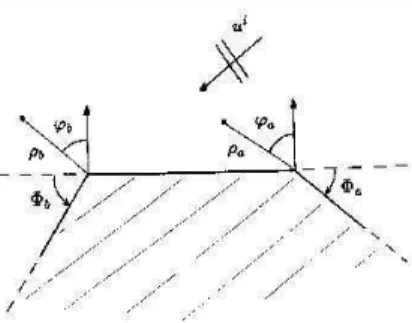
We apply in particular this approach to the important class of three-part impedance polygons composed of a finite segment attached to two semi-infinite planes.
Fig. 3. geometry of three-part impedance polygons
III. FUNCTIONAL ANDINTEGRAL EQUATIONS FOR A SEMI-INFINITE THREE-PART IMPEDANCE POLYGON
The functionsfaandfbare the spectral functions associated with the Sommerfeld-Maliuzhinets representation of the field, in cylindrical coordinate systems (ρa, ϕa) and(ρb, ϕb), with origins at opposite ends of the finite segment. We have, in
(ρa, ϕa)coordinates,
(ρa∈]0,∞[, ϕa=−π2 −Φa) with ∂u∂n−iksinθ−u= 0, (ρa ∈[0,∆], ϕa= π2) with ∂u∂n−iksinθ1u= 0, (7)
with the incident field ui =eikρacos(ϕa−ϕ◦), and, in
coordi-nates(ρb, ϕb),
(ρb∈[0,∆], ϕb=−π2) with ∂u∂n −iksinθ1u= 0,
(ρb∈]0,∞[, ϕb= π2 + Φb) with ∂n∂u−iksinθ+u= 0,(8)
with the incident field ui=eik(ρbcos(ϕb−ϕ◦)+∆ sinϕ◦).
IV. FUNCTIONAL EQUATIONS FOR THE SPECTRAL FUNCTIONS
Functional difference equations for fa andfb are obtained from (5)-(6) with (7)-(8), using parity of some expressions [5]. So, denotingfbr(α−Φ2b) =fb(α)etΦ+=π2+Φ2b, we have
(sinα+ sinθ+)fbr(α+ Φ+)−
−(−sinα+ sinθ+)fbr(−α+ Φ+) = 0,
(sinα−sinθ1)fbr(α−Φ+)−
−(−sinα−sinθ1)fbr(−α−Φ+) =
=e−ik∆ cosα((sinα−sinθ
1)fa(α− π
2)−
−(−sinα−sinθ1)fa(−α−π
2)) =R −
b(α), (9) while, denotingfar(α+Φ2a) =fa(α)andΦ− =π2+Φ2a, we
obtain
(sinα+ sinθ1)far(α+ Φ−)−
−(−sinα+ sinθ1)far(−α+ Φ−) = =e−ik∆ cosα((sinα+ sinθ
1)fb(α+ π
2)−
−(−sinα+ sinθ1)fb(−α+π
2)) =R
+
a(α),
(sinα−sinθ−)far(α−Φ−)
−(−sinα−sinθ−)far(−α−Φ−) = 0. (10)
Proceedings of the World Congress on Engineering 2008 Vol II WCE 2008, July 2 - 4, 2008, London, U.K.
A. Derivation of integral expressions and equations
From functional theory equations, the analytic function χ(α)verifying
χ(α±Φ)−χ(−α±Φ) =ϑ±(α), (11)
and regular in the band|Reα| ≤Φ(even at infinity), is given as |Reα|<Φ, by
χ(α) = χ(i∞) +χ(−i∞)
2 +
−i
8Φ
+i∞
−i∞
(ϑ+(α′)×
×tan(ν(α+ Φ−α′))−ϑ−(α′) tan(ν(α−Φ−α′)))dα′ (12)
with ν = π
4Φ, when the ϑ
±(α) are regular and summable
on imaginary axis. We then use the solutions Ψ+1(α) (resp.
Ψ1−(α)), without pole or zero in the band|Reα| ≤Φ+ (resp. |Reα| ≤Φ−) andO(cos(πα/2Φ+))(resp.O(cos(πα/2Φ−)))
in this domain, of previous functional equations taken without second member.
We then obtain for −π/2 < ϕ◦ < π/2 + Φb and
−Φ+<Reα <3Φ+,
fbr(α)
Ψ+1(α)
−χib(α) =
= i 8Φ+
+i∞
−i∞
R−
b(α′) tan(4Φπ+(α−Φ+−α ′))
(sinα′−sinθ
1)Ψ+1(α′−Φ+)
dα′
= −i 4Φ+
+i∞
−i∞
far(α′−π/2 + Φa/2)
Ψ+1(α′−Φ+) ×
× e
−ik∆ cosα′sin(πα′
2Φ+)
cos(2Φπ+(α−Φ+)) + cos(πα
′
2Φ+)
dα′, (13)
where the source termχi
b(α)is given by eik∆ sinϕ◦χi
+1(α) = 2Φπ+(
eik∆ sinϕ◦cosπϕ◦,b
2Φ+
Ψ+1(ϕ◦,b)(sin2Φ+πα −sin πϕ◦,b
2Φ+ )
), and, for−π/2−Φb< ϕ◦< π/2 et−3Φ−<Reα <Φ−,
far(α)
Ψ1−(α)
−χia(α) =
= −i 8Φ−
+i∞
−i∞
R+
a(α′) tan(4Φπ−(α+ Φ−−α
′))
(sinα′+ sinθ
1)Ψ1−(α′+ Φ−)
dα′
= i 4Φ−
+i∞
−i∞
fbr(α′+π/2−Φb/2)
Ψ1−(α′+ Φ−)
×
× e
−ik∆ cosα′sin(πα′
2Φ−)
cos(2Φπ−(α+ Φ−)) + cos(πα
′
2Φ−)
dα′, (14)
where χi
a(α) = 2Φπ−(
cosπϕ◦,a
2Φ+
Ψ1−(ϕ◦,a)(sin2Φπα
−−sin
πϕ◦,a
2Φ− )
), with ϕ◦,a=ϕ◦+ Φa/2etϕ◦,b=ϕ◦−Φb/2.
Integral equations for fbr(α+π/2−Φb/2) and far(α− π/2 + Φa/2)can be then derived.
B. non singular integral equations whenΦa,b>−π/2 WhenΦa,b>−π/2, we have, from previous expressions,
fbr(α+π/2−Φb/2)
Ψ+1(α+π/2−Φb/2) −χ i
br(α+π/2−Φb/2) =
= −i 4Φ+
+i∞
−i∞
(far(α
′−π/2 + Φ
a/2)
Ψ+1(α′−Φ+) )
× e
−ik∆ cosα′
sin(πα′
2Φ+)
cos(2Φπ+(α−Φb)) + cos(πα
′
2Φ+)
dα′, (15)
as −Φ+<Re(α+π/2−Φb/2)<3Φ+, and,
far(α−π/2 + Φa/2)
Ψ1−(α−π/2 + Φa/2)
−χiar(α−π/2 + Φa/2) =
= i 4Φ−
+i∞
−i∞ (fbr(α
′+π/2−Φ
b/2)
Ψ1−(α′+ Φ−) )
× e
−ik∆ cosα′sin(πα′
2Φ−)
cos(2Φπ−(α+ Φa)) + cos(πα
′
2Φ−)
dα′, (16)
as −3Φ− <Re(α − π/2 + Φa/2) < Φ−, for −π/2 <
ϕ◦ < π/2. The equations can be solved numerically, or
analytically by approximations, since the term depending on k∆is simple and the source terms are not oscillating. Suitable for approximations whenk∆ is large, we can also transform them by semi-inversion for approximations whenk∆is small.
V. ASEMI-INVERSION TO OBTAIN INTEGRAL EQUATIONS WITH KERNELS VANISHING ASk∆→0
We can modify equations and derive integral equations with kernels vanishing as k∆ →0 for the three-part semi-infinite impedance polygon, for approximations whenk∆is small. For this, we begin with changing the unknowns in the equations (15)-(16), considering far0(α) = far(α)−f0(α−(Φ+ −
π
2), ϕ◦), fbr0(α) =fbr(α)−eik∆ sinϕ◦f0(α+ (Φ−−π2), ϕ◦)
wheref0(α, ϕ◦), corresponding to the solution for∆ = 0, is
known [5]. These functions vanish as∆ = 0, and satisfy, from (15)-(16),
fbr0(α+π2− Φb
2 )
Ψ+1(α+π2− Φb
2 )
= −i
4Φ+(
+i∞ −i∞(
far0(α′−π2+ Φa
2 )
Ψ+1(α′−Φ+) )
× sin(
πα′
2Φ+)
cos( π
2Φ+(α−Φb))+cos(πα
′
2Φ+) dα′+
+−+ii∞∞ Ba0(α
′
) sin(πα′
2Φ+)
cos( π
2Φ+(α−Φb))+cos(πα
′
2Φ+)
dα′) (17)
where
Ba0(α′) = (
far0(α′−π2+ Φa
2 )
Ψ+1(α′−Φ+) )(e
−ik∆ cosα′
−1) +
+(e
ik∆ sinϕ◦f0(α′
−π
2+(Φa−Φb)/2)
Ψ+1(α′−Φ+) )(e
−ik∆(cosα′+sinϕ◦)−1)(18)
as −Φ+<Re(α+π2 −Φ2b)<3Φ+, and
far0(α−π2+Φ2a)
Ψ1−(α−π2+ Φa
2 )
=4Φi−(−+ii∞∞(fbr0(α′+π2− Φb
2 )
Ψ1−(α′+Φ−) )
× sin(
πα′
2Φ−)
cos( π
2Φ−(α+Φa))+cos(
πα′
2Φ−)
dα′+
+−+ii∞∞ Bb0(α
′) sin(πα′
2Φ−)
cos( π
2Φ−(α+Φa))+cos(2Φπα′
−)
dα′) (19)
Proceedings of the World Congress on Engineering 2008 Vol II WCE 2008, July 2 - 4, 2008, London, U.K.
where
Bb0(α′) = (fbr0(α
′
+π
2− Φb
2 )
Ψ1−(α′+Φ−) )(e
−ik∆ cosα′−1) +
+(f0(α′+π2−(Φb−Φa)/2)
Ψ1−(α′+Φ−) )(e
−ik∆(cosα′−sinϕ
◦)−1) (20)
as−3Φ−<Re(α−π2+Φ2a)<Φ−, for−min(π2,π2+ Φa)< ϕ◦<min(π2, π2+ Φb).
We then notice some similarity with the equations satisfied byf0 when ∆ = 0. Thus, we let
f′
br0(α+
π
2 − Φb
2 ) =
=−i∞i∞G(ϕ′)f
0(α+π2 + (Φa−Φb)/2, ϕ′)dϕ′, f′
ar0(α−π2 + Φa
2 ) =
=−i∞i∞G(ϕ′)f
0(α−π2 + (Φa−Φb)/2, ϕ′)dϕ′ (21) as |Re(α)| < π
2, and search to define G(ϕ′) so that fbr′ 0
andf′
ar0 verifies (17)-(19). The functions f0(α±π2 + (Φa−
Φb)/2, ϕ′)are regular andO(1/cos(πϕ′/2Φd))on the imag-inary axis, and a pole at ϕ′ = α± π
2 ensures that, even if
Φa= Φb= 0, generallyfbr′ 0=far′ 0.
Using the equations (15)-(16) when∆ = 0satisfied by f0,
we remark that we can write f′
br0(α+π2− Φb
2)
Ψ+1(α+π2− Φb
2 )
=
= −i
4Φ+
+i∞ −i∞
far′ 0(α
′
−π
2+ Φa
2 ) sin(πα
′
2Φ+)
Ψ+1(α′−Φ+)(cos(2Φ+π (α−Φb))+cos(πα
′
2Φ+)) dα′
+2Φπ+−i∞i∞ G(ϕ′)
Ψ+1(ϕ′− Φb
2 )
sinπ(ϕ
′+π
2) 2Φ+
(cosπ(α−Φb) 2Φ+ +cos
π(ϕ′+π2) 2Φ+ )
dϕ′,(22)
f′
ar0(α−π2+ Φa
2 )
Ψ1−(α−π2+Φ2a)
= 4Φi−−+ii∞∞ f
′
br0(α′+π2− Φb
2 ) sin(
πα′
2Φ−)
Ψ1−(α′+Φ−)(cos(2Φπ
−(α+Φa))+cos(
πα′
2Φ−))
dα′
+2Φπ− −i∞i∞Ψ G(ϕ′)
1−(ϕ′+Φ2a)
sinπ(ϕ′ −
π
2) 2Φ−
(cosπ(α+Φa) 2Φ− +cos
π(ϕ′ −π
2) 2Φ− )
dϕ′.(23)
In the case whereG(ϕ′)is regular in the band|Re(ϕ′)| ≤
π
2, we can shift the integral paths in the integrals containing
G(ϕ′). Comparing (17)-(19) with (22)-(23), we notice that (f′
br0, far′ 0)is a solution of the system of equations (17)-(19)
ifGsatisfies the conditions G(α′+π
2)
Ψ1−(α′+ Φ−)
− G(−α
′+π
2)
Ψ1−(−α′+ Φ−) =
= i
2π(Bb0(α
′)−B
b0(−α′)),
G(α′−π
2)
Ψ+1(α′−Φ+)
− G(−α
′−π
2)
Ψ+1(−α′−Φ+)
=
=−i 2π(Ba0(α
′)−B
a0(−α′)), (24)
whereΦ+= π2+Φ2b andΦ−= π2+Φ2a. Taking account of the
properites of Ψ+1 andΨ1− , and letting G(α′) = (cosα′+
sinθ1)g(α′), (24) can be written
g(α′+π
2)−g(−α ′+π
2) =
= iΨ1−(α ′+ Φ
−)(Bb0(α′)−Bb0(−α′))
2π(−sinα′+ sinθ
1) ,
g(α′−π
2)−g(−α ′−π
2) =
= iΨ+1(α ′−Φ
+)(Ba0(α′)−Ba0(−α′))
2π(−sinα′−sinθ
1)
.(25)
Since G(α′) is regular in the band |Reα′| ≤ π
2 and
Re(sinθ1) > 0, g(α′) is regular in this band. We can then
use (11)-(12), and write, as|Reα|<π2, g(α) = i
4π
+i∞ −i∞(
iΨ1−(α′+Φ−)(Bb0(α′)−Bb0(−α′))
2π(sinα′−sinθ
1) ×
×tan(12(α+π2 −α′))−iΨ+1(α′−Φ+)(Ba0(α′)−Ba0(−α′))
2π(sinα′+sinθ
1) ×
×tan(12(α−π2−α′)))dα′, (26)
Using (21) and (26), we obtain the equations with kernels vanishing as k∆→0 :
fbr0(α+π2 −Φ2b) =
= 1 8π2
+i∞ −i∞ dα′(
Ψ1−(α′+Φ−)(Bb0(α′)−Bb0(−α′))
sinα′−sinθ
1 M+(α, α
′)
−Ψ+1(α′−Φ+)(Ba0(α′)−Ba0(−α′))
sinα′+sinθ
1 M−(α, α
′)), (27)
far0(α−π2 +Φ2a) =
= 1 8π2
+i∞ −i∞(
Ψ1−(α′+Φ−)(Bb0(α′)−Bb0(−α′))
sinα′−sinθ
1 N+(α, α
′)
−Ψ+1(α′−Φ+)(Ba0(α′)−Ba0(−α′))
sinα′+sinθ
1 N−(α, α
′))dα′, (28)
whereM±(α, α′) =L±(α+π2 +(Φa−2Φb), α′), N±(α, α′) =
L±(α−π2+
(Φa−Φb)
2 , α′),
L±(α, α′) = πsinα
′Ψ
+−(α)
2Φd
i∞ −i∞
cos(π(ϕ′+(Φa−Φb)/2) 2Φd )
Ψ+−(ϕ′+(Φa−Φb)/2)
(cosϕ′+sinθ1)
cos(ϕ′±π
2)+cosα′
1 (sin(πα
2Φd)−sin(
π(ϕ′+(Φa−Φb)/2) 2Φd ))
dϕ′, (29)
In the particular caseΦa = Φb= 0,Φd= π2, the functions L±can be simplified so that we recover the expressions found
in [4] for the three-part impedance plane.
REFERENCES
[1] D.S. Jones,The theory of electromagnetism, Pergamon Press, London, 1964.
[2] L.B. Felsen, N. Marcuvitz,Radiation and scattering of waves, Prentice Hall, Englewood Cliffs, NJ, 1973.
[3] V.A. Borovikov, “two-dimensional problem of diffraction on a polygon”,
Sov. Ph. Dokl., 7, 6, 499-501, 1962.
[4] J.M.L. Bernard, “Scattering by a three-part impedance plane : a new spectral approach”,Quarterly J. of Mech. and Appl. Math., 58, 3, pp. 383-418, 2005.
[5] J.M.L. Bernard, “A spectral approach for scattering by impedance polygons”,Quarterly J. of Mech. and Appl. Math., 59, 4, pp.517-550, 2006.
Proceedings of the World Congress on Engineering 2008 Vol II WCE 2008, July 2 - 4, 2008, London, U.K.