Preparation and properties of
gradient Al
2
O
3
-ZrO
2
ceramic foam by
centrifugal slip casting method
Male, Ph.D., Associate Professor. Research interest: porous material, biomedical mechanical material. By now, he has published about 20 technical papers.
E-mail: [email protected]
Received: 2011-02-14; Accepted: 2012-07-29 *Li Qiang
*Li Qiang1
, Yu Jingyuan1
, Tang Ji2
, Qi Guochao1
, and Li Xiaodong3
(1. College of Materials Science and Engineering, Liaoning University of Technology, Jinzhou 121001, China; 2. Shenyang Research
Institute of Foundry, Shenyang 110022, China; 3. Key Laboratory for Anisotropy and Texture of Materials, Ministry of Education,
Northeastern University, Shenyang 110004, China)
C
ellular ceramics are a unique class of lightweight materials consisting of a relatively regular array of hollow cells arranged in a three-dimensional network. Porous ceramics are divided into two subclasses consisting of either open or closed cells. The closed-cell ceramics can be used as a network of soap bubbles. The porous ceramics can be widely used in catalyst carriers, hot gas collectors, molten metal ilters, chemical sensors and separation membranes [1-3]. Al2O3 matrix ceramicfoam is a kind of representative porous ceramic, which has high resistance to molten aluminum attack and is used in iltering molten aluminum. The three main processes for the fabrication of ceramic foam are the replica technique [4], the sacrificial template method [5], and the direct-foaming technique [6]. The most
common preparation method for Al2O3 ceramic foam is the
polymeric sponge method which involves the impregnation of polyurethane sponges with slurries containing ceramic particles and appropriate binders followed by pyrolysis and sintering at a special temperature [7, 8].
Abstract: The aim of the present research is to provide a novel technique for preparing gradient Al2O3-ZrO2 ceramic
foams. This technique used epispastic polystyrene spheres to array templates and centrifugal slip casting to obtain cell struts with gradient distribution of Al2O3 and ZrO2 particles and high packing density. Aqueous Al2O3-20vol.% ZrO2
slurries with 20vol.% solid contents were prepared and the dispersion and rheological characteristics of the slurries were investigated. The settling velocity and mass segregation of Al2O3 and ZrO2 particles at different centrifugal
accelerations were calculated and studied. The drying behavior, macrostructure, microstructure, compressive property and resistance to thermal shock of the sintered products were also investigated. The results show that the difference of settling velocity of Al2O3 and ZrO2 particles increases and mass segregation becomes acute with an increase in
centrifugal acceleration. The cell struts prepared at a centrifugal acceleration of 1,690 g have high sintered density (99.0% TD) and continuous gradient distribution of Al2O3 and ZrO2 particles. When sintered at 1,550
o
C for 2 h, the cell size of gradient Al2O3-ZrO2 foam is approximately uniform, about 1.1 mm. With the porosity of gradient Al2O3-ZrO2
ceramic foams increasing from 75.3% to 83.0%, the compressive strength decreases from 4.4 to 2.4 MPa, and the ceramic foams can resist 8-11 repeated thermal shock from 1,100 oC to room temperature.
Key words: ceramic foam; centrifugal slip casting; settling velocity; gradient distribution, compressive property CLC numbers: TG148/249.5 Document code: A Article ID: 1672-6421(2012)04-337-07
The ceramic foams prepared by this method currently possess low strength and fracture toughness which make them sensitive to structural stress. The reported modiication methods included the change of humping slurry content by modifying the polymeric sponge, increasing the thickness of ceramic coating on the polymeric sponge by muticoating method, and ameliorating the uniformity of ceramic coating by two-step centrifuging processing [9,10]. In the present research, gradient Al2O3-ZrO2 ceramic foams were prepared by centrifugal slip
casting to improve the mechanical properties of Al2O3 foam
ceramics. Centrifugal slip casting can avoid holes and cracks resulting from the pyrolysis of organic sponges and form optimal ceramic particle packing and minimize flaw size in cell struts, so the inal products have dense cell struts and good mechanical properties. In addition, the gradient distribution of Al2O3 and ZrO2 particles can generate residual stresses, which
can contribute to a further increase in the mechanical properties of the ceramic foams. In this paper, the dispersion and rheological characteristic of Al2O3-20vol.%ZrO2 slurries were
studied. The settling velocity of Al2O3 and ZrO2 particles was
calculated for different centrifugal accelerations. The effect of centrifugal acceleration on the mass segregation of Al2O3
and ZrO2 in the cell struts of gradient Al2O3-ZrO2 ceramic
microstructure, compressive property and resistance to thermal shock of the sintered products were also investigated.
1 Experimental detail
The α-Al2O3 powder of 99.99% purity with an average particle
size of 0.2 μm was used. The ZrO2 powder (TZ-3Y) had
99.5% purity and a median diameter of 0.3 μm. Polycarboxylic ammonium with an average molecular weight of 10,000 was used as dispersant. Epispastic polystyrene spheres (EPS) sieved through a 12-mesh screen were used to array the template. In order to determine the optimal pH value for preparing Al2O3
-ZrO2 suspensions, the Zeta potentials of Al2O3 and ZrO2
particles at different pH values were measured by using a Zeta Potentiometer (Zeta PALS BL-ZR3). The Al2O3 and ZrO2
powders were mixed at a fixed proportion (80vol.%Al2O3,
20vol.%ZrO2) and dispersed in de-ionized water containing
the special percentage of the dispersant (0.5wt.% of α-Al2O3
+ ZrO2 powder content).The suspensions were adjusted to a
desired pH value by adding ammonia water, and then ball-milled for 24 h using high purity alumina balls to obtain electrostatically stabilized suspensions with 20vol.% solid content. The viscosity of Al2O3-20vol.%ZrO2 slurries was
measured at different shear rates (20, 40, 60, 80, 100, 120, 140, 160 and 180 s-1 ) and the experimental temperature of 20 ℃
using a rotational viscometer (NXS-11A), and the curve of shear rate versus viscosity was drawn to present the rheological characteristic of the slurries.
Figure 1 shows a schematic diagram of the process for fabricating the gradient Al2O3-20vol.%ZrO2 ceramic foam.
The main steps are as follows: (a) at irst form a close-packed template with EPS spheres; (b) immerse slurry in the interstitial spaces of the pre-arrayed EPS template; (c) centrifuge slurries in the template at centrifugal accelerations of 1,118, 1,610, 2,191 and 2,860 g, for 60 min, respectively; (d) dump the supernate, remove the mold and dry the samples under different conditions to find the most successful crack-free drying conditions: (1) in an oven at 50 ℃; (2) under special condition (25 ℃, 60% Relative Humidity); (3) under ambient condition. The water
content of cast compacts at different times was measured to study the dry behavior of cast compacts; (e) the dried samples with a dimension of about Φ40 mm × 40 mm was divided into two groups. One group was all sectioned into 4 segments from the top to the bottom, like cakes, and were numbered 1, 2, 3, 4, respectively. The sliced segments in the group were pyrolyzed at 550 ℃ for 5 h with a heating rate of 1 ℃·min-1
to remove the EPS spheres, and then followed by pre-sintering at 1,000 ℃ for 30 min with a rate of 5 ℃·min-1
to measure the green density of cell struts. The other group were also heated to 550 ℃ at a low rate of 1 ℃·min-1
, held for 5 h to remove EPS spheres, and then heated again to 1,550 ℃ at a rate of 5 ℃·min-1, sintered for 2 h
to obtain cell struts with gradient distribution of Al2O3 and ZrO2
particles and high packing density, and to measure the sintered density and compressive strength of Al2O3-20vol.%ZrO2
ceramic foams.
In addition, the measured green density was regarded as the green density of each specimen, which was believed to be a tolerable approximation, although these values should be higher (~1%) than the real green densities. The green and sintered densities of cell struts were measured by means of Archimedes’ principle. The porosities of sintered products were calculated using the following equation:
Porosity = (ρr - ρb)/ρr (1)
where ρr and ρb are the real and bulk densities (kg·m -3
), respectively.
Since the discs were rather uniform and flat, their bulk densities were simply calculated from their weights and volumes. As for the real densities, the discs were irst ground to powder and then measured with a pycnometer. Photographs of the samples were taken using a digital camera. The microstructure and ZrO2 phase distribution of cell struts were
analyzed using a scanning electron microscope (SSX-505) on polished and thermally etched surfaces. The compressive strength of ired product of Φ20 mm × 20 mm was measured using a universal testing machine (CMT5105) at the speed of 0.5 mm·min-1. The resistance to thermal shock of the Al2O3
-20vol.%ZrO2 foam was measured using the following method:
Fig. 1: Schematic diagram of process for preparing gradient Al2O3-20vol.%ZrO2 ceramic foam using centrifugal slip casting
the sintered compacts was irstly heated to 1,100 ℃ and held for 15 min, and then placed in water at 15 ℃ for 5 min to cool. The above process was repeated until the porous Al2O3-20vol.%ZrO2
ceramic foams were broken. The repetitious time was used to express the resistance to thermal shock of Al2O3-ZrO2 foam.
2 Results and discussion
2.1 Analysis of dispersion and rheological
characteristic of Al
2O
3-20vol.%ZrO
2slurries
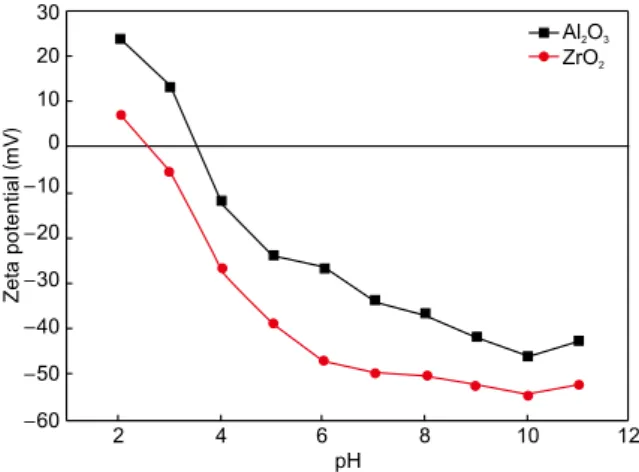
Figure 2 shows the relationship between pH value and Zeta potential of Al2O3 and ZrO2 particles. In Fig. 2 the isoelectric
points of the Al2O3 and ZrO2 particles lie at about pH 2.6 and
pH 3.5, respectively. According to the well-known DLOV theory, the suspension of colloidal particles in polarized liquids is more stable when the pH values are lower or higher than that of isoelectric point [11]. At a pH of 10, Al2O3 and ZrO2 particles
have their highest Zeta potential values of 46 mV and 55 mV, respectively. The reason is that the molecule of polycarboxylic ammonium has many carboxylic acid sites or functional groups, and the fraction of functional groups that are dissociated (i.e., COO−) varies with the solvent conditions (i.e., pH and ionic strength). At a pH of 10, the surfaces of the Al2O3 and ZrO2
particles can absorb suficient negative charge to obtain a big repulsive force between the Al2O3 and ZrO2 particles, so the
Al2O3 and ZrO2 particles can be well dispersed in the slurries.
2.2 Effect of centrifugal acceleration on green
gradient of cell struts
Figure 4 shows the green densities of cell struts in different segments sintered at 1,000 ℃ for 30 min. As can be seen in Fig. 4, with the increasing of centrifugal acceleration, the difference of green density of the cell struts from segment 1 to segment 4 improves. The difference of green density of the top and the bottom of cell struts is named as gradient in this paper. As the centrifugal acceleration changes from 1,118 g to 2,860 g, the gradient of the cell struts increases from 2.9% to 5.7%, which shows the mass segregation of Al2O3 and ZrO2 particles
becomes acute and a gradient distribution of Al2O3/ZrO2 comes
into being. When centrifuged at 2,191 g and 2,860 g, the green densities of the cell struts of segments 3 and 4 are very close, but are quite different from those of segments 1 and 2, which shows that the ZrO2 particles accumulate near the bottom of the
specimen, and form an obvious gradient distribution of Al2O3/
ZrO2. When centrifuged at 1,610 g, the green density of the
cell struts of different segments changes evenly, showing that the Al2O3 and ZrO2 particles form a uniform and continuous
gradient distribution.
Fig. 2: Zeta potential versus pH value for Al2O3 and
ZrO2 particles
Fig. 4: Green densities of cell struts in different segments prepared at different centrifugal accelerations using Al2O3-ZrO2 slurries with 20vol.% solid content Figure 3 shows the relationship between the viscosity and
shear rate for Al2O3-20vol.%ZrO2 slurries with 20vol.%
solid content. In the low shear rate region, as the shear rate increases, the viscosity of the Al2O3-ZrO2 slurries decreases
rapidly. This is because the three-dimensional network structure among the particles is destroyed, inducing a decrease in the resistance to particles moving. In the high shear rate region, the initial network structure among the particles is completely destroyed and a new stable structure forms, so the viscosity of the slurries only changes slowly. In this study, the Al2O3-ZrO2 slurries have a shear thinning characteristic,
which is beneicial to mold illing with slurries and to forming gradient distribution of Al2O3 and ZrO2 particles.
Fig. 3: Rheological curve of Al2O3-20vol.%ZrO2 slurries
(g)
Fig. 5: Schematic diagram of forces on particles in suspensions during centrifugal process
The segregation phenomenon during the centrifugal process essentially derives from a difference in the settling velocities of initial particles with different sizes and densities in a suspension. The basic principle of sedimentation originates from Stokes’ Law, which describes the movement of a sphere in an infinite medium [12]. As its Reynolds number (
= 2ρLvrh -1
) is below 1 for Al2O3-20vol.%ZrO2 slurries with
20vol.% solid content, the movement of slurries in the mold still follows creeping flow conditions [13]. The velocity of a particle moving through a liquid in a centrifugal force ield is affected by centrifugal force (Fc), buoancy force (Fb), and
frictional force (Ff) , as shown in Fig. 5.
ρs — Density of total slurry, kg·m-3;
rp,j — Radius of j-type particle, μm; ρp,j — Density of j-type particle, kg·m-3;
φj and φj — Solid content of i and j-types particle in the slurry, vol.%;
φtot — Total solid content of Al2O3-ZrO2 slurries, vol.%;
ni — A function of the Reynolds number and the particle to vessel size ratio;
As can be seen in Equation 5, the settling velocity of particles can be strongly inluenced by particle sizes and densities when other parameters are constant. The particles with bigger size or higher density (ZrO2) can settle faster than those with smaller
sizes or lower density (Al2O3). The former tends to accumulate
at the bottom but the latter easily coagulates at the top, leading to an obvious gradient composition in the samples.
Table 1 shows the parameters and data used in this paper. Equation 5 and Table 1 were adopted to calculate the settling velocities of Al2O3 and ZrO2 particles and to analyze the
segregation phenomena in Al2O3-20vol.%ZrO2 system. The
calculation results are shown in Table 2. The difference of the settling velocity of Al2O3 and ZrO2 particles is less (22.9 μm·s
-1
) when centrifuged at the acceleration of 1,118 g in Table 2. But with increasing the centrifugal acceleration, the difference in the settling velocities of two types of particles gets bigger and bigger. The difference in the settling velocities of Al2O3 and ZrO2
particles is as high as 45.2 μm·s-1 and 58.7 μm·s-1, when centrifuged
at accelerations of 2,191 g and 2,860 g, respectively. The higher difference in the settling velocities of two types of particles can form severe mass segregation, so the ZrO2 particles, with
the bigger size and higher density, mostly congregate at the bottom and the Al2O3 particles, with the smaller size and
lower density, mostly accumulate at the top. This means that The equations of Fc, Fb and Ff are described as follows:
(2)
(3)
(4)
where
h — Liquid viscosity, Pa·s;
a — Particle radius, μm; ρp — Particle density, Kg·m
-3;
ρL — Liquid density, Kg·m -3
; ω — Angular velocity, rad·s-1, and
r — Radial coordinate in the centrifuge, m.
According to our previous study [14], the settling velocity
(μm·s-1) of i-type particles in a multiple system is as follows:
In the Equation 5,
where
h — Viscosity of slurries, Pa·s;
rp,i — Radius of i-type particle, μm; ρp,i — Density of i-type particle, kg·m-3;
Table 1: Parameters and data used in this paper
Parameter Value r 0.09 m
ω1 261.6 rad·s -1
ω2 314.0 rad·s -1
ω3 366.4 rad·s -1
ω4 418.7 rad·s -1
d
1 0.2 mm
d
2 0.3 mm
η 1.0×10⁻³
pa·s ρ1 3,940 kg·m
-3
ρ2 6,050 kg·m -3
ρL 1,000 kg·m -3
n
1 = n2 4.65
Table 2: Settling velocity of Al2O3 and Al2O3 particles at
different accelerations of centrifugal slip casting
Centrifugal acceleration Settling velocity of particles (μm·s-1
) (g) Al2O3 ZrO2
1,118 5.7 28.6 1,610 8.2 41.2 2,191 11.1 56.3 2,860 14.5 73.2 (5)
the cell struts of the compacts centrifuged at high centrifugal acceleration have large gradient of green density, as shown in Fig. 4. However, when centrifuged at the acceleration of 1,610 g, the difference in the settling velocity of Al2O3 and
ZrO2 particles is not very big (33 μm·s -1
), so the cell struts of ceramic foam can have a more gradual gradient distribution of Al2O3 and ZrO2 particles, leading to the improvement in
compressive property of ceramic foam.
2.3 Analysis of drying and sintering behavior
The centrifuged green bodies still contained 9wt.% to 11wt.% water, which evaporated during drying. It is well known that fast evaporation of the liquid can lead to the formation of cracks in the green body and a decrease in the mechanical properties of the sintered body. In order to find the most successful crack-free drying conditions, the drying experiments were performed under three conditions. Drying behavior of cast compacts under various conditions is shown in Fig. 6. The inal weight (dry compact) was subtracted from that of the starting weight (wet compacts without supernate) to give the value for the total water content in the cast compact (=100%, Fig. 6). Water content in cast compacts at initial time subtracts that of drying compacts for different times. The difference is divided by drying time and then obtain drying rate. As can be seen in Fig. 6, the drying rates under three conditions from (1) to (3) are 16%, 6%, and 3% per hour during initial 5 h , respectively. According to the experimental experience, if the drying rates are faster than 5% per hour, the possibility of crack formation in the sintered compacts will be increased greatly. Hence, After drying in the oven or under ambient conditions, the sintered compacts could have some cracking. Normally, after a drying period of 3-4 days under special condition (25 ℃, humidity of 60% RH), the sintered compacts have little cracking. The reason is that EPS spheres decompose between 300 and 550 ℃. During this period, the low heating rate (at 1 ℃·min-1) and long
holding time (550 ℃ for 5 h) contributes to the EPS spheres slowly decomposing and volatilizing, decreasing the drawbacks and risk of cracks to keep the samples’ integrity. After being sintered at 1,550 ℃ for 2 h, the cell struts in the sintered products had a higher density of about 99.0% theory density.
2.4 Analysis of macrostructure and
microstructure of foams
Figure 7 shows the macrostructure of the gradient Al2O3
-20vol.%ZrO2 foam. It can be seen that the distribution of cell
size is approximately uniform in three dimensions. The average cell size is about 1.1 mm. The difference in cell sizes mainly originates from that of the initial EPS spheres. Figure 8 shows the micrograph of a pore of the sintered specimen. In Fig. 8, in the center of the cell struts there is no triangular hole that normally exists in the foams made from the pyrolysis of organic sponges [8]. This kind of dense structure contributes to
the improvement in strength of the cell struts.
Fig. 6: Drying behavior of cast compacts under various conditions
Fig. 7: Macrostructure of ceramic foam prepared with EPS template
Fig. 8: Microstructure showing a pore of gradient Al2O3
-20vol.%ZrO2 foam prepared by centrifugal method
S
Figure 9 shows the microstructures of cell struts in gradient Al2O3-ZrO2 foam prepared at centrifugal acceleration of 1,610 g
using the slurry with 20vol.% solid content. In Fig. 9, the dark domain is Al2O3 and the white domain is ZrO2. SEM
observation (in Fig. 9) shows that the distribution of ZrO2
particles from the top to middle and bottom of specimens presents a continuous gradient. The top segment has less ZrO2
particles and more Al2O3 particles, but the bottom segment has
a higher density, high enough settling velocity and larger size, all these make them tend to accumulate at the bottom of cakes and form a gradient distribution during the centrifugal casting. Figure 10 shows the composition profile for the gradient Al2O3-ZrO2 cell struts prepared at a centrifugal acceleration of
1,690 g with the slurries containing 20vol.% solid content. In Fig. 9, the content of ZrO2 phase has an obviously continuous
gradient distribution, which is consistent with the experimental results from Fig. 4 and Table 2.
(a) (b) (c)
Fig. 9: SEM micrograph showing microstructures of cell struts in gradient Al2O3-20vol.%ZrO2 foam prepared
using the slurry with 20vol.% solid content: (a) top surface, (b) middle surface, and (c) bottom surface
Fig. 10: Composition proile for gradient Al2O3
-20vol.%ZrO2 cell struts prepared at a centrifugal
acceleration of 1,690 g with the slurries containing 20vol.% solid content
2.5 Study on compressive strength and
resistance of thermal shock of foams
The EPS spheres are soft and have a deformable nature, which can be compressed to denser packing at a higher applied load on the EPS template. Hence, the porosity of the sintered foam ceramic can be adjusted by changing the weight placed on the top of the template. Table 3 shows the effects of applied load on the porosity, compressive strength and resistance to thermal shock of gradient Al2O3-ZrO2 foams. It can be seen that with an
increase in applied load on the EPS template, the porosity of the Al2O3-20vol.%ZrO2 foam increases from 75.3% to 83.0%,
the compressive strength decreases from 4.4 MPa to 2.4 MPa. This is because that the decreases of the space between the
Table 3: Effect of applied load on compressive strength and resistance to thermal shock of gradient Al2O3-ZrO2 foams
Applied load Porosity Compressive strength Repeated (N) (%) (MPa) time
12.3 75.3 4.4 8
14.7 77.2 3.8 9
17.2 79.8 3.3 11
19.6 83.0 2.4 10
EPS spheres at high applied load leads to only small amount of Al2O3-ZrO2 slurry poured into the templates and the contents
of solid cell struts of the sintered products reduced.
According to our previous research, the compressive strength of porous Al2O3 ceramic with 83% porosity is 1.8 MPa
[14]
. Compared to this, the gradient ceramic foams referred to in this paper have higher strength. The reason is as follows: first, the gradient ceramic foams prepared in this paper have uniform arrayed cell structure and high strut density, which means that the holes and cracks in the cell struts that normally exist in the foams made from the pyrolysis of organic sponges can be avoided. Secondly, the addition of ZrO2 particles into the Al2O3
matrix contributes to the improvement of mechanical properties of the foam because of the t→m phase transformation of the ZrO2 particles
[15]
. Finally, the residual compressive stresses on the surface of the gradient Al2O3-ZrO2 foams can be applied to
improve the mechanical properties of the materials. In fact, the residual stresses can be generated by using the material with different thermal mechanical properties. In this paper, Al2O3
and ZrO2 have thermal explosion coeficient of 8.5 × 10 -6 ℃
and 10.9 × 10⁻⁶ ℃, respectively [16]
. On cooling from sintering temperature, layers with higher ZrO2 content shrink more
than that of with less ZrO2 content. As a result, compressive
stresses are generated on the top and bottom surfaces of the sintered gradient Al2O3-ZrO2 foams. This is the main reason
This work was inancially supported by the Natural Science Foundation of Liaoning Province (No.: 201102090), the Doctoral Initiating Project of Liaoning Province Foundation for Natural Sciences, China (No.: 20111068), the
High School Development Plan for Distinguished Young Scholars of Liaoning Province Education Committee (No.: LJQ2012056), the National High-Tech Research and Development Program of China ("863" Program, No.: 2011AA060102), and the International Science and Technology Cooperation Program of China, (No.:
2011DFR50270).
3 Conclusions
The gradient Al2O3-ZrO2 ceramic foams can be prepared
by the centrifugal slip casting method using EPS spheres as templates. The Al2O3-20vol.%ZrO2 slurry has high dispersion
and good rheological characteristic at a pH of 10 and dispersant of 0.5wt.%. Centrifugal acceleration has an important effect on the settling velocity and mass segregation of particles. When the centrifugal acceleration is increased, the difference in the green density from the top to bottom in the cell struts and the settling velocity of Al2O3 and ZrO2 obviously increases,
causing a severe mass segregation phenomenon. After being centrifuged at 1,610 g, the specimens sintered at 1,500 ℃ for 2 h have a high sintered density (99.0% theory density) and a continuous gradient distribution of the ZrO2 particles. The cell
size of gradient Al2O3-20vol.%ZrO2 foam is approximately
uniform and about 1.1 mm. When the porosity of Al2O3
-20vol.%ZrO2 ceramic foams increases from 75.3% to 83.0%,
the compressive strength decreases from 4.4 to 2.4 MPa, and the ceramic foams can resist 8-11 times repeated thermal shock from 1,100 ℃ to room temperature.
References
[1] Ding X J, Zhang J Z, Wang R D, et al. Formation of porous
alumina with oriented pores. J. Eur. Ceram. Soc., 2002, 22: 411-414.
[2] Wang D Q and Shi Z Y. Effect of ceramic particles on cell size and wall thickness of aluminum foam. Mater. Sci. and Eng. A, 2003, 361: 45-49.
[3] Jayasinghe S N and Edirisinghe M J. A Novel Method of
Forming Open Cell Ceramic Foam. J. Porous Mater., 2002, 9:
265-273.
[4] Peng H X, Fan Z, Evans J R G, et al. Microstructure of Ceramic Foams. J. Eur. Ceram. Soc., 2000, 20(7): 807-813.
[5] Lyckfeldt O and Ferreira J M F. Processing of Porous Ceramics
by Starch Consolidation. J. Eur. Ceram. Soc., 1998, 18(2): 131-140.
[6] Dhara S and Bhargava P. A Simple Direct Casting Route to
Ceramic Foams. J. Am. Ceram. Soc., 2003, 86(10): 1645 -1650.
[7] Yamada Y, Shimojima K, Mabuchi M, et al. Compressive deformation behavior of Al2O3 foam. Mater. Sci. and Eng. A,
2000, 277: 213-217.
[8] Han Y S, Li J B, and Chen Y L. Fabrication of bimodal porous
alumina ceramics. Mater. Res. Bull., 2003, 38: 373-379. [ 9 ] H a r g u s P M , M u l a J A , R e d d e n M . K . U . S . P a t .
No.4866011,1989.
[10] Ravault. U. S. Pat. No. 4004933,1977.
[11] Guo L C, Zhang Y, Nozoun U, et al. Adsorption effects on the rheological properties of aqueous alumina suspensions with polyelectrolyte. J. Am. Ceram. Soc., 1998, 81(3): 549-556. [12] Biesheuvel P B and Verweij H. Calculation of the composition
profile of a functionally graded materials produced by centrifugal casting. J. Am. Ceram. Soc., 2000, 83(4): 743-749. [13] Lockett M J and Al-Habbooby H M. Relative particle velocities
in two species settling. Powder Technology, 1974, 10(1-2): 67-71.
[14] Yu Jingyuan, Sun Xudong, Li Qiang, et al. Preparation of Al2O3
and Al2O3-ZrO2 ceramic foams with adjustable cell structure by
centrifugal slip casting. Mater. Sci. and Eng. A, 2008, 476(1-2): 274-280.
[15] Lee B T, Lee K H, and Hiraga K. Stress-induced phase transformation of ZrO2 in ZrO2 (3mol.%Y2O3)-25vol.%Al2O3
composite studied by transmission electron microscopy. Scrip. Mater., 1998, 38(7): 1101-1107.