www.biogeosciences.net/9/965/2012/ doi:10.5194/bg-9-965-2012
© Author(s) 2012. CC Attribution 3.0 License.
Biogeosciences
Process based model sheds light on climate sensitivity of
Mediterranean tree-ring width
R. Touchan1, V. V. Shishov2, D. M. Meko1, I. Nouiri3, and A. Grachev2
1Laboratory of Tree-Ring Research, The University of Arizona, P.O. Box 210058 Tucson, Arizona 85721-0058, USA 2Siberian Federal University, Prospekt Svobodniy 79, Krasnoyarsk, 660041, Russia
3National Institute of Agronomy of Tunisia, 43 Avenue Charles Nicolle, 1002 Tunis, Tunisia Correspondence to:R. Touchan ([email protected])
Received: 11 October 2011 – Published in Biogeosciences Discuss.: 18 November 2011 Revised: 7 February 2012 – Accepted: 27 February 2012 – Published: 9 March 2012
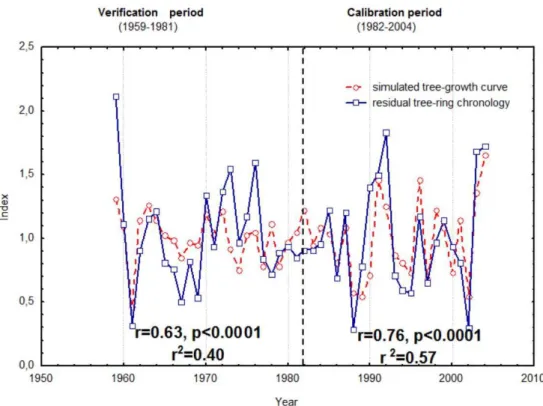
Abstract.We use the process-based VS (Vaganov-Shashkin) model to investigate whether a regional Pinus halepensis tree-ring chronology from Tunisia can be simulated as a function of climate alone by employing a biological model linking day length and daily temperature and precipitation (AD 1959–2004) from a climate station to ring-width vari-ations. We check performance of the model on independent data by a validation exercise in which the model’s parameters are tuned using data for 1982–2004 and the model is applied to generate tree-ring indices for 1959–1981. The validation exercise yields a highly significant positive correlation be-tween the residual chronology and estimated growth curve (r=0.76 p <0.0001, n=23). The model shows that the average duration of the growing season is 191 days, with considerable variation from year to year. On average, soil moisture limits tree-ring growth for 128 days and tempera-ture for 63 days. Model results depend on chosen values of parameters, in particular a parameter specifying a balance ra-tio between soil moisture and precipitara-tion. Future work in the Mediterranean region should include multi-year natural experiments to verify patterns of cambial-growth variation suggested by the VS model.
1 Introduction
Instrumental records such as precipitation and temperature can be extended back several centuries with proxy data in North Africa. The resulting records can provide estimates of the past frequency and severity of climatic anomalies and these in turn can be used to help anticipate the probability
of such events in the future. Long time series of tree-ring growth are one of the best sources of proxy data for re-constructing past records of precipitation, streamflow, and drought on interannual to centennial time scales during the late Holocene. Tree-ring records are annually resolved, well-replicated, and can be calibrated and validated against the instrumental record. Dendroclimatic studies have been per-formed in several North African countries, including Mo-rocco (e.g. Till and Guiot, 1990; Chbouki et al., 1995; Glueck and Stockton, 2001; Esper et al., 2007; Touchan et al., 2011), Algeria (Messaoudene and Tessier, 1997; Touchan et al., 2008a, 2011), and Tunisia (Aloui and Serre-Bachet, 1987; Tessier et al., 1994; Touchan et al., 2008a, b, 2011).
The process-based VS (Vaganov-Shashkin) model (Vaganov et al., 2006) can be used to resolve the critical processes linking climate variables to tree-ring formation. This model allows us to identify and account for such pro-cesses in developing better estimates of past climate. In this paper, we investigate whether a regional Pinus halepensis tree-ring chronology from Tunisia can be simulated as a function of climate alone by employing the VS model to link day length and daily temperature and precipitation from a climate station to ring-width variations (Vaganov et al., 1999, 2006).
2 Methods
We used a tree ring chronology and a modeling approach to evaluate whether the tree ring chronology could be sim-ulated as a function of climate alone. Data used include a re-gional tree-ring chronology ofPinus halepensisfrom Tunisia (Touchan et al., 2008b) and daily precipitation and temper-ature (A.D. 1959–2004) for the Jendouba weather station (36.48◦N 8.8◦E, 140 m a.s.l.). The regional chronology was built from a combination of 84 series of ring-width measure-ments from four sites in Tunisia. The sites are at a range of elevations from 383 m to 1100 m in the region 35.58◦N– 36.23◦N, 8.43◦–9.30◦E. These sites and chronologies are described in detail elsewhere (Touchan et al., 2008b).
The process-based VS model used here has two unique characteristics. First, it deals with rates of growth of cells as if their formation in the cambium is influenced entirely by the physical environment. Second, it deals explicitly with the dynamics of cell growth, division, and maturation.
The model computes the integral growth rate Gr and sim-ulates conifer tree-ring formation from three variables: so-lar radiation, daily surface air temperature, and soil moisture (Vaganov et al., 2006).
The growth rate on a specific daytis modeled as Gr(t )=gI(t )min{gT(t ),gW(t )},
wheregI(t ),gT(t ),gW(t )are partial growth rates depending on lightI, temperatureT, and soil moistureW
The partial rategI(t )is a function of latitude, declination angle, and hour angles (Gates, 1980) (Fig. 1) and can be de-scribed as:
gI(t )=II0,
whereI=I0(cos hssinϕsinθ+sinhscosϕcosθ ), cos hs=tanϕtanθ,
sinθ=sin23.5π 180
sinπ(t−80) 180
ϕ– latitude (in radians),
t– number of day in the year
Fig. 1. Harmonic function that defines partial growth rategI(t ) depending on day length and piece-wise linear functions that define partial growth rates (gT(t )andgW(t)) depending on temperatureT
and soil moistureW.
hs – hour angle for the latitude
θ– declination angle for the latitude
I0– direct solar irradiation for the Earth (≈1360W m−2) A water-balance equation is used to determine the water content in the soil from daily mean temperature and precipi-tation (Thornthwaite and Mather, 1955; Alisov, 1961):
1W=f (P )−E−3W,(Wmin ≤W≤Wmax)
where1W – first difference of water content in the soil,
f (P )– precipitation amount in the soil described by:
f (P )=
k1P ,ifk1P < Pmax
Pmax,ifk1P≥Pmax,
P – daily precipitation,
E– tree transpiration,
3W– water drainage from the soil (Vaganov et al., 2006).
k1– fraction of precipitation penetrating soil (not caught by crown) (see Table 1),
Pmax – maximum daily precipitation for saturated soil (see Table 1).
The ratesgT(t )andgW(t )are defined as piece-wise lin-ear functions (Vaganov et al., 2006; Evans et al., 2006; An-chukaitis et al., 2006) (See Fig. 1).
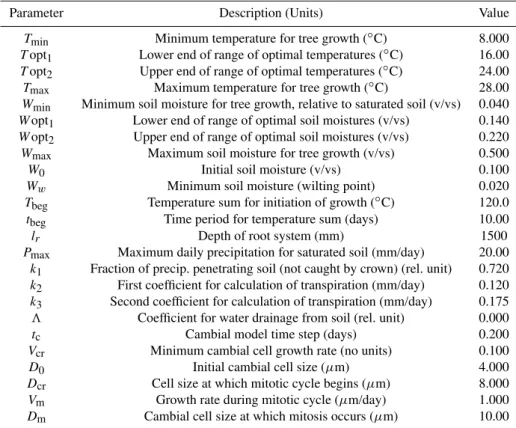
Table 1.Optimal model parameters1estimated calibration of VS model over period 1982–2004.
Parameter Description (Units) Value
Tmin Minimum temperature for tree growth (◦C) 8.000
Topt1 Lower end of range of optimal temperatures (◦C) 16.00
Topt2 Upper end of range of optimal temperatures (◦C) 24.00
Tmax Maximum temperature for tree growth (◦C) 28.00
Wmin Minimum soil moisture for tree growth, relative to saturated soil (v/vs) 0.040
Wopt1 Lower end of range of optimal soil moistures (v/vs) 0.140
Wopt2 Upper end of range of optimal soil moistures (v/vs) 0.220
Wmax Maximum soil moisture for tree growth (v/vs) 0.500
W0 Initial soil moisture (v/vs) 0.100
Ww Minimum soil moisture (wilting point) 0.020
Tbeg Temperature sum for initiation of growth (◦C) 120.0
tbeg Time period for temperature sum (days) 10.00
lr Depth of root system (mm) 1500
Pmax Maximum daily precipitation for saturated soil (mm/day) 20.00
k1 Fraction of precip. penetrating soil (not caught by crown) (rel. unit) 0.720
k2 First coefficient for calculation of transpiration (mm/day) 0.120
k3 Second coefficient for calculation of transpiration (mm/day) 0.175
3 Coefficient for water drainage from soil (rel. unit) 0.000
tc Cambial model time step (days) 0.200
Vcr Minimum cambial cell growth rate (no units) 0.100
D0 Initial cambial cell size (µm) 4.000
Dcr Cell size at which mitotic cycle begins (µm) 8.000
Vm Growth rate during mitotic cycle (µm/day) 1.000
Dm Cambial cell size at which mitosis occurs (µm) 10.00
1Description of parameters is according to Evans et al. (2006)
that provide a good approximation of the initial, or observed, tree-ring chronology, such that the simulated chronology is highly correlated with the observed chronology.
Appropriate temperature parameters for conifer trees, such as the Aleppo pine chronology used in the model, were se-lected from published studies of natural (uncontrolled) sys-tems (Deslauriers and Morin, 2005; Rossi et al., 2006, 2007, 2008). Water-use efficiency in dry environments is difficult to specify because conifer trees respond differently from one environment to the other (Oberhuber and Gruber, 2010; Gru-ber et al., 2010). Therefore, optimal parameters were chosen manually by trial and error using the model and average daily variation of model soil moisture from 1982–2004 (Table 1, Figs. 3, 4). As this process guarantees some agreement of simulated and observed chronology, it is critical to test the performance on independent data. We did this by applying the model and climate data for 1959–1981 to simulate the chronology for that earlier period.
3 Results and discussion
3.1 VS-model calibration and verification
With the estimated optimal parameters (see Table 1) we obtained highly significant positive correlation between the initial chronology and estimated growth curve (r=0.76,
Fig. 2.Variations of initial tree-ring residual chronology (blue solid line) and simulated tree-growth curve (red dashed line) for calibration period (1982–2004) and verification period (1959–1981).
3.2 Analysis of internal model characteristics
The VS model allows us to analyze features of tree-ring growth response in specific environmental conditions. For example, we can estimate the partial influence of tempera-ture and precipitation on tree-ring formation and the water content of the soil at various times throughout the growing season. Moreover, we can trace the process of cell forma-tion in the tree ring under condiforma-tions for which we have cell measurements for model verification (Vaganov et al., 2006). The estimated soil moisture in our region is shown by the VS model to increase at the start of each year, reach a maximum in April, and then monotonically decrease till August. We note that these results are consistent with experimental ob-servations for water content of soil in that region (Kleeberg and Koplitz-Weissgerber, 1983).
The limiting influence of climatic variables on tree growth during the growing season is a critical question. Standard multiple regression techniques using monthly climatic data cannot address that question. It is necessary to consider non-linear influences operating down to at least the daily time step in estimating tree growth by climatic forcing (temperature, precipitation and solar irradiation) (Vaganov et al., 2006).
The VS-model output of partial tree growth rates shows that at the start of each year, growth rategT(t )is less than
gW(t ), such that tree growth is limited by temperature until April (Fig. 3). From April to August soil moisture is the
limiting factor to tree-ring growth: partialgW(t )is generally less than partialgT(t )(Fig. 3).
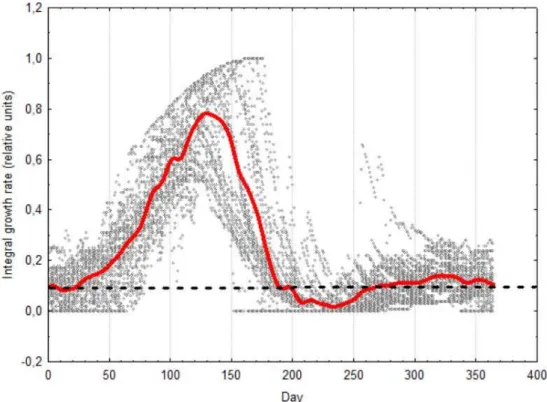
An integral growth rate Gr(t ) lower than the model-specified minimum cambial cell growth rateVcrindicates no growth. Accordingly, our results suggest that cambial ac-tivity stops in the middle of July and does not resume un-til next year (Fig. 4), despite partial growth ratesgT(t )and
gW(t )(especially, in October, November and December ) be-ing favorable for resumption of growth again after August– September (Fig. 4). The reason growth does not resume is day-length (or solar irradiance), which continues decreasing in September. In this case,gI(t )and its nonlinear interaction withgW(t )is the common limiting growth factor beginning in late August. Detailed analysis of simulated annual grow-ing seasons shows that in some favorable years (e.g. 1982, 1990, 1994, 2002) trees could possibly change their strategy of growth. They could change their unimodal growth pattern (with one spring-summer period of cambial activity per year) to bimodal – cambial cell division activated again in autumn by extremely favorable soil moisture. The possibility of bi-modal growth patterns in Spain was shown by De Luis et al. (2011). A bimodal growth pattern in our region needs to be verified by multi-year natural experiments.
Fig. 3.Partial growth rates depending on day lengthgI(t )(black circles), soil moisturegW(t )(blue line) and temperaturegT(t )(red line) for 1982-2004 fitted by negative exponentially-weighted smoothing (Mclain, 1974)2. Blue and red dots on the graph are daily values of partial rates superimposed on each other for each year.
2The negative exponentially-weighted fitting (smoothing) procedure is based on a polynomial regression algorithm similar to the one used in distance-weighted least squares.
Exponential weighting offers an adequate balance between preventing points at remote subregions from biasing the curve while not ignoring them entirely (Mclain 1974). Negative exponentially-weighted fitting is used to identify patterns in developing quantitative models of phenomenon. Specifically, the curve revealed by the smoothing procedure often consists of segments that cannot easily be described by one function (e.g. a particular polynomial function.)
days, with a standard deviation of 82 days. On average, soil moisture limits tree-ring growth for 128 days and temper-ature for 63 days. Verifying the results from simulations would require direct measurements of cambial growth, in-cluding measurements of cell sizes over several growing sea-sons. Such measurements can improve the model’s perfor-mance for a given species, and help in the interpretation of features such as false rings, or intra-annual density fluctu-ations. These features are implied by the bimodal growth curve in Fig. 4. In fact the VS model allows the user to sim-ulate cambial activity during the entire growing season, in-cluding the estimation of the number and sizes of new cells in the current tree ring (Vaganov et al., 2006). We note that false rings were observed in some samples from one of the four tree-ring sites contributing to the regional chronology.
The VS model indicates variability in the start of the grow-ing season. The mean start date is the 34thday of year, with a standard deviation of 26 days. The start of the growing season is defined by the rate of cambial cell growth. If the rate of growth is more than 0.1, the growing season is as-sumed to have started (see Table 1,Vcr). The growing season is assumed to end when the integral growth rate Gr(t )falls
below 0.1. Note that this happened in June–July of a recent year. During the 1982–2004 analysis period the principal limiting factor is soil moisture, indicated by the VS model to have limited growth in 67 % of the growing-season days.
3.3 Drought simulation and tree growth response
Fig. 4.Average integral growth rate Gr(t )(red line) for calibration period (1982-2004) fitted by negative exponentially-weighted smoothing (Mclain 1974). Dashed line corresponds to minimum cambial cell growth rateVcr.
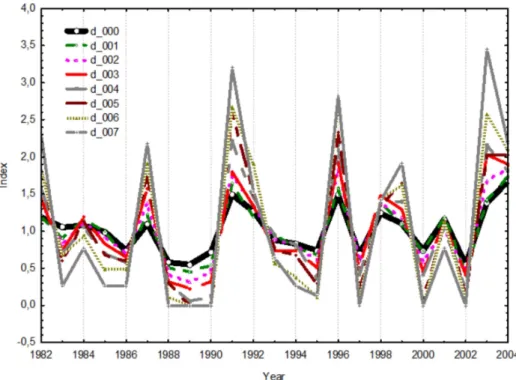
Table 2.Descriptive statistics of simulated tree-ring curves obtained by different values of drainage coefficient3. Last column is Pearson correlation between the initial chronology (3=0) and the estimated curve using different values of drainage coefficients.
Value of3 Valid N Mean Median Std.Dev. Skewness Kurtosis Pearson’s correlation 0.000 23 1.000 1.020 0.307 0.379 −0.593 1.00 0.001 23 1.000 1.000 0.368 0.268 −0.774 0.98 0.002 23 0.999 0.880 0.452 0.488 −0.754 0.96 0.003 23 0.999 0.830 0.544 0.461 −0.968 0.95 0.004 23 0.999 0.820 0.649 0.487 −0.810 0.91 0.005 23 1.000 0.750 0.748 0.539 −0.656 0.92 0.006 23 1.000 0.670 0.885 0.667 −0.751 0.91 0.007 23 1.001 0.640 1.074 0.968 −0.247 0.85
corresponds to an increase of the water deficit by about 5 %. Such a change of drainage coefficient was strongly reflected in the estimated tree-ring growth. The primary effect was a lowered median, amplified variance and increased skew-ness of tree-ring chronology with increased3(Table 2, and Fig. 5). The lowered median of growth reflects an increased water deficit in the soil. This result highlights the importance of parameter settings in the VS model, as a higher3could result in a more sensitivity of tree growth to precipitation.
4 Conclusions
Fig. 5.Simulated tree-ring growth chronologies by different values of drainage coefficients.
daily precipitation, temperature and day length alone are suf-ficient under the model framework to generate ring-width variations.
The model yields important diagnostic information on the tree-growth response to climate. For example, the model shows that the average duration of the growing season is 191 days, and that on average soil moisture limits tree-ring growth for128 days and temperature for 63 days in that 191-day window. The model also indicates a huge variability about the mean in such variables as duration of growing son, and leaves open the possibility of a bimodal growth sea-son in some years. The strength of the VS model is its abil-ity to simulate a non-linear tree-growth response to climate changes. In the Mediterranean region and elsewhere such simulations can be used to help explain observed patterns of tree-growth variation in the past and to simulate tree growth under extreme environmental changes. The VS model may also be useful in the climatic interpretation of tree-ring vari-ations when the climate-growth signal is weaker than for the samples used in this study. Good simulation results have pre-viously been reported for such cases (e.g. Vaganov et al., 2006; Shishov et al. 2007; Ivanovsky and Shishov, 2010). Of course, the ability of the model to handle nonlinear cli-mate influence on growth can result in good simulations only when the climate-growth linkage is reasonably strong.
Although primarily, as in this paper, used with conifers, the VS model is also applicable to tree-ring chronologies of angiosperms (hardwood trees). Developers of the model
(E. Vaganov, A. Shashkin and H. Fritts) have successfully used it on hardwoods (unpublished results)
Output from the processes-based VS model includes the partial influence of temperature and precipitation (soil mois-ture) on tree-ring formation, the water content in the soil during the growing season, and the start and end date of the growing season. Potential applications of this type of information include assessment of likely impact of regional warming on tree-ring indices, and evaluation of the capabil-ity of particular tree species to sense climate fluctuations in various seasonal time windows.
VS-modeling and direct cell measurements enable us to estimate cell dynamics of tree-ring formation in this ex-tremely dry Mediterranean environment, and to better under-stand how tree growth there is controlled by climate. Multi-year natural field studies, including cell dimension measure-ments, are essential to better understand the dynamics and verify model findings.
Acknowledgements. Funding was provided by the National Sci-ence Foundation under Grant AGS-Paleo Perspectives on Climate Change Program 1103314. V. Shishov was supported by the Fulbright scholar fellowship and Russian Foundation for Basic Research (no. 09-05-00900a).
References
Alisov, B. P.: The Climate of USSR, Moscow State University, Moscow, 126 p., 1961 (in Russian).
Aloui, A. and Serre-Bachet F.: Analyse dendroclimatologique com-pare’e de six populations de cheˆne zeen et d’une population de pin maritime du nord-ouest de la Tunisie,Ecol Mediterr,13, 55– 74, 1987.
Anchukaitis, K. J., Evans, M. N., Kaplan, A., Vaganov, E. A., Hughes, M. K., Grissino-Mayer, H. D., and Cane, M. A.: Forward modeling of regional scale tree-ring pat-terns in the southeastern United States and the recent influ-ence of summer drought, Geophys. Res. Lett., 33, L04705, doi:10.1029/2005GL025050, 2006.
Cook, E. R. and Kairiukstis, L. A.: Methods of Dendrochronology, Applications in the Environmental Sciences, Dordrecht, Boston, London: Kluwer Acad. Publ., 394 p., 1990.
Chbouki, N., Stockton, C. W., and Myers, D.: Spatio-temporal pat-terns of drought in Morocco, Int. J. Climatol., 15, 187–205, 1995. De Luis, M., Novak, K., Ravent´os, J., Griˇcar, J., Prislan, P., and
ˇ
Cufar, K.: Climate factors promoting intra-annual density fluc-tuations in Aleppo pine (Pinus halepensis) from semiarid sites, Dendrochronologia, 29, 163–169, 2011.
Deslauriers, A. and Morin, H.: Intra-annual tracheid production in balsam fir stems and the effect of meteorological variables, Trees, 19, 402–408, doi:10.1007/s00468-004-0398-8, 2005.
Esper, J., Frank, D., B¨untgen, U., Verstege, A., Luterbacher, J., and Xoplaki, E.: Long-term drought severity variations in Morocco, Geophys. Res. Lett., 34, L17702, doi:10.1029/2007GL030844, 2007.
Evans, M. N., Reichert, K., Kaplan, A., Anchukaitis, K. J., Vaganov, E. A., Hughes, M. K., and Cane, M. A.: A forward modeling ap-proach to paleoclimatic interpretation of tree-ring data, J. Geo-phys. Res., 111, G03008, doi:10.1029/2006JG000166, 2006. Fritts, H. C.: Tree-rings and climate, London; New York; San
Fran-cisco: Acad. Press, 576 p., 1976.
Gates, D. M.: Biophysical ecology. Springer, Berlin Heidelberg New York, 611 p., 1980.
Glueck, M. F. and Stockton, C. W.: Reconstruction of the North At-lantic Oscillation, 1429-1983, Int. J. Climatol., 21, 1453–1465, 2001.
Gruber, A., Strobl, S., Veit, B., and Oberhuber, W.: Im-pact of drought on the temporal dynamics of wood for-mation in Pinus sylvestris, Tree Physiology, 30, 490–501 doi:10.1093/treephys/tpq003, 2010.
Ivanovsky, A. B. and Shishov, V. V.: A parameterization algorithm for the Vaganov–Shashkin model of seasonal growth and tree-ring formation, Vestnik SibSAU, 2, 83–88, 2010.
Kleeberg, H. B. and Koplitz-Weissgerber, G.: A dynamic model for determination of soil moisture budget and its applications, Hydrology of Humid Tropical Regions with Particular Reference to the Hydrological Effects of Agriculture and Forestry Practice (Proceedings of the Hamburg Symposium, August 1983), IAHS Publ. no. 140, 1983.
Mclain, D. H.: Drawing contours from arbitrary data points, Com-put. J., 17, 318–324, 1974.
Messaoudene, M. and Tessier, L.: Tree-ring to climate relationships for populations ofQuercus afares Willd andQuercus canariensis Pomel in Algeria, Annals of the Science of Forensics, 54, 347– 358, 1997.
Oberhuber W. and Gruber, A.: Climatic influences on intra-annual stem radial increment ofPinus sylvestris(L.) exposed to drought, Trees, 24, 887–898, doi:10.1007/s00468-010-0458-1, 2010. Rossi, S., Deslauriers, A., Anfodillo, T., Morin, H., Saracino, A.,
Motta, R., and Borghetti M.: Conifers in cold environments syn-chronize maximum growth rate of tree-ring formation with day length, New Phytologist, 170, 301–310, 2006.
Rossi, S., Deslauriers, A., Anfodillo, T., and Carraro, V.: Evidence of threshold temperatures for xylogenesis in conifers at high al-titudes, Oecologia, 152, 1–12, doi:10.1007/s00442-006-0625-7, 2007.
Rossi, S., Deslauriers, A., Griar, J., Seo, J.-W., Rathgeber, C., An-fondillo, T., Morin, H., Levanic, T., Oven,P., and Jalkanen, R.: Critical temperatures for xylogenesis in conifers in cold climates, Global Ecol. Biogeogr., 17, 696–707, 2008.
Shishov, V. V., Naurzbaev, M. M., Vaganov, E. A., Ivanovsky, A. B., and Korets, M. A.: Analysis of tree-ring growth on Eurasian North for the last decades, Izvestiya RAS, Geographical series, 3, 49–59, 2007.
Tessier, L., Nola, P., and Serre-Bachet, F.: Deciduous Quercus in the Mediterranean region: tree-ring/climate relationships, New Phytol., 126, 355–367, 1994.
Thornthwaite, C. W. and Mather, J. R.: The water balance, (Pub-lications in climatology, Vol. 1) Drexel Institute of Technology, Philadelphia, 1–104, 1955.
Till, C. and Guiot, J.: Reconstruction of precipitation in Morocco since 1100 AD based on Cedrus atlantica tree-ring widths, Quat. Res., 33, 337–351, 1990.
Touchan, R., Anchukaitis, K. J., Meko, D. M., Attalah, S., Baisan, C., and Aloui, A.: Long term context for recent drought in northwestern Africa, Geophys. Res. Lett., 35, L13705, 5 pp., doi:10.1029/2008GL034264, 2008a.
Touchan, R., Meko, D. M., and Aloui, A.: Precipitation reconstruc-tion for Northwestern Tunisia from tree rings, J. Arid Environ., 72, 1887, doi:10.1016/j.jaridenv.2008.05.010, 2008b.
Touchan, R., Anchukaitis, K. J., Meko, D. M., Sabir, M., Attalah, S., and Aloui, A.: Spatiotemporal drought variability in north-western Africa over the last nine centuries, J. Clim. Dynam., 37, 237–252, doi:10.1007/s00382-010-0804-4, 2011.
Vaganov, E. A., Hughes, M. K., Kirdyanov, A. V, Schweingruber, F. H., and Silkin, P. P.: Influence of snowfall and melt timing on tree growth in subarctic Eurasia, Nature, 400, 149–151, 1999. Vaganov, E. A., Hughes, M. K., and Shashkin, A. V.: Growth