Annales
Geophysicae
Solar cycle variations of the energetic H/He intensity ratio at high
heliolatitudes and in the ecliptic plane
D. Lario1, E. C. Roelof1, R. B. Decker1, G. C. Ho1, C. G. Maclennan2, and J. T. Gosling3
1Applied Physics Laboratory. The Johns Hopkins University, Laurel, Maryland, USA 2Bell Laboratories, Lucent Technologies, Murray Hill, New Jersey, USA
3Los Alamos National Laboratory, Los Alamos, New Mexico, USA
Received: 23 August 2002 – Revised: 20 December 2002 – Accepted: 3 February 2003
Abstract. We study the variability of the heliospheric
en-ergetic proton-to-helium abundance ratios during different phases of the solar cycle. We use energetic particle, so-lar wind, and magnetic field data from the Ulysses, ACE and IMP-8 spacecraft to compare the H/He intensity ra-tio at high heliographic latitudes and in the ecliptic plane. During the first out-of-ecliptic excursion of Ulysses (1992– 1996), the HI-SCALE instrument measured corotating ener-getic particle intensity enhancements characterized by low values (.10) of the 0.5–1.0 MeV nucleon−1H/He intensity
ratio. During the second out-of-ecliptic excursion of Ulysses (1999–2002), the more frequent occurrence of solar energetic particle events resulted in almost continuously high (.20) values of the H/He ratio, even at the highest heliolatitudes reached by Ulysses. Comparison with in-ecliptic measure-ments from an identical instrument on the ACE spacecraft showed similar H/He values at ACE and Ulysses, suggest-ing a remarkable uniformity of energetic particle intensities in the solar maximum heliosphere at high heliolatitudes and in the ecliptic plane. In-ecliptic observations of the H/He intensity ratio from the IMP-8 spacecraft show variations be-tween solar maximum and solar minimum similar to those observed by Ulysses at high heliographic latitudes. We sug-gest that the variation of the H/He intensity ratio throughout the solar cycle is due to the different level of transient solar activity, as well as the different structure and duration that corotating solar wind structures have under solar maximum and solar minimum conditions. During solar minimum, the interactions between the two different types of solar wind streams (slow vs. fast) are strong and long-lasting, allow-ing for a continuous and efficient acceleration of interstellar pickup He+. During solar maximum, transient events of so-lar origin (characterized by high values of the H/He ratio) are able to globally fill the heliosphere. In addition, during solar maximum, the lack of strong recurrent high-speed solar wind streams, together with the dynamic character of the Sun, lead to weak and short-lived solar wind stream interactions. This
Correspondence to: D. Lario ([email protected])
results in a less efficient acceleration of pickup He+, and thus a higher value of the H/He intensity ratio.
Key words. Interplanetary physics (energetic particles,
in-terplanetary shocks; solar wind plasma)
1 Introduction
The energetic charged particle population of the heliosphere drastically changes from solar maximum to solar minimum (Lario et al., 2001a). The solar cycle variations of the supra-thermal proton-to-helium abundance ratios (Shields et al., 1985; Richardson et al., 1993; Lario et al., 2001b) faithfully reflect these changes. Shields et al. (1985) showed that at a heliocentric distance of 1 AU during solar cycle 21, so-lar minimum particle intensities tend to be richer in helium than those measured during active periods. Richardson et al. (1993) noted that the elemental abundances of corotating par-ticle flux enhancements observed at 1 AU showed a clear transition from solar maximum to solar minimum. Solar minimum corotating events have elemental abundances that are well differentiated from the abundances measured during solar energetic particle (SEP) events, while at solar maxi-mum the abundances in corotating events are more SEP-like (Richardson et al., 1993).
obser-vations with simultaneous obserobser-vations from the ACE and IMP-8 spacecraft in the ecliptic plane and at 1 AU from the Sun.
Measurements of proton and helium intensities by several spacecraft under solar minimum conditions have revealed a clear distinction between energetic particle intensity en-hancements associated with corotating events and particle intensities observed during transient events of solar origin (McGuire et al., 1978; Scholer et al., 1979; Simnett et al., 1995). McGuire et al. (1978) showed that the 1.5–8.8 MeV nucleon−1H/He intensity ratio measured in the ecliptic plane and at 1 AU from the Sun was smaller and much less vari-able in corotating events than in SEP events. The lack of variability and the close numerical value of the H/He mea-sured in high-speed solar wind plasma streams led McGuire et al. (1978) to suggest that the high-speed solar wind was the source population for the corotating energetic particle events. However, Scholer et al. (1979) noted that the H/He ratio ob-served by IMP-8 at 1 AU in the energy range of 0.54–1.0 MeV nucleon−1 during corotating energetic particle events had an average value that was low compared to that mea-sured in the high-speed solar wind streams. Scholer et al. (1979) noticed that the H/He ratio generally increased with the energy, suggesting that the overabundance of He in the corotating particle events was a low-energy phenomenon.
An additional source of particles for the corotating events, different from the ambient solar wind, was introduced by Gloeckler et al. (1994), who showed that interstellar pickup ions (in particular H+ and He+) were accelerated up to ∼1 MeV nucleon−1 in the disturbed solar wind during an in-ecliptic corotating interaction region (CIR) observed by Ulysses at∼4.5 AU. Owing to their higher injection speed compared with the solar wind ions, pickup ions are prefer-entially accelerated and may constitute the principal source of these species in CIR events (Gloeckler et al., 1994). Re-cently, Chotoo et al. (2000) showed that in CIR-events ob-served at 1 AU, the energetic (∼10-500 keV nucleon−1) He+/He++intensity ratio was enhanced over the solar wind He+/He++value, consistent with the fact that in CIR events the He+(of interstellar origin) is overabundant with respect to the He++(predominantly of solar wind origin). In addi-tion, Hilchenbach et al. (1999) showed that for CIR events at 1 AU the 25–150 keV nucleon−1 He+/He++ ratios were smaller than those observed at ∼4.5 AU (Gloeckler et al., 1994), consistent with a more abundant pickup population in the outer heliosphere than at 1 AU (Chotoo et al., 2000; Morris et al., 2001).
Measurements from the Ulysses spacecraft out of the ecliptic (>14◦), at large heliocentric distances (over 5.3– 3.9 AU), and under solar minimum conditions have revealed that the 0.5–1.4 MeV nucleon−1 H/He intensity ratio was lower in the corotating events than in transient solar events, and that the values were a factor of ten lower than those seen in the ecliptic plane and at 1 AU (Simnett et al., 1994). The lower values of the H/He ratios observed in the recurrent par-ticle events at high heliolatitudes and at large heliocentric distances were interpreted by Simnett et al. (1995) as the
re-sult of an efficient acceleration of interstellar pickup He+at
the reverse shocks formed in the interaction between slow and fast solar wind streams.
In this paper we analyze measurements of the 0.5–1.0 MeV nucleon−1H/He intensity ratio during different phases of the solar cycle. The out-of-ecliptic orbit of the Ulysses spacecraft with a period of 6.2 years allows us to study these solar cycle variations over a broad range of heliographic lat-itudes. At the end of 1992, the Ulysses spacecraft was at a distance of 5.2 AU from the Sun and moving south pole-ward of 18◦S. The spacecraft reached its most southern he-liographic latitude of 80.2◦S at a radial distance of 2.3 AU from the Sun in mid-September 1994 and its most northern heliographic latitude at 80.2◦N at a radial distance of 2.0 AU by the end of July 1995. After its first complete orbit over the poles of the Sun in January 1999, Ulysses was again at a distance of 5.2 AU from the Sun and moving south pole-ward of 18◦S. In its second out-of-ecliptic orbit around the Sun, Ulysses reached its maximum southern latitude at the end of November 2000 and its maximum northern latitude in mid-October 2001. While the first Ulysses orbit (1992– 1996) occurred during the declining phase of the solar cycle 22, the second orbit (1999–2002) coincided with the rising phase and maximum phase of the solar cycle 23. Simulta-neous observations from the ACE and IMP-8 spacecraft in the vicinity of the Earth allow us to compare energetic parti-cle data at low and high heliographic latitudes. The analysis of the H/He intensity ratio during different phases of the so-lar cycle and at different heliospheric locations helps us to distinguish how interplanetary acceleration mechanisms and “seed” particle populations change over the solar cycle.
2 Instrumentation
Fig. 1. Three-day averages of the (A) 0.5–1.0 MeV proton intensity and (B) 0.5–1.0 MeV/nucleon helium intensity as measured by the
The longevity of the IMP-8 spacecraft allows us to com-pare Ulysses data during its two orbits over the solar poles with in-ecliptic data. We use energetic particle data from the CPME (Charged Particle Measurements Experiment). The Proton-Electron Telescope (PET) of the CPME (Sarris et al., 1976) provides measurements of protons and alpha particles in several differential energy channels. It consists of two Si surface barrier fully depleted detectors placed close together near the front of the telescope, followed by a thick Li-drifted detector placed further back along the telescope axis, and an anticoincidence plastic scintillator cup that adequately re-jects background counts from high-energy interactions and off-axis penetrating particles. Ten differential proton chan-nels and six differential alpha particle chanchan-nels, operated in anticoincidence with the scintillator, are defined by on-board logic (Sarris et al., 1976). We will use particle intensities in the energy range 2.00–4.60 MeV for protons and 1.80–4.20 MeV nucleon−1for alpha particles. When either of the two intensities are near background level we do not compute the H/He ratio.
In order to identify the arrival of CMEs and stream inter-action regions (SIRs) at the Ulysses spacecraft, we also use measurements from the Ulysses solar wind plasma experi-ment (Bame et al., 1992) and magnetometer (Balogh et al., 1992). The occurrence of counterstreaming electron events has been used to determine the passage of CMEs over the spacecraft (Gosling et al., 1987), as well as those time in-tervals when Ulysses remains connected to shocks associ-ated with stream interaction regions and CIRs (Gosling et al., 1993). In order to identify the passage by the ACE spacecraft of high-speed solar wind streams and the formation of SIRs in front of these fast streams, we also use measurements from the ACE solar wind plasma experiment (McComas et al., 1998) and the ACE magnetometer (Smith et al., 1998).
3 Ulysses observations
Figure 1 shows the spin-averaged, three-day averaged inten-sities of 0.5 to 1 MeV nucleon−1 protons and helium, to-gether with the H/He ratio and the solar wind speed from 24 October 1992 to 23 April 1996 (top graph) and from 1 Jan-uary 1999 to 1 July 2002 (bottom graph). The vertical solid lines indicate the highest heliolatitudes reached by Ulysses. The vertical dotted lines are 26 days apart and indicate the so-lar rotation period. We have indicated by black rectangles at the bottom of the solar wind panel (D) the passage of CMEs identified by counterstreaming halo electron events in the so-lar wind (Gosling et al., 1987). Note that the CME identifi-cation has only been done up to the end of 2001. Upper gray rectangles at the top of the solar wind panel (D) show the arrival of magnetic compressions formed in SIRs or CIRs.
Each graph in Fig. 1 covers 3.5 years of data and includes the Ulysses ascents to high southerly latitudes (left of the first vertical solid line), the fast latitude scans from the south to the north solar poles (between the two vertical lines), and the slow descent to lower latitudes (right of the second
verti-cal solid line). At the beginning of both graphs Ulysses was moving southwards at a heliocentric distance of 5.2 AU and a heliographic latitude of 18◦S, while by the end of the graphs, Ulysses was again moving southwards at 3.7 AU and 39◦N. The closest distance to the Sun (1.34 AU) was reached in mid-March 1995 for the first orbit and at the end of May 2001 for the second orbit when Ulysses was close to the ecliptic plane.
3.1 Solar minimum orbit
Energetic ion observations over the first Ulysses polar orbit have been thoroughly analyzed (Simnett et al., 1994; Roelof et al., 1995, 1997; Sanderson et al., 1995, 1999) and we refer the reader to these papers for a detailed description. Follow-ing is an outline of the salient results from these studies.
During the first portion of the Ulysses ascent to high south-ern latitudes, the spacecraft observed, once per solar rota-tion, solar wind flows from both the streamer belt (at∼400 km s−1) and from the southern polar coronal hole (at∼800
km s−1). Each rotation has been numbered in panel (A) of the
top graph of Fig. 1 following the scheme introduced by Bame et al. (1993). Strong and recurrent CIRs, mostly bounded by forward and reverse shock pairs (FS-RS), were observed up to a latitude of∼36◦. Poleward of∼36◦S, Ulysses remained immersed in the flow from the polar coronal hole and only reverse shocks were regularly observed. Poleward of∼42◦S (rotation 19), CIR reverse shocks were observed only spo-radically (Gosling et al., 1995).
A regular pattern of particle intensity increases with∼ 26-day periodicity was observed throughout the ascent to high southern heliolatitudes. Before the disappearance of recur-rent corotating interaction regions, peaks in the ion inten-sities were observed close to the associated shocks. Pole-ward of∼42◦S the recurrent peaks in the particle intensity were still observed, although the intensity decreased with in-creasing latitude. This pattern of events was disrupted by the occurrence of transient events of solar origin as in rota-tions 6, 15, 23 and 24 (indicated by T in panels B and C), or by the arrival of interplanetary counterparts of CMEs as in rotations 6, 14, 23, 24 and 26 (black rectangles in panel D). Between rotations 7–8, 10–11, 11–12, 15–16, 16–17 and 18–19, Roelof et al. (1995) noticed the occurrence of “inter-events” (indicated by black dots in panels B and C) as events of solar origin able to fill the rarefaction regions of the high-speed solar wind streams and observed at Ulysses between two consecutive CIR particle intensity enhancements.
ra-✂✁☎✄✆✁✞✝✠✟ ✂✁☎✄☛✡✆✁☛✁ ☞✁☎✄✌✡✠✍✌✝ ✠✡✎✄✏✌✑✎✡ ✠✡✎✄✏☛✒✠✓ ✠✡✠✄✌☛✓✌✑ ✎✡✠✄✔✁✠✁✞✝
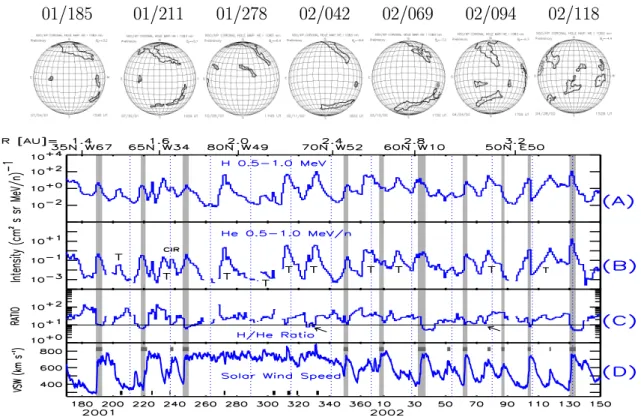
Fig. 2. Upper panel: Coronal hole 1083 nm maps provided by the National Solar Observatory at Kitt Peak taken on the day indicated at
the top. The photospheric magnetic polarity of the northern hole is negative. Bottom panel: (A) Daily averages of the 0.5–1.0 MeV proton intensities and (B) daily averages of the 0.5–1.0 MeV/nucleon helium intensities as measured by the HI-SCALE instrument (Lanzerotti et al., 1992); (C) H/He ratio between the daily averages intensity of H and He shown in panels (A) and (B). (D) Hourly averages of the solar wind speed as measured by the SWOOPS instrument (Bame et al., 1992). Time interval extends from 19 June 2001 (day 170) to 30 May 2002 (day 150). Gray shadow bars identify the passages of recurrent CIRs over Ulysses. Upper gray rectangles in the solar wind panel (D) show the arrival of compression regions formed by the interaction between solar wind of different speeds. Black rectangles at the bottom of the solar wind panel (D) indicate CMEs as identified by counterstreaming halo electron events in the solar wind. Note that CME identification was done until the end of 2001. Vertical dotted lines are spaced every 26 days. Transient events are indicated by T.
tio always remains below∼10, with the exception of the two transient events in rotations 23 and 24. We note that the oc-currence of an event of solar origin (as in rotations 14 and 15, or between rotations 10–11 and 11–12) produced an in-crease in the H/He ratio which remained high for the subse-quent solar rotations. We refer to Simnett et al. (1994) for further details on the evolution of the H/He ratio during the first southern pass.
Once Ulysses reached latitudes poleward of∼70◦S (July 1994), proton and helium intensities were low or at back-ground level. Thereafter, until the highest latitude of 80.2◦
was reached, and then back down to ∼46◦S (December 1994), the intensity stayed almost constant at around this level. The first peak in intensity during the descent to low latitudes in the fast latitude scan was not seen until 46◦S and was probably due to a remote connection to a CIR (Roelof et al., 1997). Ulysses observed slow solar wind from the streamer belt again at 22◦S (February 1995) and for three solar rotations, two intensity peaks were observed in each ro-tation, which were most likely due to the spacecraft encoun-tering CIRs from both the northern and the southern coronal holes once per solar rotation (Sanderson et al., 1995). For
these events during the fast latitude scan, the H/He ratio was around∼10, which is a low value compared to events of solar origin, but larger than the value observed at higher heliolat-itudes. This value was comparable to the H/He ratios ob-served during the first CIR events in 1992 (not shown here) when Ulysses was closer to the ecliptic plane (Simnett et al., 1994). The only easily-identified SEP events during the fast latitude scan were observed on day 82 of 1995 and in late April 1995 (Buttighoffer et al., 1996), when the H/He ratio reached values around∼20.
3.2 Solar maximum orbit
The most notable signature of the Ulysses second orbit (in contrast to the first) is the lack of any regular pattern in en-ergetic particle intensities and in solar wind data. At high as well as low southern heliolatitudes (before July 2001), Ulysses observed an irregularly structured mixture of slow (∼350 km s−1) and intermediate-speed (∼600 km s−1) solar
wind flows (McComas et al., 2000). The periods with fast (>700 km s−1) solar wind were scarce. CMEs and transient shocks driven by CMEs were numerous, and they were ob-served at high as well as low heliolatitudes (McComas et al., 2000). Solar wind flows from large stable coronal holes were not observed in the Southern Hemisphere. On the contrary, solar wind flows with typical speeds of∼500–600 km s−1 originated in a variety of smaller coronal holes (McComas et al., 2002a). Although the speed difference between the slow and intermediate-speed solar wind was small, numer-ous stream interactions were well developed, many of which were bounded by FS-RS pairs (McComas et al., 2000). Sev-eral of these interaction regions recurred at roughly the so-lar rotation period over a few consecutive rotations: for ex-ample, during the first six rotations of 1999 (Lario et al., 2001b), during three rotations in June–August 2000 and the first five rotations of 2001 (McComas et al., 2002a). How-ever, these structures were much less strictly periodic than those observed in 1992–1993. Noteworthy are the four dif-ferent periods with the highest (>700 km s−1) speeds ob-served in the Southern Hemisphere; three of them, on days 191–192 of 2000 and 46–47 and 71–72 of 2001, were flows originating in small coronal holes (McComas et al., 2002a); the other interval with the highest solar wind speed (>900 km s−1) throughout the time interval of Fig. 2 occurred on days 110–111 of 2001 and was associated with the passage of the interplanetary counterpart of a fast CME (McComas et al., 2002b).
In contrast with this complicated mixture of solar wind flows from a variety of sources, observations northward of ∼40◦N showed the reformation of a relatively steady and fast solar wind flow originating from the northern polar coro-nal holes (McComas et al., 2002b). Ulysses remained im-mersed in the high-speed solar wind flow during three differ-ent time intervals on days 189–201 (41◦N–49◦N), 220–231 (60◦N–65◦N) and 245–345 (poleward of 71◦N) of 2001. Thereafter, Ulysses alternately encountered both fast polar coronal hole and slower streamer belt flows on each solar ro-tation, presumably owing to an equatorward extension of the restructuring northern polar coronal hole. The crossings over the two types of solar winds were marked by strong, nearly-recurrent CIRs indicated by gray thin rectangles in the top of the solar wind panel (D) in Fig. 1. This period will be an-alyzed in detail below in Fig. 2. Several CMEs (black rect-angles at the bottom of panel D) were also observed, even at the highest northern latitudes and when Ulysses was im-mersed in the high-speed polar coronal hole flow (Reisenfeld et al., 2003).
In contrast to the first orbit, energetic ion intensities
fluc-tuated without any consistent pattern. Whereas at solar mini-mum the lowest ion intensities occurred at very high latitudes (gt rsim70◦S orgt rsim40◦N) or between two consecutive corotating events (without the presence of an inter-event of solar origin), proton and helium intensities at solar maximum were elevated throughout the second orbit. There was only one period, between days 230 and 256 of 2000, when the proton intensities dropped to within an order of magnitude above background levels, and helium intensities were close to background levels (so in that period we did not compute the H/He ratio). It is also relevant that at solar maximum sev-eral transient events were observed, even at heliolatitudes as high as 80◦S or 80◦N (see Fig. 2 below). The high inten-sities observed throughout the second orbit, independently of heliolatitude and heliocentric radial distance, indicate that the entire heliosphere was essentially populated by energetic particles at all heliolatitudes and heliolongitudes; i.e. the in-ner heliosphere was acting as a “reservoir” of low-ein-nergy ions (Roelof et al., 1992).
The H/He ratio usually maintained high (gt rsim20) va-lues throughout the second orbit, with only occasional de-creases below∼10. The H/He ratio did not show any lat-itude or radial dependence, i.e. high values were observed regardless of the heliocentric distance and heliographic he-liolatitude. Lario et al. (2001b) analyzed in detail the first four months of 1999 when Ulysses observed a recurrence of six CIRs bounded by FS-RS pairs. The main results of this study were (1) the passage of CIRs by Ulysses usually pro-duced a decrease in the H/He ratio, with a clear minimum towards the reverse shock or during the crossing of the fast stream. So at least qualitatively, the behavior of the H/He ratio in CIRs during early 1999 was similar to that observed in 1992–1994; (2) the occurrence of an SEP event during the passage of a CIR may produce an increase in the H/He ratio; and (3) the highest values of the H/He ratio are not exclusive to SEP events, for example, the highest value of the H/He ratio was observed at the forward shock associated with the fourth CIR in 1999.
Fig. 3. Three-day averages of the (A) 2.00–4.60 MeV proton intensity and (B) 1.80–4.20 MeV/nucleon helium intensity as measured by
the CPME instrument on IMP-8 (Sarris et al., 1976). (C) H/He ratio calculated from the H and He traces shown in panels (A) and (B). (D) Daily averages of the solar wind speed as measured by the MIT instrument on IMP-8. The top set of four panels extends from 24 October 1992 to 23 April 1996 and the bottom set from 1 January 1999 to 1 July 2002. In the top graph, the occurrence of transient particle events is indicated by Ts in the panel (C), and the periods dominated by recurrent particle intensity enhancements are indicated by CIR. The vertical dotted lines are spaced every 27 days. The horizontal line in panel (C) marks a value of H/He ratio = 17.
were observed even at the highest latitudes and when Ulysses remained immersed in the high-speed polar coronal hole solar wind flow. The arrival of recurrent CIRs produced en-ergetic particle intensity increases that were characterized by low values of the H/He ratio, occasionally decreasing below ∼10. Of particular interest are the events on days 32-38 and
general, the SEP events observed during the time interval of Fig. 2 enhanced the H/He ratio (&30–40) and the recurrent CIRs decreased H/He close to∼10. The low values of H/He intensity ratio, however, were not exclusively associated with CIRs. The onset of the SEP events on day 327 of 2001 and on day 74 of 2002 (indicated by arrows in panel C) brought the H/He ratio close to∼10. Below we will show that this reduction in H/He may be characteristic of the onset of some specific SEP events.
4 In-ecliptic observations
We use data from the CPME instrument on board IMP-8 to compare high-latitude Ulysses data with 1 AU in-ecliptic observations. We choose differential energy channels with matching energy windows for protons and alpha particles which are not affected by large and different background levels. Figure 3 shows the 2.00–4.60 MeV proton intensi-ties (panels A), the 1.80–4.20 MeV nucleon−1 alpha parti-cle intensities (panels B), the H/He intensity ratio between the two indicated energy channels (panels C) and the solar wind speed measured by the MIT experiment on board IMP-8 (panels D), using the same format and time intervals as Fig. 1. The top graph covers the declining phase of solar cy-cle 22 and the bottom graph the rising phase of solar cycy-cle 23. The dotted vertical lines are 27 days apart and indicate the solar rotation period for an Earth-orbiting spacecraft. 4.1 In-ecliptic observations during solar minimum Richardson et al. (1998) compared the recurrent energetic ion enhancements observed at Ulysses during its first orbit (from its launch until mid-1996), with energetic particle and solar wind observations at 1 AU. The authors associated the recur-rent CIR-related particle intensity increases at Ulysses with energetic particle intensity enhancements at Earth associated with the arrival of recurrent high-speed streams. During the first part of the time-interval considered in Fig. 3, several SEP events, characterized by high (gt rsim40) H/He ratios, were clearly observed at IMP-8 (indicated by T in the panel C). These events were also identified as of solar origin by Roelof et al. (1995), Lanzerotti et al. (1996) and Richardson et al. (1998). Apart from these SEP events, Richardson et al. (1998) also identified, rotation by rotation, the CIR events observed by IMP-8 (see their Fig. 8).
A particularly clear sequence of CIR-associated particle enhancements at IMP-8 was observed from August 1993 to June 1995. This sequence was only interrupted by occa-sional SEP events, as in February 1994 (Fig. 2 in Richard-son et al., 1998) or in September–October 1994. From De-cember 1993 to July 1994 an unusually persistent high-speed stream was regularly observed at the Earth. Richardson et al. (1998) identified the origin of these high-speed streams with an equatorward extension of the south polar coronal hole. The development of this stream was also associated with an increase in the CIR-event intensity at Earth. Richardson et al.
(1998) suggested that the CIR events observed by Ulysses at high latitudes occurred poleward of equatorward extensions of the polar coronal holes, which produced corotating high-speed streams in the ecliptic. Therefore, these authors sug-gested a common origin for most of the CIR events at both spacecraft.
The H/He intensity ratio during solar minimum allows us to distinguish those particle intensity enhancements associ-ated with either an SEP event or a CIR event. Our identifica-tion in panel (C) of the top graph in Fig. 3 follows that given by Richardson et al. (1998) and it completely agrees with the behavior of the H/He ratio observed on the first Ulysses or-bit. The sequence of two SEP events in September-October 1994, with high (gt rsim100) H/He ratios, with an intense CIR event in the middle, characterized by a low value of the H/He (∼17) is similar to the two SEP events observed at Ulysses in rotations 23 and 24 with a CIR event in the middle (see Fig. 1 and Simnett et al., 1995).
During solar minimum, CIR events at IMP-8 showed higher H/He values than at Ulysses. Note that the horizontal solid line in panel (C) of Fig. 3 marks a value of 17, whereas in Figs. 1 and 2 this line indicates a value of 10. The lower values of the H/He ratio for the CIR events at Ulysses may be due to either (1) the lower energy range considered at Ulysses, (2) the larger heliocentric distance of Ulysses, (3) the higher latitudes of Ulysses, and/or (4) the use of different instrumentation on each spacecraft.
The sequence of CIR events observed by Ulysses early in 1995 occurred when the spacecraft was very close to the ecliptic plane (<30◦) and very close to the Sun (<1.5 AU). These CIRs at Ulysses had 0.5–1.0 MeV nucleon−1 H/He
ratios around ∼10. Richardson et al. (1998) showed that these CIRs at Ulysses early in 1995 were associated with the CIRs observed∼10 days later at IMP-8. Figure 3 shows that these CIRs at IMP-8 had 1.8-4.6 MeV nucleon−1H/He ratios around∼17. The proximity of Ulysses to the ecliptic plane and its small heliocentric distance suggest that the difference in the H/He ratios at Ulysses and IMP-8 in early 1995 was not due to radial or latitudinal gradients. In fact, Christon and Simpson (1979) examined proton and alpha particle intensi-ties during CIR events observed simultaneously by Mariner 10 (at 0.46 AU), Pioneer 11 (at 2.2 AU) and IMP-7 (at 1 AU), with all three spacecraft close to the ecliptic plane, and con-cluded that the H/He ratio at 0.6–1.8 MeV nucleon−1did not show any radial gradient, at least inside 2.2 AU.
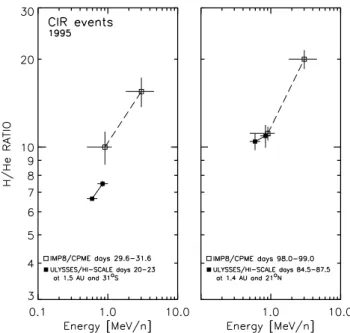
Fig. 4. H/He ratios as a function of energy/nucleon for two different
times during two CIR events at Ulysses (solid symbols) and at IMP-8 (open symbols). The association between the CIR events at both spacecraft was made by Richardson et al. (1998).
detector on IMP-8 restricted our determination of the H/He ratio only to periods of high intensities. Figure 4 shows that for both CIR events the H/He ratio increases with the energy. This is consistent with the analyses performed by Mewaldt et al. (1979), who showed that the He spectra measured dur-ing CIR events at 1 AU are usually softer than the H spec-tra on an energy per nucleon basis. Figure 4 also shows a substantial difference between the low ratios observed at Ulysses with respect to those observed at IMP-8. It is impor-tant to point out that for the CIR-event on day 84 at Ulysses (right panel of Fig. 4), the H/He ratio may be affected by a soft-spectra, low-intensity transient event observed only at Ulysses with onset on day 82. The energy dependence of the H/He ratio contributes to an increase in the H/He val-ues with energy. However, we emphasize that instrumental effects, which we cannot quantify based on existing calibra-tion data, may also contribute to the different H/He values found at both spacecraft.
Considering Ulysses data only, it is clear that the H/He ra-tios during the solar minimum fast latitude scan were higher than those observed in CIR events at high heliolatitudes and larger heliocentric distances (Fig. 1). It is difficult to discern whether the change in the H/He ratio was due to the different heliocentric distance, the different heliolatitude of Ulysses or even a temporal change in the CIR characteristics. Although the intensities of the CIR events observed at 1 AU in early 1995 were lower than those observed in 1993 (Fig. 3), IMP-8 observations did not show any change in the H/He ratio be-tween the CIRs in 1993 and early 1995. Fr¨anz et al. (1999) analyzed the variation of the H/He ratios, together with the H/O and He/O ratios, measured in the CIR reverse shocks
at Ulysses during its solar minimum ascent to southern lati-tudes (1992–1994) and concluded that the largest abundance changes during this period involved He. Fr¨anz et al. (1999) showed that He was overabundant in energetic particles ac-celerated by CIR reverse shocks at solar distances 3.0 to 5.0 AU. The authors concluded that the main variation effect on the He abundance was radial and not latitudinal. There-fore, the larger values of the H/He ratio observed by Ulysses during the fast latitude scan were consistent with the smaller heliocentric distance of Ulysses during this period. It is also important to point out that the differences between the solar wind speeds in the interaction regions observed by Ulysses during the fast latitude scan were smaller than in early 1993, implying a less efficient local acceleration of material from the high-speed solar wind streams (see discussion below). Therefore, while the large (∼10) H/He values observed by Ulysses during the fast latitude scan may be due to either the proximity of Ulysses to the Sun and the slower solar wind streams, the higher (∼17) H/He values at IMP-8 were most probably due to both the contribution of the higher energies measured at IMP-8 and possibly the instrumental differences between HI-SCALE and CPME.
4.2 In-ecliptic observations during solar maximum The bottom graph of Fig. 3 shows the IMP-8 data set for the solar maximum period. The IMP-8 data extend up to the ter-mination of normal mission operations in October 2001. The most notable feature of the solar maximum particle intensi-ties at IMP-8 is the more frequent occurrence of particle in-tensity increases which only dropped to background levels in certain periods of 1999 and in March 2001, coinciding with relatively quiet times in solar activity. The solar wind speed was usually low and only occasionally reached values above ∼800 km s−1, mostly associated with the arrival of interplan-etary counterparts of fast CMEs as in July 2000 (Bastille Day event), November 2000 and March–April 2001.
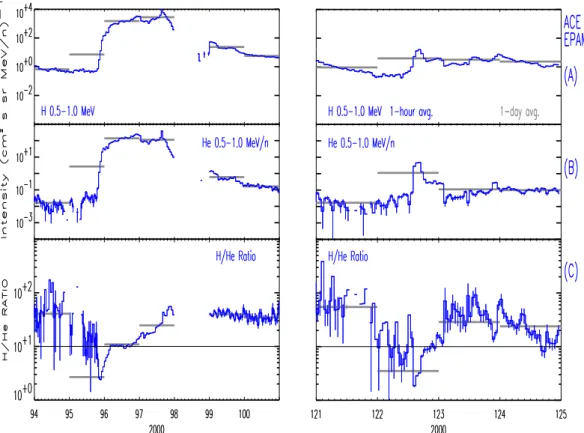
Fig. 5. One-hour (black traces) and 1-day (gray horizontal lines) averages of the (A) 0.5–1.0 MeV proton intensity and (B) 0.5–1.0
MeV/nucleon helium intensity as measured by the EPAM instrument on ACE (Gold et al., 1998) for two different SEP events observed in 2000. (C) H/He ratio calculated from the H and He traces shown in panels (A) and (B).
that the abundance ratios of low-rigidity/high-rigidity ions at the same energy per nucleon, as in the H/He ratio, should begin at low values at the onset of the event and gradually increase with time (Mason et al., 1983). In the range of ener-gies analyzed in this paper, however, departures from this ex-pected behavior are commonly observed, mainly because of interplanetary structures impeding the free streaming of par-ticles and altering the rising phase of the SEP events; hence, the rarity of these clean events (Mason et al., 1983).
Figure 6 shows ACE/EPAM data for the same time interval as the bottom graph of Fig. 3. The similarity between the in-strument responses of ACE/EPAM and Ulysses/HI-SCALE allows us to use the same energy window, i.e. 0.5–1.0 MeV nucleon−1. Unfortunately, ACE was not launched un-til September 1997, so solar minimum comparison between ACE and Ulysses is not possible. The period 1997–1998 (not included in this paper) was characterized by the sporadic occurrence of SEP events and the absence of CIR events at both spacecraft (Lario et al., 2000). For those intervals with SEP events, similar characteristics to those observed in the period 1999–2002 were observed. Figure 6 shows that, for the period considered here, the low-energy particle intensi-ties rarely decreased to background levels. The exception was in March–April 1999, as noted above for IMP-8 data in the bottom graph of Fig. 3. Comparing Fig. 6 with the higher energy intensities shown in the bottom graph of Fig. 3, we
note that the “filling” of the inner heliosphere during solar maximum is more clearly evident at low energies. This is likely due to the greater influence that interplanetary struc-tures exert on lower energy ions compared to higher energy ions.
The H/He ratio at ACE remained at high values (gt rsim40) with just occasional decreases below∼10, as at the end of 1999 and beginning of 2000 (this period will be analyzed below in Fig. 9). Figure 7 compares the H/He ratios shown in the bottom graphs of Figs. 1 and 3 with the H/He ratios measured by ACE/EPAM. Comparison of the H/He ra-tios at ACE with the H/He rara-tios at Ulysses (top panel of Fig. 7) shows similar values at both spacecraft, although dif-ferent structures and events may be observed at both space-craft. These data, together with the simultaneous observation of the most intense SEP events at ACE and Ulysses (Lario et al., 2001a), suggest a remarkable resemblance of the solar maximum heliosphere at all latitudes.
Fig. 6. Three-day averages of the (A) 0.5–1.0 MeV proton intensity and (B) 0.5–1.0 MeV/nucleon helium intensity as measured by the EPAM
instrument on ACE (Gold et al., 1998). (C) H/He ratio calculated from the H and He traces shown in panels A and B. (D) Daily averages of the solar wind speed as measured by the SWEPAM instrument on ACE (McComas et al., 1998). The time interval extends from 1 January 1999 to 1 July 2002. The vertical dotted lines are spaced every 27 days. The horizontal line in panel (C) marks a value of H/He ratio = 10.
Fig. 7. Overplot of the H/He ratios shown in panel (C) of Fig. 6 (gray traces) and the H/He ratios shown in panels (C) of the bottom graphs
in Figs. 1 and 3 (black traces).
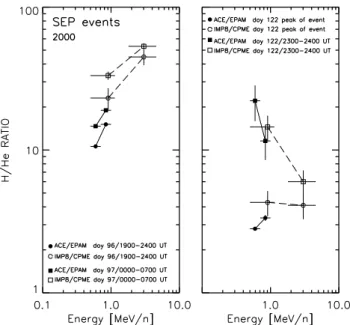
H/He energetic particle spectra at two different times during the two SEP events shown in Fig. 5. Previous studies have established that the proton to alpha particle intensity ratio for SEP events exhibits great variability from event to event and even within the same event (Briggs et al., 1979 and ref-erences therein). The energy dependence of the H/He ratio
Fig. 8. H/He ratios as a function of energy/nucleon for two
differ-ent times during the two SEP evdiffer-ents shown in Fig. 5 as observed by ACE/EPAM (solid symbols) and IMP-8/CPME (open symbols). The spectrum for the peak intensity of the event on 122 has been evaluated using 1-hour averaged intensities observed at the maxi-mum intensity for each energy (i.e. at different times).
Figure 8 also shows that for similar energies (∼0.8 MeV nucleon−1), the H/He ratios observed by IMP-8 are system-atically higher than at ACE. This suggests that instrumental differences between EPAM and CPME may also contribute to the difference between the H/He ratios shown in the bot-tom panel of Fig. 7 for the two spacecraft.
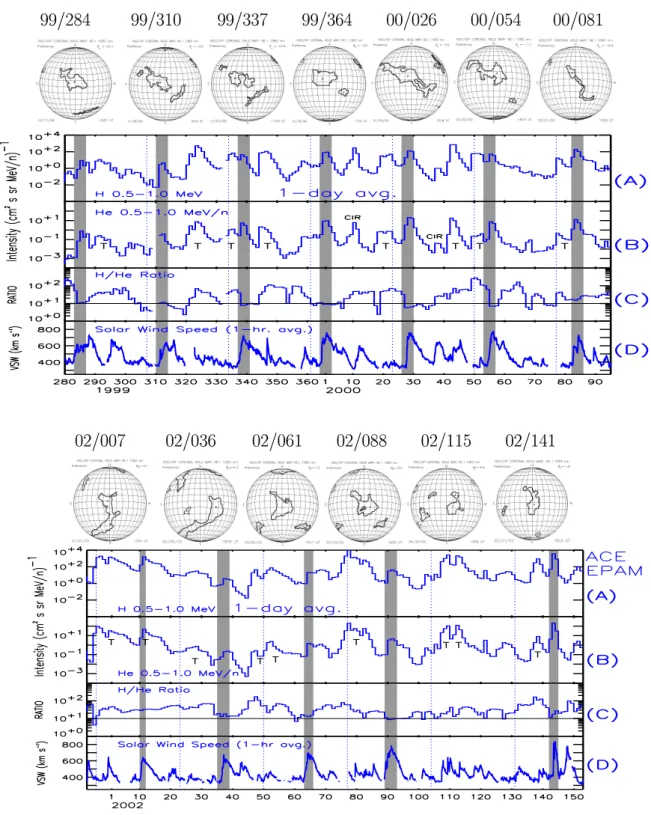
Apart from the onset of specific SEP events, low values of the H/He ratio during solar maximum may also be due to occasional CIRs. Fortuitously, it is possible to observe relatively high-speed (600–700 km s−1) solar wind streams at low latitudes. This is due to the presence, for several solar rotations, of small coronal holes at low latitudes. Figure 9 shows two of these periods at the end of 1999 and beginning of 2000 (top graph), when ACE observed a sequence of seven high-speed streams (Morris et al., 2001), and at the beginning of 2002 (bottom panel), when ACE observed a sequence of six high speed streams. Note that in this latter sequence, there was an interruption in the fifth rotation of 2002, probably due to either the presence of a previous disturbance in the interplanetary medium or to the smallness of the equatorial coronal hole at that time. At the top of each graph in Fig. 9 we have included the coronal hole 1083 nm maps provided by the National Solar Observatory at Kitt Peak (ftp.noao.edu) taken on the day indicated at the top. Ballistic projection of the solar wind and the magnetic field polarity observed during these streams confirm the coronal hole plotted in the center of these maps as the origin of the solar wind at ACE.
Gray vertical bars in Fig. 9 indicate the compression re-gions associated with the sequence of high-speed streams. In panels (B) we have identified the SEP events (indicated by T)
based on the simultaneous measurements of near-relativistic electron and high-energy ion intensity increases. Whereas the SEP events enhance the H/He ratio to high (gt rsim50) values, the intensity enhancements associated with the high-speed streams decreased the H/He ratios close to ∼10, es-pecially at the arrival of the high-speed streams. Figure 9 also shows that energetic particles associated with a transient SEP event may fill regions of high-speed streams, as on day 10 of 2002, resulting in high H/He ratios, even when a CIR crosses the spacecraft. In summary, the presence of high-speed streams, even at solar maximum and at 1 AU, may pro-duce a decrease in the H/He ratio in the corotating energetic particle events, in the same way that has been observed dur-ing solar minimum (top graph of Fig. 3) and at high heliolat-itudes (Fig. 2).
5 Summary and conclusions
The main results of the comparison between the ∼1 MeV nucleon−1H/He ratios measured during the first and second Ulysses orbits and their comparison with data from 1 AU in the ecliptic plane are:
– particle intensities at solar minimum are, on average,
richer in helium than during solar maximum,
– whereas in solar minimum the H/He ratio allows us to
distinguish transient events from corotating events, dur-ing solar maximum such distinction is not so clear,
– during solar maximum, transient events of solar
ori-gin may be superimposed on CIR structures modifying the “normal” behavior of the H/He ratio, namely an in-crease around the forward shock and a dein-crease towards the reverse shock,
– the lowest values of the H/He ratio may occur at the
onset of some specific SEP events,
– energetic particle populations at high latitudes in the
in-ner heliosphere during solar maximum have character-istics similar to those observed in the ecliptic plane. In particular, the H/He ratio does not show any latitudinal or radial dependence,
– although during the Ulysses solar maximum northern
✁✄✂✁☎✝✆✝✞ ✁✄✂✝✟✡✠☞☛ ✁✄✂✝✟✁✟✄✌ ✁✄✂✝✟✁✍✝✞ ☛✁☛✄✂✝☛✄☎✝✍ ☛✁☛✄✂✝☛✄✎✏✞ ☛✁☛✄✂✝☛✁✆✡✠
✑✓✒✓✔✝✑✁✑✄✕ ✑✓✒✓✔✝✑✓✖✁✗ ✑✓✒✓✔✝✑✁✗✡✘ ✑✓✒✓✔✝✑✁✙✓✙ ✑✓✒✓✔✚✘✓✘✜✛ ✑✓✒✓✔✚✘✣✢✤✘
Fig. 9. Two sequences of corotating high-speed streams at ACE during solar maximum. The top graph covers the time interval from 7
The different values of the H/He ratio observed for corotat-ing events at solar maximum and solar minimum raise some questions about the seed particle population accelerated in CIRs. There are several heliospheric ion populations that are candidates for acceleration in CIRs, namely the thermal solar wind ions, a background population of solar energetic particles, and the interstellar and inner-source pick-up ions (Mason, 2000). The low value of the H/He ratio observed in corotating events during solar minimum has been interpreted as a consequence of the pick-up He+ acceleration in CIRs (Gloeckler et al., 1994; Simnett et al., 1994). It is well-known that pick-up ions are favored over solar wind ions for injec-tion into accelerainjec-tion mechanisms because of their higher energies in the solar wind frame (Mason, 2000). However, since corotating streams are generally slower around solar maximum, and the maximum pick-up ion velocity scales di-rectly with solar wind speed, their injection is less favored during solar maximum than when the wind speed is higher (i.e. during 1992–1994). The solar maximum northern po-lar pass proved that, even when the sopo-lar wind streams have a very high speed and the CIRs tend to decrease the H/He ratios, contamination of SEP events results in H/He ratios higher than at solar minimum. Therefore, the lack of helium relative to protons during the solar maximum Ulysses orbit is due to a combination of the following factors: (1) the larger number of transient events, richer in protons, leads to a global filling of the heliosphere over a large range of heliolatitudes, and (2) the reverse shocks formed by the interaction between slow solar wind and intermediate solar wind are weaker and less efficient in accelerating the lower energy pick-up helium existing in this intermediate-speed solar wind. The combina-tion of these two factors fits in the picture of particle sources sketched by Mason (2000), where several particle popula-tions contribute to an interplanetary reservoir of energetic ions. This reservoir has time-dependent inputs; during so-lar minimum the particles accelerated by CIRs are dominant, whereas during activity maximum the transient events of so-lar origin are the stronger source.
Acknowledgements. We acknowledge Dan Reisenfeld for
provid-ing the CME identifications at Ulysses for 2001. We acknowledge the use of the Ulysses Data System (UDS), the ACE Science Center, the National Solar Observatory (NSO) and the IMP-8 MIT instru-ment team for providing the data used in this paper. NSO/Kitt Peak data used in this paper are produced cooperatively by NSF/NOAO, NASA/GSFC and NOAA/SEL. The work at JHU/APL was sup-ported by IMP-8/CPME-EPE and ACE/EPAM under NASA con-tract NAS5-97271 and Ulysses/HI-SCALE under NASA research grant NAG5-6113.
Topical Editor R. Forsyth thanks M. Fraenz and H. Cane for their help in evaluating this paper.
References
Balogh, A., Beek, T. J., Forsyth, R. J., et al.: The magnetic field in-vestigation on the Ulysses mission: Instrumentation and prelim-inary scientific results, Astron. Astrophys. Suppl. Ser., 92, 221– 236, 1992.
Bame, S. J., McComas, D. J., Barraclough, B. L., et al.: The Ulysses solar wind experiment, Astron. Astrophys. Suppl. Ser., 92, 237– 266, 1992.
Bame, S. J., Goldstein, B. E., Gosling, J. T., et al.: Ulysses obser-vations of a recurrent high speed solar wind stream and the he-liomagnetic streamer belt Geophys. Res. Lett., 20, 2323–2326, 1993.
Briggs, P. R., Armstrong, T. P., and Krimigis, S. M.: Hydrogen over helium enhancement in successive solar flare particle event from the same active region, Astrophys. J., 228, L83–L87, 1979. Buttighoffer, A., Pick, M., Raviart, A., et al.: Joint Ulysses and
Wind observations of a particle event in April 1995, Astron. As-trophys., 316, 499–505, 1996.
Chotoo, K., Schwadron, N. A., Mason, G. M., et al.: The suprather-mal seed population for corotating interaction region ions at 1 AU deduced from composition and spectra of H+, He++and He+ observed on Wind, J. Geophys. Res., 105, 23 107–23 122, 2000. Christon, S. P. and Simpson, J. A.: Separation of corotating nucleon fluxes from solar flare fluxes by radial gradients and nuclear com-position, Astrophys. J., 227, L49–L53, 1979.
Fr¨anz, M., Keppler, E., Lauth, U., et al.: Energetic particle abun-dances at CIR shocks, Geophys. Res. Lett., 26, 17–20, 1999. Gloeckler, G., Geiss, J., Roelof, E. C., et al.: Acceleration of
in-terstellar pickup ions in the disturbed solar wind observed on ULYSSES, J. Geophys. Res., 99, 17 637–17 643, 1994. Gold, R. E., Krimigis, S. M., Hawkins, S. E., et al.: Electron,
pro-ton, and alpha monitor on the Advanced Composition Explorer spacecraft, Space Sci. Rev., 86, 541–562, 1998.
Gosling, J. T., Baker, D. N., Bame, S. J., et al.: Bidirectional solar wind electron heat flux events, J. Geophys. Res., 92, 8519–8535, 1987.
Gosling, J. T., Bame, S. J., Feldman, W. C., et al.: Counterstreaming suprathermal electron events upstream of corotating shocks in the solar wind beyond approximately 2 AU: ULYSSES, Geophys. Res. Lett., 20, 2335–2338, 1993.
Gosling, J. T., Bame, S. J., McComas, D. J., et al.: Solar wind coro-tating stream interaction regions out of the ecliptic plane:Ulysses, Space Sci. Rev., 72, 99–104, 1995.
Hilchenbach, M., Gr¨unwaldt, H., Kallenbach, R., et al.: Observa-tion of suprathermal helium at 1 AU: Charge states in CIRs, in: Solar Wind Nine, (Eds) Habbal S., Esser, R., Hollweg, J.V., et al., AIP Conf. Proc. 471, 605–608, 1999.
Hofer, M. Y., Marsden, R. G., Sanderson, T. R., et al.: Energetic particle composition at high heliolatitudes during the declining phase of solar cycle 23: Ulysses COSPIN/LET observations, Eos Trans. AGU, 83 (47), SH11A-0385, 2002.
Lanzerotti, L. J., Gold, R. E., Anderson, K. A., et al.: Heliosphere instrument for spectra, composition and anisotropy at low ener-gies, Astron. Astrophys. Suppl. Ser., 92, 349–364, 1992. Lanzerotti, L. J., Maclennan, C. G., Armstrong, T. P., et al.: Low
energy charged particles in high latitude heliosphere, Astron. As-trophys., 316, 457-463, 1996.
Lario, D., Marsden, R. G., Sanderson, T. R., et al.: Energetic proton observations at 1 AU and 5 AU. 2. Rising phase of the solar cycle 23, J. Geophys. Res., 105, 18 251–18 274, 2000.
Lario, D., Roelof, E. C., Forsyth, R. J., et al.: 26-day analysis of en-ergetic ion observations at high and low heliolatitudes: Ulysses and ACE, Space Sci. Rev., 97, 249–252, 2001a.
Proc. 598, 183–188, 2001b.
Mason, G. M., Gloeckler, G., and Hovestadt, D.: Temporal vari-ations of nucleonic abundances in solar flare energetic particle events. I. Well-connected events, Astrophys. J., 267, 844–862, 1983.
Mason, G. M.: Composition and energy spectra of ions accelerated in corotating interaction regions, in: Acceleration and Transport of Energetic Particles Observed in the Heliosphere: ACE 2000 Symposium, (Eds) Mewaldt, R. A., Jokipii, J. R., Lee, M. A., et al., AIP Conf. Proc. 528, 234–241, 2000.
McComas, D. J., Bame, S. J., Barker, P., et al.: Solar wind electron proton alpha monitor (SWEPAM) for the Advanced Composition Explorer, Space Sci. Rev., 86, 563–612, 1998.
McComas, D. J., Gosling, J. T., and Skoug, R. M.: Ulysses observa-tions of the irregularly structured mid-latitude solar wind during the approach to solar maximum, Geophys. Res. Lett., 27, 2437– 2440, 2000.
McComas, D. J., Elliott, H. A., and von Steiger, R.: Solar wind from high-latitude coronal holes at solar maximum, Geophys. Res. Lett., 29, 10.1029/2001GL014164, 2002a.
McComas, D. J., Elliott, H. A., Gosling, J. T., et al.: Ulysses’ second fast-latitude scan: Complexity near solar maximum and the reformation of polar coronal holes, Geophys. Res. Lett., 29, 10.1029/2001GL013940, 2002b.
McGuire, R. E., von Rosenvinge, T. T., and McDonald, F. B.: The composition of corotating energetic particle streams, Astrophys. J., 224, L87–L91, 1978.
Mewaldt, R. A., Stone, E. C., and Vogt, R. E.: Characteristics of the spectra of protons and alpha particles in recurrent events at 1 AU, Geophys. Res. Lett., 6, 589–592, 1979.
Morris, D., M¨obius, E., Lee, M. A., et al.: Implications for source populations of energetic ions in corotating interaction regions from ionic charge states, in: Solar and Galactic Composition, (Ed) Wimmer-Schweingruber, R. F., AIP Conf. Proc. 598, 201– 204, 2001.
Reisenfeld, D. B., Gosling, J. T., Steinberg, J. T., et al.: CMEs at high northern latitudes during solar maximum: Ulysses and SOHO correlated observations, in: Proc. of 10th Int. Conf. on Solar Wind, (Ed) Velli, M., in press, 2003.
Richardson, I. G., Barbier, L. M., Reames, D. V., et al.: Corotating MeV/amu ion enhancements at 1 AU or less from 1978 to 1986, J. Geophys. Res., 98, 13–32, 1993.
Richardson, I. G., Mazur, J. E., and Mason, G. M.: A comparison
of recurrent energetic ion enhancements observed at Ulysses and at 1 AU by IMP-8 and SAMPEX: Ulysses launch until following the first north polar passage, J. Geophys. Res., 103, 2115–2129, 1998.
Roelof, E. C., Gold, R. E., Simnett, G. M., et al.: Low-energy so-lar electrons and ions observed at Ulysses February–April 1991: The inner heliosphere as a particle reservoir, Geophys. Res. Lett., 19, 1243–1246, 1992.
Roelof, E. C., Simnett, G. M., and Armstrong, T. P.: IMF connec-tion for energetic protons observed at Ulysses via mid-latitude solar wind rarefaction regions, Space Sci. Rev., 72, 309–314, 1995.
Roelof, E. C., Simnett, G. M., Decker, R. B., et al.: Reappearance of recurrent low-energy particle events at Ulysses/HI-SCALE in the northern heliosphere, J. Geophys. Res., 102, 11 251–11 262, 1997.
Sanderson, T. R., Bothmer, V., Marsden, R. G., et al.: The Ulysses south polar pass: Energetic ion observations, Geophys. Res. Lett., 22, 3357–3360, 1995.
Sanderson, T. R., Lario, D., Maksimovic, M., et al.: Current sheet control of recurrent particle increases at 4–5 AU, Geophys. Res. Lett., 26, 1785–1788, 1999.
Sarris, E. T., Krimigis, S. M., and Armstrong, T. P.: Observations of magnetospheric bursts of high-energy protons and electrons at approximately 35 earth radii with IMP-7, J. Geophys. Res., 81, 2341–2355, 1976.
Scholer, M., Hovestadt, D., and Klecker, B.: The composition of energetic particles in corotating events, Astrophys. J., 227, 323– 328, 1979.
Shields, J. C., Armstrong, T. P., Eckes, S. P., et al.: Solar and inter-planetary ions at 2-4 MeV/nucleon during solar cycle 21: Sys-tematic variations of H/He and He/CNO ratios and intensities, J. Geophys. Res., 90, 9439–9453, 1985.
Simnett, G. M., Sayle, K., Roelof, E. C., et al.: Corotating particle enhancements out of the ecliptic plane, Geophys. Res. Lett., 21, 1561–1564, 1994.
Simnett, G. M., Sayle, K. A., and Roelof, E. C.: Differences be-tween the 0.35-1.0 MeV/nucleon H/He ratio in solar and co-rotating events at high heliolatitude, Geophys. Res. Lett., 22, 3365-3368, 1995.