No 580 ISSN 0104-8910
Trade and Infrastructure: evidences from the
Andean Community
Gina E. Acosta Rojas, Germ ´an Calfat, Renato G. Fl ˆores Jr
Os artigos publicados são de inteira responsabilidade de seus autores. As opiniões
neles emitidas não exprimem, necessariamente, o ponto de vista da Fundação
TRADE AND INFRASTRUCTURE: EVIDENCES FROM
THE ANDEAN COMMUNITY
Gina E. Acosta Rojas
Institute of Development Policy and Management (IOB) Universiteit Antwerpen, Antwerp
Germán Calfat
Institute of Development Policy and Management (IOB) Universiteit Antwerpen, Antwerp
Renato G. Flôres Jr*
Graduate School of Economics (EPGE) Fundação Getulio Vargas, Rio de Janeiro
(
preliminary version: March 2004; this version: January 2005)
* Renato Flôres acknowledges the hospitality of IOB, University of Antwerp, where, as a
ABSTRACT
1.
INTRODUCTIONThis paper adds further evidence to the argument that infrastructure development is a source of integration and competitiveness. It shows the dynamic role played by infrastructure in explaining as well as determining the trade flows within and outside the Andean Community.
The work is organized as follows. The next two sections set the for our analysis. Section 2 briefly reviews the evolution of the Andean Community since its formation in 1969, focusing on the consolidation of the internal market and its trade pattern. An augmented gravity model of bilateral trade flows, with cross section data for the period 1993 to 1999, is applied yearly to determine whether the Andean Pact did in fact increase trade within the region, and to capture the effect of adjacency on trade among its members. Section 3 discusses the role of infrastructure in trade, showing theoretical and statistical evidences that location and endowments play a decisive role in determining whether countries will decide to enhance their trading opportunities by developing (transport-cost reducing) infrastructure. It then provides a glimpse on the transport modes used in the Andean Community trade.
Section 4, where the effect of infrastructure is fully assessed, is the core of the paper. Going beyond a traditional gravity model, we consider that transportation costs are not only a function of distance but also of the availability of infrastructure, such as roads, energy and telecommunications networks. These variables are summarized in an index measuring the level of infrastructure in the countries concerned, modifying the distance variable. The analysis sheds light on the role played by infrastructure and its impact on the relevance of other explanatory variables. We then link the results to the new concept of infrastructure development in the region, where its interaction with geographical space is regarded as a key integration and competitiveness tool. The final section concludes.
2.
THE ANDEAN COMMUNITY: TRADE FLOWS AND REGIONALINTEGRATION
The beginnings of the Andean Community date back to 1969, when a group of countries signed the Cartagena Agreement, also known as the Andean Pact, for establishing a customs union within a period of ten years. Since then, Andean integration has lived through a series of different stages where an initial inward-looking project, based on the import substitution model, gradually gave way to a more open-regionalism initiative. In June 1997, the group became the Andean Community, with the Cartagena Agreement being modified by the Trujillo Protocol. The Protocol created a Presidential Council and a Council of Foreign Ministers, giving to both a critical role in the decision making process. It also strengthened the internal cohesion of the integration process, by placing all its institutions and mechanisms under a new umbrella, the Andean Integration System. The Andean Community is, nowadays, a regional organization endowed with international legal status and five members: Venezuela, Colombia, Ecuador, Peru and Bolivia.
Since 1987, members began to design a new strategy to keep up with the liberalization process that was taking place in Latin America. The formation of a Free Trade Area (FTA) in 1992 evolved into an imperfect Customs Union. Colombia and Venezuela, already in February 1992, eliminated tariffs and other restrictions to their reciprocal trade. Bolivia joined them in September 1992 and Ecuador in January 1993, when the FTA entered into full operation among these four countries. Peru temporarily suspended its obligations under the liberalization program; instead, from 1992, it negotiated bilateral trade agreements with each of its Andean partners and, in some cases, partially liberalized the reciprocal trade flows. These bilateral agreements were effective until 1997, when a compromise was reached for Peru’s gradual incorporation into the Andean FTA (Decision 414). Most products were liberalized until 2000 and the remaining sensitive products, including agricultural goods, will be totally liberalized by 2005.
20% ceiling. The customs union, effective for Venezuela, Colombia and Ecuador, is gradually encompassing Bolivia and Peru. Full adoption is expected also in 2005.
The Andean Community has addressed most of the newer trade issues, such as investment, competition policy, services and intellectual property rights and adopted common policies in most of these areas1. The development of a common foreign policy is also a main objective, and involves the joint participation of all members in the World Trade Organization (WTO) as well as in the negotiations concerning regional agreements.
The Andean countries form a market with over 115 million people living in an area of 4,700,000 square kilometers. Their joint GDP in 2001 reached US$ 283 billion. The most important markets for their exports, as shown in Table 1, are the United States, the European Union (EU) and the Community itself.
Liberalization of the internal market has had an important effect on trade among its member countries. Trade flows have reached unprecedented levels, with intra-regional trade growing faster than trade with the rest of the world, as Table 1 shows. After a decade of flat or declining growth in the ‘80s, intra-Andean trade picked up in 1989 and grew steadily after 1990. At the end of 2001, intra-Andean exports amounted to US$ 5.6 billion, more than double the 1992 level. Equally important, Andean trade with the rest of the world has also risen; imports and exports from and to countries outside the Community have consistently increased since the agreement was reactivated in the early ‘90s (Table 1).
---
Insert Table 1 by here
---
Though there is a commitment to establish a Common Market by 2005, at the latest, nowadays, as mentioned above, the Community is an incomplete customs union, as both the CET and the FTA are still subject to a number of exceptions.
2.2. A first gravity model specification.
1 As a few examples, Decision 291 replaced Decision 24, which restricted foreign direct investment activities,
In order to create a background against which to analyze the growth of trade among Andean countries, we first estimated the following gravity equation:
0 1 2 3 4
lnMij =β β+ lnY Yi j+β Dij +β ACP+β Border+eij (1)
where: Mij =value of country i imports from country j ; YiYj = the multiplied GDP from both
countries as a proxy for size ; Dij = distance between country i and country j to capture
trade costs ; ACP = dummy to measure the impact of integration on the trade of member countries - it takes the value of one when both countries are members of the Andean Community and zero otherwise ; Border = dummy to measure the impact of adjacency - it assumes the value of one when the countries have a common border2.
The period analyzed was 1993-1999, as integration gained momentum after signature of the FTA, in 1992, and our aim is to test the significance and value of its impact over intra-regional trade. The countries in the left hand side of (1) are the five Andean members, and those at the right, the partners, i.e. their suppliers or exporters. Partners were selected based on the existence of bilateral trade with the members.
Trade flows, in millions of current US dollars, were obtained from IMF (2001), GDP data, in current US dollars, are from the World Bank Global Development Network Database3 and the distance between capital cities, in kilometers, was obtained from Haveman’s web page.4
Individual regressions were run for each year based on equation (1). Before running the regressions, a descriptive analysis of the data was performed. This led to transform imports and GDP by natural logarithm and distance by taking its square root. Ordinary Least Squares (OLS) were used, with the transformed data on imports as dependent variable. A number of countries in Asia and Africa that did not trade with the Andean Community were removed in each year.
2 Frankel (1997) used gravity models to show that regionalization could be explained by geographical
proximity and preferential trade agreements; Krugman (1991) formalized the role played by geographical proximity in the regionalization process, dummy variables being since then used to simulate and analyze these effects; Anderson and van Wincoop (2003) is a most recent and better theoretical support for all this. 3 www.worldbank.org/research/growth/GDNdata.html.
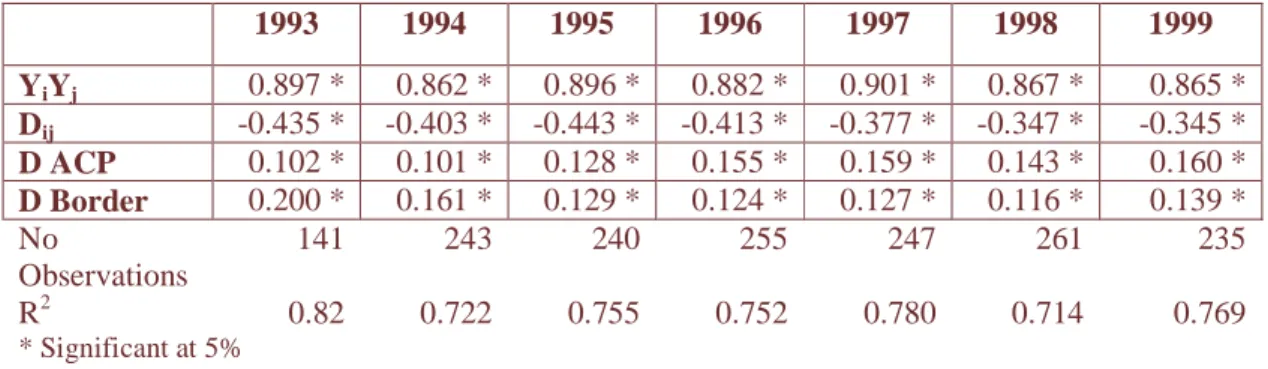
The results, in standardized coefficients, together with the R2 for each regression and the significance of the coefficients, can be found in Table 2. The gravity equation performs well in explaining bilateral trade between the Andean countries and their respective partners. The global adjustment of the regression is satisfactory, as the R2 coefficients present values that are superior to 0.70. The independent variables had, in all cases, the expected sign and were statistically significant according to the F and t-tests.
---
Insert Table 2 by here
---
The effect of the product of the countries’ GDP is positive and statistically significant, ranging between 0.862 and 0.901. These values are consistent with those found by Frankel (1997) and Echavarria (1998), for the periods 1965-1980 and 1986-1995, respectively, though slightly higher due to the fact that size is playing a more important role on trade nowadays and, of course, that the partners chosen for each analysis are different. The coefficients comply with the model assumption that trade increases with economic size, and, in the case of the Andean countries, this has a strong effect over their trade.
The distance coefficients have a negative sign, are statistically significant and present values between -0.443 and -0.345. Distance, however, has less impact than GDP. The value and sign of the distance coefficients are also similar to those found by Frankel (1997) and Echavarria (1998). These authors worked with a period before transportation services were liberalized and transportation costs reduced; therefore their coefficients are, in most cases, higher than the ones found here, when the effect of distance was already reduced.
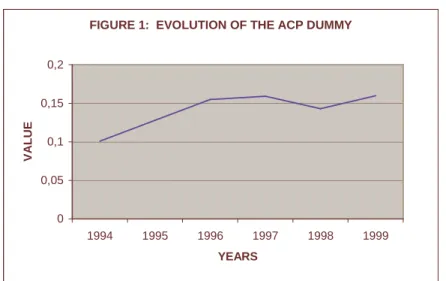
regulations are uniformly applied by all partners. The positive evolution of the coefficients and their improvement in significance reflect that member countries are trading more and more among themselves, with the exception of 1999. This year was plagued with economic and political crises in some members, like the macroeconomic and banking crashes in Ecuador, the political problems in Peru that led to the flee of President Fujimori, and the floods in Venezuela. Overall, both our empirical results as well as the trade data show that the Agreement and the FTA had a positive impact on trade among member countries.
---
Insert Figure 1 by here
---
The dummy for adjacency tries to capture whether common frontiers, that enable border trade, do in fact increase trade flows. The coefficients for this dummy are positive and statistically significant, though low and presenting a rather negative evolution. The positive values do confirm that countries having a common border will trade more, but the low values and the lack of a positive trend - rather a declining one - suggest that these economies are relatively small and may trade more with bigger, despite geographically apart, economies. It is important to mention that sometimes countries do not engage in more border trade due to inappropriate transportation infrastructure and harsh geographical conditions, as in the Andes mountain range, which may considerably increase cost.
3.
ANDEAN COMMUNITY: TRADE AND INFRASTRUCTURE3.1 Trade, infrastructure and regional integration.
argued. The effectiveness of the same investment flow may vary, in different countries, due to differences in public sector efficiency and in the prices of infrastructure capital.
Bougheas, Demetriades and Morgenroth (1999) tried to examine the role of infrastructure in a bilateral trade model and also on transport cost. Their findings predict that, for a pair of countries for which investment in infrastructure is optimal, a positive relationship between the level of infrastructure and the volume of trade takes place. As a consequence, variations in transport costs across countries may be able to account for differences in their ability to compete in international markets. Furthermore, differences in the volume and quality of infrastructure may be responsible for the differences in transport costs, which in turn may account for differences in competitiveness. As a result, reducing the cost and improving the quality of transport systems improves international market access and therefore prompts an increase in trade.
There is substantial evidence linking improvements in transportation services and infrastructure in general to improvements in export performance. Hummels (1999) estimates that exporters with 1% lower shipping costs will enjoy a 5-8% higher market share. Limão and Venables (2001) estimated that the elasticity of trade flows with respect to the trade cost factor is approximately –3, and investigated the dependence of transport costs on geography and infrastructure. Limão and Venables (2001) estimated that differences in infrastructure account for 40% of the variation in transport costs for coastal countries and up to 60% for landlocked countries. Additionally, Wilson (2003) shows that the Asia Pacific Economic Cooperation countries differ substantially in the quality of their transport infrastructure and level of logistics and trade services and that these differences mark the gap of trade performance among them. The study concludes that upgrading the transport and service infrastructure of the lagging countries will substantially increase trade.
The real costs of trade, including transportation and the costs of doing business internationally, are important determinants of a country’s ability to participate in the world economy. As Limão and Venables (2001) pointed out, remoteness and poor transport and communications infrastructure isolate countries and limit their participation in the international production chains. Improving the channels that facilitate the exchange of goods, services and people is a basic element to any strategy for increasing a region’s international competitiveness.
In terms of regional integration, as stated in IDB (2000), geographical interaction creates flows that do not necessarily circulate freely, but that do so through infrastructure networks. Infrastructure networks provide the physical support through which flows circulate, but to ensure their successful influence in integration and development, a legal and institutional framework together with efficient infrastructure-related services operations are needed.
3.2 Infrastructure integration initiatives in the Andean Community.
Infrastructure development in the Andean Community was, for a long period, not only limited by the challenges presented by the natural physical barriers of the Andean range but also by economic policies that focused on domestic markets, underestimating the benefits of trade and foreign investment. Moreover, public deficits, macroeconomic instability, restrictions to foreign capital and historical patterns of trade constrained public and private investment in infrastructure.
political commitment, in member countries, to projects that view infrastructure networks as a source of sustainable trade and economic development, and as part of measures that could contribute to the flows of goods and services among them.
Members are beginning to adopt common provisions on several fronts to facilitate and deregulate transportation services, electricity supply and telecommunications, in order to foster their intra-regional trade and physical integration5. Specific provisions for all modes of transportation, including multimodal transport, were established to determine the principles and criteria needed to provide services efficiently6.
3.3 Andean Community trade by transportation mode.
The pattern of trade within the Andean Community is determined not only by the size of their economies and those of their partners but also by the transportation costs incurred when trading. To determine the variables that affect transport costs when members perform intra-community trade it is important to analyze the modes of transportation used.
Table 3 displays trade information by mode of transportation within the Andean Community. Between 1997 and 1999, intra-community exports were mostly delivered by road; actually, nearly 49% of the value traded. Maritime transportation occupied second place with around 38% of the total value traded, and air transportation was positioned in third place with approximately 8% of the total.
---
Insert Table 3 by here
---
In 1997, road transportation was the main delivery method for Bolivia, Colombia, Ecuador and Venezuela. In 1998, Ecuador increased the participation of maritime transportation and Venezuela did the same in 1999. Venezuelan exports, between 1997 and
5 www.comunidadandina.org/servicios/trans.htm.
6
1999, were delivered to the other Andean members by road 48% of the time and by sea in 39%; its imports from the Andean partners were transported to the country 62% of the time by road and 29% by sea. Likewise, Colombian exports, within the same period, were delivered by road 55% of the time and by sea in 35%, while imports, 60% and 33%, respectively.
Maritime transportation is used mainly by Peru, in all its deliveries, and by other members when trade takes place with partners that do not share a common border, making inland transportation expensive and slow. It is the traditional method of delivery for Andean countries, when trade is carried out with distant partners as the United States and the EU. This makes it the second most important mode of delivery to and from the Andean region. Nevertheless, it is important to consider that when goods are carried by sea, in most cases, an additional inland stretch is needed, either by road or rail, both at origin and destination. Bolivia, due to its landlocked location, is the main case. It normally combines shipment to a Chilean port with inland road transportation, for both its exports and imports to countries with which it does not share a common border7.
Inland waterway transportation among members is not normally carried out due to the fact that there are not well developed corridors in the areas where it may be feasible. Moreover, the business clusters in each country are often where only road and sea transportation is possible.
Cargo by air is relatively limited: shipping merchandise by road takes a shorter time, especially if carried out between members with a common border. Also, road transportation is the mode of delivery that presents the shortest delays at border crossing8. Air transportation with partners outside the Andean region is limited and reduced to highly perishable goods.
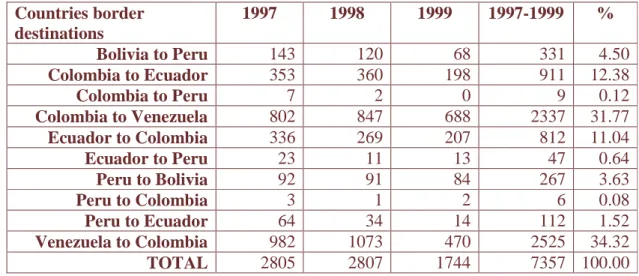
Border trade within the Andean members between 1997 and 1999 represented 98% of the intra-community trade by road and 49% of the total intra-community trade. Thus, trade by road between members that do not share a common border was limited. As can be seen in Table 4, border trade by road is very significant between Colombia and Venezuela, accounting for around 66% of the total border trade in the region by road. Trade between Colombia and Ecuador come in second position, with a little more than 23%, and that
between Bolivia and Peru in third place (8%). The lowest level happens between Ecuador and Peru, with only 2% of the total value carried.
In the late ‘80s, the lack of infrastructure and the limited relevance of the Andean Agreement made sharing a common border extremely important in terms of trade, for all members of the Andean Pact. Trade was performed at borders and there was less interest in distant partners, as logistics and transportation services were limited and expensive. By all means, distance in those times played a major role and borders marked the natural trade partners. During the ‘90s, the importance of border trade diminished considerably, the coefficients for the dummy in model (1) showing this.
---
Insert Table 4 by here
---
4. EVALUATING THE INFRASTRUCTURE EFFECT
4.1. Model specification and data.
Model (1) results stressed that economic size (GDP) is probably the most important variable when a trade partner is chosen, and established that distance plays a decisive role in terms of cost. Nevertheless, the absolute value of the distance coefficients declined throughout the period, suggesting that other factors, apart from physical distance itself, may be affecting transportation cost (and therefore trade) in the Andean Region. Indeed, as the economic size of bilateral partners did not change dramatically within the period analyzed, borders were not altered and the basic structure of the Pact was not modified, the variable that should be further analyzed is transportation cost and all its associated factors.
Following the literature described in section 3.1, we specified an augmented gravity model where physical distance is modified by an infrastructure index, i.e. a geographical
distance focusing on the interaction of geography and infrastructure, to determine the effect
of infrastructure on trade. Transportation costs become not only a function of distance but also of the availability of public infrastructure, such as roads, railroads, energy and
8 Personal communication with the firm ‘ZaiMella del Ecuador S.A’, active in export-import activities in
telecommunication networks. These public infrastructure dimensions are summarized in an index that measures the infrastructure level of the countries, modifying the distance variable.
Re-writing equation (1), bilateral trade is then modeled as:
0 1 2 3 4
lnMij =β β+ lnY Yi j+β GeoDij+β ACP+β Border+eij (2)
where Mij , YiYj , ACP and Border are as in (1), while GeoDij is the distance between
country i and country j modified by the infrastructure index.
The analysis uses a cross section for the period9 1985-1995. The countries employed as reporters are again the five Andean Community members; partners were selected according to their levels of trade with the Andean countries and the availability of information on their infrastructure stock. By keeping the dummies for the Andean Pact and border effects, the analysis continues to capture the importance of the preferential trade agreement and the significance of sharing a border, when infrastructure enters the model.
Bilateral trade flows and GDP came from the same sources as before. The Geographical Distance variable is similar to the one used by Martinez-Zarzoso and Nowak-Lehmann (2002) and Limão and Venables (2001). It is defined by the physical distance between capitals of trading partners (obtained as before) divided by the sum of the two countries’ infrastructure indexes. The index was based on five variables: kilometers of roads, of paved roads and of railroads, telephone main lines and kilowatts of electricity generating capacity, and is explained in the Annex.
Annual data on physical infrastructure stocks for the reporter and partner countries, for the period 1985-1995, were from David Canning’s 1998 Database of World Infrastructure Stocks10. Data reported by Canning are of two types: raw data with a minimum of manipulation and basically as they appear in the original sources, and processed data, for which some kind of interpolation is carried out (assuming exponential growth over the intervening period, for instance). Processed data were used to calculate the index, as recommended by the author for empirical work, due to their inter-temporal consistency. Population data and country area to normalize infrastructure stock were
obtained from the World Bank Global Development Network Database and the Country Watch web page, respectively11.
4.2 Empirical results.
Separate OLS regressions were run for each year, for model (2), with the natural log of members imports as dependent variable. Again, a number of Asian and African countries that did not engage in bilateral trade with the Andean Community were removed from the sample.
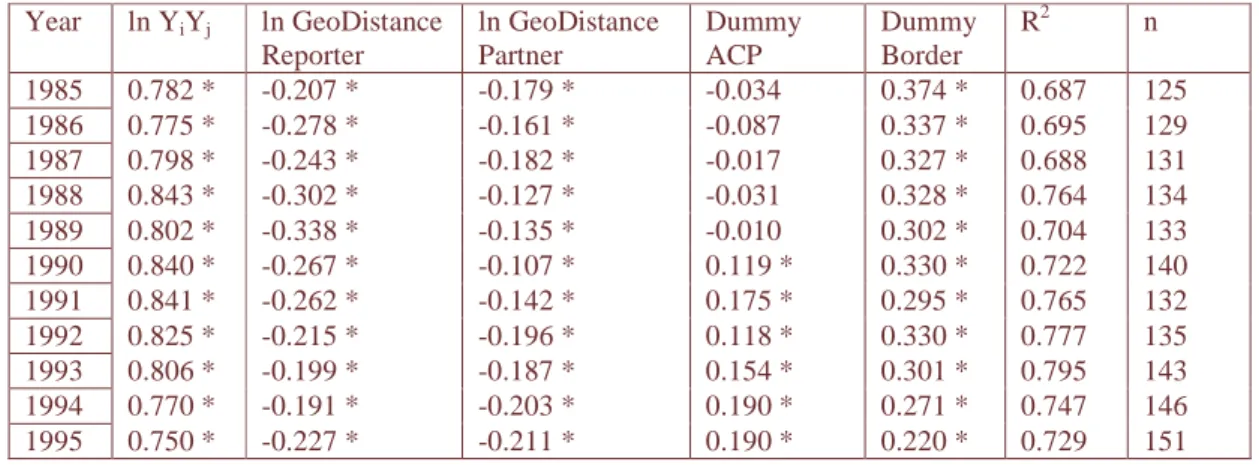
The results obtained (in standardized coefficients) for each regression are in Table 5. The R2 values range from 0.653 to 0.735, for the period between 1985 and 1991; between 1992 and 1995, they are in all cases above 0.712. Hence, the gravity equation performs well in explaining the bilateral trade of the five Andean Community members, especially in the second part of the period, reflecting the increased application and importance of the Preferential Trade Agreement.
Once again, economic size is the most important variable. This not only confirms the findings in section 2 but complies with those found in most empirical works. Nevertheless, it is important to point out that economic size (the multiplied GDP of each pair of countries) has a somewhat lower effect when infrastructure is considered in the equation. Despite the fact that the purchasing capacity of the partner is the first requirement to carry out trade, the lower effect of GDP identified in this second model confirms that the infrastructure stocks of both a member and its partner reduce distance between them. In fact, they reduce transport costs and therefore reduce the prices of the goods traded, making them more accessible and shortening the economic distance between markets. During the whole period analyzed, the value of the GDP coefficients are statistically significant, positive and do not vary significantly from one year to another. They range between 0.718 and 0.791, similar to those found by Echavarria (1998) and Frankel (1997) in previous empirical work on the Andean Community, though again higher.
The Andean Pact dummy was not significant before 1990. Until the ‘90s, import substitution policies and inward looking regionalism marked the existence of an agreement full of exceptions and without operational functions, as members did not fully comply with its requirements: all presented high tariff levels and multiple non-tariff measures. The
results for the Pact dummy confirm that the Preferential Trade Agreement did not influence trade among members before market-oriented reforms set the groundwork for boosting the integration efforts. Unfortunately, in 1992, despite the launching of the FTA, the Peruvian crisis led Venezuela to freeze diplomatic relations with Peru. As a result, Peru temporarily suspended its obligations under the liberalization program in the same year. These events left the Community without the much needed political support and brought down trade among members as confirmed by the drop in the dummy coefficient, though still significant. The values since then evidence a positive trend, indicating the sustained enforcement of the Agreement.
---
Insert Table 5 by here
---
These new values for the Pact dummy are also higher than those obtained when infrastructure endowments were not considered in the model12. Inclusion of infrastructure endowments did not only modify distance but also strengthened the role of the Preferential Trade Agreement. The combination of the appropriate infrastructure and the continuous reinforcement of regional integration on different fronts will certainly continue to influence intra-community trade in a positive way.
The border dummy did not only present statistically significant results throughout the period but also gained more importance in determining trade. All coefficients were above 0.260, being about twice as high as those encountered in model (1). The increased importance of border in the Andean Community trade complies with the already mentioned fact that nearly 50% of the trade within the region is performed by road and 98% of it is at frontiers. However, one of the most important features in the results for this variable is its decreasing trend. Until 1992, the coefficients present higher values, indicating that sharing a common border was far more important than having a trade agreement. Although existing, the agreements were not fully enforced. These higher values also reflect two
12 Throughout this and the next subsection, when assertions on the relative sizes of the same coefficients in
additional issues: the poorer infrastructure and the higher cost resulting from delivering the merchandises by other means than road transport. From 1992 onwards, when the FTA was becoming operational and transportation costs by sea decreased to affordable numbers in terms of transit and frequencies, the importance of sharing a common border was reduced, and reached levels closer to the coefficients for geographical distance and the Pact dummy.
Geographical Distance had statistically significant, negative coefficients, confirming that transportation costs, even as represented in the model, reduce trade. The results also support the theoretical framework in section 3.1: infrastructure endowments reduce bilateral distances. The geographical distance coefficients are roughly half those obtained when transportation costs were proxied by physical distance only13. From 1990 onwards, they show a positive trend. This evolution is the opposite of the one encountered when only physical distance was used, and tells that “distance” - as competition for transportation services increased and new and better ways of shipping goods were used - became more flexible, reductions in it having a greater impact on trade. Therefore, a key issue in increasing trade flows lies in the development of infrastructure and the capability of countries to mobilize efficient delivery services, reducing the prices of goods traded.
4.3 Further results: importance of partners and reporters infrastructure.
To analyze the separate role of the infrastructure of both reporters and partners, a third gravity model was estimated, under the same theoretical framework. The additional feature of the new model was the consideration of two geographical distance variables instead of one: the Geographical Distance of the reporter (the five Andean members) and that of its partner.
The results obtained are in Table 6. The coefficients for economic size and the ACP and border dummies present more or less the same evolution, exactly the same sign and approximately the same level. Economic size continues to have a positive effect on trade. In the same line, the dummy for common border presents important and significant values until 1992, before the Preferential Agreement really gained significance.
corresponding gap, compared to other countries in the region in the late ‘80s and early ‘90s, negatively affected the trade opportunities of the Andean members. As in many other countries in Latin America, their infrastructure deteriorated significantly during the ‘80s and early ‘90s, when the region lost considerable ground relative to the industrial countries and faster growing emerging economies (Calderon and Servén (2003)). The coefficients show that the lack of infrastructure of the reporters reduced the possibilities of trade to a higher degree than the level of their partner. In 1989 and 1990, the negative effect of the infrastructure of the reporter was approximately two and a half times that of the partner.
---
Insert Table 6 by here
---
When infrastructure started to gain relevance within government targets, transportation costs decreased and more and farther destinations could be reached at similar prices; the importance of the partner’s infrastructure increased while that of the reporter lost influence. The results evidence that the major efforts made by the Andean countries to increase the extent of private participation in infrastructure development proved successful. Moreover, the absolute value of the distance elasticity increases from 1990. Progress indeed has been made in reducing public sector funding shortfalls and improving productivity in infrastructure operation, Estache, Wodon and Foster (2002), making, again, distance more flexible. In 1995, the infrastructure of both countries becomes equally relevant in cost reduction and efficiency determination.
4.4. Regional infrastructure perspectives for the Andean Community.
Infrastructure should be considered not only as a key tool for integration but as a link to sustainable development. This section briefly connects this new view of infrastructure to the state of the art in the Andean region. By addressing the actual characteristics of the existing corridors, and outlining those that reveal the highest potential for development, we try to link our findings to reality.
Growing intra-regional trade in the Andean Community, ascertained in the previous sections, was followed by market concentration. The pair with the highest share of intra-regional trade is Venezuela and Colombia and, in second place, Colombia and Ecuador. Trade flows in South America are dominated by a few major corridors and associated hubs of activity, IDB (2000), but out of the six top hubs only one is located in the Andean Community. The bigger flows are not in the Community, but rather in the Southern Cone, with Brazil, Chile and, until 2001, Argentina occupying the main positions (Table 7). Nevertheless, the Colombia-Venezuela hub, linking Bogotá to Caracas, carries more than 3 million tons of cargo annually and is second only to the Argentina-Brazil one. Half of this cargo is moved by truck and half by river and sea transportation; all this amounted to 2,577.8 million dollars in 1998. There is also an electricity transmission line with 380 MW of capacity. The Ecuador-Colombia flow is the ninth in the ranking, with 856.5 million dollars in 1998. These intra-regional exchanges are being progressively upgraded. By 2002, around 50% of the goods traded were high value-added products, and among the remaining 50% low value-added products, petroleum stands out.
---
Insert Table 7 by here
---
The conceptual issues, frameworks and provisions for regional infrastructure development being put into practice in the Andean Community have been previously mentioned. Nevertheless, the Community, searching for a strategic and common vision for development, not only within the Andean region but also within the whole of South America, joined the Integration of Regional Infrastructure in South America (IIRSA) initiative.
Andean Agreement and also those with the rest of their existing and potential trading partners in South America.
Exchange hubs, which channel the strongest flows, are complemented by others with smaller volumes but significant growth potential. These corridors with somewhat lower volumes are exactly those where additional investment may have the highest returns, by reducing bottlenecks and expanding capacity. Approaching regionalism via a framework of hubs and corridors contributes to identify potential flows that could be promoted by additional integration in different areas, exploiting complementarities between economies and developing plans to tie other regions into the existing network. This new view aims at transforming trade hubs into integration and development hubs, in which infrastructure is not isolated but forms part of a set of activities, linking – through different kinds of integration - physical investment with social dimensions of development. Our results strongly confirm the relevance of these points and add further motivation to pursue such initiatives.
The operation of new FTAs in the region, like the Mercosur-Andean Community one, may change the trading map of South America. The evidences provided in this paper warn that the development of the corresponding hubs and corridors must be one of the main priorities of these agreements.
5. CONCLUSIONS
Three different, though related, gravity models were examined in this paper. The first model checked the relevance of the Andean Preferential Trade Agreement and of adjacency on the members’ trade flows. The second and third ones also considered the evolution of the Trade Agreement and adjacency factors, but included the role of infrastructure. One model evaluated the global importance of reducing distance between bilateral partners and the other separated the effects by the importer and exporter, to determine which infrastructure endowments are more relevant in reducing physical distance.
size cannot be easily modified by short-term policies, countries should focus initially on other variables, like infrastructure or preferential agreements, to foster not only trade but growth as well. Notwithstanding, in any regional negotiation, the role of the size of the economies must be considered.
The first gravity model confirmed that the Andean Community had a positive impact on trade within the region and with third partners. The positive evolution of the coefficients, together with their low values, means that the Pact gained strength slowly, due to the complex and full of exceptions integration process. The second model did confirm that the Preferential Trade Agreement became relevant only in the ‘90s, when members made the FTA operational. It also pointed out that its impact becomes larger when infrastructure endowments are considered. Reducing the cost and improving the quality of transport systems through infrastructure development improves international market access and prompts an increase in trade.
As the New Regionalism takes place in the world in general, IDB (2002), and liberalization continues to reduce trade barriers and tariffs, the effective rate of protection due to transportation costs derived from poor infrastructure may be considerably higher than the one provided by tariffs. Undoubtedly, the Andean Community should restate its integration approach and set in motion appropriate mechanisms to improve its geopolitical stability, attract foreign direct investment, foster functional regional cooperation - especially in infrastructure - and improve its economic and political negotiating position vis
à vis other groups or countries. But it should also foster a new type of integration oriented
to macroeconomic stability, cooperation at different fronts and global competitiveness, rather than to purely trade measures; otherwise the impact of its preferential agreement will progressively dilute as tariffs among Latin American countries come down through new regional agreements. In this perspective, bilateral trade will ultimately be defined in terms of costs and competitiveness. But competitiveness will only be achieved by an improvement in logistic and transportation services at all points in the production-distribution chain, and the respective reduction in costs brought out by a more encompassing kind of Regional Integration.
importance of borders lessened. However, as land transport is the favored mode of a large percentage of the growing flows of goods, and border trade is an important source of economic activities between neighbors, intra-Andean borders should be properly equipped to efficiently interlink national economies. It is crucial to open trade corridors and centers of development that connect, through their border territories, interior regions of the Andean countries with Pacific and Atlantic ports. These corridors will enable the existence of true crossroad spaces with their privileged geographic position as a main asset.
The evolution, sign, significance and values of the Geographical Distance variable stressed again the positive influence of infrastructure on trade, and strongly suggest that, as the Andean Agreement evolves into a more sophisticated and complex process of integration, infrastructure is the most manageable variable in the hands of governments for decreasing transport costs.
The results of the final gravity model, separately considering the infrastructure of the Andean countries and their partners, illustrate that nowadays the infrastructure of a country is decisive not only to import the locally required goods but also to qualify as a trade partner. Improving infrastructure in poor and middle income countries, like the Andean ones, brings high global returns in terms of trade (Brun, Carrere, Guillaumont, and De Melo, 2002)
Finally, the development of infrastructure should not only be regarded as a tool to increase trade. Infrastructure development within the framework of functional cooperation among South American economies should be regarded as a major development factor.
Annex: THE INFRASTRUCTURE INDEX
variables: kilometers of road, of paved road, and of railroads per square kilometer of country area, and telephone main lines per person. Factor components to normalize the variables and also a Cobb Douglas production function were used. Nevertheless, the authors - as others of similar methods - stated that the normalizations did not affect the results in general terms. Martinez-Zarzoso and Nowak-Lehmann (2002) used the same four infrastructure variables but only normalized the telephone lines variable for 1000 people. The authors obtained a simple average infrastructure index per country.
The index we used is calculated on the base of five infrastructure variables: the four used by Limão and Venables (2001) plus kilowatts of electricity generating capacity. Usually, quantity variables are normalized to make them independent of the size of the country; therefore telephone main lines and kilowatts of electricity were divided by population (roads, paved roads and railroads were already normalized by square kilometers of country area). This procedure was inspired by Canning, who considered that normalization of rival goods by population seems appropriate since the quantity of the good divided by population indicates average consumption14. Nevertheless, for non-rival goods, normalizing by population does not give average per capita consumption, as an increase in population with a fixed stock of non-rival infrastructure does not reduce average consumption. Hence, to normalize transportation infrastructure data by area, as done by Ingram and Liu (1997), Limão and Venables (2001) and in our case, makes sense.
The reason to include kilowatts of electricity is due to the fact that electricity contributes to the general economic activities, being crucial to telecommunication, computer and machinery operations. Also, most activities, at least at one point in the transportation and trade processes, like port operation and data processing, rely on electricity. Moreover, proper electrification along roads allows safe and efficient movement of cargo, especially at night, when most of the road transportation is carried out in the Andean countries.
For lack of comparable data across countries and along a sufficient period of time, we excluded ports and airport data, which represent a small share of overall infrastructure endowments. For similar reasons, power only included electricity. Moreover, the analysis
14 A good is rival in nature when the use of that good by one agent precludes the simultaneous use of the same
only incorporates quantitative stocks rather than qualitative measures, as data evidencing efficiency of operation is hardly available.
The final index is a linear average of the five (normalized) infrastructure variables, calculated for each country in the sample, for the period 1985-1995. The value of the index for the countries in the regressions can be obtained from the authors. We mention that normalizing the infrastructure variables eliminated the effects of size; small countries like Belgium, the Netherlands or Japan rank high, as their infrastructure is well developed, despite the fact that in terms of absolute kilometers or number of telephones they may seem to have a lower level of infrastructure.
References
Anderson, J. E. and E. van Wincoop. 2003. “Gravity with gravitas: a solution to the border puzzle”. The American Economic Review, vol. 93, n.1; 170-92.
Bougheas, S., Demetriades, P. and Morgenroth, E. 1999. “Infrastructure, transport costs and trade”. Journal of International Economics 47,. 169-189
Brun, J.F., Carrere, C., Guillaumont, P. and De Melo, J. 2002. “Has distance died? Evidence from a panel gravity model”, CEPR Discussion Paper 3500.
Calderón, C. and Servén, L. 2003, “The output cost of Latin America’s infrastructure gap”. In: Easterly, W. and Servén, L., eds., The limits of stabilization: Infrastructure, public
deficits, and growth in Latin America. Stanford University Press and The World
Bank, pp. 95-118.
Calderón, C. and Chong, A.2004. “Volume and Quality of Infrastructure and the Distribution of Income: An empirical investigation”, Review of Income and Wealth 50, 87-105.
Carrillo, C. and Li, C.A. 2002. Trade Blocks and the Gravity Model: Evidence from Latin
American Countries. University of Essex Working Paper, University of Essex,
Wivenhoe Park, Colchester, UK.
Echavarría, J.J.1998. “Flujos comerciales en los paises andinos: Liberalización o preferencias regionales?”. Coyuntura Economica, Vol. XXVIII(3), Bogotá: Fedesarrollo.
Estache, A., Wodon, Q. and Foster, V.2002. Accounting for the Poor in Infrastructure Reform: Learning from Latin America’s experience”. World Bank Institute, World Bank Group, Washington D.C.
Frankel, J., 1997. ”Regional Trading Blocs in the World Economic System”, Institute for International Economics, Washington DC.
Hulten, C.R. 1997. “Infrastructure capital and economic growth: how well you use it may be more important than how much you have”. University of Maryland. Processed. Hummels, D. 1998. ”Toward a Geography of Transport Costs”, mimeo, University of
Hummels, D. 1999. “Have International Transport Costs Declined ?”, mimeo, University of Chicago.
IDB. 2000. A new push for Integration of Regional Infrastructure. Inter-American Development Bank: Washington, D.C.
IDB. 2002. Beyond Borders. The New Regionalism in Latin America. Inter-American Development Bank: Washington, D.C.
IMF. 2001. Directory of Trade Statistics Yearbook. International Monetary Fund: Washington, D.C.
Ingram, G. and Liu, Z. 1997. “Motorization and the Provision of Roads in Countries and Cities”. World Bank Research Working Paper No. 1842. World Bank, Washington D.C.
Krugman, P. 1991. “The Move Toward Free Trade Zones”, in Policy Implications of
Trade and Currency Zones. Proceedings of a symposium sponsored by the Federal
Reserve Bank of Kansas City, Jackson Hole, Wyoming.
Limão, N. and Venables, A. 2001. “Infrastructure, Geographical Disadvantage, Transport Costs and Trade”, World Bank Economic Review, 15: 451-479.
Martinez-Zarzoso, I. and Nowak-Lehmann, F. 2002. “Explaining Mercosur sectoral exports to the EU: The role of economic and geographical distance”. Ibero-America Institute for Economic Research (IAI), Working Paper No. 85, University of Goettingen. Owen, W. 1987. Transportation and World Development. The Johns Hopkins University
Press, Baltimore.
Porojan A. 2000. Trade Flows and Spatial Effects: The Gravity Model Revisited. Universtiy of Exter, School of Business and Economics. Discussion Papers 00/04 Summers and Heston .1991. “The Penn World Tables (Mark 5): An expanded set of
international comparisons 1950-1988”, Quarterly J.l of Economics 106, 327-368. Wilson, J. 2003. “Trade facilitation, WTO rules, and capacity building: What’s at stake?”,
Development Outreach, Vol 5,2: 26-28. World Bank Development Institute,
Table 1: Andean Community: Trade Patterns, 1992-2001 (Millions of US dollars)
1992 1993 1994 1995 1996 1997 1998 1999 2000 2001
Exports (FOB)
TOTAL 28378 29740 34252 37903 45500 47677 38896 43208 57423 50173 ANDEAN
COMMUNITY
2225 2868 3428 4801 4693 5628 5411 3939 5167 5631
Bolivia 91 120 196 218 260 251 320 293 311 367
Colombia 1014 1139 1110 1937 1839 2115 2130 1634 2161 2741
Ecuador 178 295 386 359 428 636 540 445 662 760
Perú 276 269 310 405 418 515 468 347 446 523
Venezuela 666 1045 1426 1882 1748 2111 1953 1220 1586 1240
MERCOSUR 861 921 1216 1479 1642 1979 1516 1685 2299 1807
EUROPEAN UNION-15
5093 4834 6403 7183 7211 6981 6238 5589 5605 5949
NAFTA 13446 14410 15379 16205 22433 22800 17567 21337 29149 23200
ASEAN 136 117 180 195 230 254 125 172 306 274
MCCA 536 565 623 631 774 911 750 942 1262 1109
CARICOM 664 679 1217 609 579 392 374 512 1098 1016
Imports (CIF)
TOTAL 27162 29401 30731 38324 37026 43982 45709 35423 39754 44778 ANDEAN
COMMUNITY
2108 2646 3279 4880 4907 5907 5209 4098 5477 5872
Bolivia 40 77 103 116 141 166 175 157 168 179
Colombia 694 1292 1542 1845 1848 2232 1900 1438 1612 1400
Ecuador 160 181 494 706 653 918 965 578 859 1170
Perú 596 522 646 1190 1433 1564 1175 980 1399 1147
Venezuela 618 573 494 1023 832 1027 994 945 1439 1977
MERCOSUR 2233 2337 2408 2961 2676 3258 3461 2626 3344 3947
EUROPEAN UNION-15
5607 5721 5855 6892 6946 7562 8380 6421 6508 6971
NAFTA 11988 12616 12246 15671 15620 18546 18552 14796 15404 16893
ASEAN 149 152 221 277 313 327 358 292 429 509
MCCA 66 72 93 153 118 121 198 102 92 117
Source: www.comunidadandina.com
Table 2: Gravity Model Estimates (standardized coefficients)
1993 1994 1995 1996 1997 1998 1999
YiYj 0.897 * 0.862 * 0.896 * 0.882 * 0.901 * 0.867 * 0.865 * Dij -0.435 * -0.403 * -0.443 * -0.413 * -0.377 * -0.347 * -0.345 *
D ACP 0.102 * 0.101 * 0.128 * 0.155 * 0.159 * 0.143 * 0.160 *
D Border 0.200 * 0.161 * 0.129 * 0.124 * 0.127 * 0.116 * 0.139 *
No
Observations
141 243 240 255 247 261 235
R2 0.82 0.722 0.755 0.752 0.780 0.714 0.769
Table 3: Intra-Community Exports by mode of Transport 1997-1999
(in percentage of value)
Mode of Transport
1997 1998 1999
Road 49.5 51.0 45.7
Sea 38.5 36.5 39.9
Rail 0.5 0.3 0.7
Air 5.7 8.7 9.2
Multimodal 0.1 0.0 0.0
Waterway 5.6 2.9 4.4
Others 0.0 0.6 0.1
Source: www.comunidadandina.org
Table 4: Intra-Community Border Trade by Road 1997-1999
(Millions of US dollars)
Countries border destinations
1997 1998 1999 1997-1999 %
Bolivia to Peru 143 120 68 331 4.50
Colombia to Ecuador 353 360 198 911 12.38
Colombia to Peru 7 2 0 9 0.12
Colombia to Venezuela 802 847 688 2337 31.77
Ecuador to Colombia 336 269 207 812 11.04
Ecuador to Peru 23 11 13 47 0.64
Peru to Bolivia 92 91 84 267 3.63
Peru to Colombia 3 1 2 6 0.08
Peru to Ecuador 64 34 14 112 1.52
Venezuela to Colombia 982 1073 470 2525 34.32
TOTAL 2805 2807 1744 7357 100.00
Table 5: Andean Community, 1985-1995: First Gravity Model Including Infrastructure
Empirical Results (standardized coefficients)
Year ln YiYj ln GeoDistance Dummy ACP
Dummy Border R2 n
1985 0.744 * -0.252 * 0.007 0.410 * 0.677 125
1986 0.729 * -0.250 * 0.021 0.384 * 0.664 129
1987 0.743 * -0.243 * 0.032 0.374 * 0.666 131
1988 0.780 * -0.211 * 0.041 0.390 * 0.717 134
1989 0.727 * -0.244 * 0.080 0.371 * 0.653 133
1990 0.773 * -0.206 * 0.170 * 0.386 * 0.692 140
1991 0.798 * -0.228 * 0.243 * 0.349 * 0.735 132
1992 0.791 * -0.256 * 0.159 * 0.371 * 0.757 135
1993 0.786 * -0.245 * 0.197 * 0.339 * 0.777 143
1994 0.750 * -0.256 * 0.227 * 0.307 * 0.728 146
1995 0.718 * -0.293 * 0.237 * 0.264 * 0.712 151
(*) Significant at 5%.
Table 6: Andean Community, 1985-1995:
Second Gravity Model Including Infrastructure (of reporter and partner) Empirical Results (standardized coefficients)
Year ln YiYj ln GeoDistance Reporter
ln GeoDistance Partner
Dummy ACP
Dummy Border
R2 n
1985 0.782 * -0.207 * -0.179 * -0.034 0.374 * 0.687 125
1986 0.775 * -0.278 * -0.161 * -0.087 0.337 * 0.695 129
1987 0.798 * -0.243 * -0.182 * -0.017 0.327 * 0.688 131
1988 0.843 * -0.302 * -0.127 * -0.031 0.328 * 0.764 134
1989 0.802 * -0.338 * -0.135 * -0.010 0.302 * 0.704 133
1990 0.840 * -0.267 * -0.107 * 0.119 * 0.330 * 0.722 140
1991 0.841 * -0.262 * -0.142 * 0.175 * 0.295 * 0.765 132
1992 0.825 * -0.215 * -0.196 * 0.118 * 0.330 * 0.777 135
1993 0.806 * -0.199 * -0.187 * 0.154 * 0.301 * 0.795 143
1994 0.770 * -0.191 * -0.203 * 0.190 * 0.271 * 0.747 146
1995 0.750 * -0.227 * -0.211 * 0.190 * 0.220 * 0.729 151
Table 7: Ten Main Bilateral Trade Relationships in South America (1998)
(Millions of US dollars)
Bilateral Trade Partners Flows %
Argentina-Brazil 14411.3 38.64
Colombia-Venezuela 2577.8 6.91
Argentina-Chile 2413.5 6.47
Brazil-Chile 1851 4.96
Brazil-Uruguay 1815.6 4.87
Brazil-Paraguay 1598.7 4.29
Brazil-Venezuela 1367.3 3.67
Argentina-Uruguay 1338.1 3.59
Colombia-Ecuador 856.5 2.30
Argentina-Paraguay 751.7 2.02
Source: Interamerican Development Bank, 2000
FIGURE 1: EVOLUTION OF THE ACP DUMMY
0 0,05 0,1 0,15 0,2
1994 1995 1996 1997 1998 1999
YEARS
V
A
L
U
´
Ultimos Ensaios Econˆomicos da EPGE
[554] Lucas J´over Maestri e Carlos Eugˆenio Ellery Lustosa da Costa. The risk– properties of human capital and the design of government policies. Ensaios
Econˆomicos da EPGE 554, EPGE–FGV, Jul 2004.
[555] Daniel Gottlieb e Lucas J´over Maestri. Banning information as a redistributive
device. Ensaios Econˆomicos da EPGE 555, EPGE–FGV, Jul 2004.
[556] Leonardo Pio Perez e Pedro Cavalcanti Gomes Ferreira. Efeitos macroe-conˆomicos e custos sociais de uma transic¸˜ao entre regimes de previdˆencia no Brasil. Ensaios Econˆomicos da EPGE 556, EPGE–FGV, Jul 2004.
[557] Rubens Penha Cysne. Inflation and income inequality: A link through the job–
search process. Ensaios Econˆomicos da EPGE 557, EPGE–FGV, Ago 2004.
[558] Rubens Penha Cysne. A search–theoretic explanation for the negative
correla-tion between labor income and impatience. Ensaios Econˆomicos da EPGE 558,
EPGE–FGV, Ago 2004.
[559] Rubens Penha Cysne. Income inequality:The role of impatience in a job–search
process. Ensaios Econˆomicos da EPGE 559, EPGE–FGV, Ago 2004.
[560] Rubens Penha Cysne. Towards a measure of income inequality freed from the
volatility caused by variations in the rate of unemployment. Ensaios Econˆomicos
da EPGE 560, EPGE–FGV, Ago 2004.
[561] Rubens Penha Cysne. On the positive correlation between income inequality and
unemployment. Ensaios Econˆomicos da EPGE 561, EPGE–FGV, Ago 2004.
[562] Rubens Penha Cysne. A general–equilibrium closed–form solution to the
wel-fare costs of inflation (Forthcoming, Revista Brasileira de Economia). Ensaios
Econˆomicos da EPGE 562, EPGE–FGV, Ago 2004.
[563] Marcelo Casal de Xerez e Marcelo Cˆortes Neri. Aspectos dinˆamicos de um
sistema de metas sociais. Ensaios Econˆomicos da EPGE 563, EPGE–FGV, Ago
2004.
[565] Marcelo Casal de Xerez e Marcelo Cˆortes Neri. Desenho de um sistema de
metas sociais. Ensaios Econˆomicos da EPGE 565, EPGE–FGV, Set 2004.
[566] Paulo Klinger Monteiro, Rubens Penha Cysne, e Wilfredo Maldonado. Inflation
and Income Inequality: A Shopping–Time Aproach (Forthcoming, Journal of Development Economics). Ensaios Econˆomicos da EPGE 566, EPGE–FGV, Set
[567] Rubens Penha Cysne. Solving the Non–Convexity Problem in Some Shopping–
Time and Human–Capital Models. Ensaios Econˆomicos da EPGE 567, EPGE–
FGV, Set 2004.
[568] Paulo Klinger Monteiro. First–Price auction symmetric equlibria with a general
distribution. Ensaios Econˆomicos da EPGE 568, EPGE–FGV, Set 2004.
[569] Samuel de Abreu Pessˆoa, Pedro Cavalcanti Gomes Ferreira, e Fernando A. Ve-loso. On The Tyranny of Numbers: East Asian Miracles in World Perspective. Ensaios Econˆomicos da EPGE 569, EPGE–FGV, Out 2004.
[570] Rubens Penha Cysne. On the Statistical Estimation of Diffusion Processes –
A Partial Survey (Revised Version, Forthcoming Brazilian Review of Econome-trics). Ensaios Econˆomicos da EPGE 570, EPGE–FGV, Out 2004.
[571] Aloisio Pessoa de Ara´ujo, Humberto Luiz Ataide Moreira, e Luciano I. de Cas-tro Filho. Pure strategy equilibria of multidimensional and Non–monotonic
auc-tions. Ensaios Econˆomicos da EPGE 571, EPGE–FGV, Nov 2004.
[572] Paulo C´esar Coimbra Lisbˆoa e Rubens Penha Cysne. Imposto Inflacion´ario
e Transferˆencias Inflacion´arias no Mercosul e nos Estados Unidos. Ensaios
Econˆomicos da EPGE 572, EPGE–FGV, Nov 2004.
[573] Renato Galv˜ao Flˆores Junior. Os desafios da integrac¸˜ao legal. Ensaios Econˆomicos da EPGE 573, EPGE–FGV, Dez 2004.
[574] Renato Galv˜ao Flˆores Junior e Gustavo M. de Athayde. Do Higher Moments
Really Matter in Portfolio Choice?. Ensaios Econˆomicos da EPGE 574, EPGE–
FGV, Dez 2004.
[575] Renato Galv˜ao Flˆores Junior e Germ´an Calfat. The EU–Mercosul free trade
agreement: Quantifying mutual gains. Ensaios Econˆomicos da EPGE 575, EPGE–FGV, Dez 2004.
[576] Renato Galv˜ao Flˆores Junior e Andrew W. Horowitz. Beyond indifferent players:
On the existence of Prisoners Dilemmas in games with amicable and adversarial preferences. Ensaios Econˆomicos da EPGE 576, EPGE–FGV, Dez 2004.
[577] Rubens Penha Cysne. Is There a Price Puzzle in Brazil? An Application of
Bias–Corrected Bootstrap. Ensaios Econˆomicos da EPGE 577, EPGE–FGV,
Dez 2004.
[578] Fernando de Holanda Barbosa, Elvia Mureb Sallum, e Alexandre Barros da Cu-nha. Competitive Equilibrium Hyperinflation under Rational Expectations. En-saios Econˆomicos da EPGE 578, EPGE–FGV, Jan 2005.
[579] Rubens Penha Cysne. Public Debt Indexation and Denomination, The Case
of Brazil: A Comment. Ensaios Econˆomicos da EPGE 579, EPGE–FGV, Mar