Acesso à Justiça, Carreiras Jurídicas e Administração do Sistema de Justiça
Why the “Haves” Come Out Ahead in Brazil?
Revisiting Speculations Concerning Repeat Players and One-Shooters
in the Brazilian Litigation Setting
Por que “Quem Tem” Sai na Frente no Brasil?
Revisitando as Especulações sobre os Jogadores Habituais e Jogadores
Eventuais no Cenário da Litigância Brasileira
MARIA CECÍLIA DE ARAUJO ASPERTI1
Doutora e Mestre em Direito Processual Civil pela Universidade de São Paulo. Foi Visiting Scholar na Universidade de Yale pelo programa Fox International Fellowships (2011‑2012). Professora do Curso de Graduação e da Pós‑Graduação Lato Sensu da Escola de Direito da FGV Direito SP (GVlaw), Professora do Curso de Pós‑Graduação em Direito da Escola Paulista de Direito (EPD).
PAULO EDUARDO ALVES DA SILVA2
Professor da Faculdade de Direito de Ribeirão Preto da USP (FDRP/USP), Fundador e Diretor da “Rede de Pesquisa Empírica em Direito” – REED, Mestre e Doutor e Livre Docente em Direito pela USP.
DANIELA MONTEIRO GABBAY3
Bacharel em Direito pela Universidade Federal do Pará (2003), Mestre (2007) e Doutora (2011) em Direito Processual pela Faculdade de Direito da Universidade de São Paulo, Fox International Fellow (2008‑2009) no Whitney and Betty MacMillan Center for International and Area Studies – Yale University, Visiting Fellow no Departamento de Direito da London School of Economics and Political Science (2012), Professora de Mediação, Organização da Justiça e do Processo e Redação e Estratégia Processual na graduação e pós‑graduação da Escola de Direito de São Paulo da Fundação Getulio Vargas (FGV).
SUSANA HENRIQUES DA COSTA4
Professora Doutora em Processo Civil da Faculdade de Direito da Universidade de São Paulo (2009). Possui Graduação em Direito pela Universidade de São Paulo (1998), Mestrado em
1 http://orcid.org/0000‑0001‑5945‑9455
2 http://orcid.org/0000‑0002‑4069‑9405
3 http://orcid.org/0000‑0003‑0850‑3609
Direito pela Universidade de São Paulo (2002), Doutorado em Direito pela Universidade de São Paulo (2006), Pós‑Doutorado no Global Legal Studies Center da University of Wisconsin – Madison Law School (2015) e pesquisadora visitante na Università degli Studi di Firenze (2018).
ABSTRACT: Galanter’s speculations regarding the configuration and advantages of repeat players in the litigation game have been extremely relevant to understand institution, rules and actors in North American litigation, as well as the reflection on the limits and potentialities of a redistributive approach to judicial litigation. This essay attempts to read the Brazilian litigation landscape by also reversing the end of the telescope, as Galanter proposed, and focusing in the players of the litigation game. Such approach seems utterly relevant, considering that recent reforms have purported the urgent need to deal with growing caseloads of individual repeated litigation filed for or against repeat players by one‑ shooters. The idea is to better understand these reforms considering the role played by the different actors of the system. Though also a speculative essay, it is possible to infer that repeat players enjoy great advantages in the Brazilian setting and can influence judicial and procedural reforms in order to maintain and strengthen its capabilities of maneuvering a highly overloaded judicial system. The empowerment of one‑shooters, one the other hand, relies on a redistributive approach to access to justice, prioritizing proceedings and structures that provide for an easier access and more adequate responses to individual claims involving such litigants.
KEYWORDS: Access to justice; litigation; civil procedure; judicial reform; repeat players; legal professions
RESUMO: As especulações de Galanter no que diz respeito à configuração e vantagens dos jogadores habituais no jogo da litigância têm sido extremamente relevantes para entender instituições, regras e atores na litigância norte americana, bem como os reflexos nos limites e potencialidades de uma abordagem distributiva na litigância judicial. Este artigo busca entender o cenário da litigância brasileira, por meio do olhar através do outro lado do telescópio, como proposto por Galanter, e focando nos atores do jogo da litigância. Essa abordagem parece completamente relevante ao se considerar as reformas recentes que propagam a necessidade urgente de se lidar com o crescimento da litigância repetitiva individual encabeçada por jogadores eventuais em face de jogadores habituais. A ideia é entender melhor essas reformas, considerando os papéis desempenhados pelos diferentes atores do sistema. Não obstante se trate também de um artigo especulativo, é possível inferir que jogadores habituais desfrutam de maiores vantagens no cenário brasileiro e são capazes de influenciar reformas judiciais e processuais, a fim de manter e fortalecer sua capacidade de manobra de um sistema judicial sobrecarregado. O empoderamento de jogadores eventuais, por outro lado, alicerça‑se em uma abordagem distributiva do acesso à justiça, priorizando‑se procedimentos e estruturas que forneçam um acesso mais fácil e adequado para responder às demandas individuais que envolvem tais litigantes.
PALAVRAS‑CHAVE: Acesso à Justiça; litigância; processo civil; reforma do judiciário; litigantes repetitivos; profissões jurídicas.
IntRODuCtIOn
Access to justice has been a complex and persistent issue for the last three decades at least in Brazil. Despite numbers concerning litigation are always impressive, it’s far from be certain that all citizens can demand for rights and that we live in a just society. Lawsuit filings have been growing steadily every year, with about 29 million new lawsuits filed in 2017, adding up to the total of 80.1 million lawsuits pending in courts all over the country and waiting for a final ruling (CNJ, 2018, p. 73). The average congestion rate, meaning the ratio between pending lawsuits and trials and the percentage of claims that were not trialed and therefore are “carried out” to the following year, amounts to 72% (CNJ, 2018, p. 91). As a notorious Brazilian saying goes, courts seem to be “drying ice”5 every year.
Legislative and institutional changes are deemed as necessary solutions for this scenario, portraited as that of a litigious society and of an inefficient approach to access to justice. Courts have been going through meaningful reforms in the recent years following the re-democratization and the promulgation of the 1988 Federal Constitution, as well as procedural law. In 2015, a new Code of Civil Procedure has been enacted with the clear purpose of reducing caseloads, by promoting alternative dispute resolution in courts, predictability of court decisions and case management, aiming, at goal of achieving efficiency6.
This portrait of the Brazilian litigation setting is construed, as it often occurs, in view of current rules and institutional facilities, leading to discourses that access to justice went too far and that procedural rules are inadequate.
But there might be other ways of looking at this rather complex setting. This essay attempts at different approach to read the Brazilian litigation scenario by “reversing the end of the telescope” (GALANTER, 1974) to the players that litigate in such institutional facilities and are subject to procedural rules. By doing so, it acknowledges that different kinds of parties (repeat players and one- -shooters) are occupying the litigation scenario in Brazil is occupied and that its configuration and actions may deeply affect the way the system works.
5 In Portuguese one would say “enxugar o gelo”, meaning to resort endless effort and having meaningless developments.
6 As article 8º of the fundamental rules of the Code of Procedural rules state that the application of rules by judges must attend to social purposes and public interest, assuring and promoting human digninity and observing proportionality, reasonability, legality, publicity and efficiency (Art. 8º Ao aplicar o ordenamento jurídico, o juiz atenderá aos fins sociais e às exigências do bem comum, resguardando e promovendo a dignidade da pessoa humana e observando a proporcionalidade, a razoabilidade, a legalidade, a publicidade e a eficiência”).
Despite the speculative approach to the matter – as Galanter’s “Why the ‘haves’ come out ahead?”7 (1974) – it seems much is revealed by changing the
end of the telescope about how different kinds of parties use, influence and manipulate institutions and rules. Such considerations are necessary to think about recent institutional and legal reforms and their impacts. Are we addressing issues properly in Brazil? Are we moving towards a redistributive adjudication framework in our courts?
1 A FeW nOteS On tHe BRAzILIAn PROCeDuRAL AnD JuStICe SYSteMS
The Brazilian Constitution of 1988 guarantees access to justice as a fundamental right, which must fully be granted and secured by government. Article 5th, item XXXV, states that no case or controversy will be kept away
from the Judiciary. There are other key principles in the Federal Constitution which are aimed to a fair and adequate adjudication process, such as the due process of law, the right to participate and be heard (art. 5th item LIV and LV)
and, more recently, after the 45th amendment, the Constitution also sets forth the
“reasonable duration of a lawsuit” as a constitutional right.
Procedural law is issued by federal legislature and currently codified by the Code of Civil Procedure in effect since 2015. This is the most important body of civil procedural law legislation and is applicable nationwide. Although fundamentally a civil law system, there is a tendency to grant various degrees of binding effect to rulings of Brazilian higher courts, as item IV of this essay will better explain.
Still in terms of procedural legislation, the Brazilian class action model was conceived as a way to eliminate the organizational cost of group litigation by attributing standing to public and private entities. The key public entities that hold legal standing to file class actions are the Ministério Público (General Attorney Office), which acts as a public prosecutor and representative of collective rights, and the Defensoria Pública (Public Defenders Office), an institution that provides legal aid for those who do not have resources to pay for costs and fees, and stands for human rights in individual and collective actions. Also, private associations that represent collective interests may also
7 In his paper, GALANTER tried to put forward some conjectures about the way in which the basic architecture of the legal system creates and limits the possibilities of using the system as a means of redistributive (that is, systemically equalizing) change. His question, specifically, is, under what conditions can litigation be redistributive, taking litigation in the broadest sense of the presentation of claims to be decided by courts (or court-like agencies) and the whole penumbra of threats, feints, and so forth, surrounding such presentation (1974, p. 95-96).
file claims concerning the interests of its members8. This system therefore does
not recognize individual standing for class actions.
Brazil is a unified jurisdiction system, i.e. claims involving Public Administration and its agencies may be taken to courts for judicial review. There are state and federal courts, and also courts specialized in military, electoral and labor related issues. The state and federal court systems have lower and higher courts and the Supremo Tribunal Federal trials appeals against decisions rendered by the higher courts of state, federal and specialized courts to bring uniformity to the interpretation of constitutional law. In 1988, the Superior Tribunal de Justiça also became part of the justice system and responsible for trialing appeals against rulings of state and federal and to achieve uniform interpretation of federal law, among other attributions.
2 A tYPOLOGY OF PARtIeS In BRAzIL
One of main assertions Marc Galanter make in his seminal paper is that litigants have different capabilities to operate both legal and judicial systems and that such imbalance may easily defeat outcomes expected from legal reforms (GALANTER, 1974). Brazilian profiles of lawsuits and judicial litigants seem to perfectly illustrate the hypothesis.
According to recent studies, a significant share of judicial claims involves certain public and private players (CNJ, 2011; 2012), who resort to the courts or are sued by individuals in cases that often deal with similar issues and legal thesis, related to the activities of such repeat players (GALANTER, 1974, p. 4-6). The National Council of Justice (Conselho Nacional de Justiça)9 has
issued two reports in 2011 (CNJ, 2011) and 2012 (CNJ, 2012), using different methodologies10, to identify the top 100 litigants in 2010 and 2011, respectively.
The data concerning federal, state and labor Courts, as well as small claims
8 The system nevertheless does not predict effective rules about the interaction between individual and group lawsuits. In Brazil, rights may be assigned to individuals, group of individuals or to the society as a whole. The rights that are assigned to group of individuals and/or to society are considered “collective rights” but, in some circumstances, they can also be postulated in individual cases. This is the case for many claims considered to be repeated litigation claims, such as those arguing consumer rights or social security readjustments. 9 The National Council of Justice was created in 2004 through the 45th constitutional amendment of the
Federal Constitution of 1988 with the purpose of controlling the administration and budget of the Judiciary, besides other attributions stipulated by federal law. In order to promote the transparency of data concerning the administration and expenditure of courts, the National Council of Justice issues yearly reports and finances different researches in sensitive matters, such as litigation, court congestion, the prison system, among others. Such reports are available at http://www.cnj.jus.br/.
10 The 2011 report takes into account the entire amount of case dockets until March 31st 2010, involving the
100 largest litigants in Brazil. The 2012 report considers only cases filed between January 1st 2011 and
October 31st 2011. While the first research identifies the 100 largest litigators of all claims in Brazil (until
March 2010), without considering any initial timeframe, the second aims to identify which are the main litigants of 2011 (up to October), disregarding lawsuits before that. The National Council of Justice has not issued any further reports concerning the top litigators after 2012.
courts, on these top litigants, considering their economic sector, was systematized according Figure 1. Despite the different scope and methodology, the results of such reports are very similar.
f
Igure1 – t
op100
lItIgAntsIn2010
And2011
Rank Report 2011 (Litigantsconsidering case dockets until 2010)
Share of cases involving the top
100 litigants
Report 2012 (Litigants considering cases filed
in 2011)
Share of the total of cases filed in 2011
1st Federal Public Sector (i.e.
fe-deral agencies and the Fede-ral Administration)
38% Federal Public Sector (i.e. federal agencies and the Federal Administration)
12,14% 2nd Financial institutions 38% Financial institutions 10,88%
3rd States Public Sector 8% Municipalities Public
Sector 6,88%
4th Mobile and telecom 6% States Public Sector 3,75%
5th Municipalities Public Sector 5% Mobile and telecom 1,84%
6th Commerce 0,81%
7th Insurance and private
pensions 0,74%
8th Industry 0,63%
9th Service providers 0,53%
10th Professional Councils 0,32%
Figure 1: Data collected by the National Council of Justice – Department of Court related research / CNJ on the 100 top litigants in Brazil (2011 and 2012).
Public agencies (at Federal, State and Municipal levels), financial institutions and mobile companies are consistently pointed out as the top litigants in Brazil, figuring as what Galanter would classify as “repeat players” (RPs) as well as the “artificial persons” (APs) (GALANTER, 2006, pp. 1369-1417). These legal entities are frequently involved, both as plaintiff and defendant, in large amounts of claims concerning the legality of their standardized bureaucratic and commercial practices. Some of these litigants are more often involved as plaintiffs (ex. debt collection and tax foreclosures), while others are engaged more frequently as defendants (ex. damages for undue charges or compensation for product liability).
In that sense, data shows that a significant share of case dockets in Brazil correspond to claims involving the public sector in all three levels. In 2011, the top litigants related to Federal, State and Municipal Sectors, along with the top litigants who are financial institutions, were involved in an overall of 31% of the total of lawsuits that were filed. In 18% these players were plaintiffs, while in 13%, they were defendants.
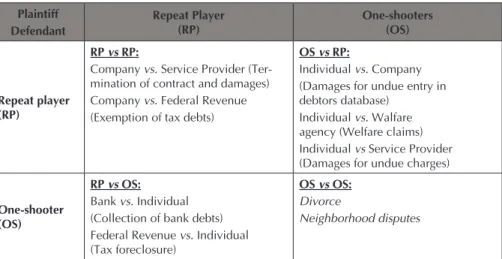
Drawing from one of the charts used in the article to explain the “taxonomy of litigation by strategic configuration of parties”, it is possible to point out some examples of very common cases of repeated litigation in Brazil. Such cases would fit in the quadrants of Repeat players vs. One-shooters (RP vs. OS) and One-shooters vs. Repeat Players (OS vs. RP), according Figure 2.
f
Igure2 – e
xAmplesofverycommoncAsesofrepeAtedlItIgAtIonInb
rAzIl Plaintiff Defendant Repeat Player (RP) One-shooters (OS) Repeat player (RP) RP vs RP:Company vs. Service Provider (Ter-mination of contract and damages) Company vs. Federal Revenue (Exemption of tax debts)
OS vs RP:
Individual vs. Company (Damages for undue entry in debtors database)
Individual vs. Walfare agency (Welfare claims) Individual vs Service Provider (Damages for undue charges)
One-shooter (OS)
RP vs OS:
Bank vs. Individual (Collection of bank debts) Federal Revenue vs. Individual (Tax foreclosure)
OS vs OS:
Divorce
Neighborhood disputes
Figure 2. Examples of repeated litigation in Brazil according to the players involved, based on the taxonomy of litigation by strategic configuration of parties proposed by Marc Galanter in “Why the Haves Come Out Ahead?: Speculations on the Limits of Legal Change” (1974).
The National Council of Justice also issues a yearly report (CNJ, 2018) on data concerning litigation, courts congestion and expenditure and was recently able to identify the share of case dockets related exclusively to tax foreclosure filed by Federal, State and Municipal revenue services. The 2018 report states that 39% of all case dockets in Brazil in the year of 2017 are tax foreclosures and that in these lawsuits, the congestion rate reaches 92%.
As pointed out by Galanter (GALANTER, 1974, pp.108-109), the filing of repeated claims is part of the regular activities of the repeat players. In Brazil, tax foreclosures and other typical claims are systematically brought to courts by repeat players using computer technology for reproducing briefs and following case developments. Also, for courts, these lawsuits demand very simplistic case management techniques and very often are decided by repeated written rulings. In these cases (RPs versus OSs), the Judiciary often becomes an ultimately great counter collection of state, bank and service debts.
In addition of litigating as plaintiff of tax foreclosures, Public Administration also is very frequently engaged as defendant in lawsuits brought by one-shooters (OSs versus RPs). This is the case of the large number of claims involving the granting of social security benefits and the implementation of social rights filed by individuals against the National Social Security Institute (INSS), the federal agency responsible for granting social security benefits. According to the National Council of Justice (CNJ, 2011, p.16), in 2010 the INSS was the defendant in 22.3% of the overall lawsuits involving the 100 largest litigants. In other words, the federal agency was the defendant in about one fifth of the total share of cases involving the top 100 litigants in Brazil.
This scenario demonstrates clearly the dimension that the Public Administration occupies in courts, both and plaintiff and defendant, as well as its institutional and normative influence. Over the years, Brazilian procedural rules have bestowed several regulatory prerogatives to the Public Administration. For instance, the Federal, State and Municipal Administration have considerably longer procedural terms11, easier access to the superior courts (Supremo Tribunal
Federal and Superior Tribunal de Justiça) and are exempted from paying court fees. These normative advantages have provided a privileged position for the Public Administration in courts.
Although there are still few empirical studies on the topic of repeat players and repeated litigation in Brazil12, findings arising from very recent researches
confirm the speculation that repeat players and especially Public Administration do come ahead in litigation.
In a study on the requirement of repercussão geral – a procedural filter according to only appeals that deal with issues of economic, political, social or legal relevance that transcends parties’ interests are to be trialed by the Supremo Tribunal Federal – Damares Medina Coelho argued that the Federal Public Administration had significant advantages in the appeals regarding its interests (2014, p. 144). Considering the paradigmatic cases chosen to establish precedent to all similar appeals in which the Federal Public Administration was the appellee, 89% of the appeals were not granted, whereas the in other cases, 52% of the appeals were not granted. Thus, there is a significantly higher rate of paradigmatic cases ruled in favor of the Public Administration.
11 During CPC/1973 (rule 188), the term for filing the defense in a civil procedure was four times that of a common defendant and twice the time limit for appeal. Currently, with the New Code of Civil Procedure (rule 180 and 183), it was established that all terms are twice longer for the Public Administration and its agencies and that all subpoenas must be done in person. Commonly, the subpoenas of procedural acts after the defendant are summoned to the lawsuit are directed to lawyers through official press.
12 On the causes, characteristics and impacts of repeated litigation in Brazil, see CUNHA, Luciana Gross; GABBAY, Daniela Monteiro (Coords.). Litigiosidade, morosidade e litigância repetitiva: uma análise empírica. São Paulo: Saraiva, 2013. (Série Direito e Desenvolvimento).
Brazilian courts are also stage for repeat private players, particularly of financial institutions, telephone companies and other service providers. All these litigants are subject to public agency regulation. When selling or providing services to consumers, they also have to comply with the Code of Defense of Consumer Rights (Código de Defesa do Consumidor13), a comprehensive and
protective law that secures rights for consumers against abusive contracts and practices, including the right to plead damages against suppliers and service providers.
Particularly in cases involving financial institutions, the percentage of cases filed by banks (RPs vs. OSs) and against them is relatively similar (CNJ, 2012). However, when focusing only in small claims courts, banks are engaged in 12.62% of the cases filed by individuals, who often dispute the legality of contractual clauses and practices adopted by banks. The same is true for cases filed telephone companies, who are usually defendants in both civil courts and small claims courts. Although private litigants do not enjoy specific procedural prerogatives, as public litigants do, there are studies reporting institutional advantages of these players, especially in small claims courts (according to item IV of this essay, below). It is not possible to be totally conclusive in this matter, but banks and telephone companies have obtained favorable results in key paradigmatic trials in the last decade at the superior courts.
A major example is the ruling in favor of banks in the matter of the inflation effects for saving accounts holders during specific monetary governmental policies during the 1980s and 1990s. Several of thousands of individual claims were filed all throughout the country, alongside with collective actions brought by public and private entities with legal standing14. The Superior Tribunal de
Justiça has decided that the statute of limitations of collective actions is of only five years, and not twenty, as the general applicable rule at the time15. With
this interpretation of procedural law, many collective claims and individual executions of collective action rulings were extinguished, and many people who relied in such claims to claim for compensation were not able to file individual
13 Federal Rule n. 8.078 of September 11th 1990.
14 To read more about the litigation involving inflation effects, see the qualitative empirical research with key players involved at GUIMARÃES, Amanda de Araújo. Ações Coletivas como Meio de Molecuralização de Demandas, presented as the final requirement of obtaining the law degree at the Law School of the University of São Paulo, 2012. More information is also available at report issued by the State Court of the State of Rio Grande do Sul on a notorious case management project to handle such claims: “Tratamento das Demandas de Massa nos Juizados Especiais Cíveis” (Coleção Administração Judiciária, Tribunal de Justiça do Estado do Rio Grande do Sul, Vol. X, maio/2010. Pesquisa coordenada por Ricardo Torres Hermann. Available at http:// www.tjrs.jus.br/export/poder_judiciario/tribunal_de_justica/corregedoria_geral_da_justica/colecao_adminis- -tracao_judiciaria/doc/CAJ10.pdf, access on Dec 11th 2017.
15 See Special Appeal n. 1.070.896 for the five-year statute of limitations in collective actions and Special Appeal n. 1.273.643 trialed on April 4th 2013 on the statute of limitations of the individual execution of
the ruling rendered in the collective action. Both trials were rendered in appeals filed by financial institutions against individuals.
claims later on, having missed the statute of limitations of twenty years while the collective action was pending.
3 LAWYeRS: HOW DO tHeY InFLuenCe tHe LItIGAtIOn SettInG?
According to Galanter’s analysis, lawyers could be expected to be that ones able to minimize asymmetry on litigation – despite the fact that the Bar has itself its own imbalances between different types of professionals (GALANTER, 1974). Also on this matter, Brazilian litigation setting is another key feature to understand the Idealtyp of repeat players and their influence in institutional and legal reforms.
Brazil has currently about 1,300 law schools, which is more than most countries to which such data is publicly known. While the Brazilian Bar establishes an exam for accreditation of law bachelors (which is necessary for all kinds of legal practice), there are more than 1.036,000 accredited lawyers in the country (ORDEM DOS ADVOGADOS DO BRASIL, 2017). The extremely large number of legal professionals generates a corporate pressure to retention of the legal services while also reflecting in high rates of case filings every year.
Although is not characteristic of all law firms that attend repeat players, specialized units that offer standardized and low-quality services rendered by an army of lawyers in a Fordist-like assemble are becoming a widespread model. These law firms work with systems that reproduce briefs and following the proceedings of thousands of lawsuits. Routines and practices are modeled considering the client (repeat players) and specific repeated claims, so that the handling such cases is done in the most economical way. In court-connected mediation and conciliation programs, or in settlement conferences, these law firms have specific lawyers to handle sessions and hearings, bringing settlement proposals in the cases where the repeat players choose to settle.
The Public Administration relies in large units of well-trained public lawyers (civil servants) working in different matters with relatively well organized public offices (Procuradorias) divided by party (the administration or its agencies specifically) and by issues, with groups of public lawyers specialized in tax foreclosure (RPs vs. OS) or claims for damages against the Public Administration, lawsuits requesting health treatments or other social or welfare rights, among others. Although a very prestigious and well-paid public career, public lawyers also deal with large-scale litigation and often resort to the reproduction of briefs and to a massive managerial practice of case management.
There are also law firms with such configuration to attend one-shooters, especially in repeated individual litigation against product suppliers and services providers (consumer rights) or related to legal adjustments in social security
pensions of retired employees of private and public sectors. In Brazil, the only possibility of pro se litigation is in small claims courts in disputes involving an amount up to 20 minimum wages16 in state courts, 40 minimum wages in
federal courts (in cases related to social security, for instance) and in labor courts. Nonetheless, even in these situations, many one-shooters choose to hire lawyers through success rate legal fee contracts, both for fearing the complexity of the legal and justice systems and for lack of information regarding its pro se rights. There are not trustworthy numbers on the matter, but a general sensation that most people do not know that they can resort to courts in such situations without legal representation.
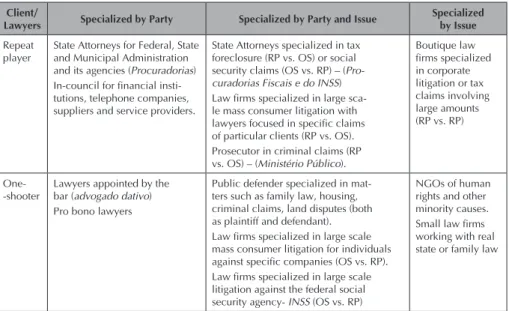
Once again drawing from one of the charts construed by Galanter in “Why the ‘haves’ come out ahead?”, it is possible to examine these units of legal services providers considering client-oriented and/or issue-oriented settings, according Figure 3.
f
Igure3 – u
nItsoflegAlservIcesprovIdersconsIderIngclIent-
orIentedAnd/
orIssue
-
orIentedsettIngsClient/
Lawyers Specialized by Party Specialized by Party and Issue Specialized by Issue
Repeat
player State Attorneys for Federal, State and Municipal Administration and its agencies (Procuradorias) In-council for financial insti-tutions, telephone companies, suppliers and service providers.
State Attorneys specialized in tax foreclosure (RP vs. OS) or social security claims (OS vs. RP) –
(Pro-curadorias Fiscais e do INSS)
Law firms specialized in large sca-le mass consumer litigation with lawyers focused in specific claims of particular clients (RP vs. OS). Prosecutor in criminal claims (RP vs. OS) – (Ministério Público).
Boutique law firms specialized in corporate litigation or tax claims involving large amounts (RP vs. RP) One--shooter
Lawyers appointed by the bar (advogado dativo) Pro bono lawyers
Public defender specialized in mat-ters such as family law, housing, criminal claims, land disputes (both as plaintiff and defendant). Law firms specialized in large scale mass consumer litigation for individuals against specific companies (OS vs. RP). Law firms specialized in large scale litigation against the federal social security agency- INSS (OS vs. RP)
NGOs of human rights and other minority causes. Small law firms working with real state or family law
Figure 3. Examples of categories of legal practice in Brazil, based on the typology of specialists proposed Marc Galanter in “Why the Haves Come Out Ahead?: Speculations on the Limits of Legal Change” (1974).
The considerations and data concerning repeat players and their lawyers reveal that such actors enjoy considerable advantages in the justice system, especially in view of its complexity and large-scale proportions.
Regarding the repeat players of the private sector, they can finance the structuring of Fordist-like law firms that specialize in the navigation of this system with large-scale, yet simplistic and low quality, case management practices, all of this for very low prices. When involved as the defendant of a lawsuit filed by an one-shooter, not only it has less to lose in the individual case, but it also calculates that the cost of litigation is so low that it is worth it to push individual cases until the higher levels of the jurisdiction, using all appeals available, in order to postpone the execution of the ruling.
Concerning claims filed by these repeat players – specially to collect debts from one-shooters – a similar reasoning is applicable: using courts as a debt collection counter and lawyers as debt collector agencies may be a simple and low-cost system.
In terms of bargaining power, studies indicate that by working in intense scale, Brazilian repeat players adopt what Galanter refers to as the minimax strategy, especially for proposing settlements in cases where they know that the chance of success in the courts are low (GALANTER, 1974, pp.141-144). While doing so, they dispute the rules of litigation because, unlike the one-shooter, who seek individual and tangible results in every claim, repeat players may maneuver these extremely numerous repeated claims with the goal of obtaining favorable case law precedents in certain issues and settling in cases where chances of success are remote.
To obtain favorable case law precedents, repeat players resort to prestigious lawyers and law firms, who enjoy great proximity to the higher court judges and servants. These lawyers are also renowned and respected jurists, who prepare legal opinions in controversial matters in favor of repeat players, both in matters related to procedural law (as the case above mentioned concerning statute of limitations for collective action) and substantive law. Such opinions exert relevant influence in the formation of precedents in the higher courts, as well as in institutional and legal reforms related to the matters involved.
Repeat players enjoy advantages not only in the litigation game, as they are able to devise discourses that are influential in changes regarding procedural law and the structure of the Judiciary itself. The dominant discourse that the facilitation of access to justice is the villain of the court system crisis is a widespread one (SADEK, 2004, pp. 79-98), often relating the large and always increasing number of claims to opportunistic behavior on behalf of one- -shooters and its lawyers (OSs vs. RPs). Such portrait is widely purported by
renowned jurists (who frequently are, as already mentioned, specialized lawyers representing repeat players in important paradigmatic cases) and accepted by public opinion, resulting in a general support to reforms that impose techniques for standardized trials, litigation filters and the search of efficiency at any cost.
Such reforms are not aimed at understanding the real causes of repeated litigation, its implications nor its social impacts. Institutional and rule changes also do not face the fact that different litigations arise from a same common cause (for instance, a widespread bank contract with an abusive clause, a poorly rendered telecom service, the legality of a certain tax practice) and that the best way to deal with such cases is, very often, the collectivization of individual claims. However, one cannot put aside all the pressure exerted by lawyers and corporative interests, who are not interested in institutional changes that will reduce the caseload of individual lawsuits that they legally represent.
4 InStItutIOnAL AnD LeGAL CHAnGeS
As already mentioned, Executive and Legislative branches in Brazil have been discussing legal and institutional reforms, especially after the 1988 Constitution and the establishment of a democratic regime.
The 1988 Brazilian Constitution marked not only the transition from military dictatorship to democracy but also a historical moment of intense social movements and great hopes to attain social and economic development through the construction of a more representative and pluralist order17. Two
years of intense debates and negotiations resulted in an extensive text (over 245 articles) establishing not only individual freedoms but also positive obligations for the state to assure social and collective rights. Furthermore, the repudiation to authoritarianism underlined the new institutional judicial arrangement, with an independent judiciary and an enhanced system of judicial review, a strengthened Ministério Público (General Attorney Office) and an autonomous Defensoria Pública (Public defender’s office), while also providing for instruments such as collective action and small claims courts intended to facilitate access to justice (CUNHA, OLIVEIRA, RAMOS. 2011). However, the 1990s marked the economic and political opening to globalization and permeability to the parameters and principles that were set forth by international players concerning economic efficiency and the attraction of foreign investment
17 As the preamble of the constitution states: “We the representatives of the Brazilian People, convened in the National Constituent Assembly to institute a democratic state for the purpose of ensuring the exercise of social and individual rights, liberty, security, well-being, development, equality and justice as supreme values of a fraternal, pluralist and unprejudiced society, founded on social harmony and committed, in the internal and international orders, to the peaceful settlement of disputes, promulgate, under the protection of God, this Constitution of the Federative Republic of Brazil.” (Translated version obtained from the World Intellectual Property Organization – WIPO – http://www.wipo.int/wipolex/en/text.jsp?file_id=218270).
in Brazil (FREITAS, 2005, pp. 31-44). The judicial reform in Brazil established by the Constitutional Amendment n. 45/2004 can be considered a turning point, since its text was discussed for many years and was influenced by two different discourses, one more concerned to access to justice and the other with the searching for efficiency in the Judiciary18. Courts ought to seek efficiency in
order to the prompt enforcement of contracts and private property rights, which were professed as essential to assure economic growth and prosperity. Again, a discourse clearly aligned with the interests of the top litigants and key repeat players of the Brazilian court system.
In the original version, issues related to the access to justice guided the judicial reform project, but Constitutional Amendment n. 45 final version followed the efficiency driven agenda, with the focus on reducing the dockets and promoting the economy growth through the predictability of court rulings and speediness of the judicial proceedings19. This second set of institutional and
rule reforms was more focused in dealing with repeated litigation by enhancing the importance of precedent system. Courts are to embrace the role of a manager of pending dockets and efficiency is the main goal, even though this discourse is sometimes subliminal.
The leading reform discourse thus sets aside the concern with the obstacles to a broad and facilitated access to justice and focuses in the search of efficiency and reduction of case congestion. Considering the purpose to reduce case dockets, courts team up with repeat players to devise campaigns and projects fight the overload of case dockets and reducing the time between filing and the final ruling (or settlement) of the case (this occurs, for example, when repeat players are involved in the screening cases submitted to mediation in court-connected programs). As Galanter speculated, repeat player enjoy the
18 According to the World Bank famous Document # 319 S concerning judicial reform in Latin America and the Caribbean: “A medida que continúa el proceso de desarrollo económico en América Latina y el Caribe, aumenta la importancia de la reforma judicial. El buen funcionamiento del poder judicial es importante para el desarrollo económico. El propósito de todo poder judicial es ordenar las relaciones sociales y resolver conflictos entre los diversos actores sociales. En la actualidad el poder judicial es incapaz de asegurar una resolución predecible y eficiente de los conflictos que respete los derechos individuales y de propiedad. No puede satisfacer las demandas del sector privado ni las del público en general, especialmente las de los pobres. Dado el actual estado de crisis de los sistemas judiciales de Latinoamérica y el Caribe, el objetivo de los esfuerzos de reforma es la promoción del desarrollo económico. La reforma judicial es parte del proceso de redefinición del estado y su relación con la sociedad; el desarrollo económico no puede continuar sin la efectiva definición, interpretación y ejecución de los derechos de propiedad. Específicamente, la reforma judicial está orientada a aumentar la eficiencia y equidad en la resolución de conflictos, mejorando el acceso a la justicia y la promoción del desarrollo del sector privado.” (DAKOLIAS, María. El sector judicial en América Latina y el Caribe. Elementos de reforma.Washington, Banco Mundial, Document # 319 S, 1997, p. 4) 19 The changes were so many that the author of the Amendment Project, former Congressman Helio Bicudo
(PT) said, days after the approval of the Amendment, that he would not like having his name in a project that became so different from the original version, since the judicial reform had been disfigured. According to CUNHA, Luciana Gross; ALMEIDA, Frederico de. Justiça e desenvolvimento econômico na Reforma do Judiciário brasileiro. In TRUBEK, David; SCHAPIRO, Mario (Orgs). Direito e Desenvolvimento: Um Diálogo Entre os Brics. São Paulo: Saraiva, 2012, p. 365.
advantage of the proximity with institutional incumbents and are therefore more able to influence institutional policies and court practices.
Among the second set of reforms above mentioned, it is also possible to identify that one of the major trends is to import the common law precedent system, but with some adaptations, to establish procedural mechanisms that provide for a more standardized court proceeding and allows the reproduction of court rulings in similar cases and appeals. The main idea is to allow the Supremo Tribunal Federal and the Superior Tribunal de Justiça to suspend all repeated claims appeals and randomly choose one for a the paradigmatic ruling applicable to all pending appeals. This is the mechanism provided for in article 1036 of the Code of Civil Procedure that establish techniques of “sample trialing” for appeals that deal with the interpretation of constitutional and federal law (in cases with few or no factual peculiarities).
However, differently from the common law system, the binding ruling is not based on the facts described in the paradigmatic case. Instead, the interpretation of the law is based only on a normative analysis of the case and legal issues raised by parties. The ruling of the paradigmatic case is often literally reproduced in the repeated cases, and not used to interpret the factual and legal arguments brought by the parties in the particular case.
This systematic is a key feature of the Code of Civil Procedure, effective since March 2016, and predicts the possibility of sample trialing not only appeals that are trialed by the higher courts, but also lawsuits at lower level once a paradigmatic case is chosen and trialed by an appellate state or federal court20.
It is an inverted system of case law: precedent is not created from bottom to up, but top down, and afterwards applied to all pending and future claims where the same legal matters are discussed. The party whose case was selected to represent all of others will be heard directly by higher courts, despite his/her conditions to do it properly – quality of his/her allegations, capability of his/her lawyers, affordability to be at lower courts and mainly familiarity to be listen by high court judges, etc. The parties whose cases are suspended at lower courts waiting for the sample ruling will have few or none opportunities to have their allegations analyzed by a judge, even for trying to distinguish their cases from the sample.
The main problem with this procedural rule is that repeat-players are likely to have considerable advantages over one-shooters, given that the result of all lawsuits is determined by one lawsuit chosen randomly by the court. In
20 This mechanism is called Incidente de Resolução de Demandas Repetitivas and it is established by Rule n. 976 of the New Code of Civil Procedure. Such procedural mechanism is inspired in a German technique (Musterverfahren) recently adopted to trial similar cases concerning matters related to capital markets (for instance, the pilot case regarded information allegedly false in an investment prospect).
this paradigmatic case, a repeat player will be able to use all its resources and expertise against a single one-shooter, in a David and Goliath systematic that will most likely benefit the player who is able to influence courts for a favorable ruling that will be reproduced in all repeated cases. As already mentioned, repeat players in Brazil have an easier access to the higher courts and can hire very specialized lawyers and jurists to influence the result of the paradigmatic case, especially in a systematic where precedent is established based on a normative analysis.
Another reform trend is to transfer the solution of some disputes to non-official offices. The ADR movement in Brazil is relatively new but growing significantly fast amidst the mass litigation crises. More recently, courts began to increasingly resort to mechanisms other than adjudication to address their caseload. By the end of 2010, the Brazilian National Council of Justice enacted the “Judicial Policy of Adequate Treatment of Conflicts” (Resolution n. 125/2005), which aims promoting conciliation and mediation in state and federal courts.
Furthermore, for the sake of taking lawsuits away from the courts, administrative agencies are becoming previous mandatory pathways for those who want to access courts. Demanding that plaintiffs file claims in administrative courts before resorting to courts can be an overturn on the achievements of Brazilian movement for access to justice, especially considering that such agencies tend to rule in favor of the State.So, despite its first appearance, the institutional and legal reforms that followed the 1988 Federal Constitutional do not express a consistent movement towards access to justice. In the 1980s, most likely due to the socio-political context of democratization, significant changes were aimed at expanding access to a formal system of dispute resolution, with the expansion of small claims courts and the regulation of collective action. In the 1990s, however, though changes were somewhat justified by the aim of providing access, the main goal was to reduce the length and the delay of proceedings. More recently, the reforms embodied ideas of clearing dockets out of repetitive lawsuits as well as to standardize rulings. It is reasonable to speculate that this latter set of reforms aimed at dealing with repeated litigation will benefit even more the “haves”, who already are coming ahead in Brazilian courts. Current Brazilian institutional and legal reforms have been influenced by repeat players and are most likely to accentuate their advantages, especially regarding the possibility to achieve favorable binding rulings in repeated cases.
5 eMPOWeRMent OF One-SHOOteRS AnD ReDIStRIButIVe IMPACtS OF LItIGAtIOn
As this essay tried to systematize, reforms in the Brazilian justice system of last three decades aimed i) to increase the access to justice, ii) to reduce the
length of lawsuits and iii) to provide predictability and legal certainty to judicial decisions. However, these goals are not at all compatible and the overall trend points towards an efficiency. Although generally considered as an offshoot of the original movement (the term access to justice has always been mentioned at formal announcements of reforms), this latest round of reforms seeks the opposite of expanding access to justice. Even reforms explicitly intended to diminish the effects of asymmetry may have their best efforts neutralized.
As Galanter previewed, different structural, economic and social conditions may deviate the outcomes of legal reforms. Among the options to minimize effects of asymmetry are the arrangements for the empowerment of OS’s litigation capabilities. Apart from a few minor exceptions, recent reforms barely show any concern the empowerment of the individual and occasional litigation.A statute created in 1950 granted care-needed people the exemption of legal fees to litigate in Brazilian courts. The rule states that whoever declares that cannot afford judicial such costs is able to litigate without paying filing and appealing fees, as well as expert fees and attorney fees for the wining party. This is a broad and protective access to justice policy that has been broadly used in the last decades also embraced by the 1988 Federal Constitution rise (article 5th item LXXIV) and the statute itself has always been reformed toward increasing the exemptions, not to restrict them (reforms occurred in 1984, 1986, 2001, 2009). Small claims courts are other important measure toward the empowerment of litigants since it is based on informality and pro se representation. Plaintiffs (individuals or small companies) are exempted of court fees and may even present their pleadings orally21. Recently, however, a reaction against legal
aid seems to be in place. The 2010’s reform toward reducing judicial dockets brought up another perspective to the debate about legal aid. Reformists argue that the exemption rule stimulated people to litigate, instead of merely facilitating access the system. There is a strong discourse proclaiming opportunistic and abusive party behavior, especially in claims filed by consumers of social security recipients. Recent case law points out to a tendency of conditioning the exemption of court fees to litigants who can prove their lack of conditions to pays these costs. Courts are requiring parties to produce evidence on their poverty, presenting tax and bank documents, evidences of monthly expenditure, among other rather discretionary and authoritarian parameters to define who is poor enough to enjoy the rights provided for in constitutional and federal rule22. 21 However, recent data about Brazilian small claims courts reveal that lawyers are always assisting parties and
pleadings are almost always presented in a written basis. Curiously, there is also a remarkable number of briefs requesting exemption of judicial costs, however they are not charged on these courts anyway, due to a specific legal rule. Also, citizens and small companies are assisted by lawyers when they litigate against other companies more often than when litigating against other citizens. (USP, 2015).
22 In that sense, a paradox is in place: those who are the poorest and the most vulnerable are the ones who will less likely have any documental evidence of their poverty and vulnerability.
It becomes clearer and clearer that accessing courts is a complex and delicate matter that surrounds a political decision concerning who has the priority to use the system and its limited resources.
Studies about small claims courts repeatedly point that notwithstanding its purpose of facilitating access to justice for the individual citizen, is key users (as defendants) are the Public Administration (especially in the Federal Level), large product suppliers and service providers, who are, as already discussed, the top litigants and most important and influential repeat players in Brazil, whose policies affects large number of citizens (CNJ, 2012; IPEA, 2013, 2014)23.
The Brazilian court system is at least in theory equally opened to all, but the reality shows just the opposite, for its institutional structure and rules are being construed in favor of a few and yet very frequent litigants, who benefit from the complexity of the system and the large-scale amount of pending lawsuits and claims. Ironically, these litigants do not need the system to resolve their disputes, since they can devise other mechanisms (ex.: better debt collection practices in banks or more effective and adequate services in the administrative social security agencies) to solve conflicts with the individuals with whom they relate. Not for other reason that repeat players often resort to arbitration to solve disputes with other repeat players concerning sensitive matters and important commercial contracts.
On the other hand, if repeat players do not make other venues effective and accessible, one-shooters need to resort to the official system when litigating against repeat players and to plead their consumer and social rights against suppliers, service providers and the public administration. This fact ought to be taken into consideration when facing the political question of who should have the priority to access Brazilian courts.
As this essay argues, few litigants are using the system while others are competing more and more with them and with each other for access to justice. Repeat players purport and promote the discourse of court efficiency and legal and institutional reforms that redefine individual access and undermine the possibility of bringing about social changes through court adjudication. Procedural techniques of sample trialing not only benefit the repeat player, but also stress out the understanding that accessing courts does not have to mean having an individual answer to your claim. If the mere application of a standardized ruling rendered in a sample case becomes the general rule of individual access to justice, it will become increasingly harder to reach social
23 Additionally, studies also unveiled the existence of several other disputes competing for the space and resources of the small claims courts, generally too busy with mass litigation involving those large litigants. Under the majority of consumer’s rights lawsuits, usually against banks and mass services corporations, there are minor disputes between both citizens and small businesses (USP, 2015).
transformations through court adjudication, for the impacts of the individual case will be neutralized in behalf of a massive mechanism of decision rendering.
COnCLuSIOn
The Brazilian features on litigation and dispute resolution raises important questions concerning access to justice and the redistributive impacts of adjudication. The typology of litigants originally systematized by Galanter in 1974 is a rich theoretical tool to better understand the barriers we have been trying to overcome for the last decades. It strongly confirms that our position on litigation and justice are far from being satisfactory.Brazilian “repeat players”, as he described, are involved in a very significant share of an overwhelming case docket, which seems to grow steadily year by year. Public Administration, product suppliers and services providers are the top litigants in Brazil and therefore the key users of this congested court system. Claims involving such litigants are often filed by or against one-shooters and frequently deal with similar matters arising from statutes and standardized agreements and practices adopted by repeat players when dealing with one-shooters. The extremely large number of lawyers in Brazil also influences this setting, making legal services cheap and abundant while also creating corporative incentives for maintaining large-scale units of legal services aimed at representing repeat players in repeated claims. The question that arises is who is using the scarce resources of the justice system?
This litigation setting has a clear impact in legal and institutional reforms. If the re-democratization was followed by reforms that aimed at attending a social demand for access to justice, an efficiency discourse is taking place in more recent years, supported by repeat players who are interested in the predictability of court rulings and the possibility of converging efforts to precedent formation in repeated litigation. This discourse has become more widespread in the last 20 years and clearly underlined the promulgation of the New Code of Civil Procedure. Such statute provides for rules of “sample trialing” which clearly attend the interests of repeat players while denying one-shooters to a real access to official and individual adjudication of their cases, relativizing, thus, their right day in court.
It seems that Brazil is enacting its own version of the phenomenon portrayed by Galanter as the “Vanishing Trials” (GALANTER, 2005), where the leading discourses and ideology against litigation and judicial activism promote the search for litigation filters and mechanisms to promote alternative dispute resolution and settlement. The mere reproduction of court rulings issued in different (despite similar) cases and the promotion of settlement are, without a doubt, means of reducing the cases that are actually and individually trialed
by judges and appellate courts. Thus, the second question raised is if aiming for vanishing trials is the only response to the congestion of the justice system. Furthermore, is this a legitimate and adequate measure?
Empowering one-shooters could be an alternative to mitigate the advantages of repeat players in the litigation game, however in Brazil this possibility is not satisfactorily achieved. The exemption of court fees which has been regulated ever since the 1950s is being disputed as a cause of abusive and opportunistic use of the justice system, bringing about more strict requirements to accessing adjudication. In terms of procedural mechanisms for bringing social rights to courts, collective action techniques are not able to provide for adequate representation of such rights, while also providing for an inefficient coexistence of individual and collective claims disputing the same matters. While the Brazilian model of collective action has somewhat empowered the one-shooter, it has not established a strong and sufficiently well-construed mechanism in which such litigants are able to overcome the advantages enjoyed by repeat players.
The Brazilian experience also seems to attest that access to justice, as any other social right, faces the challenges of universalization and distributiveness. Resources are scarce and the judicial plant is unable to respond adequately and timely to all social claims. Citing Galanter (GALANTER, 2010, p. 126) once more, if it is impossible to give access to all, certain choices are to be made. It is necessary to define which disputes are more sensitive in a remarkably unequal society. It is a political choice which enhances or undermines access to justice to one-shooters, to whom the official justice system may be the only venue to dispute widespread practices adopted by repeat players.
Recent reformist movements are based in an efficiency and managerial ideology which privileges access to the system’s already top users and most experienced players. The final questions arising from this analysis are, therefore, if Brazilian courts, so heavily drained by repeat players, can act as qualified institutions to promote social change and the interests of the excluded minorities. Or will such courts be condemned to act merely symbolically as agents of the status quo?
It seems that the answers to questions regarding the redistributive potential of Brazilian courts lie heavily a redistributive equating of access to these same courts.
ReFeRenCeS
ALVES DA SILVA, P. E. Acesso à justiça, litigiosidade e o modelo processual civil brasileiro. Tese de Livre-Docência. Faculdade de Direito de Ribeirão Preto da Universidade de São Paulo, 2018.
ALVES DA SILVA, P. E. Gerenciamento de processos judiciais. São Paulo: Saraiva, 2010.
ASPERTI, M. A. A. Acesso à justiça e técnicas de julgamentos de casos repetitivos. Tese de Doutorado. Faculdade de Direito da Universidade de São Paulo, 2018.
BRAZIL, Wayne D. “Continuing the conversation about the current status and the future of ADR: a view from the courts”. Journal of Dispute Resolution, n. 1, p. 11-39, 2000. CAPPELLETTI, Mauro; GARTH, Bryant. Access to Justice: the world-wide movement to make right effective – a general report. Milano: Dott A. Giuffre, 1978.
CENTRO BRASILEIRO DE ESTUDOS E PESQUISAS JUDICIAIS. Juizados Especiais cíveis: estudo. Brasília: Ministério da Justiça, 2006.
COELHO, Damares Medina. A repercussão geral no Supremo Tribunal Federal. Doctorade thesis presented at Faculdade de Direito da Universidade Mackenzie. São Paulo: Mackenzie, 2014.
CONSELHO NACIONAL DE JUSTIÇA. Justiça em Números. Brasília: Departamento de Pesquisas Judiciárias, 2018.
__________. 100 Maiores Litigantes. Brasília: Departamento de Pesquisas Judiciárias, 2012.
__________; INSTITUTO DE PESQUISA ECONÔMICA APLICADA. Custo Unitário do Processo de Execução Fiscal na Justiça Federal. Coord. Alexandre dos Santos Cunha. Brasília: IPEA, 2011.
CUNHA, Luciana Gross; GABBAY, Daniela Monteiro (Coords.). Litigiosidade, morosidade e litigância repetitiva: uma análise empírica. (Série Direito e Desenvolvimento). São Paulo: Saraiva, 2013.
___________. OLIVEIRA, Fabiana Luci. RAMOS, Luciana. What Kind of Judiciary do We Want? Paper presented in the 2011 IPSA-ECPR Conference, hosted by the Brazilian Political Science Association at the University of Sao Paulo. Available at http://
saopaulo2011.ipsa.org/sites/default/files/papers/paper-1526.pdf.
DURIGAN, Paulo Luiz. SFH: a prática jurídica. E-book. 1st Edition. At http://www. apriori.com.br/artigos/sfh.pdf. Curitiba: Edição do autor, 2007. Access in April 18th, 2018.
FISS, Owen. “Against Settlement”. 93 Yale Law Journal, p. 1073-1090.
FREITAS, Graça Maria Borges, “Reforma do Judiciário, o discurso econômico e os desafios da formação do magistrado hoje”. Revista do Tribunal Regional do Trabalho da 3ª Região, v.42, n.72 p. 31-44. Belo Horizonte: jul./dez.2005.
GABBAY, Daniela Monteiro. Mediação & Judiciário no Brasil e nos EUA: condições, desafios e limites para a institucionalização da mediação no Judiciário. Brasília: Gazeta Jurídica, 2013.
GALANTER, Marc. “Access to justice in a world of expanding social capability”. 37 Fordham Urban Law Journal, 2010.
________. “Planet of the Aps: reflections on the scale of law and its users”. 53 Buffalo Law Review. p. 1369-1417, 2006.
________. “The hundred-year decline of trials and the thirty years war”. Stanford Law Review, v. 57, n. 1255, p. 1115-1123, 2005.
________. “The Vanishing Trial: an examination of trials and related matters in federal and state courts”.1 J. Empirical Legal Stud. p. 459-570, 2004.
________. “Case congregations and their careers”. Law & Society Review, v. 24, n. 2, p. 371-395, 1990.
________. “Why the haves come out ahead? Speculations on the limits of legal change”. Law and Society Review, v. 9, n. 1, p. 95-160, 1974.
GIDI, Antonio Gidi. A Class Action como instrumento de tutela coletiva dos direitos – as ações coletivas em uma perspectiva comparada. São Paulo: Saraiva, 2007.
INSTITUTO DE PESQUISA ECONÔMICA APLICADA. Acesso à Justiça Federal: dez anos de juizados especiais. Brasília: Conselho da Justiça Federal – Centro de Estudos Judiciários, 2012.
___________. Tutela Judicial dos Interesses Metaindividuais – ações coletivas. Brasília: 2007.
KRITZER, Humbert M.; SILBEY, Susan (Eds.). In litigation: do the “haves” still come out ahead? Stanford: Stanford University Press, 2004.
MENKEL-MEADOW, Carrie J. “Do the ‘Haves’ come out ahead in alternative judicial systems?: repeat players in ADR”. Ohio State Journal on Dispute Resolution, v. 15, p. 19-61, 1999-2000.
MINISTÉRIO DA FAZENDA. Secretaria de Política Econômica. Reformas microeconômicas e crescimento de longo prazo. Brasília, 2004.
MINISTÉRIO DA JUSTIÇA. Secretaria da Reforma do Judiciário. Judiciário e economia. Brasília, 2005.
________. Análise da gestão e funcionamento dos cartórios judiciais. Coord. Paulo Eduardo Alves da Silva. Brasília: Secretaria de Reforma do Judiciário, 2007.
PINHEIRO, Armando Castelar. O Judiciário e a Economia no Brasil. São Paulo: IDESP, 2000.
POSNER, Richard. Economic analysis of law. 8th Edition. New York: Aspen, 2011. SADEK, Maria Tereza. “Acesso à justiça: a visão da sociedade”. Justitia, v. 65, n. 198, p. 271-279, São Paulo: jan./jun. 2008.
_______. “Judiciário: mudanças e reformas”. Estudos Avançados, v. 18, n. 51, p. 79-101, São Paulo: 2004.
_______. “O Judiciário em questão”. Revista São Paulo em Perspectiva, v. 10, n. 4, São Paulo: out./dez 1996.
SANDER, Frank. E. A. “Varieties of dispute processing”. LEVIN, Leo A.; WHEELER, Russel R. The Pound Conference: perspectives on justice in the future. St. Paul, USA: West, 1979. p. 65-87.
_______; ROZDEICZER, Lukasz. “Matching cases and dispute resolution procedures: detailed analysis leading to a mediation-centered approach”. Harvard Negotiation Law Review, Cambridge, US, v. 11, p. 1-41, 2006.
SANTOS, Boaventura de Sousa, MARQUES, Maria Manuel Leitão; PEDROSO, João. “Os Tribunais nas sociedades contemporâneas”. Available at: http://www.anpocs.org. br/portal/publicacoes/rbcs_00_30/rbcs30_07.htm, access in 18 april, 2019. Portugal: nov. 1995.
SMITH, Stephanie; MARTINEZ, Janet. “An analytic framework for dispute systems design”. Harvard Negotiation Law Review, v. 14, n. 123, p. 123-169. Cambridge: 2009.
SONGER, Donald R.; SHEEHAN, Reginald S.; HAIRE, Susan Brodie. Do the “Haves” come out ahead over time?: applying Galanter’s framework to decisions of the U.S. Court of Appeals. KRITZER; SILBEY, Susan (Eds.). In litigation: do the “haves” still come out ahead? Stanford: Stanford University Press, 2004, p. 1925-1988.
TRIBUNAL DE JUSTIÇA DO DISTRITO FEDERAL E TERRITÓRIOS. Núcleo Permanente de Mediação e Conciliação. Relatório de Atividades do NUPEMEC 2012. 2012. UNITED NATIONS. Civil and political rights (including the questions of independence of the Judiciary, administration of justice and impunity). New York: United Nations, 2005.
URY, William L.; BRETT, Jeanne M.; GOLDBERG, Stephen B. Getting disputes resolved: designing systems to cut the costs of conflict. Cambridge, US: PON Books, 1993. WADA, Rubens Morishita; OLIVEIRA, Fabiana Luci. “O Comportamento da nova classe média brasileira nas relações de consumo”. WADA; OLIVEIRA (Org.). Direito do Consumidor: os 22 anos de vigência do CDC. 1st Edition. São Paulo: Campus Elsevier, 2012, v. 1, p. 31-49.
WATANABE, Kazuo. Filosofia e características básicas do Juizado Especial de Pequenas Causas. In: WATANABE, Kazuo (Org.). Juizado Especial de Pequenas Causas (Lei 7.244, de 7 de novembro de 1984). São Paulo: RT, 1985.
______. Política pública do Poder Judiciário nacional para tratamento adequado dos conflitos de interesses. Disponível em: <http://www.tjsp.jus.br/Download/Conciliacao/ Nucleo/ParecerDesKazuoWatanabe.pdf>. Access in April 1st 2019.
WELSH, Nancy. The thinning vision of self-determination in court-connected
mediation: the inevitable price of institutionalization? Harvard Negotiation Law Review, Cambridge, US, v. 6, p. 1-96, 2001.