*e-mail: [email protected]
Trabalho apresentado no XV CBECIMAT, Natal - RN, Novembro de 2002.
Compresibility and Sinterability of HCx PM Steel
Diluted with Stainless Steels
Elena Gordo*, Nermein Hamid Khattab, Elisa María Ruiz-Navas
Departamento de Ciencia de Materiales e Ingeniería Metalúrgica Universidad Carlos III de Madrid
Avda. de la Universidad 30, E-28911 Leganés, Spain
Received: March 10, 2003; Revised: July 27, 2003
HCx powder metallurgy steel contains in its composition high contents of Cr and C, and significant quantities of alloy elements typical of tool steels (Mo, V, W), to provide the corrosion resistance of stainless steel with wear resistance of tool steels. HCx appears to be a suitable mate-rial for applications in aggressive environments, as valve seat inserts in automotive engines. How-ever, this steel presents a low compressibility leading to high production costs. In this work, some results carried out to improve the compressibility of HCx are presented. The way to attempt this improvement is the dilution of base material with two stainless steels, the ferritic 430LHC and the austenitic 316L. The powder mixes prepared were uniaxially pressed to study the compressibility. The sinterability was study by determining of density, hardness, transverse rupture strength (TRS) and microstructural evolution after vacuum sintering at different temperatures. As a result, better compressibility is observed in the mixes although not all of them present the properties required.
Keywords:powder metallurgy, dilution, stainless steels
1. Introduction
The mayor quantity of parts produced by powder metal-lurgy (PM) techniques are consumed by the automotive in-dustry, which is one of more active sector in the development of new products manufactured by PM1,2. Into the automotive sector, the most of PM parts are for engines. Some of them are submitted to high wear and corrosion demands, working usually at high temperatures. This is the case of valve seat inserts, frequently made of high-speed steels due to their ability to maintain hardness at high temperatures and their high wear resistance. However, the more demanding requirements for engines imply higher properties for materials and, for some applications, high-speed steels are not suitable.
Recently, a new type of PM high alloy steel has been developed, which commercial name is HCx, characterised for high Cr and C contents in its composition, besides of quantities of tool steel alloying elements, such as Mo, V and W. The microstructure after sintering consists of a dis-persion of hard carbides in a ferritic matrix. This steel has been designed to combine high wear and corrosion resist-ance, provided that enough Cr remains in the matrix to be
corrosion resistant and carbides support wear3. Therefore, this material seems to be suitable for applications that
re-quire both kinds of properties4. However its low
compressibility and the high costs can limit the utilisation. Some authors5,6,7 have followed investigations related with dilution or blending of low compressibility powders with others presenting higher compressibility, looking for the improvement of this property remaining good mechani-cal and wear properties. The dilution has also the advantage of diminish the final cost of the material.
2. Materials and Processes
The base material used in this study has been powder of HCx, from Powdrex. As diluting materials, two stainless steel powders, AISI 316L and AISI 430LHC, from Coldstream, have been used. The composition and charac-teristics of these powders (from suppliers) are shown in Tables 1 and 2.
Table 3 shows the composition of the mixes prepared, indicating the percentages of dilution. The powders were mixed in a ball mill at a rotary speed of 100 rpm, for 60 min. After mixing, they were characterised by measuring flow speed, apparent density, compressibility and green strength. For the determination of flow speed and apparent density a Hall flowmeter was used, carrying out the tests under the MPIF03 and ISO 3923-1:1979 standards. The compressibility was determined by pressing powders of each composition at different pressures between 550 and 700 MPa. The compacts were used to determine green strength. To study the sinterability of diluted materials, rectangu-lar samples of each composition were prepared by uniaxial pressing at 700 MPa, pressure obtained from the compressibility curve. The dimensions of these samples are in accordance with those indicated in the standards for bend-ing tests of PM products. Compacts were sintered in vacuum for 30 min, at different temperatures: 1200, 1220, 1240 and 1260 °C. Some properties were studied after sintering: den-sity, hardness, dimensional change and transverse rupture strength (TRS). Density was determined by a method based on the Archimedes principle, and the results are presented as relative density, that is, measured density to the theoreti-cal. Hardness was measured in Rockwell A scale, and TRS was evaluated through three points bending tests. All the
3. Results and Discussion
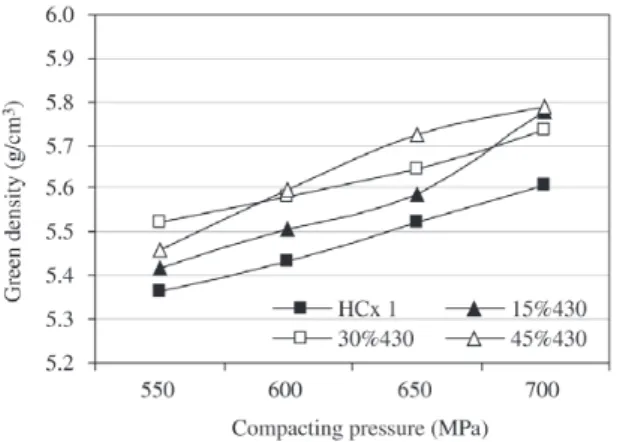
Figure 1 shows the compressibility curves of base ma-terial and diluted mama-terials with both stainless steels. In all the cases green density increases when the compacting pres-sure increases, which is the normal tendency, but the most important is that the higher the dilution (the percentage of stainless steel), the higher the green density for the same compacting pressure, which is the wanted result.
The green strength values (Fig. 2) for these samples are less influenced for the dilution than density values, that is an interesting result as this property is important to be main-tained for the industrial process.
Once the first objective has been reached, it is important to know the feasibility to sinter the diluted materials, and the best sintering conditions. Figure 3 shows the evolution of relative density with sintering temperature. The base material presents a high density (97% of the theoretical)
Table 1. Composition of initial materials (% in mass).
C Cr W Mo V Si Ni Cu Mn
HCx 1.6 22.6 2.7 2.8 1.9 1.4 - -
-316L 0.021 16.1 - 2.24 - 0.87 13.55 0.02
-430LHC 0.018 16.85 - - - 1.15 - - 0.18
Table 2. Characteristics of initial materials.
HCx 316L 430LHC
Apparent density (g/cm3) 2.5 2.95 2.77
Flow rate (s/50 g) 33.9 28.3 27.85
Particle size 0.57% > 150 µm 0.22% > 150 µm 99.8% < 150 µm
25% < 45 µm 31.1% < 45 µm
Table 3. Composition of the mixes prepared (% in mass).
Mix HCx 316L 430LHC
1 100 -
-2 85 - 15
3 70 - 30
4 55 - 45
5 85 15
-6 70 30
-Figure 2. Green strength of diluted materials vs. compacting pressure.
Figure 1. Compressibility curves of diluted materials.
Figure 3. Relative density of diluted materials vs. sintering temperature.
when sintered at 1260 °C, and more than 90% of the theo-retical is obtained for 1240 °C, which is an appropriate value for many applications. However, among the diluted materi-als only that containing 15% 316L presents the same
de-crease of density is not due to this factor.
In PM materials, density values are intimately related with their properties. Thus, it can be observed on Fig. 4 that the highest values of hardness (65 HRA) are for base material sintered at 1260 °C and for the composition containing 15% 316L sintered at the same temperature, that is coincident with density values. It is worth to notice that although density val-ues are almost independent on the sintering temperature for the most of the compositions studied, values of hardness present a tendency to increase with the sintering temperature. This feature can be observed for all the materials containing 316L, among which the addition of 15% leads to the same values of hardness than base material sintered at 1260 °C. Higher percentages of addition permit values of hardness at 1260 °C up to 10 points over those obtained at 1220 °C, al-though density does not increase. Regarding the materials diluted with 430LHC, the most significant change is for the composition with the lowest percentage of dilution, increas-ing the hardness 10 points from 1220 to 1260 °C, while
den-sity remains constant. These evolution point out to micro-structural changes, probably due to the activation of diffu-sion processes, more than a decreasing of the porosity, if val-ues of density are taken into account.
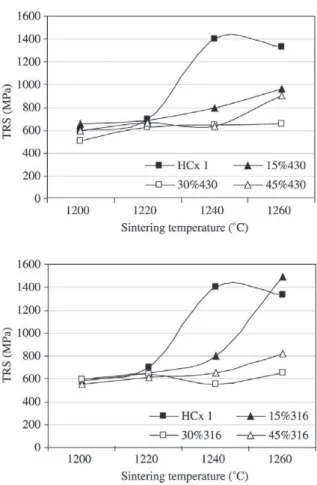
Results of TRS (Fig. 5) present the same tendencies than hardness. In this case, base material reaches the highest value (1400 MPa) for 1240 °C, meaning that a possible over-sintering for materials sintered at 1260 °C has occurred. As in the previous properties, the only diluted material that reaches high values is the mixing with 15% 316L sintered at 1260 °C, which present values of 1500 MPa, higher than base material. To understand the results of TRS it is neces-sary to take into account that the stainless steels used as addition materials present lower TRS values than base ma-terial, so we can expect that diluted materials show inter-mediate values of TRS. The other factor of influence is den-sity, which also makes values of TRS decrease. Both fea-tures seem to be applicable to materials diluted with 430, which low values can be explained for the mayor quantity
Figure 4. Hardness (HRA) of diluted materials vs. sintering tem-perature.
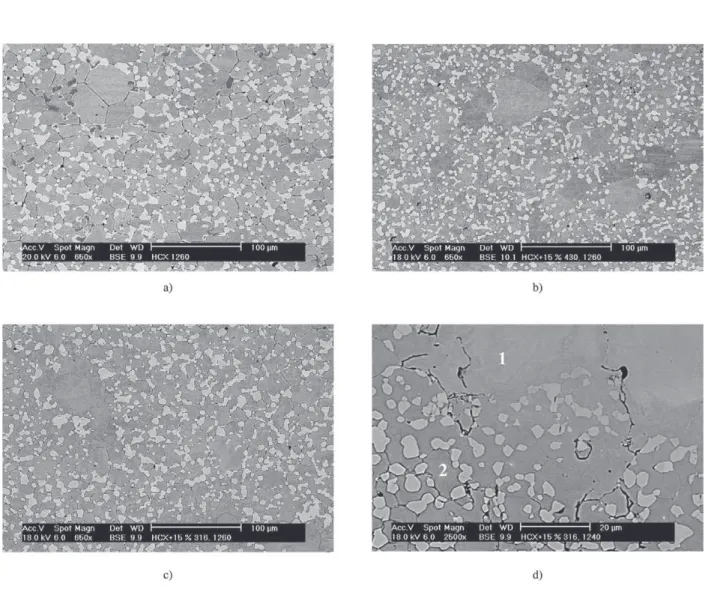
Figure 6. Microstructures (BSE) of several materials sintered in vacuum at 1260 ºC: a) HCx; b) HCx+15 % 430LHC; c) and d) HCx+15 % 316L.
Table 4. Composition (% in mass) of phases in Fig. 6a.
Mo V W Cr Fe Si
Matrix - 1.4 - 14.6 82.1 2.3
Dark phase 0.8 9.8 0.8 63.1 25.7
-Bright phase 5.3 4.8 6.6 46.9 36.4
-Table 5. Composition (% in mass) of phases in Fig. 6d.
Mo V Ni Cr Fe Si
Zone 1
2.1 0.7 8.4 15 71.8 1.9
matrix in 316L Zone 2
2.8 1.18 2.53 13.53 77.34 2.63
matrix en HCx
of ferrite and low density. However, in the case of dilution with 316L the final material can be considered to have a duplex stainless steel matrix, which mechanical properties are higher to the ferritic or austenitic stainless steels9. This point, besides the high density, can justify the high TRS value reached by the 15% 316L material sintered at 1260 °C. However, for higher percentages of dilution, the lower densities impede the material to reach higher values of TRS, remaining around 800 MPa.
bright carbides placed at the grain boundaries, in the mate-rials sintered at highest temperatures. It can be due to a microsegregation phenomena during the solidification of a liquid phase. The composition of the matrix, measured by EDX reveals that enough content of Cr (14%) remains dis-solved, ensuring its stainless character. The composition of mentioned phases are in Table 4. In the same Fig. 6a, it is possible to notice the homogeneous distribution of carbides, but also, it can be seen the big size of carbides and ferrite grains, especially near dark contrast phases, where a liquid phase could be formed during sintering. These features in-dicate that the material have been slightly over-sintered, as mentioned before.
In materials diluted with 430, for the same sintering tem-perature, both the grain size and the carbide size are smaller than base material. In Fig. 6b, showing the 15% 430 mate-rial, areas free of carbides can be distinguish where former 430 steel particles. These areas are perfectly bonded to the matrix, being the boundaries between HCx particles similar to the boundaries between HCx and 430 particles. At higher magnifications no interfaces can be seen that indicates dif-fusion phenomena.
However, in materials diluted with 316L those interfaces can be found. In Fig. 6c, taken at low magnifications, is not easy to observe the interfaces, but other interesting features can be noticed, as grain size and carbide size, that appear similar to base material sintered at the same temperature. At higher magnifications it is possible to notice diffusion phenomena between HCx and 316L areas. This is the case of Fig. 6d where a gradual change of contrast indicates a gradual change of composition. In Table 5 the composition (from EDX analysis) of 316L near boundary (marked as 1 in Fig. 6d) and HCx matrix (marked as 2 in Fig. 6d) are presented, and they reveals the diffusion of Ni from 316L to HCx. Deeply studies of this diffusion phenomena are cur-rently carrying out.
by dilution, or blending, with conventional stainless steel powders like 316L or 430LHC.
Dilution of HCx with 316L steel permits to obtain ma-terials after vacuum sintering with values of density, hard-ness and TRS similar or higher than base material. This rep-resents an advantage in relation with plain HCx due to the higher compressibility of the diluted material and the lower cost.
Dilution of HCx with 430LHC, in the percentages stud-ied, does not permit to obtain materials sintered in vacuum with high densities, and present lower properties than base material.
Acknowledgements
Authors want to acknowledge to Spanish Ministry of Science and Technology for the support through the research project COO1998AX149.
References
1. Baarton, G.M.; Deinzer, G.H. Proc. EURO PM 2000, Germany, p. 3-14, 2000.
2. Fujiki, A. Materials Chemistry and physics, v. 67, p. 298-306, 2001.
3. HCx: a corrosion and wear resistant stainless steel. Tech-nical Datasheet. Powdrex Ltd., England, 1996.
4. Whitaker, I.; Maulik, P.; Purnell, C.G. PM World Con-gress, Granada, Spain, v. 4, p. 259-264, 1998.
5. Zhou, G.L.; Wood, J.V. Powder Metallurgy, v. 38, n. 3, p. 230-236, 1995.
6. Marsh, P.; Wood, J.V.; Moon, J.R. Powder Metallurgy, v. 44, n. 3, p. 205-210, 2001.
7. Kjeldsteen, P. Proc. PM World Congress, Granada, Spain, v. 4, p. 265-270, 1998.
8. Zum, K.H. Gahr. Wear, v. 64, p. 175-194, 1980. 9. Gunn, R.N. Duplex Stainless Steel. Microestructure,