Vol. 7, No. 2, 2004 Temperature Coefficient of Piezoelectric Constants in Pb(Mg1/3 Nb2/3)O3 - PbTiO3 Ceramics 369
Materials Research, Vol. 7, No. 2, 369-372, 2004. © 2004
*e-mail: [email protected]
Articles presented at the XV CBECIMAT, Natal - RN, November de 2002.
Temperature Coefficient of Piezoelectric Constants in
Pb(Mg
1/3Nb
2/3)O
3- PbTiO
3Ceramics
Manuel Henrique Lente*, Alberto Luís Zanin, Jovan Vasiljevic, Ivair Aparecido dos Santos, Jose Antonio Eiras, Ducinei Garcia
Universidade Federal de São Carlos, Departamento de Física Grupo de Cerâmicas Ferroelétricas
Caixa Postal 676, 13565-670 São Carlos - SP, Brazil
Received: May 29, 2003; Revised: December 7, 2003
In this work, the thermal stability of piezoelectric constants of PMN-PT ceramics in the tetragonal and rhombohedral phases were investigated in a wide range of temperatures. The results showed that the tetragonal PMN-PT presented higher thermal stability and, consequently, the temperature coef-ficients for the piezoelectric constants were approximately zero. This result revealed to be much better than that commonly found for PZT ceramics. Although the rhombohedral PMN-PT presented a slight lower thermal stability, the values found for the coupling factor were significantly higher than the tetragonal composition.
Keywords: temperature coefficient, PMN-PT, hot pressing, coupling factor
1. Introduction
It is well known that the field of electroceramics is driven by technology and device applications. Doubtless, among the vast number of ferroelectric ceramic systems, that one based on Pb(Mg1/3 Nb2/3)O3 - PbTiO3 (PMN-PT) certainly shows one of the broadest range of technological applica-tions. For instance, it includes ultra-precision positioners, high dielectric constant capacitors and ultrasonic motors1,2. Over the last decades piezoelectric ceramics have been introduced into microelectronic products. However, their thermal stability, which means the independence of the pi-ezoelectric properties in relation to the temperature, is a fundamental parameter required for practical purposes. It is important that piezoelectric ceramics have low tempera-ture coefficients (TC), where zero value is highly desirable. Studies conducted on lead zirconate titanate ferroelectric ceramics, Pb(Zr, Ti)O3 or PZT, have suggested that TC is dependent on the Zr/Ti ratio3. These investigations have been centered in the temperature coefficient of the frequency constant (TCN). It has been reported that the sign and the magnitude of TC can change abruptly for compositions near the morphotropic phase boundary (MPB)3, which is the region in the phase diagram separating the
rhombohedral, monoclinic and tetragonal symmetries in the case of PZT and PMN-PT. Near the MPB ferroelectric systems exhibit outstanding electromechanical properties4,5. It is also attributed that the ceramic processing or the poling condition can shift the expected crystalline phase to an-other in the vicinity of MPB (due to changes in the stoi-chiometric) or induce phase transition, respectively.3 In addition, it is reported that for PZT based ceramics TCN is positive for the tetragonal phase and negative for the rhombohedral phase, respectively6,7.
TCN has been considered a reference to determine the thermal stability of piezoelectric ceramics. When TCN is zero due to some specific ceramic processing or poling con-dition, it is supposed that all temperature coefficients are minimized. However, it has been observed that almost all published works are focused on the temperature coefficient of the frequency constant in PZT ceramics.
depend-370 Lente et al. Materials Research
ence of the coupling factor (k31), the frequency constant (N31) and the elastic constant (s11E) in a temperature range from 213 K to 333 K. The results are compared and dis-cussed in relation to those observed and predicted for PZT ceramics taking into account the crystalline phase.
2. Experimental
(1-x)PbMg1/3Nb2/3O3 – (x)PbTiO3 ceramic powders, with x = 0.3 (rhombohedral) and x = 0.4 (tetragonal), were pre-pared through the columbite method. These samples will be labeled as PMN-0.3PT and PMN-0.4PT, respectively, hereafter. The experimental procedure is described in details in a previous work8. Briefly, the analytical graded precur-sor oxides were mixed in a ball mill using isopropyl alco-hol as solvent and stabilized ZrO2 balls as grinding me-dium. After that, the powder was calcined at 1173 K for 4 h, ball milled for 10 h and dried. The hot-pressed ceramics were densified at 1523 K for 3 h under a pressure of ~5 MPa in controlled oxygen atmosphere. X-ray diffraction analy-sis revealed only the perovskite phase for x = 0.4, while weak traces of the pyroclore phase (Pb3Nb4O13) were ob-served in the composition x = 0.3. Scanning electron microscopy (SEM) showed that both samples have a homo-geneous and crack free microstructure and that the average grain size lies between 2 - 3 µm for the ceramics of both compositions. The relative apparent density determined by the Archimedes’ method was around 98%. The sintered ce-ramic bodies were cut in a bar shape with ~7 × 3 mm2 and polished to a thickness of ~ 0.5 mm. After that, they were annealed at 900 K for 1 h to release mechanical stresses introduced during polishing. In order to make the measure-ments, gold electrodes were sputtered onto the sample sur-faces. The samples were poled under optimized poling con-ditions: an electric field of 10 kV/cm (for the PMN-0.3PT) and 25 kV/cm (for the PMN-0.4PT), during 0.5 h at 350 K8. These conditions guarantee a complete ferroelectric do-main reorientation in the electric field direction, which leads to a macroscopic polarization and, consequently, the in-duction of the piezoelectric effect in the ferroelectric ce-ramic9, 10. The piezoelectric measurements were performed in a temperature range from 213 K to 333 K. The results presented below are an average of 16 measurements. The thermal variation of generic piezoelectric constant (∆X) was determined in relation to the room temperature (X(293 K)) with the formula:
∆X=[(X(T)-X(293 K))100%] / X(293 K) (1)
where X(T) is the generic piezoelectric constant at a certain tempera-ture.
The temperature coefficient of the piezoelectric con-stant (TCX (ppm/K)) was computed in the temperature range
whole investigated, supposing a linear temperature depend-ence, i.e.:
TCX (ppm/K) = X(T) - X(293 K) / 110X(293 K) (2)
3. Results and Discussions
The piezoelectric characterization performed at room temperature showed that tetragonal and rhombohedral PMN-PT compositions have high piezoelectric constants, as summarized in Table 1. The found constants are similar to those reported in other works for ceramics with similar compositions11, 12, revealing the high quality of the sam-ples. It is observed that in general the PMN-0.3PT presents higher piezoelectric constants than that of the PMN0.4PT . This result may be related to the fact that the composition of the PMN-0.3PT is nearest to the monoclinic phase13, in which the piezoelectric properties are maximized13, 14.
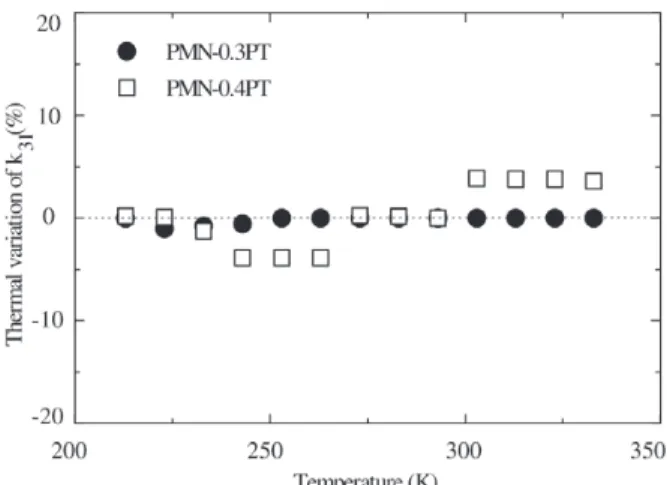
Figure 1 shows the temperature dependence of the cou-pling factor, k31, for both compositions. It is observed that the k31 for the PMN-0.3PT presents an excellent thermal stability, showing practically no changes in the whole tem-perature range investigated. On the other hand, for the PMN-0.4PT, the k31 does not present a well-defined feature, hav-ing positive and negative variations. However, the maxi-mum oscillation is limited only to 3.7 %.
Figure 2 shows the thermal variation of the frequency constant, N31, for the PMN-0.3PT and PMN-0.4PT ceram-ics. On the contrary to that observed in Fig. 1 for the k31, the frequency constant for the PMN-0.3PT ceramic reveals some variation. It can be seen a quasi-linear decreasing with the increase of the temperature, while the N31 for the PMN-0.4PT is almost temperature independent. These values are comparable to those obtained for PZT near the MPB15.
The thermal variation of the elastic constant s11 E for
both PMN-PT ceramics is shown in Fig. 3. Analogously to that verified for the frequency constant in Fig. 2, the te-tragonal composition (PMN-0.4PT) reveals a high thermal stability in the whole temperature range investigated. How-ever, the rhombohedral composition shows a reasonable lin-ear increasing of the s11
E with the increase of the temperature.
The results showed that the PMN-0.4PT ceramic presents
Table 1. Room temperature piezoelectric (coupling factor K31 and frequency constant N31), elastic (S11) and dielectric (ε33) constants for the PMN-0.3PT and PMN-0.4PT ceramics (24 h after the poling process).
Sample k31 N31 ε331 kHz s11E10-12
Hz.m m2/N
PMN-0.3PT 0.43 1728 3020 4.6
Vol. 7, No. 2, 2004 Temperature Coefficient of Piezoelectric Constants in Pb(Mg1/3 Nb2/3)O3 - PbTiO3 Ceramics 371
Figure 1. Thermal variation of the coupling factor (k31) for the PMN-0.3PT and PMN-0.4PT ceramics.
Figure 2. Thermal variation of the frequency constant (N31) for the PMN-0.3PT and PMN-0.4PT ceramics.
Figure 3. Thermal variation of the elastic constant s11 for the PMN-0.3PT and PMN-0.4PT ceramics.
higher thermal stability than the PMN-0.3PT ceramic and, consequently, the temperature coefficients for all piezo-electric constants were approximately zero even taking into account the small fluctuations observed in the k31. The re-sults also bring two contrasts when they are compared to those observed for other piezoelectric ceramics. First, ac-cording to the literature3,16, it is expected that piezoelectric ceramics in the tetragonal phase show a positive TC for N31, which was not verified here. These results remarkably re-veal that piezoceramics in the tetragonal phase do not have necessarily a positive TC, thus being a specific characteris-tic of each material. Second, as reported in the introduc-tion, anomalies in the TC can be related to changes in crys-talline phase induced by applying a high electric field, as previously verified for PZT ceramics3,16. Therefore, it is also possible to conclude that a shift to the rhombohedral phase was not induced in the PMN-04PT during poling process. This fact can be explained assuming either the PMN-04PT needs higher electric field to induce a phase transition or the compositions investigated in the PZT case were very close to the MPB, where low electric fields are able to in-duce a phase transition. The second hypothesis seems to be more reasonable since saturation conditions were applied in the poling process of the PMN-0.4PT.
On the other hand, for the rhombohedral composition, the N31 shows the standard characteristic, which means a negative TC. Although the value found for TCN31 is 4.8 ppm/K, it is much lower than that found for PZT ceram-ics3,15. The composition PMN-0.3PT is close to the MPB13 but no anomalies were observed in the TCN31, which means that no different phases were induced by preparation or poling processes. In addition, the value found for the TCs11 is 1380 ppm/K that is much higher than that found for the other constants.
372 Lente et al. Materials Research
4. Conclusion
The thermal stability of the piezoelectric constants of tetragonal and rhombohedral PMN-PT ceramics shows that the tetragonal composition is thermally more stable, con-sequently the temperature coefficients for the piezoelectric constants are approximately zero. The rhombohedral PMN-PT presents a slight lower thermal stability, but it is still similar to that observed for the PZT ceramics. Therefore, these results show the high quality of the samples and their high potential to be applied in electronic industry.
Acknowledgements
The authors thank FAPESP and CNPq for the financial support.
References
1. Uchino, K. Ferroelectric Devices - Marcel Dekker, Inc., 2000.
2. Takagi, H.; Sakata, K.; Takenaka, T. Jnp. J. Appl. Phys., v. 32, p. 4280, 1993.
3. Liang, C.K.; Wu, L.; Wu, T.S. Ferroelectrics, v. 120, p.185, 1991.
4. Guo, R.; Cross, L. E.; Park, S-E.; Noheda, B.; Cox, D. E.;
Shirane, G. Phys. Rev. Lett., v. 84, p. 5423, 2000. 5. Park, S-E; Hackenberger, W. Curr. Opin. Solid, St. M.,
v. 6, p. 11, 2002.
6. Thomann, H.; Wersing, W. Ferroelectrics, v. 40, p.189, 1982.
7. Wersing, W. Ferroelectrics, v. 37, p. 611, 1981. 8. Lente, M. H.; Zanin, A. L.; Assis, S. B.; Santos, I. A.;
Garcia, D.; Eiras, J.A. J. Eur. Ceram. Soc, v. 24, p. 1529, 2004.
9. Lente, M. H.; Eiras, J.A. J. Appl. Phys., v. 89, p.5093, 2001.
10. Lente, M. H.; Eiras, J.A. J. Appl. Phys., v. 92, p. 2112, 2002.
11. Chen, Y.; Hirose, S.; Viehland, D.; Takahashi, S.; Uchino, K. Jnp. J. Appl. Phys., v. 39, p. 4843, 2000.
12. Chen, Y. W.; Uchino, K.; Shen, M.; Viehland, D. J. Appl. Phys., v. 90, p.1455, 2001.
13. Noheda, B.; Cox, D. E.; Shirane, G.; Gao, J.; Ye, Z. G. Phys. Rev. B, v. 66, p.054104, 2002.
14. Noheda, B.; Cox, D. E.; Shirane, G.; Guo, R.; Jones, B.; Cross, L. E. Phys. Rev. B, v. 63, p. 014103, 2001. 15. Lente, M.H.; Eiras, J.A. Anais do 38° Congresso
Brasileiro de Cerâmica v.1, p.132, 1994. In portuguese. 16. Liao, J.H.; Cheng, S.Y.; Wang, C.M. Ferroelectrics,