ISSN 1 5 1 7 - 7 0 7 6
Revista Matéria, v. 14, n. 4, pp. 1146 – 1153, 2009 http://www.materia.coppe.ufrj.br/sarra/artigos/artigo11118
Recycling of glass cullet as aggregate for clays used to produce roof tiles
COSTA, F.B.; TEIXEIRA, S.R.; SOUZA, A.E.; SANTOS, G.T.A.Departamento de Física, Química e Biologia – DFQB - Faculdade de Ciências e Tecnologia - FCT Universidade Estadual Paulista - UNESP
Rua Roberto Simonsen, 305 - CP: 467 – Presidente Prudente, SP. CEP: 19060-080
e-mail: [email protected], [email protected], [email protected], [email protected]
ABSTRACT
Numerous silicates based wastes have been produced and considered for recycling and reuse. Among them, glass cullet is one of the most common silicate wastes and has considerable volume in the cities wastes. A big amount of this waste is recycled by the glass industry but another part is dumped in the cities garbage deposits. In the last few decades there has been considerable research on the reuse of glass waste as aggregate to produce glass-ceramic, for mortars, ceramics and for cement and concrete. This work is concerned to study the reuse of one way glass bottles as aggregate to produce roof tiles (red ceramic). Two kinds of glass powder were prepared by sieving: alpha (0.088 to 0.125 mm) and beta (0.037 to 0.088 mm). Prismatic ceramic bodies (CB) were pressed (60 x 20 x ~5 mm) using a ceramic mass with 0, 5, 8 and 10 % of glass cullet powder added and fired at five different temperatures (800 to 1200 oC). The results of the technological tests (flexural strength, water absorption, dimensional changes, density and porosity apparent) show that shrinkage increases with the glass content and all other properties above are improved. These changes are more exhibited at temperatures higher than 900°C and in the higher powder glass concentrations (8 e 10%).
Keywords: roof tiles, glass, one-way bottles, recycling.
1 INTRODUCTION
Red ceramic is a very promising alternative for the incorporation of residues due the wide use of pottery and ceramics in all regions of Brazil, and also because a large variety of raw materials can be utilized. The incorporation of residues in controlled quantities can extend the life time of raw materials deposits besides making use of this residue which in general is discarded into the environment, contributing to the economic viability of the recycling of some solid residues.
With the growth of the population, the increase in the consumption of disposable and returnable materials has increased the volume of residues produced in cities. The glass consumed by the public, generally in the form of container, is relatively inert and therefore non biodegradable. In 2001, more than 2 million tons of glasses were produced in Brazil, of which ~43% of the glass was for packaging [1]. Nowadays, approximately 50 % of glass residues are recycled in Brazil.
More than 95% of all manufactured glass is made from sodium oxide, calcium oxide, and silicon dioxide, commonly referred to as a soda-lime-silica composition. The facts that soda lime glass is already a vitreous silicate, that vitreous silicates are generated during the maturation of clay bodies, and that vitreous silicates act as fluxes, reducing clay body maturation temperatures, were strong evidence that the addition of soda lime glass to clay body raw materials could increase the efficiency of clay body firing and therefore be a value-added application for recycled glass fines [2]. Therefore, the incorporation of glass residue in ceramic materials is an option for reuse, and many studies on this theme have been developed in Brazil [3-8]. In addition, the works published on the recycling of glass in ceramic materials are numerous [9-15]. These studies furnish a panorama of the development of research on this theme. The addition of glass to ceramic masses causes an increase in the levels of fluxing oxides, responsible for the formation of the vitreous phase and densification of the ceramic masses during the firing process, increasing its flexural strength and reducing water absorption.
are industries to recycle the discharged glass raise the transport price and it is not feasible its recycling by them. Then it is necessary its reuse or recycling in the place nearby where it is produced. Due to the differences in the mineralogical and chemical composition of the clays used by the ceramic industry it is necessary the evaluation of the sintering performance of each clay with glass incorporated. The aim of the present work was to determine the effects of the incorporation of glass waste on the ceramic properties of clays from Presidente Epitácio County, used to produce roof tiles.
2 MATERIALS AND METHODS
Glass powder was incorporated into a ceramic mass utilized for the fabrication of roof tiles, which was obtained from a ceramic factory in the municipality of Presidente Epitacio, SP – Brazil.
The ceramic mass was allowed to stand to dry naturally and then triturated in a blade mill. Part of this sample was assayed for particle size distribution to determine the concentration of clay, sand and silt, using the pipet method [16]. The rest was passed through a set of screens to determine particle size distribution and help in the preparation of the mixtures used in the ceramic probes.
Brown beer bottles, which were the 350 ml long neck type and non-returnable, were broken into pieces and pulverized in a ball mill for 6 h. The powder was passed through sieves of 0.037, 0.088 and 0.125 mm to obtain two different particle sizes: (α) 0.088 to 0.125 mm and (β) 0.037 to 0.088 mm. These particle sizes were chosen considering the particle size distribution obtained for the ceramic mass.
The clay and glass powder were dried in an oven for 24 h at 110oC. The mixture of ceramic mass and glass powder was homogenized in a ball mill for 6 h. Four mixtures were prepared containing 0, 5, 8 and 10% glass powder, for two particle sizes, alpha and beta, which were fired at five different temperatures. Water was added to each sample, 15% by weight, for pressing.
Six ceramic probes (CBs) were made for each sample, with dimensions of 60 20 ~05 (mm), utilizing for each one approximately 20g of sample. In each pressing (7 tons), three probes were prepared simultaneously (~195 kgf/cm2, 1 min, each probe). After pressing, the ceramic probes were cleaned, labeled, measured and weighed.
After making and measuring (length and weight) the ceramic probes, they were placed in an oven at 110°C for 24 h. After the drying period, they were placed in a desiccator until reaching room temperature, and again weighed and measured.
The CBs were fired at 800, 900, 1000, 1100 and 1200°C, at a heating rate of 10°C/min up to 110°C, kept at this temperature for 30 min, and then heated up to the firing temperature also at 10°C/mim, and kept at this temperature for 2 h. After firing, the furnace was turned off, the ceramic probes were allowed to cool to ~ 60°C and then placed in a desiccator until reaching room temperature. Their dimensions and weight were then determined again using caliper and analytical balance.
Afterward, were calculated the linear drying shrinkage (LSd), linear firing shrinkage (LSf) and loss on ignition (LOI) of the ceramic probes. Flexural strength (FS) in a three-point flexure test (0.25 mm/min) was determined after firing the CBs, with control and automatic data recording, using EMIC instrumentation. Apparent specific weight (ASW), water absorption (WA) and apparent porosity (AP) were determined after firing, using the Archimedes method (hydrostatic balance) [17].
3 RESULTS AND DISCUSSION
The chemical and mineralogical composition of the samples were obtained by x-ray diffraction (XRD) and x-ray fluorescence (XRF) [2,18,19]. A typical average chemical content of the oxides in container and window glass is given by the following (oxide %): SiO2 (72.8), Na2O (13.7), CaO (8.8), MgO (4.0), Al2O3(0.1), Fe2O3(0.12), K2O(0.04) and SO3(0.26) [2]. The chemical composition of the clayed material showed a typical kaolinitic composition, characteristic of the region clays [18,19]. The samples studied in this work has the following chemical composition (oxide %): SiO2 (51.48), Al2O3(36.00), Fe2O3(8.43), CaO (0.31), K2O(1.57), TiO2(1.95) and MnO(0.11) [18]. Therefore, the presence of alkaline and alkaline earth oxides in the glass composition will act as fluxing agents helping the sintering process of the ceramic material with glass powder incorporated.
3.1 Particle size distribution
and 50% and of sand between 20 and 40%. Therefore, the amount of clay found in the sample is higher than the recommended range for the production of roof tiles, allowing it to be mixed with non-plastic material.
Table 1: Particle Size distribution (texture) for tile mass.
Fraccion Concentration (%)
Sand 24.13 Silt 17.60 Clay 58.27
3.2 Loss on ignition (LOI)
As expected, LOI increased with sintering temperature for all the mixtures (Figure 1). At 1000°C and higher, the loss of mass was constant, indicating that the reactions occurred at the lower temperatures. Kaolinitic clays, in general, show a greater loss of mass at temperatures below 600oC [18], where there is a loss of moisture, structural water (hydroxyls) in clays, hydroxides (mainly of iron and aluminum), and organic matter. Increasing the amount of glass in the mixture reduces loss of mass since it substitutes for the clay.
800 900 1000 1100 1200
6,0 6,5 7,0 7,5 8,0 8,5
LO
I (
%
)
Temperature (oC)
5% 5% 8% 8% 10% 10% Clay
Figure 1: Loss of mass on ignition to ceramic mass with glass powders ( and ).
In comparing the effect of particle size of the glass powder, it is seen that there was no substantial difference (< 1%) in loss of mass between the alpha and beta mixtures.
3.3 Linear drying shrinkage (LSd)
LSd of the ceramic probes, with and without glass powder, is small, varying between 1 and 2%. The incorporation of 5 and 8% glass powder (non plastic material) caused a small probe expansion, and 10% glass powder had practically no effect on LS of the ceramic probes.
3.4 Linear firing shrinkage (LSf)
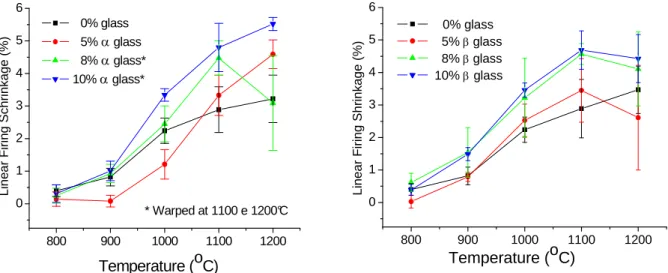
The glass powder concentrations of 8 and 10%, for both powder particle sizes, consistently resulted in a greater linear shrinkage for samples with glass incorporated. The softening warped the samples, mainly those sintered at 1200oC, impairing the measurements used in the determination of LSf, resulting in errors and a large standard deviation in the measurements.
Between 950 and 1225oC, vitrification occurs with kaolinitic samples, due to the release of silicon oxide (SiO2) which reacts with free oxides, mainly alkaline, alkaline earth and iron oxides, forming glass [17]. Some of these oxides are present in clays, some are released in the breaking of the structure of clay minerals, and others, mainly alkaline oxides, are present in glass powder. Even for samples fired at 1200oC, LSf was below the recommended maximum limit of 6% [21].
As seen in Figure 2, particle size had a small influence on LSf, with the glass powder (finer) tending to show greater linear shrinkage than at temperatures < 1000 oC .
800 900 1000 1100 1200
0 1 2 3 4 5 6
Li
n
ear F
ir
ing Shr
ink
age (%
)
Temperature (oC) 0% glass
5% glass 8% glass 10% glass
800 900 1000 1100 1200
0 1 2 3 4 5 6
* Warped at 1100 e 1200°C
Line
ar
Firin
g
Sc
hr
inkage
(
%
)
Temperature (oC)
0% glass 5%glass 8%glass*
10%glass*
Figure 2: Linear firing shrinkage as a function of firing temperature for ceramic probes containing 0, 5, 8
and 10% glass powder, alpha and beta.
3.5 Water absorption (WA)
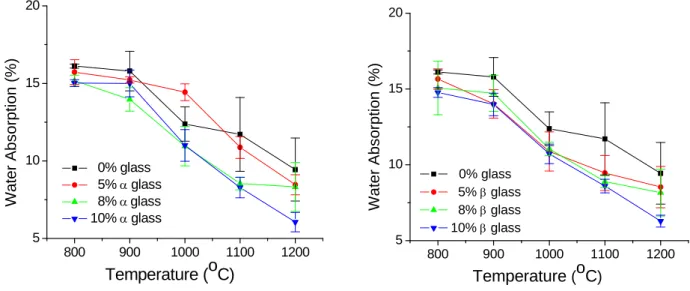
The absorption of water (WA) diminished with increase in concentration of glass in the sample and also with increase in firing temperature (Figures 3). As water absorption for ceramic mass was low and since the glass powder tended to reduce this value, all of the samples showed a WA of < 17%. Therefore, to the red ceramic firing temperatures (800 to 950°C) all samples have WA in according with the limits values. For firing at 1100oC, WA was less than 10%, and at 1200oC, the samples with 10% glass powder (alpha and beta) showed a WA of < 7.5%. All these values are below the recommended maximum value for the production of roof tiles, 18%, [22] and ceramic blocks for structural masonry and for sealing (8% < WA < 22%) [23] and some values are within the mean limit values established for the production of pressed ceramic tiles, BIIb (6 < WA 10%) and BIII (WA > 10%) [24]. It should be noted that for the production of ceramic tiles the pressure applied in the making of the pieces is much greater than that used in this work for preparing ceramic probes with clay for bricks and roof tiles. The greater pressure would improve even more the properties of the pieces. These results show that this clay with glass powder incorporated can be used to produce ceramic tiles when fired at higher temperatures.
800 900 1000 1100 1200 5
10 15 20
800 900 1000 1100 1200
5 10 15 20
Water Abs
o
rption
(%)
Temperature (oC)
0% glass 5% glass 8% glass 10% glass
Water Abs
o
rpti
on (%
)
Temperature (
o
C)
0% glass5% glass 8% glass 10% glass
Figure 3: Water absorption (WA) of ceramic mass with 0, 5, 8 and 10% glass powder, alpha and beta, as a
function of firing temperature.
3.6 Apparent porosity (AP)
The apparent porosity (AP) versus firing temperature curves shows a behavior similar to that of water absorption (WA). The data to calculate WA and PA are the same [19]. With increase in firing temperature, values for WA and AP tended to decrease since a greater densification of the sample occurred.
The apparent porosity of the ceramic mass (CM) was approximately 30%, at 800 and 900oC. At these temperatures, the incorporation of the two glass powders showed a tendency for a small decrease in the AP value (values below those for CM).
At 1000oC and higher, there was a continuous fall in AP for the two glass powders, up to 1200oC, where there appears to be difference between percentage of glass incorporated into the sample. At 1200oC, a greater decrease in AP (AP < 15%) was observed for 10% glass powder (alpha and beta).
The AP values for the two glass powders and all the samples were less than the maximum limit value (35%) established for the production of perforated bricks [17].
3.7 Apparent specific weight (ASW)
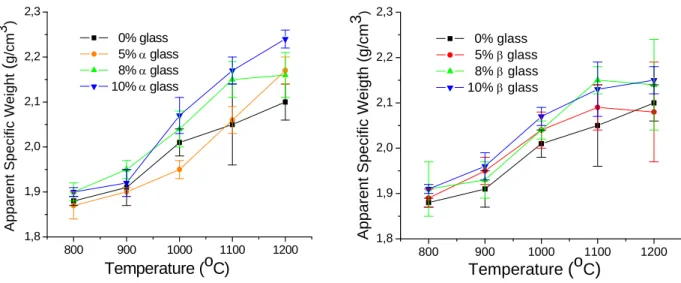
All of the samples showed ASW values greater than the recommended minimum value (1.7g/cm3). Figures 4, shows that there was an increase in ASW as the firing temperature was increased and it is improved with incorporation of 8 and 10% of powder glass [21].
3.8 Flexural strength (FS)
Flexural strength determined in a three-point flexure test (Figures 5) was greater than 5 MPa, for all the ceramic probes. The minimum limit values for heavy bricks, perforated bricks and roof tiles are 2.5, 5.5 and 6.5 MPa, respectively [17]. For firing at 900oC, which is the firing temperature used in the red ceramic industry, and higher, all the ceramic probes showed a FS greater than the limit value for the production of roof tiles.
1,8 1,9 2,0 2,1 2,2 2,3
Figure 4: Apparent specific weight (ASW) of the ceramic mass containing 0, 5, 8 and 10% glass powder,
alpha and beta, as a function of firing temperature.
Figure 5: Flexural strength (FS) of ceramic mass with 0, 5, 8 and 10% glass powder, alpha and beta, as a
function of firing temperature.
4 CONCLUSIONS
The results show that the incorporation of glass powder tended to improve all of the technological properties of clay for firing temperature higher than 1000oC. However, this is not the usual temperature used by the red ceramic industry. Therefore, glass powder can be used for improving the technological properties of the ceramic tiles industry. These changes in properties depend on the amount of glass powder incorporated into the clay and firing temperature.
On the other hand, these samples showed greater linear shrinkage and many of them warped, mainly at 1200oC, indicating the formation of a liquid phase at lower temperatures for the samples with glass powder. Some samples warped at 1100oC.
800 900 1000 1100 1200
Apparent Specific W
e ig ht ( g/cm 3 ) Temperature (oC) 0% glass
5% glass 8% glass 10% glass
800 900 1000 1100 1200
1,8 1,9 2,0 2,1 2,2 2,3 App a
rent Specific Weigth (g/cm
3 )
Temperature
(
oC)
0% glass5% glass 8% glass 10% glass
800 900 1000 1100 1200
5 10 15 20 F lex u ral St re ngt h (MP a )
Temperature (oC)
0% glass 5% glass 8% glass 10% glass800 900 1000 1100 1200
5 10 15 20 Flexural Stren gt h (MPa )
Temperature
(
o
C
)
Flexural strength was significantly altered at firing temperatures of 1100 and 1200oC, due to the formation of liquid phase attributed to the glass powder. This effect was more pronounced for the coarser powder (alpha). The incorporation 10 and 8% glass powder, in general, showed better results compared to 5%.
The variation in the particle size of the glass powder does not change significantly the ceramic properties.
5 ACKNOWLEDGMENTS
The authors are grateful to Cerâmica Romana for the collaboration; to FAPESP for the IC fellowship 04/15421-2, and to Dr. A. Leyva for the collaboration in writing and editing of the manuscript.
6 REFERENCES
[1] ABC - Associação Brasileira de Cerâmica, Anuário Brasileiro de Cerâmica 2002, São Paulo-SP, 2002. [2] CWC - Clean Washington Center, Glass Clay Body Flux, Final Report, May 1999.
http://www.p2pays.org/ref/04/03905.htm . Accessed in january 2009.
[3] GODINHO, K.O., RABELO, T.R., HOLANDA, J.N.F., SILVA, A.G.P., “Incorporação de resíduo de vidros em cerâmica vermelha”, Anais do 48º Congresso Brasileiro de Cerâmica, CBC, Curitiba-PR, CD-ROM, 2004.
[4] GODINHO, K.O., HOLANDA, J.N.F., SILVA, A.G.P., “Efeito da adição de vidro sobre propriedades de queima de uma argila vermelha”, Anais do 49º Congresso Brasileiro de Cerâmica, CBC, São Pedro-SP, CD-ROM, 2005.
[5] OLIVEIRA, A.A., CARRER, I.R., CORRÊA-SILVA, R.H., ANDRADE, F.R., CARDOSO, H.M., COUTO, J.M., MARCELLO, V.R., “Avaliação da incorporação de vidro de embalagem em massa cerâmica”, Anais do 48º Congresso Brasileiro de Cerâmica, CBC, Curitiba-PR, CD-ROM, 2004. [6] FILHO, F.P.S., GIBO, R.M., “Engobe para telhas cerâmicas”, Anais do 48º Congresso Brasileiro de
Cerâmica, CBC, Curitiba-PR, CD-ROM, 2004.
[7] BRAGANÇA, S.R., BERGMANN, C.P., “Utilização de pó de vidro em uma massa industrial de cerâmica branca”, Anais do XVI Congresso Brasileiro de Engenharia e Ciência dos Materiais, CBECIMAT, Porto Alegre-RS, CD-ROM, 2004.
[8] PEREIRA FILHO, L.I., COSIN, S., VALERA, T.S., TOFFOLI, S.M., “Utilização de vidro em pó em cerâmica vermelha”, Anais do 48º Congresso Brasileiro de Cerâmica, CBC, Curitiba-PR, CD-ROM, 2004.
[9] DELBEN, A.A.S., MENEZES, F.L., DELBEM, J.R., COELHO, M.B., RIBEIRO, R.H., “Effect of glass cullet on thermal properties of kaolinite”, Journal of Thermal Anaysis and Calorimetry, v. 87, pp. 879-882, 2007.
[10] RAWLINGS, R.D., WU, J.P., BOCCACCINI, A.R., “Glass-Ceramics: Their production from waste – A Review”, Journal of Materials Science., v. 41, pp. 733-761, 2006.
[11] ANDREOLA, F., BARBIERI, L., CORRADI, A., LANCELLOTTI, I., FALCONE, R., HREGLICH, S., “Glass-ceramics obtained by the recycling of end of life cathode ray tubes glasses”, Waste
Management, v. 25, pp. 183-189, 2005.
[12] YOON, S.D., YUN, Y.H., “An advanced technique for recycling fly ash and waste glass”, Jornal of
Materials Processing Technology, v. 168, pp. 56-61, 2005.
[13] BERNARDO, E., CASTELLAN, R., HREGLICH, S., “Sintered glass-ceramics from mixtures of wastes”, Ceramics International, v. 33, n. 1, pp. 27-33, 2007.
[14] BRAGANÇA, S.R., BERGMANN, C.P., “Traditional and glass powder porcelain: technical and microstructure analysis”, Journal of European Ceramic Society, v. 24, pp. 2383-2388, 2004.
[15] WRAP – The Waste & Resources Action Programme, 2004. Project code: GLA2-018, Ground Glass in
[16] KLUTE, A. (Editor), Methods of soil analysis part 1: physical and mineralogical methods, Soil Science Society of America, SSSA Book Series: 3, Madison-WI, 1986.
[17] SOUZA SANTOS, P., Ciência e Tecnologia de Argilas, v. 1, Ed. Edgard Blücher, 1989.
[18] TEIXEIRA, S.R., SOUZA, A.E., SANTOS, G.T.A., PEÑA, A.F.V., MIGUEL, A.G., “Sugarcane bagasse ash as a potential quartz replacement in red ceramic”, Journal of the American Ceramic
Society, v. 91, pp. 1883-1887, 2008.
[19] TEIXEIRA, S.R., Caracterização de argilas usadas para produção de cerâmica vermelha e estudo das
alterações nas suas propriedades pela adição de resíduos sólidos, Tese de Livre Docência,
Universidade Estadual Paulista – UNESP, Presidente Prudente, SP, Brasil, 2006.
[20] PRACIDELLI, S., MELCHIADES, F.G., “Importância da composição granulométrica de massas para cerâmica vermelha”, Cerâmica Industrial, v. 2, pp. 31-34, 1997.
[21] MACEDO, R.S., GALDINO, A.G.S., MORAIS, C.R.S., FERREIRA, H.C., “Estudo preliminar de argilas do Estado da Paraíba para utilização como matéria-prima em cerâmica vermelha: Parte I”,
Cerâmica, v. 42, n. 275, pp. 259, 1996.
[22] ABNT - Associação Brasileira de Normas Técnicas, Telha cerâmica tipo romana, NBR- 13582, Rio de Janeiro, RJ, 2004.
[23] ABNT - Associação Brasileira de Normas Técnicas, Componentes cerâmicos - parte 1: blocos
cerâmicos para alvenaria e vedação, Projeto 02:101.01-002, Rio de Janeiro, RJ, 2004.