ACPD
3, 4549–4632, 2003Photochemistry of VOCs and halogens
in the MBL
K. Toyota et al.
Title Page
Abstract Introduction
Conclusions References
Tables Figures
◭ ◮
◭ ◮
Back Close
Full Screen / Esc
Print Version Interactive Discussion
©EGU 2003
Atmos. Chem. Phys. Discuss., 3, 4549–4632, 2003 www.atmos-chem-phys.org/acpd/3/4549/
© European Geosciences Union 2003
Atmospheric Chemistry and Physics Discussions
A box model study on photochemical
interactions between VOCs and reactive
halogen species in the marine boundary
layer
K. Toyota1, Y. Kanaya1, M. Takahashi1, 2, and H. Akimoto1 1
Frontier Research System for Global Change, Yokohama, Japan
2
ACPD
3, 4549–4632, 2003Photochemistry of VOCs and halogens
in the MBL
K. Toyota et al.
Title Page
Abstract Introduction
Conclusions References
Tables Figures
◭ ◮
◭ ◮
Back Close
Full Screen / Esc
Print Version Interactive Discussion
©EGU 2003
Abstract
A new chemical scheme is developed for the multiphase photochemical box model SEAMAC (size-SEgregated Aerosol model for Marine Air Chemistry) to investigate photochemical interactions between volatile organic compounds (VOCs) and reactive halogen species in the marine boundary layer (MBL). Based primarily on critically
eval-5
uated kinetic and photochemical rate parameters as well as a protocol for chemical mechanism development, the new scheme has achieved a near-explicit treatment of oxidative degradation of up to C3-hydrocarbons (CH4, C2H6, C3H8, C2H4, C3H6, and C2H2) initiated by reactions with OH radicals, Cl- and Br-atoms, and O3. Rate con-stants and product yields for reactions involving halogen species are taken from the
10
literature where available, but the majority of them need to be estimated. In partic-ular, addition reactions of halogen atoms with alkenes will result in the formation of halogenated organic intermediates, whose photochemical loss rates are carefully eval-uated in the present work. Model calculations with the new chemical scheme reveal that the oceanic emissions of acetaldehyde (CH3CHO) and alkenes (especially C3H6)
15
are important factors for regulating reactive halogen chemistry in the MBL by promot-ing the conversion of Br atoms into HBr or more stable brominated intermediates in the organic form. The latter include brominated hydroperoxides, bromoacetaldehyde, and bromoacetone, which sequester bromine from reactive inorganic pool. The total mixing ratio of brominated organic species thus produced is likely to reach 10–20% or more of
20
that of inorganic gaseous bromine species over wide regions over the ocean. On the other hand, the reaction between Br atoms and C2H2is unimportant for determining the degree of bromine activation in the remote MBL. It is suggested that peroxyacetic acid formed via CH3CHO oxidation is one of the important chemical agents for triggering autocatalytic halogen release from sea-salt aerosols. These results imply that reactive
25
ACPD
3, 4549–4632, 2003Photochemistry of VOCs and halogens
in the MBL
K. Toyota et al.
Title Page
Abstract Introduction
Conclusions References
Tables Figures
◭ ◮
◭ ◮
Back Close
Full Screen / Esc
Print Version Interactive Discussion
©EGU 2003
1. Introduction
Reactive halogen chemistry involving sea-salt aerosols is potentially important for de-termining the behaviors of O3, NOx, SO2, dimethyl sulfide (DMS), and mercury in the marine boundary layer (MBL). Several exploratory modeling studies have indicated that reactive bromine and chlorine species can build up via autocatalytic halogen release
5
from sea-salt aerosols to strongly influence the fate of the above-mentioned species via reactions occurring in the gas phase as well as in aerosols and cloud droplets (Sander and Crutzen,1996;Vogt et al.,1996;Sander et al.,1999;Toyota et al.,2001; von Glasow et al.,2002a,b;Hedgecock et al.,2003). There also exists circumstantial evidence that reactive halogen chemistry exerts a strong influence on DMS and O3
10
loss rates in the air over the ocean, as envisaged from large discrepancies between their mixing ratios modeled without halogen chemistry and those observed (e.g.Chin et al.,1998;Dickerson et al.,1999;Nagao et al.,1999;James et al.,2000;Chand et al., 2003). The autocatalytic halogen release is triggered by scavenging either OH, NO3, N2O5, or O3from the gas phase to oxidize Br− in sea salt (Finlayson-Pitts et al.,1990;
15
Sander and Crutzen,1996;Hirokawa et al.,1998;Knipping et al.,2000). Caro’s acid (HSO−5), formed via aqueous-phase radical reactions of S(IV), and inorganic iodine species such as HOI, derived from organic iodines of biogenic origin, are also sug-gested to be effective in oxidizing sea-salt Br− (Mozurkewich,1995;Vogt et al.,1996,
1999). Even though small initially, the amount of reactive bromine thus produced will
20
be increased under sunlight as mediated by a series of reactions in the gas phase and in the acidified sea-salt aerosols (Sander and Crutzen,1996;Vogt et al.,1996;Sander et al.,1999):
Br−+HOBr+H+ →Br
2+H2O (1)
Cl−+HOBr+H+
→BrCl+H2O (2)
25
BrONO2+Br−→Br
2+NO−3 (3)
BrONO2+Cl− →BrCl+NO−
ACPD
3, 4549–4632, 2003Photochemistry of VOCs and halogens
in the MBL
K. Toyota et al.
Title Page
Abstract Introduction
Conclusions References
Tables Figures
◭ ◮
◭ ◮
Back Close
Full Screen / Esc
Print Version Interactive Discussion
©EGU 2003
BrCl+Br− ⇋Br
2Cl− ⇋Br2+Cl− (5)
Br2+hν→Br+Br (6)
BrCl+hν→Br+Cl (7)
Br+O3→BrO+O2 (8)
BrO+HO2→HOBr+O2 (9)
5
BrO+NO2→M BrONO2. (10)
It should be noted that reactive chlorine is also released from sea-salt aerosols in this reaction sequence. Although not definitively, model predictions about the behaviors of inorganic bromine compounds are supported by observational data. During 8 days of a cruise offthe west African coast,Rancher and Kritz(1980) collected air samples in
10
the tropical MBL using alkali-impregnated filters. They found that the mixing ratio of inorganic gaseous bromine varied between 1 and 6 pmol/mol at close range to that of particulate bromine for aerosol samples simultaneously obtained. In addition, the mixing ratio of inorganic gaseous bromine was generally higher during the daytime than during the nighttime and that of particulate bromine showed an opposite diurnal
15
trend, implying that a sunlight-induced mechanism is responsible for bromine release from sea-salt aerosols. Using the same technique,Rahn et al.(1976) determined the mixing ratio of inorganic gaseous bromine to be 6.7 pmol/mol for one sample collected at Bermuda. Further support is given by a fact that substantial Br− loss from sea-salt aerosols is quite common in the mid- and low-latitude remote MBL and closely linked
20
with the availability of acidity in aerosols (Duce et al.,1983;Arimoto et al.,1987,1990; Ayers et al., 1999; Gabriel et al., 2002). On the other hand, measurements using a Differential Optical Absorption Spectroscopy (DOAS) instrument at Mace Head (the mid-latitude coastal site) determined the mixing ratio of BrO to be always close to or below the detection limit of about 1-2 pmol/mol (James et al.,2000).Leser et al.(2003)
25
ACPD
3, 4549–4632, 2003Photochemistry of VOCs and halogens
in the MBL
K. Toyota et al.
Title Page
Abstract Introduction
Conclusions References
Tables Figures
◭ ◮
◭ ◮
Back Close
Full Screen / Esc
Print Version Interactive Discussion
©EGU 2003
Africa in October 2000. These rather low levels of BrO mixing ratios are still within the range of model predictions, and besides, capable of doubling the oxidation rates of NOxand DMS as well as augmenting the photochemical loss rate of O3by at least 5-10% in the mid-latitude MBL (Vogt et al.,1996; Ingham et al.,1999; Sander et al., 1999;Toyota et al.,2001).
5
As mentioned above, the autocatalytic halogen release from sea-salt aerosols is a consequence of interplay between the gas- and aqueous-phase reactions. There-fore the concentrations of gas-phase compounds that are reactive toward halogen species are among the key factors for the buildup of reactive halogens. For instance, model-predicted bromine activation is notably enhanced by varying O3 mixing ratios
10
from∼10 nmol/mol to∼20 nmol/mol, since Reaction (8) is an important step to give
HOBr and BrONO2, key compounds for oxidizing halide ions in the aqueous phase (von Glasow et al.,2002a;Wagner et al.,2002). Reactions between Br atoms and volatile organic compounds (VOCs) will exert an opposite influence on the autocatalytic halo-gen release by circumventing Reaction (8). To date several studies concerning halogen
15
chemistry in the springtime Arctic boundary layer have addressed the significance of such reactions. For instance, HCHO and CH3CHO are important for determining the magnitude of “bromine explosion” and its impact on O3 loss in the springtime Arc-tic boundary layer, since these aldehydes are fairly abundant there (typically [HCHO]
∼200 pmol/mol and [CH3CHO]∼100 pmol/mol) and highly reactive toward Br atoms
20
to give HBr (Shepson et al.,1996;Sumner and Shepson,1999). Addition reactions of Br atoms to C2H4and C2H2are also suggested to be effective in impeding the bromine explosion, since they result in the formation of relatively stable brominated intermedi-ates in the organic form; however, the magnitude of their impacts depends strongly on a factor that is not fully characterized, i.e. how stable the reaction products are against
25
subsequent reactions to regenerate inorganic bromine (McConnell et al.,1992;Sander et al.,1997).
ACPD
3, 4549–4632, 2003Photochemistry of VOCs and halogens
in the MBL
K. Toyota et al.
Title Page
Abstract Introduction
Conclusions References
Tables Figures
◭ ◮
◭ ◮
Back Close
Full Screen / Esc
Print Version Interactive Discussion
©EGU 2003
(e.g.Ratte et al.,1993;Zhou and Mopper,1997;Lewis et al.,1999,2001;Singh et al., 2001). In the remote MBL, the origins of short-lived VOCs such as CH3CHO and low-molecular-weight alkenes are often dominated by their oceanic emissions with impacts of long-range transport from the continents being marginal (Koppmann et al., 1992; Donahue and Prinn,1993;Plass-D ¨ulmer et al.,1993;Heikes et al.,1996;Saito et al.,
5
2000; Singh et al., 2001). Previous studies have addressed the impacts of oceanic VOCs emissions within the context of HOx-NOxchemistry and/or organic acids forma-tion (e.g.Arlander et al.,1990;Donahue and Prinn,1990;Singh et al.,2001). However, tropospheric chemical-transport models often neglect or incompletely account for the oceanic emissions of VOCs, thereby underestimating the concentrations of carboxylic
10
acids and carbonyl compounds in the remote marine atmosphere (Baboukas et al., 2000;Singh et al.,2001).
Here we investigate the potential impacts of short-lived VOCs of oceanic origin on reactive halogen chemistry in the MBL by using the multiphase photochemical box model SEAMAC (size-SEgregated Aerosol model for Marine Air Chemistry) (Toyota
15
et al.,2001). The model takes account of a number of reactions for halogen species (Clx, Brx) as well as Ox, HOx, NOx, SOx, CO and hydrocarbon oxidation products in the gas phase and in the deliquesced sea-salt aerosols. For the purpose of this study, the gas-phase reaction scheme is thoroughly updated from that in our previous work to achieve a near-explicit representation of photochemical degradation of up to C3
-20
hydrocarbons (i.e. CH4, C2H6, C3H8, C2H4, C3H6, and C2H2) initiated by reactions with OH radicals, Cl- and Br-atoms, and O3. In the following sections we will start with reviewing the state of knowledge about the origins of C2H4, C3H6, and CH3CHO in the MBL (Sect.2) and will then describe the new chemical mechanism introduced to SEAMAC (Sect. 3). Then the basic framework of SEAMAC will be briefly described
25
ACPD
3, 4549–4632, 2003Photochemistry of VOCs and halogens
in the MBL
K. Toyota et al.
Title Page
Abstract Introduction
Conclusions References
Tables Figures
◭ ◮
◭ ◮
Back Close
Full Screen / Esc
Print Version Interactive Discussion
©EGU 2003
2. Ethene, propene, and acetaldehyde in the MBL
Seawater concentrations of low-molecular-weight non-methane hydrocarbons and some carbonyl compounds have been found to be supersaturated relative to their con-centrations in the overlying air (Lamontagne et al.,1974;Bonsang et al.,1988;Plass et al.,1992;Donahue and Prinn,1993;Zhou and Mopper,1997). These compounds
5
are produced primarily via photochemical degradation of dissolved organic carbon of biogenic origin, whereas their direct formation via biological processes is of secondary importance (Ratte et al.,1993,1998;Zhou and Mopper,1997). Among the compounds supersaturated in seawater, the origins of relatively long-lived species including C2H6, C3H8, and C2H2 appear to be dominated by long-range transport from the continents
10
even in the remote MBL (Koppmann et al.,1992;Plass-D ¨ulmer et al.,1993). On the other hand, low-molecular-weight alkenes including C2H4 and C3H6are almost exclu-sively derived from their oceanic emissions in the remote MBL (Koppmann et al.,1992; Plass-D ¨ulmer et al.,1993;Heikes et al.,1996). Similarly,Singh et al.(2001) found that the atmospheric mixing ratios of CH3CHO simulated by a global-scale tropospheric
15
chemical-transport model of Harvard University were lower by about 80-90% than ob-served over the remote tropical Pacific Ocean, suggesting the presence of missing sources including the oceanic emission.
Table 1 lists the observed mixing ratios of C2H4, C3H6, and CH3CHO in the MBL with clean air masses as reported in the recent literature. In the present work, model
20
runs are conducted to cover the ranges of these observed mixing ratios by varying net sea-to-air fluxes of these compounds.
Regarding CH3CHO, only the work ofZhou and Mopper(1997) has quantitatively as-sessed its sea-to-air flux by measuring the concentrations in the sea surface microlayer and the underlying bulk seawater of the south Sargasso Sea about 100 km east of the
25
sea-to-ACPD
3, 4549–4632, 2003Photochemistry of VOCs and halogens
in the MBL
K. Toyota et al.
Title Page
Abstract Introduction
Conclusions References
Tables Figures
◭ ◮
◭ ◮
Back Close
Full Screen / Esc
Print Version Interactive Discussion
©EGU 2003
air flux of CH3CHO was estimated to be approximately 1.2×10 10
molecule cm−2s−1. We find that this value is more than enough to give observed CH3CHO mixing ratios presented in Table 1 under the mid-latitude MBL conditions. Thus oceanic emission rates somewhat smaller than estimated byZhou and Mopper(1997) are invoked in our model runs (see Sect.4).
5
It is interesting to note that a significant enrichment of HCHO in the sea surface mi-crolayer also takes place as a result of its photochemical production during the daytime. Zhou and Mopper(1997) found the molar concentration of HCHO in the sea surface microlayer to be even greater than that of CH3CHO. However, since the hydration constant of HCHO is three orders of magnitude greater than that of CH3CHO, HCHO
10
formed in the surface microlayer will be diffused downward to the bulk seawater rather than emitted to the overlying atmosphere. In other words, the sea surface represents a sink for atmospheric HCHO.
Regarding C2H4and C3H6, a fairly large number of studies have been performed in attempts to estimate their fluxes from the ocean (see Fig.1). Methods applied in such
15
estimates can be categorized into two types. The first type of method is a diffusive microlayer approach based on observed seawater concentrations (e.g.Plass-D ¨ulmer et al.,1993), which would be less susceptible to anthropogenic influences than atmo-spheric concentrations. However, this approach as applied to date might have under-estimated the rates of alkene emissions from the ocean, since seawater samples have
20
been generally taken from the bulk subsurface water rather than from the surface mi-crolayer (Lewis et al.,2001). The second type of method is a budget analysis based on observed atmospheric concentrations with the aid of photochemical models (e.g. Heikes et al., 1996). Flux estimates made by Donahue and Prinn (1990) based on this method are extremely greater than other estimates, since the atmospheric data
25
they used are biased toward higher concentrations ([C2H4] ∼150 pmol/mol, [C3H6]
∼100 pmol/mol) than those typical of the remote MBL. As suggested byDonahue and
ACPD
3, 4549–4632, 2003Photochemistry of VOCs and halogens
in the MBL
K. Toyota et al.
Title Page
Abstract Introduction
Conclusions References
Tables Figures
◭ ◮
◭ ◮
Back Close
Full Screen / Esc
Print Version Interactive Discussion
©EGU 2003
be probable reasons for high alkene concentrations obtained in some earlier studies. Among the estimates presented in Fig.1, those made byPlass-D ¨ulmer et al.(1993), Heikes et al.(1996),Thompson et al.(1993),Bonsang(1993), andDonahue and Prinn (1990) are used in our model runs. Under the mid-latitude MBL conditions the first four estimates will generally give the lower-bound to median mixing ratios of alkenes
5
presented in Table 1, whereas the estimates by Donahue and Prinn (1990) will give C2H4and C3H6mixing ratios both in excess of 100 pmol/mol. Although the latter situ-ation would hardly occur in the remote MBL, resultant influence on halogen activsitu-ation is noteworthy as will be shown later (see Sect.5).
3. Chemical mechanism development
10
A number of studies have been conducted to address tropospheric photochemistry of hydrocarbons initiated via reactions with OH, NO3, and O3. Relevant kinetic and photochemical parameters for these reactions have been determined by numerous ex-perimental studies and critically evaluated to give recommended values (e.g.Atkinson et al.,1997,1999), which provide a primary basis for our chemical mechanism
devel-15
opment. By supplementing with a protocol based on the version 3 of Master Chemical Mechanism (MCM) (Jenkin et al.,1997;Saunders et al.,2003), a near-explicit chemical mechanism describing the degradation of up to C3-hydrocarbons is constructed.
Kinetic and mechanistic information on hydrocarbon degradation initiated by halo-gen atoms has been less characterized in comparison. Nevertheless, kinetic data for
20
the reactions of Cl- and Br-atoms with various low-molecular-weight hydrocarbons and their mechanistic information are becoming available (e.g.Barnes et al.,1989; Walling-ton et al.,1989;Bierbach et al.,1996;DeMore et al.,1997;Atkinson et al.,1997,1999). In view of results from laboratory studies identifying reaction products, their degrada-tion pathways possess qualitative similarities to those for OH-initiated reacdegrada-tions (e.g.
25
halogen-ACPD
3, 4549–4632, 2003Photochemistry of VOCs and halogens
in the MBL
K. Toyota et al.
Title Page
Abstract Introduction
Conclusions References
Tables Figures
◭ ◮
◭ ◮
Back Close
Full Screen / Esc
Print Version Interactive Discussion
©EGU 2003
containing organic oxygenates. They need to be estimated in the majority of cases; however, by extrapolating available information, a near-explicit description of Cl- and Br-initiated degradation of up to C3-hydrocarbons is also achieved. The methodology applied in MCM helps create a protocol for such reactions as well.
Unfortunately experimental data for aqueous-phase reactions of halogen-containing
5
organic oxygenates are generally lacking. Hence our efforts to develop an updated chemical mechanism are placed mainly on gas-phase chemistry. The uptake of or-ganic acids onto sea-salt aerosols is basically taken into account, although their further degradation via aqueous-phase chemistry are neglected except those for HCOOH/HCOO−. The aerosol uptake of organic hydroperoxides, aldehydes, and
ke-10
tones is also neglected with a few exceptions. These assumptions may not constitute major drawbacks, since the aqueous solubility of these gases is expected to be fairly low and the liquid water content of sea-salt aerosols would be too small for such com-pounds to exert a noticeable influence on overall chemistry.
In this section we describe how we have constructed a new chemical
mecha-15
nism by highlighting the Br- and/or Cl-initiated degradation pathways of each hydro-carbon considered in the present work. Since Cl-initiated degradation of alkenes possess qualitative similarities to Br-initiated counterparts, the descriptions of the former are eliminated from this section and provided in an electronic supplement (http://www.atmos-chem-phys.org/acpd/3/4549/acpd-3-4549 supp.zip) to this paper
20
instead. Complete listings of gas- and aqueous-phase reactions with their rate con-stants and of relevant parameters (Henry’s law concon-stants, mass accommodation co-efficients, and equilibrium constants for ion dissociation) for multiphase reactions are also given in the electronic supplement (http://www.atmos-chem-phys.org/acpd/ 3/4549/acpd-3-4549 supp.zip).
25
3.1. Alkane degradation initiated by Cl/Br atoms
ACPD
3, 4549–4632, 2003Photochemistry of VOCs and halogens
in the MBL
K. Toyota et al.
Title Page
Abstract Introduction
Conclusions References
Tables Figures
◭ ◮
◭ ◮
Back Close
Full Screen / Esc
Print Version Interactive Discussion
©EGU 2003
The reactions will proceed via hydrogen abstraction from alkyl group to give HCl and alkyl peroxy radicals in the ambient air:
Cl+CH4 O2
→HCl+CH3OO (11)
Cl+C2H6 O2
→HCl+C2H5OO (12)
Cl+C3H8 O2
→HCl+0.43×CH3CH2CH2OO+0.57×CH3CH(OO)CH3. (13)
5
In the present work rate constants for these reactions are taken from those recom-mended byAtkinson et al.(1999). The product branching ratios of Reaction (13) are taken from experimentally determined values at 296 K (Tyndall et al.,1997).
Alkyl peroxy radicals thus produced will undergo further degradation following the same pathways as those produced via OH-initiated alkane oxidations. Among the
10
degradation products a series of aldehydes, HCHO, CH3CHO, and C2H5CHO, is most noteworthy in terms of autocatalytic halogen release from sea-salt aerosols, since they react quite rapidly with Br atoms to give relatively stable HBr:
Br+HCHOO2
→HBr+CO+HO2 (14)
Br+CH3CHO O2
→HBr+CH3C(O)OO (15)
15
Br+C2H5CHO O2
→HBr+C2H5C(O)OO. (16)
It should be noted that rate constants for these reactions become progressively greater as the carbon number of alkyl group increases: k15/k14 = 3.60±0.29 and
k16/k14 =6.65±0.53 over the temperature range 240-300 K (Ramacher et al.,2000).
In view of recent observational data for the mixing ratios of HCHO (ca. 300 pmol/mol)
20
and CH3CHO (ca. 90 pmol/mol) in the remote Pacific lower troposphere (Singh et al., 2001), CH3CHO is suggested as important as HCHO for impeding autocatalytic halo-gen release in the MBL (see Sect.5.2for further discussion).
Reactions between Br atoms and low-molecular-weight alkanes proceed so slow at atmospheric temperatures that they are of negligible importance in the atmosphere
ACPD
3, 4549–4632, 2003Photochemistry of VOCs and halogens
in the MBL
K. Toyota et al.
Title Page
Abstract Introduction
Conclusions References
Tables Figures
◭ ◮
◭ ◮
Back Close
Full Screen / Esc
Print Version Interactive Discussion
©EGU 2003
(Russell et al.,1988). Thus the reactions of Br atoms with CH4, C2H6, and C3H8 are neglected in our reaction scheme.
3.2. C2H4degradation initiated by Br atoms
The reaction Br + C2H4 will proceed predominantly via addition channel to give BrCH2CH2OO radicals in the ambient air:
5
Br+C2H4 M,O2
→ BrCH2CH2OO (17)
whereas a hydrogen abstraction channel is too endothermic (∆H298 = 23.2 ± 1 kcal/mol) to possess a noticeable rate at ambient temperature (Bedjanian et al., 1999):
Br+C2H4→HBr+C2H3. (18)
10
In the present work the rate constant for Reaction (17) is taken fromRamacher et al. (2001).
Yarwood et al. (1992) performed an FTIR product study for UV-irradiated Br2/C2H4/air mixtures and identified BrCH2CHO, BrCH2CH2OOH, and BrCH2CH2OH as main degradation products where secondary reactions are minimized. This implies
15
that BrCH2CH2OO formed via Reaction (17) will undergo qualitatively similar reactions to those of simple peroxy radicals such as CH3OO. Thus reactions with either NO, HO2, or CH3OO are deemed to be the most likely fate of BrCH2CH2OO in the ambient air:
BrCH2CH2OO+NO→BrCH2CH2O∗+NO2 (19)
20
BrCH2CH2OO+HO2→BrCH2CH2OOH+O2 (20) BrCH2CH2OO+CH3OO→0.44×(BrCH2CH2O+CH3O+O2)
+0.28×(BrCH2CHO+CH3OH)+0.28×(BrCH2CH2OH+HCHO). (21) Unfortunately, kinetic and mechanistic data do not exist except the self-reaction of BrCH2CH2OO and are therefore estimated as described in Sect.3.5. Here it should
ACPD
3, 4549–4632, 2003Photochemistry of VOCs and halogens
in the MBL
K. Toyota et al.
Title Page
Abstract Introduction
Conclusions References
Tables Figures
◭ ◮
◭ ◮
Back Close
Full Screen / Esc
Print Version Interactive Discussion
©EGU 2003
be noted that kinetic and mechanistic nature of the reactions of BrCH2CH2OO with NO, HO2, and CH3OO are assumed generally identical to those of ClCH2CH2OO (see also Sect. S1 of the electronic supplement, http://www.atmos-chem-phys.org/ acpd/3/4549/acpd-3-4549 supp.zip). There are two justifications for this assumption. Firstly,Yarwood et al.(1992) also performed an FTIR product analysis for UV-irradiated
5
Cl2/C2H4/air mixtures and found that main degradation products are ClCH2CHO, ClCH2CH2OOH, and ClCH2CH2OH with the yields identical to those of BrCH2CHO, BrCH2CH2OOH, and BrCH2CH2OH formed from UV-irradiated Br2/C2H4/air mix-tures. Secondly, rate constants for the self-reactions of BrCH2CH2OO (k = 4.0 × 10⁻¹²cm3molecule−1s−1) and of ClCH2CH2OO (k =3.3×10−
12
cm3molecule−1s−1)
10
are fairly close to each other, being more than an order of magnitude greater than that for the self-reaction of C2H5OO (Crowley and Moortgat,1992;Villenave et al.,2003). The slight difference between the rate constants for the self-reactions of BrCH2CH2OO and of ClCH2CH2OO results in a somewhat greater rate constant estimated for Re-action (21) than that for the analogous cross-reaction ClCH2CH2OO + CH3OO (see
15
Sect.3.5).
By analogy with the fate of HOCH2CH2O radicals produced via OH-initiated C2H4 ox-idation, alkoxy radicals (BrCH2CH2O∗and BrCH2CH2O) formed via Reactions (19) and (21) can either decompose to give BrCH2+HCHO or react with O2to give BrCH2CHO +HO2. However, in view of fairly good mass balance between C2H4reacted and the
20
three main products containing bromine in the experiments performed byYarwood et al. (1992), it is quite likely that BrCH2CH2O radicals formed via Reaction (21) exclusively react with O2:
BrCH2CH2O+O2→BrCH2CHO+HO2. (22)
On the other hand, recent experimental studies identified several examples for
chlori-25
ACPD
3, 4549–4632, 2003Photochemistry of VOCs and halogens
in the MBL
K. Toyota et al.
Title Page
Abstract Introduction
Conclusions References
Tables Figures
◭ ◮
◭ ◮
Back Close
Full Screen / Esc
Print Version Interactive Discussion
©EGU 2003
et al.,1998,1999;Orlando et al.,1998). However, it is completely unknown whether Reaction (19) gives internally excited BrCH2CH2O∗, since previous product studies for Br-initiated C2H4degradation have not been conducted with added NO to facilitate Re-action (19) (Barnes et al.,1989; Yarwood et al., 1992). The fate of BrCH2CH2O∗, if formed, is also unknown. In the present work it is tentatively assumed that Reaction
5
(19) does give BrCH2CH2O∗ and that the further degradation of BrCH2CH2O∗ occurs analogously to that of ClCH2CH2O∗(see Sect. S1):
BrCH2CH2O∗ O2
→0.58×(BrCH2CHO+HO2)+0.42×(BrCH2OO+HCHO). (23)
The reactions of BrCH2OO have been characterized relatively well. Rate constants and product branching ratios for its reactions with NO, HO2, and itself have been
mea-10
sured or derived experimentally (Sehested et al., 1993;Chen et al., 1995; Villenave and Lesclaux, 1995). Such information well delineates the fate of BrCH2OO in the ambient air:
BrCH2OO+NO→BrCH2O∗+NO2 (24)
BrCH2OO+HO2→0.9×(BrCH2OOH+O2)+0.1×(HCOBr+H2O+O2) (25)
15
BrCH2OO+CH3OO
→0.65×(BrCH2O+CH3O+O2)+0.35×(BrCH2OH+HCHO) (26)
where the rate constant and the branching ratios for Reaction (26) are estimated as described in Sect.3.5.
The fate of BrCH2O (or BrCH2O∗) radicals has been addressed by experimental
20
studies in the context of atmospheric chemistry of CH3Br initiated by OH- or Cl-attack (Nielsen et al., 1991; Weller et al., 1992; Chen et al., 1995; Orlando et al., 1996). The formation of HCOBr is generally observed in the absence of NO in the reaction systems, which was attributed to a reaction between BrCH2O and O2byNielsen et al. (1991) andWeller et al.(1992):
25
ACPD
3, 4549–4632, 2003Photochemistry of VOCs and halogens
in the MBL
K. Toyota et al.
Title Page
Abstract Introduction
Conclusions References
Tables Figures
◭ ◮
◭ ◮
Back Close
Full Screen / Esc
Print Version Interactive Discussion
©EGU 2003
The yields of HCOBr were suppressed to levels lower than detection limits by adding NO to the reaction systems (Weller et al.,1992;Chen et al.,1995;Orlando et al.,1996), which can be deemed to represent a piece of evidence for internally excited BrCH2O∗ radicals formed via Reaction (24) decomposing before reacting with O2:
BrCH2O∗→HCHO+Br. (28)
5
However,Chen et al.(1995) andOrlando et al. (1996) found the independence of the HCOBr yield on O2 partial pressure even in the absence of NO, and thus concluded that HCOBr observed in the absence of NO was likely to be formed via Reaction (25) rather than via Reaction (27). In the present work BrCH2O is assumed to undergo either Reaction (27) or decomposition via Br-atom elimination:
10
BrCH2O→HCHO+Br (29)
wherek27 =6×10−
14
cm3molecule−1s−1andk29 =3×10
7
s−1, respectively (Orlando et al.,1996). It follows that approximately 99% of BrCH2O loss occurs via Reaction (29) in 1 atm of air. On the other hand, BrCH2O∗radicals are assumed to exclusively undergo decomposition via Reaction (28).
15
Kinetic and mechanistic data for the degradation reactions of brominated organic intermediates are severely limited. Therefore the fate of this class of compounds is described mostly on the basis of estimated reaction rates as mentioned below.
In the ambient air BrCH2CHO will be destroyed via either photolysis or OH attack:
BrCH2CHO+hν→BrCH2+HCO O2
→BrCH2OO+CO+HO2 (30)
20
→CH3Br+CO (31)
BrCH2CHO+OH→BrCH2CO+H2O. (32)
The rate constant for Reaction (32) as well as absorption cross sections and quantum yields for BrCH2CHO photolysis are unknown at the present time; they are estimated as described in section3.6. The formation of CH3Br+CO, i.e. Reaction (31), is assumed
ACPD
3, 4549–4632, 2003Photochemistry of VOCs and halogens
in the MBL
K. Toyota et al.
Title Page
Abstract Introduction
Conclusions References
Tables Figures
◭ ◮
◭ ◮
Back Close
Full Screen / Esc
Print Version Interactive Discussion
©EGU 2003
to occur as a minor channel of BrCH2CHO photolysis. BrCH2CO radicals formed via Reaction (32) will be lost via three different pathways:
BrCH2CO+O2 M
→BrCH2C(O)OO (33)
BrCH2CO→M BrCH2+CO O2
→BrCH2OO+CO (34)
M
→Br+CH2=CO (35)
5
where the branching ratios of Reactions (33), (34), and (35) are 0.5, 0.25, and 0.25, respectively, at 297 K in 700 Torr of air (Chen et al.,1996). BrCH2C(O)OO radicals thus produced will undergo reactions analogous to those of CH3C(O)OO, giving various products including BrCH2(O)OONO2(PBrAN), BrCH2COOH, and BrCH2C(O)OOH:
BrCH2C(O)OO+NO2 M
⇋BrCH2(O)OONO2 (36)
10
BrCH2C(O)OO+NO M,O2
→ BrCH2OO+CO2+NO2 (37)
BrCH2C(O)OO+HO2→
0.71×(BrCH2C(O)OOH+O2)+0.29×(BrCH2COOH+O3) (38)
BrCH2C(O)OO+CH3OOM,O2
→ 0.7×(BrCH2OO+CO2+HCHO+HO2+O2)
+0.3×(BrCH2COOH+HCHO+O2). (39)
15
The formation of these compounds has been verified experimentally: PBrAN formed from Br-atom initiated oxidation of BrCH2CHO in the NO2-rich air (Chen et al.,1996); BrCH2COOH and possibly BrCH2C(O)OOH formed from Br-atom initiated oxidation of C2H4in the air without added NO2 (Barnes et al.,1989). However, the rate constants and product yields of Reactions (36)–(39) are unknown and therefore assumed
identi-20
cal to those of analogous reactions for CH3C(O)OO radicals.
ACPD
3, 4549–4632, 2003Photochemistry of VOCs and halogens
in the MBL
K. Toyota et al.
Title Page
Abstract Introduction
Conclusions References
Tables Figures
◭ ◮
◭ ◮
Back Close
Full Screen / Esc
Print Version Interactive Discussion
©EGU 2003
be about 6.5 days in the mid-latitude MBL (see Table S2 of the electronic supplement, http://www.atmos-chem-phys.org/acpd/3/4549/acpd-3-4549 supp.zip):
HCOBr+hν O2
→Br+CO+HO2. (40)
Although the rate constants of OH- and Cl-attacks against HCOBr are unknown at the present time, they are quite likely similar to those of OH- and Cl-attacks against
5
HCOCl (resultant lifetime will be longer than 45 days; see Sect. S1) and therefore of minor importance compared with HCOBr photolysis. On the other hand, previous experimental studies reported that HCOBr is highly susceptible to a wall reaction on the chamber surface to give HBr+CO (Weller et al.,1992;Chen et al.,1995;Orlando et al.,1996). An analogous wall reaction of HCOCl also takes place on the chamber
10
surface (Libuda et al.,1990;Kaiser and Wallington,1994;Wallington et al.,1996). On the basis of experimental evidence that non-hydrolytic decay of HCOCl to give HCl +CO occurs quite rapidly in aqueous solutions (Dowideit et al., 1996), the reactive uptake coefficient of HCOCl on the surface of sea-salt aerosols is estimated to be 0.1 in the present work (see further discussion in Sect. S1). The same uptake coefficient
15
is assumed to apply to HCOBr, constraining its lifetime in the MBL to be on the order of hours.
Brominated hydroperoxides will be destroyed via either OH attacks or photolysis, although no experimental data exist for these reactions. As for BrCH2CH2OOH, the following pathways are considered:
20
OH+BrCH2CH2OOH→H2O+BrCH2CH2OO (41)
→H2O+BrCH2CHO+OH (42)
BrCH2CH2OOH+hν→BrCH2CH2O+OH. (43) Similarly, BrCH2OOH will be destroyed via the following pathways:
OH+BrCH2OOH→H2O+BrCH2OO (44)
25
→H2O+HCOBr+OH (45)
ACPD
3, 4549–4632, 2003Photochemistry of VOCs and halogens
in the MBL
K. Toyota et al.
Title Page
Abstract Introduction
Conclusions References
Tables Figures
◭ ◮
◭ ◮
Back Close
Full Screen / Esc
Print Version Interactive Discussion
©EGU 2003
Rate constants or J values for Reactions (41)–(46) are estimated as described in Sect.3.6. Actually, the OH attack on BrCH2CH2OOH may have an additional channel to give BrCHCH2OOH+H2O. It is estimated, however, of minor importance compared with channels (41) and (42), and therefore neglected in the present work. Then the rate constant of Reaction (42) is scaled to maintain the overall rate of the OH attack
5
(see Sect.3.6).
Finally, brominated alcohols will be destroyed via reactions with OH radicals:
OH+BrCH2CH2OHO2
→H2O+BrCH2CHO+HO2 (47)
OH+BrCH2OHO2
→H2O+HCOBr+HO2 (48)
where rate constants are estimated as described in Sect.3.6 and channels of minor
10
importance are neglected as in the case of brominated hydroperoxides. BrCH2OH is also quite likely to undergo rapid unimolecular decomposition to give HCHO+HBr by analogy with ClCH2OH (Tyndall et al.,1993).
3.3. C3H6degradation initiated by Br atoms
The reaction Br+C3H6will proceed predominantly via Br-atom addition to the double
15
bond:
Br+C3H6M,O2
→ 0.87×CH3CH(OO)CH2Br+0.13×CH3CHBrCH2OO (49)
where product branching ratios are assigned by analogy with Cl-atom addition to C3H6 (see Sect. S2 in the electronic supplement,http://www.atmos-chem-phys.org/acpd/3/ 4549/acpd-3-4549 supp.zip). In the present work the second-order rate coefficients in
20
H-ACPD
3, 4549–4632, 2003Photochemistry of VOCs and halogens
in the MBL
K. Toyota et al.
Title Page
Abstract Introduction
Conclusions References
Tables Figures
◭ ◮
◭ ◮
Back Close
Full Screen / Esc
Print Version Interactive Discussion
©EGU 2003
abstraction from the methyl group by Br atoms has also been determined experimen-tally (Bedjanian et al.,1998):
Br+C3H6 O2
→HBr+CH2=CHCH2OO, (50)
although the probability of this channel in the overall reaction Br+C3H6 is less than 1% in 1 atm of air.
5
CH3CH(OO)CH2Br radicals formed via Reaction (49) will be lost via reactions with NO, HO2, or CH3OO in the ambient air. However, their rate constants are currently unknown and therefore estimated as described in Sect.3.5:
CH3CH(OO)CH2Br+NO→CH3CH(O)CH2Br∗+NO2 (51) CH3CH(OO)CH2Br+HO2→CH3CH(OOH)CH2Br+O2 (52)
10
CH3CH(OO)CH2Br+CH3OO→0.6×(CH3CH(O)CH2Br+CH3O)
+0.2×(CH3COCH2Br+CH3OH)+0.2×(CH3CH(OH)CH2Br+HCHO) (53)
where the product branching ratios of Reaction (53) are taken from generic values as-signed in the work of MCM. To date no experimental study has been performed in an attempt to resolve complete pathways of Br-initiated C3H6 degradation. Impey et al.
15
(1997), however, determined the yield of bromoacetone (CH3COCH2Br) from the re-action Br+C3H6in NO-rich air to be 0.75. From their data and our assumed product branching ratios for Reaction (49), it is estimated that CH3CH(O)CH2Br∗ radicals un-dergo decomposition and reaction with O2with the branching ratios of 0.14 and 0.86, respectively:
20
CH3CH(O)CH2Br∗→CH3CHO+BrCH2 O2
→CH3CHO+BrCH2OO (54)
CH3CH(O)CH2Br∗+O
2→CH3COCH2Br+HO2. (55)
ACPD
3, 4549–4632, 2003Photochemistry of VOCs and halogens
in the MBL
K. Toyota et al.
Title Page
Abstract Introduction
Conclusions References
Tables Figures
◭ ◮
◭ ◮
Back Close
Full Screen / Esc
Print Version Interactive Discussion
©EGU 2003
analogous reactions of 3-bromo-2-butoxy (CH3CH(O)CHBrCH3) radicals were investi-gated byBierbach et al. (1997) in their FTIR product study of Br-initiated oxidation of
trans-2-C4H8in the 1000 mbar air. At 298 K approximately 40% of CH3CH(O)CHBrCH3 radicals were found to undergo decomposition to give CH3CHO+CH3CHBr rather than reaction with O2 to give CH3COCHBrCH3+HO2, whether NO is added or not to the
5
reaction system.
CH3COCH2Br will be destroyed via either photolysis or OH attack in the ambient air. Based on experimentally determined data for the absorption cross sections of CH3COCH2Br and quantum yields for its photolysis (Burkholder et al.,2002), the life-time of CH3COCH2Br against photolysis is estimated to be less than half a day in the
10
mid-latitude MBL (see Table S2):
CH3COCH2Br+hν O2
→CH3C(O)OO+BrCH2OO (56)
O2
→CH3OO+BrCH2CO. (57)
BrCH2OO and BrCH2CO radicals are also formed from Br-initiated C2H4degradation and their fate is already described in Sect.3.2. The OH attack on CH3COCH2Br, whose
15
rate constant is estimated as described in Sect.3.6, will take place much slower than photolysis.
Experimental data for OH attacks on and/or photolysis of CH3CH(OOH)CH2Br and CH3CH(OH)CH2Br are lacking at the present time and therefore estimated as de-scribed in Sect.3.6. Photochemical loss of these species gives either CH3COCH2Br
20
or its precursors (CH3CH(OO)CH2Br and CH3CH(O)CH2Br):
CH3CH(OOH)CH2Br+OH→CH3CH(OO)CH2Br+H2O (58) CH3CH(OOH)CH2Br+OH→CH3COCH2Br+OH+H2O (59) CH3CH(OOH)CH2Br+hν→CH3CH(O)CH2Br+OH (60)
CH3CH(OH)CH2Br+OH O2
→CH3COCH2Br+HO2+H2O. (61)
ACPD
3, 4549–4632, 2003Photochemistry of VOCs and halogens
in the MBL
K. Toyota et al.
Title Page
Abstract Introduction
Conclusions References
Tables Figures
◭ ◮
◭ ◮
Back Close
Full Screen / Esc
Print Version Interactive Discussion
©EGU 2003
There exist no experimental data concerning Br-initiated C3H6degradation that fol-lows CH3CHBrCH2OO formation via Reaction (49). Therefore, kinetics and mech-anisms of reactions for this pathway are virtually completely estimated by methods described in Sects.3.5–3.6.
3.4. C2H2degradation initiated by Cl/Br atoms
5
Rate constants for reactions Cl/Br +C2H2 have been measured by several workers. In the present work, parameters to yield the pseudo-second-order rate constant for the reaction Cl +C2H2 are taken from recommended values given by Atkinson et al. (1999), whereas the second-order rate constant for the reaction Br +C2H2 measured over 239–296 K in 700 Torr air (Ramacher et al.,2001) is fitted in the Arrhenius form.
10
In the ambient air these reactions are likely to proceed in a similar way to reaction OH +C2H2: the formation of X-C2H2adducts (X=Cl, Br) followed by O2-addition to give XCH=CHOO radicals, which further undergo isomerization and decomposition to form either HCO+HCOX, HCOCHO+X, or HX+HCO+CO (Barnes et al.,1989;Yarwood et al.,1991;Ramacher et al.,2001):
15
X+C2H2 M,O2
→ XCH=CHOO (62)
XCH=CHOO→HCOX+HCO→O2 HCOX+CO+HO2 (63)
→HCOCHO+X (64)
→HX+HCO+CO→O2 HX+2 CO+HO2. (65)
The branching ratios of these pathways are not sensitive to the NO concentration but
20
slightly to temperature (Ramacher et al.,2001). Actually, two geometric isomers exist for XCH=CHOO radicals, i.e.cis-XCH=CHOO and trans-XCH=CHOO, and the reaction of the former with O2 to give O3 (Reaction (66)) may well compete with isomeriza-tion/decomposition (63)–(65) in the ambient air (Yarwood et al.,1991;Zhu et al.,1994):
cis-XCH=CHOO+O2→XCH=CHO+O3 (66)
ACPD
3, 4549–4632, 2003Photochemistry of VOCs and halogens
in the MBL
K. Toyota et al.
Title Page
Abstract Introduction
Conclusions References
Tables Figures
◭ ◮
◭ ◮
Back Close
Full Screen / Esc
Print Version Interactive Discussion
©EGU 2003
where the yield of O3 from C2H2 reacted is dependent on O2 partial pressure and is on the order of 0.1 at 296 K in 700 Torr air for both of Cl- and Br-initiated reactions. XCH=CHO radicals, formed along with O3, will then react with O2to give HCOX+CO +OH:
XCH=CHO+O2
isom./dec.
· · · → HCOX+CO+OH. (67)
5
It appears, however, that the formation of O3 via reaction (66) is of negligible impor-tance for O3 budget in the MBL; taking the upper limits for reactant concentrations as [C2H2]=100 pmol/mol (Gregory et al.,1996), [Cl]=10
5
molecule/cm3 (Graedel and Keene,1995), and [Br]=107molecule/cm3(Dickerson et al.,1999), and assuming the yields of O3from both of the reactions Cl/Br+C2H2to be 0.1, the rate of O3production
10
is estimated to be not more than 5 pmol/mol/day at 298 K in 1 atm of air. Considering further the rapid exchange between OH- and HO2-radicals occurring in the ambient air, the reaction products of O3-forming pathway via Reactions (66)–(67) are virtually equivalent to those of Reaction (63).
In the present work the branching ratios of reactions Br/Cl +C2H2 are taken from
15
the values as derived in the FTIR product study performed byYarwood et al.(1991) at 296 K in 700 Torr air by disregarding the contributions from O3-forming pathways:
Cl+C2H2 M,O2
→ 0.26×(HCOCl+CO+HO2)
+0.21×(HCOCHO+Cl)+0.53×(HCl+2 CO+HO2) (68)
Br+C2H2 M,O2
→ 0.17×(HCOBr+CO+HO2)
20
+0.09×(HCOCHO+Br)+0.74×(HBr+2 CO+HO2). (69)
3.5. Kinetics and mechanisms for the reactions of halogen-containing organic peroxy radicals
As described in the preceding sections, the most likely fate of halogen-containing or-ganic peroxy radicals in the ambient air is reactions with either NO, HO2, or CH3OO
ACPD
3, 4549–4632, 2003Photochemistry of VOCs and halogens
in the MBL
K. Toyota et al.
Title Page
Abstract Introduction
Conclusions References
Tables Figures
◭ ◮
◭ ◮
Back Close
Full Screen / Esc
Print Version Interactive Discussion
©EGU 2003
radicals. However, relevant kinetic and mechanistic data are lacking in the majority of cases. A protocol for estimating the rate constants for reactions of chlorinated organic peroxy radicals with NO and HO2 is available in the work of MCM (Saunders et al., 2003). Thus, where no experimental data exist, their rate constants are estimated fol-lowing the MCM protocol. Here the same protocol is assumed to apply to the reactions
5
of brominated organic peroxy radicals with NO and HO2.
Kinetic and mechanistic data for the reactions of halogenated organic peroxy radi-cals with CH3OO are lacking except for a reaction ClCH2OO+CH3OO (Villenave and Lesclaux, 1996). Madronich and Calvert (1990) proposed an empirical approach to estimate rate constants and product branching ratios for cross-reactions between
or-10
ganic peroxy radicals (so-called permutation reactions) where their experimental data exist for each of self-reactions. This approach has been proved to work fairly well at least for the reaction ClCH2OO+CH3OO (Villenave and Lesclaux,1996), and is there-fore adopted for estimating kinetics and mechanisms for this class of reactions in the present work. Here kinetic and mechanistic data for self-reactions of ClCH2CH2OO,
15
BrCH2CH2OO, and BrCH2OO are taken from experimentally determined values ( Light-foot et al.,1992;Yarwood et al.,1992;Villenave and Lesclaux,1995;Villenave et al., 2003). Rate constants for self-reactions of CH3CH(OO)CH2Cl and CH3CH(OO)CH2Br are estimated following a protocol proposed byVillenave et al. (2003). As to the other halogenated organic peroxy radicals, no experimental basis currently exists to predict
20
kinetics and mechanisms even for their self-reactions. For such species, rate constants and product branching ratios of cross-reactions with CH3OO are taken from generic values assigned in the work of MCM (Saunders et al.,2003).
3.6. Degradation of organic intermediates: hydroperoxides, aldehydes, ketones, al-cohols, etc.
25
ACPD
3, 4549–4632, 2003Photochemistry of VOCs and halogens
in the MBL
K. Toyota et al.
Title Page
Abstract Introduction
Conclusions References
Tables Figures
◭ ◮
◭ ◮
Back Close
Full Screen / Esc
Print Version Interactive Discussion
©EGU 2003
mechanistic data for such reactions are again lacking in many cases and thus need to be estimated.
Where no experimental data exist, rate constants for the reactions of halogenated organic intermediates with OH radicals are estimated by structure-activity relation-ships (SAR) (Atkinson, 1987; Kwok and Atkinson, 1995) with supplemented
param-5
eters taken from the work of MCM. In particular, the neighboring group activation pa-rameter for ‘-OOH’ for the purpose of reaction rate estimation is assigned to be 13 for C1-species and 8.4 for C2- and C3-species following the MCM protocol (Jenkin et al., 1997;Saunders et al.,2003). The rate constant of hydrogen abstraction from ‘-OOH’ group is also taken from Jenkin et al. (1997). Actually, there often exist more than
10
two distinct product channels for hydrogen abstraction from the C–H bonds of C2- and C3-species. Although the SAR method is capable of predicting the rate constant of each channel, channels of minor importance are disregarded and the rate constant of primary channel is scaled proportionally to maintain the overall rate. This should be a reasonable compromise to avoid making the reaction scheme too much complicated,
15
considering the dearth of experimental data.
Photochemical loss of halogenated and non-halogenated organic intermediates via reactions with Cl, Br, or NO3is taken into account only where experimental data exist. Since these reactions are generally of minor importance for the budget of organic inter-mediates considered, mechanism extrapolation is not basically performed for reactions
20
for which no experimental data exist.
Photolysis reactions are considered for halogenated carbonyls (RC(O)R’ and RCHO), hydroperoxides (ROOH), and percarboxylic acids (RC(O)OOH), as with non-halogenated counterparts. Again, experimental data for their absorption cross sections in the actinic range are lacking in many cases. Thus, where no experimental data exist,
25
J values for halogenated organic compounds need to be estimated.
ACPD
3, 4549–4632, 2003Photochemistry of VOCs and halogens
in the MBL
K. Toyota et al.
Title Page
Abstract Introduction
Conclusions References
Tables Figures
◭ ◮
◭ ◮
Back Close
Full Screen / Esc
Print Version Interactive Discussion
©EGU 2003
by about 10–30 nm via Cl- or Br-substitution. Absorption cross sections for ClCH2CHO were determined experimentally (Libuda, 1992), whereas those for BrCH2CHO are unknown at the present time. The quantum yields of ClCH2CHO/BrCH2CHO photol-ysis are also unknown. In the present work, absorption cross sections for BrCH2CHO are estimated to be red-shifted by 10 nm relative to those for ClCH2CHO. Then,
5
wavelength-dependent quantum yields for two channels of CH3CHO photolysis to give CH4 + CO and CH3 + HCO, respectively, recommended by Atkinson et al. (1997) are used as a reference for estimating quantum yields of haloacetaldehyde photolysis; wavelength-dependent quantum yields of the photolysis of ClCH2CHO and BrCH2CHO are estimated to be red-shifted by 10 nm and 20 nm, respectively, relative to those of
10
CH3CHO photolysis. Similarly, J values for other halogen-substituted alkyl aldehy-des are estimated by taking absorption cross sections of non-halogenated counter-parts from the literature and then red-shifted by 10 nm for chlorinated aldehydes and by 20 nm for brominated aldehydes. Wavelength-dependent quantum yields are red-shifted accordingly. J values for halogenated ketones of interest in the present work, i.e.
15
CH3COCH2Cl and CH3COCH2Br, are calculated based on experimentally determined absorption cross sections and quantum yields (Burkholder et al.,2002).
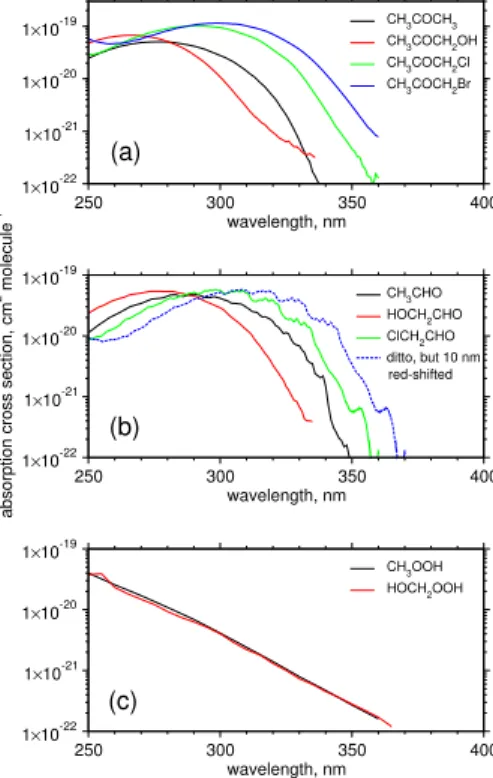
To our knowledge, experimental data for absorption cross sections in the actinic range do not exist for hydroperoxides other than CH3OOH and HOCH2OOH ( Atkin-son et al., 1999;Bauerle and Moortgat,1999). A comparison between their
absorp-20
tion cross sections reveals that the longer-wavelength tails of UV absorption bands for hydroperoxides exhibit no discernible change by the presence of substituents (see Fig. 2c). It is therefore assumed that absorption cross sections for halogenated hy-droperoxides are identical to those for CH3OOH. Then the quantum yields of unity are assumed as with CH3OOH photolysis. Following the MCM protocol for estimating J
val-25
ACPD
3, 4549–4632, 2003Photochemistry of VOCs and halogens
in the MBL
K. Toyota et al.
Title Page
Abstract Introduction
Conclusions References
Tables Figures
◭ ◮
◭ ◮
Back Close
Full Screen / Esc
Print Version Interactive Discussion
©EGU 2003
3.7. Aqueous-phase reactions of peroxyacetic acid (PAA)
Reactions of OH/NO3/Br/Cl with CH3CHO will proceed predominantly via abstraction of aldehydic-H to give CH3C(O)OO radicals in the ambient air (Atkinson et al.,1999):
X+CH3CHO O2
→HX+CH3C(O)OO (70)
where X is either OH, NO3, Br, or Cl. In the remote MBL where NOxconcentrations are
5
relatively low, a fairly large fraction of CH3C(O)OO radicals will react with HO2/CH3OO radicals rather than with NOxto give CH3C(O)OOH (peroxyacetic acid, or PAA) and/or CH3COOH (Jenkin et al.,1997;Atkinson et al.,1999;Saunders et al.,2003):
CH3C(O)OO+HO2→0.71×(PAA+O2)+0.29×(CH3COOH+O3) (71)
CH3C(O)OO+CH3OO O2
→
10
0.7×(CH3OO+CO2+HCHO+HO2)+0.3×(CH3COOH+HCHO+O2). (72)
Henry’s law constants and acid dissociation constants in water have been determined experimentally for both CH3COOH and PAA so that their uptake onto sea-salt aerosols can be simulated quite reasonably. In addition, rate coefficients for the aqueous-phase oxidation of S(IV), Br−, and Cl−by PAA have been experimentally determined (Fortnum
15
et al.,1960;Lind et al.,1987), allowing quantitative estimates of their impacts:
HSO−
3 +PAA H+
→SO24−+2 H++CH3COOH (73)
Br−+PAA
→BrO−+CH3COOH (74)
Cl−+PAA→ClO−+CH
3COOH. (75)
Pandis and Seinfeld(1989), using a numerical model, demonstrated that Reaction (73)
20
ACPD
3, 4549–4632, 2003Photochemistry of VOCs and halogens
in the MBL
K. Toyota et al.
Title Page
Abstract Introduction
Conclusions References
Tables Figures
◭ ◮
◭ ◮
Back Close
Full Screen / Esc
Print Version Interactive Discussion
©EGU 2003
as that from Br− +O3 and about a few percent of those from Br−/Cl− +HSO−5 (see Sect.5.6).
4. Model description and experimental settings
Numerical experiments in the present work are performed by the box model SEAMAC, which describes chemistry of Ox, HOx, NOy, SOx, Clx, Brxspecies, hydrocarbons, and
5
their oxidation products in the gas phase and in the deliquesced sea-salt aerosols oc-curring in the MBL of 1 km thickness (Toyota et al.,2001). SEAMAC owes its basic architecture to the ASAD atmospheric chemistry integration package (Carver et al., 1997), which allows flexible modifications of reaction scheme. As described in the previous section, the reaction scheme is updated to achieve a near-explicit
descrip-10
tion of degradation of up to C3-hydrocarbons. Consequently, the model includes 199 gas-phase species undergoing 645 reactions and 100 aqueous-phase species under-going 279 reactions. Chemical interactions between the gas- and aerosol-phases are treated as reversible mass transfer (43 species), irreversible uptake onto aerosols (1 species: H2SO4), or heterogeneous surface reactions on aerosols (10 species).
Ki-15
netic parameters have also been updated from those in our previous work (Toyota et al.,2001), where new experimental data are available (see the electronic supple-ment (http://www.atmos-chem-phys.org/acpd/3/4549/acpd-3-4549 supp.zip) for a full account of reactions considered in the present work). Size-dependent aerosol pro-cesses are expressed by segregating the size distributions of sea-salt aerosols into 8
20
size bins according to their dry radius (from 0.06 µm to 16 µm). For each bin, volumetric mean values are prescribed for liquid water content, atmospheric residence time, and mass transfer coefficients of chemical species, based on methods described inToyota et al. (2001). The size distributions of dry sea-salt aerosols are taken fromPorter and Clarke (1997), and linearly scaled to yield the total mass concentrations predicted by an
25
ACPD
3, 4549–4632, 2003Photochemistry of VOCs and halogens
in the MBL
K. Toyota et al.
Title Page
Abstract Introduction
Conclusions References
Tables Figures
◭ ◮
◭ ◮
Back Close
Full Screen / Esc
Print Version Interactive Discussion
©EGU 2003
of 9 m/s, which yields 16.4 µg/m3for the mass concentration of dry sea-salt aerosols. Actinic flux is calculated based on a two-stream algorithm in the pseudo-spherical at-mosphere (Kylling,1995;Kylling et al.,1995). It is assumed that the actinic flux inside aerosol particles is enhanced by a factor of two relative to that in the surrounding air as a result of multiple scattering within the particles (Ruggaber et al.,1997). Numerical
5
integration is performed with the Livermore Solver for Ordinary Differential Equations with general Sparse jacobian matrix (LSODES) (Hindmarsh,1983). Although actual time steps for integration are determined internally by LSODES depending on the stiff -ness of the ordinary differential equation system, the external time step is set to 120 seconds at which interval diurnally varying photolysis rates (J values) are given.
10
The mid-latitude remote MBL condition is assumed for all model runs: 40◦N, Julian day 80 (equinox), 340 DU total ozone, clear sky, and the sea surface albedo of 0.05 for calculating actinic flux; 1013.25 hPa total pressure, 293 K temperature, and 76.2% relative humidity for calculating reaction rates and hygroscopic particle growth. O3 mixing ratio is fixed at 20 nmol/mol (Johnson et al., 1990;Oltmans and Levy,1994).
15
The mixing ratios of relatively long-lived VOCs are also fixed at values typical of re-mote MBL: [CH4] = 1.7 µmol/mol, [C2H6] = 400 pmol/mol, [C3H8] = 18 pmol/mol, [C2H2]=35 pmol/mol, and [CO]=80 nmol/mol (Gregory et al.,1996); [CH3COCH3] =400 pmol/mol (Singh et al.,2001); [CHBr3]=1 pmol/mol (Penkett et al.,1985; Yok-ouchi et al.,1997).
20
For shorter-lived species such as alkenes, nitrogen oxides, and DMS, influxes from the ocean surface and/or from the free troposphere are invoked to maintain their calcu-lated mixing ratios in the MBL (see Table2). The oceanic emissions of C2H4and C3H6 are taken from five independent works, which derived different values by more than an order of magnitude (Donahue and Prinn, 1990; Bonsang, 1993; Plass-D ¨ulmer et al.,
25
ACPD
3, 4549–4632, 2003Photochemistry of VOCs and halogens
in the MBL
K. Toyota et al.
Title Page
Abstract Introduction
Conclusions References
Tables Figures
◭ ◮
◭ ◮
Back Close
Full Screen / Esc
Print Version Interactive Discussion
©EGU 2003
and by emission from the ocean (7×10⁷molecule cm−2s−1). A large fraction of NO,
NO2, and PAN will be converted to HNO3 or BrONO2 via photochemical processes in the MBL, thereby serving as a source of NO−
3 in the sea-salt aerosols along with HNO3 entrained from the free troposphere. Similarly, DMS emitted from the ocean (2×10⁹molecule cm−2s−1) will be oxidized to give SO24− or CH3SO−3. In our model
5
runs NO−
3, SO 2−
4 , and CH3SO−3 thus produced are the principal sources of acidity in sea-salt aerosols (see Figs.3d-f). Among the species emitted from the ocean, NO, C2H4, C3H6, and CH3CHO are primarily produced via photochemical processes in seawater (Zafiriou and McFarland,1981;Ratte et al.,1993,1998;Zhou and Mopper, 1997) and hence their emission rates are scaled by diurnally varying J(NO2) values.
10
Organic oxygenates, whether halogenated or not, will be subject to dry and/or wet deposition. In the present work dry deposition velocities for organic oxygenates are given as follows: 0.1 cm/sec for ketones and alcohols, 0.5 cm/sec for peroxy radicals, hydroperoxides, aldehydes except for CH3CHO, and carbonyl halides (e.g. HCOBr), and 1 cm/sec for carboxylic acids. The dry deposition velocities (v0) are then converted
15
to first-order loss rate coefficients (D) in the model box following an approach taken by Levy et al.(1985):
D= v0 Zmbl
1 1+v0/CMUs
where Zmbl is the MBL thickness (= 1 km), CM is bulk coefficient for mass transfer over the ocean (= 0.0011; Garratt, 1992), and Us is wind speed over the ocean (=
20
9 m/s). The wet deposition is assumed to take place for carboxylic acids, aldehydes, and carbonyl halides as a first-order loss process withτ=8 day.
5. Results and Discussion
In the present work the impacts of acetaldehyde, alkenes, and acetylene on bromine activation are assessed by varying their oceanic emission rates or their mixing ratios
ACPD
3, 4549–4632, 2003Photochemistry of VOCs and halogens
in the MBL
K. Toyota et al.
Title Page
Abstract Introduction
Conclusions References
Tables Figures
◭ ◮
◭ ◮
Back Close
Full Screen / Esc
Print Version Interactive Discussion
©EGU 2003
in the MBL (see Table3). In each run numerical integration is carried out for 20 days long, starting at 0:00 a.m. local sun time. Initially, halogen species are present only in the forms of Br− (∼ 9.8 pmol/mol) and Cl− (∼ 6.4 nmol/mol) within nascent
sea-salt aerosols, HCl (60 pmol/mol) and CHBr3 (1 pmol/mol) in the gas phase. Uptake of sulfur and nitrogen oxides from the gas phase initiates radical chain reactions in the
5
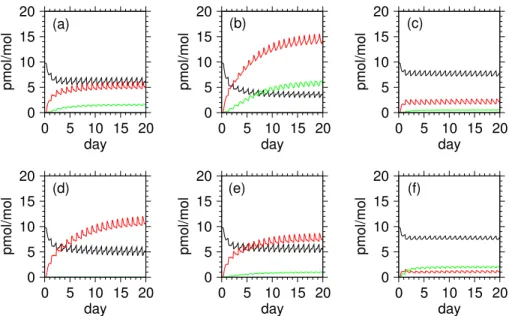
deliquesced sea-salt aerosols, which consequently release a small amount of Br2 to the gas phase. At the same time sea-salt aerosols other than those belonging to the largest-size bin are acidified and buffered to pH of about 4-5 by releasing (or scaveng-ing) HCl to (or from) the gas phase (see Figs.3a-f). Under sunlight Reactions (1)–(10) also operate to release Br2 and BrCl from the acidified sea-salt aerosols and thus the
10
amounts of reactive halogen species increase appreciably with time (see Figs.4a-f). Within 10 days or so, the temporal evolutions of pH and Cl− deficits in the sea-salt aerosols other than those belonging to smallest-size bins are getting stabilized and the buildup of reactive halogens is limited by the decreased availability of Br− in the
sea-salt aerosols. However, pH and Cl− deficits in the sea-salt aerosols of smallest-size
15
bins evolve slowly with time in accordance with the accumulation of sulfate until Day 20. This causes the gradual buildup of reactive halogens lasting until Day 20.
In Runs 1a-e and 2-6, the oceanic emission rate(s) of either CH3CHO or alkenes are varied to examine their impacts on reactive halogen chemistry. Here the mixing ratios of HCHO, CH3CHO, C2H4, and C3H6 are calculated according to their oceanic
20
emissions, photochemical sources/sinks, and dry/wet deposition to the sea surface with the initial mixing ratios given as [C2H4] = [C3H6] = 0 pmol/mol, [CH3CHO] = 90 pmol/mol, and [HCHO]=300 pmol/mol in each run. Their mixing ratios generally reach quasi-steady states on shorter time scales than those of reactive halogens (not shown). Thus the quasi-steady-state levels of reactive halogens after Day 10 and their
25
ACPD
3, 4549–4632, 2003Photochemistry of VOCs and halogens
in the MBL
K. Toyota et al.
Title Page
Abstract Introduction
Conclusions References
Tables Figures
◭ ◮
◭ ◮
Back Close
Full Screen / Esc
Print Version Interactive Discussion
©EGU 2003
5.1. Impacts of oceanic emissions on the mixing ratios of C2H4, C3H6, CH3CHO, and HCHO
First of all, it should be noted that halogen chemistry plays a minor role in the pho-tochemical loss of C2H4, C3H6, HCHO, and CH3CHO in the MBL. Breakdowns of their photochemical loss processes simulated in Run 1a (base run) are as follows: for
5
C2H490% by OH attack, 9% by reaction with O3, and the remaining 1% by reactions with halogen atoms (mainly Cl atoms); for C3H6 83% by OH attack, 14% by reaction with O3, and the remaining 3% by reactions with halogen atoms (mainly Br atoms); for HCHO 64% by photolysis, 35% by OH attack, and 1% by reactions with halogen atoms (mainly Br atoms); for CH3CHO 90% by OH attack, 5% by photolysis, and 5%
10
by reactions with halogen atoms (mostly Br atoms). NO3attacks in the gas phase and aqueous-phase loss processes within deliquesced sea-salt aerosols make negligible contributions to the loss of HCHO and CH3CHO. Thus, the changing level of activity in halogen chemistry as will be demonstrated in the following sections is not a critical factor for determining the mixing ratios of these alkenes and aldehydes.
15
The oceanic emissions of alkenes and their resultant buildup in the MBL, if they are large enough, can appreciably augment the photochemical loss rate of OH radicals (Donahue and Prinn,1990). In our model runs, however, the simulated concentrations of OH radical, which is the most important scavenger of alkenes, change by not more than 25% following more than an order of magnitude change in oceanic alkene fluxes
20
(see Table4). In addition, the mixing ratio of O3, which is the second most important scavenger of alkenes, is fixed at the same value (20 nmol/mol) in all model runs. Thus, the simulated mixing ratios of alkenes are virtually linearly related to their oceanic emis-sion rates. Among the model runs conducted, Run 1a takes the alkene emisemis-sion rates from Bonsang (1993) and then yields 89.9 pmol/mol of C2H4 and 12.6 pmol/mol of
25