J. Serb. Chem. Soc. 73 (12) 1187–1196 (2008) UDC 547.672:54.02:54–74:537.872
JSCS–3798 Original scientific paper
doi: 10.2298/JSC0812187W
1187
Electronic structures and spectra of
conducting anthracene derivatives
ZHONGFA WANG and SHI WU*
Department of Chemistry, Zhejiang University, Hangzhou 310027, PRC (Received 20 June, revised 26 November 2007)
Abstract: Theoretical studies on anthracene and a series of its derivatives were performed using the AM1 method and DFT. Based on B3LYP/6-31G(d) opti-mized geometries, the electronic, IR and NMR spectra of anthracene oligomers were calculated using the Indo/Cis, AM1 and B3LYP/6-31G(d) methods, res-pectively. The energy gaps of the oligomers decreased and the main absorp-tions in the electronic spectra of the oligomers were red-shifted, whereas the IR frequencies for some of the C=C and C–H bonds were blue-shifted with in-creasing chain length and in the presence of substituents. The 13C-NMR chemi-cal shifts of the bridged carbon atoms were upfield shifted in the presence of an electron-donating group, while the chemical shifts of the carbon atoms on the two side rings of the anthracene moiety shifted downfield in the presence of an electron-withdrawing group.
Keywords: anthracene; conducting polymer; energy gap; chemical shift; B3LYP/6-31G(d).
INTRODUCTION
Many polymers possess conductive properties, which has stimulated inten-sive interest of scientists. These conducting polymers are often classified into polythiophene,1–3 polypyrrole,4 polyheterocycles,5,6 polyaniline7 and polyaryl rings.8–12 Henze et al. reported that the stabilities of polythiophene assemblies
are enhanced with increasing chain length.1 Methoxyl substitution in conducting polymers containing conjugated bithiazole moieties led to an improvement of the solubility.5 For conducting copolymers of pyridine with thiophene, n-doped states are more stable than p-doped states.6 Conducting and insulating phases are
pos-sibly located in the same polymer.7 Polymers containing dimethyldihydropyene can be designed for optoelectronic redox switching by the introduction of a pho-tochromic unit.8 New phenanthroline dicarboxamide-based helical foldamers can promote the polymerization of aromatics and oligoamides for potential
tions in biology and material science.11 Weibin et al. achieved the synthesis and characterization of soluble oligo(9,10-bisalkynylanthrylene)s.12
There are some reports on important properties of anthracene polymers, which are of interest for possible applications. Many anthracene moieties are photolu-minescent, and polymers containing such units as a part of the extended -elec-tron system are also likely to be electroluminescent. A film of poly(anthracene- -2,6-diyl) was found to be electroconducting after being doped with potassium naphthalenide polymers and ferric chloride, with conductivities of 4.0×10⁻² and
0.12 S cm–1, respectively. These film showed yellow-green luminescence.13
Po-lyanthracene is partly soluble in organic solvents and its soluble part is a strong blue light emitter.14 On the other hand, poly(9,10-anthracene diylidene) exhibits thermochromism and high thermal stability.15–17
However, there are only a few theoretical reports on the electronic structure and spectroscopy of anthracene derivatives. Herein, a series of such oligomers were designed to explore the effects of chain length and substituents on the energy gaps and spectra. These properties are useful to explain the conductivities and stabilities of conducting polymers.
METHODOLOGY
A linear polymer can be considered as a one-dimensional box. Electrons are delocalized and move over the whole system. Then, a minimum on the potential curve can be found. Based on the monomer anthrylene (compound 1), compounds 2–4 and 5–11 were designed by increasing the chain length and changing the substituents, respectively (Fig. 1). The chain was elongated via 2,6-linkage and the substituents were inserted at the 9,10-positions on the an-thrylene unit.
Fig. 1. The structures of compounds 1–11. Compound 1: n = 1, R = H; Compound 2: n = 2, R = H; Compound 3: n = 3, R = H; Compound 4: n = 4, R= H; Compound 5: n = 1, R = NH2; Compound 6: n = 1, R = NO2; Com-pound 7: n = 2, R = NH2; Compound 8: n = 2, R = NO2; Compound 9: n = 3, R = NH2; Compound 10: n = 3, R = NO2; Compound 11: n = 4, R = NH2.
Full geometry optimization of these compounds without any symmetry restriction was performed step by step using the AM1 method and DFT at the B3LYP/STO-3G, B3LYP/3- -21G and B3LYP/6-31G(d) levels (the optimized geometry of compound 11 at B3LYP/6- -31G(d) level is shown in Fig. S1 in the Supplement, available only in electronic form at http://www.shd.org.rs/jscs).
the generation of 196 configurations. Subsequently, the IR frequencies were computed using the AM1 method. Finally, 13C-NMR chemical shifts were calculated using the Giao method at the B3LYP/6-31G(d) level.
RESULTS AND DISCUSSION
LUMO–HOMO energy gaps
The LUMO–HOMO energy gaps of the unsubstituted compounds 1–4 gra-dually decreased with increasing value of n (Table I); those of compounds 5, 7, 9
and 11with R = NH2 and of compounds 6, 8 and 10 with R = NO2 showed the
same regularity. With decreasing energy gap, electrons can be easily excited from the ground state and, hence, the conductivities of the oligomers increased over those of the monomers. It was experimentally shown that the energy gap of oligo(9,10--bialkynylanthrylene)s decreased from 2.60 (n = 1) to 2.31 eV (n = 5),12
support-ing the above calculation results. The energy gaps of polyanthrylene, and its de-rivatives substituted by amino and nitrate groups were predicted via the extra-polation method to be 2.95, 2.38 and 2.73 eV.25 On the other hand, the energy gaps of compounds 5 and 6 are less than that of compound 1, owing to the pre-sence of the substituents. The electron-donating group affects the energy gap more than the electron-withdrawing group. Comparing the energy gaps of compounds
7–10 with that of compound 1, the same conclusion as above can be drawn. The HOMO energy of the oligomer increased, and the energy gap decreased in the presence of the electron-donating group,31 which supports the present calcula-tions. Therefore, the presence of substituents decreases the energy gaps, improves the conductivities and also enhances the solubilities of the oligomers.
TABLE I.Several variables of compounds 1–11 optimized at the B3LYP/6-31G(d) level
Compounds Variable
1 2 3 4 5 6 7 8 9 10 11
Energy gap / eV 3.599 3.230 3.045 2.995 2.902 3.182 2.615 2.913 2.463 2.760 2.393
/ eV 1.800 1.615 1.523 1.478 1.451 1.591 1.308 1.457 1.232 1.380 1.197
be-tween neighboring anthracene units. Hence, polyanthracenes formed via 9,10-lin-kages will exhibit better conductivities than those formed via 2,6-ling9,10-lin-kages.
Some important variables
Conducting polymers generally display poor thermodynamic stabilities due to their expanded conjugated structures. The improvement of their stability is a main problem. The influence of substituents on stability was investigated in this study. The ionization potential (IP), electron affinity (EA), absolute hardness () and absolute electron negativity () (Table I) changed linearly as the chain length increased. The IP and values of compounds 1–4 decreased with increasing n. Thus, polyanthrylene easily looses electrons and its thermal stability becomes worse. Simultaneously the EA and of compounds 1–4 grew more, leading to the easy reduction of polyanthrylene. Then the polymer is reactive. The experimental IP values of the substituted anthrylene decreased from 5.45 (n = 1) to 5.29 eV (n = 5), whereas the EA values increased from 2.85 (n = 1) to 2.98 eV (n = 5),12 supporting the above calculation results. Observing the values of the four vari-ables of compounds 5, 7, 9 and 11 and 6, 8 and 10, it can be concluded that the polyanthrylenes substituted by electron-withdrawing and donating groups also possess sensitive redox characteristics.
The IP and EA values of compound 5 are lower than those of compound 1, thus it is easy inject holes into compound 5. The IP and EA values of compound
6 are higher than those of compound 1, thus compound 6 easily catch electrons. Hence, the presence of the electron-donating group leads to easy oxidation, whereas the electron-withdrawing group stimulates reduction of the substituted polyan-thrylenes. The values of compounds 5 and 6 are lower than that of compound
1, thus the presence of the substituents does not improve the thermal stability of the polymer.
Intrinsic conducting materials with large EA and values, such as com-pounds 6, 8 and 10, are likely to undergo n-doping. Compounds 5, 7, 9 and 11 of lower IP have a low oxidation potential, resulting in a low resistance and good conductivity. For example, the anthrylene pentamer with the electron-donating group displays a large charge carrier mobility of 2.95×10⁻³ cm2 V–1·s–1.12
Electronic absorption spectra
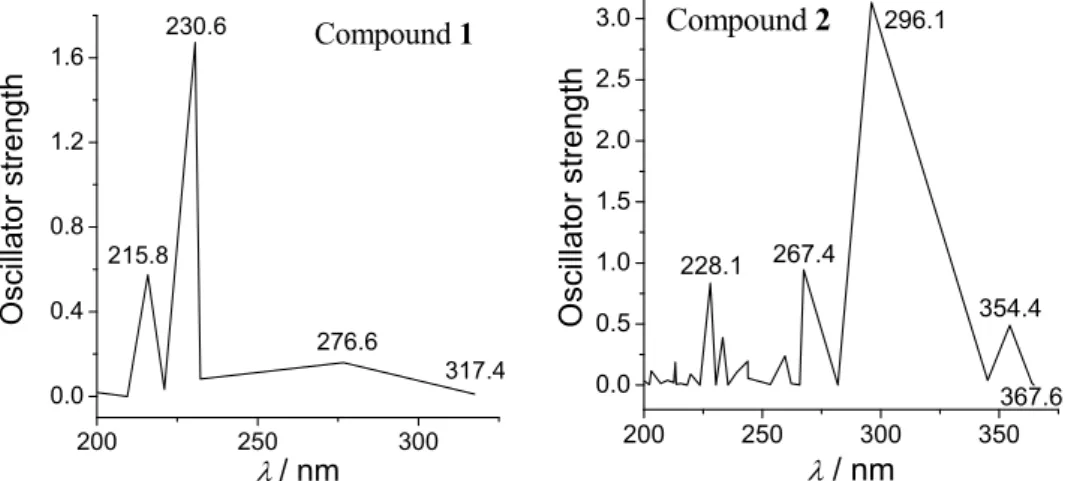
The main absorption peaks in the electronic spectrum of compound 1 were calculated to be at 215.8, 230.6, 276.6 and 317.4 nm. The first absorption at 317.4 nm was scaled by the multiplier 1.18, although its oscillator strength, 0.0109, was small compared with the experimental result 375 nm.14 There was a
the two anthrylene planes are not coplanar in the presence of the large steric ef-fect. The absorptions at 235.2 and 362.4 nm of compound 3 were red-shifted re-lative to 228.1 and 354.4 nm of compound 2. Those at 306.5 and 366.0 nm of compound 4 were also red-shifted in comparison with 304.3 and 362.4 nm of com-pound 3. Thus, the main absorption bands were red-shifted as the chain length in-creased, which is in agreement with the experimental conclusion that the first UV absorptions of substituted anthrylene are red-shifted as n increases from 1 to 5.12
200 250 300
0.0 0.4 0.8 1.2 1.6
317.4
Oscillator strength
/ nm
Compound 1
230.6
215.8
276.6
200 250 300 350
0.0 0.5 1.0 1.5 2.0 2.5 3.0
367.6
Oscillat
o
r st
ren
g
th
/ nm
Compound 2 296.1
267.4 228.1
354.4
Fig. 2. The electronic spectra of compounds 1 and 2 calculated by the Indo/Cis method.
The first peak of compound 5 appeared at 395.2 nm, arising from the -* transition of the HOMO (39) to the LUMO (40), in view of the valence electrons of the Indo method. This absorption was red-shifted compared with that of com-pound 1, which was caused by substitution with NH2 groups. The contribution
coefficients of the Pz atomic orbitals of the two nitrogen atoms to the HOMO
(39) are 0.2256 and –0.2256, and those to the LUMO (40) are both –0.1104. Obviously, the atomic orbitals of the nitrogen atoms participate in the formation of the molecular orbitals and play an important role in the frontier orbitals. This effect results in a decrease of the energy gap and red-shifts of the main electronic transitions. Similarly, the main peaks of compounds 5, 7, and 9 are sequentially red-shifted.
IR spectra
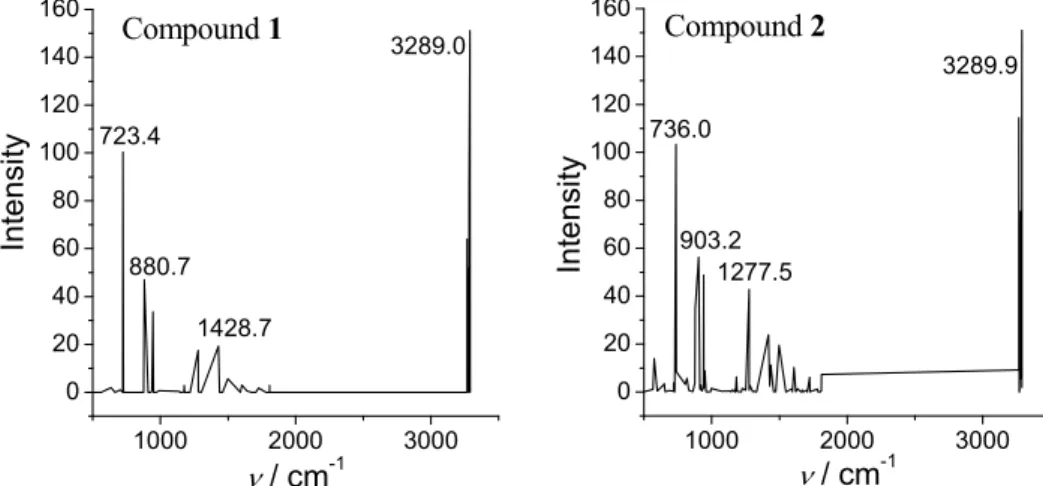
The stabilities of polymers are related to the delocalization of electrons and strength of the main chain bonds, which can be reflected in the IR spectra. The main absorption peaks in the IR spectrum of compound 1 were calculated to be at 723.4, 880.7 and 3289.0 cm–1. The first two bands are assigned to the C–H out-
-of-plane deformation vibrations, which are consistent with the experimental re-sults of 725 and 883 cm–1.14 The last one is attributed to the C–H stretching
vibration. There were large blue-shifts in the absorptions at 736.0, 903.2 and 3289.9 cm–1 of compound 2 relative to those of compound 1 (Fig. 3; the IR
spec-tra of the other compounds are given in Fig. S3 of the Supplement). Simultane-ously, the number of the absorptions increased with increasing chain length. These absorptions of compound 2 were further blue-shifted to 737.5, 908.0 and 3290.0 cm–1 in compound 3. This indicates that the C–H bonds were strengthened with
enlargement of the conjugation system and delocalization of the electrons.
1000 2000 3000
0 20 40 60 80 100 120 140 160
1428.7
Int
ensit
y
/ cm-1
Compound 1
723.4
880.7
3289.0
1000 2000 3000
0 20 40 60 80 100 120 140 160
Int
e
nsity
/ cm-1
Compound 2
736.0
1277.5 903.2
3289.9
Fig. 3. The IR spectra of compounds 1 and 2 calculated by the AM1 method.
The main IR absorptions of compound 5 were at 846.4, 1660.8 and 3292.7 cm–1, i.e., blue-shifted relative to the corresponding bands of compound 1 at
880.7, 1428.7 and 3289.0 cm–1. The absorption at 1660.8 cm–1 of compound 5 is generated by the stretching vibration of the C=C bonds, which is basically con-sistent with the experimental frequency at 1597 cm–1 of the C=C bonds in poly-naphthylene.10 The IR band at 1660.8 cm–1 of compound 5 could be due to
the O–H stretching vibration at 3383 cm–1 in polynaphthylene.10 The absorption at 1658.8 cm–1 resulting from the C=C bonds in compound 7 was red-shifted
relative to that of compound 5. The main absorptions at 853.4, 3293.3 and 3364.7 cm–1 in compound 9 were blue-shifted, whereas the absorption at 1658.1 cm–1
was red-shifted in comparison with the corresponding bands in compound 7. The electron density on the anthrylene ring decreased as the chain length increased, leading to a weakening of the C=C bonds and a strengthening of the C–H and N–H bonds.
The main IR absorptions caused by the C–H bonds of compounds 6, 8 and
10 compared with those of compounds 5, 7 and 9 were blue-shifted, whereas those arising from the C=C bonds were red-shifted. The absorptions near 1867 cm–1 of compounds 6, 8 and 10 resulted from N=O bonds, which were stronger
than the C=O bonds with an experimental stretching frequency at 1743 cm–1.32 The -electron density on the anthrylene ring was delocalized in the presence of the –NO2, which reduced the strength of the C=C bonds.
NMR spectra
The change in electron density of the carbon atoms and symmetry of the oli-gomers can be observed in the NMR spectra, which are helpful in understanding the stabilities of polymers. The chemical shifts of the hydrogen atoms in the
1H-NMR spectra of compounds 1–3 were calculated to be in the ranges 5.4–9.2,
5.3–11.9 and 5.3–12.1 ppm, respectively. Thus, the range of the values of the hydrogen atoms was enlarged and the data were shifted downfield with in-creasing n. The electrons on the hydrogen atoms were delocalized and the shield-ing effect was reduced with the increasshield-ing chain length. The data of the hydro-gen atoms on the naphthylene ring were determined to be at 7.1–7.6 ppm,10
which supports the above calculation.
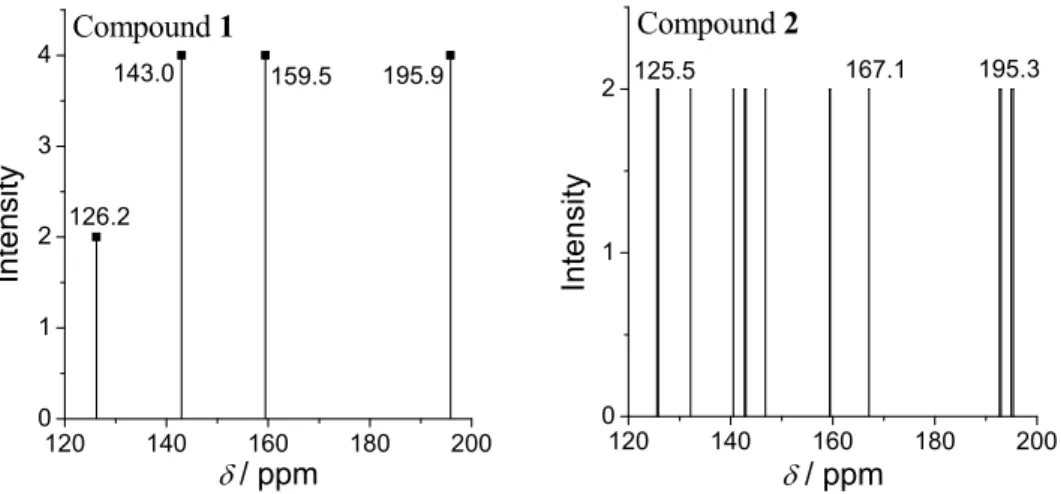
The values of the carbon atoms in the 13C-NMR spectrum of compound 1
appeared in the range 126.2–195.9 ppm. The absorption at 126.2 ppm arose from C(9) and C(10), whereas the absorption at 195.9 ppm is ascribed to C(11)–C(14). The data of C(2) and C(6) for the linkage of the two anthrylene rings in com-pound 2 were shifted downfield to 167.1 ppm (Fig. 4; the NMR spectra of the other compounds are given in Fig. S4 of the Supplement), and the C–C bond was weakened because of the formation of the dimer. In the naphthylene oligomer, the values of the two linkage carbon atoms were also downfield shifted from 118.7 to 120.6 ppm.10 The 13C-NMR absorptions of compound 3 were split
be-cause of the decreased symmetry. The data of C(9) and C(10) in compound 5
and C(10), and C(11)–C(14) in compound 6 were shifted upfield to 87.2 and 184.4 ppm, respectively, while those of C(1), C(4), C(5) and C(8), and C(2), C(3), C(6) and C(7) were shifted downfield to 159.6 and 169.2 ppm, respecti-vely. A similar regularity was observed in the bands of compound 8. The pre-sence of the electron-withdrawing group reduces the electron density on the two side rings, but elevates that on the middle ring in the anthrylene unit.
120 140 160 180 200
0 1 2 3 4
In
te
n
s
it
y
/ ppm Compound 1
126.2
143.0 159.5 195.9
120 140 160 180 200
0 1 2
Intensity
/ ppm Compound 2
125.5 167.1 195.3
Fig. 4. 13C-NMR spectra of compounds 1 and 2 calculated on the B3LYP/6-31G(d) level.
CONCLUSIONS
The electronic structures and spectroscopic characteristics of the anthrylene oligomers were affected by the chain length and substituents. The energy gaps of the oligomers decreased with increasing number of repeating units, thus polyan-thrylene becomes a conducting polymer. The presence of the substituents decreases the energy gaps of the oligomers. Substitution by NO2 or NH2 groups and
elon-gation of the chain length lead to red-shifts of the main absorptions in the elec-tronic spectra of the oligomers. The electron density on the bridged carbon atoms in the anthrylene ring was elevated on substitution by amino groups; thus the C=C and C–H bonds are strengthened. The anthrylene polymer with the amino groups was predicted to be a better conducting material because of its lower oxi-dation potential and energy gap.
SUPPLEMENT
В
А А В ВА АА А А
ZHONGFA WANG SHI WU
Department of Chemistry, Zhejiang University, Hangzhou 310027, PRC
AM1
DFT. B3LYP/6-31G(d)
-, IR NMR Indo/Cis, AM1 and B3LYP/6-31G(d)
, . ,
, IR
C=C and C–H
-. 13C-NMR
- ,
- .
( 20. , 26. 2007)
REFERENCES
1. O. Henze, W. J. Feast, F. Gardebien, P. Jonkheijm, R. Lazzaroni, P. Leclère, E. W. Meijer, A. P. H. J. Schenning, J. Am. Chem. Soc. 128 (2006) 5923
2. P. Lu, G. M. Xia, J. Serb. Chem. Soc. 70 (2005) 201
3. G. M. Xia, P. Lu, G. B. Xu, J. Serb. Chem. Soc. 69 (2004) 335 4. C. Visy, E. Pinter, T. Fülei, R. Patakfalvi, Synth. Met. 152 (2005) 13 5. I. H. Jenkins, P. G. Pickup, Macromolecules 26 (1993) 4450 6. I. H. Jenkins, U. Salzner, P. G. Pickup, Chem. Mater. 8 (1996) 2444 7. J. Y. Bergeron, L. H. Dao, Macromolecules 25 (1992) 3332
8. M. J. Marsella, Z. Q. Wang, R. H. Mitchell, Org. Lett. 2 (2000) 2979 9. I. Cianga, Y. Yagci, Prog. Polymer Sci. 29 (2004) 387
10. Y. Sasada, Y. Shibasaki, M. Suzuki, M. Ueda, Polymer 44 (2003) 355 11. Z. Q. Hu, H. Y. Hu, C. F. Chen, J. Org. Chem. 71 (2006) 1131
12. W. Cui, X. Zhang, X. Jiang, H. Tian, D. Yan, Y. Geng, X. Jing, F. Wang, Org. Lett. 8
(2006) 785
13. Hodge, G. A. Power, M. A. Rabjohns, Chem. Commun. (1997) 73 14. B. Fan, L. Qu, G. Shi, J. Electroanal. Chem. 575 (2005) 287
15. M. Baumgarten, U. Müller, A. Bohnen, K. Müllen, Angew. Chem. Int. Edn. Engl. 31
(1992) 448
16. I. Schopov, C. Jossifov, Polymer 19 (1978) 1449
17. M. Satoh, F. Uesugi, M. Tabata, K. Kaneto, K. Yoshino, J. Chem. Soc. Chem. Commun.
12 (1986) 979
Salvador, J. J. Dannenberg, V. G. Zakrzewski, S. Dapprich, A. D. Daniels, M. C. Strain, O. Farkas, D. K. Malick, A. D. Rabuck, K. Raghavachari, J. B. Foresman, J. V. Ortiz, Q. Cui, A. G. Baboul, S. Clifford, J. Cioslowski, B. B. Stefanov, G. Liu, A. Liashenko, P. Piskorz, I. Komaromi, R. L. Martin, D. J. Fox, T. Keith, M. A. Al-Laham, C. Y. Peng, A. Nanayakkara, M. Challacombe, P. M. W. Gill, B. Johnson, W. Chen, M. W. Wong, C. Gonzalez, J. A. Pople, Gaussian 03, Revision B. 01, Gaussian Inc., Pittsburgh, PA 2003 19. S. Wu, Q. Teng, X. Chen, R. Zhou, Chem. J. Chin. Univ. 24 (2003) 1271
20. L. Zhu, Q. Teng, S. Wu, J. Serb. Chem. Soc. 72 (2007) 375 21. L. Qi, Q. Teng, S. Wu, Z. Liu, Chem. J. Chin. Univ. 26 (2005) 1909 22. Z. Wang, S. Wu, Chem. Pap. 61 (2007) 313
23. A. N. Pankratov, A. V. Shalabay, J. Serb. Chem. Soc. 72 (2007) 151 24. L. Ding, Y. Ding, Q. Teng, K. Wang, J. Chin. Chem. Soc. 54 (2007)853 25. L. Yang, A. M. Ren, J. K. Feng, J. F. Wang, J. Org. Chem. 70 (2005) 3009 26. S. Wu, Q. Teng, Int. J. Quantum Chem. 106 (2006) 526
27. Q. Teng, S. Wu, J. Mol. Struct. (TheoChem) 756 (2005) 103 28. Q. Teng, S. Wu, J. Mol. Struct. (Theochem) 719 (2005) 47 29. Q. Teng, S. Wu, Int. J. Quantum Chem. 104 (2005) 279
30. M. A. Thompson, M. C. Zerner, J. Am. Chem. Soc. 113 (1991) 8210 31. M. A. Hsu, T. J. Chou, J. Chin. Chem. Soc. 52 (2005) 811