Electronic Journal of Plant Breeding, 6(2): 600-602 (June 2015) ISSN 0975-928X
http://ejplantbreeding.com 600
Research Note
Genetic variability study in pearl millet
(
Pennisetum glaucum
(L.) R. Br.
for green fodder yield and related traits
Nagendra Kanwar Bika * and S. S. Shekhawat
S. K. Rajasthan Agricultural University, Bikaner-334006, Rajasthan, India * E-mail: [email protected]
(Received:26 Dec 2014; Accepted:11 Feb 2015)
Abstract
A field experiment was carried out in pearl millet (Pennisetum glaucum (L.) R. Br.) with 30 genotypes including three check varieties, to study genetic variability for green fodder yield and its related characters. The observations were recorded on individual plant basis for five randomly selected plants of each genotype for each replication for plant height, leaf length, leaf width, stem thickness, internode length and spike length. Days to 50% flowering, number of tillers per meter row length, dry matter per cent, dry matter yield, leaf area, green fodder yield and ash content were observed on plot basis. The results revealed that the genotypes were significantly different for all the 13 characters, indicating sufficient variability in the experimental material. The characters dry matter yield, leaf: stem ratio, green fodder yield, leaf area, spike length and number of tillers per meter row length showed high GCV and PCV. High estimates of heritability along with high genetic advance (% of mean) were observed for number of tillers per meter row length, leaf stem ratio, spike length, green fodder yield, dry matter yield and leaf area. Therefore, selection for these characters will be more effective.
Keywords
Pearl millet, Genetic variability, heritability, genetic advance Pearl millet (Pennisetum glaucum (L.) R. Br.) is
world’s sixth and India’s fourth important cereal food crop after rice, wheat and maize. Pearl millet is an important food and fodder crop of short duration in India. The efficiency of milch as well as draught animals largely depends upon the supply of quality of ration in which green fodder plays a vital role. In the recent years, shortage of fodder has remained the burning problem which calls for the attention of researchers to initiate efforts that can ensure regular fodder supply for development of dairy farming and improving the cattle wealth. Pearl millet is rated as good source of fodder owing to its prolific regeneration capacity, good growth, heavy tillering, leafiness, thin and succulent stem and capacity to provide nutrients. It is valuable as cattle feed on account of its good utility and high albuminoids and fat content. The straw of this crop is fairly rich in carbohydrates (67%). Some of other important quality aspects of forage are protein (11.6%), lignin, dry matter yield and its digestibility. The development of new high yielding varieties of green fodder requires knowledge of the existing variability and also the extent of association among the yield contributing characters. The variability in plant population is the first need for genetic improvement in any crop. The amount of variability for improving economic characters in the germplasm of any crop sets the limit of progress that can be achieved through selection. The extent of variability is measured by GCV and PCV which provides information about relative amount of variation in different characters.
Heritability provides sufficient indication about the cause or complexity of improvement in a character. Development of a plant breeding strategy hinges mainly on the support provided by genetic information on the inheritance and behavior of major quantitative characters associated with the yield or any other economic trait of concern to the plant breeder. Hence the present investigation was undertaken.
Electronic Journal of Plant Breeding, 6(2): 600-602 (June 2015) ISSN 0975-928X
http://ejplantbreeding.com 601
calculated as per formula suggested by Burton (1952) and Johnson et al. (1955). Heritability was estimated by the formula as suggested by Johnson et al. (1955). The expected genetic advance at 5% selection intensity was calculated by formula as given by Lush (1940) and Johnson et al. (1955).
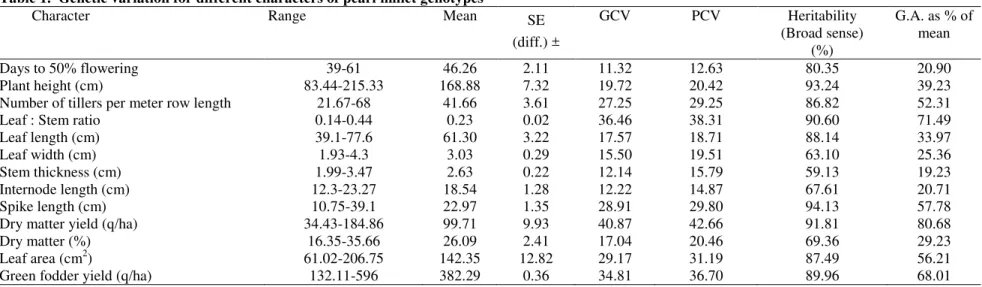
The analysis of variance revealed that genotypes differed significantly for days to 50% flowering, plant height, number of tillers per meter row length, leaf : stem ratio, leaf length, leaf width, stem thickness, internode length, spike length, dry matter yield, dry matter (%), leaf area and green fodder yield indicating that sufficient variability was present in the material for the characters studied. The estimates of GCV, PCV, heritability and GA as per cent of mean for 13 characters was given in Table 1. Comparison of coefficients of variance indicated that phenotypic coefficient of variance was higher than the genotypic coefficient of variance for all the characters, which indicated that the environment plays a role in the expression of characters. The high GCV and PCV were observed for dry matter yield, leaf : stem ratio, green fodder yield, leaf area, spike length and number of tillers per meter row length. It indicates that selection can be applied on the traits to isolate more promising line. Moderate GCV and PCV were observed for plant height, leaf length, dry matter per cent and leaf width This indicates these characters can be improved by the vigorous selection. Low GCV and PCV were observed for internode length and days to 50 % flowering. It indicates that the breeders should go for source of high variability for these traits to make improvement. High and significant variability was reported earlier for leaf: stem ratio by Ghazy et al. (2012); for leaf area by Aryana et al. (1996); for number of tillers and fodder yield by Vidyadhar et al. (2007); for number of tillers, leaf: stem ratio and green fodder yield by Shanmuganathan et al. (2006); and for dry matter yield by Nagar et al. (2006).
In general the heritability estimates were high for most of characters. High heritability was reported for leaf: stem ratio by Shanmuganathan et al. (2006) and Ghazy et al. (2012); for green fodder yield by Lakshmana and Guggari (2001), Khatri et al. (2002), Bochaliya (2005), Shanmuganathan et al. (2006), Vidyadhar et al. (2007) and Gangaram (2011); for dry matter yield by Rathore (1993) and Nagar et al. (2006) and for leaf area by Bochaliya (2005). Genetic advance as per cent of mean was high for all traits except stem thickness. Stem thickness recorded moderate level of genetic advance as per cent of mean.
To conclude, heritability estimates along with genetic advance were more useful than heritability
estimates alone in predicting this response to selection. High heritability along with high genetic advance (% of mean) was observed for number of tillers per meter row length, leaf length, spike length, green fodder yield, dry matter yield and leaf area. In this condition, selection will be more effective. Low heritability and low genetic advance (% of mean) was observed for stem thickness and inter node length, where the response to selection will be poor.
References
Aryana, K.J., V.M. Kulkarni, S.C. Desale, and P.A. Navale. 1996. Variability, heritability and genetic advance in pearl millet (Pennisetum glaucum (L.) R. Br.). Crop Res.- (Hisar), 12 (3) : 399-403. Bochaliya, T.C. 2005. Genetic variability in germplasm
lines of pearl millet. (Pennisetum glaucum (L.) R. Br.). M.Sc.(Ag.) Thesis, Rajasthan Agricultural University, Bikaner.
Burton, G.W. 1952. Quantitative inheritance in grasses.
Proc.VI. International Grassland Congr. ,1: 155-157.
Gangaram. 2011. Comparative study of S1 and open
pollinated progenies of pearl millet [Pennisetum glaucum (L.) R. Br. emends stuntz] for green fodder yield and its components. M.Sc. Thesis, SKRAU, Bikaner.
Ghazy, M.F. Mona and S.S.M.Abo-Feteih. 2012. Estimation of genetic parameters of yield and yield component in selected genotypes of forage pearl millet. J. Agric. Res. Kafer El-Sheikh Univ., 38(1): 72-82.
Johnson, H.W., H. F. Robinson and R. E. Comstock. 1955. Estimates of genetic and environmental variability in Soybean. Agron. J., 47 : 314-318. Khatri, R.S., R. Avtar, D.S. Phogat, and S.K. Pahuja.
2002. Genetic variability and association between fodder yield and its components in pearl millet.
Nat. J. Plant Improv., 4(2) : 60-61.
Lakhsmana, D. and A.K. Guggari. 2001. Variability studies in white grain pearl millet. Karnataka J. Agric. Sci., 14(3) : 793-795.
Lush, J.L. 1940. Intra-sire correlation and regression of offspring on dam as a method of estimating heritability of characters. Proceed. American Society of animal Production, 33:293-301. Nagar, R.P., D. Singh, and R.K. Jain. 2006. Genetic
variability in fodder pearl millet. Range Mgmt. & Agrofor., 27 (1): 55-57.
Rathore, S.S. 1993. Assessment of elite Bajra (Pennisetum americanum) germplasm for fodder yield and quality traits in arid and semi-arid conditions of Rajasthan. M.Sc. (Ag) Thesis, RAU, Bikaner.
Shanmuganathan, M., A. Gopalan and K. Mohanraj. 2006. Genetic variability and multivariate analysis in pearl millet (Pennisetum glaucum (L.) R. Br.) germplasm for dual purpose. J. Agric.Sci.,
2(1): 73-80.
Electronic Journal of Plant Breeding, 6(2): 600-602 (June 2015) ISSN 0975-928X
http://ejplantbreeding.com 602
Table 1. Genetic variation for different characters of pearl millet genotypes
Character Range Mean SE
(diff.) ±
GCV PCV Heritability
(Broad sense) (%)
G.A. as % of mean
Days to 50% flowering 39-61 46.26 2.11 11.32 12.63 80.35 20.90
Plant height (cm) 83.44-215.33 168.88 7.32 19.72 20.42 93.24 39.23
Number of tillers per meter row length 21.67-68 41.66 3.61 27.25 29.25 86.82 52.31
Leaf : Stem ratio 0.14-0.44 0.23 0.02 36.46 38.31 90.60 71.49
Leaf length (cm) 39.1-77.6 61.30 3.22 17.57 18.71 88.14 33.97
Leaf width (cm) 1.93-4.3 3.03 0.29 15.50 19.51 63.10 25.36
Stem thickness (cm) 1.99-3.47 2.63 0.22 12.14 15.79 59.13 19.23
Internode length (cm) 12.3-23.27 18.54 1.28 12.22 14.87 67.61 20.71
Spike length (cm) 10.75-39.1 22.97 1.35 28.91 29.80 94.13 57.78
Dry matter yield (q/ha) 34.43-184.86 99.71 9.93 40.87 42.66 91.81 80.68
Dry matter (%) 16.35-35.66 26.09 2.41 17.04 20.46 69.36 29.23
Leaf area (cm2) 61.02-206.75 142.35 12.82 29.17 31.19 87.49 56.21