800 Brazilian Journal of Physics, vol. 34, no. 3A, September, 2004
Spatial Variability and Cesium-137 Inventories in Native Forest
A. C. Andrello and C. R. Appoloni
Universidade Estadual de Londrina, Departamento de F´ısica, CCE, Campus Universit´ario, CEP 86051-990, Londrina, PR, Brazil
Received on 17 September, 2003
With the nuclear fission discovery and development of nuclear weapons in 1940s, artificial radioisotopes were introduced in the environment. This contamination is due to worldwide fallout by superficial nuclear tests real-ized from early 1950s to late 1970s by USA, former URSS, UK, France and China. One of theses radioisotopes that have been very studied is cesium-137. Cesium-137 has a half-life of 30.2 years and its biological behavior is similar to the potassium. The behavior in soil matrix, depth distribution, spatial variability and inventories values of cesium-137 has been determinate for several regions of the world. In Brazil, some research groups have worked on this subject, but there are few works published about theses properties of cesium-137. The aim of this paper was study the depth distribution, spatial variability, and inventory of cesium-137 in native forest. Two native forests (Mata 1 and Mata UEL) were sampling in region of Londrina, PR. The results shows that there is a spatial variability of 40% for Mata 1 and 42% for Mata UEL. The depth distribution of cesium-137 for two forests presented a exponential form, characteristic to undisturbed soil. Cesium-137 inventory determinate for Mata 1 was 358 Bq m−2and for Mata UEL was 320 Bq m−2.
1
Introduction
Because of nuclear fission discovery and atomic weapons development, many nuclear tests were realized, mainly by USA and former URSS until early of 1970s. Before of Lim-ited Nuclear Test Ban Treat, in 1963, the majority of nuclear tests were realized in earth surface, which injected great quantity of debris into troposphere and stratosphere. Ra-dioisotopes formed in nuclear explosion contaminated the debris, and when these contaminated particles reach tro-posphere and stratosphere, it is dispersed by atmospheric winds and are droplets gradually fall back to earth. This effect is referred to as fallout. Although the nuclear plant ac-cidents have contributed with radioisotopes contamination, it is only as local fallout in the nearest regions.
Several radioisotopes were introduced in the environ-ment by nuclear explosion, and one that has been widely study is cesium-137. Cesium-137 has a half-life of 30.2 years and its biological behavior is similar to the potas-sium. When cesium-137 reaches the earth’s surface, it is rapid and tightly adsorbed by fine particles of soil. After adsorbed by soil, cesium-137 has a limited movement by chemical processes, and its redistribution in landscape is due to soil movement by physical processes. Because of this, cesium-137 has been used in superficial soil erosion assess-ment. Many works has been developed utilizing cesium-137 methodology in soil erosion determination in different coun-tries [1-5]. In Brazil, scarce works has been realized using cesium-137 methodology for soil erosion quantification [6-9].
To use cesium-137 methodology, the knowledge of cesium-137 behavior and depth distribution in soil,
spa-tial variability and inventory value is necessary. Many au-thors has devoted works to determine depth distribution, in-ventories values and spatial variability of cesium-137 [10-12]. Ritchie et al [13] presented cesium-137 inventory of 1590 Bq m−2 in Mississipi, USA. Martz and de Jong
[14] presented cesium-137 inventory of 2537 Bq m−2 in
Saskatchewan, Canada. Owens et al [15] presented cesium-137 inventory of 2172 Bq m−2in Yendacott, UK and 252.3
Bq m−2in Masna, Zimbabwe.
In Brazil, Guimar˜aes [6] presented cesium-137 inven-tory of 306 Bq m−2in a basin of Piracicaba, SP and Bacchi
et al [8] presented cesium-137 inventory of 419 Bq m−2in
another basin of the same region. Andrello et al [9] pre-sented cesium-137 inventory of 292 Bq m−2 in Londrina,
PR. Cambray et al [16] shown that cesium-137 inventory of North Hemisphere is one order greater than cesium-137 in-ventory of South Hemisphere, as presented above.
Walling and Quine [17] presented several depth distri-bution of cesium-137 in different soil classes. In undis-turbed soil, cesium-137 concentration shows an exponential decrease with depth, and in cultivated soil it is uniformly distributed in plough layer due to soil tillage.
In Brazil, little works present depth distribution of cesium-137. Guimar˜aes [6] presented cesium-137 profile for three samples sites in cultivated soil, which shows an uniform depth distribution of cesium-137 activity. Bacchi et al [8] presented cesium-137 profile in undisturbed soil as result of average value of eight samples sites, in increments of 5 cm, which show an exponential decrease in depth.
A. C. Andrello and C. R. Appoloni 801
2
Methodology
To determine the depth distribution of cesium-137 in undis-turbed soil, two native forests were sampling at region of Londrina, PR, named Mata 1 and Mata UEL. These forests are Lowland rainforests and soil is classified as Oxisol. The slope of Mata 1 is 10 - 20% and for Mata UEL is 3 - 5%. Mata 1 had a 3 cm thickness of dried leaf and mulch on soil surface and presented a great quantity of little roots through to the soil profile that was sampled. Mata UEL had a 2 cm thickness of dried leaf and mulch on soil surface and pre-sented little roots to 5 cm depth. In each forest, one site was sampling in depth increments of 1, 2, 4 and 5 cm, where was taking care to choose these sites far of great trees and holes for not sampling sites with cesium-137 accumulation due to rain water runoff through of stem and root of trees at time of fallout. In these sites, an area of 1 m2was defined and three replicate of 80 cm2was sampling for each depth increment. These three replicates were bulked, so that the punctual vari-ability of cesium-137 was diminished, resulting soil samples of 2 kg for each depth increments. The samples of these two sites were used to determine the depth distribution of cesium-137 for two forests. In addition, was sampling a grid with nine sites in each forest, which were used to determine the spatial variability and the average value of cesium-137 inventory. In each site of grid, an area of 1 m2was defined and three replicates of 80 cm2 were sampled. Each repli-cate were formed of three depth increments, 0 - 5 cm, 5 - 15 cm, 15 - 30 cm. These three replicates for each depth incre-ment were bulked, so that each site in grid had three depth increment samples.
All samples were dried in open air for 48 hours. After each sample reach your dried weight, it was sieved in 2 mm mesh and packed in Marinelli beaker of 2 liters for gamma ray spectrometry with HPGe detector and shield for environ-mental samples. The time acquisition for each samples was 24 hours and the limit detection was 0.29 Bq kg−1.
Cesium-137 concentration of samples was determined at the 95% confidence level.
3
Results
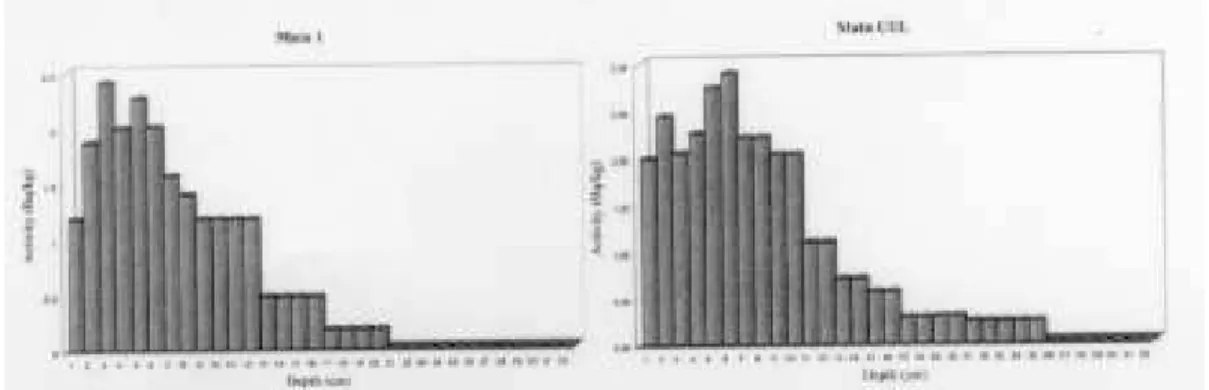
Figure 1 shows depth distribution of cesium-137 for two forests. These figure shows that 66% of cesium-137 is con-centrate in firsts 6 cm of soil. Analyzing the cesium-137 pro-file for Mata 1 (Figure 1a) can be seen that cesium-137 activ-ity increase in first centimeters and then decrease exponen-tially, having no detected cesium-137 below to 20 cm. Ana-lyzing the cesium-137 profile for Mata UEL (Figure 1b) can be seen that cesium-137 increase to 6 cm and then decrease exponentially having no detected cesium-137 below to 25 cm. This difference in cesium-137 profile of two forests can be due to there are animal perturbation in the firsts
centime-ters of Mata UEL. Depletion of cesium-137 in the first cen-timeter of two forests can be due to soil loss or cesium-137 migrations in the soil matrix.
Cesium-137 inventory determinate in these two sites was 241±9 Bq m−2for Mata 1 and 325±7 Bq m−2for Mata
UEL. Table 1 present cesium-137 concentration of the depth increments in the sampling sites of grid.
Can be seen of Table 1 that for all sampling sites in two forests, 86% of cesium-137 concentration is concentrate in firsts 15 cm. For nine sites of each grid, five sites in Mata 1 and four sites in Mata UEL presented cesium-137 concen-tration below of limit detection. According to depth distri-butions of cesium-137 for Mata 1, cesium-137 was detected only to 20 cm, so that the profile 15-30 cm for this forest is a mixture of soil with cesium-137 and soil with no cesium-137 that generated cesium-137 dilution in this profile. For Mata UEL, that presented cesium-137 until 25 cm, little soil with no cesium-137 was incorporated in soil with cesium-137.
Cesium-137 inventory determinate for all sites in grids change from 171 ±35 Bq m−2to 595±85 Bq m−2for
Mata 1 and from 119±34 Bq m−2to 506±56 Bq m−2
for Mata UEL. Average value of cesium-137 inventory for Mata 1 was 359 ± Bq m−2 and 321 ±137 Bq m−2 for
Mata UEL. Spatial variability of cesium-137 was 40% for Mata 1 and 42% for Mata UEL. This mean that there was a non-homogeneous deposition in the sampling forests, which can been due to the great canopy in this forests as well as by water runoff in stem and roots in time of fallout. Comparing the average value of cesium-137 inventory can be perceived that there is a spatial variability of 10% between two sam-pling forests, which can be due to different rainwater precip-itation since Mata 1 is located 15 km beside of Mata UEL.
4
Conclusion
Regarding Fig. 1, can be observed that the depth distri-butions for two forests show a exponential decrease be-low of the firsts centimeters. Besides that, spatial variabil-ity show that there is need have refined sampling to deter-mine cesium-137 inventory with a low spatial variability in forests. Although the soil analyzed in this work is clayed soil, the results obtained for depth distribution of cesium-137 are similar to that presented by Guimar˜aes [6] and Bac-chi et al [8] for sandy soil in undisturbed site. This show that cesium-137 present exponential decrease with depth and similar behavior of cesium-137 for these two soil kind.
Acknowledges
802 Brazilian Journal of Physics, vol. 34, no. 3A, September, 2004
Figure 1. Depth distribution of cesium-137 for Mata 1 and Mata UEL.
TABLE 1. Cesium-137 concentration determinate for the sampling sites of grids. Sampling
Sites
Depth increments (cm)
Mata 1
Activity per unit mass (Bq kg−1)
Mata UEL
Activity per unit mass (Bq kg−1)
Site 1
0 - 5 5 - 15 15 - 30
2.19 2.13 0.72
0.90 0.43 0.12 Site 2
0 - 5 5 - 15 15 - 30
2.79 2.50 0.88
2.21 1.50 0.45 Site 3
0 - 5 5 - 15 15 - 30
1.89 1.34 0.17
1.82 0.77 0.35 Site 4
0 - 5 5 - 15 15 - 30
2.88 1.57 0.25
1.61 1.09 0.92 Site 5
0 - 5 5 - 15 15 - 30
3.62 1.55 0.35
1.17 0.40 0.00 Site 6
0 - 5 5 - 15 15 - 30
2.12 1.17 0.51
2.22 1.96 0.49 Site 7
0 - 5 5 - 15 15 - 30
1.52 0.70 0.17
1.52 0.99 0.29 Site 8
0 - 5 5 - 15 15 - 30
1.30 0.57 0.09
2.08 1.32 0.26 Site 9
0 - 5 5 - 15 15 - 30
2.02 0.73 0.17
2.16 1.72 0.38
References
[1] J. C. Ritchie and J. R. McHenry, J Environ Qual, 19, 215 (1990)
[2] G. L. Elliott, B. L. Campbell, R. J. Loughran, Appl Radiat Isot,41, 713 (1990)
[3] J. J. Kiss, E. de Jong, L. W. Martz, J Environ Qual,17, 445 (1988)
[4] D. E. Walling and Q. He, J Environ Qual,28, 611 (1999)
[5] R. G. Kachanoski and E. de Jong, J. Environ Qual,13, 301 (1984)
[6] M. F. Guimar˜aes, Doctored Thesis, CENA/USP, Piracicaba, 107p (1988)
[7] A. C. Andrello, Master degree Dissertation, UEL, Londrina. 105p (1997)
A. C. Andrello and C. R. Appoloni 803
[9] A. C. Andrello, C. R. Appoloni, M. F. Guimar˜aes, Rev Bras Cienc Solo,27, 223 (2003)
[10] R. B. Brown, N. H. Cutshall, G. F. Kling, Soil Sci Soc Am J,
45, 1184 (1981)
[11] F. Garcia-Oliva, R. Martinez Lugo, J. M. Maass, J. Environ Radioactivity,26, 37 (1995)
[12] P. N. Owens and D. E. Walling, Appl. Radiat. Isot.,47, 699 (1996)
[13] J. C. Ritchie, J. A. Spraberry, J. R. McHenry, Soil Sci Soc Amer Proc,38, 137 (1974)
[14] L. W. Martz and E. de Jong, Catena,14, 439 (1987) [15] P. N. Owens, D. E. Walling, Q. He, J Environ Radioactivity,
32, 169 (1996)
[16] R. S. Cambray, K. Playford, G. N. J. Lewis, AERE-R 13575, HMSO, London (1989)