256 Chun-Hua Zeng et al.
Dynamical properties of a mutualism system in the presence of noise and time delay
Chun-Hua Zeng
Faculty of Science, Kunming University of Science and Technology, Kunming 650093, China
Gui-Qin Zhang and Xiao-Feng Zhou∗
Department of Physics, Qujing Normal University, Qujing 655000, China
(Received on 31 October, 2008)
The normalized correlation functionC(s)and the associated relaxation timeTcof the mutualism system in the presence of noise and time delay are investigated. The effects of noise and time delay onC(s)andTcfor a mutualism system are discussed. Based on the numerical computation, it is found that: (i) The noise intensityD
slows down the the fluctuation decay of species density firstly and then enhances it. (ii) The time delayτslows down the fluctuation decay of species density while the mean nterspecies interaction intensityJspeeds up the fluctuation decay of species density.
Keywords: time delay; relaxation time; correlation function; mutualism system
I. INTRODUCTION
The behavior of a nonlinear system under the influence of noise have been widely studied from both theoretical and experimental points of view [1]. Particulary, noise-induced phase transition [2], noise-enhanced stability [3], resonant activation [4], noise-induced nonequilibrium transport [5], noise-induced multistability [6], and stochastic resonance [7, 8] have been intensively investigated in a large variety of physical, and biological systems. However, these investiga-tions neglect the effects induced by time delays. In practice, in many physical as well as biological systems, time delays always exist and play a significant role in the dynamics, such as, biophysiological controls [9], and signal transmissions in biological and artificial neuronal networks[10], and laser dy-namics in optical cavities [11, 12] etc. Meanwhile, it appears that the combination of noise and time delay is ubiquitous in nature and often change fundamentally dynamics of the sys-tem [13–16]. Recently Nie and Mei [17] have studied the effects of noise and time delay in a classical Lotka-Volterra model of the mutualism system, and found that the combina-tion of noise and time delay completely suppressed the pop-ulation explosion of the mutualism system. Yet in order to characterize further the dynamics properties of the mutualism system with noise and time delay, the correlation function and the associated relaxation time of species density should be considerd.
In the present paper, the normalized correlation function C(s)and the associated relaxation timeTcof the mutualism system with noise and time delay are investigated. In section 2, the analytical expressions ofC(s) andTc of the mutual-ism system with noise and time are obtained. The effects of noise and time delay onC(s)andTcare discussed. Finally, a conclusion is given in Section 3.
∗Electronic address:[email protected]
II. STATIONARY PROBABILITY DISTRIBUTION, RELAXATION TIME AND CORRELATION FUNCTION
In order to study the effects of noise and time delay on the relaxation time and correlation function of the mutualism system. First, the effects of noise and time delay on the one-species mutualism system is presented. Then the effects of noise and time delay on the multispecies mutualism system is analyzed.
II.1. The one-species mutualism system
Consider a classical Lotka-Volterra model introduced by Vito Volterra for the description of struggle for existence among species [18, 19]. In the deterministic case, the differ-ential equation describing the one-species mutualism system reads
dx(t)
dt =x(t)[r+ax(t)], (1) wherex is the species density, r is the growth rate, and a represents the intraspecies interaction parameter. We con-sider effects due to some environmental perturbations, such as temperature, and climate, etc. These factors will give rise to a fluctuation of intraspecies interaction parameter. We can rewrite the intraspecies interaction parameterain Eq. (1) as a+√2Dη(t), whereη(t)is the Gaussian white noise defined ashη(t)i=0 andhη(t)η(t′)i=δ(t−t′), in which Dis the noise intensity. If a time delay is also introduced into the sys-tem. Then Eq. (1) can be rewritten as
dx(t)
dt =x(t)[r+ax(t−τ)] + √
2Dx2(x)η(t), (2) whereτis the delay time of the system. The delay Fokker-Plank equation corresponding to Eq. (2) is [20, 21]
∂P(x,t) ∂t =−
∂ ∂x
Z
x(r+axτ)−2Dx3P(x,t;xτ,t−τ)dxτ +D
Z ∂2
∂x2x 4P(x
Brazilian Journal of Physics, vol. 39, no. 2, June, 2009 257
are employed [20–23], the stationary probability distribution (SPD) corresponding to Eq. (3) can be obtained [17, 24] Pst(x) =Nxa
2τ−2 exp
−1
D
h r
2x2+
a x+aτ
r
x+2Dx
i
,(4) hereNare the normalization constant. Then the expectation values of thenth power of the species densityxare given by
hxnist=
R+∞
−∞xnPst(x)dx
R+∞
−∞Pst(x)dx
. (5)
In this paper, we are interested in the stationary correlation function and associated relaxation time, which are used to describe the fluctuation decay of dynamical variablex. The normalized correlation function is [25, 26]
C(s) =exp
− Dhx
4i
st
hx2i
st− hxi2st s
, (6)
and the associated relaxation time is Tc=h
x2ist− hxi2st Dhx4i
st
. (7)
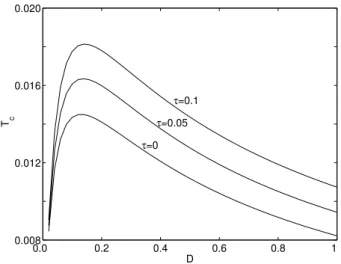
By virtue of the expressions of the normalized correlation function (6) and the associated relaxation time (7). The ef-fects of noise and time delay onC(s)andTccan be studied by the numerical computation, respectively. Tcas a function ofDfor various values ofτis plotted in Fig. 1. From figure 1,Tcincreases firstly and then decreases withDincreasing, showing a single-peak structure. While for a fixedDvalue, as the value ofτincreases, the peak ofTcbecomes higher and the position of the peak does not change.C(s)versus the de-cay timesare shown in Figs. 2 and 3 for various values of
τand for various values ofD, respectively. C(s)decreases exponentially as the decay timesincreases. It is seen that the value ofC(s)increases asτincreases (see Fig. 2), while for a fixedτvalue, the value ofC(s)increases asDincreases from 0.01 to 0.05 (see Fig. 3a) and decreases asDincreases from 0.2 to 1 (see Fig. 3b).
0.0 0.2 0.4 0.6 0.8 1 0.008
0.012 0.016 0.020
D Tc
τ=0 τ=0.05
τ=0.1
FIG. 1: The relaxation timeTcvsDforr=1.5 anda=1.τtakes 0, 0.05, and 0.1, respectively
0.00 0 0.02 0.04 0.06 0.08 0.10 0.2
0.4 0.6 0.8 1.0
s
C(s)
τ=0.3 τ=0.1 τ=0
FIG. 2: The correlation functionC(s)vssforD=0.05.τtakes 0, 0.1, and 0.3, respectively. The other parameter values are the same as those in Fig . 1.
0.00 0 0.01 0.02 0.03 0.04 0.05 0.06 0.2
0.4 0.6 0.8 1.0
s
C(s)
D=0.01
D=0.02
D=0.05
(a)
0.00 0.01 0.02 0.03 0.04 0.05 0.06 0
0.2 0.4 0.6 0.8 1.0
s
C(s)
D=1
D=0.5
D=0.2
(b)
258 Chun-Hua Zeng et al.
II.2. The multispecies mutualism system
Consider the multispecies mutualism system subjected to noise and time delay. It can be described by the following differential equation
dxi(t) dt =xi(t)
"
r+axi(t) +
∑
j6=iJi jxj(t−τ)
#
+√2Dx2i(x)ηi(t), i,j=1, ....,M, (8) in whichxiis thei-th species density,M is the total number of species,Ji jrepresents the interspecies interaction intensity between thei-th species and the j-th one, andJi j>0.ηi(t)is the Gaussian white noise by environments on thei-th species, and define ashηi(t)i=0 andhηi(t)ηj(t′)i=δi jδ(t−t′). As M→∞, making use of the mean-field approximation to the system, we obtain
∑
j6=i
Ji jxj(t−τ) = J
M
∑
j xj(t−τ) =Jhxist, (9) whereJis the mean nterspecies interaction intensity, andhxist is the stationary average value of x. Thus Eq. (8) can be rewritten asdx(t)
dt =x(t)[r+Jhxist+ax(t−τ)] + √
2Dx2(x)η(t), (10) with
hη(t)i=0, hη(t)η(t′)i=δ(t−t′). (11) In the condition of small time delay approximation and first order approximation, the SPD ofxcan be obtained [17, 24]
Pst(x) =N′xa 2τ−2
exp
−1
D
r+J hxist 2x2 +
a x+aτ
r+J hxist
x +2Dx
,
(12) whereN′are the normalization constant. The expectation val-ues of thenth power of the species densityxare
hxnist=
R+∞
−∞xnPst(x)dx
R+∞
−∞Pst(x)dx
. (13)
The stationary normalized correlation function and the as-sociated relaxation time can be respectively expressed as [25, 26]
C(s) =exp
− Dhx
4i
st
hx2i
st− hxi2st s
, (14)
and
Tc=h
x2ist− hxi2st Dhx4i
st
. (15)
Making use of the expressions of the normalized correla-tion funccorrela-tion (14) and the associated relaxacorrela-tion time (15). The
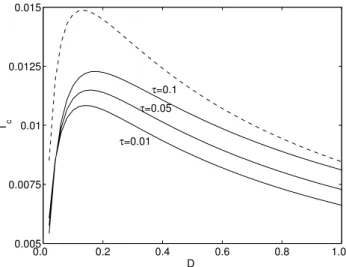
results are shown in Figs. 4 and 5. Figure 4 displays the ef-fects of noise and time delay onTcof the multispecies mu-tualism system. Compared with the one-species mumu-tualism system with the noise and the time delay, the multispecies mutualism system exhibits its own peculiarities: i) the fluc-tuation decay of its species density is faster than that without interspecies interaction (J=0), which can be seen from the comparison of theTcheights between the dashed line and the solid line ofτ=0.01 in Fig. 4; ii) the peak position of the Tcis shifted to the larger value ofDwithτincreasing, but for the one-species mutualism system it does not change. From figure 5, the largerJis, the smaller the value ofC(s).Jspeeds up the the fluctuation decay of species density.
0.0 0.2 0.4 0.6 0.8 1.0 0.005
0.0075 0.01 0.0125 0.015
D T c
τ=0.1
τ=0.05
τ=0.01
FIG. 4: The relaxation timeTcvsDforJ=2. τtakes 0.01, 0.05, and 0.1, respectively. The dashed line representsJ=0,τ=0.01. The other parameter values are the same as those in Fig. 1.
0.00 0 0.02 0.04 0.06 0.08
0.2 0.4 0.6 0.8 1.0
s
C(s)
J=4
J=2
J=0
FIG. 5: The correlation functionC(s)vssforD=0.05,τ=0.05.J
Brazilian Journal of Physics, vol. 39, no. 2, June, 2009 259
III. CONCLUSIONS
In this paper, we have studied the effects of noise and time delay on the relaxation time and correlation function of the mutualism system subjected to noise and time delay. The re-sults of the numerical computation show that noise and time delay play important roles in the mutualism system. The noise intensity D slows down the the fluctuation decay of species density firstly and then enhances it. The time delayτ
decreases the fluctuations and slows down the fluctuation de-cay of species density, on the contrary, the mean nterspecies
interaction intensityJ enhances the fluctuations and speeds up the fluctuation decay of species density.
Acknowledgments
This work were supported by the Natural Science Founda-tion of Yunnan Province (under Grant No 2005A0080m-2 and 08C0235) and the Key Subjects Fund for Condensed Physics of Qujing Normal University.
[1] L. Gammaitoni, P. H¨anggi and F. Marchesoni, Rev. Mod. Phys. 70,224 (1998) .
[2] W. Horsthemke and R. Lefever, Noise-Induced Transition
(Springer-Verlag, Berlin, 1984).
[3] N. V. Agudov and B. Spagnolo, Phys. Rev. E64, 035102(R) (2001).
[4] C. R. Doering and J. C. Gadoua, Phys. Rev. Lett.69, 2318 (1992).
[5] M. O. Magnasco, Phys. Rev. Lett.71, 1477 (1993); J.Mad- dox, Nature (London)368, 287 (1994).
[6] F. Julicher and J. Prost, Phys. Rev. Lett.75,2618 (1995) ; R. Deza, H. S. Wio and R. Toral, Phys. Rev. Lett.79, 2389 (1997). [7] R. Benzi, A. Sutera, and A. Vulpiani, J. Phys. A 14, L453
(1981).
[8] C. Nicolis, and G. Nicolis, Tellus33, 225 (1981). [9] C. Mackey and L. Glass , Science197, 287 (1997).
[10] P. C. Bressoff and S. Coombes, Phys. Rev. Lett. 78, 4665 (1997).
[11] J. Garc¨aa-Ojalvo and R.Roy, Phys. Lett. A224, 51 (1996). [12] C. Masoller, Phys. Rev. Lett.86, 2782 (2001).
[13] L. S. Tsimring, and A. Pikovsky, Phys. Rev. Lett.87, 250602
(2001).
[14] C. Masoller, Phys. Rev. Lett.90, 020601 (2003). [15] J. Houlihanet al, Phys. Rev. Lett.92, 050601 (2004). [16] M. Arizaletaet al, Phys. Rev. Lett.99, 023903 (2007). [17] L. R. Nie and D. C. Mei, Europhys. Lett.79, 20005 (2007). [18] V. Volterra,Lec¸ons sur la th´eorie math´ematique de la lutte pour
la vie(Gauthier-Villars, Paris) 1931.
[19] N. S. Goel, S. C. Maitra, and E. W. Montroll, Rev. Mod. Phys. 43, 231 (1971).
[20] T. D. Frank, Phys. Rev. E71, 031106 (2005). [21] T. D. Frank, Phys. Rev. E72, 011112 (2005).
[22] S. Guillouzic, I. L. Heux and A. Lonhtin, Phys. Rev. E59, 3970 (1999).
[23] S. Guillouzic, I. L. Heux and A. Lonhtin, Phys. Rev. E61, 4906 (2000).
[24] D. J. Wu, L. Cao and S. Z. Ke, Phys. Rev. E50, 2496 (1994). [25] Noriega, J. M. et al., Phys. Rev. A44, 2094 (1991); Phys. Rev.
A38, 5670 (1988).