MD Study of Energetics, Melting and Isomerization of Aluminum Microclusters
Mustafa B¨oy¨ukataa and Ziya B. G¨uvenc¸b
aDepartment of Physics, Erciyes University, 66100 Yozgat, Turkey
bDepartment of Electronic and Communication Engineering, C¸ ankaya University, 06530 Ankara, Turkey
Received on 7 September, 2005
Voter and Chen version of an Embedded Atom Model has been applied to study the locally stable struc-tures, energies, melting, isomerization and growth patterns of small aluminum clusters,Aln, in the size range of
n=2−13. Using molecular dynamics and thermal quenching simulations, the global minima and the other
lo-cally stable structures have been distinguished from those stationary structures that correspond to saddle points of the potential energy surface. A large number (10000) of independent initial configurations generated at high temperatures has been used to obtain the stable isomers, and the probabilities of sampling different basins of attractions, for each size of the clusters. Their energy spectra have been determined and melting, and isomer-ization dynamics are investigated.
Keywords: Aluminum; Cluster; Molecular dynamics
I. INTRODUCTION
The study of metallic clusters received an increasing at-tention in the recent years because of many technological ap-plications [1-5]. The nature of their chemical/physical prop-erties provides a rich source for experimental and theoretical studies. Investigations on structures and melting properties of atomic clusters are important due to their roles as building blocks for new nanomaterials, between molecules and bulk [6-12]. A systematic study of evolution of these properties with size allows elucidation of the transition from the molecular structure to condensed matter phase. Furthermore, clusters play an important role in many chemical reactions as cata-lysts since the structure of small metal clusters in a reaction can have a major effect on the rate of formation of products [13,14] because of the larger surface to volume ratio. Phases and phase changes of finite systems have been studied exten-sively, as well [15,16].
In this study theAl clusters are characterized by using a semi-empirical Voter and Chen [17] version of the embedded atom method (EAM). The EAM, which requires 2 to 5 times the work of a pair potential includes many-body effects that are important for description of metallic cohesion, is more ad-equate for the metallic systems. The virtue of Voter and Chen version is that it is derived by fitting the EAM to both the basic bulk properties of the metal and to the length and bond-energy of the diatomic molecule,Al2, simultaneously [18-20]. So, this EAM may have a wider range of validity from a few atoms to the larger sizes of theAlnclusters. The EAM grasps the major parts of the interatomic interactions and gives accu-rate structural and energetic information on various extended and truncated systems [21-23]. In the literature Garcia-Rodeja et al. [23] used the Voter and Chen version of the EAM by car-rying out molecular dynamics (MD) simulations to study the structures and melting of 6 fcc transition metals includingAl clusters (Ni,Pd,Al,Cu,Ag, andAu) in the size range of the n=2−23. However, they did not present any information about the stable isomeric forms and their sampling probabili-ties.
We have carried out MD and thermal quenching (TQ)
sim-ulations to study not only the lowest energy structures of the Alnclusters, but also their number of stable isomers for the size range of n=2−13. In addition, the clusters’ growth pathway, probabilities of sampling the basins of attraction of the stable isomers, and their energy spectrum-widths (ESW) which are defined by the energy difference between the most and the least stable isomers, have been analyzed. The melting process (phase changes from solid to liquid forms) has also been investigated, and the underlying mechanisms are dis-cussed. In addition temperature dependence of the number of isomers for then=7,10,and 13 clusters are investigated. The computational method, described in Section II, combines the interaction potential and the computational procedure. The re-sults and discussions are presented in Section III, and a brief summary of our conclusions is given in Section IV.
II. THEORETICAL BACKGROUNDS
In anyN-scaling energy expression, the total energy of anN-atom cluster in the EAM is given by a sum of the total interaction energies of all the atoms
VEA=
∑
i[Fi(ρi) + 1
2
∑
j6=iφi j(ri j)] (1) whereρi is the effective host electron density at the atom-i site, and it is obtained by a linear superposition of the spheri-cally symmetric atomic densityρi,ρi=∑iρj(ri j),
ρj(r) =r6(e−βr+29e−2βr). (2)
model of Voter and Chen has a medium-range attractive con-tribution in the core-core interaction. All the parameters in the model were determined by minimizing the root-mean-square deviation between the calculated and experimental values of the elastic constants, and the unrelaxed vacancy formation en-ergy of the bulk material and of the length and bond-strength of the diatomic molecule. The experimental data used in the fitting process along with the calculated values can be found in Ref. [17].
In this study, the equilibrium structural forms of theAln, n=2−13 clusters have been obtained using the MD and TQ simulations. Hamilton’s equation of motion were solved for all the atoms in a cluster using Hamming’s modified 4thorder predictor-corrector propagator with a step-size of 4×10⁻¹⁶ s, which guarantees conservation of total energy of the clus-ters to within 0.01%. The dynamical properties of the clusclus-ters at different fixed values of their total energies were extracted from the simulation runs of 4×10⁶steps. The melting behav-iour of the clusters was investigated by the root-mean-square (RMS) bond-length fluctuation,δ,
δ= 2
N(N−1)i
∑
<j(<r2i j>−<ri j>2)1/2 <ri j>
. (3)
Clusters are prepared at temperature,T(K), as T(K) = 2<Ek>
(3n−6)k (4) wherekis the Boltzmann constant,Ekis the total kinetic en-ergy of the cluster , the<> denotes the long-time average, and thenis the number of atoms. In order to obtain isomer statistics, 10000 independent initial configurations are gener-ated by recording of phase-space coordinates of the clusters at every 500 MD simulation steps along high-energy trajec-tories. The internal energies were chosen to be high enough (over 2000 K) to ”melt” the clusters, so that, one can sam-ple as many different points as possible in the 6Ndimensional phase-space. The TQ of these configurations were completed by quenching at every 30 simulation steps. This was achieved by setting the internal kinetic energies of the clusters to zero at every 30 simulation steps until the internal kinetic energies were completely removed - this process of quenching elimi-nates all the meta-stable forms of the isomers.
III. RESULTS AND DISCUSSION
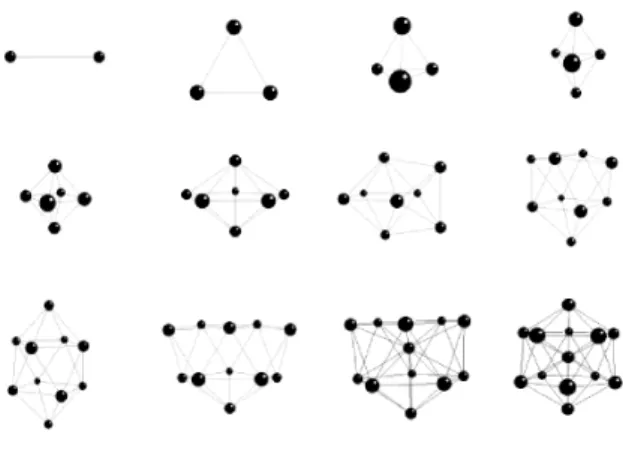
For theAln, n=2−13, clusters studied we have per-formed a series of MD simulations. The random search method has been used to find the global minima for the Al clusters with up to 13 atoms, bound by the EAM potential. After quenching 10000 different phase-space configurations which were prepared at high temperature (over 2000K) near fragmentation points, the global minimum energy geometries of theAl2−Al13 clusters are obtained and presented in Fig. 1. The bond-energy and the bong-length of theAl2dimer are
−0.77 eV/atomand 2.44 ˚A, respectively (these experimen-tal values were used in the fitting procedure of the EAM).
FIG. 1: Stable structures of theAl2−Al13clusters.
The lowest energy structure of theAl3 cluster is an equilat-eral triangle with a bond length of 2.52 ˚A, and energy of−1.5 eV/atom. Tetrahedral is found to be the lowest energy struc-ture for anAl4, with a bond length of 2.58 ˚A, and a binding energy of−1.59eV/atom. The least energy structure of the Al5belongs to a trigonal bipyramid group. The bond length is 2.58 ˚A, and the binding energy of theAl5cluster is calculated as−1.79eV/atom. The largest bond distance is obtained for theAl6, and it has a bipyramid form with a bond length of 2.61
˚
A, and a binding energy of−1.98eV/atom. Each of the clus-ters,n>6, has one or more of the trigonal, tetragonal, pen-tagonal bipyramid forms as a main sustaining part. Therefore, it is possible to classify them with respect to their backbones. We callAl2−Al4group as primitive. The tetragonal bipyra-mid symmetry is observed in the lowest energy structures of theAl6andAl8clusters. TheAl7cluster belongs to pentagonal bipyramid group. The pentagonal bipyramid form is the most stable structure of theAl7clusters. This structure forms the backbone of the icosahedral symmetry with the binding en-ergy of−2.078eV/atom. The lowest energy structure of the Al8can be constructed from the minimum energy structure of theAl6by capping the symmetric two faces of the bipyramid with respect to the equatorial plane, and its energy is−2.162 eV/atom. The minimum energy structures of theAl9andAl10 clusters are constructed from the tetragonal pyramid forms. It is possible to construct theAl10from the previous size (with-out changing much its existing structure) by simply capping the upper surface with an atom. They have two 4-atom rings in their geometries. The lowest energy form of theAl11has two pentagonal rings. TheAl12−Al13 clusters have the pen-tagonal bipyramid as their backbones. As seen, it is possible to construct the structure of theAl13from that of theAl12by simply adding an atom without changing the existing symme-try. The lowest energy structure of then=13 has a particular importance since it is the first of so called magic numbers, and it is an icosahedron - a central atom is surrounded by 12 atoms, which form a spherical shell with a calculated radius of 2.60 ˚A.
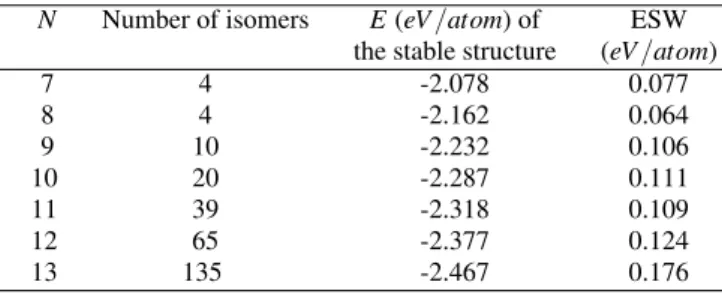
TABLE I: Number of isomers and energetics of theAl7−Al13
clus-ters obtained from 10000 phase space coordinates.
N Number of isomers E(eV/atom) of ESW
the stable structure (eV/atom)
7 4 -2.078 0.077
8 4 -2.162 0.064
9 10 -2.232 0.106
10 20 -2.287 0.111
11 39 -2.318 0.109
12 65 -2.377 0.124
13 135 -2.467 0.176
size increases due to the high dimensionality of the configura-tion space. The ESW per atom increases fromn=8 to 10 and n=11 to 13. In these two different intervals the clusters have two different ’mother’ geometries,Al6andAl7, respectively.
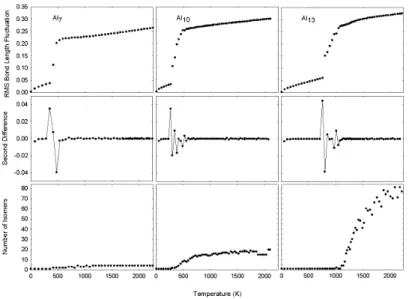
Results for the dynamical properties and phase changes of the 3 selected clusters (Al7,Al10 and Al13) are presented in Fig. 2.
The starting structures of the clusters (n=7,10, and 13) are in their global minimum energy forms. In order to see the phase change properties of the stable structures, the RMS bond-length fluctuation curves are plotted as a function of the temperature for these three structures in Fig. 2 (top). These curves are formed by calculating d values over 4×10⁶ sim-ulation steps at different total energies (total energies are in-creased in a stepwise manner). The melting points of these three clusters are lower than that of the bulk system (melting points are extracted from the middle points of the jumps ob-served in the RMS curves). It is also possible to determine the melting temperature using the stability functions (S) of the RMS fluctuations,
S=δm−1−δm+1
2 −δm (5)
Here, themrefers to each of the RMS values. The changes in the stability functions are monitored for then=7,10 and 13, and presented in Fig. 2 (middle). The fluctuations inS illustrate phase transformation from the solid-like to liquid-like forms, and the transition temperature intervals for each of the clusters (width of the fluctuations). The first peak shows the end of solid like, and the last one defines the full liquid like behaviors of the clusters. In addition, isomerizations start from the beginning of the melting process (beginning of the fluctuations inS). As seen, the melting temperature increases as the cluster’s size increases. However, they are all smaller than the bulk melting temperature.
We also give the changes in the number of isomers as a function of the temperature of these three structures in Fig. 2 (bottom). In order to see the increase in the number of iso-mers as a function of the internal kinetic energy of the clusters, 5000 phase-space coordinates were prepared at all tempera-ture steps from 0 to over 2000K. Using the TQ technique numbers of the isomers have been determined. TheAl7(and also for theAl8) cluster has four stable isomers. All these iso-mers can be obtained within the phase transformation interval
from solid to liquid form. However, in this interval, just three of the isomers of theAl8are observed, and the fourth one is determined above 1400K. On the other hand, the number of isomers increases sharply for then≥9. For theAl9there is a threshold value of the number of stable isomers at near 1600 K. As seen, the number of isomers also reaches to a threshold value for then=13 above 2000K. At the lower tempera-tures, the numbers are equal to 1 since the clusters are in the potential energy wells of their global minima. As a result, it is important to run trajectories longer for any size of the clusters, and record as many numbers of the phase- space coordinates as possible at very high temperature (near the fragmentation point).
In order to test the result obtained with 5000 different con-figurations, 10000 independent phase-space coordinates are sampled by using the TQ simulations for all the sizes consid-ered at high temperature, over 2000K. As seen, even though 5000 samples capture many isomers, it is better to use much more phase-space configurations for the sampling. Especially, this is more important for the larger clusters (n>13) because of their higher dimensionalities which lead to produce more stable isomers. In addition, quenching from the higher tem-perature also yields larger number of stable isomers. The total numbers of the stable isomers are presented in Table I. From these TQ processes for all the sizes the isomer forming prob-abilities are obtained. Although the total energy of the most stable structure of theAl7is less than that of the second one, the sampling probability of the 2nd isomer is higher than the others (not shown). This means that, probability of finding the final configuration of the hot molten cluster reached at the end of the cooling process, the energy value of the quenched stable isomer is not the only control parameter. The other pa-rameters may affect the probabilities are the number of ac-cessible states (identical configurations) of the isomer at its lowest energy configuration, the backbones, and the symme-try of the clusters. However, for many cluster sizes, the most stable structure is the most probable one. Generally, as the to-tal energy of the locally stable structures increases for a given size (n>8), the backbones of the structures change from one of the hexagonal, pentagonal, or tetragonal forms to mostly trigonal bipyramid form.
There are some energy bands, in which, a number of ener-getically close isomers are present with smoothly decreasing probabilities, and there are some energy gaps, in which, no isomers are observed. The backbones are responsible for the energy bands and the energy gaps in the isomer energy spec-trum probability distribution (see Fig. 3).
The effect of the symmetry is the best seen for then=13. The probability distribution graph of theAl13differs from the others (not shown). In this size, the probability of the lowest energy structure is much higher than those of the other iso-mers because of the perfect spherical symmetry of the icosa-hedron. The isomer forming probability distribution is fitted by an exponential function of the form;
P(E) =ae{ b
E+|Eh|} (6)
FIG. 2: Temperature dependent changes in the RMS-bond length fluctuations, stability functions for RMS-fluctuations, and isomers of
Al7,Al10,Al13clusters.
FIG. 3: Isomeric probability distribution for theAl13cluster. Inset shows all the points except the probability of the lowest energy structure
and behavior of the exponential function, Eq. (6).
scaling factor in units ofeV,Ehis the energy of the energet-ically highest isomer, and E<0 is the internal energy of a quenched isomer [24, 25] (starts from the first isomer). The exponent, as seen, is inversely proportional with the energy of the isomer. For all the sizes the probability distributions as a function of the energy nearly obeys the equation with exclu-sion of some of the points in the distributions.
IV. CONCLUSIONS
A computational analysis has performed for inves-tigating structures, energetics, melting and isomerization
results we report here, at least, represent this opportunity for theAl clusters described by Voter and Chen [17] version of the EAM in the size range ofn=2−13. Finally, the present study shows that investigating the numbers and the structures of the stable isomers can provide a deeper understanding of the clusters’ growth paths, the energy spectrum widths, energy bands and gaps formed by the isomers. Moreover, it is observed that in order to find all possible stable structures for any cluster size, the preparation of the phase-space coordinates must be done at very high temperature (near the fragmentation point), and it must consist of a sufficient
number of samples for the TQ process.
Acknowledgements
This work was supported by Erciyes University Research Fund (Project Number: FBA.03.29).
[1] B. K. Rao, S. N. Khanna, and P. Jena, J. Cluster Sci.10, 477
(1999).
[2] R. O. Jones, Phys. Rev. Lett.67, 224 (1991).
[3] B. K. Rao and P. Jena, J. Chem. Phys.111, 1890 (1999).
[4] M. D. Deshpande, D. G. Kanhere, I. Vasiliev, and R. M. Martin,
Phys. Rev. B68, 035428 (2003).
[5] P. Mitev, D. G. Papageorgiou, Ch. E. Lekka, and G. A. Evange-lakis, Surf. Sci.566-568, 937 (2004).
[6] H. Haberland (Ed.),Clusters of atoms and molecules(Springer, Berlin, 1994).
[7] G. Schmid (Ed.), Clusters and colloids, (VCH, Weinheim,
1994).
[8] T. P. Martin (Ed.),Large clusters of atoms and molecules
(Kluwer, Dordrecht, 1996).
[9] J. Jellinek (Ed.),Theory of atomic and molecular clusters
(Springer, Berlin, 1999).
[10] H. Cox, R. L. Johnston, and J. N. Murrell, J. Sol. Stat. Chem. 145, 517 (1999).
[11] R. Alrichs and S. D. Elliott, Phys. Chem. Chem. Phys.1, 13
(1999).
[12] L. D. Lloyd and L. R. Johnston, J. Chem. Soc., Dalton Trans., 307 (2000).
[13] J. Jellinek and Z. B. G¨uvenc¸, Z. Phys. D26, 110 (1993).
[14] J. Jellinek and Z. B. G¨uvenc¸,in The Synergy Between
Dynam-ics and Reactivity at Clusters and Surfaces, ed. L. J. Farrugia (Kluwer, Dordrecht, 1995), p.217.
[15] Y. J. Lee, R. M. Nieminena, E.-K. Lee, and S. Kim, Comp.
Phys. Comm.142, 201 (2001).
[16] S. Darby, T. V. M. Janes, R. L. Johnston, and C. Roberts, J.
Chem. Phys.116, 1536 (2002).
[17] A. F. Voter,Los Alamos Unclassified Technical Report#
LA-UR 93-3901 (1993).
[18] Z. B. G¨uvenc¸, and J. Jellinek, Z. Phys. D26, 304 (1993). [19] Z. B. G¨uvenc¸, J. Jellinek, and A. F. Voter,Physics and
Chem-istry of Finite Systems: From Clusters to Crystals, Vol.1 (Kluwer Academic Publishers, Dordecht (1992), p.411. [20] M. B¨oy¨ukata, Z. B. G¨uvenc¸, S. ¨Ozc¸elik, P. Durmus¸, and J.
Jellinek, Int. J. Quantum Chem.84, 208 (2001).
[21] Y. Mishin, D. Farkas, M. J. Mehl, and D. A. Papaconstantopou-los, Phys. Rev. B59, 3393 (1999).
[22] V. G. Grigoryan and M. Springborg, Chem. Phys. Lett.375, 219
(2003).
[23] J. Garcia-Rodeja, C. Rey, and L. J. Galleo, Phys. Rev. B49,
8495 (1994).
[24] Z. B. G¨uvenc¸ and D. G¨uvenc¸, J. Jellinek, Math. Comp. Appl.4, 75 (1999).