118 Brazilian Journal of Physics, vol. 37, no. 1, March, 2007
Nuclear Dependence of the Saturation Scale and its Consequences for the Electron-ion Collider
V. P. Gonc¸alves1, M. S. Kugeratski2, and F. S. Navarra2 2Instituto de F´ısica, Universidade de S˜ao Paulo,
C.P. 66318, 05315-970 S˜ao Paulo, SP, Brazil
1Instituto de F´ısica e Matem´atica,
Universidade Federal de Pelotas
Caixa Postal 354, CEP 96010-090, Pelotas, RS, Brazil
Received on 29 September, 2006
We study the predictions of CGC physics for electron-ion collisions at high energies. The nucleus at high energies acts as an amplifier of saturation effects. We have investigated some observables, using a generalization for nuclear targets of the Iancu-Itakura-Munier model, and our results indicate that the experimental analysis of these observables in the future electron-ion collider could discriminate between linear and saturation physics, as well as constrain the behavior of the saturation scale.
Keywords: Electron-ion collisions; Saturation physics; Color dipole formalism
I. INTRODUCTION
The search for signatures of parton saturation effects has been subject of an active research in the last years (for recent reviews see, e.g. [1]). It has been observed that HERA data in the smallxand lowQ2region can be successfully described with saturation models [2–4]. Moreover, the experimentally measured total cross sections [5] and charm production cross section [6] present the property of geometric scaling. The re-cently observed [7] supression of highpThadron yields at
for-ward rapidities indAucollisions at RHIC follows the behavior anticipated on the basis of CGC ideas [8–11]. All these results provide strong evidence for saturation at HERA and RHIC. However, more definite conclusions are not possible due to the small value of the saturation scale in the kinematical range of HERA and due to the complexity ofdAucollisions, where we need to consider the substructure of the projectile and the tar-get, as well as the fragmentation of the produced partons. So far, other models (without saturation included) are able to de-scribe the same set of data (see e.g. Refs. [12, 13]). In order to discriminate between these different models and test the CGC physics, it would be very important to consider an alternative search. To this purpose, the future electron-nucleus eRHIC collider is ideal, because it can probably determine whether parton distributions saturate or not and constrain the behavior of the nuclear gluon distribution. After the eRHIC was pro-posed, it became crucial to have some quantitative estimates of the impact of saturation effects on observables. Some of these estimates can be found in [14–16].
In the following section we present the color dipole for-malism. In the next section we introduce the saturation scale and its possible nuclear dependences. In sequence, a compar-ison of the results of the model with available data onFA
2 is shown, as well as the estimate of saturation effects on the nu-clear structure function. Finally, we present our conclusions.
II. DIPOLE FORMALISM
At smallx, Deep Inelastic Scattering (DIS) is most con-veniently computed with the dipole formalism. The virtual photon splits into a quark anti-quark dipole, which interacts with the target [17]. In this formalism the structure function of the target can be expressed as:
F2(x,Q2) = Q2 4π2α
em
(σT+σL) (1)
where
σT,L(x,Q2) =
Z 1
0 dz
Z
d2r|ΨT,L(z,r,Q2)|2σdip(x,r) (2)
with
|ΨT(z,r,Q2)|2=
6αem 4π2
∑
f
e2f ×
[z2+ (1−z)2]ε2K12(εr) +m2fK02(εr) (3) and
|ΨL(z,r,Q2)|2=
6αem
π2
∑
f
e2f ×
©
Q2z2(1−z)2K02(εr)ª
(4) The last two expressions represent the squared photon wave function for transverse (T) and longitudinal (L) photons, re-spectively. The variablerdefines the relative transverse sep-aration of the pair (dipole) andz(1−z) is the longitudinal momentum fraction of the quark (antiquark). The auxiliary variableε2=z(1−z)Q2+m2
f depends on the quark mass,
mf. TheK0,1are the McDonald functions and the summation is performed over the quark flavors.
At high energy [18–20], σdip can be computed in the
eikonal approximation and it is given by:
σdip(x,r) =2
Z
V. P. Gonc¸alves et al. 119
where
N
(x,r,b)is the forward scattering amplitude for a di-pole with size r and impact parameter b. Here we assume that the impact parameter dependence ofN
can be factorized asN
(x,r,b) =N
(x,r)S(b). So,σdip(x,r) =σ0N
(x,r), withσ0=2πR2p(Rpis the proton radius).
In the IIM parametrization [4] the dipole-target forward scattering amplitude was assumed to have the form:
N
=
N
0³r
Qs
2
´2 ³
γs+ln(2κ λ/rYQs)´
rQs≤2
1−exp−aln2(brQs) rQs>2
(6)
whereQsis the saturation scale discussed in the next section.
The expression in the second line of Eq. (6) has the correct functional form forr≫2/Qs, as obtained either by solving
the BK equation [18, 21] or from the theory of the CGC [1]. This is strictly valid only to LO accuracy, but here it is used merely as a convenient interpolation. The details of this in-terpolation are unimportant for the calculation ofσγ∗p. The
coefficientsaandbare determined uniquely from the condi-tion that
N
(rQs,Y)and its slope be continuous atrQs=2.The overall factor
N
0in the first line of Eq. (6) is ambiguous, reflecting an ambiguity in the definition ofQs. Thecoeffi-cientsγs andκare fixed to their LO BFKL values:γs=0.63
andκ=9.9.
III. SATURATION SCALE
The saturation momentum,Qs(x), is the value of the
trans-verse momentum below which saturation effects are expected to be important in the gluon distribution. It can be estimated in a simple geometrical way. Let’s assume that the trans-verse area of one gluon in the target is approximately given by αs/Q2 and that the number of gluons (per unit rapidity)
“seen” by an external probe isx G(x,Q2). The area occupied by all these gluons is αs/Q2xG(x,Q2). When this area
be-comes comparable to the total geometrical area of the target,
πR2p, saturation sets on. This matching of areas gives an equa-tion, which can be solved for Qyielding the especial value Qs:
Q2s(x)≃αs
xG(x,Q2s) πR2
p
=Q20³x0 x
´λ
(7)
wherex0=0.3×10⁻⁴andλ=0.29. For a nuclear target we expect that, in a first approximation,xG(x,Q2)→A xG(x,Q2), Rp→RA=RpA1/3and thus, from (7) we have:
Q2s(x)→A1/3×Q2s(x) (8) Moreover, we may generalize the IIM model to nuclear col-lisions assuming the following basic transformation for the parameterσ0:
σ0→σA0=A2/3×σ0 (9)
These two transformations define what we call model IIM1. For comparison we also consider another A-dependence of
the saturation momentum, which was suggested in [22] Q2s(x)→Q2s,A= [A1/3]1/δ×Q2s(x) (10) whereδ=0.79. Notice that, with this choice forδtheA de-pendence ofQsbecomes stronger. This feature arises from the
inclusion of the impact parameter in all calculations, as done in [22]. The transformations (9) and (10) define the model IIM2. Further studies of the A-dependence ofQscan be found
in Refs. [23, 24].
IV. RESULTS AND DISCUSSION
In this section we calculate the ratio: R≡ 2F
A
2
AF2D (11)
whereD=deuteron, with the models IIM1 and IIM2 and compare the results with the experimental data, taken by the Fermilab E665 collaboration, using inelastically scattered muons of average incident momentum 470 GeV/c [25]. These data, taken over a wide kinematic range, have shown that the proton and neutron structure functions are modified by a nu-clear environment. The modifications depends on the parton momentum fraction: for momentum fractions x<0.1 and 0.3<x<0.7, a depletion is observed in the nuclear struc-ture functions. The lowx(shadowing region) and the larger x(EMC region) are bridged by an enhancement known as an-tishadowing for 0.1<x<0.3. We refer to the entire phe-nomena asthe nuclear shadowing effect[27]. As shown in Ref. [26] these effects can be described by the DGLAP evolu-tion equaevolu-tion with a suitable set of nonperturbative initial con-ditions. Another possibility to describe the small-xbehavior of the ratioRis to consider multiple scattering of the projec-tile on several target nucleons using Glauber-Gribov approach [24]. Here we are interested in the low-xregion (x<10−3), where it is believed that the behavior of R should be deter-mined by high density QCD and parton saturation effects. In our approach we do not include higher-xcorrections and rather try to understand the behavior ofRin terms of parton saturation. Strictly speaking, our formalism is valid only in the very lowxregion, whereas the available data exist only in the intermediatexregion. In order to have an idea of how well our results can reproduce the data we have to extrapo-late them to intermediatexregion. In doing this, we move to the region dominated by the linear regime, where satura-tion is not important and the dipole scattering amplitude is dominated by the first line of expression (6). In this regime, denoted color transparency regime, the scattering amplitude should behave as(r Qs)2. However a careful analysis of this
expression shows that the parenthesis in the exponent never becomes equal to one (!) and thus the (r Qs)2 behavior is
120 Brazilian Journal of Physics, vol. 37, no. 1, March, 2007
10-5 10-4 10-3 10-2 10-1
x
0.4 0.5 0.6 0.7 0.8 0.9 1 1.1
F2 A /AF
2
D
EKS IIM1 IIM2
0 10 20 30 40
Q2 (GeV2)
0.4 0.5 0.6 0.7 0.8 0.9 1 1.1
F2 A /AF
2
D
Q2 = 2.5 GeV2 x = 10 -4
(a) (b)
FIG. 1: RatioR(x,Q2)≡F2A(x,Q2)/F2p(x,Q2)as a function ofx(a) and Q2 (b). The predictions of the EKS parametrization are also shown.
with the parameters of (6). Making use of this freedom, we have multiplied the ratioRby a constant so that, at the point x=0.1, it coincides with one, in agreement with experimental data. SinceF2is a function ofQ2this adjust has to be done for each value ofQ2.
In Fig. 1, we show the ratioRcomputed with both models, IIM1 and IIM2, as a function of x[Fig. 1(a)] andQ2[Fig. 1(b)] for a lead nucleus (A=208). As expected the IIM2 model has a stronger dependence with A and therefore a larger deviation fromR=1. For comparison we also show the ratio Rcalculated with the EKS parametrization [26] of the ratio of nuclear structure functions. This parametrization comes from a global fit of the nuclear experimental data using DGLAP evolution. Notice that, as mentioned above, atx=0.1 the EKS curve approaches one. Our curves IIM1 and IIM2 were constrained to pass through this point as well.
The main difference between the predictions is the behavior of the ratioRat smallx. EKS predicts that the ratio is constant, and the IIM1 and IIM2 predict that the ratio still decreases in this limit (small x). We can see that forR as a function of Q2, the predictions differ significantly. This behavior arises because EKS is directly related to DGLAP evolution and the IIM1 and IIM2 models are associated to the saturation and geometric scaling regimes.
The deviation ofRfrom one in the region 0.01<x<0.1 comes from the non-trivialAdependence of the dipole cross section [Eqs. (8) and (10)]. In this region our Ansatz, (8) or (10), leads to results similar to those obtained with for with the Glauber-Gribov approach [27], although they are independent from each other.
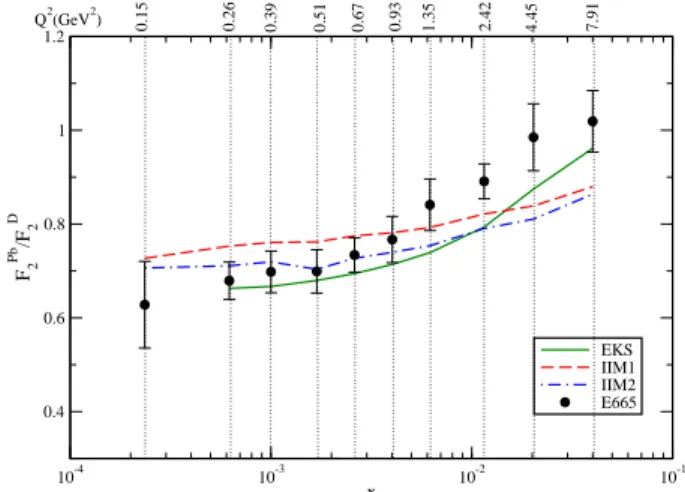
In Fig. 2 we show the ratioRas a function ofxfor a lead nucleusA=208. On the top of the figure we have included the values ofQ2, which are different for eachx. The model IIM1 (IIM2) is represented by the dashed (dash-dotted) line. As it can be seen both models agree reasonably well with the data, especially considering that, apart from a normalization factor there was no free parameter.
10-4 10-3 10-2 10-1
x
0.4 0.6 0.8 1 1.2
F2 Pb /F
2
D
EKS IIM1 IIM2 E665 Q2(GeV2) 0.15 0.26 0.39 0.51 0.67 0.93 1.35 2.42 4.45 7.91
FIG. 2: Comparison of the results of the models IIM1 and IIM2 with experimental data at smallxfor the ratio of Pb (lead) to D (deuteron), from E665 Collaboration [25].
10-5 10-4 10-3 10-2
x 0.4
0.5 0.6 0.7 0.8 0.9 1
RF
2
A = 197 (IIM1) A = 197 (IIM2) A = 1 (IIM1) A = 1 (IIM2)
Q2 = 1
FIG. 3: Ratio of the full to the linear predictions for the nuclear struc-ture function as a function ofx.
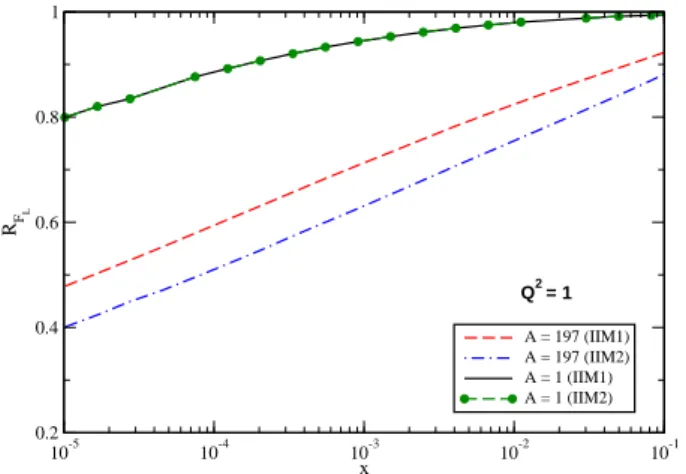
In order to obtain a more precise estimate of modification in the observablesF2andFL by saturation physics, in Fig. 3
and Fig. 4 we present the ratiosRF2 andRFL of full to linear
predictions for nuclear structure functionF2AandFLA. We con-sider two typical values of the atomic number. As expected, the contribution of the saturation physics increases at larger nuclei and smaller values ofx. In particular, for values of x around 10−5, we predict a reduction of about 50% in the total and longitudinal structure functions.
V. SUMMARY & CONCLUSIONS
V. P. Gonc¸alves et al. 121
10-5 10-4 10-3 10-2 10-1
x
0.2 0.4 0.6 0.8 1
RF
L
A = 197 (IIM1) A = 197 (IIM2) A = 1 (IIM1) A = 1 (IIM2) Q2 = 1
FIG. 4: Ratio of the full to the linear predictions for the longitudinal nuclear structure function as a function ofx.
our results with experimental data from the E665 collabora-tion and also with the EKS parametrizacollabora-tion. Although the EKS formula does not include saturation physics and although the E665 data are taken at too low energy (for saturation ef-fects to be dominant), the reached values of x andQ2 fall already in the saturation domain, justifying the comparison. For the sake of a preliminary estimate of saturation efects in an electron-ion collider we have computed, with the existent nuclear dependent saturation scales, the ratio of theF2 and FL structure functions, finding a strong reduction (≃50 %)
of these ratios. The impact of these results encourages us to further study the subject.
[1] E. Iancu and R. Venugopalan, hep-ph/0303204; J. Jalilian-Marian and Y. V. Kovchegov, Prog. Part. Nucl. Phys.56, 104 (2006).
[2] K. Golec-Biernat and M. W¨usthoff, Phys. Rev. D59, 014017 (1999),ibid.D60, 114023 (1999).
[3] J. Bartels, K. Golec-Biernat, and H. Kowalski, Phys. Rev. D66, 014001 (2002).
[4] E. Iancu, K. Itakura, and S. Munier, Phys. Lett. B590, 199 (2004).
[5] A. M. Sta´sto, K. Golec-Biernat, and J. Kwieci´nski, Phys. Rev. Lett.86, 596 (2001).
[6] V. P. Gonc¸alves and M. V. T. Machado, Phys. Rev. Lett.91, 202002 (2003).
[7] I. Arseneet al.[BRAHMS Collaboration], Phys. Rev. Lett.91, 072305 (2003); Phys. Rev. Lett.93, 242303 (2004); Phys. Rev. Lett.94, 032301 (2005); nucl-ex/0410020.
[8] R. Baier, A. Kovner, and U. A. Wiedemann, Phys. Rev. D68, 054009 (2003); J. Jalilian-Marian, Y. Nara and R. Venugopalan, Phys. Lett. B577, 54 (2003); D. Kharzeev, Y. V. Kovchegov, and K. Tuchin, Phys. Rev. D68, 094013 (2003); J. L. Albacete, N. Armesto, A. Kovner, C. A. Salgado, and U. A. Wiedemann, Phys. Rev. Lett.92, 082001 (2004); E. Iancu, K. Itakura, and D. N. Triantafyllopoulos, Nucl. Phys. A742, 182 (2004). [9] A. Dumitru, A. Hayashigaki, and J. Jalilian-Marian, Nucl. Phys.
A765, 464 (2006); Nucl. Phys. A770, 57 (2006).
[10] D. Kharzeev, Y.V. Kovchegov, and K. Tuchin, Phys. Lett. B
599, 23 (2004).
[11] V. P. Gonc¸alves, M. S. Kugeratski, M. V .T. Machado, and F. S. Navarra, Phys. Lett. B643, 273 (2006).
[12] J. R. Forshaw, G. Kerley, and G. Shaw, Phys. Rev. D60, 074012 (1999); J. R. Forshaw, G. R. Kerley, and G. Shaw, Nucl. Phys. A675, 80C (2000).
[13] R. C. Hwa, C. B. Yang, and R. J. Fries, Phys. Rev. C71, 024902 (2005); J. w. Qiu and I. Vitev, Phys. Lett. BB=632, 507 (2006); B. Z. Kopeliovich, J. Nemchik, I. K. Potashnikova, M. B.
John-son, and I. Schmidt, Phys. Rev. C72, 054606 (2005).
[14] M. S. Kugeratski, V. P. Gonc¸alves, and F. S. Navarra, Eur. Phys. J. C44, 577 (2005).
[15] M. S. Kugeratski, V. P. Gonc¸alves, and F. S. Navarra, Eur. Phys. J. C46, 413 (2006).
[16] M. S. Kugeratski, V. P. Gonc¸alves, and F. S. Navarra, Eur. Phys. J. C46, 465 (2006).
[17] V. Barone and E. Predazzi,High-Energy Particle Diffraction, Springer-Verlag, Berlin Heidelberg, (2002).
[18] I. I. Balitsky, Nucl. Phys. B463, 99 (1996), Phys. Rev. Lett.
81, 2024 (1998), Phys. Rev. D60, 014020 (1999), Phys. Lett. B518, 235 (2001); I.I. Balitsky and A.V. Belitsky, Nucl. Phys. B629, 290 (2002).
[19] E. Iancu, A. Leonidov, and L. McLerran, Nucl. Phys.A692, 583 (2001); E. Ferreiro, E. Iancu, A. Leonidov, and L. McLerran, Nucl. Phys. A701, 489 (2002).
[20] J. Jalilian-Marian, A. Kovner, L. McLerran, and H. Weigert, Phys. Rev. D55, 5414 (1997); J. Jalilian-Marian, A. Kovner, and H. Weigert, Phys. Rev. D 59, 014014 (1999), ibid. 59, 014015 (1999), ibid.59 034007 (1999); A. Kovner, J. Guil-herme Milhano, and H. Weigert, Phys. Rev. D 62, 114005 (2000); H. Weigert, Nucl. Phys. A703, 823 (2002).
[21] Y.V. Kovchegov, Phys. Rev. D 60, 034008 (1999), ibid. 61
074018 (2000).
[22] N. Armesto, C.A. Salgado, and U.A. Wiedemann, Phys. Rew. Lett. B94, (2005) 022002.
[23] A. H. Mueller, Nucl. Phys. A724, 223 (2003). [24] N. Armesto, Eur. Phys. J. C26, 35 (2002).
[25] E665 Collaboration: M.R. Adamset al., Z. Phys. C67, 403 (1995).
[26] K. J. Eskola, V. J. Kolhinen, and C. A. Salgado, Eur. Phys. J. C
9, 61 (1999).