20 Brazilian Journal of Physics, vol. 37, no. 1, March, 2007
Color Flavor Locked Phase Transition in Strange Quark Matter
Milva Orsariaa, H. Rodriguesb, and S. B. Duartea
aCentro Brasileiro de Pesquisas F´ısicas
Rua Dr. Xavier Sigaud 150 CEP 22290-180, Rio de Janeiro, Brazil
bCentro Federal de Educac¸˜ao Tecnol´ogica CEFET/RJ,
CEP 20271-110, Rio de Janeiro, Brazil
Received on 29 September, 2006
We discuss macroscopic aspects of quark matter phase transition in cold dense stellar matter, considering global charge neutrality and baryonic charge conservation. We determine the critical condition for the phase transition between the strange quark matter,SQM, and the color-flavor locked,CFL, superconducting phase. We also discuss the sensitivity of our results to variations in the gap energy,∆, and in the current strange quark mass,ms0. The phase transition is calculated taking into account the baryonic density dependence of the quark masses in dense baryonic medium.
Keywords: Cold dense stellar matter; Phase transition; Color superconductivity
I. INTRODUCTION
The strange quark matter (SQM) is supposed to be the most stable quantum state of the hadronic matter [1],[2]. TheSQM can be originated by a first-order hadron-quark phase transi-tion occurring in the core of a massive star at the end of its evolutionary path when a gravitational collapse of the struc-ture takes place. This hadron-quark phase transition leads to a deconfined quark gas at densities presumably near to 2-3 times the normal nuclear matter density. At sufficiently large baryon chemical potential, the more stable configuration ofSQM is the color flavor locked (CFL)[3] superconducting phase in which Cooper pairs of quarks of different flavors and colors are coupled with total zero momentum. For very high den-sity, the mass of the strange quark is negligible compared to the baryonic chemical potential, leading to the same density of the three flavors ofu, d andsquarks. Consequently, the CFLphase is naturally electrically neutral.
In the present work we study the phase transition between the SQMandCFLphases, determining the critical value of the baryonic chemical potential,µ, for different baryonic den-sities. A phenomenological model taking into account the de-pendence of the quark mass with the baryonic density is em-ployed: the dynamical density quark massDDQMmodel[4]. The sensitivity of the calculated values for the critical chemi-cal potential for theSQM−CFLphase transition is analyzed in respect to the parameter ofDDQM model used. We also discuss some results obtained when the values of the color su-perconducting gap and the current strange quark mass are both changed.
II. THEDDQMMODEL IN THESQMPHASE
According to the low-density regime of QCD, the quark masses are not merely originated from the explicit breaking of chiral symmetry. So, in the study of stability of quark mat-ter, we can not neglect the dynamical mass induced by the strong quark interaction with the medium. For low and mod-erate density regime, we model the dynamical mass by the
density dependent quark mass given by[4], [5] MD=
C 3nB
, (1)
wherenBdenotes the baryon density andCis a free parame-ter that in the zero density limit (nB→0) correspond to the constant energy density in theDDQMmodel. For null current masses of quarksu andd and for the current strange quark mass,ms0, we have
m∗u=m∗d=MD,
m∗s =ms0+MD. (2)
TheDDQMmodel establish the effective quark mass val-ues in pertubative and nonperturbative regime through the de-pendence with the dynamical massMD. With this model two characteristic situations for quark matter (the confinement of quarks and asymptotic freedom regime)is reproduced when the corresponing densities regime is considered.
We consider the quark matter in stellar medium, that can be treated as a degenerate Fermi gas ofu,d,squarks and elec-trons with chemical equilibrium maintained by the weak in-teraction processes
d(s) ←→ u+e−+νe u+d ←→ u+s.
If neutrinos freely scape from the medium, playing no role on the beta equilibrium conditions, the processes displayed above imply the following relation between the chemical potentials:
µu=µd−µe,
µd=µs. (3)
Milva Orsaria et al. 21
When the temperature is small enough, the antiquarks are statistically negligible and the density of fermions in the ab-sence of interactions may be approximated by
Nq V =nq≃
1
π2
µ2q−m∗q232. (4)
where,q=u,d,s. The same expression is valid for the elec-trons with a factor 13in the right hand side.
The electromagnetic charge neutrality and the baryonic density are
2nu−nd−ns−3ne=0, (5)
nB=1
3(nu+nd+ns), (6) respectivelly. To solve the nonlinear system of Eqs. (5) and (6) we replace the quark densitiesnqby its corresponding ex-pressions in terms of chemical potentials of (3).
The pressure of theSQMin theDDQMmodel aplying to theSQMcase is given by the thermodynamic relation
P= ∂Ω/nB
∂(1/nB)
T,{µq}
=nB
∂Ω ∂nB
T,{µq}
−Ω, (7)
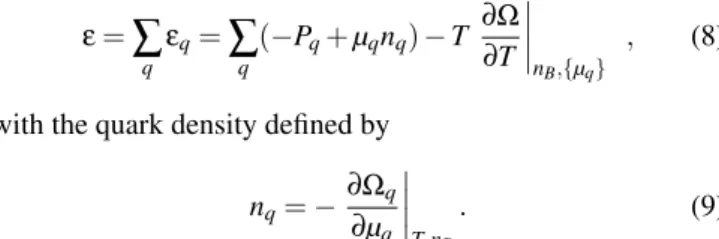
whereΩis the thermodynamical potential of the system. No-tice that the first term on the right hand side is necessary to make the pressure expression thermodynamically consistent with the energy density given by
ε=
∑
q
εq=
∑
q
(−Pq+µqnq)−T
∂Ω ∂T
nB,{µq}
, (8)
with the quark density defined by
nq=−
∂Ωq ∂µq
T,nB
. (9)
AtT=0,the expressions for the quarks pressure and energy density are
Pq= gq 48π2m
4 q
F(xq)− C nB
4 mqG(xq)
, (10)
εq= gq 48π2m
4 q
3H(xq) + C nB
4 mq
G(xq)
, (11)
wherexq= [( µq
m∗q)
2−1]12.
In the above equations the auxiliary functionsF,GandH,
are defined as
F(x) =x(x2+1)1/2(2x2−3) +3sinh−1(x), (12)
G(x) =x(x2+1)1/2−sinh−1(x), (13) and
H(x) =x(x2+1)1/2(1+2x2)−sinh−1(x). (14) The contributions of free electrons to the thermodynamic po-tential is given by
Ωe=− 1
12π2µ 4
e. (15)
From Eq.(10) we can see that there is a given value of bary-onic density for which the pressure is null. At this density the null pressure can be interpreted as a consequence of the attrac-tive internal interaction among the constituents of the system, simulated by the change ofMDin the model. This null pres-sure situation represents the quark matter confinement. On other hand in Eq.(10), the increase of density leads to a pres-sure expression of a free fermionic gas, characterizing the as-ymptotic freedom.
III. THECFLPHASE
In theCFL phase the Cooper pairs occup the same low-est energy quantum state at zero temperature, leading to a Bose condensate. In this configuration, the ground state of quark matter becomes a color superconductor[6], [7], [8]. The main consequence of color superconductivity is the ap-pearance of a nonzero energy gap in the one-particle energy,
εi=(Ei−µ)2+∆2, with∆being the CFL superconducting gap.
TheCFLphase is characterized by same density of quarks u, d and s, so the charge neutrality is automatically satis-fied. The gap∆can be calculated with perturbativeQCDwith quark-gluon exchange[ref.], but in this work we consider it like a free parameter whit characteristic values for the transi-tion.
280 320 360 400 440 480 520
µB [ MeV ]
0 2 4 6 8 10 12
PSQM
- P
CF
L
[ MeV
/fm
3 ]
ms0 = 170 MeV ∆CFL = 20 MeV
FIG. 1: Pressures difference,PSQM−PCFL, versus baryonic chemical
potential,µB forms0=170MeV. The difference between the pres-sures is null for the critical valueµB∼482MeV, coinciding whitµc
22 Brazilian Journal of Physics, vol. 37, no. 1, March, 2007
70 71 72 73 74 75
C [ MeV/fm3 ]
460 480 500 520 540 560 580
µc
[
M
e
V
]
ms0 = 170 MeV
ms0 = 165 MeV
ms0 = 160 MeV
∆CFL = 20 MeV
a)
70 71 72 73 74 75 76 77 78
C [ MeV/fm3 ] 460
480 500 520 540 560 580
µc
[ M
e
V
]
ms0 = 155 MeV
ms0 = 150 MeV
ms0 = 145 MeV
∆CFL = 15 MeV
b)
70 72 74 76 78 80 82 84
C [ MeV/fm3 ] 460
480 500 520 540 560 580
µc
[M
eV
]
ms0 = 130 MeV
ms0 = 125 MeV
ms0 = 120 MeV
∆CFL = 10 MeV
c)
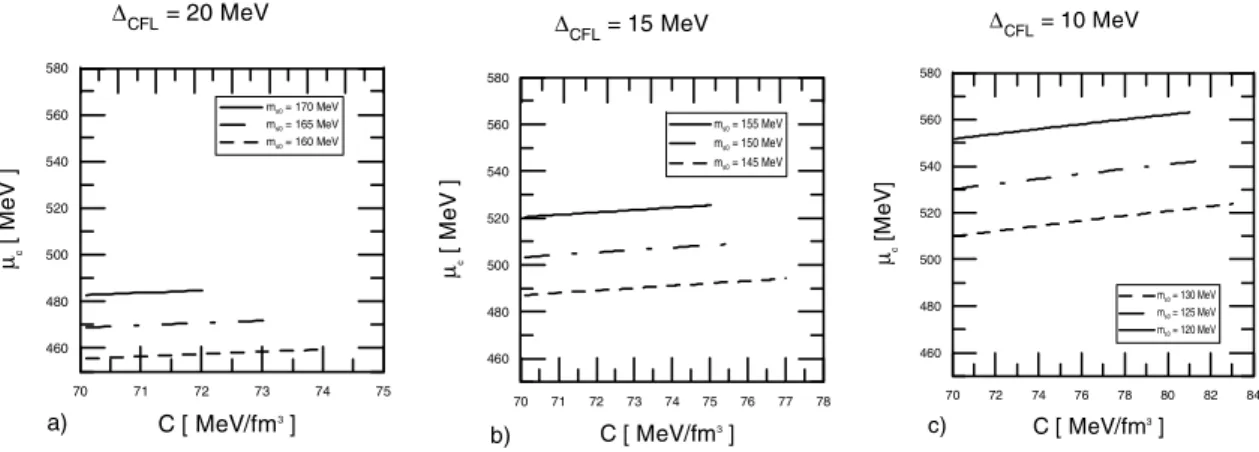
FIG. 2: Critical chemical potential, µc, versus theCparameter of theDDQM model for differentsms0, fixing the gap in all the cases: a) ∆CFL=20 MeV, b)∆CFL=15 MeV e∆CFL=10 MeV.
The pressure in theCFLreads
PCFL=
∑
qPq+ 3∆2µ2
π2 , (16)
where the first term gives the pressure of free quarks, with equal number densitiesnu=nd=ns= (ν3+2∆2µ)/π2, where
νis the common Fermi momentum, given by
ν=2µ−
µ2+m2s
3 ,
andµ= (µu+µd+µs)/3. The second term in Eq. (16) is the contribution from the formation of the condensate to the pressure.
IV. RESULTS AND CONCLUSIONS
We have applied the Gibbs conditions for construct the phase transition between the two phases described in the last
section. The critical chemical potential is defined as the value for which the pressure of the pureSQMphase equals the pres-sure of the pureCFLphase. Besides the Gibbs conditions, the local (neutral) electromagnetic charge of each phase and the global baryonic charge conservation are simultaneously required. In Fig.(1) we can see the difference of pressures PSQM−PCFLas a function of the baryonic chemical potential, for a given value of the gap and current strange quark mass, ms0, showing the critical potential value.
The main result of this work consists in discuss the sensi-tivity of the critical chemical potential of the phase transition in theDDQMmodel parameter,C. In Fig.(2) we display the critical chemical potential as a function of the parameterC,for different values of the superconducting gap andms0. The
re-sults show that the critical chemical potential is less sensitive to the model parameterCthan the gap and the current strange quark mass. Consequently, it is very important to have a satis-factory values for these last two external parameters in order to obtain a more accurate discution for theSQM−CFLphase transition.
[1] A. R. Bodmer, Phys. Rev. D 4, 1601 (1971). [2] E. Witten, Phys. Rev. D 30, 272 (1984).
[3] M. Alford, K. Rajagopal, and F. Wilczek, Nucl. Phys. B537, 443 (1999); R. Rapp, T. Schaefer, and T. Schaefer, Nucl. Phys. B575, 269 (2000).
[4] G.N. Fowler, S. Raha, and R.M. Weiner, Z. Phys. C 9, 271
(1981).