das Clínicas, Faculty of Medicine, University of São Paulo.
MONITORING THE TREATMENT OF SEPSIS WITH
VANCOMYCIN IN TERM NEWBORN INFANTS
José Kleber Kobol Machado, Rubens Feferbaum, Edna Maria Albuquerque Diniz, Thelma S. Okay, Maria Esther J. Ceccon and Flávio Adolfo Costa Vaz
RHCFAP/3031 MACHADO JKK et al. - Monitoring the treatment of sepsis with vancomycin in term newborn infants. Rev. Hosp. Clín. Fac. Med.
S. Paulo 56(1):17-24, 2001.
A prospective study was conducted to determine if standardized vancomycin doses could produce adequate serum concentrations in 25 term newborn infants with sepsis. Purpose: The therapeutic response of neonatal sepsis by Staphylococcus sp. treated with
vancomycin was evaluated through serum concentrations of vancomycin, serum bactericidal titers (SBT), and minimum inhibitory concentration (MIC).
Method: Vancomycin serum concentrations were determined by the fluorescence polarization immunoassay technique , SBT by the macro-broth dilution method, and MIC by diffusion test in agar .
Results: Thirteen newborn infants (59.1%) had adequate peak vancomycin serum concentrations (20–40 mg/mL) and one had peak concentration with potential ototoxicity risk (>40 µg/mL). Only 48% had adequate trough concentrations (5–10 mg/mL), and seven (28%) had a potential nephrotoxicity risk (>10 µg/mL). There was no significant agreement regarding normality for peak and trough vancomycin method (McNemar test : p = 0.7905). Peak serum vancomycin concentrations were compared with the clinical evaluation (good or bad clinical evolution) of the infants,with no significant difference found (U=51.5; p=0.1947). There was also no significant difference between the patients’ trough concentrations and good or bad clinical evolution (U = 77.0; p=0.1710). All
Staphylococcus isolateswere sensitive to vancomycin according to the MIC. Half of the patients with adequate trough SBT (1/8),
also had adequate trough vancomycin concentrations and satisfactory clinical evolution.
Conclusions: Recommended vancomycin schedules for term newborn infants with neonatal sepsis should be based on the weight and postconceptual age only to start antimicrobial therapy. There is no ideal pattern of vancomycin dosing; vancomycin dosages must be individualized. SBT interpretation should be made in conjunction with the patient’s clinical presentation and vancomycin serum concentrations. Those laboratory and clinical data favor elucidation of the probable cause of patient’s bad evolution, which would facilitate drug adjustment and reduce the risk of toxicity or failing to achieve therapeutic doses.
DESCRIPTORS: Physiologic monitoring. Newborn infants. Sepsis. Vancomycin. Antimicrobial susceptibility testing.
Since 1990 Staphylococcus sp., or,
more precisely, thecoagulase-negative
Staphylococcus, has been the pathogen
most commonly associated with hospi-tal-acquired infection in neonatal inten-sive-care units of several countries. Until the end of the 80’s coagulase-negative Staphylococcus was
consid-ered to be non-pathogenic1-5.
There is an array of difficulties in the therapy of newborns severely in-fected by Staphylococcus sp., the most
prominent of which are the indication of antibiotic therapy, the prescribed dose, and length of its use. Therapeu-tic failure is due to many factors that are hardly ever measurable; such as the newborn’s humoral and cellular de-fenses, site and severity of the
The associations and changes of antibiotics, when empirically made without taking into account the patient’s response, or especially, the etiologic agent, often lead to super-in-fections by multi-resistant bacteria and fungi.
As a result, the increased incidence of nosocomial infections by methicil-lin-resistant Staphylococcus sp. in
neo-natal intensive care units has led to an increase in the utilization of vancomy-cin. Its widespread use, however, has brought about the emergence of Sta-phylococcus sp, which is increasingly
resistant to this drug.
To obtain success with antimicro-bial therapy, it is necessary to select the appropriate antibiotic and provide the adequate dose, as well as to use the best administration technique. With the introduction of studies characterizing the parameters of antibiotic pharmaco-kinetics in specific populations, the usual dose of vancomycin has been demonstrated to be either insufficient or potentially toxic in many situa-tions10,11.In this context, monitoring of both the antibiotic therapy and the newborn’s clinical response becomes significantly important. Therefore, the authors’ purpose was to assess whether therapy with vancomycin results in ad-equate serum concentrations of the an-tibiotic in term neonates with sepsis and to evaluate the antimicrobial therapy of neonatal sepsis caused by
Staphylococcus sp., monitoring the
se-rum vancomycin concentration, sese-rum bactericidal titers (SBT), and minimum inhibitory concentration (MIC).
METHOD
The study population consisted of 25 term newborns admitted to the Outpatient Newborn Intensive Care Unit (ONICU), during the period from October 1995 to October 1997, with diagnoses of neonatal sepsis, all of
whom received vancomycin after ad-mission to the ONICU.
The diagnostic criteria of neonatal sepsis were based on clinical signs12, hypothermia or hyperthermia, respira-tory alterations (tachypnea, grunting, apnea), cyanosis, tachycardia, poor feeding, postprandial gastric residue, or abdominal distention.
This was a prospective study, in which the authors included term new-borns with gestational ages of > 37 and < 42 weeks, based on the date of the mother’s last menstrual period, with clinical and laboratory diagnoses of neonatal sepsis and suspicion of noso-comial infection caused by S taphylo-coccus sp.
All patients included in the sample received oxacillin and/or amino-glucosides in other services previous to the introduction of vancomycin. None of the patients included in this study presented kidney failure at the onset of treatment with vancomycin. Initially, the newborns also received antibiotic therapy for gram-negative bacteria un-til elucidation of the etiologic agent by means of blood culture or general cul-tures.
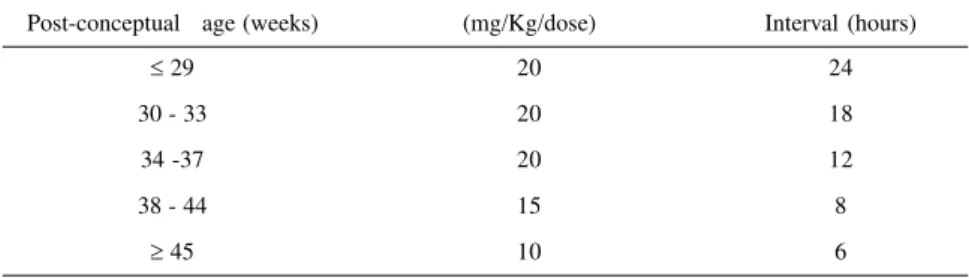
The term newborn infants with sep-sis who had vancomycin suspended before completing 14 days of antibiotic therapy were excluded from the study. The vancomycin dose adminis-trated and intervals of administration were established according to post-conceptual age13, based on the routine of the ONICU (Table 1).
The BACTECÒautomated system was used to identify the infectious agent in the blood cultures. Vancomy-cin (VancocynÒ/Lilly) was diluted in dextrose solution at 5% (D5W) and ad-ministered intravenously with an infu-sion pump over a period of 1 hour into a peripheral vein or central catheter.
After 72 hours of antibiotic therapy with vancomycin, 0.8 mL blood samples were collected 1 hour after the end of infusion (serum peak) for dos-ing serum vancomycin concentration by the fluorescence polarization immu-noassay technique (TDx/Abbott). The same procedure was performed with the sample collected 1 hour before the be-ginning of the next vancomycin dose, i.e. at the serum trough. The authors considered as normal or adequate val-ues for peak serum concentration of vancomycin 20 to 40 mg/mL and trough concentration 5 to 10 mg/mL14,15. For newborn infants who had
Staphylococcus sp. isolated, the serum
bactericidal titer (SBT) was also mea-sured, both at the serum peak and trough, by the macro-broth dilution method. Trough SBT 1/8 and peak SBT 1/16, at the minimum, were con-sidered adequate16,17.
In addition, the minimum inhibi-tory concentration (MIC) of vancomy-cin was analyzed in those that had Sta-phylococcus sp. isolated. The E-testÒ
(AB-Biodisk), consisting of micro-dif-fusion test in agar, was the technique used to obtain the MIC of vancomycin. According to the criteria adopted by
Table 1 - Vancomycin dosing regimens for newborn infants13.
Post-conceptual age (weeks) (mg/Kg/dose) Interval (hours)
£ 29 20 24
30 - 33 20 18
34 -37 20 12
38 - 44 15 8
the National Committee for Clinical Laboratory Standard (NCCLS)18-22, an
MIC < 4 mg/mL was considered as susceptible, a MIC of 8 to 16 mg/mL as intermediate, and over 32 mg/mL23 as resistant.
With the objective of diagnosing nephrotoxicity, serum urea and creati-nine were collected at the onset of treatment and 5 days after it, in accor-dance with the routine of the Service for dosing by automated method (COBASÒ). The values considered nor-mal were from 5 to 35 mg/dL for se-rum urea and from 0.4 of 0.96 mg/% for serum creatinine24,25.
With regard to treatment, the pro-gressive disappearance of clinical signs of sepsis, according to Bone’s criteria12, was considered good clinical evolution, and the permanence or worsening of clinical signs of sepsis after at least 72 hours of treatment with vancomycin was considered bad clinical evolution. When needed, patients underwent clinical intervention involving increase or decrease of vancomycin dosage, in-crease or dein-crease of the intervals be-tween administrations, or the supply of immunotherapeutic support (plasma and immunoglobulins).
The variables studied — gestational age, post-conceptual age, patient’s weight at birth and at the moment of collection, and peak and trough serum concentration of vancomycin — were analyzed by descriptive methods.
The McNemar test was performed to evaluate whether trough and peak normality levels were equivalent.
The clinical evolution variable split the sample into 2 groups, one with bad evolution and another with good evo-lution. The 2 groups of clinical evolu-tion were compared with regard to the serum concentrations of vancomycin, as well as to the numeric variable (Mann-Whitney’s statistical U test). The pre- and post-vancomycin admin-istration dosages of serum urea and creatinine were evaluated by
Wilcoxon’s Z Test. The authors estab-lished an a error of 5%.
RESULTS
The gestational age of the newborn infants included in this study varied from 37 weeks to 41 weeks and 5 days, and the post-conceptual age from 38 weeks to 44 weeks and 5 days. The av-erage gestational age was 38 weeks ± 1 week; median of 39 weeks, while the average post-conceptual age was 41 weeks ± 2 weeks, median of 41 weeks. At the time of collection, the aver-age weight was 3130 g ± 861.3, me-dian of 3000 g. In 9 (36%) of the cases, the cultures were positive for Staphy-lococcus sp., 88.9% of which were Sta-phylococcus coagulase-negative and
11.1% were Staphylococcus aureus
positive.
With regard to the susceptibility shown by the minimum inhibitory con-centration (MIC), all the strains were sensitive to vancomycin in vitro, since
the MIC varied from 1.0 to 3.0 mg/mL (Table 2).
In the 25 cases studied here, 22 samples were collected at the serum peak and 25 at the serum trough of vancomycin.
Serum vancomycin levels obtained at the serum peak of vancomycin var-ied from 5.1 to 51 mg/mL, with an av-erage of 23.9 ± 10.8 and median of 25.5, while those levels at the serum trough varied from 2.6 to 25 mg/mL,
with average of 9.4 ± 5.8 and median of 8.0.
Thirteen cases (59.1%) presented adequate or normal peak serum con-centrations of vancomycin.
There were 8 cases (36.4%) with peak serum concentrations of vanco-mycin below 20 mg/mL, while just 4.5% of the cases presented a serum concentration of vancomycin with po-tential risk for ototoxicity, i.e. with peaks above 40 mg/mL.
With regard to concentrations at the serum trough of vancomycin, the low-est value obtained was 2.6 mg/mL, and 25.0 mg/mL was the highest. The aver-age was 9.4 mg/mL ± 5.8 and the me-dian 8 mg/mL. Nineteen cases (76%) presented therapeutic serum levels of vancomycin. Just 12 cases (48%), how-ever, presented adequate or normal se-rum values at the trough. Sub-therapeu-tic levels (serum concentrations of van-comycin at the valley below 5 mg/mL) were found in 6 cases (24%). In 7 of the cases (28%), there were serum concen-trations above 10 mg/mL, with poten-tial risk of nephrotoxicity.
Only 5 cases (22.7%) presented ad-equate peak and trough serum concen-trations of vancomycin. There was, therefore, no significant agreement be-tween normality (adequate results) de-termined by peak and trough of van-comycin in the evaluation by the TDx/ Abbottâmethod (McNemar’s Test: p = 0.7905 (Table 3).
Wilcoxon’s Z Test was used to compare the serum levels of urea and
Table 2 - Cases with positive culture.
Cases Infectious Agent MIC (mg/mL)
1 S. coagulase negative 1.5
2 Staphylococcus haemolyticus 1.0
4 S. coagulase negative 1.0
7 S. coagulase negative 2.0
17 S. coagulase negative 3.0
18 S. coagulase negative 1.0
20 S. coagulase negative 1.5
21 S. coagulase negative 1.5
creatinine before and after the admin-istration of vancomycin. The results showed that the difference between the values of serum urea pre- and post-van-comycin was not statistically signifi-cant: Z = 1.02; p = 0.3062. Conversely, the difference between the values of serum creatinine, before and after the introduction of vancomycin was statis-tically significant: Z = 2.54; p = 0.0444.
The authors compared peak serum concentration of vancomycin to the clinical evolution of the newborn in-fants with sepsis, using Mann-Whitney’s U Test. There was no statis-tically significant difference between the values of serum peaks obtained from those with good or bad evolution: U=51.5; p=0.1947. (Table 4).
In addition, there was also no statis-tically significant difference between the values of serum valleys obtained from those with good or bad clinical evolu-tion: U= 77.0); p=0.1710. (Table 5).
It was possible to determine the se-rum bactericidal titers (SBT) in 6 of the patients that presented Staphylococcus sp-positive blood or general cultures.
The SBT was not determined in all of the cases, due to flaws in collection and in the macro-broth dilution technique. Of the 6 determinations performed at both the peak and trough levels of se-rum vancomycin, 3 cases (50%) pre-sented adequate SBT at both peak and trough conditions.
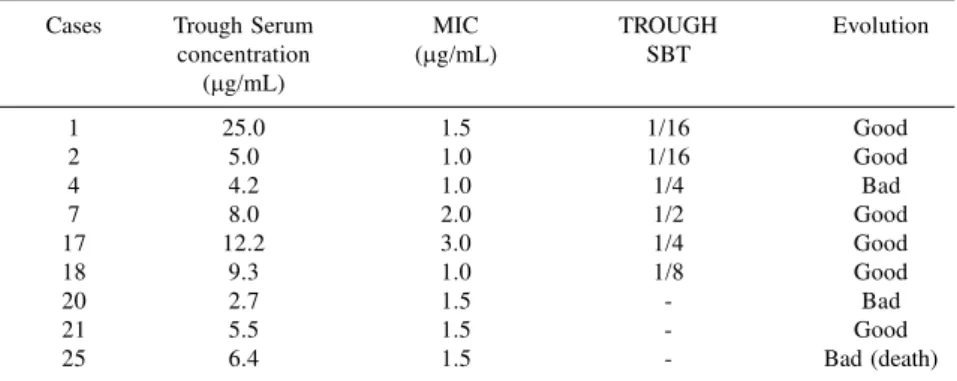
The data regarding laboratory and clinical monitoring is presented in table 6.
DISCUSSION
The few published prospective studies on neonatology or pharmacol-ogy dealing with the levels of serum concentrations of vancomycin mostly report results obtained from preterm newborn infants (30 to 36 weeks of post-conceptual age). Due to the small number of cases studied to date
world-Table 6 - Comparison of therapeutic serum concentration (mg/ml). trough sbt
(titer), mic (mg/ml), and clinical evolution in each case.
Cases Trough Serum MIC TROUGH Evolution
concentration (mg/mL) SBT
(mg/mL)
1 25.0 1.5 1/16 Good
2 5.0 1.0 1/16 Good
4 4.2 1.0 1/4 Bad
7 8.0 2.0 1/2 Good
17 12.2 3.0 1/4 Good
18 9.3 1.0 1/8 Good
20 2.7 1.5 - Bad
21 5.5 1.5 - Good
25 6.4 1.5 - Bad (death)
Table 5 - Comparison of trough serum concentration of vancomycin (mg/ml) to
the newborn infants’ clinical evolution with sepsis.
Clinical Evolution
3rd to 4th day of Average ± SD Median Minimum Maximum
antibiotic therapy
Good (n= 20) 10.2 ± 5.8 8.8 4.5 25.0
Bad (n = 5) 6.2 ± 5.2 4.2 2.6 15.0
U = 77.0 p = 0.1710
Table 4 - Comparison of peak serum concentration of vancomycin (mg/ml) to
the newborn infants’ clinical evolution with sepsis.
Clinical Evolution
3rd to 4th day of Average ± SD Median Minimum Maximum
antibiotic therapy
Good (n= 18) 25.2 ± 10.7 27.4 5.1 51.0
Bad (n = 4) 18.1 ± 10.6 16.4 8.8 31.0
U = 51.5 p = 0.1947
Table 3 - Agreement between normality determined by the peak serum
concentrations (20-40 mg/ml) and at the trough (5-10 mg/ml) as measured by TDx/Abbott® method.
Peak
Valley Adequate (%) Inadequate (%) Total (%)
Adequate 5 (22.73) 6 (27.27) 11 (50)
Inadequate 8 (36.36) 3 (13.64) 11 (50)
Total 13 (59.09) 9 (40.91) 22 (100)
McNemar’s Test: P = 0.7905
wide, further studies in term newborns are needed 26.
The authors determined vancomy-cin levels by the fluorescence polariza-tion immunoassay procedure (TDx/ Abbottâ). It was employed because it
is still the technique used most inter-nationally; among its advantages are the possibility of quick analysis, the requirement for small amounts of se-rum samples, and its low cost.
vancomycin is best described by a 2 or 3 compartmental model, and it is be-lieved that a compartmental model is adequate to describe it in the clinical practice26. A single compartmental model has also been used in recent studies of the pharmacokinetics of van-comycin in premature infants. Al-though there may be shortcomings in the use of the single compartmental model, it is believed that these are not clinically significant 27-32.
To determine the peak serum con-centration, a sample was collected 1 hour after the end of the infusion, in order to minimize the effect of incom-plete distribution of the drug33-35.
Some authors have shown greater percentages of adequate peak serum than those found in the present study, reaching as much as 92%, with peak serum concentrations of vancomycin between 20 – 40 mg/mL. These results, however, vary greatly in the literature, and most of them are from preterm in-fants36.
When the serum concentration of vancomycin is collected at the peak, the objective is to diagnose the poten-tial risk for ototoxicity, although there is limited information in the literature regarding this possible toxic effect re-lated to vancomycin in newborns27 .
When the serum content of vanco-mycin is collected at the trough, the goal is to detect the nephrotoxic ef-fects, as well as the adequate or sub-therapeutic serum concentrations. Some authors14 consider the serum level as therapeutic when the concen-tration at the valley is > 5 mg/mL. Thus, the therapeutic serum level of vancomycin is adequate when it is > 5 and £ 10 mg/mL, or inadequate when it is above 10 mg/mL (therapeutic, but with potential risk for nephrotoxicity). The adequate serum concentrations of vancomycin at the valley and at the peak in pediatric patients vary between 5 and 12 and between 25 and 40 mg/ mL, respectively. Other authors, as
mentioned previously, consider as ad-equate the serum valleys of vancomy-cin between 5 and 10 mg/mL and the serum peaks between 20 – 40 mg/ mL14.
The nephrotoxicity due to vanco-mycin is associated to trough serum concentrations above 30 mg/mL27.
When the SBT value is obtained, it is possible to correlate it to the serum concentration value of the antibiotic.
Some authorssuggest that there has to be a minimum of 1/8 of trough se-rum bactericidal titer for it is associated to efficacy in the treatment26.
Other authorsreport the relation-ship between SBT levels of 1/8 at the serum trough and successful healing in 95% of the pediatric patients (with ages varying from 3 days to 12 years)27. In our results, there was one case in which it was necessary to main-tain the serum concentration of vanco-mycin above 12 mg/mL to obtain a trough SBT of 1/8. The SBT can dem-onstrate that the patient’s serum is act-ing efficiently against the infection, but that does not necessarily mean that there is efficacy at the infection site. Examples of sites in which this can oc-cur are bones, cerebrospinalis fluid, and pleural fluids, since the SBT mea-sures the therapeutic action of the se-rum against the bacteria in vitro, not at
the infection site.
With regard to clinical follow-up, there are no studies with term infants in the literature that analyze the direct effect of concentrations of vancomycin and patients’ clinical responses. There are also few studies that correlate MIC, SBT, and rates of cure14,37-39.
However, if the therapeutic objec-tive is a 20 – 40 mg/mL range of peak serum concentration of vancomycin, that would result in peak serum values 20 times greater than the MIC and trough values 5 to 8 times greater than the MIC36.
By definition, if the trough serum concentration of the antibiotic is 4 to
8 times greater than the MIC, it means that the vancomycin has reached thera-peutic tissue concentration.
Considering only the patients with adequate peak serum vancomycin con-centrations, the concentration varied from 13 to 20.7 times the MIC; in the patients with adequate trough serum levels, the concentration varied from 4 to 9.3 times the MIC. The latter values are close to those found in the existing literature.
The lack of standardization of the dosage or of concern for the individual patient often results in undesirable pharmacokinetic effects, which results in the action of the drug being thera-peutically ineffective.
Therapy with potent drugs becomes safer and more effective in the neona-tal period when the dose is adjusted to the needs and tolerance of each new-born, since there are individual differ-ences regarding the bioavailability of the dose used, host factors, weight and general conditions of the patient, dis-tribution through compartments and fluids, links to inactive sites, metabo-lizing rate, and renal excretion. All of these determining factors undergo in-dividual and temporal variations.
CONCLUSIONS
Recommended vancomycin doses for term treatment of newborn infants have to be based on individual weight and especially on the post-conceptual age. A standardized dose should be used only to start the antimicrobial therapy in cases of neonatal sepsis; the dose must be individualized and cor-rected after the measurement of the se-rum level of vancomycin, which is the indispensable requirement for correc-tion of the antibiotic dose.
RESUMO RHCFAP/3031
MACHADO JKK e col. - Monitori-zação da terapêutica com vancomicina em recém-nascidos de termo com sepse, utilização e importância clínica.
Rev. Hosp. Clín. Fac. Med. S. Paulo 56(1):17-24, 2001.
Foi realizado um estudo pros-pectivo para verificar se as doses ha-bituais de vancomicina determinam concentrações séricas adequadas em 25 recém - nascidos de termo com sepse.
Objetivos: Avaliou-se a resposta
terapêutica da sepse neonatal por
Staphylococcus sp., tratada com
vancomicina, monitorizando além de sua concentração sérica, o poder bactericida do soro (PBS) e a concen-tração inibitória mínima (MIC).
Método: Os níveis séricos do
anti-biótico foram obtidos através do imunoensaio por fluorescência polari-zada, o MIC através de micro-difusão em ágar, e o PBS foi obtido por macro-diluição em caldo.
Resultados: Concentrações séricas
no pico de vancomicina adequadas (20-40 mg/mL) ocorreram em 59,1% dos casos e um recém-nascido apresen-tou potencial risco de ototoxicidade (>40 mg/mL). Em 48% dos pacientes ocorreram vales séricos adequados (5-10 mg/mL) e 28% dos pacientes apre-sentaram potencial risco de nefrotoxicidade (>10mg/mL). Não houve concordância significante entre a normalidade determinada pelo pico e vale de vancomicina no método (pro-va de McNemar: p=0,7905). A concen-tração sérica no pico de vancomicina foi comparada com a evolução clínica dos recém-nascidos com sepse neonatal, não havendo diferença esta-tisticamente significante entre os picos séricos dos pacientes que apresentaram boa e má evolução (U=51,5; p=0,1947). Também não houve dife-rença estatisticamente significante en-tre os vales séricos dos pacientes que apresentaram boa e má evolução
clíni-ca ( U= 77,0; p=0,1710). Todos os MICs obtidos demonstraram sensibili-dade à vancomicina. Metade dos paci-entes que apresentou PBS no vale ade-quado (1/8), também tiveram concen-tração sérica de vancomicina adequa-da e boa evolução clínica.
Conclusões: A recomendação de
doses de vancomicina para recém-nas-cidos de termo deve ser baseada no peso e na idade pós-conceptual apenas para dar início à terapia antimicrobiana na sepse neonatal, não existindo um padrão de doses ideal. Logo, a dose deve ser individualizada. A utilização desses da-dos laboratoriais com a clínica favore-cem a elucidação da provável causa da má evolução do paciente, facilitando o ajuste da droga e a menor chance de efeitos tóxicos ou sub-terapêuticos .
DESCRITORES: Monitorização fisiológica. Recém-nascido. Sepse. Vancomicina. Teste de susceptibili-dade antimicrobiana.
lengthen the intervals between the doses of vancomycin to achieve a lower frequency of administration while maintaining the same vancomy-cin concentration at the serum peak.
Although the study sample was small, the authors concluded that the SBT must be analyzed in conjunction
with the patient’s clinical evaluation and the measurements of the serum concentration values of vancomycin. The MIC must always be part of the antibiogram in order to quantify the susceptibilityof the Staphylococcus sp.
and to obtain the precise information regarding the intermediate or the
REFERENCES
1. FREEMAN J, EPSTEIN MF, SMITH NE et al. - Extra hospital stay and antibiotic usage with nosocomial coagulase-negative staphylococcal bacteremia in two neonatal intensive care unit populations. Am J Dis Child 1990; 144-324.
2. GRUSKAY JA, NACHAMKIN I, BAUMGART S et al. - Predicting the pathogenicity of coagulase-negative Staphylococcus in the neonate: Slime production, antibiotic resistance and predominance
of S. epidermidis species. Pediatr Res 1986; 20:397A.
3. GUNN BA - Comparative virulence of human isolates of coagulase-negative staphylococci tested in an infant mouse weight retardation model. J Clin Microbiol 1989; 27:507.
4. HALL RT, HALL SL, BARNES WG et al. - Characteristics of coagulase-negative Staphylococci from infants with bacteremia. Pediatr Infect Dis J 1987; 6:377.
5. MARTIN MA, PFALLER MA & WENZEL RP - Coagulase-negative staphylococcal bacteremia. Mortality and hospital stay. Ann Intern Med 1989; 110: 9.
6. BALEY JE & FANAROFF AA - Neonatal infections, part 2: Specific infectious diseases and therapies. In: SINCLAIR JC & BRACKEN MB - Effective care of the newborn infant. Oxford, Oxford, University Press, 1992. p.477-50.
7. COLE FS - Bacterial infections of the newborn. In: TAEUSCH HW, BALLARD RA & AVERY ME - Schaffer and Avery’s Diseases of the Newborn. 6th ed. Philadelphia, Saunders, 1991. p.
350-369.
8. KLEIN JO & MARCY SM - Bacterial sepsis and meningitis. In: REMMINGTON JS & KLEIN JO - Infectious diseases of the fetus and newborn infant.4th ed. Philadelphia, Saunders, 1990.
p. 601-656.
9. GINOVART GG, ANDREU DMD, FANE RR et al. - Sepsis caused by coagulase-negative Staphylococcus in the newborn infant. Clinical and therapeutic aspects. An Esp Pediatr 1993; 38 (6):488-92.
10. RODVOLD KA, EVERETT JA, PYKA JA et al. - Pharmacokinetics and administration regimes of vancomycin in neonates, infants and children. Clin Pharmacokinet 1997; 33(1):32-51.
11. ZOKUFA HZ, RODVOLD KA, BLUM RA et al. - Simulation of Vancomycin peak and through concentrations using five dosing methods in 37 patients. Pharm 1989; 9:10.
12. BONE RC - The pathogenesis of sepsis . Ann Intern Med 1991;115: 457-469.
13. YOUNG TE & MANGUM OB - The Manual of Drugs used in Neonatal Care. 9th ed. Raleigh, North Carolina, Acorn Pub, 1996, p. 52-53, Vancomycin.
14. SCHAAD UB, MCCRACKEN GH Jr & NELSON JD - Clinical pharmacology and efficacy of vancomycin in pediatric patients. J Pediatr 1980; 96:119-26.
15. TAKETOMO CK, HODDING JH & KRAUS DM - In: Pediatric Dosage Handbook. 3rd ed. Hudson, Cleveland Lexi, 1997, p.703-04, Vancomycin.
16. COLEMAN DL, HORWITZ RI, ANDRIOLE VT - Association between serum inhibitory and bactericidal concentrations and therapeutic outcome in bactericidal endocarditis. Am J Med 1982; 73: 260-67.
17. WOLFSON JS & SWARTZ MN - Serum bactericidal activity as the monitor of antibiotic therapy. N Engl J Med 1985; 312 :968-975.
18. NATIONAL committee for clinical laboratory standards -Methodology for the serum bactericidal test: proposed guideline. NCCLS document. In: NATIONAL committee for clinical laboratory standards, Villanova, Pa., 1987. p. M21- P.
19. NATIONAL committee for clinical laboratory standards -Methodology for the Serum Bactericidal Test. Tentative Standard. In: NATIONAL COMMITTEE FOR CLINICAL LABORATORY STANDARDS. Villanova, Pa., 1992. p.M21-T.
20. NATIONAL committee for clinical laboratory standards – Methods for Determining Bactericidal Activity of Antimicrobial Agents. Tentative Standard, M26-t. In: NATIONAL COMMITTEE FOR CLINICAL LABORATORY STANDARDS. Villanova, Pa., 1992. p. M26-T.
21. NATIONAL committee for clinical laboratory standards – Methods for Dilution Antimicrobial Susceptibility Testing for Bacteria that Grow Aerobically. Approved standard. In: NATIONAL COMMITTEE FOR CLINICAL LABORATORY STANDARDS. Villanova, Pa., 1993. p.M7-A3.
22. NATIONAL committee for clinical laboratory standards - Performance Standard. In: NATIONAL COMMITTEE FOR CLINICAL LABORATORY STANDARDS. Villanova, Pa., 1993. p.M2-A5. 23. CENTERS for disease control. MMWR 1997; 46:765-6.
24. JOHNSON GM, LEE DA, REGELMANN WE et al. - Interference with granulocyte function by Staphylococcus epidermidis slime.
Infect Immun 1986; 54:13.
25. RUDD PT, HUGHES EA, PLATCZEK MM et al. - Reference ranges for plasma creatinine during the first month of life. Arch Dis Child 1983; 58:21.
26. GABRIEL MH, KILDOO CW, GENNRICH JL et al. - Prospective evaluation of the vancomycin dosage guideline for neonates. Clin Pharm 1991; 10:129-32.
27. MATZKE GR, ZHANEL GG & GUAY DRP - Clinical pharmacokinetics of vancomycin. Clin Pharmacokinet 1986; 11: 257-82.
28. ALPERT G, CAMPOS JM, HARRIS MC et al. - Vancomycin dosage in pediatrics reconsidered. A J D C 1984; 138:20-2.
29. BAUMGART S, HALL SE, CAMPOS JM et al. - Sepsis with coagulase-negative staphylococci in critically ill newborns. AJ D C 1983; 137:461-3.
31. JAMES A, KOREN G, MILLIKEN J et al. - Vancomycin pharmacokinetics and dose recommendations for preterm infants. Antimicrob Agents Chemother 1987; 31:52.
32. LEONARD MB, KOREN G, STEVENSON DK et al. - Vancomycin pharmacokinetics in very low birthweight neonates. Pediatr Infect Dis J 1989; 8:282.
33. NAQVI SH, KEENAN WJ, REICHELEY RM et al. - Vancomycin pharmacokinetics in small, seriously ill infants. A J D C 1986; 140:107-120.
34. KILDO CW III, LIN L, GABRIEL MH et al. - Vancomycin pharmacokinetics in infants: relationship to post-conceptional age and serum creatinine. Dev Pharmacol Ther 1990; 14:77-83. 35. REED MD, KLIEGMAN RM, WEINER JS et al. - The clinical
pharmacology of vancomycin in seriously ill preterm infants. Pediatr Res 1987; 22:360.
36. GABRIEL MH & GENNRICH JL - Vancomycin dosing for neonates. Pediatr Infect Dis J 1993; 12(2):156-7.
37. LISBY-SUTCH SM & NAHATA MC - Dosage guidelines for the use of vancomycin based on its pharmacokinetics in infants. Eur J Clin Pharmacol 1988; 35:637-42.
38. LOURIA DB, KAMINSKI T & BUCHMAN J - Vancomycin in severe staphylococcal infections. Arch Intern Med 1961; 107:225-40.
39. SORRELL TC, PACKHAM DR, SHANKER S et al. - Vancomycin therapy for methicillin-resistant Staphylococcus aureus. Ann Intern Med 1982; 97:344 –50.