Study conducted at the Professional Master’s Program in Speech-Language Pathology and Audiology, Universidade Veiga de Almeida – UVA – Rio de Janeiro (RJ), Brazil.
(1) Professional Master’s Program in Speech-Language Pathology and Audiology, Universidade Veiga de Almeida – UVA – Rio de Janeiro (RJ), Brazil. Conflict of interests: None
Author´s contributions: MHD was responsible for the study concept and design, acquisition of the data, analysis and interpretation of the data and drafting of the manuscript, JVB was responsible for the study concept and design, analysis and interpretation of the data, statistics analysis, drafting of the manuscript and study supervision, MMBP was responsible for the analysis and interpretation of the data, drafting of the manuscript and study supervision.
Correspondence address: Mônica Medeiros de Britto Pereira. R. Ibituruna, 108, casa 3, sala 202, Tijuca, Rio de Janeiro (RJ), Brazil, CEP: 20271-020. E-mail: [email protected]
Received: 11/30/2011; Accepted: 7/10/2013
Assessment of the awareness of dyscalculia among
educators
Avaliação do conhecimento sobre a discalculia entre educadores
Michelle de Almeida Horsae Dias1, Monica Medeiros de Britto Pereira1, John Van Borsel1
ABSTRACT
Purpose: To obtain local data in the metropolitan region of Rio de Ja-neiro on the knowledge and perception of educators of signs indicative of dyscalculia. Methods: A questionnaire with 18 questions (two open questions and sixteen closed questions) was presented to primary school teachers of public and private schools. The questions were related to the occurrence of the topic of dyscalculia during their education as a teacher, their professional experience, specific knowledge about dyscalculia, and strategies to be used in the classroom. Results: Forty five point two percent reported not to know what dyscalculia is. Only 12.9% believed they can identify signs of dyscalculia. Conclusion: The participants have little specific knowledge about dyscalculia and showed to be insecure with respect to their ability to identify possible cases of dyscalculia.
Keywords: Learning; Mathematics; Faculty; Knowledge; Dyscalculia
RESUMO
Objetivo: Obter dados locais na região metropolitana do Rio de Janei-ro sobre o conhecimento ou a percepção do pJanei-rofissional de educação sobre os sinais indicativos de discalculia. Métodos: Foi elaborado e aplicado a 63 professores do ensino fundamental das redes de ensino pública e particular, um questionário com 18 perguntas específicas sobre discalculia, sendo duas perguntas abertas e 16 fechadas. As perguntas abordavam a presença do tema na formação, experiência profissional, conhecimento específico e propostas de estratégias pedagógicas para a discalculia. Resultados: Quarenta e cinco vírgula dois por cento dos professores informaram desconhecer o quadro de discalculia. Apenas 12,9% consideraram-se capazes de identificar um caso de suspeita de discalculia. Conclusão: De acordo com os resultados obtidos, os pro-fessores possuem pouco conhecimento específico sobre a discalculia e se mostram inseguros da sua capacidade de identificar um caso suspeito.
INTRODUCTION
Developmental dyscalculia is a disorder that affects mathe-matical skills and is probably caused by a specific disturbance of cerebral functioning(1-3).
Common complaints in anamneses are the occurrence of dyslexia, an attention deficit hyperactivity disorder (ADHD) or general learning problems. Dyscalculia, on the other hand, rarely occurs as a specific complaint(4,5). This does not mean,
however, that the disorder is rare but rather that it can be masked by other learning disorders.
In the first systematic study on specific math learning difficulties the term “developmental dyscalculia” was in-troduced(6). This new nomenclature directed the attention of
future researchers. However, other terminology has been used such as “arithmetic learning disabilities”,” specific arithmetic difficulties” or “specific arithmetic learning difficulties”. The difference in terminology is compounded by differences in criteria for assigning children to the category(7).
It is a fact that in comparison with dyslexia(7,8) and other
disorders, little research has been conducted on dyscalculia thus far, which makes assessment and treatment difficult. Individuals with dyscalculia may be highly gifted and very successful in areas that do not depend on numerical skills(9). Since it concerns
a field of study that received only recently some major attention, dyscalculia presumably is not well-known among educators.
In general, a great number of pupils present with low per-formances in mathematics(10). As part of public politics some
evaluations have been conducted in order to gather information on the academic performance of pupils in this area. The Sistema de Avaliação da Educação Básica (SAEB), for example, is conducted every two years and evaluates knowledge of ma-thematics and Portuguese language. According to this system, hardly 5.99% of the pupils of secondary school that were evaluated in 2003 reached an adequate level in mathematics with skills in line with the class they were in. Twenty-six point fifty-seven percent performed slightly below the expected level. The remaining 67.44% had results below the level they were attending, being unable to perform operations as required or to interpret everyday situations that involve mathematics(11).
Looking at how diagnosis is performed, not only of dyscal-culia but of learning disorders in general, there doesn’t seem to be a consensus on parameters or a standard for identifica-tion. However, in the majority of studies the identification is somehow based on an evaluation by the teacher. Hence, the relevance of taking into account the ability of this professional in correctly judging signals presented by his/her pupils(12).
Since the teacher is the professional that has daily direct contact with the pupils, it is of utmost importance that he/she be able to identify those that possibly suffer a specific disorder of mathematic skills. The purpose of the present study, therefore, was to gather data on the knowledge and perception of educators in the metropolitan region of Rio de Janeiro of signs indicative
of dyscalculia.Hopefully, the results of this study contribute to the development of political measures for identifying pupils with dyscalculia and are useful for informing teachers, so that the needs of schools can be met better.
METHODS
Participants
As a sample were selected professionals teaching in the edu-cation area in private as well as public basic schools irrespective ot time of experience with as inclusion criterium teaching only in the basic education from the 1st to the 9th year. Teachers of
kindergarten, secondary schools or higher education or teachers that were not employed at the moment the study was conducted were not included. In total 63 teachers being 54 (85.7%) of the female gender and nine (14.3%) of the male gender ) of schools in the east zone of Rio de Janeiro, Niteroi, São Gonçalo and the Baixada Fluminense agreed to participate. The mean was 39 years and 2 months,with a median of 36 years and 8 months (standard deviation of 9,4; minimum of 22 years and 7 months and maximum of 59 years and 8 months).
Material
The perception of dyscalculia of the educational profes-sional was investigated by means of a questionnaire, which was developed by the authors based on their knowledge of the literature and their ample experience with children with dyscalculia and dyslexia. As such, it may be assumed that the questionnaire had face validity. To the best of our knowledge, no other similar instruments exist in the Brazilian context that could have been used to also assess concurrent validity. The questionnaire presented eight general questions and 18 specific questions being two open and 16 closed questions. It is formed of three parts. The first presented to the teacher the objective of this study.The second consisted of with general questions with initials of the name, date of birth, date of filling out the questionnaire, the place where is the professional teaches, , the year where the professional teaches, time working as a teacher, place where he was fomed (university, faculty,school) and level of formation (graduate, postgraduate, master, doctoral). The third part consited of specific questions about dyscalculia, being two open questions (item 2 ”what is dyscalculia”) and item 6 (“which is/are your coinduct when confronte with a case of dyscalculia”) (Appendix 1).
Procedure
order to avoid any bias no further instructions were given as to how to fill out the questionnaire.
The specific questions 1 to 4 relate to the teacher’s vocatio-nal training regarding the topic. Questions 5, 6 and 7 inquire about the teacher’s experience and conduct when confronted with a case of suspected dyscalculia and how he estimates his/ her own competence in identifying dyscalculia. Questions 8 to 16 and question 18 concern knowledge of the clinical and differential diagnostic characteristics of dyscalculia and the way dyscalculia may present in the classroom. Question 17 has no correct or wrong answer but was meant to find out to which specialized professional the teacher would refer a pupil with suspected dyscalculia.
The present study was approved by the ethics and rese-arch committee of the Veiga de Almeida University (number 359/11). All participants signed the informed consent.
Answers on the closed questions were subjected to a quan-titative analysis, those on the open questions to a qualitative analysis. Statistic tests used were the Chi-square test and Fisher’s exact test (nominal data) and the Mann-Whitney U test and Friedman test (ordinal data) with an alpha level set at 0.05. Qualitative analysis involved classification of the various answers.
RESULTS
Forty-four participants (69.8%) were teaching in one class only, 19 (30.2%) were teaching in two or more classes. Distinguishing between lower grade (years 1 to 5) and higher grade (years 6 to 9), 51 of the 62 respondents who furnished the information required (82.3%) were teaching in the lower grade, 11 (17.7%) in the higher grade. Forty-eight (76.2%) respondents were teaching in public schools, 20 (31.7%) in private schools and 6 (9.5%) in both types.
In the distribution of the participants according to time of working, two distinct groups were considered: a group of tea-chers with less than ten year of work and another of professors with more than ten years of work. Of the total of Sixty-one valid answers,thirty-seven (60.7%) of the professors presented with more than then years of work and 24 (39.3%) less than ten years of work.In relation to the formation of the teachers, the answers of 55 participants were valid, since 8 did not answer. Of those valid 42 (76.4%)took only graduate courses, 11 (20%) postgraduate, 1 (1.8%) master and 1 (1.8%) doctoral
Question n° 1: Do you know what dyscalculia is? Of the 62 participants who answered, 34 (54.8%) answe-red “yes” and 28 (45.2%) declaanswe-red not to know dyscalculia . Distributing the answers according to working time, it was observed that among the participants that answered “yes” to this question, 25 (69.4%) had more than ten years of work and 8 (33.3%) had less than ten years of work; Among those that answered “no”, 11 (30.6%) had more than ten years of work and 16 (66.7%) had lees than ten years of work. Application of
the chi square test revealed a significant difference (p=0.006). This means, there was an effect of years of work. According to the formation of the teachers, the ones with a graduate degree presented 50 % positive answers. Among those with a formation beyond graduate level, 9 (75%) answered “yes”. Application of the chi square test did not reveal a significant difference t (p=0.124). Distributing the answers according to the year of basic teaching, among that teach in the 1st seg-ment (1st to 5th year) 28 (56%) answered “yes” and 22 (44%)
answere “no”. Of the teachers teaching in the 2nd segment (6th
to 9th year), 6 (54.5%) answered “yes” and 5 (45.5%) answered
“no”. There was no difference between the answers “yes” and “no” in the two groups (Fisher’s exact test, p=1,000). According to the type of school – public or private- there was a predominance of positive answers among those that teach in private schools. Of the 41 that teach in public school, 20 (48.8%), answered “yes” and among the 15 that teach in pri-vate school, 12 (80%) answered “yes”, revealing a difference (chi square test, p=0.037).
Question n° 2: Give your definition of dyscalculia Answers to this question were classified according to pre-vailing opinion. Twenty-five answers associated dyscalculia with a general difficulty or disorder in math processing and 11 associated dyscalculia specifically with the comprehension and manipulation of number concepts. A minority of answers made reference to a general learning disorder, a neurological lesion or dyslexia.
Question n° 3: Was the topic “dyscalculia” discussed during your vocational training? (graduate/post-graduate)
This question was analyzed distinguishing between par-ticipants with graduate degree and those with post graduate education. Four participants did not answer this question. Of the 59 with a graduate degree, 47 (80%) informed not to have dealt with the topic of “dyscalculia” and 12 (20.3%) had contact with the topic. Of the 24 valid answers of those with post graduate degree, 17 (70.9%) informed not oto have had contact with “dyscalculia” and 7 (29.1%) declared to having had contact with the topic in some type of post-graduation.
Question n° 4: Was the topic “dyslexia” discussed during your vocational training? (graduate/post-graduate)
The analysis of this question was similar to the previous question. Of the 59 participants with a graduate degree that answered, 42 (71.2%) informed to have had contact with the topic “dyslexia” in the graduation and 17 (28.8%) informed no. In relation to the post-graduated, of the 22 valid participants 16 (72.7%) confirmed that they had contact with the topic and 6 (27.3%) did not have contact with the topic “dyslexia” in post graduation.
about dyslexia: 12 i.e. 20.3% and 42, i.e. 71.2%, p<0.001 and 7, i.e. 29.1% and 16, i.e. 72.7%, p=0.003, respectively).
Question n° 5: Did you already encounter situations during your professional career that made you suspect a dyscalculia? The frequency of negative answers of the 63 questionnaires analyzed was 58.7% (37) and of the positive answers 41.3% (26).
Distributing the data according to time of work, it was observed that among those with less than ten years of work, 3 (12.5%) answered “yes”. Among those with more than ten years of work, 23 (62.2%) answered “yes”, presenting a difference (chi square test, p=0,001).
According to the segment of basic teaching the participants were working in , among those that were working in the first segment (1st to 5th year), 28 (54.9%) answered “no” and among
those teaching in the second segment (6th to 9th year) 8 (72.7%)
answered “no”. In the analysis, there was no difference (Fisher’s exact test, p=0.332).
With reference to the type of school –public or private- those teaching in public schools, 24 (57.1%) answered “no” and of those teaching in private schools 10 (66.7%) answered that they did not met situations with suspected dyscalculia. In the analysis, there was also no difference (chi square test, p=0.519).
Question n° 6: What was your conduct when confronted with (a) pupil(s) with suspected dyscalculia?
The following types of answers were given to this question: refer to another professional within the school or to a specialist (24 answers), proposals to try to somehow change the behavior of the child (8 answers), inform and advise the family about the problem (5 answers), and change the attitude in front of the pupil (3 answers).
Question n° 7: Do you think that you are able to identify a child with dyscalculia in your class?
Of the 62 teachers who responded to this question the frequency of those who said “maybe” was 56.5% (35), among those who said no it was 30.6% (19), and among those that said yes it was a12.9% (8) For the correlation analysis that follows, two categories of answers were considered, only “yes” or “no” = no + maybe. Considering the time of work, the majority of the two groups answered not to believe to be able to identify a pupil with dyscalculia. There was no difference between the answers of the 20 (87%) teachers with less than 10 years of work and the 33 (89.2%) with more than 10 years of work (Fisher’s exact test, p=1.000).
According to the formation, there was also no difference among the answers of the 35 (85.4%) that had a graduate degree and answered “no” and those 11(84.6%) that had a post gradu-ate degree and answered “no” (Fisher’s exact test, p=1.000).
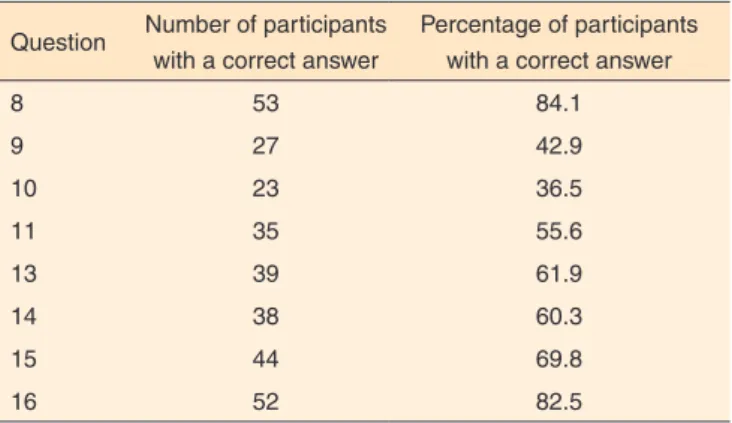
Questions 8, 9, 10, 11, 13, 14, 15, and 16 were analyzed individually and as a set. The mean number of correct answers on these 8 questions was 4.95, with a median of 5 and a standard deviation of 2.18. The total number of correct answers for each question is in shown in Table 1.
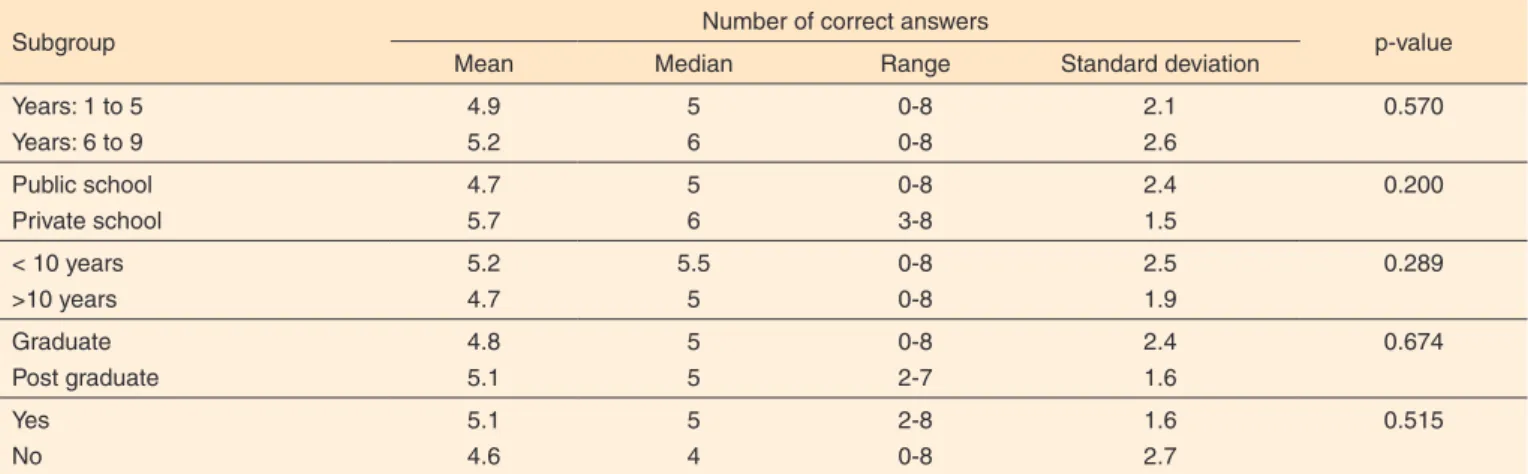
A Friedman test showed that the number of correct answers differed significantly (p<0.001) from question to question. As shown in Table 2 the number of correct answers did not signi-ficantly differ between teachers of the lower grade and those of the higher grade, between teachers of private schools and those of public schools, between those with more than ten years of experience and those with less than ten years of experience, between those with a graduate degree and those with a post graduate degree, or between those that had answered “yes” on the first question of this questionnaire (do you know what dyscalculia is?) and those that had answered “no”.
Question n° 12: Which of the following conditions could be mistaken for dyscalculia?
The number of options that were marked in response to this question ranged from 0 to 6 with a median of 3. The option “A lack of interest in mathematics” was marked by 43 of the 63 respondents (68.3%) who answered this question, “an attention deficit” and “dyslexia” were marked by 41 (65.1%) and 12 (19%) respondents, respectively (Table 3).
Question n° 17: In your opinion, who is the professional that should treat a child with dyscalculia?
The number of options that were marked in response to this question ranged from 0 to 5 with a median of 1. The speech language pathologist was marked most frequently (33 times, i.e. 52.4%), followed by the pedagogue (24 times, i.e. 38.1%). The option “other professionals” was indicated 22 times (34.9%) and included most often a psycho-pedagogue (9 times) and neurologist (8 times).
Question n° 18: In your opinion, what is the cause of dyscalculia?
The number of answers to this question ranged from 0 to 6 with a median of 2. “Brain damage” was marked 31 times (49.2%), “emotional problems” 28 times (44.4%) and a lack of attention 23 times (36.5%) (Table 4).
DISCUSSION
In some studies consulting the teacher has been considered a valid approach for identifying learning disorders(6). However, Table 1. Number of correct answers for each question
Question Number of participants with a correct answer
Percentage of participants with a correct answer
8 53 84.1
9 27 42.9
10 23 36.5
11 35 55.6
13 39 61.9
14 38 60.3
15 44 69.8
16 52 82.5
in the present study almost half of the teachers reported not to know what dyscalculia is and as such would, in principle, not be able to identify suspected cases. Maybe teacher opinions are valid only for identifying learning problems in general but not for identifying specific disorders.
The majority of the respondents that claimed to know what dyscalculia is had more than ten years of teaching experience. Years of experience appeared to be the most important factor. Level of education did not play a role. Respondents with a higher level of education did not more often report to know what dyscalculia is than those with a graduate degree only.
Since arithmetic skills are inborn and do not necessarily depend on formal education(7-12), children with suspected
dys-calculia could already be identified at the beginning of primary school. Children with specific language difficulties may also show problems in the acquisition of math skills. In order to build and develop a spatial image of ordinal numbers it is necessary to link the comprehension of magnitude with the symbolic and spatial/ordinal properties of the number.This process requires cognitive functions that develop during preschool years and the first years of primary school and include, among others, language skills and working memory(13,14).
As such, the first years of primary school, when the first concepts of number and calculation are taught, might be the moment when dyscalculia in a pupil can first be suspected. Early identification could improve support for the pupil by more specific help. There are studies available that established the characteristics of dyscalculia and that can help the teacher in identifying pupils with dyscalculia(15). Unfortunately, it appears
that teachers of the earlier years are not more knowledgeable about dyscalculia than those of the later years, so that the op-portunities to early start with specific help are lost.
A striking result of the present study was that teachers of private schools more often reported to know what dyscalculia is than teachers of public schools. Possible explanations for this difference might be that private schools invest more in the training of their professors, and the need to give priority to more basic educational aspects and a lack of stimulation of both teachers and pupils in the public schools due to different socio-economic conditions, violence, etc. Future studies could explore these and other hypotheses.
Another striking result is that 3/4 of the respondents repor-ted not to have dealt with dyscalculia during their academic training, neither at graduate nor at post-graduate level. By contrast, half of the respondents had dealt with dyslexia even at graduate level. Clearly, dyslexia is a much better known disorder than dyscalculia(7,8).
Regarding experience with dyscalculia, the majority of
Table 2. Correct answers per subgroup
Subgroup Number of correct answers p-value
Mean Median Range Standard deviation
Years: 1 to 5 Years: 6 to 9
4.9 5.2
5 6
0-8 0-8
2.1 2.6
0.570
Public school Private school
4.7 5.7
5 6
0-8 3-8
2.4 1.5
0.200
< 10 years >10 years
5.2 4.7
5.5 5
0-8 0-8
2.5 1.9
0.289
Graduate Post graduate
4.8 5.1
5 5
0-8 2-7
2.4 1.6
0.674
Yes No
5.1 4.6
5 4
2-8 0-8
1.6 2.7
0.515
Mann-Whitney U Test
Table 3. Conditions that could be mistaken for dyscalculia
No Yes
Dyslexia 51 (81%) 12 (19%)
Attention deficit 22 (34.9%) 41 (65.1%)
Specific lack of interest in mathematics 20 (31.7%) 43 (68.3%)
Difficulty understanding the formulation of problems
30 (47.6%) 33 (52.4%)
Visual or auditory deficit 40 (63.5%) 23 (36.5%)
Other learning disorders 32 (50.8%) 31 (49.2%)
Table 4. The cause of dyscalculia
Number
(out of 63) %
Reduced intelligence 4 6.3
Lack of attention 23 36.5
Poor quality of education 11 17.5
Brain damage 31 49.2
Heredity 16 25.4
Emotional problems 28 44.4
Social problems 17 27.0
participants denied to ever have come across cases of dyscalcu-lia. Number of years teaching appeared to be the decisive factor: most of those who reported to have seen cases of dyscalculia were teachers who had been teaching for more than ten years. Level of teaching (lower of higher grade) and type of school (public or private) did not make any difference.
Only a minority of the participants was of the opinion that they were able to identify a case of suspected dyscalculia. This stands in contrast to other studies that pointed out a better ca-pacity of educators to identify suspected learning disorders(11).
This result is worrying as one would expect that first diagnoses are made foremost by teachers.
The scores on the questions with correct or wrong answers, on average, were only slightly above the mean, and unlike for other questions scores were not better in teachers with a longer teaching experience. Also scores were not better in the teachers that had claimed to know what dyscalculia is. This could suggest that answers had been arrived at by deduction from the context rather than being based on previously existing knowledge.
Conditions which according to the respondents could be mistaken for dyscalculia are mainly a lack of interest in ma-thematics and an attention deficit. For the latter there is some support in the literature: an attention deficit hyperactivity disorder (ADHD) is considered a common comorbidity of dyscalculia or the cause of comparable symptoms(12,16,17,). Other
conditions that can cause similar symptoms, even disorders that are known to co-occur frequently with dyscalculia or with importance for differential diagnosis, such as dyslexia, were not often marked(17,18).
The professional that was most often indicated to be the person that should treat a pupil with dyscalculia was the speech language pathologist. However, when asked about their conduct when confronted with a case of suspected dyscalculia, the most common action was referral to a psychologist. Perhaps the for-mer answer was induced by the questionnaire itself. Anyhow, both professionals may stimulate working memory, an approach that is recommended in various studies(19).
The most frequently suggested conduct was referral, either within the school or to a specialist. When the teacher him/ herself proposed actions some pertinent ideas were given, such as involving the remedial teacher(16). The attitude of referring
suspected cases(10,11) underscores the important role of the
teacher in early identification.
The majority of the respondents correctly associated the cause of dyscalculia with a brain dysfunction or brain damage by(1,17,20,21,). Nonetheless, also emotional problems and a lack
of attention were mentioned, suggesting that dyscalculia was not considered to be a disorder. At present there are but few specific standardized test for dyscalculia. One international tool is the Dyscalculia Screener(8) which also consists in the form of
an interactive website(22). Others tried to use and adapt existing
tests that were originally developed for other purposes such as
the Wechsler Intelligence Scale (WISC-III)(23) and the Teste de Desempenho Escolar(24).
Dyscalculia can have different meanings and may be asso-ciated with disorders of different cognitive domains and as such can be ascribed to various diagnoses. Currently, dyscalculia is mostly viewed as a difficulty understanding the elements and mechanisms of calculation(7,11,25).
CONCLUSION
Dyscalculia is a disorder that is probably as common as other learning disorders and is currently receiving more atten-tion. Professionals that potentially can contribute to the early identification of dyscalculia are teachers. However, as the present study shows, dyscalculia is as yet discussed too rarely during the training of teachers; they have but limited knowledge of the characteristics of dyscalculia and feel insecure dealing with the disorder. Including speech language pathologist at the universities and in training courses for teachers could help familiarizing them with dyscalculia. Another proposal is to include more speech language pathologists in school teams, both for screening pupils as well as for providing continuous education for the teachers.
REFERENCES
1. Wilson AJ, Revkin SK, Cohen D, Cohen L, Dehaene S. An open trial assessment of “The Number Race”, an adaptive computer game for remediation of dyscalculia. Behavioral and Brain Funct. 2006;2:20. 2. Cohen Kadosh R, Cohen Kadosh K, Schumann T, Kaas A,
Goebel R, Henik A, et al. Virtual dyscalculia induced by parietal-lobe TMS impairs automatic magnitude processing. Curr Biol. 2007Apr;17(8):689-93.
3. Gross-Tsur V, Manor O, Shalev RS. Developmental dyscalculia, gender, and the brain. Arch Dis Child. 1993Apr;68(4):510-12. 4. Gross-Tsur V, Manor O, Shalev RS. Developmental dyscalculia:
prevalence and demographic features. Dev Med Child Neurol. 1996Jan;38(1):25-33.
5. Light JG, De Fries JC. Comorbidity of reading and mathematics disabilities: genetic and environmental aetiologies. J Learn Disabil. 1995Feb;28(2):96-106.
6. Kosc L. Developmental dyscalculia. J Learn Disabil. 1974;7:159-162.
7. Butterworth B. Developmental Dyscalculia. In: Campbell JID. The handbook of mathematical cognition. London, 2004; p. 455-67. 8. Butterworth B. Dyscalculia screener: highlighting pupils with
specific learning difficulties in maths Age 6 –14 years. London, nferNelson Publishing Company Limited; 2003.
9. Kadosh R, Cohen WV. Dyscalculia. Curr Biol. 2007;17(22):946-7. 10. Dyslexia & Dyscalculia. London: Parliamentary Office of Science
and Technology – Postnote. 2004July;226.
ao insucesso nesta área. [monografia]. Brasília (DF): curso de Graduação em Matemática, Universidade Católica de Brasília; 2006. 12. Feitosa FB, Delprette ZAPD, Loureiro SR. Acuracidade do professor
na identificação de alunos com dificuldade de aprendizagem. Temas Psicol. 2009;15(2):237-47.
13. von Aster MG, Shalev RS. Number development and developmental dyscalculia. Dev Med Child Neurol. 2007Nov;49(11):868-73. 14. Rotzer S, Loenneker T, Kucian K, Martin E, Klaver P, von Aster M.
Dysfunctional neural network of spatial working memory contributes to developmental dyscalculia. Neuropsychologia. 2009;47(13):2859-65.
15. Vieira E. Transtornos na aprendizagem da matemática: número e a Discalculia. Ciências e Letras. 2004;35:109-20.
16. Shalev R, Gross-Tsur V. Developmental dyscalculia. Pediatr Neurol. 2001May;24(5):337-42.
17. Shalev RS, Auerbach J, Manor O, Gross-Tsur V. Developmental dyscalculia: prevalence and prognosis. Euro Child Adolesc Psychiatry. 2000;9:5864.
18. Kaufmann L, Nuerk HC. Basic number processing deficits in ADHD: a broad examination of elementary and complex number processing skills in 9 to 12 year-old children with ADHD-C. Developmental Science. 2008:11(5):692-9.
19. Rubinsten O, Henik A. Automatic activation of internal magnitudes: a study of developmental dyscalculia. Neuropsychology. 2005;19 (5):641-8.
20. Carvalho AMP, Reis I, Nori MC. Problemas na educação matemática do ensino fundamental por fatores de dislexia e discalculia. Vida de Ensino. 2010Mar/Set;2(8):66-72.
21. Silva WRC. Discalculia: uma abordagem à luz da educação matemática. Guarulhos (SP): Universidade de Guarulhos, 2008. 22. Iuculano T, Tang J, Hall CWB, Butterworth B. Core information
processing deficits in developmental dyscalculia and low numeracy. Developmental Science. 2008;11(5):669-80.
23. Figueiredo V, Pinheiro S, Nascimento E. Teste de inteligência WISC III: adaptando para a população brasileira. Psic Esc e Educ. 1998;2(2):101-7.
24. Stein LM. TDE - Teste de Desempenho Escolar. São Paulo: Casa do Psicólogo; 1994.
25. Munro J. Dyscalculia: a unifying concept in understanding mathematics learning disabilities. Australian J Learn Disabil. 2003;8(4):25-32.
Appendix 1. Questionnaire: “Evaluation of the perception of dyscalculia by educators”
Dear teacher,
This questionnaire was designed to evaluate the capacities in public and private schools to identify cases of suspected dyscalculia and the kno-wledge of the professionals in order to refer a pupil for specialized help. The data will be used as part of a professional master’s degree in speech language pathology, entitled “Evaluation of the perception of dyscalculia by educators”. Anonymity of the participants will be preserved.
General questions: 1) Initials of your name: 2) Birth day:
3) Date of filling out this questionnaire: 4) Year in which you are teaching:
( ) 1st year ( ) 2nd year ( ) 3rd year ( ) 4th year ( ) 5th year ( ) 6th year ( ) 7th year ( ) 8th year ( ) 9th year
5) Teaching at: ( ) public school ( ) private school
6) Teaching since how many years: ( ) less than 1 year ( ) 2 to 5 years ( ) 5 to 10 years ( ) more than 10 years
7) Where were you trained (university, faculty, school):
8) Degree: ( ) graduate ( ) post-graduate ( ) maters ( ) doctoral
Specific questions:
1) Do you know what dyscalculia is? ( ) Yes ( ) No
2) If yes, give your definition of Dyscalculia:
______________________________________________________ ______________________________________________________ ______________________________________________________
3) Was the topic “dyscalculia” discussed during your vocational training? Graduate ( ) Yes ( ) No
Post-graduate ( ) Yes ( ) No
4) Was the topic “dyslexia” discussed during your vocational training? Graduate ( ) Yes ( ) No
Post-graduate ( ) Yes ( ) No
5) Did you already encounter situations during your professional career that made you suspect a dyscalculia?
( ) Yes ( ) No
6) If yes, what was your conduct?
______________________________________________________ ______________________________________________________ ______________________________________________________
7) Do you think that you are able to identify a child with dyscalculia in your class?
( ) Yes ( ) Maybe ( ) No
8) Is a pupil with Dyscaculia always also dyslexic? ( ) Yes ( ) No
9) A pupil without any previous school problems suddenly performs much worse when mathematics are introduced. Is this suggestive of Dyscaculia?
10) A pupil is able to solve mathematical problems given by the tea-cher such as “5+3=8”. Hower, he does not succeed to solve the same exercise when presented as a word problem, for instance “Joana has five candies and Maria has, how many do they have together?” Could this be Dyscalculia?
( ) Yes ( ) No
11) A pupil presents with difficulties comparing objects using concepts like bigger/smaller and more/less. Could this be Dyscalculia? ( ) Yes ( ) No
12) Which of the following conditions could be mistaken for dyscalculia? ( ) dyslexia ( ) attention deficit ( ) specific lack of interest in mathematics ( ) difficulty understanding the formulation of problems
( ) visual or auditory deficit ( ) other learning disorders
13) A pupil appears to be distracted but only during the math class. Sometimes he appears to be frustrated and anxious. He complains and confirms not to like the material. Could this be Dyscalculia?
( ) Yes ( ) No
14) A pupil has difficulty with measures (weight, distance, time). Could this be Dyscalculia?
( ) Yes ( ) No
15) A pupil has difficulty with sequencing elements (dates, cardinal and ordinal numbers). Could this be Dyscalculia?
( ) Yes ( ) No
16) In your opinion, is Dyscalculia a condition that can cause discomfort, anxiousness and behavioral changes and be the of educational or professional failure?
( ) Yes ( ) No
17) In your opinion, who is the professional that should treat a child with dyscalculia?
( ) the teacher ( ) the psychologist ( ) the pedagogue ( ) the speech language pathologist
( ) others ______________________________________________
18) In your opinion, what is the cause of dyscalculia? (more than one alternative can be marked)
( ) reduced intelligence ( ) lack of attention ( ) poor quality of education
( ) brain damage ( ) heredity ( ) emotional problems