Trisomy 18: review of the clinical, etiologic, prognostic, and ethical aspects
Trissomia 18: revisão dos aspectos clínicos, etiológicos, prognósticos e éticosTrisomía 18 (síndrome de Edwards): revisión de los aspectos clínicos, etiológicos, pronósticos y éticos
Rafael Fabiano M. Rosa1, Rosana Cardoso M. Rosa2, Paulo Ricardo G. Zen3, Carla Graziadio4, Giorgio Adriano Paskulin5
Instituições: Universidade Federal de Ciências da Saúde de Porto Alegre (UFCSPA); Complexo Hospitalar Santa Casa de Porto Alegre (CHSCPA), Porto Alegre, RS, Brasil
1Doutor pelo Programa de Pós-Graduação em Patologia da UFCSPA;
Geneticista Clínico do Hospital Materno Infantil Presidente Vargas (HMIPV), Porto Alegre, RS, Brasil
2Doutoranda pelo Programa de Pós-Graduação em Patologia da UFCSPA,
Porto Alegre, RS, Brasil
3Doutor pelo Programa de Pós-Graduação em Patologia da UFCSPA;
Professor-Adjunto da Disciplina de Genética Clínica da UFCSPA, Porto Alegre, RS, Brasil
4Doutoranda pelo Programa de Pós-Graduação em Patologia da UFCSPA;
Professora-Assistente da Disciplina de Genética Clínica da UFCSPA, Porto Alegre, RS, Brasil
5Doutor pelo Programa de Pós-Graduação em Genética e Biologia Molecular
da Universidade Federal do Rio Grande do Sul (UFRGS); Professor-Associado da Disciplina de Genética Clínica da UFCSPA, Porto Alegre, RS, Brasil ABSTRACT
Objective:To review the clinical, etiological, diagnos-tic, and prognostic characteristics of trisomy 18 (Edwards syndrome).
Data sources: Scientific articles in the MedLine, Lilacs, and SciELO databases were searched using the descriptors ‘trisomy 18’ and ‘Edwards syndrome’. The research was not limited to a specific time period and included all articles in such databases.
Data synthesis: Edwards syndrome is a disease character-ized by a broad clinical picture and a very reserved prognosis. There are descriptions of more than 130 different anomalies, which can involve virtually all organs and systems. Its find-ings are the result of the presence of three copies of chro-mosome 18. The main chromosomal constitution observed among these patients is a free trisomy of chromosome 18, which is associated with the phenomenon of nondisjunction, especially in maternal gametogenesis. Most fetuses with Edwards syndrome die during the embryonic and fetal life. The median of survival among live births has usually varied between 2.5 and 14.5 days.
Conclusions: Knowledge on the clinical picture and on the prognosis of Edwards syndrome patients is of great im-portance regarding the neonatal care and the decisions about invasive treatments. The speed to have a confirmed diagnosis is important for making decisions about medical procedures.
Often, interventions are performed under emergency condi-tions, without many opportunities for discussion, and they involve difficult medical and ethical issues.
Key-words: chromosomes, human, pair 18; trisomy; chromosome aberrations; survival analysis; prognosis.
RESUMO
Objetivo: Revisar as características clínicas, etiológicas, diagnósticas e prognósticas da trissomia do cromossomo 18 (síndrome de Edwards).
Fontes de dados: Foram pesquisados artigos científicos presentes nos portais MedLine, Lilacs e SciELO, utilizando-se os descritores ‘trisomy 18’ e ‘Edwards syndrome’. A pesquisa não se limitou a um período determinado e englobou artigos presentes nestes bancos de dados.
Síntese dos dados: A síndrome de Edwards é uma doença caracterizada por um quadro clínico amplo e prognóstico bastante reservado. Há descrição na literatura de mais de 130 anomalias diferentes, as quais podem envolver praticamente todos os órgãos e sistemas. Seus achados são resultantes da presença de três cópias do cromossomo 18. A principal constituição cromossômica observada entre estes pacientes é a trissomia livre do cromossomo 18, que se associa ao fenômeno de não disjunção, especialmente na gametogênese materna. A maioria dos fetos com síndrome
Endereço para correspondência: Giorgio Adriano Paskulin
Rua Sarmento Leite, 245, sala 403 – Centro CEP 90050-170 – Porto Alegre/RS E-mail: [email protected]
Fonte financiadora: Coordenação de Aperfeiçoamento de Pessoal de Nível Superior (Capes)
Conflito de interesse: nada a declarar
de Edwards acaba indo a óbito durante a vida embrionária e fetal. A mediana de sobrevida entre nascidos vivos tem usualmente variado entre 2,5 e 14,5 dias.
Conclusões: O conhecimento do quadro clínico e do prognóstico dos pacientes com a síndrome de Edwards tem grande importância no que diz respeito aos cuidados neonatais e à decisão de instituir ou não tratamentos invasi-vos. A rapidez na confirmação do diagnóstico é importante para a tomada de decisões referentes às condutas médicas. Muitas vezes, as intervenções são realizadas em condições de emergência, sem muita oportunidade de reflexão ou discussão, e envolvem questões médicas e éticas difíceis.
Palavras-chave: cromossomos humanos par 18; tris-somia; aberrações cromossômicas; análise de sobrevida; prognóstico.
RESUMEN
Objetivo: Revisar las características clínicas, etiológicas, diagnósticas y pronósticas de la trisomía del cromosoma 18 (síndrome de Edwards).
Fuentes de datos: Fueron investigados artículos científi-cos presentes en los portales MedLine, Lilacs y SciELO, utili-zando los descriptores “trisomy 18” y “Edwards syndrome”. La investigación no se limitó a un periodo determinado y abarcó artículos presentes en estas bases de datos.
Síntesis de los datos: La síndrome de Edwards es una enfermedad caracterizada por un cuadro clínico amplio y pronóstico bastante reservado. Hay descripción en la litera-tura de más de 130 anomalías distintas, que pueden implicar a prácticamente todos los órganos y sistemas. Sus hallazgos son resultantes de la presencia de tres copias del cromosoma 18. La principal constitución cromosómica observada entre estos pacientes es la trisomía libre del cromosoma 18, que se asocia al fenómeno de no disyunción, especialmente en la gametogénesis materna. La mayoría de los fetos con síndrome de Edwards evoluciona a óbito durante la vida embrionaria y fetal. La mediana de sobrevida entre los nacidos vivos tiene usualmente variado entre 2,5 y 14,5 días.
Conclusiones: El conocimiento del cuadro clínico y del pronóstico de los pacientes con el síndrome de Edwards tiene gran importancia en lo que se refiere a los cuidados neonatales y a la decisión de instituir o no tratamientos invasivos. La rapidez en la confirmación del diagnóstico es importante para la toma de decisiones referentes a las conductas médicas. Muchas veces, las intervenciones son realizadas en condiciones de emergencia,
sin muchas oportunidades de reflexión o discusión, e implican cuestiones médicas y éticas difíciles.
Palabras clave: cromosomas humanos par 18; trisomía; aberraciones cromosómicas; análisis de sobrevida; pronóstico.
Introduction
Trisomy 18 was irst described in 1960 by Edwards et al, who reported a newborn with multiple malformations and cogni-tive impairment(1). Interestingly, unlike Down syndrome, the
syndrome had never been recognized as a distinct clinical entity until then(2). Edwards et al reported a “new trisomy syndrome”,
which was irst named as “17-18 trisomy”. That occurred due to the dificulties in differentiating the pair of autosomal chromosomes(1). By that time, autosomal chromosomes were
classiied based on the length and the position of the centro-mere, and were subdivided into categories assigned by letters from A to G(3). Shortly after the description of the syndrome,
in 1960, Smith et al(4) showed that the additional chromosome
was the chromosome 18. In the following years, several other different chromosomal constitutions associated with Edwards syndrome (ES) were reported, such as trisomy 18 mosaicism, double aneuploidy (i.e., trisomy 18 associated with other nu-merical changes of autosomal and sexual chromosomes) as well as structural anomalies, such as translocations.
ES is one of the most frequent autosomal trisomies observed at birth, second only to Down syndrome (trisomy of the chromosome 21). Its importance lies on its high prevalence, estimated from 1: 3600–1:8500 live births in different areas of the world, such as North America, Europe and Australia(5-10).
In trisomy 18, a predominance of affected females is observed, in the ratio of almost 1 male to 2 females(7,11-13). Some authors,
however, have reported an equal frequency of genders in fetal evaluations(9), mainly before the 18th gestational week(14).
Clinical Manifestations
ES is characterized by variable clinical manifestations, with involvement of multiple organs and systems. More than 130 different anomalies have been reported in the literature, which may affect virtually all organs and systems, none of which is pathognomonic of trisomy 18(2,15-18). The most frequent
Neurological findings
Mental retardation is frequent and usually severe in this syndrome. The hypotonia, observed in the neonatal period, is followed by hypertonia. The cry is weak and the response to sounds is reduced. Suction dificulties are common. Severe cognitive and motor development dysfunction is the rule(16,17,19). Nevertheless, individuals with ES usually reach
some degree of psychomotor maturity and keep learning continuously(19). Interestingly, cases of trisomy 18 mosaicism
with normal intelligence have been reported(20).
Growth
Low birth weight is common, and followed by failure to thrive. The hypoplasia of the subcutaneous, fat, and skeletal muscles is characteristic(2,16,17). Growth curves speciic for
trisomy 18 patients can be found in the literature(21).
Skull and face
The skull of patients with ES is dysmorphic, with narrow bifrontal diameter and prominent occipitus; enlarged fonta-nels and microcephaly may be present. The face shows a tri-angular shape, and the forehead is high and wide. Palpebral issures are narrow, the nose and mouth are small, the palate is narrow and high, and there is micrognathia. The ears are dysplastic and low-set, resembling faun ears, and may be
associated with preauricular tags. Cleft lip is reported in 5% of cases, and cleft palate in other 5%. Choanal atresia may also be present(2,13,16,17).
Less frequent anomalies include wide fontanels, hypopla-sia of the supracilliary ridges, Wormian bones, eye abnor-malities such as corneal opacities, microphtalmia, coloboma, cataract, glaucoma, blue sclera, oblique or narrow palpebral issures, epicanthic folds, ptosis, abnormally thickened eye-lids, abnormally long or sparse eyelashes, blepharophimosis, hypertelorism, strabismus and nystagmus(2,16,17).
Thorax and abdomen
Short neck with excess hair, short sternum, small nipples, umbilical or inguinal hernia and/or diastasis of the rectus muscles, narrow pelvis and limitation of the hip abduction may be noticed. The chest may be relatively wide, with or without widely spaced nipples. Other indings include incomplete ossiication of the clavicle, hemivertebrae, fused vertebrae, scoliosis, rib anomalies, pectus excavatum and hip dislocation(2,16).
Extremities
Typically, the ists are clenched, with overlapping of the second over the third and of the ifth over the fourth ingers(2,16,17) (Figure 1). The distal crease of the ifth inger
and, less frequently, of the third and fourth ingers may be lacking. Analysis of the dermatoglyphics usually shows a pattern of increased arches at the digital pulps of six or more ingers. Single palmar crease and clinodactyly of the ifth ingers may also be present(2,16). The nails are hypoplastic.
Clubfoot and prominent calcaneus are common, and there may be rocker-bottom (or rocking chair) foot. The hallux is shortened and dorsilexed. Syndactyly of the second and third toes is also a common inding(2,16,17). Less frequent
anomalies include syndactyly of the third and fourth ingers, polydactyly, ectrodactyly, thumb aplasia and hypoplasia/ aplasia of the radius(16,17).
Genitals
Cryptorchidism, clitoral hypertrophy with hypoplasia of the labia majora and ovaries are common. Hypospadia, micropenis, ovarian or gonadal dysgenesis, and biid uterus may also be observed(2,16,17).
Skin and cutaneous annexes
Redundancy of the skin, hirsutism of the forehead and the back, prominent cutis marmorata and hemangiomas can be observed. Hypomelanosis of Ito and skin abnormalities along the Blaschko´s lines have also been described(2,16,17).
Internal organs malformations
Central nervous system malformations occur in nearly 30% of cases, with frequent cerebellar hypoplasia, heterotopy of the granule cells in the white matter, and anomalies of the corpus callosum. Other abnormalities include hydrocepha-lus, anencephaly, myelomeningocele, facial palsy, Arnold-Chiari malformation, arachnoid cysts and periventricular heterotopia of the brain(16,17).
Congenital heart defects are often described and are considered almost a rule. The frequency of heart defects reported in autopsies and echocardiography studies is simi-lar (usually greater than 90%)(9,10,17,21-23). A wide spectrum
of heart defects is reported in patients with ES, with most individuals presenting with multiple defects. Ventricular septal defects and patent ductus arteriosus were described in the original report of Edwards et al(1), and are considered
as major anomalies, frequently described in the literature. Polivalvular heart disease (characterized by the involvement of two or more atrioventricular and/or semilunar valves) is considered by some authors as a characteristic inding, which has been described in some case series of patients with ES in 100% of cases(13,17,22,24).
Regarding the intra-abdominal organs, several types of re-nal abnormalities have been observed, the most frequent be-ing the horseshoe, polycystic, ectopic or hypoplastic kidneys, renal agenesis, hydronephrosis, hydroureter and ureteral duplication(16,17,22). Malformations of the digestive system
include esophageal atresia with or without tracheoesophageal
Table 1 - Frequently observed anomalies in patients with trisomy
18, based on Marion et al(15); Hodes et al(16) and Kinoshita et al(17)
Alterations
Growth
Failure to thrive Central nervous system
Neurodevelopmental delay
Hypertonia
Skul and face
Prominent occipitus
Micrognathia
Dysplasic, low-set ears
Microcephaly Thorax
Widened spaced nipples
Heart deffects
Ventricular sept defects
Patent ductus arteriosus
Patente foramen ovale Polivalvular heart disease
Abdomen
Umbilical/inguinal hernia
Ectopic pancreas
Meckel´s diverticulum Urogenital
Cryptorchidism
Prominent clitoris Renal deffects
Horseshoe kidney
Cystic kidneys
Limbs
Hypoplastic nails
Camptodactyly of the ingers
Clubfoot
Prominent calcaneous
Dorsilexed halux
Rocker-bottom foot
istula, omphalocele, pyloric stenosis, extra-hepatic biliary atresia, ileal atresia, Meckel´s diverticulum and intestinal malrotation. Thyroglossal duct cyst, hypoplastic gallbladder, gallstones, abnormal liver lobulation, heterotopic pancreas, incomplete ixation of the colon, agenesis of the appendix, accessory spleen, cloacal exstrophy, diaphragmatic eventra-tion, diaphragmatic hernia, imperforate or misplaced anus can also be observed.
The most frequent anomaly in the organs of the immune system is the atrophy or hypoplasia of the thymus. The decreased lymphocyte count in the spleen, lymph nodes and intestinal tract has also been described. Agenesis or segmentation defects of the right lung, thyroid or adrenal hypoplasia may be present(2,16,17), as noted in Table 1.
Several neoplastic diseases have been occasionally reported in individuals with ES and include Wilms´ tumor(25) and
hepatoblastoma(26).
Pathophisiology
It is important to note that the abnormalities presented by the patients result from the additional genetic mate-rial of the chromosome 18, and there is controversy in the literature regarding the critical region for the syndrome(27).
For instance, the region 18q21.1→qter is considered critical by some authors, as its duplication is enough to result in the ES phenotype(28). Other authors consider the 18q12 as
the critical region. According to Boghosian-Sell et al, there are two critical regions, a proximal (18q12→q21.2) and a distal one (18q22.3→qter), which act together to produce the typical phenotype of the trisomy 18(27).
The less severe, nonspeciic phenotype of patients with mosaicism seems to be related to the proportion of normal cells in the organism of the affected individual. However, some authors have not observed this association. In some instances, patients with trisomy 18 may present unusual clinical manifestations, making the diagnosis a challenge(18).
The discrepancies in the phenotype can even be observed between monozygotic twins(29).
Etiology
In ES, as well as in other trisomies, maternal age is usually older(6,9,13,17,30). There is no doubt in the literature
that this is the most important predisposing factor for the non-disjunction of the chromosomes in the process of cell division. Most cases of trisomy 18 occur due to the de novo
meiotic non-disjunction of the maternal meiosis phase II. Interestingly, in other trisomies the defects commonly occur during the meiosis phase I(31).
Chromosomal translocations can happen as new anomalies (de novo) or can be transmitted within a family. The chromo-somal mosaicism, in the other hand, is always a post-zygotic event. The main cause is the mitotic non-disjunction that can occur in any phase of the embryogenesis or development(32).
Diagnosis
The clinical features of ES are very singular, and it is rarely confused with other conditions. Marion et al(15)
developed a scoring system aiming to optimize its identi-ication in the neonatal period. Their goal was to create a method to help the physician with no speciic training in clinical genetics and dysmorphology to differentiate the newborns with the syndrome from other children with multiple congenital defects(15).
The diagnosis of ES is usually conirmed by the karyo-type test showing either partial or complete trisomy of the chromosome 18. More recently, other techniques such as the luorescent in situ hybridization (FISH) and the comparative genomic hybridization (CGH) have been used to detect patients with trisomy 18, especially in speciic situations such as the rapid diagnosis of newborn babies or prenatal diagnosis. The irst descriptions on the use of these tech-niques date back to the mid-eighties. The FISH test can also be performed in tissues ixed in formalin and embedded in parafin(33). The sequencing of fetal DNA molecules in the
maternal blood has also emerged as an accurate and non-invasive form of prenatal diagnosis(34).
About 90 to 95% of patients with ES have the chromo-somal constitution of free trisomy of the chromosome 18; less than 10% present a translocation that involves the chromo-some 18 which results in the trisomy, or mosaicism, which shows the chromosomal constitution of a lineage of trisomy 18, usually associated with a normal lineage. Double aneu-ploidy, i.e., the presence of a chromosomal constitution of trisomy 18 associated with another aneuploidy (for instance, of the chromosome X) is considered rare.
and second gestational trimesters), and conirmed by fetal chromosomal analysis obtained by chorionic villus puncture and amniocentesis(35).
Fetal echocardiography, especially when performed by the 20th gestational week, can detect heart defects
sugges-tive of trisomy 18. It is considered an essential method for the diagnosis of the syndrome, once the echocardiographic inding of heart defects is considered the most sensitive for the diagnosis of the syndrome after the 16th gestational
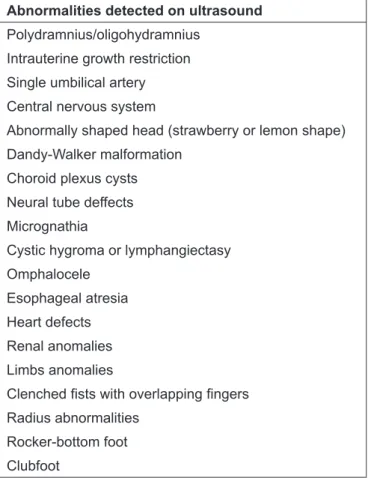
week. Other common manifestations reported during preg-nancy can be observed in Table 2. Szigeti et al report that perinatal autopsy can provide additional information in fetuses with ES and may help the diagnosis(37). According
to Viora et al, the modern ultrasound examination is clearly highly sensitive (sensitivity > 90%) to detect fetuses with this syndrome(36).
In Brazil, the identiication of patients with trisomy 18 during prenatal care is especially important for planning the birth, since termination of pregnancy is not legally allowed (it may only be permitted in cases of risk to the mother´s life or when there is a history of sexual violence)(38).
The frequency of cesarean deliveries is quite high in pregnancies of fetuses with ES, ranging from 48 to 90%(6,9,12,13,23,30) and some studies particularly highlight this
aspect(12). Interestingly, few maternal complications during
pregnancy have been reported. Preeclampsia has been de-scribed in 12.5 to 17% of mothers of fetuses with ES(17,22,30).
Preterm birth, with low birth weight and low irst and ifth minutes Apgar scores are also frequent among children with ES(6,9,13,17,21,30).
Differential diagnosis
The differential diagnosis of ES is relatively wide, and includes conditions such as the fetal akinesia sequence (also called Pena-Shokeir syndrome type I), and Patau´s syn-drome. Due to the defects of the hands, some cases may be misinterpreted as the so-called distal arthrogryposis type I. Other conditions to be considered in the differential diag-nosis, due to the overlapping of some malformations, are the CHARGE syndrome, previously named as CHARGE association (Coloboma, congenital Heart defects, choanal Atresia, Retardation of growth, Genital and Ear abnormalities) and the VACTERL association (Vertebral defects, Anal atresia, Cardiac malformations, Tracheoesophageal istula with Esophageal atresia, Renal dysplasia, and Limb anomalies).
Prognosis
Most of the fetuses with ES do not survive to the end of the gestational period. Those who are born alive have a poor prognosis. The median survival reported in the literature ranges from 2.5 to 14.5 days. In general, 55–65% of the affected newborns die during the irst week, 90% in six months, and only 5–10% reach the end of the irst year of life(5-11,13,24,30,39-41), as shown in Table 3.
The indings of Lin et al(13), in agreement with Weber(11),
Carter et al(5), Baty et al(21), Root and Carey(8), Embleton et al(9),
Rasmussen et al(10) and Niedrist et al(24) suggest that the girls
with ES have greater chances of being born alive and survive for longer periods than the boys. Moreover, some cases of ES seem to have a longer survival due to a chromosomal constitution of mosaicism(10).
In the other hand, long term survival (in a few cases, longer than two decades) is well documented, even in the absence of mosaicism, mostly in non populational studies (most of them, case reports). However, it is important to note that these patients usually present with severe neuro-developmental delay and high dependency(42).
Table 2 - Abnormalities that can be observed at ultrasound in
fetuses with trisomy 18, based on Viora et al(36)
Abnormalities detected on ultrasound
Polydramnius/oligohydramnius Intrauterine growth restriction Single umbilical artery Central nervous system
Abnormally shaped head (strawberry or lemon shape)
Dandy-Walker malformation
Choroid plexus cysts
Neural tube deffects
Micrognathia
Cystic hygroma or lymphangiectasy
Omphalocele
Esophageal atresia
Heart defects
Renal anomalies
Limbs anomalies
Clenched ists with overlapping ingers
Radius abnormalities
Rocker-bottom foot
11
11-20.
Rafael Fabiano M. Rosa et al
Table 3 - Data on survival of patients with trisomy 18 born alive according to studies from different countries
Author Weber (11) Carter
et al(5)
Young et al(6)
Goldstein e Nielson (7)
Root e Carey (8)
Embleton et al(9)
Brewer et al(39)
Rasmussen et al(10)
Niedrist et al(24)
Lin et al(13)
Imataka et al(40)
Hsiao et al(41)
Rosa et al(30)
n 192 43 21 76 64 34 84 114 161 39 179 31 31
Country
USA Australia United
Kingdom Denmark USA England Scotland USA Switzerland Taiwan Japan Taiwan Brazil
% % % % % % % % % % % % %
Birth 100 100 100 100 100 100 100 100 100 100 100 100 100
1 day 98 60 67 60 86 70 88 86 68 95 85 90
1 week 89 35 32 44 45 43 63 40 46 69 58
2 weeks 81 15 32 41 50 31 27 45
1 month 72 11 18 21 34 15 25 39 22 16 32 52
2 months 53 8 22 30 17 11 36 14 32
3 months 38 5 20 6 21 14 5 23
4 months 30 14 19 12 5 19
5 months 23 0 9 12 9 3
6 months 13 5 3 9 11 9 3 18 10 13
1 year 8 4 5 0 2 8 6 3 9 6 6
2 years 5 0 5 4 3 6 3
3 years 3 5 3 3 3
4 years 2 5 2 3
5 years 1 3 2 3
6 years 0.3 3 1 3
Median of SV (days)
70 5 2.5 6 4 3 6 14.5 4 6 UD 12 31
Tanigawa et al found that some ultrasound indings are associated to less than one month survival(43). Such indings
consist of severe polyhydramnios, lack of luids in the stom-ach, major heart defects, and male gender. Gestational age on birth also seems to affect survival(8,10,24). Some recent studies
have shown survival rates lower than previously reported, possibly due to the less aggressive care of children with ES, related to the short survival expectancy(10).
In addition, previous studies have shown that the pres-ence of congenital heart defects do not inlupres-ence the survival of patients with ES(9,10). More recently, Niedrist et al also
found, in a Swiss cohort study, that heart defects have little or no inluence on survival(24). In the past, apnea and no
therapeutical investment were considered the major causes of death(9). According to Kaneko et al, patients older than
one month usually die due to complications of the congenital heart defect (apnea is a common cause among neonates in the irst week of life)(44). However, recent studies indicate
that congenital heart defects are the leading cause of death in intensive care patients(23,45). Thus, intensive management,
including heart surgery, can improve the survival of patients with the syndrome(45). Indeed, studies that evaluated patients
receiving neonatal intensive care have shown median survival longer than usual, ranging from 152.5 to 238 days(23,45).
Heart surgery is rarely performed in patients with ES. However, indications of heart surgery have been growing in the recent years. This seems to be related to a change in the behavior of healthcare providers towards greater acceptance on the autonomy of the parents regarding treatment deci-sions(44). To date, there are no well-deined criteria of heart
surgery indications in this group of patients. Most individu-als survive to palliative and corrective surgeries. However, the risk of complications consequent to surgical corrections of the heart defects, as well as the risk of death from other causes, is high(46). Therefore, as stated by Yamagishi,
guide-lines for the treatment of such patients are needed(46).
Heart surgery can improve life expectancy, allow the hospital discharge and improve the quality of life of patients and their families(46). Some limitations, however, can be
ob-served among the studies that support these results, such as the small sample sizes and the selection of patients with less severe cardiac and extracardiac defects(44,46,47). Yamagishi(46)
and Muneuchi(47) have reported that selected individuals
can beneit from the surgical correction of heart defects, and the indication of such procedure should be carefully individualized. Nevertheless, few studies have evaluated the effectiveness of heart surgery and the further quality of life
in the long term follow up of patients with ES(47). Thus, it
is unclear whether heart surgery improves the prognosis of these individuals(46). Patients with ES present several risk
factors for developing sepsis, an important cause of death, which include low birth weight, prematurity, multiple malformations, associated with long intensive care stay and the consequent invasive procedures, which favor the devel-opment of infections.
In Brazil there are no speciic guidelines on cardio-vascular resuscitation of newborns with ES, neither in the delivery room nor later. However, according to the Neonatal Resuscitation Program of Sociedade Brasileira de Pediatria(48), medical decisions in the delivery room need
to be supported by the prenatal diagnosis, and take into consideration the parents’ wishes and the recent thera-peutic advances. The ‘wait to see’ strategy before starting the resuscitation should be abandoned, as it may lead to deleterious consequences such as hypoxemia and hypoten-sion, which further increase morbidity and mortality. As reported by Rosa et al(30), the prenatal diagnosis of ES in
Brazil is still poor, which has important implications on the management of these patients. In their series of 31 consecutive patients evaluated in a referral hospital in southern Brazil, Rosa et al found that none of them had been diagnosed prenatally(30).
Interestingly, the choice for performing cardiopulmonary resuscitation can be inluenced, for instance, by cultural factors. In the evaluation of patients born in Taiwan from 1991 to 2003, Hsiao et al(41) did not ind any differences on
survival between the genders in individuals with ES, and attributed this observation to the more frequent no consent for resuscitation for female newborns (bearing in mind that the male sex is favored in relation to the female sex among traditional Chinese families).
Genetic Couseling
in general. However, the recurrence of the same trisomy in another child has only rarely been reported, and the risk is considered virtually unknown. Some studies point a risk from 0.5% to less than 1%(21). Those estimates were based
mainly on the risk for nondisjunction, which was empirically calculated for trisomy 21.
Uehara et al found that none of the 170 women who had a child with trisomy 18 had the same anomaly repeated in a further pregnancy(49). However, it is important to take into
consideration the increased risk of trisomies with advancing maternal age. Moreover, one cannot rule out the possibility of gonadal mosaicism, especially in recurrent cases.
In the other hand, in cases of trisomy 18 due to transloca-tion, the chromosomal analysis of the parents is indicated, in order to rule out the presence of a balanced chromosomal rearrangement in one of them. In that case, the risk of recur-rence for the couple is increased, depending on the type of chromosomal anomaly. However, if the parental karyotypes are normal, it is assumed that the syndrome occurred due
to a new (de novo) mutation, although the possibility of germinative mosaicism cannot be ruled out.
Conclusions
The knowledge of the clinical features and prognosis of patients with ES is of great importance regarding the neona-tal care and the decision of performing invasive procedures, such as heart surgery or cardiopulmonary resuscitation. The early diagnostic conirmation is important for mak-ing medical decisions. Often, interventions are performed under emergency conditions, leaving little opportunity for relections or discussion, and involve dificult medical and ethical issues.
Acknowledgements
To the Coordenação de Aperfeiçoamento de Pessoal de Nível Superior (Capes), for the scholarship given.
References
1. Edwards JH, Harnden DG, Cameron AH, Crosse VM, Wolff OH. A new trisomic syndrome. Lancet 1960;1:787-90.
2. Smith DW. Autosomal abnormalities. Am J Obstet Gynecol 1964;90:1055-77. 3. Patau K. The identiication of individual chromosomes, especially in man. Am
J Hum Genet 1960;12:250-76.
4. Smith DW, Patau K, Therman E, Inhorn SL. A new autosomal trisomy syndrome: multiple congenital anomalies caused by an extra chromosome. J Pediatr 1960;57:338-45.
5. Carter PE, Pearn JH, Bell J, Martin N, Anderson NG. Survival in trisomy 18. Life tables for use in genetic counseling and clinical paediatrics. Clin Genet 1985;27:59-61.
6. Young ID, Cook JP, Mehta L. Changing demography of trisomy 18. Arch Dis Child 1986;61:1035-6.
7. Goldstein H, Nielsen KG. Rates and survival of individuals with trisomy 13 and 18. Data from a 10-year period in Denmark. Clin Genet 1988;34:366-72. 8. Root S, Carey JC. Survival in trisomy 18. Am J Med Genet 1994;49:170-4. 9. Embleton ND, Wyllie JP, Wright MJ, Burn J, Hunter S. Natural history of trisomy
18. Arch Dis Child Fetal Neonatal Ed 1996;75:F38-41.
10. Rasmussen SA, Wong LY, Yang Q, May KM, Friedman JM. Population-based analyses of mortality in trisomy 13 and trisomy 18. Pediatrics 2003;111:777-84. 11. Weber WW. Survival and the sex ratio in trisomy 17-18. Am J Hum Genet
1967;19:369-77.
12. David TJ, Glew S. Morbidity of trisomy 18 includes delivery by caesarean section. Lancet 1980;2:1295.
13. Lin HY, Lin SP, Chen YJ, Hung HY, Kao HA, Hsu CH et al. Clinical characteristics and survival of trisomy 18 in a medical center in Taipei, 1988-2004. Am J Med Genet A 2006;140:945-51.
14. Niedrist D, Riegel M, Achermann J, Rousson V, Schinzel A. Trisomy 18: changes in sex ratio during intrauterine life. Am J Med Genet A 2006;140:2365-7. 15. Marion RW, Chitayat D, Hutcheon RG, Neidich JA, Zackai EH, Singer LP et al.
Trisomy 18 score: a rapid, reliable diagnostic test for trisomy 18. J Pediatr 1988;113:45-8.
16. Hodes ME, Cole J, Palmer CG, Reed T. Clinical experience with trisomies 18 and 13. J Med Genet 1978;15:48-60.
17. Kinoshita M, Nakamura Y, Nakano R, Morimatsu M, Fukuda S, Nishimi Y et al. Thirty-one autopsy cases of trisomy 18: clinical features and pathological indings. Pediatr Pathol 1989;9:445-57.
18. Zen PR, Rosa RF, Rosa RC, Dale Mulle L, Graziadio C, Paskulin GA. Unusual clinical presentations of patients with Patau and Edwards syndromes: a diagnostic challenge? Rev Paul Pediatr 2008;26:295-9.
19. Baty BJ, Jorde LB, Blackburn BL, Carey JC. Natural history of trisomy 18 and trisomy 13: II. Psychomotor development. Am J Med Genet 1994;49:189-94. 20. Bettio D, Levi Setti P, Bianchi P, Grazioli V. Trisomy 18 mosaicism in a woman
with normal intelligence. Am J Med Genet A 2003;120A:303-4.
21. Baty BJ, Blackburn BL, Carey JC. Natural history of trisomy 18 and trisomy 13: I. Growth, physical assessment, medical histories, survival, and recurrence risk. Am J Med Genet 1994;49:175-88.
22. Moerman P, Fryns JP, Goddeeris P, Lauweryns JM. Spectrum of clinical and autopsy indings in trisomy 18 syndrome. J Genet Hum 1982;30:17-38. 23. Kosho T, Nakamura T, Kawame H, Baba A, Tamura M, Fukushima Y. Neonatal
management of trisomy 18: clinical details of 24 patients receiving intensive treatment. Am J Med Genet A 2006;140:937-44.
24. Niedrist D, Riegel M, Achermann J, Schinzel A. Survival with trisomy 18 – data from Switzerland. Am J Med Genet A 2006;140:952-9.
25. Anderson CE, Punnett HH, Huff V, de Chadarévian JP. Characterization of a Wilms tumor in a 9-year-old girl with trisomy 18. Am J Med Genet A 2003;121:52-5.
26. Maruyama K, Ikeda H, Koizumi T. Hepatoblastoma associated with trisomy 18 syndrome: a case report and a review of the literature. Pediatr Int 2001; 43:302-5.
27. Boghosian-Sell L, Mewar R, Harrison W, Shapiro RM, Zackai EH, Carey J et al. Molecular mapping of the Edwards syndrome phenotype to two noncontiguous regions on chromosome 18. Am J Hum Genet 1994;55:476-83.
28. Mewar R, Kline AD, Harrison W, Rojas K, Greenberg F, Overhauser J. Clinical and molecular evaluation of four patients with partial duplications of the long arm of chromosome 18. Am J Hum Genet 1993;53:1269-78.
30. Rosa RF, Rosa RC, Lorenzen MB, de Moraes FN, Graziadio C, Zen PR et al. Trisomy 18: experience of a reference hospital from the south of Brazil. Am J Med Genet A 2011;155A:1529-35.
31. Bugge M, Collins A, Petersen MB, Fisher J, Brandt C, Hertz JM et al. Non-disjunction of chromosome 18. Hum Mol Genet 1998;7:661-9.
32. Paskulin GA, Lorenzen MB, Rosa RF, Graziadio C, Zen PR. Importance of the ibroblast chromosomal analysis in suspected cases of mosaicism: experience of a clinical genetics service. Rev Paul Pediatr 2011;29:73-9
33. Isaksen CV, Ytterhus B, Skarsvåg S. Detection of trisomy 18 on formalin-ixed and parafin-embedded material by luorescence in situ hybridization. Pediatr Dev Pathol 2000;3:249-55.
34. Chen EZ, Chiu RW, Sun H, Akolekar R, Chan KC, Leung TY et al. Noninvasive
prenatal diagnosis of fetal trisomy 18 and trisomy 13 by maternal plasma DNA sequencing. PLoS One 2011;6:e21791.
35. Kagan KO, Wright D, Maiz N, Pandeva I, Nicolaides KH. Screening for trisomy 18 by maternal age, fetal nuchal translucency, free beta-human chorionic gonadotropin and pregnancy-associated plasma protein-A. Ultrasound Obstet Gynecol 2008;32:488-92.
36. Viora E, Zamboni C, Mortara G, Stillavato S, Bastonero S, Errante G et al. Trisomy 18: fetal ultrasound indings at different gestational ages. Am J Med Genet A 2007;143:553-7.
37. Szigeti Z, Csapó Z, Joó J, Pete B, Papp Z, Papp C. Quality control of prenatal sonography in detecting trisomy 18. The value of perinatal autopsy. Early Hum Dev 2007;83:505-9.
38. Diniz D. Selective abortion in Brazil: the anencephaly case. Dev World Bioeth 2007;7:64-7.
39. Brewer CM, Holloway SH, Stone DH, Carothers AD, FitzPatrick DR. Survival in trisomy 13 and trisomy 18 cases ascertained from population based registers. J Med Genet 2002;39:e54.
40. Imataka G, Nitta A, Suzumura H, Watanabe H, Yamanouchi H, Arisaka O. Survival of trisomy 18 cases in Japan. Genet Couns 2007;18:303-8. 41. Hsiao CC, Tsao LY, Chen HN, Chiu HY, Chang WC. Changing clinical
presentations and survival pattern in trisomy 18. Pediatr Neonatol 2009; 50:147-51.
42. Shanske AL. Trisomy 18 in a second 20-year-old woman. Am J Med Genet A 2006;140:966-7.
43. Tanigawa T, Nakayama D, Miura K, Miura S, Shimada T, Masuzaki H. Prenatal ultrasonographic indings may be useful in predicting the prognosis of trisomy 18. Prenat Diagn 2007;27:1039-44.
44. Kaneko Y, Kobayashi J, Achiwa I, Yoda H, Tsuchiya K, Nakajima Y et al. Cardiac surgery in patients with trisomy 18. Pediatr Cardiol 2009;30:729-34. 45. Kaneko Y, Kobayashi J, Yamamoto Y, Yoda H, Kanetaka Y, Nakajima Y et al.
Intensive cardiac management in patients with trisomy 13 or trisomy 18. Am J Med Genet A 2008;146A:1372-80.
46. Yamagishi H. Cardiovascular surgery for congenital heart disease associated with trisomy 18. Gen Thorac Cardiovasc Surg 2010;58:217-9.
47. Muneuchi J, Yamanoto J, Takahashi Y, Watanabe M, Yuge T, Ohno T et al. Outcomes of cardiac surgery in trisomy 18 patients. Cardiol Young 2011;21:209-15.
48. Sociedade Brasileira de Pediatria [homepage on the Internet]. Programa de Reanimação Neonatal da Sociedade Brasileira de Pediatria: Condutas 2011 [cited 2012 Dec 05]. Available from: http://www.sbp.com.br/pdfs/PRN-SBP-ReanimacaNeonatal-2011-24jan11.pdf