(1) Escuela Fonoaudiología Universidad del Bío, UBB, Chillán, Región del Bío-Bío, Chile.
(2) Departamento de Enfermería, Universidad del Bío-Bío, UBB, Chillán, Región del Bío-Bío, Chile.
(3) Departamento de Ciencias de la Rehabilitación en Salud, Universidad del Bío-Bío, UBB, Chillán, Región del Bío-Bío, Chile.
Source: Departamento de Investigación, Universidad del Bío-Bío, Chile. Proyecto de Investigación Regular DIUBB 122921 3/R.
Conlict of interest: non-existent
Relationship between postural cephalic pattern and speech
intelligibility
Asociación entre el patrón postural cefálico y la inteligibilidad articulatoria
del habla
Carlos Rojas Zepeda(1)
Claudio San Martín Barra(2)
Miguel López Espinoza(3)
Rodolfo Peña Chávez(3)
Received on: April 21, 2016 Accepted on: May 10, 2016
Mailing address: Carlos Rojas Zepeda
Avenida Andrés Bello S/N Campus Fernando May, Universidad del Bío-Bío, Casilla 447, Chillán - VIII Región Chile E-mail: [email protected]
ABSTRACT
Purpose: the objective of this study was to establish an associative factor that connects the morphology of the skull - cervical system with the articulatory intelligibility level of speech in young subjects. Methods: cross-sectional study. It considered a sample of 42 university students from a universe of 140, both male and female, without morbid background and of an age range in between 18 and 21 years.
Evaluated aspects: a) articulatory intelligibility by the diadochokinetic periodic variation coeficient,
b) traditional static postural parameters using the photogrammetric method and c ) cephalic postural pattern by lateral cephalometric radiograph
Results: 36 subjects with adequate intelligibility and 6 having altered intelligibility where cervical antero--posterior skull rotation variable showed statistically noteworthy differences ( p = 0,009 ) in between the group with normal intelligibility compared to the group with impaired intelligibility. The linear regression analysis showed that subjects with posterior rotation of head on neck show more variability in the syllabic emission of speech diadochokinetic performance (Sq r lineal = 0,128).
Conclusion: it is established that cephalic position with subsequent posterior rotation of the head on the neck is associated with loss of speech intelligibility in the sample studied.
Keywords: Articulation Disorders; Speech; Posture; Head; Neck
RESUMEN
Objetivo: el propósito de este estudio fue establecer un factor asociativo que relacione la morfología del sistema cráneo - cervical con el nivel de inteligibilidad articulatoria del habla en sujetos jóvenes. Métodos: estudio transversal, consideró una muestra de 42 jóvenes universitarios de un universo de
140, ambos sexos, sin antecedentes mórbidos y con un rango de edad entre 18 y 21 años. Se evalúo: a) inteligibilidad articulatoria mediante el coeiciente de variación periódica diadococinética, b) parámetros
posturales estáticos tradicionales mediante método fotogramétrico y c) patrón postural cefálico mediante radiografía cefalométrica lateral.
Resultados: se encontraron 36 sujetos con inteligibilidad adecuada y 6 alterada, donde la variable
rota-ción cráneo cervical antero-posterior presentó diferencias estadísticamente signiicativas (p= 0,009)
entre el grupo con inteligibilidad normal respecto al grupo con inteligibilidad alterada. El análisis de regresión lineal evidenció que sujetos que presentan rotación posterior de cabeza sobre cuello presentan mayor variabilidad en la emisión silábica del rendimiento diadocinético del habla (Sq r lineal = 0,128). Conclusión: se establece que la postura cefálica con presencia de rotación posterior de la cabeza sobre el cuello se asocia a la pérdida de inteligibilidad del habla en la muestra estudiada.
INTRODUCTION
The biomechanical study of the human body is deined as one great morpho-functional unit where each biokinetic link is intrinsically connected to other subunits. Cephalic posture has been traditionally studied because of the biomechanical relationship existing between the cervical spine, head, and dento-facial structures1. Therefore, if one of these segments
is compromised, and very often undiagnosed, changes could be triggered in other structures responsible for vital human functions, such as mastication, deglutition, respiration, and speech articulation2,3.
Cephalic posture has been deined as a particu -larly important factor in the morphological diagnosis of skeletal, articulatory, and myofunctional discrep-ancies4. Updated reports on the topic have established
a consensus that a good cranio-cervical posture can positively inluence the individual’s speech production5.
Nacci et al.6 studied proprioceptive postural behavior in
subjects with voice alterations, and they concluded that increased proprioceptive awareness through speech and kinesic therapy directly affect oral production.
Other studies have demonstrated that cephalic posture directly inluences the diameter of the pharyngeal airway7, generates changes in cervical
muscle tension8, and can affect respiratory support
and voice quality5; a correlation has been reported
between the cranio-cervical posture pattern and the
abovementioned factors. Cuccia and Caradonna3
were able to conclude that dentofacial alterations can modify cephalic posture and demonstrate that nasal obstruction induces anomalous head extension, which represents a functional adaptation that facilitates oral respiration.
Rocabado9 proposes a teleradiography method to
objectively assess cephalic posture in anteroposterior and vertical direction using cephalometric measure-ments on a sagittal plane to deine three parameters: a) hyoid position (hyoid triangle), b) anteroposterior cranio-cervical rotation, and c) suboccipital space cervical 0–cervical 1 (C0-C1); the inluence of these parameters is emphasized in the harmony of dento-facial structures involving respiration, speech, voice, deglutition, and the limited clinical relevance given to the orthostatic stability of the skull on the cervical spine4.
Ferrand10 conceptualizes speech as a complex
motor activity by which oral, laryngeal, and respiratory structures produce sound patterns, whose production can be inluenced by a good postural alignment and
permanent self-correction and proprioception of the body scheme8. García de Paula et al.11 point out
that the cranio-cervical postural relationship would condition the existence of the odonto-stomatological equilibrium necessary for successful and intelligible speech production.
In this context, Pahkala and Qvarnström12 conducted
an interdisciplinary study in a population of 287 children and young adults; they were able to establish a corre-lation between cranio-cervical-mandibular dysfunc-tions and the presence of functional dyslalia. Likewise, Anegawa et al.7 demonstrated that the cervical spine
position with respect to the head is directly associated with a change in the muscle tension chains related to oral motor skills, which could alter speech and deglu-tition. In summary, evidence establishes that alterations of the cranio-cervical postural pattern can represent a risk factor for developing odonto-stomatological system disorders, which in turn provoke alterations of any of the ive basic motor processes of speech, such as respiration, phonation, resonance, prosody, and articulation13.
The present study attempts to understand if there is a relationship between the morphology of the cranio-cervical system and speech articulation, particularly at the intelligibility level measured by diadochokinetic (DDK) speech performance in young university subjects with no relevant morbid history. This population is considered to be high risk for exhibiting bad habits or postural defects resulting from factors such as a sedentary lifestyle, misuse of backpacks or bags, and excessive use of mobile devices, and laptops14,15. Staes
et al.5 mention that there are few studies that provide
information about cranio-cervical postural descriptor parameters in a young and apparently healthy university population. Most available research studies on this topic establish relationships between postural disorders and voice dysfunctions, not to mention the inluence that cephalic posture can cause on correct speech production.
METHODS
We included subjects with no history of musculo-skeletal deformities of the locomotor system, no speech and language disorders, no history of neuro-logical impairment, or who would have received physio-therapy, speech physio-therapy, or orthodontic treatment during this period. Subjects who did not complete the planned measurements of the study were excluded. The research study involved three stages:
The irst stage considered speech intelligibility level assessment by the diadochokinetic periodic variation coeficient (cpv) of speech measured as a percentage (normal DDK cpv: 6.006 % ± 1.118 %). A sample of 113 subjects was obtained from an eligible population of 140 students (1-α/2= .95, e= 0.041, and Pestimated=
0.50).
The procedure was carried out in the Speech and Language Therapy Laboratory of the Universidad del Bío-Bío by a speech and language therapist experi-enced in this area. Three acoustic registers were conducted per subject, and each register repeatedly emitted the syllable “pa” for 8 s. Registers were entered into the Motor Speech Proile software, and an automatic method for measuring the degree of regularity (or percentage of variability) of syllable emission was then applied. Results were automatically compared with the pattern of normality generated by the software (normal DDK cpv: 6.006%±1.118%) where values greater than or equal to 7.124% were considered an anomalous variation. A unidirectional Shure SM58 microphone, speech digitalization CSL4500 KayPENTAX hardware, and Motor Speech Proile KayPENTAX software were used to obtain these registers.
In the second stage, traditional postural descriptor parameters were characterized: a) Plantar footprint, b) Lumbo-pelvic equilibrium, c) Torso cervical segment, d) Torso lumbar segment, e) Rachis equilibrium, and f) Head equilibrium. This was also applied to a sample of 113 subjects from an eligible population of 140 students (1-α/2= 0.95, e= .041, and Pestimated= 0.50).
The procedure was carried out by a professional kinesiologist specialized in posture biomechanics in the Biomechanics and Motor Control Laboratory of the Universidad del Bío-Bío. The assessment technique is the bipodal photogrammetric postural analysis protocol described by the Universidade de São Paulo, Brazil16. The following equipment was used: Panasonic
DMC-FZ40PU-K camera, tripod, body relective spherical markers, Arquimed symmetrograph, as well as the tpsDig2 photogrammetric analysis program (angular and linear scalar measurements) (Figure 1).
Finally, plantar footprint analysis was performed with a podoscope and the Hernández Corvo protocol.
The third stage included cephalometric analysis of 45 subjects willing to undergo the radiological study. The procedure was performed in the DentoAnalisis Radiology Center in Chillán, Chile. A total of 42 subjects were evaluated (1-α/2= 0.95, 1-β= 0.80, and restimated
minimum= .43). The other subjects did not complete the
study. The parameters referred to in this sample were analyzed according to the protocol described by Rocabado with the following main descriptors: a) hyoid position, b) anteroposterior cranio-cervical rotation, and c) suboccipital distance C0-C1; units of measurement were degrees and centimeters (Figures 2 and 3).
Figure 1. Photogrammetric method according to Ferreira et al.16 used to describe the static postural variables. Markers,
lines, quadrants, and angles generated with the tpsDig2 photogrammetric analysis program are highlighted.
Figure 2. Lateral cephalometry (X-ray). All the X-rays were taken with the X-ray tube positioned at 165 cm from the ilm, and the
midsagittal plane of the subject’s head was 15 cm from the ilm. X-rays were taken under the following conditions: subject in sitting position, natural head position (external reference: horizon), jaw occlusion, and tongue in rest position.
(A) (B)
Legend: PO =odontoid plane; PMG = McGregor plane; HH =hyoid bone
When comparing arithmetic means of the postural characteristics of subjects with normal versus altered speech intelligibility in the women’s subgroup (n=27), the plantar footprint (p= 0.013), lumbo-pelvic equilibrium (p= 0.038), anteroposterior cranial rotation (p= 0.047), and suboccipital distance C0-C1 (p= 0.049) variables exhibited statistically signiicant differ -ences. In the case of the men’s subgroup, no signiicant differences were found in any of the analyzed postural variables (Table 2).
RESULTS
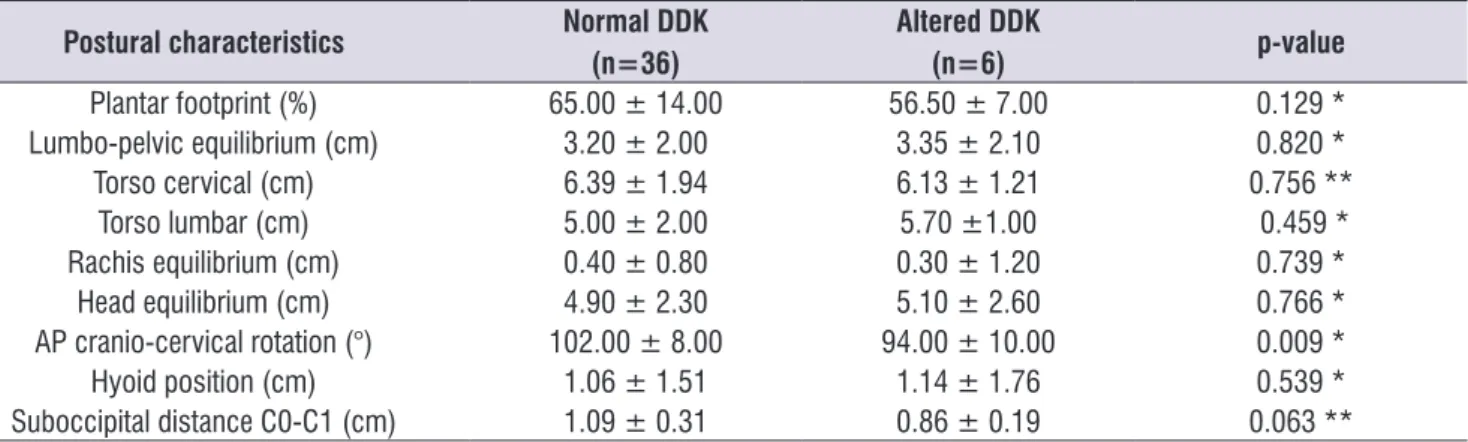
A sample of 42 subjects (27 women and 15 men) was analyzed; of the total, 36 exhibited appropriate speech intelligibility (normal DDK performance) and 6 altered speech intelligibility (altered DDK performance). The anteroposterior cranio-cervical rotation revealed statistically signiicant differences with a mean of 102.0° in the normal DDK group and 94.0° in the altered DDK group (p= 0.009) (Table 1).
Table 1. Comparison of measurements of anatomical and postural characteristics according to speech intelligibility (DDK performance)
Postural characteristics Normal DDK
(n=36)
Altered DDK
(n=6) p-value
Plantar footprint (%) 65.00 ± 14.00 56.50 ± 7.00 0.129 * Lumbo-pelvic equilibrium (cm) 3.20 ± 2.00 3.35 ± 2.10 0.820 *
Torso cervical (cm) 6.39 ± 1.94 6.13 ± 1.21 0.756 **
Torso lumbar (cm) 5.00 ± 2.00 5.70 ±1.00 0.459 *
Rachis equilibrium (cm) 0.40 ± 0.80 0.30 ± 1.20 0.739 *
Head equilibrium (cm) 4.90 ± 2.30 5.10 ± 2.60 0.766 *
AP cranio-cervical rotation (°) 102.00 ± 8.00 94.00 ± 10.00 0.009 *
Hyoid position (cm) 1.06 ± 1.51 1.14 ± 1.76 0.539 *
Suboccipital distance C0-C1 (cm) 1.09 ± 0.31 0.86 ± 0.19 0.063 **
*; Mann-Whitney U test (data does not belong to a normal distribution, previously evaluated by Shapiro-Wilk test) ** ; Student’s t-test (normal data distribution evaluated by Shapiro-Wilk test)
Legend:
Plantar footprint (%) = relationship between plantar forefoot and isthmus. Lumbo-pelvic equilibrium (cm) = relationship between pelvis and lumbar lordosis. Torso cervical (cm) = linear measurement of cervical lordosis segment.. Torso lumbar (cm) =linear measurement of lumbar lordosis segment,
Rachis equilibrium (cm) =separation of spinous processes of the vertebral column with respect to the gravity line. Head equilibrium (cm) = linear measurement between the head segment and the gravity line.
Anteroposterior (AP) cranio-cervical rotation (°) =angular relationship between the head position and the direction of the cervical spine. Hyoid position (cm) = relationship between hyoid bone and direction of cervical spine.
The linear regression analysis demonstrated that the anteroposterior cranio-cervical rotation was statisti-cally associated with speech intelligibility in such a way that subjects with posterior head-neck rotation showed
a higher percentage of variability in syllable emission of diadochokinetic speech performance (Table 3 and Figure 4).
Table 2. Comparison of means of anatomical and postural characteristics in women according to speech intelligibility (DDK performance)
Postural characteristics Normal DDK
(n=22)
Altered DDK
(n=5) p-value
Plantar footprint (%) 69.00 ± 15.00 56.00 ± 8.00 0.013 * Lumbo-pelvic equilibrium (cm) 4.18 ± 1.55 3.20 ± 0.63 0.038 **
Torso cervical (cm) 6.66 ± 1.85 6.16 ± 1.35 0.575 **
Torso lumbar (cm) 5.50 ± 2.00 6.00 ± 1.00 1.000 *
Rachis equilibrium (cm) 0.00 ± 0.90 0.00 ± 1.10 0.976 *
Head equilibrium (cm) 4.90 ± 4.10 5.50 ± 3.50 0.786 *
AP cranio-cervical rotation (°) 101.00 ± 6.00 91.00 ± 10.00 0.047 *
Hyoid position(cm) 0.74 ± 1.19 1.05 ± 1.63 0.880 *
Suboccipital distance C0-C1 (cm) 0.98 ± 0.66 0.92 ± 0.50 0.049 **
*; Mann-Whitney U test (data does not belong to a normal distribution, previously evaluated by Shapiro-Wilk test) ** ; Student’s t-test (normal data distribution evaluated by Shapiro-Wilk test)
Legend:
Plantar footprint (%) = relationship between plantar forefoot and isthmus. Lumbo-pelvic equilibrium (cm) = relationship between pelvis and lumbar lordosis. Torso cervical (cm) = linear measurement of cervical lordosis segment. Torso lumbar (cm) =linear measurement of lumbar lordosis segment.
Rachis equilibrium (cm) = separation of spinous processes of the vertebral column with respect to the gravity line. Head equilibrium (cm) = linear measurement between the head segment and the line of gravity.
Anteroposterior (AP) cranio-cervical rotation (°) =angular relationship between the head position and the direction of the cervical spine. Hyoid position (cm) = relationship between hyoid bone and direction of cervical spine.
Suboccipital distance C0-C1 (cm) =separation distance between the occiput and irst cervical vertebra (atlas).
Table 3. Linear regression between the cranio-cervical posture, which is statistically signiicant, and the speech intelligibility level (DDK
performance) (n=42)
Variables Beta
coeficient Typical error Wald gl Sig. OR AP cranio-cervical rotation (°) -0.176 0.075 5.568 1 0.018 0.839
Constant 15.403 7.143 4.650 1 0.031
Legend:
DISCUSSION
Different studies point out the importance of the cranio-cervical relationship and the modiication of odonto-stomatological functions3,5,6 given that postural
equilibrium can be deined as an important factor that describes the human physical and mental condition where controlled and balanced willingness allows preserving body structures and minimizing the risk of deformation or progressive dysfunction; this willingness is a descriptor of biomechanical eficiency to deal with the environment17. The present study revealed that
a group of young subjects with no relevant morbid history can exhibit slight speech intelligibility alterations as a result of postural dysfunctions at the head-cervical level, particularly because of the presence of posterior head-neck rotation.
The reviewed literature states that an imbalanced head-cervical posture does not allow either eficient or synchronized muscular work, which eventually modiies the morphology and functionality of the musculoskeletal
system7; this affects the mobility of the intrinsic-extrinsic
tongue, perioral, masseter, and orbicularis musculature necessary for well-articulated and intelligible phoneme production. Discacciati de Lértora et al.1 also point
out a relationship between cranio-facial morphology, cephalic posture, and functions such as respiration, deglutition, speech, and voice; these alterations could be explained by posture problems from childhood that were not promptly corrected18 and became more
noticeable in adolescence because of poor posture habits. Noll et al.19 provide an example of this in their
study about the prevalence of these bad habits in youth, concluding that only 15.1% adopt a correct posture when writing and 21.5% sit properly at the computer.
In addition, Avantika et al.14 studied a group of
young and healthy subjects with no diagnosed posture or speech disorders, but who were considered to be at high risk because they exhibited inappropriate daily habits by carrying heavy backpacks equivalent to 10% to 20% of their body weight, which conditions Legend:
Anteroposterior (AP) cranio-cervical rotation (°) =angular relationship between the head position and the direction of the cervical spine.
DDK Performance (%) = diadochokinetic periodic variation coeficient of speech.
signiicant changes in postural behavior and the gravi -tational position of the center of body mass causing anterior translation of the head, shoulders, and upper back region. Straker et al.15 pointed out the postural
impact of the height of the computer screen and desk design in 36 young adult subjects of both sexes; they concluded that a higher screen results in less head and neck lexing, lower elevation and protrusion of the scapula, and less shoulder lexing and abduction. We believe that both these studies show very well the reality of the studied sample and the results that were obtained given that these university students carry weight and dedicate most of their time in front of a computer every day; a number of them exhibit undiag-nosed postural alterations.
More speciically, the study results indicate contrasts in the cephalic postural pattern at the anteroposterior cranio-cervical rotation level because there was a statis-tically signiicant difference for this variable between youth with good speech intelligibility compared to those with altered intelligibility (p= 0.009). This difference can be explained by the study by Wilson and Frederick20,
which points out that deined body postures, such as cervical hyperlordosis and thoracic kyphosis, are associated with an anomalous head rotation, thus generating an increased distance from the hyoid bone to the mandibular symphysis. As a consequence, exaggerated tension of the supra- and infrahyoid muscles in the dorsocaudal direction is produced, which promotes an increase in tongue muscle tension that leads to imprecise and slurred speech articulation.
A comparative analysis of the women’s group with good speech intelligibility and low speech intelligibility led to statistically signiicant differences for the plantar footprint posture variables (p= 0.013) and lumbo-pelvic equilibrium (p= 0.038). On this point, Kendall et al.21 point out that persons that exhibit sway back
posture are characterized by a marked anterior pelvic translation (lumbar imbalance) and increased thoracic kyphosis, which leads to functional ineficiency of the anterolateral abdomen and diaphragm musculature, thus affecting the respiratory function and intelligible speech production. All these posture parameters can be explained because the magnitude of lumbar lordosis has been traditionally considered as being higher in women than men; mean differentiation values have even been established [2°- 5°]22. This could be
associated with a compensatory cervical hyperlordosis as a response to the arthrokinematic rachis equilibrium; however, it is now possible to clarify that lumbar
hyperlordosis in women is more apparent than real because it is mainly conditioned by the high muscle and gluteal fat mass on the hip23.
In this same group, it was established that the anteroposterior cranio-cervical rotation and suboc-cipital distance C0-C1 variables equally showed statisti-cally signiicant differences between women with good intelligibility and those with low intelligibility (p= 0.047 and p= 0.049, respectively). We believe that when there is a reduction of the posteroinferior angle formed by the McGregor and odontoid planes for the anteropos-terior cranio-cervical rotation variable, a compensatory cervical hyperlordosis associated with an increased distance from the hyoid bone to the mandibular symphysis would be generated. An exaggerated tension of the supra- and infrahyoid muscles and a decrease in the suboccipital distance between C0 – C124 would be added to this. As a result of these
imbal-ances, we hypothesize that a loss of equilibrium of the extrinsic tongue muscles, which limits their mobility and causes a loss of articulatory accuracy of post-dental, alveolar, and palatal phonemes.
The anteroposterior cranio-cervical rotation variable was determined by the linear regression test and was statistically associated with speech intelligibility. Thus, the studied sample showed that the posterior head-neck rotation affects speech intelligibility. This result was similar to the inding published by Kooijman et al.25,
who evaluated 25 teachers and reported a relationship between hypertrophy of the laryngeal extrinsic muscles, postural deviations, and vocal dysfunction; the muscles most affected by hypertension were the sternocleido-mastoid and geniohyoid muscles, which are associated with cranio-cervical postural changes and hyoid elevation; this demonstrates that a correct and upright posture inluences adequate articulation. In addition, Carneiro and Teles26 investigated the inluence of
different body postures in voice production based on a sample of 25 subjects of both sexes who exhibited three postures: (A) orthostatic upright posture, (B) forward head posture associated with marked cervical extension, and (C) posture with increased kyphosis associated with forward head posture. Results showed that voice characteristics, such as pitch, resonance, and voice quality, were statistically better in the upright position without the anomalous head-neck rotation. Miller et al.27 investigated the relationship between
they were able to verify the existence of correlations between cranio-facial bones, cervical vertebrae, size of respiratory tract, and the position of the hyoid bone, larynx, epiglottis, uvula, and jaw.
When comparing the means between subjects with good and low speech intelligibility with the rest of the described postural variables, no signiicant differences were found for the results obtained in the present study. This can be explained by the presence of compensatory postural responses that are mainly deined in a one-dimensional plane, as mentioned by Rodríguez et al.28, who point out that global postural
re-education methods try to establish an equilibrium between muscle chains mainly arranged in a single plane (anteroposterior direction), favoring the agonist-synergist functional relationship between static muscle chains. It is therefore necessary to mention the intrinsic characteristics of the sample: young, healthy university subjects; these characteristics provided them with more awareness and proprioception of the body scheme, cephalic postural pattern, and speech articulation whereby they possibly compensated imbalances when being assessed.
CONCLUSION
The present study establishes evidence to suggest that the cephalic postural pattern measured by the degree of anteroposterior head-neck rotation is associated with the speech intelligibility level of young, healthy university students exhibiting poor posture habits. This also demonstrates that postural alterations not only have a repercussion on the phonatory system, as extensively exposed in the literature, but also at the speech articulation level. We consider that this report can be of interest to approach speech therapy from the point of view of oral motor skills and esthetics, especially associated with the therapeutic approach of rehabilitating or restructuring at the oral muscle level, considering the growing number of adult users looking to enhance their oral articulatory skills for their profes-sional or artistic development.
REFERENCES
1. Discacciati de Lértora M, Lértora Ê, Quintero de Lucas G, Armella B. Relación entre actitudes posturales y maloclusiones, Revista AAOFM. 2006; 35 (2): 35-40.
2. Heredia A, Albornoz M, Piña F, Luque A. Craneocervical posture and its relationship with dental occlusion and the use of orthodontics: review study. Osteopatía Cientíica. 2010; 5(3): 89–96.
3. Cuccia A, Caradonna C. The measurement of craniocervical posture: A simple method to evaluate head position. Int. J. Pediatr. Otorhi. 2009; 73: 1732–6.
4. Mariel J, Flores J, Gutiérrez F, Mariel G, Sánchez W, Guerrero A. Estudio morfométrico de la posición cráneo-cervical en pacientes con clases esqueletales II y III. Int. J. Morphol. 2015; 33(2): 415-9.
5. Staes F, Jansen L, Vilette A, Coveliers Y, Daniels K, Decoster W. Physical therapy as a means to optimize posture and voice parameters in student classical singers: A case report. J. Voice. 2011; 25(3): 91-101.
6. Nacci A, Fattori B, Mancini V, Panicucci E, Matteucci J, Ursino F, et al. Posturographic analysis in patients with dysfunctional dysphonia before and after speech therapy/rehabilitation treatment. Acta Otorhinolaryngo. 2012; 32(2): 115-21.
7. Anegawa E, Tsuyama H, Kusukawa J. Lateral cephalometric analysis of the pharyngeal airway space affected by head posture. Int. J. Oral Maxillofac.Surg. 2008; 37: 805–9.
8. Bruno E, De Padova A, Napolitano B, Marroni P, Batelli R, Ottaviani F, et al. Voice Disorders and Posturography: Variables to deine the success of rehabilitative treatment. J. Voice. 2007; 23 (1): 71-5. 9. Rocabado M. Análisis biomecánico craneocervical
a través de una telerradiografía lateral. Rev. Chil. Ortod.1984; 1: 42-52.
10. Ferrand C. Speech Science: An Integrated
Approach to Theory and Clinical Practice. 3era. ed. Boston: Pearson Education Inc; 2013.
11. García de Paula F, Mussolino de Queiroz A, Díaz – Serrano K. Alteraciones posturales y su repercusión en el sistema odontoestomatológico. Acta Odontol Venez. 2008; 46(4): 1-7,
12. Pahkala R, Qvarnström M. Mandibular movement capacity in 19-year-olds with an without articulatory speech disorders. Acta Odontol. Scand. 2002; 60(6): 341-5.
14. Avantika R, Shalini A, Sarita B. Postural effect of back packs on school children: Its consequences on their body posture. Int. J. Health Sci. Res. 2013; 3(10): 109-16.
15. Straker L, Pollock M, Burgess-limerick R. Towards evidence-based guidelines for wise use of computers by children. Int. J. Ind. Ergonom. 2006; 36(12): 1045-53.
16. Ferreira E, Duarte M, Maldonado E, Bersanetti A, Marques A. Quantitative Assessment of postural alignment in young adults based on photographs of anterior, posterior, and lateral views. J. Manip. Physiol. Ther. 2012; 34 (6): 371-380.
17. Zagyapan R, Iyem C, Kurkcuoglu A, Pelin C, Tekindal M.The relationship between balance, muscles, and anthropomorphic features in young adults. Anat Res Int. 2012. 2012: 1-6.
18. Coelho J, Graciosa M, Medeiros D, da Costa L, Martinello M, Ries L. Inluencia da lexibilidade sexo na postura de escolares. Rev. paul. pediatr. 2014; 32(3): 223-8
19. Noll M, Candotti C, Tiggemann C, Schoenell M, Vieira, A. Prevalência de hábitos posturais inadequados de escolares do Ensino Fundamental da cidade de Teutônia: Um estudo de base populacional. Rev. Bras. Ciênc. Esporte. 2013; 35(4): 983-1004.
20. Wilson B, Frederick A. Considerations for
maintenance of postural alignment for voice production. J. Voice. 2006; 22(1): 90–9.
21. Kendall F, McCreary E, Provance P, Rodgers M, Romani W. Muscles: Testing and Function, with Posture and Pain. 5ta. ed. Baltimore: Lippincott Williams & Wilkins; 2005.
22. Vialle R, Levassor N, Rillardon L, Templier A, Skalli W, Guigui P. Radiographic analysis of the sagittal alignment and balance of the spine in asymptomatic subjects. J. Bone Joint Surg. Am. 2005; 87(2): 260 -7.
23. Been E, Kalichman L. Lumbar lordosis. Spine J. 2013; 14(1): 87-97.
24. Cielo C, Christmann M, Ribeiro V, Hoffmann C, Padilha J, Steidl E, et al. Musculoskeletal stress syndrome, extrinsic laryngeal muscles and body posture: Theoretical considerations. Rev. CEFAC. 2014; 16(5): 1639-1649.
25. Kooijman P, de Jong F, Oudes M, Huinck W, Van Acht H, Graamans K. Muscular tension and body posture in relation to voice handicap and voice quality in teachers with persistent voice complaints. Folia Phoniatr Logo. 2005; 57(3): 134-147.
26. Carneiro P, Teles L. Inluence of postural alterations, followed by computadorized photogrammetry, in the voice production. Fisioter. Mov. 2012; 25(1): 13-20.
27. Miller N, Gregory J, Semple S, Aspden R, Stollery P, Gilbert F. The effects of humming and pitch on craniofacial and craniocervical morphology measured using MRI. J. Voice. 2012; 26(1): 90-101. 28. Rodríguez B, Mesa J, Paseiro G, González M.