PREVALENT NURSI NG DI AGNOSES AND I NTERVENTI ONS I N THE HOSPI TALI ZED ELDER CARE
Mir iam de Abr eu Alm eida1 Gr aziella Badin Alit i2 Elen ar a Fr an zen3 Elisabet h Gom es da Rocha Thom é4 Mar gar it a Rubin Unicov sk y5 En eida Rej an e Rabelo6 Mar ia Luiza Machado Ludw ig7 Mar ia Ant oniet a Mor aes8
Alm eida MA, Alit i GB, Fr anzen E, Thom é EGR, Unicov sk y MR, Rabelo ER, Ludw ig MLM, Mor aes MA. Pr ev alent n u r sin g diagn oses an d in t er v en t ion s in t h e h ospit alized elder car e. Rev Lat in am En fer m agem 2 0 0 8 j u lh o-agost o; 16( 4) : 707- 11.
Obj ect iv es: t o iden t ify t h e pr ev alen t n u r sin g diagn oses ( ND) in t h e h ospit alized elder car e; t o com par e t h e pr ev alent ND w it h t he dur at ion of hospit al st ay and w it h t he pr escr ibed car es for t heir r espect iv e diagnoses. Met hod: Transversal hist orical st udy carried t hrough in Port o Alegre, RS, by analyzing pat ient records age e• 60 y ear s old, int er ned in clinical unit ies of a univ er sit y hospit al. Result s: 1665 r ecor ds w er e analy zed; t he four pr ev alent NANDA nur sing diagnoses – w it hin 62 ident ified ones – w er e: Self- Car e Deficit – Bat hing/ Hy giene, I m balanced Nu t r it ion – Less t han Body Requ ir em en t s, Risk for I n fect ion an d I neffect iv e Br eat h in g Pat t er ns, v ar y in g f r om 1 4 t o 1 7 d ay s of h osp it al st ay . Th e m ain car es w er e: aid in g b ed b at h , com m u n icat in g d iet accept ance, im plem ent ing r out ines of car e in v enous punct ur e and check ing r espir at or y pat t er n. Conclusion: four pr ev alent ND w er e ident ified w it h t he appr opr iat e pr escr ibed car e. How ev er , ot her car e could hav e been est ablished as a pr ior it y .
DESCRI PTORS: nur sing, car e; nur sing pr ocess; nur sing diagnosis; hospit alizat ion; elder
DI AGNOSTI COS DE ENFERMERI A E I NTERVENCI ÓNES PREVALENTES EN EL
CUI DADO AL ANCI ANO HOSPI TALI ZADO
Obj et iv os: iden t ificar los diagn óst icos de en fer m er ía ( DE) pr ev alen t es en la pr áct ica asist en cial en an cian os h ospit alizados; com par ar est os DE con el t iem po de h ospit alización y con los cu idados pr escr it os. Mét odo: Est udio t ransversal hist órico realizado en Port o Alegre, RS, m ediant e el análisis de hist orias clínicas de pacient es con edad = 60 años, int er nados en los ser vicios de un hospit al univer sit ar io. Result ados: De 14 a 17 días de hospit alización, 1665 hist orias fueron analizadas; los cuat ro DE de la NANDA prevalent es ent re los 62 ident ificados fueron: Déficit en el Aut ocuidado- baño/ higiene, Alt eraciones en la Nut rición- m enor a lo que el cuerpo hum ano r equ ier e, Riesgo de I n fección y Pat r ón Respir at or io I n eficaz. Los pr in cipales cu idados: ay u da en el bañ o en cam a, infor m ar la acept ación de la diet a, im plem ent ar r ut inas de cuidados par a la punción v enosa y v igilar pat rón respirat orio. Conclusión: Se ident ificaron cuat ro DE prevalent es con sus respect ivos cuidados prescrit os. Sin em bar go, ot r os cuidados podr ían haber sido consider ados pr ior it ar ios.
DESCRI PTORES: cuidados de enfer m er ía; pr ocesos de enfer m er ía; diagnóst ico de enfer m er ía; hospit alización; an cian o
DI AGNÓSTI COS DE ENFERMAGEM E I NTERVENÇÕES PREVALENTES NO
CUI DADO AO I DOSO HOSPI TALI ZADO
Ob j et iv os: id en t if icar os d iag n óst icos d e en f er m ag em ( DE) p r ev alen t es n a p r át ica assist en cial d e id osos hospit alizados; com par ar os DE pr evalent es com o t em po de hospit alização e com os cuidados pr escr it os par a os r espect iv os diagnóst icos. Mét odo: Est udo t r ansv er sal hist ór ico r ealizado em Por t o Alegr e, RS, por m eio da an álise de pr on t u ár ios de pacien t es com idade e• 6 0 an os, in t er n ados em u n idades clín icas de u m h ospit al u n iv er sit ár io. Resu lt ad os: An alisou - se 1 6 6 5 p r on t u ár ios; os q u at r o DE d a NANDA p r ev alen t es d en t r e 6 2 i d en t i f i cad o s f o r am Déf i ci t n o Au t o cu i d ad o – b an h o / h i g i en e, Nu t r i ção Deseq u i l i b r ad a: m en o s d o q u e as necessidades cor por ais, Risco de I nfecção e Padr ão Respir at ór io I neficaz, com 14 a 17 dias de hospit alização. Os pr incipais cuidados for am auxiliar no banho de leit o, com unicar aceit ação da diet a, im plem ent ar r ot inas de cu idado n a pu n ção v en osa e v igiar padr ão r espir at ór io. Con clu são: I den t if icar am - se qu at r o DE pr ev alen t es com os cuidados prescrit os adequados aos m esm os. No ent ant o, out ros cuidados poderiam t er sido est abelecidos p r ior it ar iam en t e.
D ESCRI TORES: c u i d a d o s d e e n f e r m a g e m ; p r o c e s s o s d e e n f e r m a g e m ; d i a g n ó s t i c o d e e n f e r m a g e m ; h ospit alização; idoso
1 RN, Ph.D. in Educat ion, Adj unct Professor, School of Nursing, Rio Grande do Sul Federal Universit y, Brazil: e- m ail: m iriam .abreu@t erra.com .br; 2 RN, M.Sc.
in Cardiovascular Sciences; 3 RN, M.Sc. in Cardiology. Port o Alegre Hospit al de Clínicas, Brazil; 4 RN, M.Sc. in Educat ion, Assist ant Professor; 5 RN, Ph.D. in
Biom edical Geriat rics, Adj unct Professor; 6 RN, Ph.D. in Biological Sciences: Biol physiology, Adj unct Professor; 7 RN, M.Sc. in Nursing, Assist ant Professor.
School of Nursing, Rio Grande do Sul Federal Universit y, Brazil; 8 RN, M.Sc. in Healt h Sciences: Cardiology, Rio Grande do Sul Cardiology I nst it ut e. Disponible en castellano/ Disponível em língua portuguesa
I NTRODUCTI ON
T
h e e l d e r l y p o p u l a t i o n h a s i n c r e a s e d considerably worldwide bot h in absolut e num bers and in average of years lived. Dem ographic t ransit ion has been slow and gr adual in t he indust r ialized count r ies in Eur ope and t he US( 1). How ev er, in Lat in- Am er ican count ries t he accelerat ed drop in m ort alit y since 1940 h as con t r ibu t ed f or t h e pr ogr essiv e in cr ease in t h e n u m ber of elder ly in t h ese popu lat ion s. I n 2 0 0 0 in Brazil for each group of 100 children aged 0- 14 t here were 18.3 elderly aged 65 or up, and t he est im at e for 2050 is for t his rat io t o be 100 t o 105.6. Moreov er, it h as been v er if ied in t h is agin g pr ocess seen in t h e Brazilian populat ion t hat in 2000 t here were 1.8 m illion people aged 8 0 or u p an d t h at in 2 0 5 0 t h is f igu r e could r each 13. 7 m illion( 2). Ther efor e, elder ly people w i l l l i v e l o n g er, w i l l t h u s t en d t o d ev el o p ch r o n i c illnesses inher ent of t he aging pr ocess and w ill m or e lik ely n eed h osp it alizat ion . Th ese ch r on ic d am ag es are defined as usually incurable condit ions, which call for individual adapt ive processes in order t o prevent , m inim ize, and cont r ol long- t er m com plicat ions( 3). The rapidly growt h of t he aging populat ion and consequent d e m a n d f o r g o o d h e a l t h c a r e i s i n c r e a s i n g a n d i m p o s i n g a g r e a t e r b u r d e n o n h e a l t h c a r e p r o f e s s i o n a l s , p o l i c y m a k e r s , g o v e r n m e n t s a n d societ y as a whole. This issue m akes urgent for healt h ca r e p r o v i d e r s, i r r e sp e ct i v e o f t h e i r co u n t r y, t o u n d e r s t a n d t h e c h a r a c t e r i s t i c s o f t h e i r e l d e r l y com m unit ies, t heir st r engt hs and t heir r equir em ent s. Nurses play an im port ant role in t he care for chronic pat ient s. I nnov at ions r elat ing t o t he nur sing pr act ice and car e for chr onic pat ient s ar e being im plem ent ed in m an y cou n t r ies t o p r od u ce n ew f or m s of h ealt h car e( 4 ).One approach is t o allow specialist nurses t o t ak e ov er t h e f ollow - u p of t h e p at ien t in or d er t o prom ot e self- caring, t o im prove healt h relat ed qualit y of life and decr ease healt h car e cost s( 5).
Pu blish ed in 2 0 0 5 in t h e An n als of I n t er n al Medicine, in which t he program s of Self- m anagem ent f o r a n d o s t e o a r t h r i t i s w e r e e v a l u a t e d . S e l f -m a n a g e -m e n t p r o g r a -m s f o r d i a b e t e s -m e l l i t u s a n d h y p er t en sion p r ob ab ly p r od u ce clin ically im p or t an t benefit s. I n t he ost eoar t hr it is, t he ar t iculat ion ( j oint ) m alfunct ion and pain ar e not com plet ely cont r olled.
Ther efor e, t he chr onic illness in t he elder ly pat ient s i s i n se r t e d i n a co n t e x t w h e r e t h e r e i s r o o m f o r im plem ent at ion of self- car e st r at egies.
I n on e an aly sis of n u r sin g in t er v en t ion s – u s e d m o s t l y d u r i n g a n a c u t e h o s p i t a l s t a y a n d docum ent ed in an elect r onic dat abase – t he pat ient s w er e div ided int o t hr ee gr oups older t han 60 y ear s: 1 0 3 5 w i t h h e a r t f a i l u r e ; 5 6 7 w i t h h i p f r a c t u r e p r o ce d u r e s a n d 1 1 7 5 6 r e ce p i e n t s o f t h e n u r si n g int ervent ions fall prevent ion. Each pat ient in t he heart f ai l u r e g r o u p r ecei v ed an av er ag e o f 1 8 d i f f er en t int er v ent ions. I n t his gr oup, 57 % w er e m en, 94 % w hit e, 5 8 % m ar r ied, t he m ean age w as 7 3 w it h a m edian lengt h of st ay of 6 days. Eleven int ervent ions w er e u sed in a h igh r at e an d a h igh per cen t age of hospit alizat ion: sur v eillance, in 95,3 % of t he v isit s, r ou t in e car e: adu lt ( 9 6 , 7 % ) ; car diac car e ( 8 8 , 4 % ) , i n t r a v e n o u s t h e r a p y ( 9 4 , 5 % ) , f l u i d m a n a g e m e n t ( 9 9 7 % ) , pain m an agem en t ( 6 1 , 5 % ) , bed r est car e ( 78% ) , diet st aging ( 99,7% ) , oxygen t herapy ( 49% ) , t eaching ( 86,3% ) and infect ion prevent ion in 73,2 % of t he visit s. This dat a was obt ained in a large m edical cent er from 33 general hospit al inpat ient unit s in t he per iod of f ou r y ear s, an d t h e st u dy based on su ch d at a in dicat ed t h at in t er v en t ion s d if f er ed f r om on e pat ien t t o t h e ot h er, poin t in g ou t t h at n u r sin g car e w a s i n d i v i d u a l i zed t o d a i l y p a t i en t n eed a n d w a s cont inued right up t o t he t im e of hospit al discharge( 6). Nu r si n g Pr o ce ss cu r r e n t l y ca l l e d Nu r si n g A s s i s t a n c e S y s t e m a t i z a t i o n i n B r a z i l i s t h e m et hodology used by nurses t o develop individualized and hum anized care at t he hospit al w here t his st udy w a s c o n d u c t e d . Th i s m e t h o d i s d e v e l o p e d b y a c o m p u t e r i z e d p r e s c r i p t i o n s y s t e m t h a t i n c l u d e s nur sing diagnoses accor ding t o NANDA Taxonom y( 7), con cep t u al f r am ew or k b ased on b asic h u m an n eed t heory, as well as t he checklist of care for each of t he nur sing diagnosis ( ND)( 8).
As we work in an I nst it ut ion t hat uses Nursing Pr ocess an d t h e issu e of t h e eld er ly p at ien t s an d chronic illness is growing in im port ance, t he obj ect ives of t h e pr esen t st u dy w er e t o iden t if y t h e pr ev alen t ND pr esent in t he nur sing pr act ice w it h hospit alized eld er ly ; t o com p ar e p r ev alen t ND w it h d u r at ion of hospit al st ay and t o com pare prescribed nursing care w it h t hese diagnoses.
METHOD
The present was a cross- sect ion hist oric st udy t hat was conduct ed in 2005; 1665 m edical records of p a t i e n t s a g e d ≥ 6 0 w e r e i n cl u d e d ; p a t i e n t s w e r e hospit alized in clinical unit s of a universit y hospit al in t h e sou t h of Br azil. Th e com p u t er ized p r escr ip t ion sy st em con t em p lat es t h e ND accor d in g t o NANDA Tax onom y in t his inst it ut ion; t he pr escr ibed nur sing care does not follow a st andardized classificat ion. The f ollow in g p at ien t s w er e ex clu d ed f r om t h e sam p le: pat ient s who underwent surgical int ervent ion; pat ient s whose regist ers did not include ND, and t hose whose durat ion of hospit alizat ion was less t han 48 hours. By m eans of t he com put er ized sy st em of t he I nst it ut ion t he r egist er s of nur sing diagnoses and pr escr ipt ions w er e obt ain ed, as w ell as dem ogr aph ic an d clin ical v ar iab les. St at ist ical an aly ses w er e d on e u sin g t h e st a t i st i cs p r o g r a m SPSS v e r si o n 1 2 . Co n t i n u o u s variables are expressed as m ean ± st andard deviat ion, and cat egor y v ar iables, as per cent ages. The pr oj ect w as appr ov ed by t he Resear ch Et hics Com m it t ee of t he I nst it ut ion w her e t he st udy w as conduct ed.
RESULTS
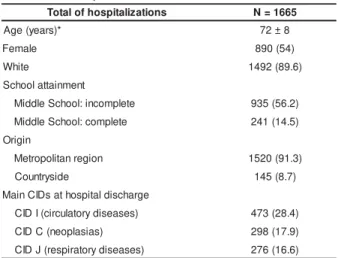
Mean age of hospit alized pat ient s was 72 ± 8 y ear s; 5 4 % of p at ien t s w er e f em ale; 8 9 . 6 % w er e w h i t e; 5 6 . 2 % h ad i n co m p l et e m i d d l e sch o o l , an d 9 1 . 3 % w e r e f r o m t h e m e t r o p o l i t a n r e g i o n . Th e f o l l o w i n g w e r e m o s t f r e q u e n t c l i n i c a l c a u s e s o f h osp it alizat ion : 2 8 . 4 % cir cu lat or y d iseases, 1 7 . 9 % neoplasias diseases, and 16.6% r espir at or y diseases. Th e s e d i s e a s e s a r e i n a g r e e m e n t w i t h t h e N D est ablished, since t hey ar e a r esult of degener at iv e pr ocesses t h at ar e com m on in t h e agin g pr ocess( 9 ). Th e r em ain in g sam p le ch ar act er ist ics ar e sh ow n in Table 1.
Table 1 - Sam ple charact er ist ics
* Mean and st andard deviat ion; cat egory variables n ( % )
Table 2 show s t he four pr evalent ND of t he 62 ND prescribed. Median hospit alizat ion in days were: S e l f - Ca r e D e f i c i t – B a t h i n g / H y g i e n e , 1 4 d a y s ; I m balanced Nut rit ion – Less t han Body Requirem ent s, 14 day s; Risk for I nfect ion, 17 day s, and I neffect iv e Breat hing Pat t erns, 15 days. On average, each pat ient pr esent ed 4 ND.
Ta b l e 2 - N u r s i n g D i a g n o s e s a n d d u r a t i o n o f h ospit alizat ion
Median and percent iles; cat egory variables n ( % )
For t he four prevalent ND, 197 different cares w er e pr escr ibed. As t o t he ND – Self- Car e Deficit – Bat hing/ Hy giene, t he m ost fr equent et iology w as t he disease ev olut ion ( 2 7 % ) , and t he pr edom inant car e w as bed bat h ( 2 8 . 7 % ) . As t o t he ND – I m balanced Nut rit ion – Less t han Body Requirem ent s, t he et iology w a s i n a p p e t e n ce ( 2 9 % ) , a n d t h e m a i n ca r e w a s com m unicat ing diet accept ance ( 34% ) . I n t he ND –
Risk for I nfect ion, t he et iology pr esent in 9 6 . 4 % of t he records was invasive procedure ( 96.4% ) , and t he m ost frequent care was im plem ent ing rout ines of care in venous punct ure ( 100% ) . As t o t he ND – I neffect ive
Br eat h i n g Pat t er n s, t h e m ai n et i ol o g y w as ai r w ay infect ious pr ocesses ( 24.3% ) , and car e w as checking r espir at or y pat t er n ( 4 6 . 3 % ) .
s n o i t a z i l a t i p s o h f o l a t o
T N=1665
* ) s r a e y ( e g
A 7 ± 82
e l a m e
F 890(54)
e t i h
W 1492(89.6)
t n e m n i a t t a l o o h c S e t e l p m o c n i :l o o h c S e l d d i
M 935(56.2)
e t e l p m o c :l o o h c S e l d d i
M 241(14.5)
n i g i r O n o i g e r n a t il o p o r t e
M 1520(91.3)
e d i s y r t n u o
C 145(8.7)
e g r a h c s i d l a t i p s o h t a s D I C n i a M ) s e s a e s i d y r o t a l u c r i c ( I D I
C 473(28.4)
) s a i s a l p o e n ( C D I
C 298(17.9)
) s e s a e s i d y r o t a r i p s e r ( J D I
C 276(16.6)
s e s o n g a i D g n i s r u N t n e l a v e r
P N(%) Daysof
n o i t a z i l a t i p s o h e n e i g y H / g n i h t a B -t i c if e D e r a C -fl e
S 793(11.7) 14(8-25)
y d o B n a h t s s e L -n o it i r t u N d e c n a l a b m I s t n e m e r i u q e
R 640(9.4) 14(8-25)
n o it c e f n I r o f k s i
R 585(8.6) 17(9-30)
s n r e t t a P g n i h t a e r B e v it c e f f e n
DI SCUSSI ON
Th e p r esen t st u d y d et ect ed t h e f o l l o w i n g pr ev alen t ND: Self - Car e Def icit – Bat h in g/ Hy gien e, I m balanced Nut rit ion – Less t han Body Requirem ent s,
Risk for I nfect ion, and I neffect ive Breat hing Pat t erns.
The m ost fr equent r easons for hospit alizat ion of t he sam ple populat ion w ere circulat ory diseases, follow ed b y n e o p l a s i a s a n d r e s p i r a t o r y d i s e a s e s . Th e s e diseases ar e in agr eem ent w it h t he ND est ablished, since t hey are a result of degenerat ive processes t hat ar e com m on in t h e agin g pr ocess( 9 ). An ot h er st u dy developed in t he sam e cit y t o ident ify t he healt h and d i sease co n d i t i o n o f el d er l y p eo p l e f r o m a Fam i l y Healt h Program present s sim ilar charact erist ics, which ar e: m or e w om en, low educat ion lev el, pr esence of non- t r ansm issible chr onic diseases, am ong ot her s( 10). For t he pat ient s wit h ND – Self- Care Deficit – Bat h in g / Hy g ien e, t h er e w er e 1 0 et iolog ies an d t h e m o st f r e q u e n t e t i o l o g y w a s t h e Ev o l u t i o n o f t h e Disease ( 2 7 % ) . For t h is ND, 4 3 n u r sin g car e w er e p r escr ib ed an d t h e p r ed om in an t on e w as b ed b at h ( 28. 7% ) . Ot her nur sing car es w er e Help or per for m or al h y g ien e, Per f or m h air h y g ien e an d I m p lem en t
r out ine for shav ing.
A recent st udy aim ing t o assess t he m eaning o f co m f o r t f r o m t h e st a n d p o i n t o f p a t i e n t s a n d caregivers showed t hat cares relat ed t o body hygiene a n d d a i l y c a r e s a r e t h e f o c u s o f c o m f o r t f o r h ospit alized pat ien t s. Th ese car es ar e n ot essen t ial for t h e su r v iv al r at e r elat ed t o t h e ev olu t ion of t h e d isease; h ow ev er, t h ey ar e im p or t an t f or t h e w ell-being of pat ient s( 11).
The ND – I m balanced Nut r it ion – Less t han Body Requir em ent s, has 11 et iologies and t he m ost frequent one was inappet ence ( 29% ) . For t his ND 46 n u r sin g car es w er e p r escr ib ed , an d t h e m ain car e w a s co m m u n i ca t e d i e t a cce p t a n ce ( 3 4 % ) . Ot h e r n u r sin g car e w er e m on it or h y pogly cem ia sign s an d sy m pt om s, im plem ent pr ocedur es t o v er ify capillar y
gly cem ia, st im ulat e food and liquid ingest ion.
N u t r i t i o n i s a n e s s e n t i a l f a c t o r f o r t h e p r om ot ion , m ain t en an ce an d / or r ecov er y of h ealt h at all st ages of life and, wit h aging, people m ay lose t heir int erest in preparing and eat ing m eals( 12). At t he s t u d y h o s p i t a l , t h i s c a r e i s p r e s c r i b e d t o b e i m p l em en t ed b y t h e n u r si n g st af f ai m i n g at d ai l y nut r it ional cont r ol. As a r esult of aging, physiological ch a n g e s m a y a f f e ct v a r i o u s o r g a n s a n d sy st e m s result ing in m alfunct ioning( 13). Nut rit ional disorders in
t he elder ly m ay r esult in a br oad r ange of diseases t h at m ay ag g r av at e t h e n u t r it ion al st at u s of t h ese indiv iduals. Thus, t he need of an adequat e nut r it ion in all st ages of life is a det erm ining fact or for qualit y o f l i f e a n d i s r e f l e c t e d i n t h e o l d - a g e( 1 3 ). Th e ident ificat ion of inadequat e nut rit ional pat t erns during h ospit alizat ion is essen t ial so t h at t h e h ealt h st af f, especially n u r ses, st ar t ear ly follow - u p an d m on it or nut rit ional st rat egies in t hese m ost vulnerable pat ient s. The ND – Risk for I nfect ion had 6 et ilogies. Th e et iolog y p r esen t in 9 6 . 4 % of t h e r ecor d s w as I nvasive Procedure. For t his ND 54 nursing cares were p r e s c r i b e d a n d t h e m o s t f r e q u e n t o n e w a s i m p l e m e n t i n g c a r e r o u t i n e s i n v e n o u s p u n c t u r e ( 1 0 0 % ) . Ot h e r n u r s i n g c a r e s p r e s c r i b e d w e r e im plem ent car e r out ines in v esical pr obe, im plem ent r o u t i n e f o r ch an g e/ m an i p u l at e w o u n d d r essi n g o f cen t r a l v en o u s, o b ser v e p r o b e h o l e a n d ca t h et er inser t ion places and m ak e w ound dr essing.
D u r i n g h o sp i t al i zat i o n , t h e el d er l y h av e a gr eat er chance of dev eloping hospit al infect ions, and t he m ost com m on sit es ar e infect ions of t he ur inar y t r act , pneum onia, and sepsis( 14- 15).
Th e ND – I n e f f e ct i v e Br e a t h i n g Pa t t e r n s pr esent ed 9 et iologies and t he m ain one w as air w ay infect ious processes ( 24.3% ) . For t his ND 54 nursing car es w er e p r escr ib ed an d t h e p r ev alen t on e w as m onit oring oxygen sat urat ion ( 46.3% ) . Ot her nursing
ca r e s p r e scr i b e d w e r e k e e p t h e h e a d o f t h e b e d elev at ed , im p lem en t r ou t in es w it h ox y g en t h er ap y /
n a sa l ca t h e t e r , m o n i t o r r e sp i r a t o r y p a t t e r n a n d
com m u n icat e r espir at or y pat t er n alt er at ion s. The r espir at or y t r act m ay suffer anat om ical and funct ional changes at differ ent degr ees t hat ar e inherent t o t he elderly and t hat should not be assessed in isolat ion. There are several fact ors t hat m ay affect pulm onar y funct ion and t hat oft en w or sen t he aging pr ocess, su ch as sm ok in g an d ot h er en v ir on m en t al f a c t o r s , b e s i d e s o f c o u r s e p r e v i o u s p u l m o n a r y d iseases( 1 6 ). Th e w eat h er in t h e r eg ion w h er e t h e present st udy was conduct ed is hum id and has great v a r i a b i l i t y, w h a t m ay a l so p r e d i sp o se r e sp i r a t o r y infect ions in t he elder ly.
CONCLUSI ON
Body Requirem ent s, Risk for I nfect ion, and I neffect ive Br eat hing Pat t er ns. The hospit alizat ion t im e av er age ranged from 14 t o 17 days for t he prevalent ND.
The m ain prescribed nursing care were: aiding b e d b a t h , c o m m u n i c a t i n g d i e t a c c e p t a n c e , im plem ent ing rout ines of care in venous punct ure and check ing r espir at or y pat t er n t hat ar e appr opr iat e t o t h e iden t if ied ND. How ev er ot h er car es cou ld h av e been labeled pr ior it y.
Th e p r ev alen ce of t h ese ND an d t h e m ost f r eq u en t clin ic sit u at ion s ch ar act er ize t h e in h er en t lim it at ions of t his age gr oup and t he r isk s t o w hich t h e a g ed a r e ex p o sed t o t en d t o a g g r a v a t e w i t h hospit alizat ion t im e. The individualized plan of nursing care should be devised wit h t he obj ect ive of reducing or m in im izin g t h e r isk f act or s, aim in g at ex cellen t r esu lt s an d in depen den ce w it h in t h e lim it s im posed by age.
REFERENCES
1 . La u r e n t R. Tr a n s i ç ã o d e m o g r á f i c a e t r a n s i ç ã o ep id em iológ ica. I n : ABRASCO, ed it or. Con g r esso Br asileir o de Epidem iologia; 1990; Rio de Janeir o; 1990.
2 . Ol i v e i r a JC, Al b u q u e r q u e FRPC, Li n s I B. Pr o j e çã o d a população do Br asil por sex o e idade par a o per íodo 1980-2 0 5 0 : Re v i s ã o . I n : D i r e t o r i a d e Pe s q u i s a s – D PE. Coor den ação de Popu lação e I n dicador es Sociais - COPI S; 2 0 0 4 .
3. Chodosh J, Mort on SC, Moj ica W, Maglione M, Sut t orp MJ, H i l t o n L, e t a l . M e t a a n a l y s i s : c h r o n i c d i s e a s e s e l f -m an ag e-m en t p r o g r a-m s f o r o l d er ad u l t s. An n I n t er n Med 2 0 0 5 ; 1 4 3 : 4 2 7 - 3 8 .
4. Tem m ink D, Franche AL, Hut t en JBF, Zee J, Abu- Saad HH. I nnovat ions in t he nursing care of chronically ill: a lit erat ure r e v i e w f r o m a n i n t e r n a t i o n a l p e r s p e c t i v e . J A d v N u r s 2 0 0 0 ; 3 1 ( 6 ) : 1 4 4 9 - 5 8 .
5. Fr ich LMH. Nur sing int er v ent ions for pat ient s w it h chr onic con d it ion s. J Ad v Nu r sin g 2 0 0 3 ; 4 4 ( 2 ) : 1 3 7 - 5 3 .
6. Docht erm an J, Tit ler M, Wang J, Reed D, Pet t it D, Mat hew-Wilson M, et al. Descr ibing use of nur sing int er v ent ions for t hr ee gr oup of pat ient s. J Nur s Scholar ship 2005; 37( 1) : 57-6 0 .
7 . N o r t h A m e r i c a n N u r s i n g D i a g n o s i s A s s o c i a t i o n . D i a g n ó s t i c o s d e e n f e r m a g e m d a N A N D A : d e f i n i ç õ e s e classif icação: 2 0 0 3 - 2 0 0 4. Por t o Aleg r e: Ar t m ed ; 2 0 0 5 . 8. Alm eida MA, Vieira A. Nursing diagnosis and int ervent ions in t h e or t h op ed ic p at ien t s car e - p r elim in ar y r esu lt s. I n : Eu r o p e a n Co n f e r e n c e o f t h e A s s o c i a t i o n f o r Co m m o n Eu r opean Nu r sin g Diagn osis, I n t er v en t ion s an d Ou t com es. ; 2 0 0 5 ; Ver lg Hans Huber ; 2 0 0 5 . p. 8 4 - 8 .
9 . Mar in MJS, Bar b osa PMK. Diag n óst icos d e en f er m ag em m ais freqüente entre idosas hospitalizadas em unidade de clínica m édica e cirúrgica. Rev Bras Enf 2000; 53( 4) : 513- 23. 1 0 . S o u z a LM , M o r a i s EP, B a r t h Q CM . Ca r a c t e r ís t i c a s d e m o g r á f i ca s, so ci o e co n ô m i ca s e si t u a çã o d e sa ú d e d e idosos de um program a de saúde da fam ília de Port o Alegre, Brasil. Rev. Lat ino- Am . Enfer m agem . [ per iódico na I nt er net ] . 2006 Dez [ cit ado 2007 Jul 16] ; 14( 6) : 901- 906. Disponível e m : h t t p : / / w w w . s c i e l o . b r / s c i e l o . p h p ?s c r i p t = s c i _ a r t t e x t & p i d = S0 1 0 4 - 1 1 6 9 2 0 0 6 0 0 0 6 0 0 0 1 1 & l n g = p t & n r m = i so . 11. Tut t on E. Com fort on a w ard for older people. Journal of Ad v an ced Nu r sin g 2 0 0 4 ; 4 6 ( 4 ) : 3 8 0 - 9 .
1 2 . Cer v at o AM, Der n t l AM, Lat or r e MRDO, Mar u cci MFN. Educação nut r icional par a adult os e idosos: um a ex per iência p o si t i v a e m Un i v e r si d a d e Ab e r t a à Te r ce i r a I d a d e . Re v Nu t r ição 2 0 0 5 ; 1 8 ( 1 ) : 4 1 - 5 2 .
1 3 . San t os VH, Rezen d e CHA. Nu t r ição e en v elh ecim en t o. I n : Fr eit as EV, Py L, Can çad o FA, Gor zon i ML. Tr at ad o d e Geriat ria e Geront ologia. Rio de Janeiro: Guanabara Koogan; 2 0 0 6 . p . 9 4 2 - 6 1 .
1 4 . Zam ir D, Poly ch u ck I , Leibov it z I , Reit blat T, Zam ir C, S c h a r t S . N o s o c o m i a l i n f e c t i o n s i n i n t e r n a l m e d i c i n e d ep ar t am en t s. Har ef u ah 2 0 0 3 ; 1 4 2 : 2 6 5 - 8 .
15. Mart one WJ, Jarvis WR, Edwards JR , Culver DH, Haley R. I n ciden ce an d n at u r e of en dem ic an d epidem ic n osocom ial infect ions. I n: Bennet t JV, Brachm an PS. Hospit al infect ion. 4 t h. New Yor k : Lippicon t Rav en Pu blish er s; 1 9 9 8 . p. 4 6 1 -7 6 .
16. Gor zoni ML, Russo MR. Env elheciem nt o r espir at ór io. I n: Fr eit as EV, Py L, Nér i AL, Cançado FAX, Gor zoni ML, Rocha SM, et al. Trat ado de Geriat ria e Geront ologia. Rio de Janeiro: Guanabar a Koogan; 2 0 0 6 . p. 5 9 6 - 9 .