PRODUCTION AND DISCRIMINATION OF VOICING CONTRAST
OF STOPS IN CASES OF PHONOLOGICAL DISORDER
Produção e discriminação do contraste de sonoridade
das plosivas nos casos de desvio fonológico
Roberta Michelon Melo(1), Helena Bolli Mota(1),
Carolina Lisbôa Mezzomo(1), Brunah de Castro Brasil(1)
(1) Programa de Pós-Graduação em Distúrbios da Comunica-ção Humana da Universidade Federal de Santa Maria – UFSM, Santa Maria, RS, Brasil.
Scholarship agency: FAPERGS/CAPES (Doctorate Scholarship).
Conlict of interest: non-existent
by an interval of silence followed by a transient noise, known as burst 1.
The distinction between voiceless and voiced and stops is acoustically marked by the absence or presence of absence or presence of pre-voicing or voicing concomitant to burst, i.e., by a positive, negative or zero Voice Onset Time (VOT) 1-3. In
addition to VOT, other acoustic signals are also mentioned as being responsible for establishing the voicing contrast, among them, the length of the vowel adjacent to stop 2,4,5, to burst amplitude1,5,6
and length of the occlusion preceding to burst 4,5,7.
The voicing contrast of stops involves, therefore, a complex temporal-spatial coordination of oral and laryngeal gestures. Such articulatory and acoustic reinement is a hard task for some children with phonological disorders 3,5 and, in addition to impairing
INTRODUCTION
In Brazilian Portuguese (BP), the class of stops is represented by six segments - /p/, /b/, /t/, /d/, /k/ and /g/. For the production of those obstruents two essential articulation moments are required, the irst refers to a complete obstruction of the air passage by the phonoarticulatory organs, and the second, to a sudden release of that air current. Those articu -latory gestures can be identiied, via spectrogram,
ABSTRACT
The stops voicing contrast represents a complex acoustic and articulatory coordination, frequently impaired in cases of speech disorders. Therefore, one believes that the researchers should strive to understand the factors that inluence in the stabilization of that contrast. So, the purpose of this research was correlating the production data and the performance in a perception test of the feature [+voice] in speech disordered children. Thereunto, ive speech-disordered boys, that presented dificulties in the production of voiced stops and other dificulties, were evaluated. Through the pairs of words introduced in carrier phrases, one observed the occurrence of positive voice onset time production during the [+voice] stops production and the duration pattern of the vowels adjacent to the voiced and devoiced stops. The authors elaborated a Perception of Stops Voicing Test to evaluate the subjects’ performance regarding to the perception. The test has 12 pairs of words, in which the difference is only the contrast [+voice] and it’s represented by pictures. Through a descriptive analysis, no direct relation between dificulties of stops voicing contrast production and speech perception of this sounds was veriied, both on the observation of pre-voicing production, and on the observation of vowel duration pattern production. Nevertheless, one emphasizes that the use of perception evaluation and acoustical analysis in cases of speech disorder shouldn’t be ignored by the speech pathologists, because those instruments can give important information to a good therapeutic progress.
also to two schools of public schools in the same
city.
Study sample
We considered the speech data of ive boys aged ive years and four months to seven years and
nine months (average age = seven years, standard
deviation = 11.8 months), with phonological disorder and dificulty in the production of voiced stops, among other speech dificulties.
In order to include those children in the research,
it was necessary to adopt the following criteria: have
permission to participate in the research through
the Consent Term, be aged between four and
eight years and eleven months, had not received
previous therapy phonological; be native speaker of BP, no history of bilingualism and having a diagnosis of phonological disorders, percentage of correct production of voiced stops up to 39% (failing to produce a perceptible contrast between voiced and
voiceless stops in relation to a percentage greater
than or equal to 40%), whereas the voiceless stops
should be acquired in phonological system. This
criterion was adopted according to the resolution of
another study 12, which suggests that a phoneme is
considered to be acquired when their occurrence is from 80% to 100%; partially acquired when the instance is from 40% to 79%, and not acquired when its occurrence is equal to or less than 39%.
In relation to the exclusion criteria were considered: the presence of vocal, auditory,
language, evident neurological damage in the cognitive, psychological and / or emotional aspects,
and changes in the orofacial organs that were
related to the phonological system.
For sample selection it was performed speech,
voice, language and hearing screening, consisting
of: (a) initial interview conducted with parents and/ or guardians, (b) assessment of the stomatognathic system, with emphasis on observation of the aspect, posture, muscle tension and mobility of orofacial
organs (tongue, lips, cheeks, dental occlusion and
the aspect of the soft palate and hard palate) and functions (breathing, speech articulation, chewing and swallowing), ( c) assessment of language,
speech and voice, through spontaneous speech
elicited through a logical sequence of four facts. And yet, a hearing screening was performed with the testing of hearing thresholds by air from 500 to 4000
Hz, tested at 20 dB HL (scan mode). The audiometer
was used Interacoustics Screening Audiometer AS208, properly calibrated and respecting the care
of the ambient noise. Finally, it was carried out the Phonological Assessment of Children (PAC) 13.
speech intelligibility and perception of the listener, the instability of the feature [+ voice] in phonological therapy seems to persist for a long period 1.
In relation to the perception, it is a consensus
that during the early stages of language acquisition, perception precedes production. Before the irst words or phonemes begin to be produced, the child
perceives and understands a lot more speech than
he/she actually produces. Thus, the development of
speech is closely related to auditory perception 8.
The auditory perception, in turn, can be subdi-vided into several components such as: detection, sound sensation, discrimination, location, recog-nition, understanding, attention and memory 2.
Some researches focused on the perception of the listener front some distinct sound acoustic characteristics from those ones observed in adult speech, whether through speech data - in devel -opment - in young children 9, or in children already
diagnosed with phonological disorders 3. In contrast,
other studies 1,2,10,11 carried out an investigation
speciically about the auditory discrimination in children with dificulties in establishing the voicing contrast of stops. Most of the results presented
above suggest an adequate perception in those
cases in which children appear to adequately distinguish the contrast of sounds that they do not produce properly. Some of these authors also reported that dificulties in the perception and in the production levels can impair the progression of the
speech therapy 10.
However, we believe that there are still many gaps in the understanding of this relationship. The persistence of a dificulty in stabilizing the contrast
[+ voice] is a recurring situation that speech
thera-pists have encountered. For that reason, we believe that efforts should be made to better understand the factors that inluence the stabilization of this
contrast. With this desire, this research reports
an instrumental method of analysis of speech
production (acoustic analysis), connecting it to data
discrimination of this contrast.
In face of what was mentioned, the aim of this study is to correlate production (VOT and vowel duration adjacent to stop) and discrimination of voicing contrast of stops in children with phono -logical disorders.
PRESENTATION OF THE CLINIC CASE
This study was approved by the Research Ethics Committee of the institution of origin which was developed under the number 23081.008886/2009-29. It was carried out in a
school clinic associated to a higher education
To measure the length of the vowel in milli
-seconds (ms), we adopted the criterion of irst and last regular cycle adjacent to stop to determine the limits of each vowel segment. After, we compared the irst measure of length of the vowel in the context of stop [-voice] with the irst measure of the length of the vowel in the context of stop [+ voice], and so on, among the other ive repetitions of each target word. Thus, the length of the vowel was contrasted in the context of the length of the vowel[p] versus[b],
[t] versus [d] and [k] versus [g]. This comparison was
made to verify if the length of the vowel in the context of voiced stops was longer, as described in the
literature 2,4,5. Finally, we calculated the percentage
of cases that this pattern occurred.
Stop Voicing Discrimination Test (SVDT)
For the investigation of the performance of the
individuals in a contrast discrimination task [+ voice]
of the six stop consonants of BP, it was elaborated
the “Stop Voicing Discrimination Test (SVDT)”, based on “Phoneme Discrimination Picture Test “ 14,
once the last one had few minimal pairs contrasting voiceless and voiced stops, focus of this study.
For preparation of the test, in a irst moment, the three possible voicing contrasting of stops in the BP were included, i.e., /p/ versus /b/; /t/ versus
/d/; /k/ versus /g/. Then, two minimum- pairs were
selected for each position in the word, initial onset
and medial onset. Thus, we obtained 12 pairs of
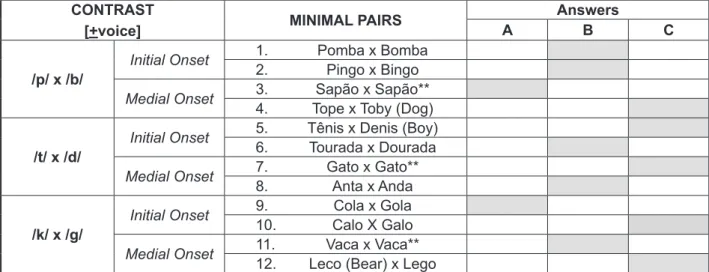
words, including all stop phonemes and belonging to the vocabulary of the child (such as Figure 1).
Two word pairs, well known by children, were also selected, which served as a items of demon
-stration of the test, so that they could obtain a better understanding of the orders of it (as set out in
Figure 1).
Acoustic analysis
To obtain the data submitted to acoustic analysis,
we created a list of words of the same linguistic context (two syllables, penultimate stress and in the context of the vowel / a /), containing the contrast [+ voice] of the six stop of BP ([‘papa], [‘baba], [‘tata], [‘dada], [‘kaka] and [‘gaga]). The words were inserted
in the carrier phrase (“Fala _____ de novo”).
Stimuli containing the carrier phrase were
arbitrarily presented by using headphones (Sennheiser HD280 PRO) and, children were asked
to repeat the entire heard phrase according to the
usual vocal quality they were used to. Thus, a total of 180 productions were analyzed (two recordings x three repetitions x six stops x ive children = 180
productions).
The instruments used for data recording were:
an acoustics cabin, an omnidirectional microphone (brand Behringer EMC8000), placed on a pedestal,
about four inches from the mouth of the individuals; and an external sound card (brand M-AUDIO, model FW 410) connected to a laptop computer.
The recordings were made directly in the MATLAB software V7.1 SP3 (Simulink Signal Processing Toolbox V6.4) in Wave ile and in high resolution (24
bits and 96 kHz).
Then, the speech registers were analyzed in a processing audio software named Praat - version
5.1.29 (available at www.praat.org), with a sampling
rate of 96 kHz and 16 bits. By means of spectroscopy
it aimed at prevoicing production, i.e., the measure
of VOT (if negative), during the production of stops [+ voice], and measured the length of vowels in the context of stop [+ voice] versus [-voice].
The percentage of production of prevoicing was estimated from the number of times that the
preceding voicing bar to burst was observed,
divided by the total number of stops [+ voice] that were produced, multiplied by 100.
Demonstration items of TDSP 1. Show: Caminhão e Boneca
2. Show: Faca e Pata
Stimulus of TDSP
1. Show: Pomba e Bomba 2. Show: Pingo e Bingo 3. Show: Sapão e Sapão**
4. Show: Tope e Toby (name of dog) 5. Show: Tênis e Denis (name of boy) 6. Show: Tourada e Dourada
7. Show: Gato e Gato** 8. Show: Anta e Anda 9. Show: Cola e Gola 10. Show: Calo e Galo 11. Show: Vaca e Vaca**
12. Show: Leco (name of bear) e Lego
tourada x dourada; anta x anda; vaca x vaga; Leco (bear) x lego.
Then, it was hired a professional of the visual arts for preparing the illustrations, which required a closer understanding of the drawing with the reality. Each minimum-pair was then represented by igures arranged in three columns, as the example displayed in Figure 2. If any researcher expresses interest in the complete instrument of this research, he/she may contact the authors of this work.
We chose to select words frequently presented in children vocabulary in the age group of children who participated in the study, and also words that were easily representable by means of igures. However, with respect to some selected word pairs, such criteria could not be truly followed, due to the immense dificulty of selecting minimal pair sin
relation to the studied oppositions. That occurred in cases like: tope x Toby (dog); tênis x Denis (boy);
Figure 2 – Example of chart igure used in Stop Voicing Discrimination Test (SVDT) – Pingo x Bingo
The test was composed of 12 illustrated cards (Figure 2), a Protocol of Presentation (Figure 1) and a Protocol of Answers (Figure 3). Each card consisted of three columns, the irst being released twice the igure that shows the irst word, in the second, twice
incorrect answers or for the ones that required the help of the examiner. Therefore, the total amount would be 12 points.
Data analysis
After cross-sectional collection, the production data and discrimination of stop phonemes were analyzed by means of a descriptive analysis.
RESULTS
For the prevoicing production of voiced stops,
only one child in the sample presented a negative
VOT during the production of stops. On the other hand, there was a greater use of other acoustic indication, length of the vowel adjacent to stop,
among all children in the sample.
Regarding the performance in the SVDT, children in the study had mean score of 70%, with a median of 75%. With the percentage of correct answers on the test ranged from 33.33% to 91.67%.
Table 1 presents the results for all the variables of the study, per individual.
In relation to the procedure of the SVDT, initially, it was explained to children “what would be done” and “how it would be done.” Then, irst, the items of demonstration were presented and, after, the
analyzed minimal pairs. The child listened through
headphones the stimulation of the test, which was previously recorded by a female subject - “mostre pingo e bingo” and he/she should point to the corre-sponding column.
Nine orders of the test had two different words, and other three orders, two words were equal, denoted by two asterisks (**) in Protocol of Answers of the SVDT. This procedure was selected with the
intention that the child paid attention to test stimuli
and also that there was not a pattern of induced answers.
Despite the stimuli of the test have been provided
by using headphones, the researcher should be
very careful to not give the children language and/ or visual clues, allowing, this way, that they have the guidance, unique and exclusively, of the auditory
stimulus.
Regarding the score o0f the SVDT, it was added one point for each correct answer and zero for
CONTRAST
[+voice] MINIMAL PAIRS
Answers
A B C
/p/ x /b/
Initial Onset 1. Pomba x Bomba
2. Pingo x Bingo
Medial Onset 3. Sapão x Sapão**
4. Tope x Toby (Dog)
/t/ x /d/
Initial Onset 5. Tênis x Denis (Boy)
6. Tourada x Dourada
Medial Onset 7. Gato x Gato**
8. Anta x Anda
/k/ x /g/
Initial Onset 9. Cola x Gola
10. Calo X Galo
Medial Onset 11. Vaca x Vaca**
12. Leco (Bear) x Lego
Note: The squares highlighted in the columns of answers refer to the correct answers.
between production and perception in the studied sample. It is possible to afirm that once for some children the percentage of production of standard length expected for the vowels was higher than the percentage of correct answers in the discrimination test and, for others, the reverse is also veriied.
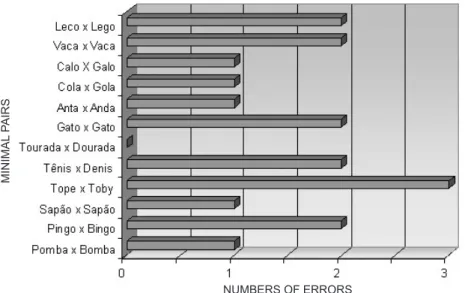
Further, in order to observe if the minimal pairs of the SVDT inluenced the performance of children in the test, it was counted for each pair, the minimum error for each pair in the sample. It was observed that the maximum number of errors per pair of three incorrect responses was for the pair “tope x Toby”
and no incorrect answers for the pair “tourada x dourada” (Figure 4).
By comparing the percentage of prevoicing production and the percentage of correct answers in the SVDT of each child, it is not possible to show a positive relation between the perception and production of the feature [voice], once that it is
possible to notice, according to the data, that the only
child who showed signs of negative VOT production, who obtained 58.33% of accuracy on the test, i.e., a lower percentage of the one evidenced for some children in the sample that showed the absence of pre-voicing for all voiced stops.
When analyzed together, the percentage of production of long vowel in the context of stop [+
voice] and the result in the SVDT also give the
impression of bringing evidence of a relation
Table 1 – Presentation of variables of study by participant - percentage of prevoicing production; percentage of production of long vowel in the context of stop [+ voice] and percentage of correct answers in the Stop Voicing Discrimination Test (SVDT)
Participants
Variables
Prevoicing /b/
-Prevoicing /d/
-Prevoicing /g/
-Length of Vowel /b/
-Length of Vowel
/d/
-Length of Vowel
/g/
-Correct answers in the
SVDT C1 0/0 0% 0/0 0% 0/0 0% 0/3 0% 4/5 80.00% 4/6 66.67% 11/12 91.67% C2 3/6 50.00% 4/6 66.67% 2/6 33.33% 5/6 83.33% 5/5 100.00% 4/6 66.67% 7/12 58.33% C3 0/0 0% 0/0 0% 0/0 0% 3/6 50.00% 1/2 50.00% 2/6 33.33% 9/12 75.00% C4 0/0 0% 0/0 0% 0/0 0% 3/6 50.00% 3/6 50.00% 4/5 80.00% 4/12 33.33% C5 0/0 0% 0/0 0% 0/0 0% 5/6 83.33% 1/6 16.67% 3/5 60.00% 11/12 91.67%
Legend 1: C – children (participants of study); SVDT – Stop Voicing Discrimination Test.
Figure 4 – Errors total, by minimal pairs, in the Stop Voicing Discrimination Test (SVDT)
MI N IMAL P AI R S
cannot be ignored. That fact seems to be conirmed
in another theoretical perspective through the covert contrast 15-19.
For the discrimination of voicing contrast, it was observed in this research that only one of the children had a low performance in the SVDT, with a percentage of less than 50% of correct answers.
This result differs from another study 20, which
investigated the phonemic discrimination of all phonemes of BP, also in children with phonological
disorders. Those authors also suggested a possible
causal relation between an inability of auditory
discrimination and phonological disorders that,
however, did not apply to all cases they assessed. This relation was also mentioned by another
author 8.
However, there seems to have an inconsistency in the literature regarding the association of deicits
in the auditory production and discrimination. In another study 11, for example, it was veriied no
relation between perception and production of the voicing feature. Children with deviant speech presented a higher number of correct answers with reference to stop consonants; however, they produced more accurately fricative consonants.
Corroborating in some aspects to the referred study, this research also seems to show a direct relation between discrimination and production of the feature [+ voice], being that four of the ive children presented favorable results in SVDT. However, only one of them showed vocal fold vibration when
producing some voiced stops, and all assessed
children employed the acoustic clue of length of the vowel, even if not in 100% of cases.
A discrepancy between perceptual tasks and production of speech sounds has also been described in the literature for children with articu -lation disorders 21 and phonological disorders 1,10,11. A theoretical model able to accommodate
the differences between the levels of perception and production is the Two-Lexicon Model, this one suggests the existence of a lexicon input (used for words recognition) and a lexicon output (used for the words production). A fail in the connection between these two lexicons result in deicits in one or another
level 21.
Another study 19 highlights that there is a possible
inluence of other factors in perceptual performance, including: peculiarities of the language, pre-estab
-lished cultural concepts, type of perceptual tasks, among others. Then, the auditory information, separately, would not be the only basis of the perceptual judgment of a sound.
Regarding the type of perceptual task, another
author 16 highlights from her indings that children
with phonological disorder showed a dificulty in
DISCUSSION
The introduction of acoustic spectrography in data interpretation of children with phonological disorders, has increasingly established itself as
a practical and necessary tool during the speech assessment 1-7,10,11,15-18. The observation of
attempts of correct production of sounds, veriied via spectrogram and, which were not previously identiied by auditory perceptual analysis, has already been reported and conirmed by many studies of the area 1,5,6,10,11,15-18.
A research 5 that also investigated the voicing
contrast of the stop phones found that a group of children with speech and dificulty in stabilizing the feature [+ voice] did not distinguish acoustically the voiced x voiceless contrast. However, even though children with phonological disorders have not submitted to a differentiation of voicing through the investigated acoustic parameters (VOT, length of the vowel, length of the occlusion and burst amplitude), those ones showed a tendency to anchor on clues that are less robust during the attempt of imple -menting that contrast. In this case, taking the clue
of length of the vowel adjacent to stop and of burst
amplitude.
In the study, it was also observed that the production of a negative VOT for the stops [+ voice] appears to be a quite complex and rarely used acous
-tical clue by children who have not yet stabilized the
voicing contrast sounding in his/her phonological
system. That can be conirmed by the percentage of prevoicing, once only one of the children presented the production of voicing bar preceding to burst, conirming the requirement of a complex temporal coordination between glottal (vocal fold vibration) and supra-glottal (oral gestures) events, which was
corroborated in another study 3.
In contrast, for the presence of longer vowels in the context of voiced stops, it was observed that despite not in all occurrences of the analyzed words, this acoustic clue was used in the speech of all assessed children, agreeing with the research that was mentioned above 5.
The previously discussed fact also conirms the existence of redundant and secondary clues in relation to the identiication of the stop
phones 2,3,6, so that even when using some distinct
acoustic parameters among stops [+ voice], the
that are not frequent in the vocabulary of children and hardly representable by means of igures - it was decided to submit them before the SVDT, with the aim of evaluating, exclusively, the discrimination of the voicing contrast of stop phones, eliminating potential dificulties of the lexicon.
In order to contribute to further studies, it is suggested to increase the sample of this research, which was not possible because of the necessity of considering strict inclusion criteria. Besides, it is suggested the inclusion of other minimum-pair that could focus the voicing contrast of the other phones in the BP, such as fricatives and affricates, as well as the implementation of the SVDT to other samples, such as bilingual speakers, with language disorders, with dyspraxia, among others.
FINAL CONSIDERATIONS
The results presented here do not point to a direct
relation between dificulty in producing of voicing contrast of stops and auditory discrimination of these segments, both in observing the production of negative VOT, as in the observation of the standard production of the length of the vowel.
Thus, in our sample, the dificulty at the stabi
-lization of the production of the contrast [+ voice] does not seem to be related to a dificulty in a perceptual level, more speciically, at the level of phonemic discrimination of these sounds.
However, even though this relationship has not been found, it is noticed that the use of an assessment of phonemic discrimination, as well as performing an acoustic analysis in cases of phonological disorder,
should not be ignored by speech therapists. The
results of these assessments may point to the necessity of a therapeutic intervention in this part, and then indicate a greater phonological knowledge of some children with phonological disorders, which
could contribute to a more immediate therapeutic success and, thus, contribute to a better prognosis.
ACKNOWLEDGMENTS
To the children and their parents by the availability
of participation in research. To the Foundation for Research Support of the State of Rio Grande do Sul (FAPERGS) and the Coordination of Improvement of Higher Education Personnel (CAPES) for providing a PhD scholarship of the irst author.
identifying contrasts from typical categorical stimuli, unlike the results of some assessed individuals in
the study.
However, when faced with their own gradient stimulus (i.e., with the presence of covert contrast, denoting an knowledge in construction), their
perception tends to be more pronounced and
may be guiding these children for nonstandard
(or secondary) acoustic-auditory clues, both in production levels, as in perception.
Although the data shown here have not evidenced a cause-effect relation between perception and production of voicing contrast, it is important to carry out some assessments of discrimination and inclusion of strategies that enable children with
phonological disorders, establishing the connection
between discrimination and phonemic aspects of speech production. Once, from the perception of the differences between their productions from the productions of an adult, the child starts the movement of abandoning the stable pattern in his/her speech to venture into new attempts. Therefore, this is a facilitator period, permitting the speech therapist to provide the ways and appropriate means to promote
the approach to the standard language 17.
This fact may be reinforced by another study 22,
which states that the presence of positive results in relation to the phonemic discrimination of speciic sounds can promote a greater progression of therapy, giving important considerations for the selection of target sounds, as well as for the type of treatment to be adopted. Moreover, the insertion of a perceptive training concomitant to phonological therapy is capable to offer improvements in the
phoneme discrimination, as in speech patterns 23.
With respect to the instrument that was used in this study, it was also investigated a possible inluence of the minimal pairs of the SVDT at the performance of the assessed children.
It observed that the minimum-pair “tope x Toby”
was the one that presented the most errors in the discrimination of stops [+ voice]. Consequently, it is possible to infer that the fact of agreeing with the child that the igure of the dog was referring to
“Toby” has not been a good alternative to assess
phonemic discrimination, due to lexical inluences. However, the pair which showed no error in the test was “tourada x dourada”, words that we believe are
7. Barroco MA, Domingues MT, Pires MF, Lousada M, Jesus LM. Análise temporal das oclusivas orais
do Português Europeu: um estudo de caso de normalidade e perturbação fonológica. Rev CEFAC. 2007;9(2):154- 63.
8. Nijland L. Speech perception in children with speech output disorders. Clin Ling Phon. 2009;23(3):222-39.
9. Bonatto MTRL, Madureira S. Estudo sobre
a percepção e a produção do contraste de
vozeamento da fala de crianças de 3 anos. Rev CEFAC. 2009;11(1):67-77.
10. Tyler AA, Figurski GR, Langsdale T.
Relationships between acoustically determined knowledge of stop place and voicing contrasts and
phonological treatment progress. J Speech Hear
Res. 1993;36:746-59.
11. Souza APR, Scott LC, Mezzomo CL, Dias RF,
Giacchini V. Avaliações acústica e perceptiva de fala
nos processos de dessonorização de obstruintes. Rev CEFAC. 2011;13(6):1127-32.
12. Bernhardt B. Developmental implications of
nonlinear phonological theory. Clin Ling Phon.
1992;6(4):259-81.
13. Yavas M, Hernandorena CLM, Lamprecht RR.
Avaliação fonológica da criança: reeducação e terapia. Porto Alegre: Artes Médicas; 1991.
REFERENCES
1. Levy IP. Uma nova face da nau dos insensatos: a diiculdade de vozear obstruintes em crianças de
idade escolar [tese]. Campinas (SP): Faculdade de
Ciências da Universidade Estadual de Campinas; 1993.
2. Russo I, Behlau M. Percepção da fala: análise
acústica. São Paulo: Lovise; 1993. As pistas
acústicas das vogais e consoantes; p. 25-50. 3. Melo RM, Mota HB, Mezzomo CL, Brasil BC,
Lovatto L, Arzeno L. Desvio fonológico e a diiculdade com a distinção do traço [voz] dos fonemas plosivos
– dados de produção e percepção do contraste de
sonoridade. Rev CEFAC. 2012;4(1):18-29.
4. Snoerena ND, Halle PA, Seguia J. A voice for the voiceless: Production and perception of assimilated
stops in French. J Phonetics. 2006;34:241-68. 5. Melo RM, Mota HB, Mezzomo CL, Brasil BC, Lovatto L, Arzeno L. Parâmetros acústicos do contraste de sonoridade das plosivas no
desenvolvimento fonológico típico e no desviante.
Rev Soc Bras Fonoaudiol. 2012;17(3):304-12. 6. Forrest K, Rockman BK. Acoustic and perceptual
analysis of word-initial stop consonants in
phonologically disordered children. J Speech Hear
Res. 1988;3:449-59.
RESUMO
O contraste de sonoridade das plosivas representa uma complexa coordenação acústica e articula
-tória, muitas vezes prejudicada nos desvios fonológicos. Por esse motivo, acredita-se que esforços devem ser realizados no sentido de melhor entender os fatores que inluenciam na estabilização desse contraste. Assim, o objetivo desta pesquisa foi correlacionar os dados de produção e o desem -penho em um teste de discriminação do traço [+voz] em crianças com desvio fonológico. Para isso
foram avaliados cinco meninos com desvio fonológico e diiculdade na produção das plosivas sono
-ras, entre outras diiculdades de fala. Por meio de pares de palavras inseridos em frase-veículo, observou-se a ocorrência de produção de Voice Onset Time positivo durante a produção de plosivas
[+voz] e o padrão de duração das vogais adjacentes às plosivas surdas e sonoras. Elaborou-se um Teste de Discriminação de Sonoridade das Plosivas, a im de se avaliar o desempenho dos sujeitos em relação à discriminação. O teste consiste de 12 pares de palavras, diferenciados apenas pelo
contraste [+voz] e representados por iguras. Na análise descritiva, não se veriicou uma relação
direta entre diiculdade de produção do contraste de sonoridade das plosivas e discriminação auditiva
desses segmentos, tanto na observação da produção de pré-sonoridade, quanto na observação da produção do padrão de duração das vogais. Mesmo assim, salienta-se que o emprego de uma
avalia-ção de discriminaavalia-ção, bem como, de análise acústica nos casos de desvio fonológico, não devem ser desprezados pelos fonoaudiólogos, uma vez que esses instrumentos podem fornecer informações fundamentais para um bom progresso terapêutico.
DESCRITORES: Criança; Fala; Distúrbios da Fala; Acústica da fala; Espectrograia do Som;
19. Munson B, Edwards J, Schellinger S,
Beckman ME, Meyer MK. Deconstructing phonetic transcription: covert contrast, perceptual bias, and
an extraterrestrial view of vox humana. Clin Linguist
Phon. 2010;24(4-5):245-60.
20. Santos-Carvalho B, Mota HB, Keske-Soares M, Attoni TM. Habilidades de discriminação auditiva
em crianças com desvios fonológicos evolutivos.
Pró-Fono R Atual Cient. 2010;22(1):311-6.
21. McGregor KK, Schwartz RG. Converging evidence for underlying phonological representation in a child who misarticulates. J Speech Hear Res. 1992;35:596-600.
22. Wolfe V, Presley C, Mesaris J. The importance of sound identiication training in phonological
intervention. Am J Speech Lang Pathol. 2003;12:282-8.
23. Rvachew S, Nowak M, Cloutier G. Effect of phonemic perception training on the speech production and phonological awareness skills of children with expressive phonological delay. Am J
Speech Lang Pathol. 2004;13:250-63. 14. Santos-Carvalho B, Mota HB, Keske-Soares
M. Teste de iguras para discriminação fonêmica:
uma proposta. Rev Soc Bras Fonoaudiol. 2008;13(3):207-17.
15. Berti LC. Contrastes e contrastes encobertos
na produção da fala de crianças. Pró-Fono R Atual
Cient. 2010;22(4):531-6.
16. Berti LC. Produção e Percepção da fala em crianças com distúrbios fonológicos: a ancoragem em pistas fonético-acústicas secundárias. In:
Ferreira-Gonçalves G, Brum-de-Paula M, Keske-Soares M (edts). Estudos em Aquisição Fonológica.
Pelotas: Editora e Gráica Universitária PREC –
UFPel; 2011, p.153-74.
17. Freitas MC. O gesto fônico na aquisição
“desviante”: movimentos entre a produção e a percepção [tese]. Campinas (SP): Universidade Estadual de Campinas, Instituto de Estudos da Linguagem; 2012.
18. Rinaldi L, Albano E. Contrastes em estabilização
em crianças sem queixas fonoaudiológicas. Verba
Volant. 2012;3(1):1-23.
Received on: March 10, 2013 Accepted on: May 15, 2013
Mailing address: Roberta Michelon Melo
Serviço de Atendimento Fonoaudiológico - SAF
Rua Mal. Floriano Peixoto, 1751 - Centro
Santa Maria – RS – Brasil
CEP: 97015-372